Jim Baumer's Blog, page 34
July 8, 2016
Dream Sequences and Baseball Fields
Dreams get referenced often, yet I contend that they’re one of the least understood elements of our brains and subconscious.
All of us dream. Researchers tell us that people can spend two hours of their sleep in some stage of dreaming.
Sometimes reality impersonates the dream fugue. Visiting former haunts and places that once occupied significance in our lives can unleash memories that we’d stored away.
The Ballpark in Old Orchard Beach was built in 1983, principally fueled by the vision and dream of a successful Bangor lawyer, Jordan Kobritz, who didn’t want to practice law anymore. Kobritz believed that OOB’s summer influx of tourists and vacationers would provide the population necessary to support a minor league baseball team, one played at the AAA-level.
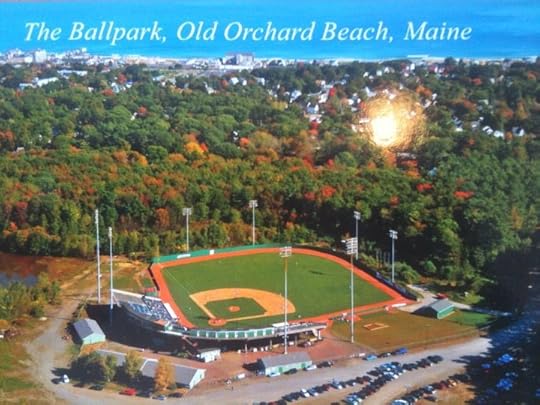
Baseball meets the beach at OOB.
I found Kobritz quoted in an older article (published in the Boston Globe) by the late Boston sportswriter Will McDonough, saying that “I just didn’t want to be a lawyer anymore.” According to McDonough’s article (from 1984), Kobritz had been thinking about doing something else for a while and during a business trip to Atlanta, realized he was finished with practicing law.
Dreams that are vivid to us, are equally opaque and hard to fathom to those on the outside. To Kobritz’s friends (and likely, family), he probably seemed like a man that had taken leave of his senses.
This man on a mission formed a limited partnership consisting of 24 partners. They raised $4 million to build a ball park and acquire the rights to a minor league franchise. Ground was broken on June 23, 1983. Things began well but ultimately, they didn’t proceed as Kobritz probably hoped for.
My first visit to The Ballpark came a decade later, after it had been neglected for a period of time. The community wasn’t sure what to do with a ball field built to professional baseball specifications, tucked away from the beach in a grove of pine trees. A local group attempted to bring it back as a venue for baseball and even music. I actually saw Bob Dylan perform there. I also pitched a few semi-pro games there during the tail-end of my time playing competitively.
There is now a baseball team, the Old Orchard Surge, occupying The Ballpark as their home base. They play in the four-team Empire League, likely the lowest rung of baseball’s professional ladder. Their home dates fill two months of programming, but the facility remains under-utilized and unknown to most Mainers, even baseball fans 20 minutes north in Portland. Their summer fixation remains the Portland Sea Dogs.
On Wednesday night, I returned to The Ballpark, stepping foot on the field for the first time since I struck out Bill Lee. This time it was as a member of the “blue fraternity,” also known as umpires.
The evening was warm and pleasant. The field looked immaculate when my partner and I strode towards home plate for our pre-game conference. Other than us and the 20+ players making up the two teams playing—members of the Southern Maine Men’s Baseball League (SMMBL)—there were four other people sitting in the stands, the night’s fan base.
Being a base ump is very different than calling balls and strikes. Part of the night is spent standing, waiting to spring into position to call a bang-bang play at first, second, or even third. Most of your action is filled with routine outs, however.
My thoughts drifted back to my own playing days on this surface, as well as a host of other diamonds not quite as fancy. I also thought about the ghosts representing players from the past. The late Mark Fidrych was part of the barnstorming contingent that Lee brought to OOB in August, back in 1993. Fidrych would meet an untimely end when he was killed in an accident involving a dump truck, in 2009.
Whatever happened to Jordan Kobritz? His dreams live on in a slightly altered state. While no longer a minor league owner, Kobritz is still connected to sports—he’s now a professor at SUNY Cortland, and writes a syndicated column called “Sports Beyond the Lines,” detailing the ancillary, but important elements buffeting sports—things like the financial, marketing, management, legal and ethical issues that are often equally important as home runs, and three point shooting proficiency in today’s corporate framework—if not more so.
The dreams I once harbored 35 years ago of playing professional baseball are long gone. Other aspirations have been altered, and life continues to move me towards new and different configurations.
I remain tethered to baseball in ways I never dreamed about when the game first captured me and populated my imagination, nearly 50 years ago.


July 5, 2016
The 5th Always Follows the 4th
While the candidates for president were out and about on the 4th of July, lying to American voters, I spent the long weekend uncharacteristically relaxing, even attending a wonderful family gathering and cookout hosted by “the hostess with the mostest,” Aunt Tomato.
Alas, another work week’s begun. There are still a few jobs to be done in what remains of the Republic.
In this age of truncation and Twitter, I thought something I read in Jay Parini’s biography of Gore Vidal was fitting and Twitter-ific. It was also noteworthy enough to break my silence on politics here at the JBE.
Vidal (just prior to the nation’s Bicentennial year, working on his new book at the time, 1876) was being interviewed by Mike Wallace on 60 Minutes, and he gave an answer to Wallace about the reporter’s claim that Vidal was being overly cynical about the nation’s fate at the time, 40 years before we’d suffer from an election choice of Clinton vs. Trump.
Vidal explained that “cheap labor and cheap energy” were gone, and the results would be dire. He continued, “We’re never going to have that again. We’re going to have to have less gross national product, not more.” Prescient, I’d say.
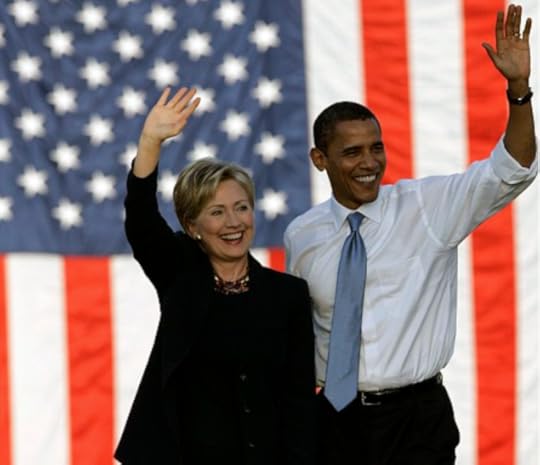
Promising things they can’t deliver.
But of course, post-July 4th, we will be treated to the shyster, Clinton, promising us (while flying around on Air Force One with our “Magic” president) that she’ll bring our jobs back, and Trump will continue his tired refrain about “making America great again.”
Vidal would have considered them both idiots.
July 1, 2016
Using New Words
I am fascinated with words. That goes with the territory of being a writer, as we’re “arrangers of words.”
When I was in elementary school, Mondays were when my classmates and I would receive new spelling words for the week. We’d have to copy them down, and then, define them. Sometimes we’d be asked to use them in a sentence. I’d always go home at night and ask my mother to query me to make sure I knew how to correctly spell my words. I took pride in knowing my spelling list when we’d have our spelling quiz on Thursday.
Dictionary.com offers a daily email. They send out their “word of the day.” I’ve been able to add new words to my vocabulary on the strength of their emails. Reading regularly also contributes to having a healthy vocabulary, too.
I don’t recall where it was this week that I ran across the word nadir. Something about the look of the word (the “ir” at the end also adds to its appeal) and the fact that I never hear anyone in my life using it only adds to the word’s mystique.
Nadir means, the lowest level; a low point; rock-bottom. As in, “the United States still has a ways to go before reaching its political nadir.”
An antonym of nadir might be, zenith.
Go ahead and look it up. Feel free to use it in a sentence, too.
June 28, 2016
Looking for an Answer Man
In another time, answers seemed ascendant, or at least, you knew how and where to find them. Knowing your way around a good library was helpful. Sometimes it was as simple as asking dad. Our culture was built around a functional model that’s now nostalgic at best. Now if a youth in school suggested that his information source was good ole’ dad, he’d probably be suspended for some violation or another. Now, it’s all about Google.
Those of us of a particular vintage remember The Shell Answer Man and the series of commercials that Shell Oil ran during the 1960s into the early 1990s. Again, a time not that long ago (when viewing history’s arc) where assurance, rather than uncertainty was trumpeted. Perhaps Americans were simply less skeptical than they are at the moment.
Nicholas Carr linked to one of the more interesting blog posts I’ve read in quite some time, over at his own Rough Type blog. The post he recommended was written by Will Davies at the British think tank, the Political Economy Research Centre’s (PERC) blog. Davies (in the most provocative piece I’ve read on Brexit) touched on (in point #4) how we’re now relying on data, rather than facts. This reinforces my own point about difficulty in finding answers. It’s also why polling prior to the Brexit vote was flawed and why our own political polling is meaningless. We’ll just have to wait ‘til November to see how everything shakes out. Kind of eliminates the need to follow the news media closely, doesn’t it?
I’ve been reading Neil Postman’s Technopoly: The Surrender of Culture to Technology. He concludes the book with a chapter called, “The Loving Resistance Fighter.” I thought it was an apt ending to what I consider a classic work on how not to be duped by the techno-utopian crowd. Postman, writing 25 year prior to Davies, delineates that our flood of data has made us all reliant on priesthood of experts, bureaucrats, and social scientists to explain what it all means. Their answers often come up short.
I’m grateful to Postman (and writers/bloggers like Carr) in that they offer a road map for anyone that prefers answers to questions, or at least appreciates the past and where we’ve come from in framing intelligent questions.
June 24, 2016
Pedaling to work
The last time I biked to work, Bush 41 was in the White House. Hillary’s husband, who would come next, was still an obscure governor of a Southern backwater. It was the early 1990s and I was working for a large power company in Brunswick.
From my home in Durham, the ride took just over an hour. Luckily, my employer had a locker room with two showers. I developed a routine of bringing clothes to change into the day before and kept a few other supplies in a locker to dress for work.
Six weeks ago, I accepted a position with a local credit union. They have a branch in Topsham, 12 miles from my house. On my first day, during the tour, I noticed a downstairs locker room and shower. I said to the branch manager, “I’m going to have to bike into work some day.”
Today is finally “bike to work day.” I’m kind of excited. I’ve had to wait ‘til now for a number of reasons, including afternoon and early evening commitments that prevented me from being able to meander back home following work.
I had to do some thinking about it and some pre-planning. A week ago Saturday, I even pre-rode the route, which is a different one than the one I normally take in the car. It’s slightly longer (just over 16 miles). The bike route takes me through Brunswick, a bicycle-friendly community with a designated bike route. In essence, a bike-friendly designation provides a welcoming environment for people on bikes. This is accomplished through providing safe accommodations for bicycling and by encouraging people to bike for transportation and recreation. It allows cyclists an environment that’s safe, comfortable, and convenient for all ages and abilities. Bike-friendly, or not, biking in traffic during rush-to-work time requires vigilance and some experience riding in traffic.
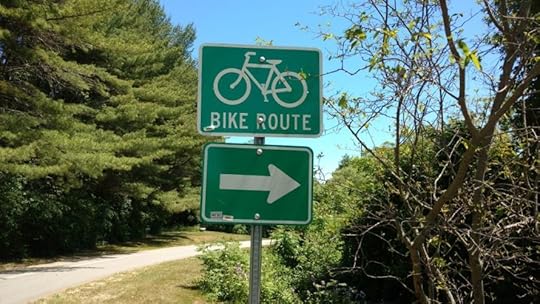
Keeping to the bike route.
Yesterday, I brought my Friday wardrobe in, along with some supplies for showering. I even picked up some food after swimming, as I won’t be able to run out at lunch. Mainly, my goal was to keep from having to carry a heavy backpack. Now, I can ride in a similar vein to how I ride when I’m out training or doing a longer ride.
From Durham, I take the aptly-named Durham Road (past White’s Beach), cross Route 1 and pick up the route for bikes on Greenwood Road to Church Road. Then it’s down McKeen Street to Maine Street, around First Parish Church, a small jog on Bath Road to Federal Street and then, I make my way onto the Androscoggin River Bicycle and Pedestrian Path (via Water Street) until picking up the on-ramp to the Brunswick/Topsham Connector. This will be my busiest stretch. While I have a designated bike lane, I will also encounter heavy traffic whizzing by. There are also three traffic light intersections where I’ll have to make sure I properly navigate the lane so some idiot driver doesn’t cut me off. If you’ve ever ridden in traffic, you know how drivers feel entitled to all of the road, plus their sheer size and weight makes you under-matched on the back of your bike.
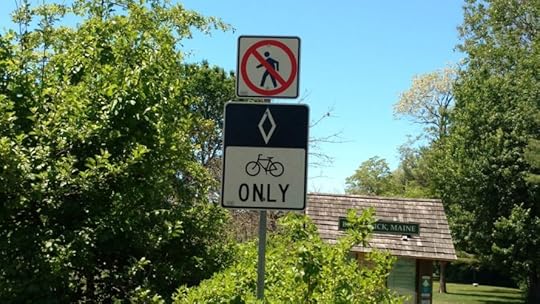
My own designated on-ramp.
By the time you read this, I’ll have reached my destination barring some incident or accident. I’ll be showered and sitting at my desk, munching on a banana I brought to work, yesterday. I’ll be feeling good and looking forward to my return ride home this afternoon.
If all goes well, I may make this a weekly event and even up the frequency once umpiring winds down.
June 21, 2016
A New Standard for Beer
The first beer I ever tasted was probably a Carling Black Label. How do I know that? There’s a grainy picture taken when I was three or four, with my Uncle Dick letting me have a sip of his beer. He was big on that brand.
Given our current culture wars and the binary battles being waged that extend even to beer, this might be the time to step away from the people who flaunt particular lifestyles. Or, if you are part of a group that’s not in the vanguard—stop hiding your uncouth behavior away from the bright lights and your Facebook profile.
I mean, what kind of country are we living in that certain arbiters get to decide the brands of beer we’re all supposed to be belting down? Given the explosion of craft beer and brewing, especially in burgs like Portland, Maine—where a new craft brewer opens every other week—or so it seems, admitting that you like “lawnmower beer” is liable to get you exiled to a place with a much lower hipster quotient.
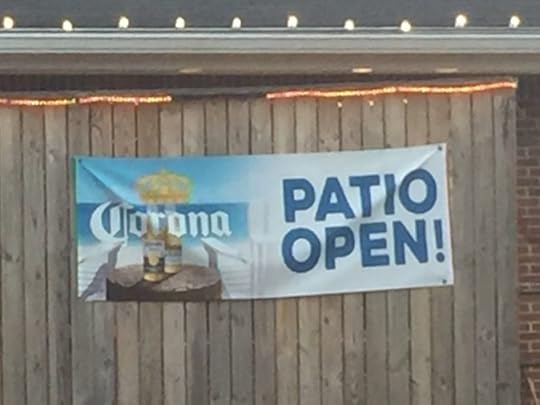
Cold beers on the patio: the stuff of summer.
Like so much of what now passes for beer cred in places like Portland proper (and similar havens of hip), I’m weary of the hype and celebrity extended to certain people simply because they drink “the right brands of beer.” I’m more likely to be holding a Pabst Blue Ribbon (or a Corona) these days, rather than something by Bissell Brothers or some other local craftster. This coming from a guy that’s posted favorably about microbreweries in the past.
I decided six weeks ago that this summer, I going to take a break from spending extravagant sums of money on overpriced (and over-hopped) beer simply because people with handles like “The Beer Babe” tell us that we should. I mean, I’m sure she’s a perfectly lovely person. But, when you can’t simply enjoy a beer without getting into , then it’s time to look to the past when beer came in red, white, and blue cans, and make these overwrought ramblings disappear.
Beer used to be one of those simple pleasures that didn’t require passing a litmus test.
June 17, 2016
The Anachronism
I’m feeling more and more like an anachronism. The things that I think are important seem out-of-date and not in-sync with technology and our app-based culture.
I like slow things—books, conversation, food, bikes, and black & white movies. I’m not so big on Facebook, Twitter, and a culture with an attention span of 10 seconds.
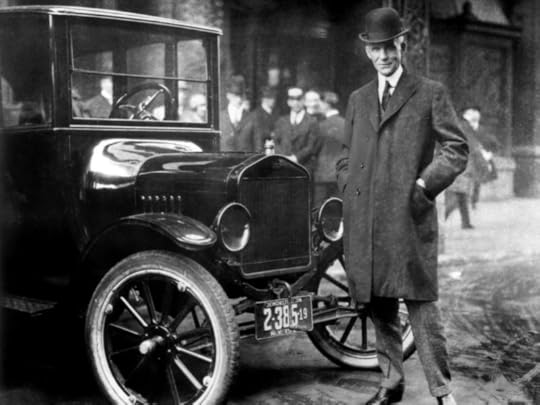
Innovation, early 20th century style.
Reading about the past, and prescient thinkers who accurately sketched out what life would be like in the present some 25 or 30 years ago (or even further back) indicates that Americans lack the capacity to change their trajectory, no matter how detrimental their track might be. That sums up the span of my life, demonstrated by history’s arc back to my time of birth in 1962.
As I think about these things and many other matters, I’m less sure about what’s right and perfect. And again, this puts me out of step with the masses—who have never been surer that their opinions and actions are right and justified. Even worse, technology gives them all platforms to spew their drivel.
Of course, the same applies to me. Except writing a 200-word post like this one is torturous, and seems like an exercise in futility.
June 14, 2016
From the Bike Seat
On Sunday, I was out biking around Massachusetts, and even up into New Hampshire, part of the Bicycles Battling Cancer (BBC) ride, which was staged from Hillside School, in Marlborough, Massachusetts. A fun time was had by all, or most of the riders, save for some Monday aches and soreness from riding anywhere from 30 to 100 miles.
Mary and I opted for the 70-mile leg, which today feels just about right. I’m sore, and a bit tired, but am grateful that I was able to help in some small way the battle against the scourge of cancer. I’m also appreciative of those who helped me double my fundraising total of $300. Stay tuned, as I want to give a public shout out to all of you later in this post.
Marlborough is like many places I’ve dropped in on in Massachusetts, always passing through. If all you ever do is drive to Boston, or blow through the state via the many interstates criss-crossing The Commonwealth, then you’d think the state is nothing but one big strip of convenience stores, strip malls, and business parks—and much of Massachusetts consists of these things.
The best part of BBC, save for the underlying purpose, was getting out on my bike and seeing things that you’d never experience from interstates like I-495, or I-290. Even better, biking slows travel down to where you actually notice things on the side of the road and can begin to assemble a different narrative, recognizing that Massachusetts is more than simply Boston, or Worcester, or even Cape Cod.
The countryside north of Marlborough is hilly and has some farming left. I say “left,” because like much of rural America, developers have bought up farmland being sold by aging farmers and turned much of it into subdivisions filled with McMansions. This was certainly noticeable along the ride, but better, there were fields, streams, and even major waterways that we crossed on our trek north to Hollis Center, in New Hampshire, when we turned back south, on our return ride to Marlborough in the afternoon.
When you are married to Mary Baumer—triathlete and a sheJAMer, you get to hang with the important people, sometimes—like Travis Kroot, world-class cyclist, and even more phenomenal human being. He biked with the We Jam for Cancer team that I was part of. Thanks for letting me tag along, honey.
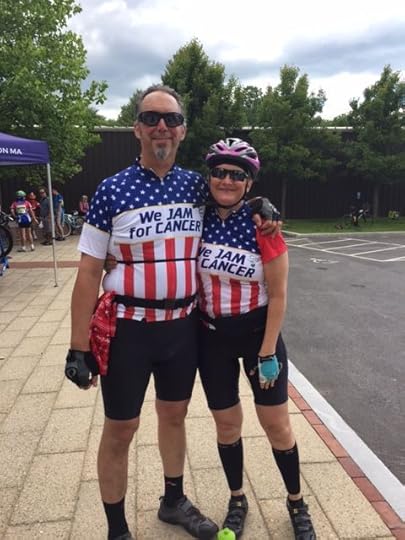
Out on our bikes, again.
Not everything went perfectly for me. I got stung pretty good by a bee that intersected with me just off the town square in Pepperell. At first, when he hit my lip, I thought someone shot me with a BB gun or something, it hurt so bad. Then, no blood, but lots of initial swelling later, I realized it was Mr. Bee that had intercepted my ride.
Then, it was north, crossing into New Hampshire. We picked up the Nashua River Rail Trail for about eight miles, just west of the state’s second largest city. The trail was fun at first, with numerous turtles dotting the right-of-way. I stopped to help one across the bike path, but then realized I’d never finish my ride if I became “shepherd of the turtles.” After about three or four miles of being on the shaded trail, I was jones-ing to get back on the paved roadways. I got my wish when we exited the rail trail and headed for our final rest stop (there were three of these at mile markers 12, 36, and mile 50) at historic Groton School, in Groton Mass. If you know anything about the place, you know it’s a prestigious boarding school that the likes of FDR attended at one time. The place looks and feels of old money, which in my book is not a bad thing.
Perhaps the turtles I encountered on the rail trail were a sign. After Groton, instead of hanging back with the group, I decided to play the hare (as opposed to the turtle) and headed out on my own making my wait to the finish line 20+ miles down the road.
Somehow, I missed a turn about three miles out from the finish and got off the 70-mile course, ending up back where the route started in the morning (and part of the final leg of the 100-miler). I think I was disoriented enough from fatigue and my bike malfunctioning with several chain derailments, not to mention the frustration of asking locals and no one could tell me where Hillside School was. This was when I just pulled into a convenience store and called the rescue vehicle to come get me.
All in all, a good time was had for most of the day. And it was all for a great cause.
I rode my 70+ miles in memory of four individuals who died from cancer. My late father-in-law, Joe Tarazewich. Also, my former boss and mentor, Bryant Hoffman. Dave Tomm was another person who I consider important in my life, and I miss him whenever I think of him. Lastly, my Aunt Dot, my favorite aunt, who died back in 1999.
Thanks to all my sponsors for allowing me to hit and surpass my fundraising goal. Derek Volk, Julie-Ann Baumer (the best sister anyone could ever have), Mark Baumer, Herman and Helen Baumer (my parents), Patricia Maxim, Linda Andrews, Paul Scalzone, John Lemieux, Harry Simones, and Marjorie Wise. I am grateful for you generosity and support.
The world slows down enough from the back of a bike where you notice things that you’d miss behind the wheel of a vehicle. It’s also a great location to observe and ruminate on many other things, as well as reconnect with reality—all positives that keep me cranking.
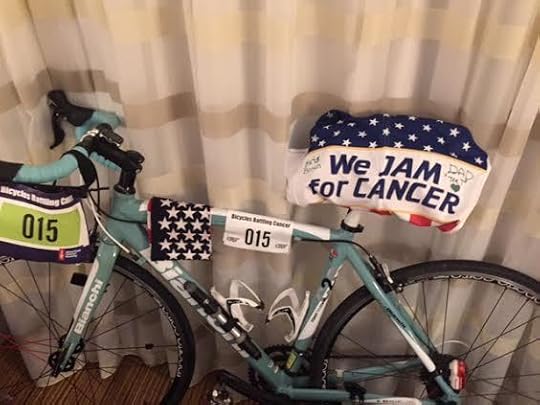
Making the world a better place, one crank at a time.
June 10, 2016
Holding My Place
When you’ve been blogging since 2003, like I have, there are ebbs and flows to content creation. A new job, a topsy-turvy month of May (and now into early June) often bring challenges to my own self-imposed schedule of Tuesdays and Fridays.
As much as I’d like to sit home this morning and crank out 500+ words, my aching knees and back (from umpiring) tell me that I’ll feel better if I put in 30-40 minutes in the pool before heading to work. I try to listen to my body now and then.
Think of today as a placeholder. I’ll have something more substantial next Tuesday, even if it’s simply pictures from Sunday’s Bicycles Battling Cancer ride.
See you then.

I’m sort of like this in the pool.
June 7, 2016
Summer Reading Program
May wasn’t a red letter month for me and reading. While I read a couple of books, nothing I ran across seemed to captivate me. The topics were lackluster and perfunctory. I’m sure umpiring 23 games in 30 days had something to do with this malaise.
June hints at hope that I’ve found some new reading choices that will once again reignite my passion for the written word. Great books always do that for me. Better, deep thinkers and prolific authors proffer up a plethora of new options.
I’ve mentioned Neil Postman countless times before. His books critiquing television as well as the power of a medium to affect its message have framed my thinking on the topic. Postman also introduced me to Jacques Ellul, the French polymath.
While searching for someone or one book to kick start my reading heading into the summer months, I learned that no one’s ever written a biography on this intellectual giant of the 20th century. The closest I could come was a book offering up a comprehensive overview of his life and writing (he wrote more than 50 books and over 1,000 articles). This work, written by three Wheaton College (the Illinois-based school) professors, is called Understanding Jacques Ellul.
I’m sure I’ll have much more to share and summarize as I work my way through Ellul in June. For today, I’ll leave you with a few thoughts on technology, which might be the topic Ellul was best-known for tackling. His The Technological Society was a best-seller and brought him notoriety on both sides of the Atlantic.

Ellul, prolific throughout his life.
The tour-de-force on the dangers of technology, with the capacity to wrap its tentacles around every aspect of our existence was written in 1954. Talk about being prescient.
Writing long before our culture became obsessed with touchscreens and friends on Facebook, Ellul offered a concern that when read today seems prophetic—the idea that technology would bring about the dehumanization of mankind, totally given over to an alien, technological mindset.
In my own life, I’m finding the need to disconnect from much of the social media landscape and its virtual surrogates. Ellul seems like the ideal docent for that journey.