Jim Baumer's Blog, page 33
August 23, 2016
Writing Questions
I’ve been writing for a long time. Well, it seems like that to me, and for most people, 14 years isn’t anything to sneeze at. That’s a quarter of my life.
If you’ve been a reader of my various blogs, then you are somewhat familiar with my story. If you haven’t heard it before, here it is in a nutshell. At the age of 39, after dabbling with writing on-and-off for a couple of years, I got serious about my craft. Much of this newfound motivation was a result of reading Stephen King’s well-known book about writing, On Writing: A Memoir of the Craft. I followed his advice in establishing a routine and adopting discipline. About a year later, I had an essay published. Three years later, my award-winning first book, When Towns Had Teams, came out. That was in 2005.
I continued on through two Moxie books, the period I called “the Moxie years,” and in 2012, decided it was time to move on to something more personal—a book of seven essays touching down on my life experiences, with several centered on my hometown of Lisbon Falls. That book was a failure from a sales standpoint, even though it contained my best writing to date.
During the last decade-and-a-half, I’ve also spent extended periods freelancing for local newspapers, regional magazines, alt-weeklies, and a few websites. I’ve gathered a file of clips, with my most recent ones posted here.
A week ago, a talented local writer who also happens to blog posted about her own challenges as a writer. She was honest about her own struggles and a recent tough patch that she’s been through, including receiving rejection notices for her latest novel.
It takes courage to remain transparent and not paper over our failures and the moments when we question whether writing really matters, or not. I commend this talented writer for being forthright.
When I decided to get real about my own quest to be a writer, I embraced blogging. That was back in 2003 and I was working at a large insurance company I often refer to as, “Moscow Mutual.” My posts pretty much wrote themselves, I had so much to talk about and wanted to share everything with the whole world.
During the past 13 years, I’ve experienced maybe two “dry spells” as a blogger. The last one was back in 2007, I think.
My routine of blogging twice weekly since 2012 has been fun. This self-imposed schedule used to be something I shared as a point of pride, especially with writing students, as an example of “writers gotta’ write.”
Yes, “writers gotta’ write” until it feels like writing is self-indulgent and whatever I have to say has been said by others (much better). After years of at best, mediocre traffic at any of my various blogs, I have been wondering, “what’s the point?”
I’m not going to deep-six the JBE just yet, but I’m not feeling any real urgency to post regularly, either.
Maybe the multiple “jobs” I’ve taken on to cobble together my daily bread have sapped some of my creative energy. I’m no writing super hero, you know! Or perhaps I’m just tired of being ignored by everyone, save for a few devoted readers and commenters.
When it’s hard finding the words…
At one point, I was overtly political as a blogger. I’ve decided that I’m not going to tell you how you should vote each and every week. Not that any of it really matters, anyways. There are only so many ways you can frame posts that posit “technology is bad” before you sound like a broken record. I think it’s better to just keep my thoughts and ideas to myself.
The last time I went on a blogging sabbatical, it was short-lived and I came back a few weeks later armed for bear. Maybe that will happen again, I don’t know. Until that happens, I have plenty of tasks on my to-do list to cross off.
In the old days, people seemed to know how to track us down. They sent letters, or picked up their rotary dial phones and rang us up. Now, email is to labor-intensive to bother with.
In our current era of button-pushing and “liking,” it seems much harder to remain tethered to others outside of the digital realm. There’s an isolation that I’ve been experiencing for some time now.
There is no blog post, or series of posts that will fix that.


August 20, 2016
What’s the Call?
I am a baseball umpire. I enjoy telling people that and I’m proud of my development over the past four years.
Baseball is a sport that I’d say is “in my blood,” one I’m intimately familiar with—I played it, then served as a coach and later—ran a summer college league (one of the oldest in the country) for five years. I can say with authority that I know the game of baseball. I think that’s played a role in helping me advance as an umpire. This spring and summer, I’ve done 65 games and save for a couple of miserable games in the rain, enjoyed every experience of being on the field and calling games.
Several weeks ago, I learned from one of my umpiring partner that volleyball is growing rapidly in Maine and that there is a need for new officials. He had begun attending rules classes, and he encouraged me to check it out.
I asked Joe if he had played the game and his answer was, “no.” That piqued my interest because like him, I have never played volleyball, save for the backyard-variety version of the sport that many of us have dabbled in at a party or family gathering. I’ve also been interested in picking up a “second sport” to officiate. Perhaps volleyball could be added to my repertoire? A secondary question could be added; “Do I need to add yet another task to my already loaded list?”

I’ll be calling a brand new sport this fall.
This morning, I head over to Greely High School to attend my first “practical.” I’ll be one of a group of volleyball referees—several of us considered “newbies”—officiating a series high school preseason matches. To say I’m “stressing out” would be an understatement. No amount of early morning cramming, or watching “Refereeing 101” videos at the USAVolleyball website can camouflage or take the place of actual being on the court and failing. That’s not a comforting thought less than three hours ahead of my first match.
I’ve been attending rules classes and have been reviewing the Volleyball Rules Book issued by the National Federation of State High School Associations (NFSHA), but I know I’m going to spend most of my first morning asking myself, “what just happened?” as that’s the stage where I’m at as a brand new official. Compared to umpiring, this is going to take some getting used to and I’m guessing, some patience as I progress and go through the natural learning curve that many new officials go through, especially when officiating a sport that isn’t second nature to them.
I’ll report back over the next six to eight weeks as I progress through my first season as a volleyball referee.
August 16, 2016
Travel Day
Last Thursday, I got on a plane headed to Omaha, Nebraska. On the way, we had to stop in Charlotte because the airline said it takes two planes to make it halfway across the country.
My travel companion was headed to Omaha to swim, bike, and run. This was for the 2016 USA Triathlon National Championships in her age group. She had qualified at last summer’s Challenge America Triathlon held in Old Orchard Beach.
Initially, I wasn’t bullish on going to Omaha, Nebraska. But a vacation is good once in awhile, even if I think they’re overrated. Plus, Warren Buffett lives in Omaha, and maybe he’d give me a pile of money if I saw him on the street.
Miss Mary (my travel companion and wife) swam in some water on Saturday morning. This was Carter Lake, and I think it was actually in Iowa, but I’m not sure. Iowa is really close to Omaha—it’s just across the river, truth be told.
After her swim, Mary biked. She did really well. Mark (our son, who met us in Omaha after coming down from Vancouver, headed to Providence, RI) and I cheered every time Mary went by us. We took lots of pictures, too.
Omaha is hot, much hotter than Maine. Mary started out great on the run, but slowed down because the heat was getting to her. She did really well in my book and the Baumers celebrated by going out to a restaurant that served lots of vegetables on Saturday night.
On Sunday, Mark ate a big pile of fruit, then went to the airport. Mary and I drove our rental car to Iowa—Des Moines to be exact. We were headed to see the Butter Cow at the Iowa State Fair.
In Maine, whenever we go to the fair, the line into the fairgrounds is usually long. In Iowa, even though their fair is the biggest one in the country, you can park on people’s front lawns for $5 and walk a few blocks. Then, you stand in a line to get a corn dog, or a pork chop on a stick.
We were really happy that the fair was happening while we were in Iowa. I got to see the Butter Cow, too.
Then, we drove to our hotel located on the Des Moines River.
Des Moines is a great city. They seem to be bike-friendly with lots of bike lanes and paths along the river. Like Maine, they also have lots of craft beer to drink. We went to a local bar down the street and drank some Iowa beer. While we were there, we saw two rabbits running across the street. We thought that was so cool.
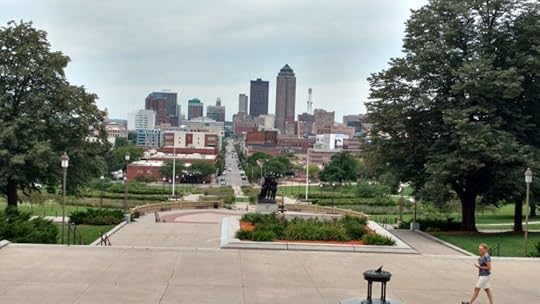
Looking downtown from the Iowa State Capitol.
Mary’s dad and mom got married 68 years ago and took a train to Des Moines. Her dad was a football player at Drake University. He used to talk about his football days. It only took Mary and I 35 years to make the trek to the stadium where Joe played football.
Mary contacted the Drake coach to say we were in town and asked, “could we see the stadium?” Even though it’s the busiest time of year for a college football coach, he said “yes,” and we had an assistant named Michael give us the gold star tour. We even got to walk on the field named after a teammate of her dad’s, Johnny Bright. He was a Heisman Trophy candidate in 1949 before someone broke his jaw. This incident was captured in a series of award-winning photographs.
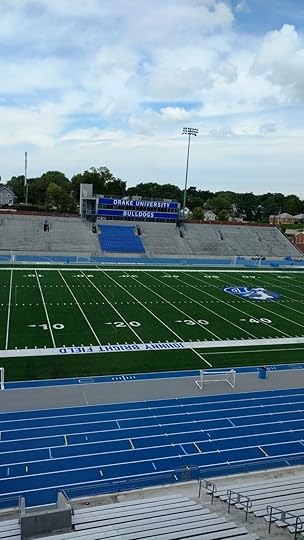
On the field at Drake.
East Coast elites think they were the ones who invented art and culture, especially elites from New York and even Boston, Both Omaha and Des Moines have their own vibrant cultural scenes. We were both favorably impressed.
Then, it was Tuesday and we had to pack our bags full of dirty clothes and head back to Omaha for an early afternoon flight. As an added bonus, we got to see a Danish Museum in Elk Horn, Iowa. Mary saw the sign on the highway on Sunday and remembered it. It was definitely worth the 6 mile detour off I-80 to see it. The Danes are cool, as evidenced by Miss Mary, who is Danish.
On the plane, headed towards Portland. It will take two planes again.
Omaha and Des Moines were a blast. I loved Drake. Michael told me nicely that he didn’t think I could suit up for the Bulldogs, however.
Thanks Mary for letting me tag along.
August 12, 2016
A Bit More About John Gould
[I’m “off the air” for a few days, holed up at an undisclosed location. It’s what guys like me call “vacation time.” While I’m away, I’ll leave you with the transcript of my talk on former Lisbon writer, John Gould, held at the Lisbon Historical Society, Wednesday night.–the j(b)e.]
John Gould is one of a handful of Maine authors that once were known statewide and beyond for their literary contributions. Today, few people outside of a demographic that is likely to be weighted towards card-carrying members of the AARP know who Gould is.
So, who was John Gould?
A thumbnail bio reads like this:
Between 1942 and 2003, he wrote more than 30 books.
He also maintained a weekly syndicated column for The Christian Science Monitor that ran for 62 years, which makes him America’s longest-running syndicated columnist.
He wrote a best-selling book, the book that put him on the map for many, Farmer Takes a Wife. That book reached best-selling status 71 years ago.
Gould’s final work, Tales from Rhapsody Home, or What They Don’t Tell You About Senior Living , was released when Gould was 92-years-old. For his efforts to put the spotlight on how many seniors were being mistreated in the twilight years of their life, and paying for that “privilege,” he and his wife Dot got booted out of the home where they were living at the time.
You could say that Gould was the Garrison Keillor of his time and generation. His wry observations, mixed with a contrarian streak, offered a portrait of small-town Maine that few others have been able to capture—Ruth Moore (another forgotten Maine writer) is someone that comes to mind. Ironically, Moore’s book of letters contains several between her and Gould, as he was also fond of corresponding in a fashion that once marked how we kept in touch, long before social media made button pushing the bomb.
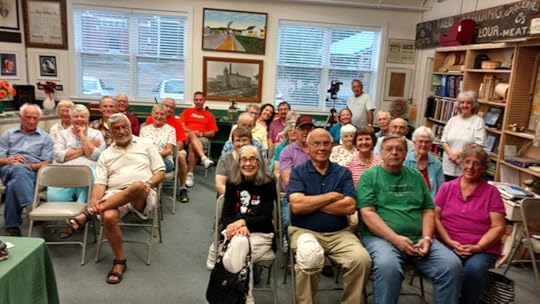
Nice turnout at the Lisbon Historical Society to hear about John Gould.
I’ve now written two essays about Gould—one found in my book, The Perfect Number: Essays and Stories, Volume 1 that came out in 2012, and the one that came out last November in Down East Magazine, comparing and also contrasting Gould with another contemporary, E.B. White, he of Charlotte’s Web fame, along with other popular titles.
Yet for all of Gould’s considerable talent and popularity, White remains fairly well-known with his books being readily available. John Gould’s work, save for a handful of titles, is now out-of-print.
When I was first doing some preliminary research on Gould back in 2011, considering at least an essay to try to resurrect some interest in a writer I first heard about when I was in grade school, I spoke with Gary Lawless, the co-owner of Gulf of Maine Books in Brunswick.
Lawless had published one of John’s books (I don’t remember the title). Like often happens with small press publishers like Lawless’s Blackberry Press, the distribution wasn’t as wide and the sheer numbers less than possible as with some of Gould’s prior national publishers, like Little, Brown and Company, W.W. Norton and others.
I’ve gotten to know Lawless over the years from convincing him to carry my own books, and he and I will often talk about the state of publishing. He mentioned that John wasn’t the easiest guy to work with and that he was critical of Gary’s efforts to distribute his book.
I’m sure this was born of frustration, as Gould’s lifetime paralleled the subsequent zenith of publishing, and then he began experiencing firsthand its descent into its current digital Balkanization. Once, publishing was a vehicle that kept writers like Gould in business and able to make a comfortable living, rewarding him for a talent that is still all-too-rare—the ability to use words to tell stories. And fortunately for Gould, his place in history allowed him to clunk along to the end, not needing to scramble about holding all manner of other gigs in order to keep writing.
I could go on about Gould as an author and about his myriad titles from Farmer Takes a Wife forward, but tonight, I wanted to touch on another aspect of Gould’s life that I rarely hear anyone talk about. That being his newspaper background and days as a publisher. There’s a reason for that and you’ll recognize it by the end of tonight’s short talk, which I want to wrap up in another 10 minutes or so, and then I’ll open it up to some questions if anyone has any.
Gould actually self-identified as a newspaper guy.
He began his newspaper career in 1922, when he was still a freshman in high school, writing the Freeport news for the Brunswick Record. He continued with them right on through his time at Bowdoin and then worked full-time for the old Boston Post.
Later, he’d cover news and opinion for the Brunswick Record through 1939.
In 1942, he launched a weekly column for the Christian Science Monitor, and continued it up until shortly before his death in 2003.
Much like Norm Fournier, he was interested in covering the things that make small towns tick, as well as the things that happen behind the scenes. Newspaper men like Fournier and Gould never get rich and probably barely scraped by at times—yet they felt a calling to cover the news in a manner that made journalism an honest calling—unlike the ideological hackery that passes for journalism today, with reporters in the bag for Candidate Clinton. But I’m not here to prove that point (I’ll leave that up to you to do your own research on that).
Gould was the publisher of a statewide weekly called The Lisbon Enterprise, from 1958, through 1965. He was a Goldwater Republican, and it was his support of Goldwater in 1964 that ultimately proved to be his undoing. Kind of like if we still had a newspaper here in town and the editor week in and week out tried to counter the tide of fluff pieces in purported bastions of journalism like the New York Times and the Washington Post, portraying Mrs. Clinton as far superior to Mr. Trump, with the media casting him as a buffoon, unhinged, and all manner of other ad hominem attacks.
My point is that John Gould was no shrinking violet. Later, Fournier would continue that journalistic tradition. Gould believed what he believed and even if he went down with the ship, he was going to write and publish what he thought was right, not what was politically expedient.
For several years now, I’ve watched my former town of Lisbon turn into a shell of its former self. The economic vitality that the town once had is long gone. I actually tacked that subject in another essay. A lot of damn good it’s done me to care about John Gould and the economic fortunes of Lisbon. While my Moxie books, about some bitter soft drink that a cult following lionizes, have sold in the thousands, my book of essays have garnered sales of slightly more than 200 copies. Writing about what needs to be written about doesn’t guarantee riches, that’s for sure. Fournier warned me about that back in 2006 or 2007.
Now, Lisbon has no one writing about what’s happening. Fournier and Gould, of course, are long gone. Instead, we’re treated to a bunch of blathering on Facebook that rarely contains even a glimmer of truth and is at best, mere conjecture.
Look at the Worumbo Mill. Has anyone bothered to write about how a once-vibrant textile mill fell into disrepair and eventually, the choice of last resort was to demolish it? Anyone with an ounce of care and concern for this town can’t drive by the site without wondering what might have been if someone, or a handful of community leaders could have mustered a vision and set about saving it. Look at places that have rescued former mills—Fort Andross in Brunswick and the former Pepperell Mill complex in Biddeford. Heck, the Bates Mill in Lewiston was slated for demolition, but a group of leaders got together and managed to resurrect one of L-A’s architectural gems.
Using Gould and Fournier as guides, I’ve attempted to offer a narrative about the town that’s fallen on ears that lack the capacity to hear. I’m not sure why that is, although I have a few theories.
Let me end tonight with a passage from the essay I wrote about John Gould in 2012 (from The Perfect Number: Essays & Stories, Vol. I).
August 9, 2016
Vacations are Overrated
I rarely take vacations anymore. The main reason is that freelancers don’t get paid when they’re not working.
On the other hand, many people that I know that work a traditional job with vacation benefits seem to be on vacation all the time, or at least several times a year. I was at a family party on Saturday and I asked where some people were—the answer was, “they’re at the Jersey Shore.” I wasn’t surprised because these are people who seem to live to take vacations. To each his own, I guess.
Once you get into a certain rhythm for work, you actually don’t require as much downtime as the traditional 6-week-a-year vacation types insist that they must have. A day here or there seems to suffice.
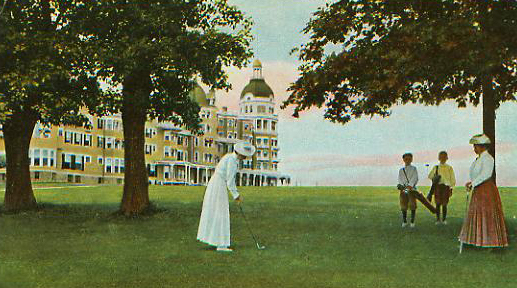
Old school vacationers playing golf.
The best vacation I’ve had in recent memory was when Mary and I rented a camp in Steuben, sight-unseen. That was back in 2007, when our Sheltie, Bernie, was still alive. Mark and his girlfriend-at-the-time drove up from Boston. It was a bucolic week spent frolicking along the seashore, walking the neighboring nature preserve, biking off-the-beaten path, and eating clams that we bought each day from a local digger—we even visited the site where a baby whale had washed up on the beach.
My O’Pa never took vacations. Yes, he rested on Sundays and like many men of his day, tended to keep some variation of “the Sabbath.” I don’t remember him ever saying he was tired or bitching about his work.
My last extended period of time away from working for a living that could be considered a “vacation” was two years ago. I’m not complaining, merely stating a fact.
I’m actually going to be away for a few days after getting on an airplane later in the week. We’re headed to a secret destination that I’ll report back from at some point.
It will seem different not being on-call, or driving for the Uber, or even going in for my part-time job where I now spend four days each week. I’m curious how the change will feel to me.
Work of some sort has been central to humans since the beginning of recorded time. Technology and in particular, artificial intelligence, are likely to change that equation. At some point, humans might never have to work.
Will permanent vacations make our lives more fulfilling?
August 2, 2016
One Week, in One Year
Our lives are made up of minutes that become hours that run into days that eventually become years. Then, it’s over. There’s an announcement in the newspaper, or a Facebook update mentioning an obituary. Maybe there’s a visitation, a funeral, or simply the memories of a life lived out across a small ripple in a sea of time.
I’ve lived out more than half of my ripple. Will it leave even the smallest of marks on the water’s surface after I’m gone? Nothing’s certain on that front. I hold the belief that how we live and what we do while here matters—at least that’s the hope, lacking any guarantee.
Last week offered perhaps the most representative summation of the freelance lifestyle from my vantage point. Equal parts enjoyable, even empowering, intertwined with a stretch that left me uncharacteristically weary, requiring tapping into a reserve that I wasn’t sure I had. Every segment of my puzzle-piece work life was represented.
Back when I was running laps around the usual five-day-a-week labor track, I complained that my two-day weekends weren’t long enough. Now, finding a 48-hour stretch of time to step away from wage-gathering happens so infrequently for me that I sometimes resent those who have it so good—and yet find the need to voice their displeasure in my presence or via social media—not knowing that it irritates me (although I try to overlook it).
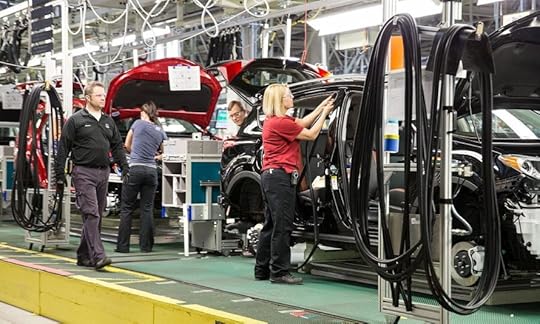
The world of work continues evolving.
Writing is a passion of mine. If I have to name what it is that I do, I’ll always self-identify as “a freelance writer.” It took me nearly 40 years to recognize a talent (some might even qualify it as “a gift) that remained hidden under layers of work, family obligations, and even romantic notions about what constituted “the writing life”—as if there’s one defining frame for being a writer. Runners have different strides, just like pitchers rely on their own style and array of pitches in getting batters out. My writing experience is probably different than yours (if you’re a writer), as it should be.
I began the writing journey back in 2002, with 2003 being the year that I set my face “like flint” towards a goal to make writing central in my life. By 2006, I recognized that writing didn’t automatically deliver riches, but rather (at least for me) required creativity and supplemental income—at least if I didn’t want to end up foreclosing on my house, or worse. I turned back towards a more traditional, 40-hour way of making a living, while still continuing to write. In fact, it was during this stretch that I released my two books on Moxie.
This would also lead me to meet and work for one of the most important people to come along in my life. His belief in me and validation provided a boost, fueling my forward maneuvers as an author, an independent publisher—while eventually, becoming a consultant for other writers looking to do what I had done—publish my own writing and bring it to the marketplace.
I was reminded of that again this week when I had lunch on Friday with someone from that former life. My former partner in crime, Paul, has become a close friend. He’s the only person—now that my old boss has passed over to something other than this life—that I care to remain in contact with. I am thankful for Paul’s friendship. He and I always have honest discussions, mixed with laughter, and we part ways with the certainty that despite our busy lives, we’ll at some point schedule time to see each other once again.
In May I located a part-time job that provides a financial anchor for me. I’m committed to this employer four days each week between Monday and Friday. Tuesdays are my “off day,” but Tuesday usually is already pre-booked to work on writing tasks, like producing articles for an auto trade magazine publisher I’ve been writing for since last August.
Writing about cars, especially technology’s place and how it affects the industry are some of the types of articles I get to develop. I also have touched on elements that might be considered ancillary to parts of the industry (such as repair shops), things like food trucks, electric vehicles, and even Uber.
Speaking of , I have now driven four times for the ridesharing app. If I’m going to moonlight, the job’s got to offer some certainty and an equation that delivers a number that’s fairly concrete when I factor in hours spent working, and its value for me. While I’m still really new motoring about Uberville,last weekend’s incentives that included guaranteeing an hourly rate motivated me to get out on the road and make some money.
Last December, I answered an ad in the newspaper for a Portland funeral home, looking for funeral attendants. What they wanted was someone who could go out on night “removals.” If you aren’t sure what that entails, I’m basically an undertaker. When people die, especially during the after-hours period between 4:30 at night and 8:00 the next morning, people like me go out with a van and pick up the deceased. It might sound a bit weird at first, but if you know anything about the industry, it’s a pretty standard practice.
The home that hired me serves as Portland’s “gold standard” for funeral services. Even on police calls and the worst possible death scenario, we arrive at the scene dressed to the nines, arrayed in the dark suit and white shirt. That’s the way it’s done at this particular establishment.
I think It takes something that I’m not sure everyone has to get roused from a dead sleep in the middle of the night (or early morning), get dressed, and then drive 30 minutes to pick up the van, and go out to a local nursing facility, hospice, hospital, or crime scene, and retrieve a dead body. Sometimes you go by yourself and other times (at unattended deaths at home or elsewhere involving a police call), you arrive with a partner.
Friday afternoon I was summoned to my first suicide. This followed being called 12 hours earlier at 3:00 a.m. to remove someone who had died in their home not far from where I live.
This was what we call a “police call,” and it involved the municipal PD. The deceased had died of a self-inflicted gunshot wound. I’ll let you imagine how you’d react to your first experience seeing someone with a golf ball-sized hole in their forehead, with lots of blood, and skull fragments scattered nearby.
I was fortunate to be on this call with a colleague that had spent 26 years in law enforcement. This wasn’t his first suicide. He was great to be with and I drew upon his experience and professionalism. Actually, blood doesn’t bother me and I’ve watched enough episodes of CSI Miami to have a sense of what I’d be encountering. I wasn’t shocked at all. Also, having been on a couple of previous calls involving lots of blood, I made sure to be as cautious as possible to avoid getting it on me, save for my gloves.
Saturday morning, I woke up after my first full night’s sleep in nearly a week. I felt re-energized enough to ride 26 miles with Mary as she readies for her first USA Triathlon Age Group National Championship in Omaha, Nebraska in two weeks. That was enough for me, but Mary—someone who is a great fitness role model—then went out and ran 6.2 miles (a 10K) to complete her training brick.
Lest you think Mr. Jimmy (aka, the JBE) is all work and no play, we spent Saturday afternoon on Bailey Island, one of our favorite places on earth. Drinks and a late lunch followed at Morse’s Cribstone Grill. Then, an annual trip to Land’s End was in order, as this Maine landmark was a mere 2 miles away.
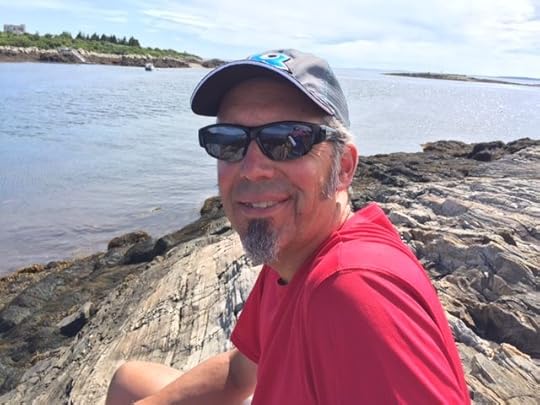
The JBE-off the clock and enjoying some leisure.
It might sound weird to anyone who works a fairly structured schedule (or is “living for their weekends” Monday through Friday), but it’s now increasingly difficult for me to relax and chill out for more than a 24 hours at a time. Even during that downtime, I have to remind myself that I don’t need to be anywhere else and tamp down that antsy feeling, or not anticipate getting a call to pick up a body. There is certainly an adrenaline rush that comes with living and working this kind of way, but then there is the crash that comes, also, when you are running on fumes from two hours sleep.
As hectic as my week was that also included chasing interviews and being on deadline for my trade mag article, I relished most of my week. For you communists out there, and those who want to overthrow the state for Utopian bliss (or perhaps better, the trust fund set), I know that my efforts this week delivered a better than usual payday. For me, working my ass off better deliver some ka-ching, or I don’t know why the hell I do it.
Like the farmers who must “make hay while the making’s good,” I never look a gift horse in the mouth these days. I remember how bleak things looked last January. At that time, I wasn’t even sure I’d still be writing articles for my trade magazine editor.
Seven months later, I’ve done some of my best writing for trade magazines like National Oil & Lube News and VehicleMD. Not the “sexiest” publications out there, but I could care less. I like the appreciation of a decent paycheck and one that’s delivered promptly upon invoicing. You can have your alt-weeklies and regional dailies. I’m likely done with them forever.
Who knows where all this is leading me. All I know is that I have a newfound appreciation for work of any kind—especially work that affords me a measure of personal control and flexibility (that would be Uber and my umpiring). The funeral work is less certain and I’m not as sure about it remaining in my personal mix, although I’m on the August call-out schedule due to some wrangling by the local manager, who also “sweetened the pot” for me. It also looks like I’m going to become a volleyball referee too, as I’ve recently learned that Maine’s burgeoning high school volleyball scene has generated a demand for officials.
For those who believe their jobs are (or should be) guaranteed for life, I’ve got news for you. I don’t identify with you anymore. I’m personally sick of lazy whiners who expect taxpayers to foot the bill for their mediocrity—and yes, I’m talking about state employees. You might want to update your resumes fairly soon.
My additional parting remarks are, “welcome to the future.” I’ve already arrived, as this has been my reality now for the past four years.
July 26, 2016
When Your Autopilot Fails
Cars have always fascinated me. This likely dates back to what I can recall of my earliest memories—sitting next to my father, riding with him in his 1962 Ford Fairlane, and watching him manually shift on the column. He’d even let me grab the shifter and after he depressed the clutch, I got to throw the Ford into third gear.
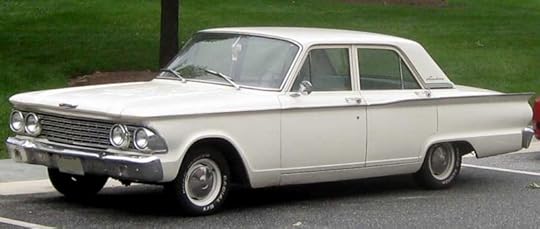
The 1962 Ford Fairlaine: Back when men were men, and cars were meant to be driven.
I’ve just spent much of the past week trying to get JBE1 back to where he was pre-breakdown. For some reason, when my electrical system failure related to losing the serpentine belt, the incident also threw off my air conditioning. All seems to be right in the world, or at least with my car, at the moment.
The automotive world, like much of the rest of the things in our lives, has been increasingly altered by technology. Techno-utopians always consider technology’s upside, while minimizing and often, whitewashing any of the negatives of computers controlling most of our lives—and now, our cars.
For a year now, I’ve been writing for trade magazines about cars. Being a freelance writer who loves cars, it doesn’t get much better than getting paid to write about a subject that you are interested in and have a passion for. Even better, I’ve been getting assigned some articles of late that touch on the intersection between our vehicles and said technology. Here’s just one example—this one covering hackers and today’s hyper-networked cars.
In the course of researching these articles and speaking to knowledgeable car and computer people, I’ve picked up a host of new things that I didn’t know before. I’ve also become less critical about some of the technological innovation than I might have been before. I’m still not ready to join the evangelical wing of the techno-utopian movement yet, especially when it comes to the autonomy of my car.
Associated Press writer Joan Lowy’s article the other day about self-driving cars and the human element piqued my interest. Lowy touched on a previous story about autonomous cars that didn’t have a happy ending. It also highlighted one of the major pitfalls and concerns the prevent Google from ruling the highways and byways of America—at least for another week or so.
Joshua Brown was a 40-year old tech company owner from Ohio who I’m guessing was in the techno-evangelist camp when it came cars and his Tesla Model S. Brown had ceded driving to his Tesla’s Autopilot near Gainsville, Florida when it didn’t recognize the danger directly ahead, failing to brake when a tractor trailer made a left turn and his car drove into the side of the trailer. After hitting the trailer, Brown’s Tesla went under it, then veered off the road, hitting two fences and a power pole, killing Brown.
What I noticed about Lowy’s article, and the accompanying NY Times piece about Brown’s accident, is that both of the journalists take a “distant” approach to the outcome. What I mean is that they are careful not to assign blame to the Autopilot (which obviously failed to recognize the clear and present danger of a tractor trailer directly ahead), or offer any obvious critique of technology moving at a pace that exceeds the human capacity to adapt to it. Better, at least in Lowy’s article, it’s humans that are at fault—our brains are just too unreliable to step in when our Autopilot decides to check out. I’m sure that the way our brains function in these situations is due to how we’re hard-wired to adapt based on the previous 300,000 years as hunter-gatherers, prior to the recent Happy Motoring epoch, with cars covering the earth. Perhaps we’ll adapt, or maybe we just simply cede our driver’s perch to a robot.
I don’t want to be too critical of Lowy or any other person writing about technology. It’s the landscape that anyone who hopes to get paid to write has to trod, whether they’re covering progress, politics, or automobiles. Being overly critical of technology only gets you labeled as a crank—and who wants that?
July 19, 2016
Hot in Cleveland
I’ve never been to Cleveland. I did drive a U-Haul truck through the middle of the city on a couple of occasions between Mike Pence’s Indiana and Maine. They tell me that the GOP is having their convention in the place where rock and roll is lionized, at least by the arbiters at the Rock and Roll Hall of Fame.
I do remember a night from Cleveland’s past, filled with smoke and burning records. That took place at a strange intersection where baseball and disco came together—at a stadium by the lake that’s a mere memory.
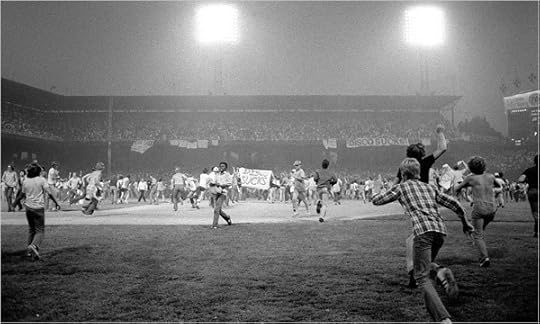
Rock and Roll and disco are like oil and water.
Not much to say today, at least nothing that I can say that won’t get me on the wrong side of the PC fence from the real fascists and censors.
I did have the strangest of dreams last night. I was at the Democratic National Convention and I was supporting Hillary in the most lukewarm sort of ways. Oddly, she had morphed from the frumpy and shrill, to slender (in a female volleyball player’s body) and unassuming. All the attendees were pudgy white males and women worshiping their queen. Bernie Sanders’ gang were not present, so no graying ponytails.
Until I can come up with a blog post about the weather, cars, or biking to work, this one will have to suffice.
July 15, 2016
My Car Let Me Down
I was looking forward to Wednesday night. Not because I was planning a night on the town, nor was it a high-end date night at one of Portland’s finer restaurants, either.
Wednesday wasn’t even my “day off”; that happens to be Tuesday nowadays—me with my five variant shades of work. After knocking out six hours of financial coordination at the credit union, I was off to umpire in South Portland, at SMCC. The night was comfortable, especially with the school’s ball field situated, overlooking Casco Bay.
What was the source of my anticipation? A night when I wouldn’t be beckoned while being on-call at the funeral home. I’d finally have a night where I could finish my game, drive home, eat dinner, have a beer or two, and somewhat approximate the normal end-of-the-day experience of most Americans.
Instead, JBE1, aka my 2008 Ford Taurus, had other plans. He would choose Wednesday night to shed his serpentine belt and offer a glimpse of the night ahead.This was foreshadowed while we were tooling along Broadway in South Portland, headed towards the college. A red battery icon began glowing, while a message of “check charging system” commenced flashing across the car’s instrument panel.
I made it to my game, which involved being behind the plate for a mundane Twilight League game. Nothing of note happened and I walked off the field with my partner just prior to 8:00 p.m. So far, so good.
My initial thought when I began receiving the equivalent of warning texts from JBE1 was that I’d take it over to VIP when I arrived at work on Thursday, as the credit union branch where I’m now working is just across Union Park Road from a popular Maine auto repair chain. I was confident that the mechanic would hook it up to his diagnostic computer and would tell me that I was looking at a battery issue, or possibly something more serious.
Crossing the Casco Bay Bridge on my journey home, heading from South Portland to Portland, I noticed that my instrument panel wasn’t as bright as normal when I flicked on my headlights to ward off the approaching dusk. I killed the air conditioning and turned off the radio/CD player. Conserving power was now my priority #1, if I had any hope of completing my 25-mile trek back to Durham. I even threw safety to the wind and crossed the city sans headlights hoping to limit the electrical load on a system that was struggling, if not yet in failure mode.
Just north of Portland, I got that ominous feeling that this might be a repeat of a previous episode on the road that didn’t end well. That time, Mary and I were making our way back to Maine from Norton, Massachusetts and a trip to Wheaton College to watch our son, Mark, play college baseball for the Lyons.
Back then, I was driving a 1998 Ford Taurus wagon that I’d acquired as a one-year-old program car with just over 10,000 miles on the odometer. Like my current Ford, this previous vehicle held up well in terms of dependability and reliability. But with any domestically-made vehicle, usually when you begin getting close to the 200,000 mile mark, the frequency and size of subsequent repairs increases.
That time, we were just 20 miles from Wheaton, on I-95, when I had to turn on my headlights. If Ford had equipped their cars with the old-fashioned alternator gauge, I’d have known for sure that my electrical system was discharging. But dimming panel lights and then, the loss of my power steering just prior to fighting the car off the interstate, while eventually coasting into the parking lot of a convenience store where the car died, was the start of a “fun” evening. The night’s events also involved a tow, along with a call to Mark to “come get us” in the 1993 Camry wagon that we bequeathed to him. We then drove him back to his dorm, turned around, and made the 180 mile trip back to Maine in his 12-year-old car with 250,000 miles on the odometer.
Wednesday night, things were headed downhill fast as I blasted up the interstate. I figured my best bet would be to jump off the exit in Yarmouth, and continuing north on U.S. Route 1. My hope was that I might be able to jog west and follow some well-known back roads with my headlights off, and limp into my driveway at home. That plan crashed and burned on County Road in Freeport less than a ½ mile from Route 1. Just as I crested the hill, JBE1 conked out. I coasted him to the edge of the road, stopping off the pavement and hit my flashers. There was still enough juice in my battery to illuminate my location on the side of the road. Time to summon AAA.
I ended up being towed to Lee’s Tire and Service in Brunswick. The tow truck driver from Atlantic Coast Towing, a young man named David, was courteous, professional, and he and I had a nice conversation on the drive from Freeport to Cook’s Corner.
Thursday, my day was heavily weighted towards a hastily-devised plan B. A ride with Miss Mary to Lee’s to drop off the keys and let Wayne Gagne know why my car was sitting in his parking lot. Then, getting dropped me off at work in Topsham. I was on-time, too.
JBE1 won’t be road-worthy ‘til later today. Parts from a Portland dealership wouldn’t be making it to Lee’s on Thursday, so I was told by the mechanic who called me. Not only did I have a busted belt, I had a major oil leak—the ultimate cause of the belt breaking—as well as a bent pulley. All told, my repair would be the equivalent of a car payment for a luxury sedan.
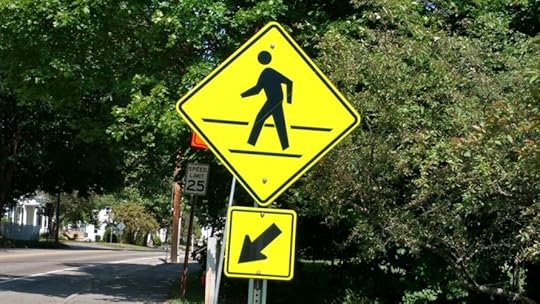
Make way for walkers.
Thursday afternoon, I walked a mile and a half into Topsham to meet Mary who had an appointment at the Bowdoin Mill, a place where my father once worked when he first was hired by Pejepscot Paper Company. My commute to work on Friday will require some pedal power, once again.
While I can’t say I’m happy that my car died, things could have been worse. I’d also offer up that any time you have the chance to get out of the driver’s seat and see the world from an alternative commuting vantage point—whether bicycling, or playing the role of a pedestrian—illustrates one of the major dysfunctions of 21st century America.
Political types of either persuasion will insist that choosing to vote for their opponent—whether Hillary if you’re a conservative Republican—or Donald Trump if you’re a Democrat, even a so-called progressive one—will be the end of life as we know it. I’d disagree vehemently with that faulty, binary perspective.
My son and I don’t always see eye-to-eye on some of the key issues of the day. But I commend him for choices he has made that have delivered him from the tyranny of vehicle ownership and the cost associated with being a car owner, estimated to be close to $9,000 per year in the U.S. according to a study commissioned by AAA. He walks, bikes, and when necessary—wedges his 6’4” into the confines of a seat in the middle of some transcontinental bus carrier, like Greyhound—simply because he believes there are more efficient ways of getting around than relying on the internal combustion engine, powering vehicles most likely inhabited by a lone occupant.
Mark lives in Providence. This is a city, with public transportation options, bus routes that will take you to Boston or New York City, and commuter rail, too.
In a rural state like Maine, owning a car—with all the attendant costs associated with ownership—is at best, a kind of Faustian bargain. As the price of new cars continues to rise, coupled with all kinds of ancillary costs associated with having a vehicle, more and more Americans might be forced to choose something different, or worse, have no choice at all in the manner.
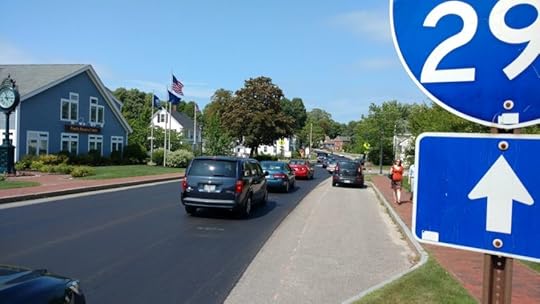
Cars always outnumber pedestrians in place like Maine.
My concern is that we’ll continue spiraling downward, attempting to apply Band-Aids to an infrastructure devoted to Happy Motoring and excluding all other alternatives. We’ll keep on trying to fix and patch our crumbling network of roads. All because in America, cars (like many other symbols) are viewed as birthrights, and not open to honest debate.
Walking into Topsham yesterday afternoon, I knew Mark had made a wise choice in how he’s oriented his life without a car.
July 12, 2016
Pride and Prejudice
Everyone’s looking for a tribe to run with. Sometimes, people find it when they embrace a certain way of seeing the world—religion and politics being two of these.
Turning on the Tee Vee is always fraught with the potential that it could ruin one’s day. I was reminded of this again on Sunday.
After standing in the rain for 5 ½ hour, umpiring two AAU tournament games, I got home late on Saturday, cold, hungry, and exhausted. If you were out in the elements on Saturday, you’ll remember it was unseasonably cold, with precipitation alternating between light drizzle and downpours.
With yet another game on the books for Sunday afternoon, I was looking for a weather forecast, while also wanting to see if the local news puppets bothered to cover the Moxie Festival parade from Saturday, I flicked on the television after pouring my first coffee of the morning.
Oddly, I was treated to a series of social justice warrior gatherings in the first 10 minutes of the newscast. Maine, like the rest of the country, seems to be in the midst of some kind of collective meltdown.
The second story, about a group of white people, mainly women, caught my attention. They had gathered on Saturday in Belfast, Maine, and held a Black Lives Matter rally, or so I was told by the newscaster, reading from his teleprompter. Have there been a rash of racially-motivated shootings in Maine that I missed?

Blacks Lives Matter in Belfast.
This is how the story was introduced to viewers:
After a week of racially charged violence in the country…emotions are still running high. And groups around Maine are continuing to take a stand.
Around 50 people protesting in Belfast Saturday. Holding signs that read “Black Lives Matter.”
Was this some “Saturday Night Live” skit, or something? No, this was really a group in Maine taking on an issue that affects Mainers (I guess).
Someone named Lindsay Piper, the event’s organizer, said she was using her “white-based privilege” to speak out against racial violence.
Apparently she’s a mother, and wanted to lead by example—certainly a noble sentiment. She is quoted as saying, “I want my daughters to know about their white privilege and I want them to be a part of the solution in ending white supremacy and if I’m not taking daily action steps to do that then how do I expect them to learn how to do that.”
I’m old enough to have some historical perspective, and I was curious as to where the concept of “white privilege” came from and how it came to be front and center in 2016. As in, my white skin somehow affords me advantages that some other, darker pigmentation lacks—simply by being white. I don’t remember being indoctrinated (taught?) about this in school back in the 1970s and 1980s.
According to The New Yorker, the phrase originated with a woman named, Peggy McIntosh, someone who the article identifies as a women’s-studies scholar at Wellesley. She wrote a paper in 1988 called “White Privilege and Male Privilege: A Personal Account of Coming to See Correspondences Through Work in Women’s Studies.” Feel free to read the entire story about McIntosh. It’s a solid article, done in a manner typical of publications like The New Yorker. Ding, Ding, Ding!!
Thanks to the aforementioned article, I also ended up directed to an opinion piece written by a freshman at Princeton (at the time) named Tal Fortgang. He takes a slightly less doctrinaire position than Ms. McIntosh on the subject of privilege. You’ll see that he’s outside the “blame it on Whitey” camp, also.
Everyone has an opinion on all manner of subjects. Our opinions are often fueled by emotion and they also allow us to feel “proud” that we have certain beliefs that others don’t have. It helps us to feel superior to others.
While people like Piper think that cops are indiscriminately killing black people, Heather MacDonald, a fellow at the Manhattan Institute, has been offering up some countervailing information that calls into question many of the claims have been made by groups like Black Lives Matter. The Wall Street Journal actually republished an OpEd that she originally wrote and ran in February. Her data is worth considering if you care to look at facts, rather than simply getting churned by emotion. I also learned that she’s just come out with a new book this month called, The War on Cops.
I recognize that I’m swimming in shark-infested waters today with this blog post. There are certain narratives that we’re probably wise to avoid and just go along with the madding crowd. Or, we can choose to read and research a bit more broadly than politically-motivated groups and their operatives want us to.
My motivation for doing so comes in large part from a significant period in my own life when I was so sure that I was on the primrose path that I ignored all the signs and signals (facts, basically) that I was actually immersed in a false ideology. That was thirty years ago and the consequences of that time still resonate and affect me each and every day. And just so you know, false teaching is very seductive. I’ve been lured and tempted to dismiss facts and evidence nearly every day, since.