
Alan Baxter's Blog, page 83
June 7, 2011
What's in a name? The Pink Floyd Effect.
The Pink Floyd Effect – The process of a name becoming perfect for its subject through familiarity with that subject and/or its actions.
Names. Very powerful things. Anyone with even a passing acquaintance with demonology or the occult will tell you what a powerful thing a name can be. If you know something's true name, you have great power over it. Maybe that's why Prince changed his name to a symbol, which is very hard to pronounce in spells – could he be a demon, hunted by occult adventurers? But I digress.
I've been thinking about this lately because we rescued a tiny stray kitten last week and he appears to live here now. He has a strangely large chin and I said, "He's like Stan from American Dad." Henceforth, the kitten's name is Stanley. He's very cute, really. Look:
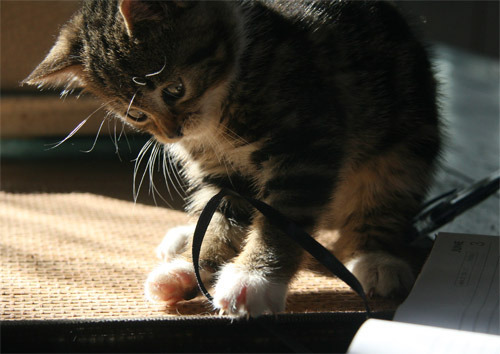
When I mentioned this on Facebook and Twitter, people were universally besotted with him, but the reaction to his name was interesting. A lot of people thought it was a great name and many people complimented me on giving him a "proper" name. I presume they meant as opposed to Tiddles or Mr Snookums. Other people were very confused and made comments like, "Stanley? Really!?" A couple of people even pointed out that he looks like a Stanley. Which he does, of course, because that's his name. Chicken and egg.
The name and the named grow into each other and become inseperable. I guarantee that within a few weeks, our new kitten and the name Stanley will be completely normal, at least to us. It happens in every walk of life. For example, my favourite band of all time is Pink Floyd. Stop and have a look at that name. When you hear it, you think of the band and all the amazing work they've done. But really? Pink Floyd? The etymology is interesting. They started out called The Tea Set, then one day found themselves on a bill with another band called The Tea Set. So Syd Barrett suggested a name he'd been keen on for a while, based on his two favourite blues musicians, Pink Anderson and Floyd Council. So they played as The Pink Floyd Sound. After a few gigs they dropped Sound, but remained known as The Pink Floyd. Usually known simply as Pink Floyd since the early seventies, the definite article is still used occasionally even now. But really, when you think about it, Pink Floyd is a bloody silly name. However, it's also awesome as it contains and references everything about one of the most seminal bands of all time.
So of course, I relate this name situation to fiction. Names become incredibly important when we're writing. I agonise over names – it's probably the thing that gives me the most grief when I write. I want to get names just right. I want them to fit. But the truth is, whatever name I give a character will fit if I tell the story well and write the character convincingly, because the character and the name will grow together and seem like it was always the perfect match. I call this 'The Pink Floyd Effect'.
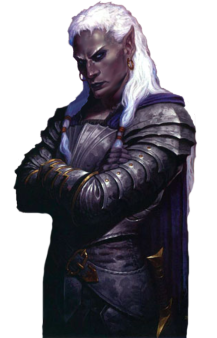 I think the important thing is to not try too hard when coming up with names for your fiction, especially if you write fantasy. Remember, the apostrophied name is so overused now that it's become something of a joke. Characters like Drizzt Do'Urden owned the concept back in the day, but now it's seen as overly try-hard, or extreme wankery, to include crazy apostrophied names in your fantasy fiction.
In Brent Weeks' Night Angel Trilogy, I was initially really annoyed at the name Durzo Blint. It annoyed me because it seemed uneccessarily "fantasy", and it still does annoy me a bit. But the name also now conjures for me everything about that character, and he's a character I really like.
Let's look at it from another real world example. I'll write a name, you be aware of your immediate reaction. Ready?
Rodney King.
That's a pretty ordinary sounding name in and of itself, but I bet you had a pretty visceral reaction to it. The man, the name and the events for which he's known have become ingrained in our culture and the name carries a lot of power because of it.
Let's try another one:
Errol Flynn
Calm down, ladies. Take a deep breath. Errol Flynn is actually a pretty funny name, and you might feel a bit sorry for anyone with a name like that these days. Although I do quite like the name Errol myself. But there's no denying that it has power.
Okay, one more:
Sarah Palin.
Did you feel yourself get a bit dumber just then? Just reading or hearing the name actively destroys brain cells and enhances right wing idiocy and religious insanity. And that's a name that could become much more powerful if the American people don't take a moment to get their shit together. But in itself, Sarah Palin is a pretty ordinary name.
So, my point is this: Don't over-stress the names you use, be it for your pets or the characters in your fiction. The Pink Floyd Effect will kick in with time and the name and the named will become one and the same thing. And potentially attach themselves to events people are aware of around the world.
When you're writing your fiction, spend some time to think about the names, make sure they have a good ring to them, are easily read off the page and stuff like that. Then put your effort into writing the characters and the story as well as you possibly can. By the time you're finished, the names you've chosen will be perfect.
***
Agree or disagree? Please feel free to share your thoughts and examples in the comments.
.


June 5, 2011
Aussie authors on Twitter
I love Twitter and spend a lot of time chatting with people there. I find out out great information. I get most of my news from Twitter these days, from following the BBC, ABC, Reuters and so on as well as links from other people. There's a world of interaction and information out there and, if you follow the right people, Twitter is like a huge curated news feed of stuff you find interesting, plus chit-chat with like-minded people.
With that in mind I thought I'd put together a list of all the Aussie authors I could find on Twitter. I'm an Aussie author, albeit a British ex-pat one, and I regularly chat with loads of other great Aussies. I started with a handful of them I could bring immediately to mind.
And Holy crap, I've created a monster! I put the call out on Twitter and Facebook about this and it went bananas, so I've had to call a stop to it. I can't keep up! If you responded on Twitter and I've missed you, I apologise – my @reply column went crazy. But please do add yourself or anyone I've missed in the comments.
So following is a list of Aussie authors that tweet – writers Down Under represent! Let's make this post a one stop shop for all your Australian author tweeting needs! (Don't forget to check the comments.)
Joanne Anderton – @joanneanderton
Karen Andrews – @Miscmum
Kathryn Apel – @KatApel
Peter M Ball – @Petermball
Lee Battersby – @leebattersby
Alan Baxter – @AlanBaxter
Adrian Bedford – @kabedford
Deborah Biancotti – @deborah_b
Russell Blackford – @Metamagician
Georgia Blain – @MeGeBe
James Bradley – @cityoftongues
Adam Byatt – @revhappiness
Trudi Canavan – @TrudiCanavan
David Carlin – @dcarlx
Greg Chapman – @darkscrybe
Jodi Cleghorn – @JodiCleghorn
Neil Creek – @neilcreek
Sophie Cunningham – @sophiec
Belinda D'Alessandro – @bdabooks
Killya Darling – @KillyaD
Josh Donellan – @jmdonellan
Felicity Dowker – @FelicityDowker
Tom Dullemond – @Cacotopos
Joanne Ellis – @JoWritesRomance
Annie Evett - @annieevett
Karen Lee Field – @karenleefield
Jason Fischer – @jasonifischerio
Rebecca Fraser – @BecksMuse
Katrina Germein – @katrinagermein
Laura Goodin - @lauragoodin
Donna M Hanson – @DonnaMHanson
Marieke Hardy – @mariekehardy
Narrelle Harris – @daggyvamp
Pip Harry – @PipHaz
Erica Hayes – @ericahayes
Talie Helene – @TalieHelene
Robert Hoge – @RobertHoge
Cally Jackson – @callyjackson
David Jacobs – @il_beavo
Trent Jamieson – @trentonomicon
Patty Jansen – @pattyjansen
Kathleen Jennings – @tanaudel
Deborah Kalin – @debkalin
Pete Kempshall – @petekempshall
Tessa Kum – @sirtessa
Nansi Kunze – @NansiKunze
Kylie Ladd – @kylie_ladd
Margo Lanagan – @margolanagan
Martin Livings – @martinlivings
Nikki Logan – @ReadNikkiLogan
Joshua Londero – @judgewhisky
Emily Maguire – @EmMaguire
Bronnie Marquardt – @maidinaustralia
Nicola Marsh – @NicolaMarsh
Walter Mason – @walterm
Kirstyn McDermott – @fearofemeralds
Andrew McKiernan – @AndrewMcKiernan
Sharlene Miller – @MillerBrown1
Jennifer Mills – @millsjenjen
Vanessa Monaghan – @vanessamonaghan
Tara Moss – @Tara_Moss
Lily Mulholland – @lilymulholland
Nicole R Murphy – @nicole_r_murphy
P M Newton – @pmnewton
Tracey O'Hara – @traceyohara
Wendy Orr – @wendyorr
Favel Parrett – @favelparrett
Ben Payne – @granfalloon
Mark Pesce – @mpesce
Amanda Pillar – @amanda_pillar
Tim Richards – @Aerohaveno
Daniel I Russell – @danielirussell
M J Scott – @melscott
Yolanda Sfetsos – @yolandasfetsos
Benjamin Solah – @benjaminsolah
Cat Sparks – @catsparx
Kirsten Tranter – @ktranter
Kaaron Warren – @KaaronWarren
Tehani Wessley – @editormum75
Charlotte Wood – @charlotteshucks
See what I mean? This list all happened in one evening – I had to stop it before it consumed me. So those are the lucky ones that make the main list. Please add yourself or any other Aussie authors you know in the comments.
.
June 3, 2011
Books that make me happy
I got a great book in the post today. I love getting books in the post. I especially love getting books in the post that include stories I've written. I love most getting books in the post that include stories I've written and exist to raise money for people who desperately need it. This book is a tremendous achievement and I'm very proud to be a part of it. Got yours yet?
http://100storiesforqueensland.org/
Here's mine: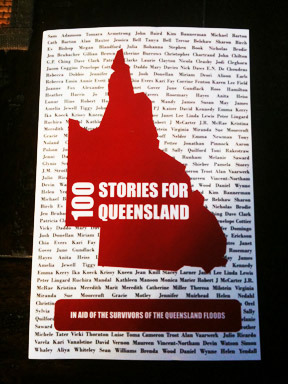
.
June 2, 2011
Yog-Blogsoth
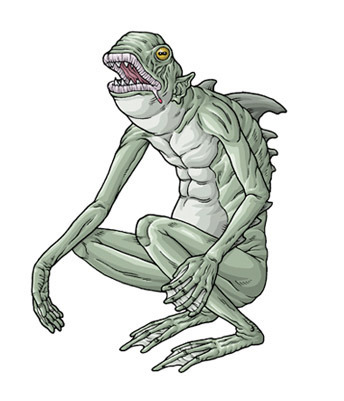
Yog-Blogsoth is a website well worth your time. Thanks to Michael for pointing me in the direction of this one.
From TheLovescraftMan.com:
Michael Bukowski is admittedly obsessed with H.P. Lovecraft and has spent the last year posting drawings of Lovecraft creatures on his blog Yog-Blogsoth. (Side note: Don't we Lovecraft bloggers come up with fun blog names?) His ultimate goal is "to draw EVERY creature he ever describes (sticking to Lovecraft only so far) from Elder Things and and The Great Race (who are described in immense detail) to Vooniths and Wamps (who are only mentioned).
Have a look. It's great!
.
Conquilt from Aussiecon 4 going up for auction
 At Worldcon last year, which was Aussiecon4, nearly 100 authors, illustrators, publishers and editors who were present signed a square of fabric. Each piece of fabric was worked into a quilt to celebrate the SF community. Click on the picture for a larger version. This is Conquilt.
Now, Conquilt is being auctioned on eBay as a fundraiser for the local Melbourne convention, Continuum. International bidders are encouraged and worldwide postage is available (at cost to the auction winner). The quilt will be on display at Continuum 7, 10th June to the 13th June 2011, and the auction will run on eBay from 10th June to 20th June.
My signature is on there, but don't let that put you off. Look at this list of amazing names:
Alan Baxter Alastair Reynolds Alisa Krasnostein Alison Croggon Amanda Pillar
Andrew J. McKiernan Angie Rega Bill Congreve Bob Eggleton
Carrie Vaughn Cat Sparks Catherynne M. Valente Charles Stross
China Mieville Chris Miles (an associate of H. I. Larry) Chuck McKenzie
Cory Doctorow Deborah Biancotti Delia Sherman Dirk Flinthart
Duncan Lay Fiona McIntosh Foz Meadows Gail Carriger
Garth Nix George Ivanoff George R. R. Martin Gillian Polack
Glenda Larke Grace Duggan Howard Tayler Ian Irvine Ian Nichols
Jane Routley Jason Nahrung Jay Lake Jean Johnson Jenner
Jennifer Fallon Jetse de Vries John Scalzi Jonathan Strahan Juliet Marillier
K. A. Bedford K. J. Taylor Kaaron Warren Kaja Foglio Karen Haber
Karen Healey Kate Elliot Kate Paulk Kathleen Jennings Keith Stevenson
Kim Stanley Robinson Kirstyn McDermott Kyla Ward Lara Morgan
Leanne Hall Lisa L. Hannett Lucy Sussex Marianne de Pierres
Mary Victoria Matthew Hughes Michael Pryor Michelle Marquardt
Narrelle M. Harris Nick Stathopoulos Nicole R. Murphy Paul Collins
Paul Cornell Paul Haines Peter M. Ball Peter V. Brett Phil Foglio
Richard Harland Rjurik Davidson Rob Shearman Robert Hood Robert Silverberg
Russell B. Farr Russell Blackford Russell Kirkpatrick Seanan McGuire
Shane Jiraya Cummings Shaun Tan Sue Bursztynski Tansy Rayner Roberts
Tehani Wessely Tracey O'Hara Trent Jamieson Trudi Canavan
I've randomly bolded a few of the bigger names to give you an idea.
Conquilt was assembled by Rachel Holkner and award-winning quilter Jeanette Holkner. It is based on the pattern 'Tribble Trouble' by Martha Thompson. It measures 152 cm x 192 cm with a 5cm diameter rod pocket on the back for easy display. More details here.
This strikes me as a fairly bizarre item, but certainly a unique one and something that is likely to become more valuable over time and a true collector's item. So get bidding!
.
May 31, 2011
ThrillerCast Episode 18 – getting noticed as a writer
 Episode18 of the podcast I host with David Wood is now up. In this episode we talk about what it takes to get noticed as a writer. We discuss short fiction as a means of promotion as well as a means of creativity in itself. We talk about the difference between having a large body of work and a large online presence. Whether one or the other is better and so on. Go and have a listen, share it with your friends and anyone else you think might like it and feel free to comment or email.
.
May 28, 2011
Slut is a powerful word
Cities across Australia and the world are meeting points today for thousands of people who plan to take part in a SlutWalk. There have been many walks already and many more are planned. The idea was born when one Canadian policeman said women needed to take responsibility in the prevention of sexual assaults by not dressing like sluts. The reaction was, understandably, outrage. The walks are, in essence, women reclaiming the word slut and marching for their rights to dress how they please and never be at risk of sexual assault, abuse and rape.
Gay people have done a great job in reclaiming the word queer. Black people have managed to make nigger a part of their own vocabulary while it's completely taboo for anyone else to say it. But they're just words. Words on their own have no power. It's how they're used and how they're directed that make them powerful. I just said nigger above – look, I did it again! – but it's simply a word, used to convey a point. Using it in description of someone is universally recognised as an abusive, racist act and that's wrong.
I've known girls that will greet each other with, "What's up, sluts?" and all laugh about it. But if I were to call any one of them a slut they would be justifiably outraged and offended. It's not the word that's the problem, it's the intent. It's the baggage that comes with the word. It's the sneakily "disguised" position held by the person using the word that has the power.
That Canadian policeman said to ten college students in April, "I've been told I'm not supposed to say this – however, women should avoid dressing like sluts in order not to be victimised." The guy is clearly a dickhead. Dressing "like a slut" doesn't make people sexually assault you, any more than heavy metal makes you suicidal or video games make you a mass murderer. People are already suicidal, homicidal or sexually sociopathic and any excuse will do. Women can dress however they like and should be able to do so without ever feeling at risk. They might attract some appreciative glances, but they should never be told they're attracting attack.
I don't know whether reclaiming the word slut is really going to work in the same way as queer or nigger or other reclamations have worked. But I do know this:
No woman should ever be the victim of sexual abuse or assault for any reason. There is never an excuse, whether it be alcohol/drugs made me do it, the way she dressed means she was asking for it, or the little voices in my head told me to. Any victimisation of anyone is wrong and only the fault of the attacker.
So walk with pride, and know that most men I know agree that a women is never a fair target of abuse or assault.
.
May 25, 2011
Emerging Writers' Festival 2011 TwitterFEST
The Emerging Writers' Festival is an independent arts organisation based in Melbourne's Wheeler Centre for Books, Writing and Ideas, that exists in order to promote the interests of emerging writers – to improve their opportunities for professional development as well as their engagement with the broader public. Each year the Emerging Writers' Festival brings writers, editors, publishers and literary performers together with the reading public for a festival that is fast becoming an essential part of Australia's literary calendar.
This year it's held from May 26th (that's tomorrow!) until June 5th, and there's loads going on. You can learn all about it and find out what's happening at the website: http://www.emergingwritersfestival.org.au/
But you don't have to be in Melbourne to get involved. There's an online component and I'll be part of that. The EWF this year includes TwitterFEST. From the site:
TwitterFEST is a series of festival discussions featuring… you! It's social media mixed with literary debate, so get those #ewf11 hashtags happening and get ready to bounce ideas off some of Australia's best writers and thinkers.
Follow @emergingwriters on Twitter, watch the #ewf11 hashtag and show up at 2pm each day to join in. I'm hosting the TwitterFEST on Wednesday, June 1st. Here are the TwitterFESTs in order:
Mon 30 May, 2pm – 3pm
Do you play? with Paul Callaghan (@paul_callaghan)
How important is experimentation and play to the creative process?
Tues 31 May, 2pm – 3pm
Writing vs Sport with Soph Langley (@sophlangley)
Can physical fitness play a role in our writing lives?
Wed 1 June, 2pm – 3pm
Can Genre Fiction Be Literary? with Alan Baxter (@alanbaxter)
Why is genre fiction so often spoken about separately from literary fiction?
Thursday 2 June, 2pm – 3pm
Writing about Place with PM Newton (@pmnewton)
How do you create a strong sense of place in your work – and do you need to visit somewhere to be
able to write about it?
Friday 3 June, 2pm – 3pm
Are we living in a post-publisher world? with If:Book Australia (@ifbookaus)
How is the role of publisher evolving since the digital revolution, and what does it mean for writers?
So get involved. Tell your friends, spread the word and let's get some lively debate happening. See you there!
.
May 23, 2011
Of readers and gatekeepers – a call to arms
Are you reading this? Then I'm talking to you. You're a reader and you have a new responsibility. I'm including myself in this. I'm a writer, but I'm a reader too. Any writer worth his or her salt should be a voracious reader, and we've got a new responsibility as well. We're all the New Gatekeepers. No, not extras in a Doctor Who episode, don't get over-excited.
There's so much talk about the changing face of publishing, and justifiably so. It's an exciting time and writing and publishing is going through a renaissance brought about by new technologies. That means there are options out there for pretty much everyone to get their writing out into the world, and a lot of people are taking up the opportunity. Some people are doing seriously well out of it, like Amanda Hocking. Others are doing rather less well, like the poor woman that immolated her career with one online review – you know who I mean. But one of the net results of this revolution in publishing is that readers have been saddled with a massive new responsibility.
Gatekeeping is important. In the good old days of the late 90s and early 2000s, and since forever before that, the gatekeepers were the publishers. Writers would approach publishers, either directly or through agents, and publishers would decide what was published and what wasn't. They essentially filtered what everyone got to read. The upside of this was, largely, the stuff that made it into print was generally well written and worth reading. Generally. We all know publishers are quite capable of turning out reams of utter shite too. But on the whole they ensured a general level of quality control. The downside, apart from the afore-mentioned shite, is that they also ensured that anything risky or unusual, something strangely cross-genre, something not immediately saleable, was unlikely to see the light of day. There were self-publishing and small press success stories, where the unlikely became massive, but those hits were very, very rare.
Now, with the advent of Print On Demand and ebook technology, publishers have found those gatekeeping responsibilities ripped away. Writers are still keen to be published by the big guys – there's a definite advantage to it, both in terms of credibility and distribution, hence readership. But literally millions of people are circumventing the publishers and self-publishing. Millions more are scoring smaller deals with small press. The volume of stuff out there is staggering. And a lot of it is complete shit.
Remember, the publishers themselves have turned out many stinkers over the years, but the strike rate for quality – in editing, formatting, production and so on, as well as writing ability – has generally been kept high even if the stories were rubbish. Not always, but often. Nowadays people think it's easy to write and be "published" and there's loads of stuff out there that really shouldn't see the light of day. Poorly written, poorly edited, poorly formatted – just poor. And that's where we as readers come in. This is why we are the New Gatekeepers.
Success in writing has always relied on word of mouth. When a big publisher puts the might of the marketing machine behind a new release that word of mouth gets a massive head start, but it's still the reviews and recommendations of critics and readers that determine whether a book is truly successful or not. That's still the case, but the mainstream reviewers can't keep up with the tsunami of words constantly bearing down on them. Along with all the newly published writers, a whole bunch of new reviewers have cropped up, and many book review blogs are developing considerable power. This is a very good thing, as it helps to strim out the crap and let the quality stuff rise to the top.
But you don't need a review blog to wield power in this new world. You're a reader – you have enormous power. If only you'd use it. By the Power of Yourskull! Or, more accruately, the brain within it. If you read something you like, tell people all about it. Recommend it to your friends, buy it and gift it to people. You can gift ebooks now as well as print books. There is no better result for a writer than a reader enjoying the book and recommending it. But don't stop there – there's so much more you can do, very easily.
You don't need to be a talented reviewer to review books. Amazon.com, Amazon.co.uk, Goodreads, Smashwords – all these places and more make it very easy for you to leave a review and rate a book. Or just rate it. Your review doesn't have to be anything lengthy to have an impact. For example, look at this review of my second novel, MageSign, that a reader called Joefredwheels left on Amazon.com (Yes, I'm going to use my own work as reference. Sue me.):
excellent follow up – great story continuing adventure of first book protaganist. hoping for more stories in this world. Baxter is an excellent writer of a fast past exciting plot. THIS IS WORTH THE MONEY. BUY THE BOOK
He also rated it five stars. Brilliant. It's very short, it's not worrying about being good writing in itself, it's simply conveying the person's enjoyment of the book. Sure, it's cool when readers take the time to write a few paragraphs of carefully thought out critique when they review, but the review above is just as valuable.
Here's another example, this time a review of RealmShift, left on Amazon by Cathy Russell "Ganymeder":
a well thought out tale – I liked that this story had believable characters and explored faith (or lack of), it's origins, etc. It had a lot of deep themes. The characters were well thought out. The plot was engaging, and I liked the whole idea of a superhuman who could kick the devil's ass. While reading this, I kept thinking it would make a great action movie or comic book too. I'd recommend this. 4 stars.
That wouldn't have taken long to write, but in a single paragraph she recommends the book and gives some basic reasons why. Again, brilliant.
I can't express how grateful I am when people take the time to do this. And it's something we can all do, for any publication, anywhere on the web.
I tend to review books I enjoy here on my blog, but I'm a regular blogger anyway. I always rate them on Goodreads. I'm also planning to copy my reviews over onto Amazon and Goodreads – I wish I'd done it as I wrote them, as now it's going to take a while and a concerted effort. But I'll do it, because I plan to put my reviews where my mouth is.
So we, as readers, are the new gatekeepers. It's our responsibility to help spread the word about the good stuff we read, and the bad. You don't have to leave negative reviews on anything – just don't review them. But it's an act of true benevolence to leave good reviews of stuff you enjoy, or drop by websites and leave a star rating. You can write a single line or single paragraph review and copy that to all the sites you visit or shop at. If you do blog, then reviewing a book on your site is fantastic. But whatever you do, do something. Help spread the word. As writers, nothing is more valuable to us than the recommendations of readers. It's always been that way, and now it's more true than ever. Readers can make sure the good stuff out there gets noticed and more writers get themselves a well-earned career. Power to the people!
.
May 22, 2011
2010 Aurealis Awards results
Last night I attended the Aurealis Awards presentation, held for the first time in Sydney. Now I'm very tired and recovering from a hangover, so this won't be a long post. It was great to catch up with so many friends again and celebrate the strength of speculative fiction in Australia. I'll post a list of the winners below.
I had an additional honour in that I got to receive an award on behalf of someone that couldn't be there. The Kris Hembury Encouragement Award this year went to Jodi Cleghorn, writer and publisher. You might recognise the name as I've blogged here a fair bit about 100 Stories For Queensland, that Jodi was instrumental in organising and publishing through her eMergent Publishing label. She also has a story of her own in Dead Red Heart, the anthology of Australian vampire stories from Ticonderoga Publications, which I've also blogged about as I have a story in there too. So I've been crossing paths a fair bit with Jodi over the last couple of years and it was my absolute pleasure to be able to receive the award on her behalf last night. She really deserved it. She didn't know anything about it, and came back from a camping trip this morning to a flood of congratulations that completely spun her out. That's what awards should be like!
The full winners list is as follows:
KRIS HEMBURY ENCOURAGEMENT AWARD: Jodie Cleghorn
PETER MCNAMARA CONVENORS' AWARD: Helen Merrick
BEST SCIENCE FICTION NOVEL: Transformation Space by Marianne de Pierres
BEST SCIENCE FICTION SHORT STORY: "The Heart of a Mouse" by K.J. Bishop
BEST FANTASY NOVEL: Power and Majesty by Tansy Rayner Roberts
BEST FANTASY SHORT STORY [TIE]: "The February Dragon" by L.L. Hannett & Angela Slatter and "Yowie" by Thoraiya Dyer
BEST HORROR NOVEL: Madigan Mine by Kirstyn McDermott
BEST HORROR SHORT STORY: "The Fear" by Richard Harland
BEST ANTHOLOGY: Wings of Fire, Edited by Jonathan Strahan and Marianne S. Jablon
BEST COLLECTION: The Girl With No Hands by Angela Slatter
BEST ILLUSTRATED BOOK/GRAPHIC NOVEL: Changing Ways: Book 1 by Justin Randall
BEST YOUNG ADULT NOVEL: Guardian of the Dead by Karen Healey
BEST YOUNG ADULT SHORT STORY: "A Thousand Flowers" by Margo Lanagan
BEST CHILDREN'S FICTION(told primarily through pictures): The Boy and the Toy, Sonya Hartnett (writer) & Lucia Masciullo (illustrator)
BEST CHILDREN'S FICTION (told primarily through words): The Keepers, Lian Tanner
You can find out more about the awards and a full list of this year's nominees at the Aurealis Awards site. Congratulations to all the nominees and winners.
.


