
Alan Baxter's Blog, page 82
June 27, 2011
ThrillerCast Episode 20 – Books You Want to Be Buried With
 In this episode, we talk about which books are so important that you can't even die without them, let alone live without them.
Many people gave us their answer and we have a chat about several of the selections, so have a listen and see who says what. Some pretty interesting answers crop up. Plus, we have one special guest who rings in on the subject- Justin Macumber, one of the hosts of the Dead Robots Society Podcast!
We won't list the other guests or books here, so not much in the way of show notes for this one, but we do end up discussing a broad range of awesome books, some in detail. Enjoy!
.


June 24, 2011
Game changer – J K Rowling, Pottermore and ebooks without a publisher
The internet has been abuzz lately since mega-billionaire-super-author, J K Rowling (of Harry Potter fame, in case you've been a monk in a cave for more than ten years) announced Pottermore. In a nutshell, it goes like this:
After seven books and eight films and more merchandising than you can fit in George Lucas's ego, Rowling has now announced a website which will be a complete interactive experience for all ages based on her stories. Along with that she's announced that for the first time ebook editions of the Harry Potter series will be made available. Well, legal ebook editions that is. Rowling truly is the master at monetising her ideas and characters, having turned some books about wizards at school into an international behemoth across all media.
With Pottermore, as the press release says:
For this groundbreaking collaborative project, J.K. Rowling has written extensive new material about the characters, places and objects in the much-loved stories, which will inform, inspire and entertain readers as they journey through the storylines of the books. Pottermore will later incorporate an online shop where people can purchase exclusively the long-awaited Harry Potter eBooks, in partnership with J K Rowling's publishers worldwide, and is ultimately intended to become an online reading experience, extending the relevance of Harry Potter to new generations of readers, while still appealing to existing fans.
It's a pretty inspired concept. Of course, Rowling with her riches and business partners is the kind of author with the kind of clout you'd need to make something like this happen.
The real game changer among all this, however, despite the partnership comment above, is that the ebooks will be essentially self-published. Her publishers, Bloomsbury, Scholastic, etc., don't own the eletronic rights – and I bet they're really happy about that. So Rowling is planning to make the ebooks available directly through Pottmore. Of course, when Rowling self-publishes, she's has a team of people behind her and her own company on the case, so it's not like she sits there on her own and uploads files to Amazon. But the key here is the lack of a third-party publisher.
The Kindle will accept epub format ebooks soon and the announcement that the Harry Potter ebooks will be available from October seems to fit in with that, so it's likely the books will be in epub. That certainly does seem to be the prominent format and, aside from Amazon's mobi format, has been the industry leader all along. Once the Kindle accepts epub too, we have the first stage of industry standardisation and that's a good thing for all of us. Perhaps we have Rowling to thank in part for forcing that change – who knows who talked to who while this was getting off the ground.
Authors leveraging their existing print success to manage their own ebook releases is nothing new – just see J A Konrath's example for one. But nothing on this scale has happened before and we can see things shifting a little more on the axis. I've said it before – we're living in exciting times in writing and publishing and the ride ain't over yet. I wonder how many kids will get an ereader with a set of Harry Potter books on board for Xmas this year? This will be a big step in mainstreaming ereaders, which are becoming more and more mainstream anyway. On a recent flight to Melbourne I noticed several people reading from Kindles and Sony Readers while waiting for my plane.
The kind of cross-media storytelling and promotion which Pottermore represents is certainly not new, but we've seen nothing on this scale before. Just the official announcement video is better than any book trailer a lowly author like myself could hope for. I wonder where we go from here?
Here's the official release video from Rowling herself:
And here's the Pottermore site.
Interesting times indeed. What do you think? Is this a good thing or not? Where do things go from here?
.
June 22, 2011
So you don't understand Twitter?
I really love Twitter and find it one of the most useful social networks I use. But I regularly get people saying to me things like, "What's the point of Twitter? I think it's stupid. I don't get it." And therein lie two different things. Asking what it is and saying you don't understand it is like saying, "What's the point of French? I don't understand it." Well, if you learned French, you'd understand it and find it really useful. Especially in France. So I always try to explain what Twitter is, as that seems to be the best starting point. And that's not as easy as it sounds.
Half the trouble when new people come to Twitter is figuring out what it really does. And when people like me, absolute Twitter converts, have trouble explaining it, you can see why a lot of people give up on the whole idea. So I was driven to figure out a decent, clear, concise description. Here it is:
So what is Twitter?
Over time, with a bit of effort, Twitter becomes a self-curated news feed of information, gossip and conversation that you're personally interested in, with all the noise you don't care about filtered out.
If people are still interested after that, we can spend a bit more time explaining it. Notice that I open with, "Over time, with a bit of effort". This is a fundamental point. You can't just go to Twitter, look at the thing and expect to understand it and benefit in any way. It doesn't take much time and effort to get started, but it takes some.
You start by setting up an account. Once you have an account I highly recommend a third party Twitter application. I use Tweetdeck, because I can sort my feed into columns and keep much better track of things that way. Using Twitter directly from the Twitter site is messy. Also, I have Tweetdeck for iPhone, so I can tweet and read tweets wherever I am. Once you have an account, you must fill in your bio and pic, then you can start to tweet things, but we'll get to that in a minute.
Getting the most out of Twitter is all about following the right people. Whenever someone you follow posts a tweet, it will appear in your news feed. So don't follow people who don't interest you – only follow people who you think might say stuff you care about. Initially you can do a few searches with keywords. For example, you can search for things like:
author
writing
science fiction
dark fantasy
horror
martial arts
kung fu
motorcycles
dogs
The list above is an example of the kind of things I'm most interested in. Those are the sort of searches I started with. When people cropped up with those things mentioned in their tweets or their bio, I followed them. If they tweeted interesting things I would reply to them, maybe retweet them to share what I found interesting with people who follow me. If they were boring or inactive, or just on a hard sell, I'd stop following them.
Once you're following a few people you'll start to see who they follow. It's a fair bet you'll all have shared areas of interest, so follow some of their friends. The hashtag #ff or #followfriday is useful for this. It's when people list all the people they follow who they think their followers might enjoy. So check out some of those people too.
You see how this is taking a bit of time and effort? It doesn't have to be much. You can have a search and follow a handful of new people a day. Before long you'll start to have a very busy news feed. And a lot of those people will start to follow you back. You'll start to interact with them and away you go.
What do I post?
So, let's get to what you post. First, you absolutely must fill in your bio and add a picture. Twitter is all about interaction and sharing, so you have to tell people something to help them decide if they're interested in you. Here's my Twitter bio:
Alan is an author from NSW, Australia. He writes dark fantasy, sci-fi & horror, rides a motorcycle and loves his dog. He also teaches Kung Fu.
It's concise, as it has to be in the restricted world of Twitter, but says plenty about me. It says what I do, what I like and where I'm from. That's enough to start with. After that, people will read my tweets and continue to follow if I interest them. So what do I tweet? Everything!
I tweet interesting or funny things that happen to me or that I notice.
I tweet about writing projects, progress on them, ups and downs of publishing.
I tweet about my dog and cats and regularly tweet photos.
That's all the chit chat stuff. I also share all the links that I find interesting. And here lies the real power of Twitter. On the one hand I interact with people and have a chat and a laugh. On the other, I share information I find interesting. I also find stuff that the people I follow post. If I really like it, I'll retweet it and share it around some more. Interesting blog posts, news articles, submission calls, new releases, movie reviews – you name it, if it's interesting, I'll post the link. That way my followers can see the tweet, which might say something like: Great review of the new X-Men movie
, and they can choose to go and read that review or not. If you spend a bit of time reading the tweets of others you'll soon get the idea.
This is where it becomes a self-curated news feed. I only follow people who interest me, so they're likely to post links I'm interested in. In the reverse, my followers are likely to be interested in the links I post. There are Twitter users posting links to pony club announcements and Barbie Doll parties (whatever the hell they might be), but I don't know about it because I don't follow those people. The folks interested in ponies and Barbie Dolls follow them. See how it works?
I get most of my news from Twitter now, as I follow the BBC, ABC, Reuters and a few others. They post headlines and links and I'll read the stories that catch my eye. If people's tweets start to bore me, I'll stop following them. I'm always following new people who strike me as interesting. And you have to accept that most of what happens on Twitter you'll miss. Just get used to only seeing the tweets that happen to go by while you're actually checking Twitter and let the rest slide. All the really good stuff comes around again in retweets anyway.
Finally, here's a few things not to do:
Don't just promote yourself – I'll often talk about my writing and occasionally promote it and ask people to buy my books in one way or another, but very infrequently. I want at least 10 tweets about other stuff to every 1 tweet about myself, and a much bigger ratio when it comes to actually pushing my stuff. It's not about selling yourself – it's about being yourself. If you're interesting, people will check out what you do.
Don't just vomit minutiae constantly – If you have a really good breakfast, sure, tell us about it. But we don't care about what you have every day.
Don't spam people – Just chill and interact, all casual-like.
Here's a golden Twitter rule:
Will this tweet entertain or inform my followers in any way?
Ask yourself that question before every tweet and don't post if the answer is no. Of course, a lot of people are pretty poor at judging that stuff and think they're a lot more interesting than they really are, but we'll let natural filtration take care of them.
Here I am – follow me if you think I'm interesting: @AlanBaxter
What about you? Do you tweet? Feel free to offer your tweeting advice in the comments.
.
ThrillerCast episode 19 – Reading & Writing
The latest episode of ThrillerCast is now available. In this episode we talk about our Parsec Award nominations, fiction podcasts, I review The Intruders by Michael Marshall, David reviews C J West's The End Of Marking Time, then we go on to discuss the importance of reading for a writer and what kind of influence our reading has on our writing. It's thirty minutes of interesting stuff, so go get it now and have a listen. As ever, we're happy to get feedback – you can comment on the ThrillerCast blog or email us. If you want to join in on the podcast and review a good book you've read, drop us a line.
All the details and episodes can be found here: http://thrillerpodcast.blogspot.com/
.
June 19, 2011
X-Men: First Class – review
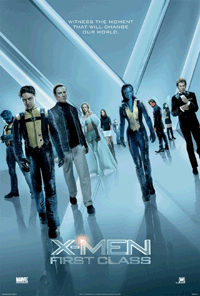 I've been getting a bit tired of the X-Men movie franchise. You may remember how disappointed I was with the Wolverine movie. So I went into this one with some trepidation, but also a secret hope that it would be good. After all, it's directed by Matthew Vaughn, who previously directed Layer Cake, Stardust and Kick-Ass, so we have good reason to expect quality from him. And I wasn't disappointed. X-Men: First Class was absolutely brilliant.
It's a genesis story and tells us how the whole X-Men thing began. In essence, it's really a Magneto story, focussing more on what made Erik Lehnsherr into Magneto than anything else, but it manages to be so much more than that. It touches on how the mutants are the children of the nuclear age and not an aberration but the evolution of humanity, thereby setting the stage for the stand-off between humans and mutants that we've seen in the other films.
Charles Xavier, excellently played by James McAvoy, discovers Raven (Mystique), played by Jennifer Lawrence, when they're children. They realise they're not alone in their weirdness and thus begins Xavier's interest in genetics which leads him to become a professor. He's a genius and a telepath and, through a few connections with the CIA, begins to gather other mutants together. He shows them they're not alone and gives them a safe place and a purpose. I'm deliberately skipping a MASSIVE chunk of the story here, as it's far better experienced through the film.
Alongside this story we see Erik Lehnsherr, forced through horrible methods by Kevin Bacon's Sebastian Shaw, to embrace his own mutant powers, and there the seed of his genesis is planted. It turns out that Shaw is up to no good in a massive way and is trying to trigger a nuclear war. In this way the film manages to weave the plot of the mutants into the real world history of the Cuban missile crisis and it does a superb job of that. If you're a serious history buff you might have trouble with some of the liberties taken with events surrounding the Cuban missile crisis. To this I would point out that there aren't really mutant people with incredible super powers, so if you can suspend that disbelief and accept a young man who flies by screaming at the ground, you can let a bit of alternate history go.
The film is set in 1962 and the faith to the era and environment is really well done. The performances are top notch. I've already mentioned that James McAvoy was excellent as Xavier. Other stand-outs are Jennifer Lawrence as Mystique and Nicholas Hoult as Hank McCoy/Beast. Kevin Bacon is excellent as Shaw and creates in that character a very convincing bad guy. But the entire film is stolen by Michael Fassbender as Erik Lehnsherr/Magneto. His performance is true brilliance.
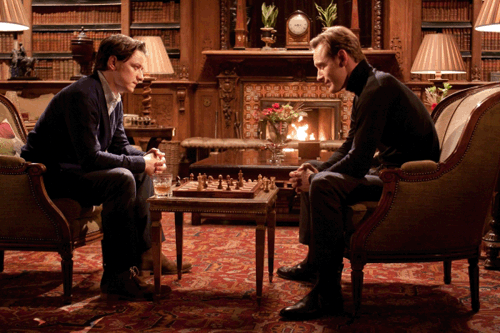
The film largely focusses on Magneto's genesis, and an integral part of that is the friendship between Xavier and Lehnsherr and how that grows and then fractures. The film does a great job of exploring that dynamic. Some of the best scenes in the film are conversations between Xavier and Magneto, which is some going for an action flick.
The political backdrop of the missile crisis provides an excellent crucible for the bigger issues explored by this film. Always the X-Men have been about accepting difference and this film is no exception. This is particularly well explored with the relationship between Mystique and Beast, with her spending all her time trying to conceal her true appearance, while he does all he can to cure his. Eventually, of course, they face the truth of who they are and make decisions based on those realisations. The film manages to get its messages across in entertaining ways, with plenty of humour thrown in and some stellar action sequences. Also, talking of humour, there's a blink-and-you'll-miss-it cameo in this one that will have fans nerdgasming all over the place. It's hilarious and brilliant. You'll know it when you see it.
So there's new life in the X-Men franchise and this is perhaps the best X-Men film yet. Well worth your time and money. I already want to see it again.
.
Real world inspiration for fantasy and horror
They say a picture says a thousand words. Which is annoying, but largely true. After all, it really depends on the picture, as some would struggle to say a sentence and others could illustrate a novel. But I digress. No great analogy stands up to close criticism. I saw some pictures today that simply blew me away and made me realise that when we're writing genre fiction, trying to create incredible "other" worlds or horrific scenarios, it doesn't all have to come from our imaginations. There is so much wonder in this world that we have enormous reserves of the fantastic all around us to draw on.
Below are some examples of something truly magnificent and truly terrifying. Here's a writing exercise for you – Try to get this image convincingly conveyed in words.

(Click the images for a bigger version)
Isn't that just incredible? That's lightning striking above the explosion of the Puyehue-Cordon Caulle volcano in south-central Chile, about 500 miles south of Santiago. According to the Mail Online, "A three-mile long fissure has opened up in the Andes as toxic gases and ash belched a cloud more than six miles high across Chile and Argentina."
Here are a couple more pictures:


The ash cloud can be clearly seen from space and is having a massive impact in the surrounding area. Check out the apocalyptic beauty of this picture of a rose covered with volcanic ash in the Patagonian city of San Martin de los Andes, Argentina:

You want inspiration for your apocalyptic fiction? Here's some imagery to get your brain working:


I've been staring in wonder at these pictures for ages this morning. This kind of activity is part of the reason that we exist on this planet, and when the Earth decides to cough this stuff up, there's absolutely nothing we can do about it. Not a fucking thing. We are specks on the face of nature and that fills me with awe.
Go to this article at the Mail Online to read more about the explosions and see more photos, including shots of the ash plume from space.
.
June 16, 2011
Other authors are not your enemy
I was talking recently about how important it is these days for readers to review and talk about the books they like in order to help the authors of those books have a career. I also mugged myself with an idea about making a list of all the Aussie authors who tweet. That turned out to be way more work than I thought it would, but I'm glad I did it. And I've been surprised by a few comments here and there from people that basically boil down to, "Why do you do so much to promote other authors? Aren't they your competition?"
Which is a bizarre position to take. I've always thought of other authors as partners, not competitors. We're all partners in this big old mess of writing and publishing. We all need to work together to keep the publishing world alive and fresh. Readers are voracious animals – they subsist on stories and get really ornery if the stories run thin. It's not as if my promoting another author is going to result in the loss of a sale for me. Can you imagine ever reading something on my site and thinking, "Hmm, well I was going to buy RealmShift, but Alan's convinced me I should buy this other book by this other author instead"? If anything, a reader is more likely to think, "Excellent, I'll buy RealmShift and then I'll go and track down this other book that Alan thinks is worth reading."
Of course, that assumes said reader holds my opinion in any esteem, which is unlikely, but the principle of the argument is sound. Readers love books. Duh.
I wouldn't have a fraction of the tiny career I do have without other writers. The spec fic community in Australia is particularly friendly, but in my experience writers in general are very supportive of each other. Of course, there are the dicks who think they deserve the career they have and no one else is worthy. But you get elitist fuckknuckles in every walk of life and they're usually the scared and insecure people, terrified of being exposed as having something they don't deserve. Which is rubbish, because they deserve everything they've worked for, and so do the rest of us.
Other writers have been incredibly supportive of me, from when I was first starting out, wandering around an SF convention like a startled rabbit, wondering just how the hell I was supposed to find my way in this bizarre world. I've subsequently done all I can to embrace and encourage other emerging writers and help them to get a start in any way I can. Hell, I'm still an emerging writer myself! I don't have any great career upon which to rest my laurels. I'm paying it forward and back and intend to continue doing so until I'm bigger than Gaiman. Which I will be, of course. Aim for the stars and all that – if I don't dream big, how can I ever expect to succeed at all? And regardless of how successful I may or may not get, I'll still keep doing what I'm doing, and talk about the other writers out there who I believe in. I don't want to ever look down from my own success on other writers, or ever think that other writers are in any way my enemy.
So don't think of other authors as your competition if you're a writer. If you're a reader, don't think you need to be faithful to a particular handful of authors – you're doing no harm by promoting everything you like. There's loads to go around and we all need all the help we can get, so it's only reasonable that we help each other too.
.
June 13, 2011
Nekropolis by Tim Waggoner – review
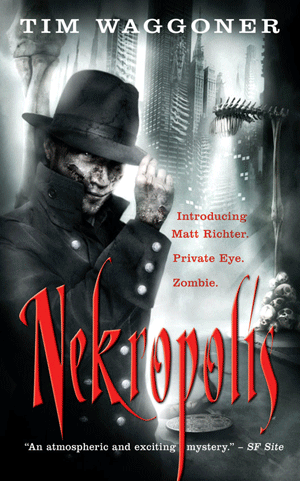 Two reviews in two days? You can tell it's a long weekend. Yesterday was the new Pirates Of The Caribbean movie, On Stranger Tides. This time it's a novel, Nekropolis, by Tim Waggoner. I'd heard rumblings here and there about this book and it kept cropping up in People Who Bought This Book Also Bought lists, so I thought I'd finally give it a go.
It's the story of Matt Richter, a dead ex-policeman. He's now a zombie and in serious danger of rotting away to nothing. He lives in Nekropolis, the city of the Darkfolk. The basic idea behind the location is that all the vampires, lycanthropes and other monsters got sick and tired of being persecuted by humans, so the most powerful among them created a city in a paralell dimension. It's the shape of a pentagram, Father Dis manages the whole thing while five Darklords are each responsible for one section. Imagine a pentagram and you'll get the idea. Each section has a different vibe based on its darklord – lycanthropes in one section, death in another, and so on. The idea that the darkfolk left as they were sick of persecution is a bit rich – after all, they're persecuted because they eat people – but that aside, it's a cool way to have a paralell world of creepiness and weirditude while still being able to reference Earth. Matt Richter is an Earth cop who went to Nekropolis on the trail of a murderer. While there he was killed, zombified and he's stayed there ever since, being a kind of private detective for the dark and undead population. In this book he's drafted in by half-human, half-vampire Devona to help her out. She guards the collection of magical artefacts collected by Lord Galm, her father and one of the five Darklords. One particular artefact has gone missing and she needs to find it before Galm discovers it's gone and shit hits the fan.
So we have a classic noir detective thriller, with a pretty girl, a missing thing and various nefarious subplots, but it's all wrapped up in the gloriously weird environment of Nekropolis.
Waggoner does a great job building the world and feeding us information about how it works and how it came to be. We learn more about Matt Richter and how he came to be the way he is. Nekropolis really is a richly detailed and populated setting. It reminded me of a Tim Burton film, especially as there's a distinct thread of humour throughout. It could easily have been all very dark and horrifying, but Waggoner treats the denizens of Nekropolis like the population of anywhere else and draws a fair amount of black comedy from the conceit. I couldn't help seeing the place as a Tim Burton/Henry Selick type production, all in stop motion animation like The Nightmare Before Christmas. In some places the author tries almost too hard to make things as weird as possible, but on the whole it all works very well.
The plot itself is something of a story by numbers – you can see from the setup how the thing will play out in the big picture and there's the expected movement of the characters through all the major areas of Nekropolis that have been alluded to. There are standard set pieces and even at one point a bad guy giving the whole monologue while the good guys engineer their escape thing, which was a bit of a shame. But on the whole the story was a good noir detective yarn and I didn't pick the details of how it all worked out. I kept reading and I wanted to know what happened. There were enough surprises and twists along the way too, which drew away from the somewhat formulaic plot, and the setting was often distraction enough.
In places I found the writing a little bit too explanatory. We really didn't need reminding that Matt was a zombie, therefore dead, every single time he alluded to any kind of emotion or physical sensation, for example. It got really tiresome. But those kind of writing related niggles were very superficial and on the whole the book read very easily and carried me along just as good fiction should. But that brings me to the editing. I know this isn't the fault of the author, or a problem with the story, but the editing in this one was atrocious.
I've read a lot of indie and self-published work and one of the things the indie crowd are always going on about is quality editing. When a book is full of typos and stuff, it devalues the whole experience and also makes it stand out from trad published work. But this is not a self-published book. This is from Angry Robot, a publisher that I have enormous respect for and love the stuff they publish. Hell, I'd love to be published by Angry Robot! But the editor on this job needs to seriously improve his game.
Let me give you some examples of what I'm getting at. There were loads, and I mean LOADS, of missed words. There were numerous examples of misspelled words, things like -ed missing off the end of words that should have been past tense, things like "nearly" when the word should have been "nearby" and so on. In one scene, that was only a few pages long, one incidental character had his name spelled three different ways in two pages! There are always typos in books – I know that my novel, RealmShift, has a bad typo on the second page (taught instead of taut – GAH!) and we accept that it's going to happen. But this book was riddled with them. And then there were editing errors like one scene where a lamb became a goat with no explanation and stuff like that. I would normally look past this stuff – I've been an editor as well as a writer and I know how hard it is to get everything, even when you have a whole team of people on board. There will always be typos. But this one went a bit beyond the pale. Incidentally, I read the Kindle edition, but that shouldn't matter – the source file should be the same for all editions.
But let's move on. Nekropolis is a clever and entertaining noir mystery, set in a truly imaginative world that kept me entertained from start to finish. It's not a world-breaking novel, but it's darn good fun and I enjoyed it a lot. 3 Stars.
.
June 12, 2011
Pirates Of The Caribbean: On Stranger Tides – Review
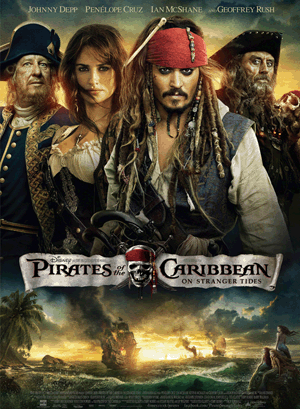 I went into this movie with very low expectations and I have to admit that I was pleasantly surprised. The basic premise for all these movies is fairly bulletproof. You've got your standard mythological pirate, the original lovable rogue, sailing the high seas, carousing and pillaging, but always with a heart of gold and only really killing the bad guys. Which is bollocks, of course, but all tremendous fun. Then you wind that in with a decent supernatural story, a few good chase scenes and some shit blowing up, and populate the movie with actors guaranteed to draw a crowd. Win.
But the Pirates movies have suffered something in the way of diminishing returns with each new release. The first one was excellent and the next two, while good fun, very clever with their special effects and excellent fantasy escapism, didn't really hit that high again. This installent, however, did. I don't necessarily want to suggest it's the best of the lot, as a several people I know have said, but it's definitely a return to form.
Essentially, Captain Jack Sparrow meets up with an old lover, Angelica, played by Penelope Cruz, and she has a plan to find the Fountain Of Youth. There's a Spanish fleet also looking for it, and King George has got Captain Barbossa to turn over an honest leaf and captain a ship to find the Fountain for Britain. Turns out that Angelica is actually on board ship with Blackbeard, the pirate that even pirates fear, and the whole thing gets very complicated. But therein lies one of the strengths of the film. The plot is complex and characters have agendas other than those we initially believe and so on. It's not so complicated that we can't keep up, but it's not simplistic either. It's a good, convoluted story, and you all know how I appreciate some good storytelling. There are some issues that crop up. A few times there are characters who do things completely out of character, or purely for convenience. There are some twists that don't really make sense and are obviously there to shoe horn the next twist or create a set piece that's expected in the franchise. But these are all small niggles in an otherwise good yarn.
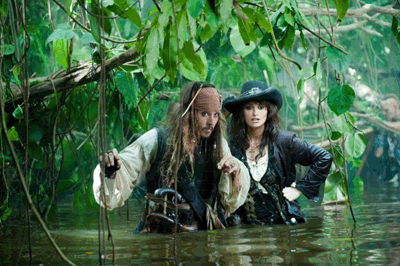 The performances are excellent as always, especially Ian McShane as Blackbeard. And, on a side note, I want Blackbeard's coat. I mean, I really want it. If you're reading this and you know how to get it, I want to know! Geoffrey Rush is excellent as always playing Barbossa, Cruz is good as Angelica, Depp is perfect as Captain Jack Sparrow and Keith Richards has a brief cameo return as Jack's dad.
The story comes from Tim Powers' 1987 novel, On Stranger Tides, with the Pirates Of The Caribbean characters woven in. There are zombies, though they are a bit unexplained in the film, other than being the voodoo kind, and turned that way because they obey better and Blackbeard likes his crew to be easily controlled. There are mermaids, and part of the problem the characters face is getting a mermaid's tear to make use of the Fountain Of Youth. This led to the best scene in the film for me – Sparrow, Blackbeard, et al travel to Whitecap Bay, famous for being the kind of place from which people never return. This is where they'll find mermaids and they set a longboat of crew out as bait, with a spotlight from land lighting the water, to attract the mermaids. The mermaids themselves are the nasty siren kind, that start off all lovely and desirable, then grab you and eat your face off. Which is, of course, the best kind of mermaid. The scene with the sailors in the long boat as bait and the first appearance of the mermaids is a proper creepy bit of film-making and I thoroughly enjoyed it.
To be honest, I thoroughly enjoyed the whole film. The required Jack Sparrow escape scene at the start was contrived and not very well done, some of the plot was a bit too convenient, some people did mystifying things, but on the whole it was a clever and creepy yarn, well told and well played, with the expected level of special effects eye candy. And a nice line in drumming as part of the score, which I noticed on a few occaions. If you like your pirates and your supernatural adventures, you'll like this.
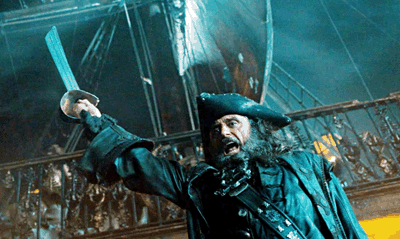
Seriously, I want this coat. Badly. Get it for me.
.
June 11, 2011
2011 Chronos Awards winners
The Chronos Awards for 2011 (the regional SF awards from the state of Victoria, Australia) were announced at Continuum 7 in Melbourne last night:
Best Long Fiction: Madigan Mine, Kirstyn McDermott (Pan MacMillan Australia)
Best Short Fiction: "Her Gallant Needs", Paul Haines (Sprawl,Twelfth Planet Press)
Best Artwork: Australis Imaginarium cover, Shaun Tan (FableCroft Publishing)
Best Fan Writer: Alexandra Pierce
Best Fan Written Work: "Review: The Secret Feminist Cabal by Helen Merrick", Alexandra Pierce
Best Fan Artwork: Continuum 6 Props, Rachel Holkner
Best Fan Publication: Live Boxcutters Doctor Who at AussieCon IV, Josh Kinal and John Richards
Best Achievement: Programming: AussieCon IV, Sue Ann Barber and Grant Watson
Congrats to all the winners and nominees.
.


