
Jane Brocket's Blog, page 63
January 28, 2011
i bake
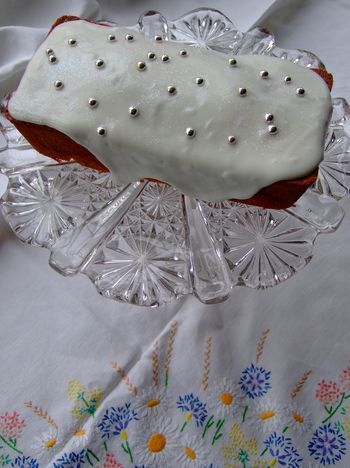
For the fun of squeezing a lemon in my hand, then picking out the pips from the icing.
For the twinkly effect of iridescent glitter and silver balls on a lemon cake, then picking off the balls before eating (to preserve teeth).
For the pleasure of using the same old pressed-glass cake-stand to make a Thurday cake look posh.
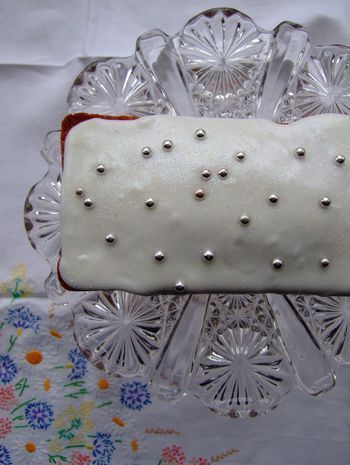
For my friend who makes me laugh, encourages my vintage tablecloth habit, and never says no to a slice of cake.
For the excuse of spending time in a warm kitchen when I should be working in a draughty study.
For the smell of vanilla extract which I am tempted to wear as perfume and dab behind my ears.
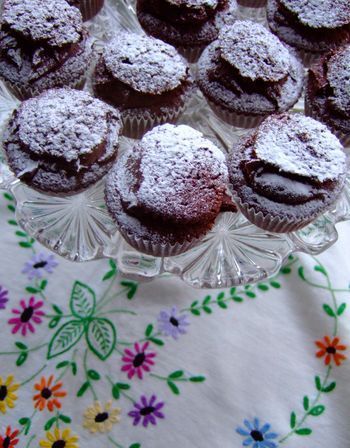
For the delight of seeing Tom's delight when I make his favourite chocolate buns as surprise. And the greater delight when I give him a bowl of leftover chocolate butter icing to supplement the already generous filling.
For the pretty patterns you can make on a work surface when you sift icing sugar over cakes on a cake rack (but not for the stickness that remains left even after wiping).
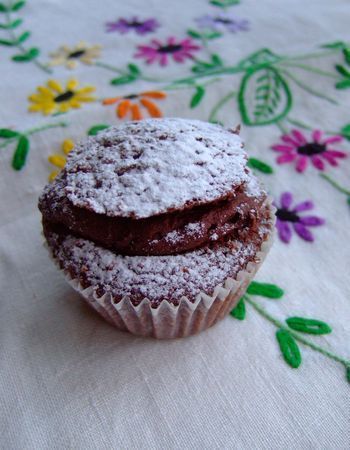
For the chance to scrape the bowl and eat the mixture.
For the happy memories.
But most of all I bake for the pleasure of eating cake.


January 25, 2011
exquisite
'Exquisite' is a word I associate with the likes of Meissen porcelain, Fabergé eggs, eighteenth century paper silhouettes, Wedgwood cameos, Thomas Bewick woodcuts, petit point purses, and the details in the paintings by the Pre-Raphaelite Brotherhood. In other words, pretty unattainable stuff that reveals an attention to detail that I find hard to believe is humanly possible. Despite all this, at the moment I have something truly exquisite in the house.
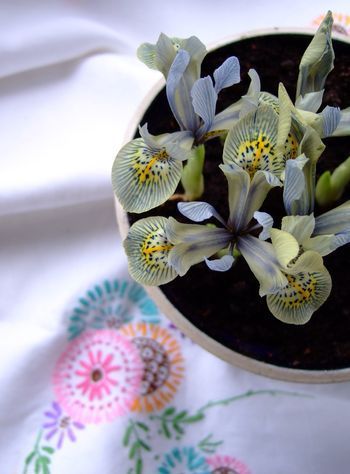
I've grown the tiny reticulata iris in the garden for years. The sad fact is, though, that they are so small and flower at such a bitterly cold time of year (Jan/Feb) that I barely get to see them properly as they require me to crouch down in a cold wind and stay there while I admire them. But last autumn I remembered that I'd read in a column by the late Elspeth Thompson that it was possible to grow these iris indoors. So in November I filled a couple of pots with iris reticulata 'Katharine Hodgkin', one of my favourite iris which I'd previously only ever seen outside. (This particular iris is not cheap; another reason for planting just a few where I could appreciate them). Then I left them in the garage and forgot about them until last week when I saw that they were growing nicely but were very pale and in dire need of sunlight. So I brought them inside and, a few days later, this is what I have:
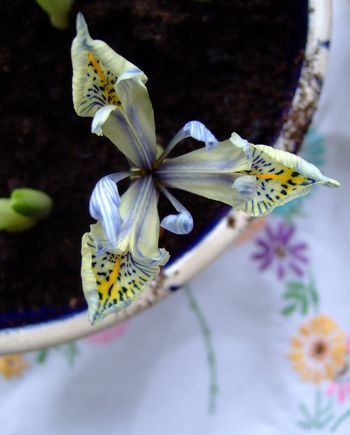
Two bowls of exquisite iris, small and and beautifully formed, with delicate markings and a most unusual mix of saffron yellow, violet shadows and indigo spots on a greenish-blue background. It's the kind of flower that requires a Collins or a Millais to do it justice. But if I can't paint them, at least I can enjoy them in a place where I can get as close as I like for as long as I like, and all the while staying warm.
[Iris bulbs from here.]
January 21, 2011
what's not to like?
I watched Toast when it was on at Christmas and although I relished the sets, vintage props and magnificent food, I didn't relish some of the dialogue. As with many current dramas set in an earlier decade, there are some horribly anachronistic turns of phrase (Downton Abbey has quite a few and even Mad Men does not manage to excise them all). The worst in Toast was 'what's not to like?', something that was never said in the sixties, and even now sounds wrong. But it got me thinking about what's not to like this week (even when I type it I stop to consider the clunking awfulness of the phrase) so here we are, my answer to the question:
:: The King's Speech. It's marvellous, utterly absorbing and has many meesmeringly good performances. There are also some quite amazing wallpapers,windows, and beautifully composed shots. (The thing that may not be to like about it is summed up here.)
:: Helena Bonham Carter. She is fantastically vulgar in Toast and fantastically regal in The King's Speech. Absolutely nothing not to like about her. And she has a craft room at home which makes her a real star in my eyes.
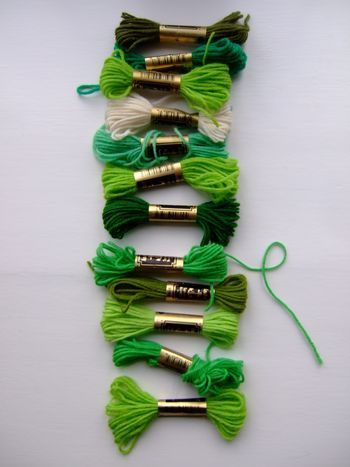
:: Working with green. Shades of emerald, chatreuse, lime, moss, leaf and grass, all looking fresh and clean and bright.
:: Emerging greenness in the garden. There are a few green tips of tulips, narcissi and iris appearing in the bare earth. Very exciting.
:: Blogs with garden-related titles. I don't read masses of blogs, but I do like Charlotte's Plot which is always down to earth (ha ha), thoughtful and interesting. And The Quince Tree, which is energetic, wry and multi-faceted. Charlotte and Sue are worth visiting.
:: Radio. Ed Reardon, the consummate curmudgeon, is back and is so grumpy and penny-pinching it's laugh out loud stuff. LOL. (Seriously nothing to like about that abbreviation.)
:: A Crisis of Brilliance by David Haycock. Although I've read biographies and books about many of the artists and personalities who appear in this book (eg Stanley Spencer, Carrington, Christopher Wood, Roger Fry, Mark Gertler, Augustus John), I find there's still plenty more to be said about them. David Haycock writes clearly, fluently and engagingly about a highly influential and often quite unbalanced group of artists. And there is always something to like when the defiantly odd Stanley Spencer is around, and he emerges from these pages as, yet again, quite unique.
:: The weekend. There's not much not to like about it.
And now I need never write or say those words again.
January 17, 2011
a matter of taste
I've just been reading the chapter on the nineteenth century in an erudite and well respected history of embroidery. It presents a very clear hierarchy of value of the different types of stitching, something that does nothing to endear me to the author. However, the fact that he is so sniffy about and dismissive of Berlin wool work has rekindled my interest in what I think is an amazingly interesting and eye-catching stitching phenomenon.
I suppose I have what passes for very dubious taste when it comes to the Victorians. I love the excesses of Charles Dickens, theatrical extravaganza and pantomime, Gothic architecture and polychromatic brickwork, chocolate-box style paintings and blowsily colourful Berlin wool work. For my MA thesis (Victorian Art & Literature, or Old Paintings & Books as Simon would say), I did consider writing about needlework in mid-Victorian art and/or literature (eg the ladies in Cranford enjoy stitching Queen Adelaide's face on a canvas) but found it to be such an enormous subject that I would need and want far more time and words to do justice to the subject.
I first came across the very distinctive Berlin woolwork in genre paintings like this one by James Collinson which is in the Graves Gallery in Sheffield (he also painted another of my favourites - no doubt quite distasteful to some people - here). Just look at the detail, the lush colouring, the choice of objects, the symbolism - and the Berlin wool work braces and unfinished slipper canvas. It turns out Berlin wool work was one of the biggest crazes of the nineteenth century. (What did we have a century later? Clackers. I don't think we are in any position to belittle beautiful stitching just because it was colourful and copied from charts and patterns when we can't come up with anything better...).
Anyway, I still love the look of Berlin wool work and enjoy finding it in books and paintings. It's not difficult as it was everywhere; on furniture covers, bell pulls, bags, slippers, hats, purses, footstools, spectacle cases and gancy goods made for selling at the hugely popular charity bazaars. It sums up a very special mid-Victorian look and, whether or not you like it, it's one you can't ignore.
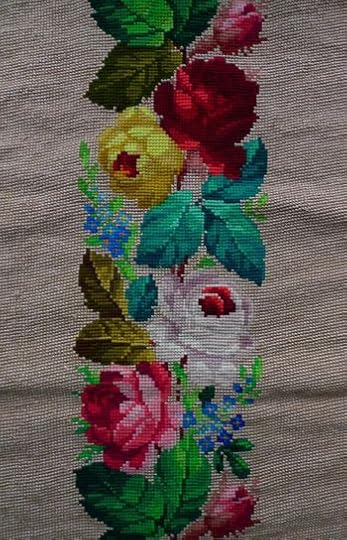
I recently found this Berlin work-style piece of needlepoint on eBay. The seller let me have it for free because she didn't think it was worth paying for. Admittedly, it's not Victorian and it's done in nylon thread in places, but it's a beautiful design, nicely stitched, and in the deep, bright colours associated with the newly discovered synthetic dyes that fuelled the Berlin wool work craze. I think it's wonderful because it's done with commitment and panache, and immediately makes me want to stitch big roses and vibrant foliage, which is more than can be said of some of the more tasteful and valuable 'art' needlework that is so highly rated elsewhere.
l'édition française est arrivée!
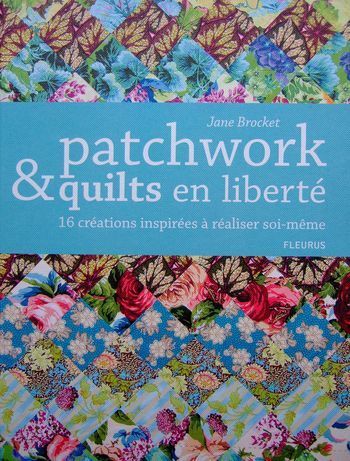
Quite by coincidence, the day after writing about the joys of French vocabulary, my copies of the French edition of The Gentle Art of Quilt-Making arrived. Mrs Thompson, my wonderful, inspirational, impeccably accented French teacher at school, would have been delighted but would probably have suggested I translate it myself as extra homework (and indeed I would have done so for her). On the other hand, my French tutors at Bristol University would not be impressed as the book would have nothing in common with Descartes, Flaubert, Zola and Robbe-Grillet. Tant pis.
I am thrilled to see my words translated into French and published by Fleurus. It is very exciting to think the book will, from April, be available ici and in some of those amazing French shops full of tasteful fabrics, notions, ribbons and haberdashery.
l'édition française est arrivé!
Quite by coincidence, the day after writing about the joys of French vocabulary, my copies of the French edition of The Gentle Art of Quilt-Making arrived. Mrs Thompson, my wonderful, inspirational, impeccably accented French teacher at school, would have been delighted but would probably have suggested I translate it myself as extra homework (and indeed I would have done so for her). On the other hand, my French tutors at Bristol University would not be impressed as the book would have nothing in common with Descartes, Flaubert, Zola and Robbe-Grillet. Tant pis.
I am thrilled to see my words translated into French and published by Fleurus. It is very exciting to think the book will, from April, be available ici and in some of those amazing French shops full of tasteful fabrics, notions, ribbons and haberdashery.
January 11, 2011
hebdomadal writing
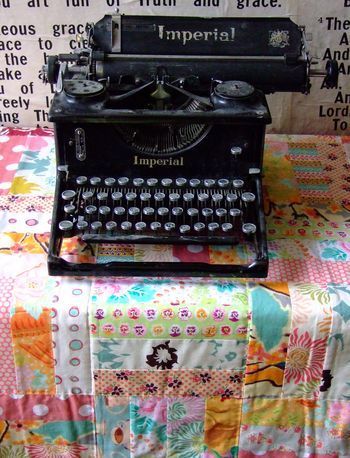
[photo taken at photoshoot for the quilt book]
When I studied French, I picked up some really wonderful words. La spéléologie (potholing) was one (I think we all claimed this one was one of our hobbies in our A level orals) and hebdomadaire (weekly - learned in the context of daily and weekly newspapers) was another. I was reminded of the latter by a question last night on University Challenge which required an understanding of the the English equivalent - hebdomadal - and was delighted to answer it correctly.
It's funny how the right word presents itself just when you need it to frame your thoughts, because I've been thinking about how often I post here and the fact that this is going to change. After six years of very frequent posting, I'll now be writing once a week. It's been a wonderful six years but blogging is very time- and energy-consuming, and I need more of that time and energy for other things, mainly work and family.
Thank you for coming back time and again to look at the pictures and to read the words, and for leaving your comments. The blog has opened up a whole new world to me and it has brought me amazing friendships and opportunities. I'll still be here, just hebdomadally from now on.
January 9, 2011
i knead rhythm
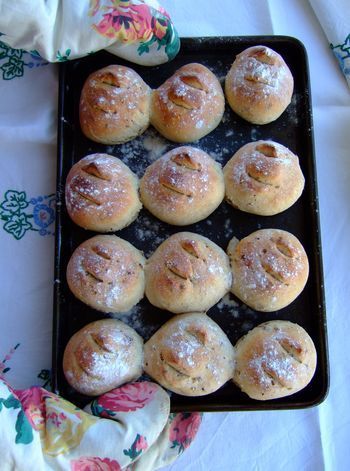
This morning I found the perfect piece of music to knead to. I was listening to the radio and I'd just got the dough out of the bowl when Nina Simone came on. I love this song anyway but hadn't listened to it while making bread before, and discovered it has just the right kneading rhythm for me - plus I can sing all the words. I know everyone has their own natural kneading style; some thump, some fold, some stretch, some go slowly and others beat hell out of the dough, but I now know that I go at Nina Simone pace. (And if anyone ever asks me again why I 'bother' to make bread this way, I've got another Nina Simone answer: I got my hands.)
[Bread rolls made with two parts Dove's Farm malthouse flour to three parts my favourite white bread flour, Waitrose Very Strong Canadian White Flour, tops snipped twice with scissors and dusted with flour just before going into the oven.]
January 7, 2011
the lights are out
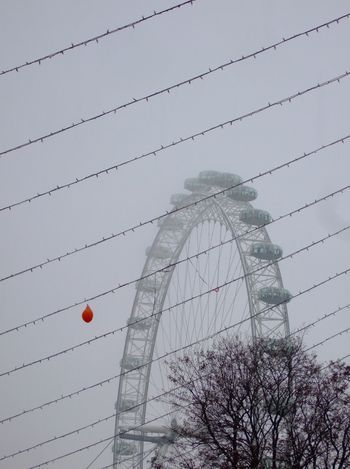
The South Bank in London was a misty, dank, wet, Dickensian scene this morning. The fairy lights have been switched off (above - not barbed wire, although the place was dismal enough to suggest the thought to me), the top of the London Eye was in cloud, and there was one forlorn, flaccid balloon hanging from the lights as a reminder of the lights, fireworks and revelries of New Year's Eve.
(I went to see the Gauguin exhibition before it closes soon. I grew up looking at a small print of a famous Gauguin painting at home but never really liked it, and much preferred the small Renoir and Cezanne prints (Mum was always a great fan of the Impressionists and LS Lowry). But the show has had such good reviews, and I fancied some South Sea colour and vibrancy. But I wasn't won over. In fact, I really didn't like much of what I saw and I realise tastes are formed very young, much younger than we often realise.)
January 6, 2011
favourite hyacinths
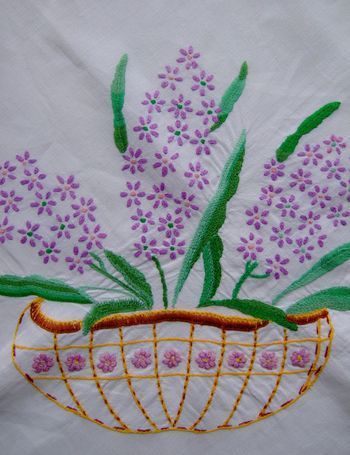
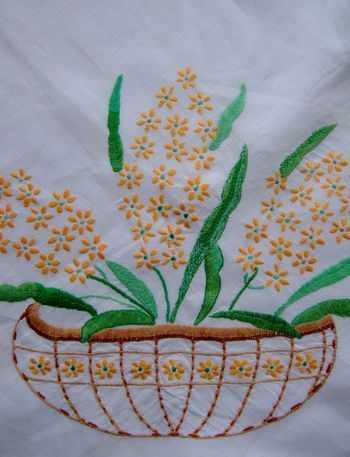
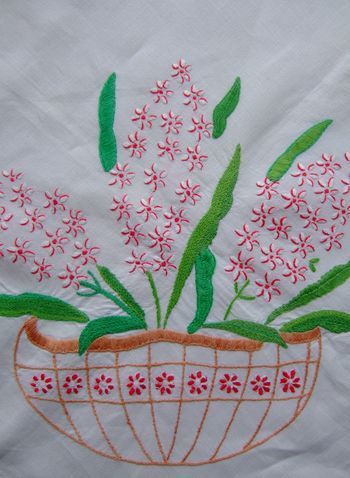
Hyacinths appear in many vintage embroidery transfer designs. The many individual florets give a stitcher plenty of opportunity to play with colour and stitch, and they look particularly pretty in a nicely patterned, shallow bowl. This is one of my favourite hyacinth tablecloths; it has a bowl of hyacinths in each corner and the embroiderer has used a different colour scheme for each one. (If we'd had something like this when I was little, I can easily imagine insisting on always having my special, best bowl in front of me and my three siblings claiming the same - just for the sake of a good argument.)
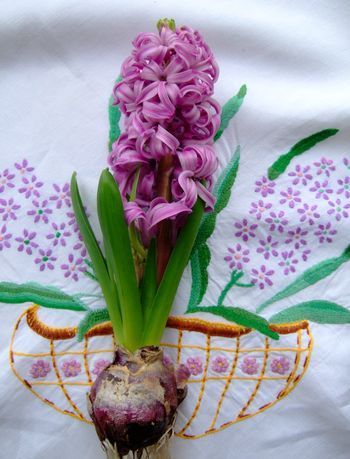
My real hyacinths have suddenly appeared of (almost) nowhere. One day there seems to be nothing but a chunky green stem, and the next there's a whole host of purply-pink flowers smelling glorious. I am growing a couple of varieties of prepared hyacinths at the moment; this one is Purple Sensation which is a new one to me.
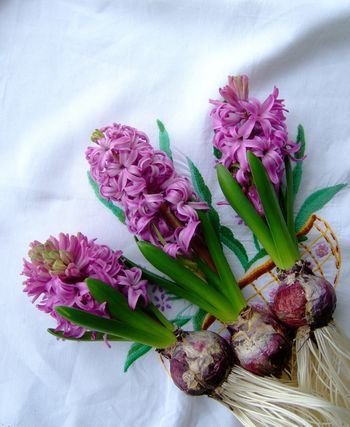
Hyacinths always seem to be blue, pink or white so I'm very glad I chose these which are a little different. They also match one of the bowls of embroidered hyacinths very nicely. And here, for the record, are the other three bowls:
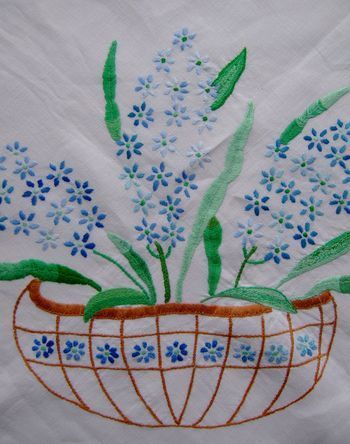
Shades of blue. (Could be 'Delft Blue' or 'Blue Star')
Butter yellow. (Possibly 'City of Haarlem')
And the version I would have claimed as my special flower which is red and white. Unfortunately, such a hyacinth does not exist in reality - only in a stitcher's imagination.
[The real hyacinth that I would happily still argue about sitting next to is the stunning Woodstock, but I couldn't find any at a reasonable price when buying last autumn.]
Jane Brocket's Blog

- Jane Brocket's profile
- 27 followers

