
Michael R. Miller's Blog, page 5
December 1, 2015
My First Official Interview With The Saint
Hey everyone, I’ve had my first official interview with The Saint – the student paper of the University of St Andrews.
You can read it here.


November 4, 2015
Re-Reading The Silk Worm: A Dark Insight Into Publishing?
It goes without saying that, as a member of the ‘Harry Potter generation’, I think J.K. Rowling is fantastic. I suspect that I am not in a minority in admitting that the Harry Potter series was amongst the first, if not the first, books I read, or at least fell in love with. Some questioned back in 2007 whether Rowling would have anything else to write after the release of Deathly Hallows. The answer has been a resounding yes. Personally, I have enjoyed both the standalone novel The Casual Vacancy and the expanding detective stories in the Cormoran Strike series (written under the pseudonym Robert Galbraith). It is the second novel of that series, The Silk Worm, that I am going to talk a little about here.
Before I go any further, I want to make it absolutely clear that I hold no prejudice against traditional publishers or the traditional system. Although I have gone for the self-publishing route myself – arguably hybrid-publishing – I’d be pretty ecstatic if a publisher such as Harper Voyager offered me a deal. I have taken this road because I felt it was the best one for me to take at the time. That’s it really. However I do love to think about the industry, which is still in a state of change, and where it may or may not go. With that out of the way, on with the post.
Back in early October I discovered that the third book in the series (A Career of Evil) was due to come out, so I re-listened to The Silk Worm audio book in preparation. I found that I had a completely different reaction to it the second time around. This is probably due to the fact that I have now embarked upon the perilous course of becoming an author and The Silk Worm, while under the umbrella of a larger murder mystery, is a book all about the world of writing and publishing.
The victim of the tale, author Owen Quine, is found dead in some of the most gruesome circumstances imaginable. This is made all the more ominous when it is discovered that Quine met the same fate as the hero of his last controversial manuscript. The manuscript in question is called Bombyx Mori – the latin term for a silk worm – and is controversial because it seems to attack nearly everyone in the author’s life, including major figures in this London’s literary world. Agents, editors, whole publishing houses, other authors and aspiring writers are all included in the roster of suspects and characters.
A lot of the meaning of this passed over my head on first reading because they were just characters to me. Not the fact that the characters were writers, editors and so on, but what they represented. And what they represent is the nightmare anyone in those professions dreads. Naturally the characters in a crime series were not all going to be joyful and enjoying successful careers. That would hardly be fitting for the tone of a macabre tale of resentment and murder.
There is the victim Owen Quine, whose debut book is widely held to be his only worthwhile piece of work. He has since been living off of the projected hope that he might one day produce something of an equal calibre. This is a scary thought for any writer or author. Yes, your first book being a success is overwhelmingly positive. But how do you maintain and build upon that success? How do you do it all again?
Running parallel to Quine’s story is that of his once close friend Michael Fancourt, who has gone on to become a bestseller. Fancourt highlights a very different problem. I interpret that his money, fame and renown, have ingrained misogynistic and overly cynical beliefs into his work and his person. One wonders whether Fancourt is really like that or whether we are always seeing the public front of Fancourt, the persona he puts on in order to rile up interviewers and drive up his sales. Although his position is likely where authors would prefer to be in, rather than the destitute Quine’s, it seems Fancourt has become known for writing and acting in a certain way and is stuck with that. Few would wholeheartedly say they would embrace this, especially as most writers would like to develop and try new things when they can.
Quine’s agent, Elizabeth Tassel, is a failed writer turned agent. She began with a promising roster of authors – Fancourt included – who have now either left her or declined in prominence. Her bitterness at being left on the fringes of literary London is plainly displayed. Although I know little about agents, I can imagine this would be a painful place to be.
Daniel Chard is the president of the publishing house, Roper Chard. He is another unlikeable character, though he is designed to be so. Through Chard we are given insight into the worry of publishers about ‘digital books’ and how they are going to make money in this day and age. His most memorable line, in my mind, was his allusion to needing ‘more readers and less writers.’ These days, he says, everyone is a writer and not enough people are reading. Frankly it is impossible to tell Rowling’s own opinion on this matter. Like all good writers she reflects all sides of the issue. Chard’s stock phrases and opinions are ones we have all heard a thousand times before. And yet they become paradoxical when we enter Chard’s mansion, custom built and designed with the huge wealth he has evidently accumulated over the years. His worries over money and the future are undermined by the financial resources he can seemingly afford to throw around. Michael Fancourt is brought over to Roper Chard for an estimated £500,000 – just think of how many debuts he might have financed with that amount of money? Instead, Chard and his business seems to be punting more money on the big names rather than investing in the future talent. This seems to be the case in our own world too, where advances for debuts and established names are polarising further and being signed to a major house is no longer a guarantee of success. There is certainly an uncomfortable truth at play in The Silk Worm.
Perhaps the lowliest of all characters in The Silk Worm is the woman who represents the self-publishers. Kathryn Kent, Quine’s mistress, has written a series of erotic fantasy novels and published them on Kindle. She has been rejected by agents and editors alike, including Quine’s own agent Tassel; who at one point tells detective Strike how god awful they are. She has developed a reflexive hostility towards publishers, claiming they don’t actually look for ‘good books anymore’ and they will only take on books which ‘fit their sale categories.’ Again, these are typical stock phrased arguments that we’ve all heard many times before. Anyone as rancorous and aggressive as Kent is not a true self-publisher – she is hardly professional.
“[Publishers] don’t want to take a chance on something that hasn’t been seen before, it’s all about what fits their sales categories, and if you’re blending several genres, if you’re creating something entirely new, they’re afraid to take a chance.” (Kathryn Kent)
Rowling’s book is in no way a debate on traditional vs self-publishing, but it is an interesting insight into the psyche of it all. What is most intriguing is how she portrays the zealot natures of both sides. Both Chard and Kent are fairly extreme in their opinions, but they are not terribly far from reality – I suspect there are many out there who would sympathise with both. Yet each extreme throws up the childish, almost naïve nature of stubbornly adhering to one belief. Chard and Tassel ought to recognise the talent that might be out there, while Kent ought to accept that her books are being rejected for a reason and think about improving them.
A particularly reflective moment for detective Strike comes in an expensive restaurant, where he witnesses Chard approaching the son of a famous rock star to encourage his father to write and publish an autobiography with Roper Chard. Strike notes the disparity in opportunity between this rock star – who has his pick of the publishers – and another struggling character he has met, Pippa Midgley, a transgender woman about to undergo gender reassignment surgery and hoping to publish her own life’s story.
Finally, there is Leonora Quine, the wife of our unfortunate victim and a painful reminder that even those closest to a writer may not read or be interested in their work. Leonora states that she only reads her husband’s books ‘when they’ve got the covers on.’

Robin and Strike
It is an often overlooked aspect of writing that sometimes even your family and friends just won’t care enough to read it. Your audience is probably not who you would expect it to be. In my own limited experience, I discovered that some of my most enthusiastic beta readers were actually people with whom I had minimal or no face to face contact. They were friends of friends, some even off in different countries. It is why I’d argue you ought to get your work out under a lot of strangers’ noses in order to gauge how you’re doing.
After reading this post, you would be forgiven for thinking that all this publishing business makes up the majority of the novel. Far from it. The Silk Worm focuses on the characters of Strike and his associate Robin. Rowling’s greatest skill has always been her delicate yet powerful characterisation and this continues into her detective series.
I had a completely different experience with The Silk Worm the second time around. It kicks off a discussion on the world of writing and publishing despite that never becoming the focus of the novel. The arrogant character of Michael Fancourt claims that literature is only true art if it provokes and stokes debate. For anyone like myself, The Silk Worm certainly does just that.
October 26, 2015
Sanderson Signing, FantasyCon2015 And Expectations With Writing
 So last week was extremely busy and very fun! There was a Brandon Sanderson signing to attend and adventures at FantasyCon to be had.
First of all, the signing. It took place at Forbidden Planet in London and the place was packed. Everyone was treated to a surprise reading from Stormlight 3 (a flash back chapter of Dalinar which I believe is now up on Tor’s website) before a generous signing. Everyone was allowed to grab a picture and ask the man a question or two if they liked. I took the opportunity to thank him for his amazingly useful lectures on writing (found here Write About Dragons and BYU English) and he even had a look at the cover of Dragon’s Blade and seemed pretty taken with the art. So I walked away, a rather happy young fantasy writer, my signed copy of Shadows of Self in hand.
 Then came the weekend and FantasyCon 2015, hosted by the British Fantasy Society. This year the convention took place at the East Midlands Conference centre in Nottingham and the campus just looked beautiful in autumn. Publishers were giving away free books and you weren’t limited to how many you took– yes I really mean it. I had a late night reading on the Friday at 11:30pm which went rather well and I was glad my small audience seemed engaged with the prologue.
This was my first experience of a Con I must have met every type of author and fan there, from those with dozens of books out, to those just experimenting with their first early chapters. It made me think a lot on the expectations people had, what they deemed success as, and gave me insights into publishing I would never have found on the internet.

With such an array of people there were some sad stories of disappointment, alongside joyful writers excited to be launching their book at the event. A lot of advice was contradictory at times, and expectations varied wildly. It all led to me conclude, perhaps too simply, that if you are out there and want to write, then just write the book you would want to read. Write the best damn book you think you can and worry about what happens after that. But you should also understand what you want out of it. If writing is a hobby then your expectations will be very different from the person who wants to make a career out of it. It all starts with knowing what your own goals are.
The good news these days is there are a lot of options out there. You can shoot for that major publishing house, or you can aim for a smaller press. You can even go completely alone if you want or take a slightly more hybrid route. It’s all there. The key is to be honest with yourself and decide what is best for you. Do the research into what it involves and be prepared.
And when you have a good idea of what to expect, you’re more likely to be pleasantly surprised.
October 14, 2015
Fantasy map creation: from author scribbles to finished product.
Hi folks. I thought you might be interested to see the process of how a fantasy world map is created. Maps in fantasy books are brilliant, especially if the world itself is important to the story and the characters are moving around it. Lord of the Rings and the ongoing Song of Ice and Fire series (Game of Thrones) are the best examples of this that come to mind.  Describing where places are in the world can be tricky, as I found out when writing. When relating the geography, I had to think, ‘okay this city is to the east but how far? What else lies in the way? It is east but also it’s also a little south but not really south-east…what do I do??’ Having the map there for everyone to see makes this a lot easier. They are also cool. I love them. Maps are, in their way, the ultimate show over tell.
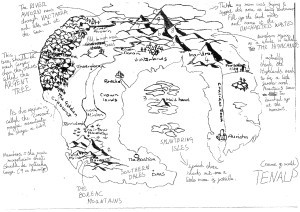
This is clearly going to be specific to me and other people will do it very differently. I didn’t, for example, use graph paper and other precise tools to draw my first ideas out. This was largely because I have many different races and species in my world beyond humans and each of them travel differently from humans which would have made it a nightmare to nail down distances and how long each of those races take to get from A to B. I was also building a lot of the world as I went along. I had the important places fixed in my mind. But regional names? Nope. Other names for smaller settlements? Nope. River names? Nope. I would say I am a hybrid of a discovery and architect writer but I lean more towards discovery. I first did some doodles in my little red book which I carry around to note down anything writing related which comes to me. You can see here my first attempts at sorting out the shape of the world. In many ways this shape has remained a constant although this first try looks a bit too much like a croissant. On the left you can see I had the super important places named and roughly positioned – Aurisha (the dragon capital), The Bastion (Castallan’s fortress), Brevia (the human capital) and Kar’drun (the lair of Rectar).
This meant I had some advantages and disadvantages when it came to the map and the world in general. On the one hand, not having a precise and detailed map drawn out meant I sometimes had to stop and think very carefully about where the characters would be going and why, without a point of reference. That was tough and required a lot of editing later. It also meant that I had a lot of place holder names e.g. what is now The Golden Crescent was at first just called ‘the grainlands’ in the early drafts and The Cairlav Marshes was just called the ‘marshes’. Not the best when rereading as it didn’t make the world feel real; even to me.

 However, there were some advantages to building as I went along. It meant that I was not tied down in my own mind to where the characters could and could not go. I don’t think any writer should allow themselves to get too restricted by their preplanning at any rate. Torridon is a perfect example of this. It was a place I inventing on the fly as I was going. The crannogs, the great smoke houses, the smell of fish and the gentle ebb and flow of the waves of the loch – it is one of my favourite parts of Tenalp. It also allowed me to focus on what mattered most and not get distracted. If I had a huge world mapped out I think I would have been tempted to write in or reference more places or regions than were necessary for book one. It helped me keep the plot tighter than it otherwise might have been.
On the right, you can see I was evidently putting a lot more thought into the west than the east. As the majority of The Reborn King takes place in the west it made sense for me to focus my energies there.
You can also see that I really didn’t know what to do with the east whenever this was drawn.
So that was how the world began….at least on paper. The next major stage came after I had finished the manuscript and sent it to my editor. I drew out a much more comprehensive sketch and gave it to my mum (who is an artist/art teacher) to draw up nicely. We went through a few versions until we came to this next image.

Now the image on the left is starting to look a lot like the finished product. However, there are some key differences. In this version the two rivers (the Avvorn and Dorain) both flow into Loch Minian. This was correct –according to the wording in the book at the time – but upon seeing it visualised on paper, it just looked odd. The path of the Avvorn doesn’t look natural when it suddenly veers right and into the loch. Rivers generally take the path of least resistance away from mountains and hills towards the sea. It made much more sense for the Avvorn to flow through the whole forest and lead to the sea. As such I did have to make a note for my major editing draft to fix this in the book.
So with a couple of tweaks we reached the final working sketch of the map, shown here. I actually think it looks pretty good like this. I feel fantasy maps are always trying to fake the impression that someone from the world itself sat down with quill, ink and parchment, and drew it out. As this version was hand drawn this effect comes across well but it also makes it a bit unclear. This all led to getting a professional (Rachel Lawston) to take it to the next level. Along with a brief, I sent along a blown up version of the map with quite a few annotations….As you might be able to tell, I was adding in more names even as this late stage.
The designer took the outline of the land from the sketch and began by getting the positioning and size of the mountains right – as the mountains are quite vital in a world with the name Tenalp.
We then had a slight confusion. This was my fault. I wasn’t specific enough on what I was after and the buildings on the sketch made the designer think I wanted images on the map. The result was as follows below.
 Now there is nothing wrong with this style but I think in a book it might prevent readers suspending their disbelief. It reminded me more of board game or video game maps rather than Middle Earth, and it was the Middle Earth feel I hoped for. Again this was my bad – I ought to have been very clear from the get go to avoid confusion. That is strong advice for anyone else out there undertaking something like this. You can never be too detailed when it comes to a design brief on a map.
We got it sorted out quite fast. I asked to change the style of trees of Val’tarra because the trees there are not evergreens like the images above might suggest and much more besides. The next version was much more what I had in mind.
 I jumped for joy when this map came through as I could really visualise it at the front of the book. There were still a few things to slot in but I felt like the journey was virtually complete at this point. It took months of sketching, re-working the first ideas and editing the text of the book itself to get here. It’s hard to convey all of that that in one short blog post but hopefully this will help give you an idea.
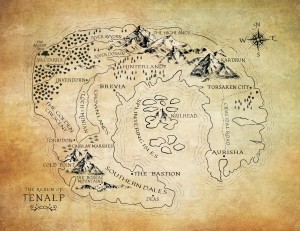
I hope you enjoyed this brief look at the map making process. If you have any questions or comments please leave them below. The first book in The Dragon’s Blade Trilogy, The Reborn King, is due to be published this November: so you can journey to Tenalp soon!
Map design by Rachel Lawston at http://www.lawstondesign.com/book-design.html
October 8, 2015
Thoughts on the Powder Mage Trilogy by Brian McClellan
 I am about to attempt the unusual here and review an entire trilogy as a whole. That trilogy is the Powder Mage Trilogy by Brian McClellan.
The reasons I am doing this are twofold. Firstly, I have recently blitzed through the series and so it feels like one long book to me rather than three individual ones. Secondly, McClellan was taught by Brandon Sanderson at Brigham Young University and so, as I learned a lot from watching Sanderson’s classes online, I feel a sort of kindred spirit with him. As I’m covering a whole trilogy I am going to be discussing things in detail but I won’t spoil or simply rehash the plot. I should also add that I listened to this series on Audible (this is something I do a lot) and the narrator, Christian Rodska, did an amazing job in bringing it to life.
Before delving into the meat of the review I will say that I thoroughly enjoyed this series and would certainly recommend it to any fantasy reader. I believe it was McClellan himself who coined the phrase ‘Flintlock Fantasy’ to describe fantasy with guns. If you’re interested in a setting based on the French Revolution and Napoleonic Wars then this is for you. Rifles, bayonets and canons have long since replaced swords, arrows and armoured knights.
The series features powder mages, magical manifestations of the transition to gunpowder, who use black powder to enhance their physical strength, agility and stamina by eating or snorting it. Powder mages also have the ability to ‘float’ bullets, keeping their projectiles flying towards their target over extremely long distances with deadly precision, even bending the path of bullets if needs be. They can also ignite nearby stores of powder at will and can warp the blast in the direction they want, making them particularly effective killing machines if surrounded by regular soldiers carrying powder charges. Yet powder mages have long been persecuted because they threaten the established magic wielders of the Nine Nations, the privileged, who have a weakness to gunpowder. Only in the nation of Adro are the powder mages respected enough to be drafted into the national army as elite snipers, leading one mage in particular to rise to the high rank of Field Marshal. This Adran mage is Tamas, who is the central character of the trilogy.
It is with Tamas that plot, setting and character converge to create one of the most gripping openings to a series I’ve ever come across. “The age of Kings is dead and I’ve killed it,” says Tamas within the opening chapter of A Promise of Blood, following his military coup against the incompetent monarch and his Royal Cabal of Privileged. Field Marshal Tamas begins the story as an old and experienced soldier, already in his sixties, and was easily my favourite character of the series. He is a gifted commander, a powerful powder mage and a man driven to extremes because he sees no other way out. Adro’s King was about to sign an agreement with the neighbouring nation of Kez which would have effectively forced Adro’s citizens into a form of indentured servitude in order to repay the crown’s debts. Tamas’ coup, and indeed his whole motivation from book one to three, rests on the idea that the people of Adro, his people, ought to rule themselves and forge their own future.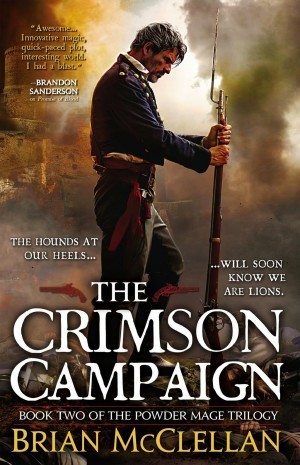
This was a great setup for a long and epic story. A blend of fantasy and real historical narrative examining the clash of old world systems and powers against new rising technology and political ideology. At least that is where the series initially appeared to be heading. In many ways it did and all the right elements were there, but they were a little under worked in my opinion. This was an issue I had with the series more broadly and is what prevents it rising to become something which really resonates.
Whilst I thoroughly enjoyed the trilogy, it did leave me wanting a more. Some plots, sub-plots, aspects of the world and characters did not feel like they were taken to their ultimate conclusion or delved into in a huge amount of depth. This was probably due to the frequent shifting trajectory of the plot. Of course an evolving plot is not a negative point in itself, but it often felt like characters were achieving their goals and then their plots were rebooted, creating a feeling of constant stop and start.
The greatest instance of this, in my opinion, was the refocusing of the plot about a third of the way into the first book. Tamas’ opening coup d’état swiftly leads to a purge of the nobility and a royalist backlash, suggesting Adro would soon head the way of the ‘Terror’ that plagued France post-revolution. It makes for powerful tension and character moments where Tamas wonders whether he really has done the right thing. Yet this is quickly resolved and almost forgotten as a war with Kez becomes the focus of the trilogy. As a whole the trilogy felt like a series of smaller plots and lacked a larger unifying strand to tie it all together beyond ‘we have to beat the Kez’. Gods even get involved in events but this element also fades in and out as needed and lacked cohesion at times.
Another point of view (POV) character is police inspector Adamant. He is gifted with a perfect memory which makes for some fascinating plot points, yet his investigations turn into something of a game of cat and mouse which gets slightly wearing by book three, The Autumn Republic. However, Adamant was still my second favourite character and the most well rounded after Tamas, offering a welcome respite from the high octane action the soldiering characters are often involved in.
Taniel ‘Two-shot’ is another powder mage and the son of Field Marshal Tamas. Despite being in his early twenties, he feels much older due to his already long service history in the military and having the exacting Tamas as a father. Of the three main POV characters he was the least compelling to me. He is the ‘gritty’ one, being brusque, aggressive, jaded from a past heartbreak and a little blood-thirsty at times – he spent just a little too much time fighting to get to know the man beyond the fighter. That being said, Taniel has some of the most heart-warming and genuinely unique interactions of the series with his companion Ka-Poel. She is a mute girl from a distant land and only communicates through simple gestures and facial expressions. Their exchanges are invariably well written, elevating those scenes and showing off McClellan’s chops when it comes to character interaction.
The last POV character is Nyla, who begins the series as a servant in a noble house before becoming displaced after the coup. She is unfortunately not given very much to do and seems to serve little purpose to the story until The Autumn Republic. When her plot does pick up it is interesting but by then I had already long since lost interest in her or what she was doing. It was largely the humorous minor character she is partnered up with which carried those chapters for me.
The magic systems in this trilogy manage to delicately skirt the fine line between being mystical and scientific without falling too far onto one side. The powers of the powder mages are well enough explained throughout the story, though it was a shame I had to wait until book three to learn more on the elemental system used by the privileged. The privileged tap directly into magical energy called the Else (a damn good name in my opinion) and I thought the need for specifically woven and patterned gloves was a nice touch, though I was left wondering whether different patterns could enhance or influence their magic.The third system comes close to being too unexplained for the level of story involvement it has but it works because the only character who understands and practises it is the mute Ka-Poel. However, we do get a decent sense of how it works and I was never left confused by its usage.

In this fan art by Jeff Yargas you can see an imagining of the privileged gloves.
There are also some real gems here such as the character Mihali; a genius chef with mysterious powers that help him produce food on a mass scale. The descriptions of the dishes are mouth-watering and the reliance that the characters come to place on him, both for their own dining pleasure and the morale of the Adran army, is a unique and interesting exploration.
The dialogue worked very well which is all the more important when you are listening to an audio book. The character interactions were believable and consistent, other than the occasional slip-up near the start of book one when a couple of characters come off as extremely unlikeable and brutal out of the blue. These could be hangovers from older drafts that slipped through the editing net. That happens. But overall the prose was clean, concrete and efficient. I’ve seen some reviewers suggest it goes too far in making ‘windowpane prose’ and becomes overly simplistic but I never found this to be the case. This is a more modern world than fantasy readers are perhaps used to and the characters we are following are mostly from military backgrounds or the lower classes of society. They wouldn’t have the time nor inclination to be flowery and so it makes perfect sense that the writing is approached in this manner. Tamas is not Kvothe.
Overall this was a solid trilogy which falls just short of being great. This is probably due to the lack of depth and explanation we are presented with at times. McClellan may have rectified this through his series of novellas set in the same world but I have not read them and so cannot say for sure. That I managed to get through sixty hours of it in under two months speaks volumes as I am not averse to putting a book down if I’m not enjoying it. The Powder Mage Trilogy is a fun series and an accessible one for readers looking to dip their toes into fantasy but are wary of the larger one-thousand page tomes.
 Book 1 = A Promise of Blood
Book 2 = The Crimson Campaign
Book 3 = The Autumn Republic
I’d like to hear what you think in the comments below. If you have read this series as well what did you think of it and would you like to see more fantasy set in this historical period?
September 16, 2015
Hello world!
Hello everybody!
This will be where I post things which I hope will be of interest to people interested in fantasy and writing broadly as well as my own work in good time.
Currently the Buy Now link only goes to a generic Amazon page as the product isn’t finalised yet.
The book extract will be available shortly, as soon as I get the text back from the proofreader and the final version is in hand.
Until then, all the best and I look forward to hearing from you all.
Michael


