D.L. Havlin's Blog, page 14
November 29, 2016
Announcing ……….

DL with Mary Custureri, Director and Managing Editor of Taylor & Seale Publishing.
I’m happy to announce that I’ve signed a contract with Publisher Taylor & Seale to publish my most recent manuscript, The Bait Man. I’m pictured above with May Custureri, Ed.D., the Director of the firm. Taylor & Seale is a traditional publisher with more than a hundred different authors who have had works printed by the group. The Bait Man is a suspense/thriller that will be released sometime early in 2017. I’m looking forward to a mutually beneficial relationship with this fine company. I’ll be providing a lot more on The Bait Man as we approach its release.
My short story There are no lights in Naples has been published in the November edition of the literary magazine Ripen the Page (link is) http://ripenthepage.com
The link appearing here should get you to it or Goggle it. It’s the featured article on the first page. I’m proud to have my work published in this fine, up-and-coming publication! You have to increase your hat size just a little when good fortune comes your way.
It would be unfair of me to not share credit for this smidge of success with Jan Kardys and Bob Zaslow of the Unicorn Writers group. I’ve always had the story-telling capability and modest writing skills, but their counseling has sharpened my craft tools. After working with them, my latest novel was accepted readily by the first publisher (a quality house) to whom I submitted it. I’d suggest serious writers sign up for their upcoming conference. Its held in March, in NYC, and it is a legitimate door to the publishing business. Check out – www.unicornwritersconference.com on the I-net.
# # # # #



October 28, 2016
“I’m sorry Virginia … there is no publishing fairy.”

DL at Daytona State College
“Is it really that hard to get published, traditionally?” one student asked. I answered, “You ever heard the newspaper reporter’s answer to a girl named Virginia when she asked if their was a Santa Claus?” She smiled and said, “Yes.” I told her, “Then my answer to you is, sorry Virginia, there is no publishing fairy. That’s not to discourage you … it’s to impress on you the huge effort you’ll need, rejection you’ll face, and perseverance you’ll require to reach your goal.”
I thoroughly enjoyed my experience at Dayton State College where I participated in the program titled “Bloom where you were planted.” This mini seminar was the inspired concept of Dr. Lynn Hawkins, PhD. and Director Mary Custureri of publisher Taylor and Seale. They’re speaking of making this an annual event; I certainly hope they do.
The cross-section of students who attended from DSC and Bethune-Cookman encouraged me. They weren’t the kooks and and rabble so often shown on television these days. IF they are representative of their generation, we don’t have to be nearly as concerned for our country’s future as many would have you believe. They were attentive and asked great questions.
My experience was enhanced by sharing a break-out discussion table with Veronica Helen Hart, a truly talented author, who knows the secret of an engaging novel is in its story. I strongly recommend you try one of her books. You’ll be captivated by her stories and writing quality. Amazon is probably the quickest and easiest way to obtain one. Look her up by author name.
As I stated, it was a joy to engage in discussion with these students. A couple of things struck me as we shared conversation. This generation IS concerned with the future, most are willing to work to achieve their goals, and light bulbs go on as you speak to them … they comprehend. Most of these students are great candidates to join organizations like the Florida Writers Association and to attend writers conferences like the Unicorn Writer’s Conference both of which I recommended.
Lynn and Mary, thanks again for “inventing” this great event.

Part of the audience at “Bloom where you are planted”

“They’re listening”

DL and marvelous author Veronica H. Hart drew double rows around their discussion table.
PS – Hooray folks — The book I recommended to you is now on Amazon! Maledicus: The Investigative Paranormal Society Book I, is available!
# # # # #


October 13, 2016
Hookers … do strange (and great) things

Filleting 400 pounds of fish for the “Hookers.”
I’m working for my Hooker friends today. You might say, “Surely you jest.” I’d have to answer, “Not at all.” Then you might say, “Oh, its a fishing club!” I’d say, “No, it’s a bunch of women.” Silence – then you might inquire, “Real Hookers?” I’d be your echo, “Yep, real Hookers.” Another few seconds of silence, then you’d ask, “What’s your wife think of that?” I’d answer, “She is one.”
Yes, I’m married to a Hooker; a Matlacha Hooker. And, I’m proud of it. The women who comprise the Matlacha Hooker’s are one of the most effective civic organizations I’ve ever seen or even heard about. They raise money and SPEND THAT MONEY on the projects they sponsor. Independent and flexible, these gals get things done! Funds don’t get frittered away in corporate style home offices. These ladies, the Hookers of Matlacha, Florida are the embodiment of the American spirit of community and charity.
The project pictured above is to raise money for the Pine Island Elementary School. The funds are given directly to the school to buy everything from classroom supplies to expensive items the school could not afford. The event is a combination fishing tournament (You can participate if you wish – flyer below) and derby. There’s music, auctions, the famous fish fry (That’s what I sliced and diced for), and much more.
The derby is unique. Young people can participate in this “junior” tournament! Go to http://www.matlachahookers.org for more information and rules etc. This is truly a fun event.
You have to admire the Hookers. They have their sleeves rolled up, not their hands out.

If you’d like to say Hi, I’ll be cleaning fish for the tournament participants and children’s derby on Sunday
# # # # #


October 7, 2016
Maledicus … An adventure in reading … and learning writing skills.

Reading well-crafted novels is a great way to improve your writing skills. May I make a recommendation? Maledicus: The Investigative Paranormal Society, Book I is a novel that I’d like to recommend that you read. The book will become a cult horror classic. It’s written by Charles F French. French’s writing does what I believe an author should do, he appeals to the “thinker” that lives in every reader. The book deals with a subject that enters all our minds, ‘what does happen after death?’ There’s a link to the trailer for his book at the end of this post.
Everything you read is instructive if you look for it. In this book, there are many great things to learn. For example, observe closely how Charles crates atmosphere using imagery and sentence structure. Dread is palpable.
You would benefit from adding his blog to your reading list. He’s a professor and that automatically makes him a student of great writers. He shares a lot of their wisdom in his posts. Check out his blog at URL frenchc1955.
The trailer follows:
Maledicus:Investigative Paranormal Society Book I

Charles F French, Author
# # # # #


September 15, 2016
Consequence — put it in your writing!

DL with Sara at the Blue Ridge Book Festival, April 2016
One common thread found weaved through successful novels, both those critically and commercially acclaimed, is a little used word in writing – consequence.
Here’s an exercise to try. Name five novels you like. Identify what the characters did or did not do that was important in the story and plot. Define what happened as a result. In most cases, you’ll find that these consequences are what drives the tension in the work.
I believe focusing on consequence is a good way to help develop and improve story/and or/plot in any work you are considering. Look at the cascade effect consequence has on other characters and you’re on the way to succinctly fleshing out your project. It will help you write with more depth and keep the fictional souls you create relevant and realistic.
Three of my favorite writers do this, whether purposely, or within their personal writing regimen. Here are three books where consequence is vital and their authors who build consequence in their novels. I recommend you read At the Water’s Edge by Sara Gruen, The Snow Concerto by Virginia Crane, and A Land More Kind Than Home by Wiley Cash. All are great reads and will add to your craft level if you choose to study them.
Sure, you write consequences into your novel. You can’t avoid it. Even Jerry Seinfeld, who said his sitcom was “about nothing,” had consequences in every show.
Focusing on consequences focuses you writing on the heart of your story.
Many books I read, fumble their way toward telling the effects of their characters actions, often wasting verbiage that simply doesn’t advance the story. Focusing on consequence will tighten your writing and make it more powerful.

NYT best selling author Wiley Cash shown here with DL

DL with fellow author Virginia Crane at the Port Charlotte Cultural Center
A note in closing – I’ll be at the On Point Book Fair at West Shore Plaza in Tampa Florida this Saturday from 10AM until 9PM. That’s long! But, I’ll be there.
# # # # #


August 14, 2016
Is faster better? Not when writing.
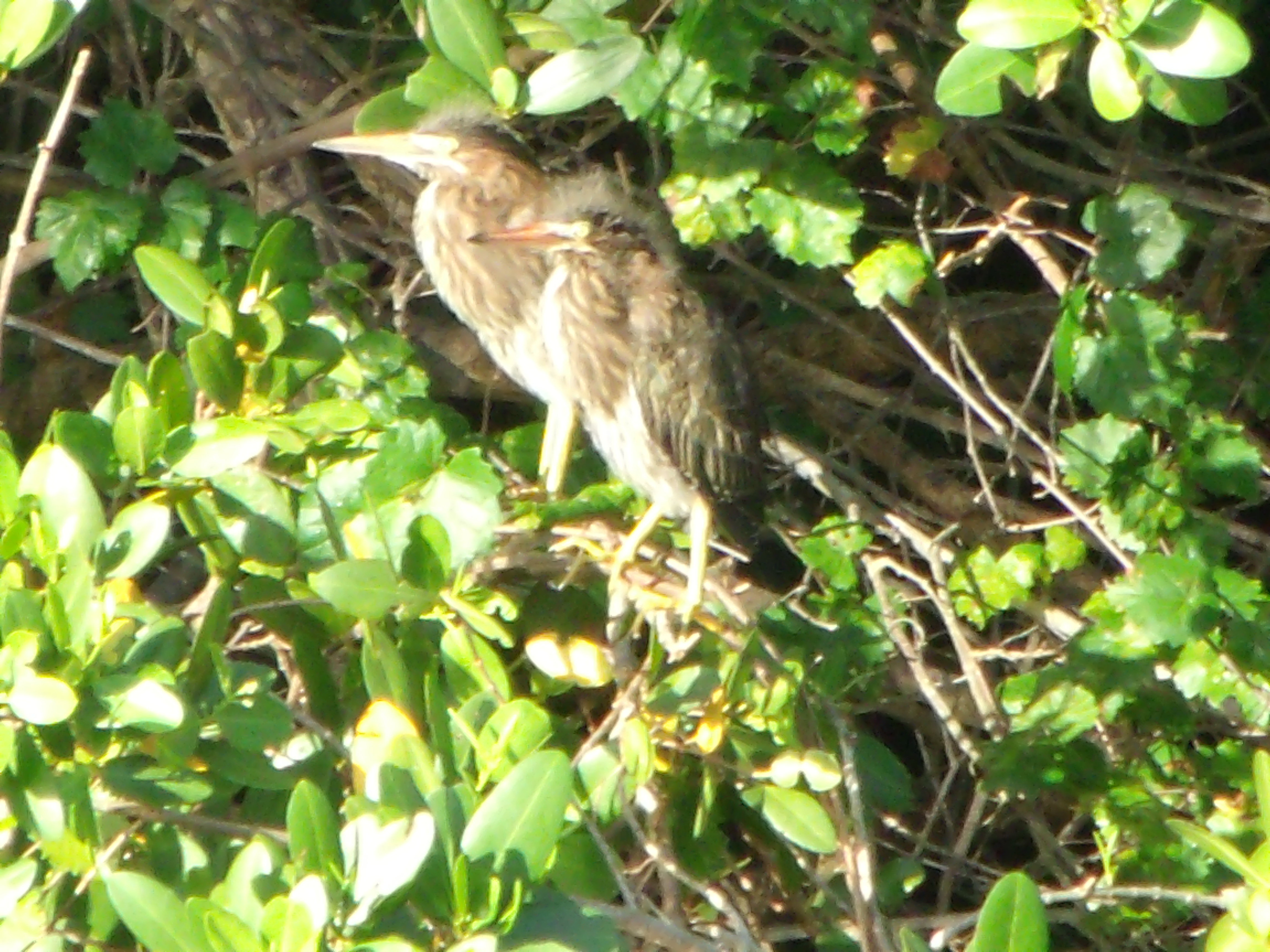
Many times novice writers are like these baby night herons. They need some guidance.
One of the writers who requested my opinion about the work they produced and requested I read, had what I consider valid reasons to write. First, she loved the effort. Second, she wanted to use her writing to help others avoid mistakes she’d made. She’d chosen a plot and story that weren’t threadbare from overuse. The passion she wrote the novel with was palpable. …. However, the result was disappointing. The work wasn’t cohesive. There were errors in continuity I wouldn’t have expected. Grammar was strange … good in portions … errors made in sections of the book that were correct in others. Why?
The answer came out when she proudly told me, “And it only took me 90 days to write it.” After gagging and struggling to maintain a straight face, I understood part of her problem. She’d succumbed to the mindset that there is some great virtue to writing at a pace designed to win a 100 meter sprint in the Olympics. Unfortunately, this is cultivated by some literary folks. I’d already discussed the vital need for her to rewrite her novel. It could end up as a salable book. I added this piece of advice, “Few (if any) of us can produce a “finished” manuscript on the first pass. The need for rewrites, or polishing if you prefer, is universal, and taking the time to produce a better quality starting point will pay dividends when the rewrites are made. A finished, waxed, and shined product is required to send your work to agents and publishers.”
I can assure YOU ALL that you won’t get agents or publishers to accept your manuscript because you wrote it faster than a speeding bullet. There won’t be an extra 40,000 copies sold because you wrote it in 60 days. No one who reads it will proclaim it a masterpiece because it was vomited onto the printed page at an unparalleled rate of puke. (colorful to make the point) People will brag about your novel or non-fiction because you have executed all the authorship skills required to a level that exceeds the thousands (literally) of your competitors.
Writing every day to hone your skills to the point you are a razor is important. Hemingway set a goal of 300 to 500 words of PROPERLY WRITTEN, MEANINGFUL PROSE A DAY. Speed helps you win races. It doesn’t do much for you when writing.
# # # # #


July 26, 2016
Want to be your own boss? … You’d better be a good one!
Authors like NYT best selling author Wiley Cash shown here with me at The Blue Ridge Book Fest usually have a strong message in their work.
“I want to be my own boss. I don’t need some rectal aperture (my substitution) hanging over me, pushing me every second of the day.”
This was an answer to my question, “Why do you want to write?” One of the authors whose work I read … who wanted my opinion … was adamant about all the bosses he’d worked for over the last fourteen years and his last nine jobs. Having hired and fired many people during my work career, the smell of dead fish wafted in the breeze.
“All the people you worked for pushed you?” I asked.
“Yes.”
“What did they say your problem was? The quality of your work? The quantity you produced?” I had a specific reason for asking. Though there was a hint of talent in his writing, there was a large red flag fluttering above.
“Mostly quantity, but they bitched about everything. Particularly, the women I worked for.” He frowned as he said that. That told me something since I’ve found women are usually more than fair when judging a workers output.
There was a pattern in his writing. It started out in a well-ordered coherent manner. The work was engaging and the prose solid. Then … then … it degenerated. It became rushed, disjointed, and sloppy. This cycle repeated six times within the novel. The writer became bored and “just rushed through it” at his own admission. We had a discussion about the need for actually being your own boss, if that is the path you choose, and the imperative for a writer to have a massive dose of self-discipline. After we went through his work, he accepted the need and conceded his biggest challenge would be to push himself.
Yes, you are your own boss when writing. You had better be a damned good one. If you aren’t harder on yourself than anyone you ever worked for the probability of your reaching success in the hyper competitive world of published writing is geometrically diminished.
If you think your agent, editor, and publisher are going to say, “No problem, take your time, no rush,” when you miss a deadline, I have the Pacific Ocean I’ll sell you at a bargain price.
# # # # #


July 18, 2016
Writings not a easy living? … Say it isn’t so!

Cat to dog – “You going to write something today?” Dog to cat – “Yes, if you’ll hold my paws over the keyboard.”
Question – “Why did you decide to write your novel, xyzxyzxyz?”
Answer (After a long pause) – “I’m tired of getting paid $xx. an hour. I want to make some big money and not have to be a slave to my work to do it. I can’t think of a better way than writing to do that.”
I got this answer, or some variation of it, when I asked the “why” question of five of the eleven would be authors I’ve been writing about in my last couple posts. One lady, unpublished, with a first time novel, explained that she expected she would to have to write two or three additional books after “this book” was printed to meet her objective of buying a small island in the Bahamas and retiring. I guess reality is something that you can be ignorant of, or blissfully ignore, convincing yourself it doesn’t pertain to you.
Lets discuss reality. I’m trying to keep my posts short so ……
Making large dollars from writing is normally achieved from an enormous volume of effort through the traditional publishing route. Do self-published authors become rich and famous? Yes. BUT, as a percentage, they’re harder to find than hen’s teeth.
Unlike my friends pictured above, successful authors don’t decide to slide out of bed if the inspiration strikes them on a particular day. Vomiting on the keyboard, sending your visionary words to an eagerly waiting publisher, who will assign hordes of editing staffers to polish your Socratic wisdom, which the editor-in-chief will send a limo to pick up … isn’t going to happen. No one is going to beg you for your manuscript. Cancel your Porsche.
Writing is an everyday grind … your breaks are normally spent in research … most writers, if they took the time to calculate, would be ebullient making minimum wage. I average seven to eleven rewrites for each of my books. Rewrites are tedious and intense WORK. If you love what you’re doing it’s worth it. If you’re looking for a hammock and a Mai Tai way to make a living, writing isn’t for you.
If you work your rectal area off, your chance of becoming a name author is miniscule. This is particularly true when writing fiction. Read my post back on April 14, 2015 titled, “Publishing to Enterprise – Beam me up Scotty – from where-ever I am.” It details that reality word. (less probably than making an NFL roster by many, many times).
After all that, for those beating the odds and becoming traditionally published, today’s reality is that you’ll be out promoting your book(s). Even “name” authors like Sara Gruen (Water for Elephants) are out hustling their work. I shared a signing area with her at a small book festival last April. YOU ARE A USED CAR SALESMAN – LIKE IT OR NOT.
If you believe being a successful author is going to work in your undies, while sipping wine, eating lotus, and having Brinks Armored delivered sacks of cash to your door, you may wish to revise your thoughts.
# # # # #


July 13, 2016
Writing’s not a casual default when there’s nothing better to do.

Sometimes being a writer can be as lonely as a sand hill crane standing in the middle of a field.
In my last post I explained how I’d read some books that authors sent me. They wanted an opinion, and, usually a question or two answered. Some needed tweaking. Some an overhaul. Some needed @#&%! …… I wanted to help so I made a diligent effort to understand the authors POV. What was their intent? After several of these discussions, a pattern emerged. The authors were “just writing” without a clear idea of what they wished to accomplish with their book. My question to one of these writers was, “If you don’t have a clear objective for writing your book, why are you writing?”
The first answer was convoluted, so I rephrased and repeated my question. I got an embarrassed, but honest answer. “I lost my job to downsizing. I spent over a year looking for something in accounting without luck. I decided I’d try to write novels. Some of the (manure) I’ve read and some of the stuff on TV is really bad. I thought I can do that good.”
There was no message in the writing. Well, that’s not correct. There was the desperation of someone who had invested in having a book printed after spending a lot of money on the manuscript. It was “edited,” formatted, had a rather good cover (the only reasonably done production work) and printed. I’m not a grammatical guru, but even my average skill level found 37 errors in the first chapter. Eight pages. Continuity was poor. The heroine’s car was a red BMW, a few chapters later it changed to gray, half-the-book-later it remained gray, but morphed into a Mercedes. I thought it might have been some unusual way to establish time passage (that was another problem). When I asked, the writer had no idea that a changeling vehicle was roaming the book’s pages.
Writing for publication is difficult —- very, very difficult. The competition is fierce and often unfair. Don’t be lulled into the mind set that “Anyone can write a best-seller.” The advertising convinced this person they could. Writing is a process that requires lots and lots and lots of preparation, perspiration, rejection, and commitment. It’s not a casual default when there’s nothing better to do. At least, only one hundred books were printed. If you’re new to writing for publication, there is a sobering fact you might want to keep in mind; there are almost as many folks making money from authors as there authors making money from their books. There are many excellent literary professionals who can do great things to help you develop your talent. There are more that will simply take your checks.
# # # # #


July 11, 2016
Is why you write the reason you succeed or fail?

I used the recovery time from my hip operation to do some reading. People ask me for evaluations of their work and it’s caused some questions in my mind. One is, “Why are people writing?”
I decided that I’d put aside the books I’m working on during the weeks prior to going into surgery and post carpentry recovery. People request that I read work they’d done; most times they’re manuscripts … two of these were printed novels. All told, I read eleven books … ten fiction, one historical work. When I finished it was my opinion that three of the works were well written, marketable, and with a piece of the author contained in their pages. They had a fighting chance. That left eight that varied from “needs work” to “really?” After contemplating these less-than-magnificent-eight, I assumed the fault was in me … I must just not have “gotten it.” I went on a quest. How did I miss their message. I asked. What I found is sobering. They really didn’t have one.
Each of these conversations – that started with objective, plot, story, characterization – ended with this question, “Why are you writing?” The answers weren’t always forthcoming; it took quite an effort to get to the unvarnished truth. While I’d never share any details about individuals or their work, the writer’s answers to the question are enlightening. They explain why there are so many books being written, produced, and why the bulk of it is a waste of paper and computer storage.
After a great deal of unwrapping packaged answers, I was able to state eight reasons given by the eleven folks who asked for an opinion. My next series of posts will deal with these. If you read them, ask yourself, “is this me?” Try answering honestly. The first one I’ll be discussing is this answer, “I can’t find any other work.”
# # # # #