Jane Alison Sherwin's Blog, page 3
December 5, 2014
Feeling Stronger and Hopeful
A couple of posts ago I wrote about how low I was and how the time had come for me to find time for me again. I have been battling depression on and off for years and I have had a particularly tough battle with a mix of depression and anxiety for about the last six months. The good news is that I have taken some positive steps and that I am finally beginning to feel a little bit more like me and less like an empty shell running on auto pilot and fumes.
My way of coping with high anxiety and depression is to recoil from the world and so this is something that I can truly empathise with Mollie on. Unfortunately this also means that I often need to withdraw from my world of social media and to simply ‘take a break’ while I try to sort my head out. Thankfully my fellow admins on our ‘Facebook support group’ have graciously and without pressure given me all the time off that I needed from our support group until I was feeling better. Hopefully I will now be able to make more regular contributions to group discussions and I would like to thank them both for their support while I have been ‘off my legs’ so to speak.
I have found being at home all day, ever day for year after year extremely lonely, isolating and depressing. It is also extremely hard to keep up the self discipline and motivation that is required in order to stop yourself from falling into a lethargic and can’t be bothered rut. Once you do fall into a lethargic and what is the point of life rut it becomes even harder to pull yourself out of it and your motivation and self discipline stores become even more depleted. The more depleted your reserves become the more you fall even deeper into the rut of despair. It is a dangerous cycle to fall into and a very difficult one to drag yourself out of. I think that this is also a cycle that Mollie often finds herself in and so I hoped that if I could find the answers for me then these answers could in turn be adapted for Mollie.
The thing that really kicked off a positive thought pattern in my mind which has in turn created a huge amount of enthusiasm was an idea that one of my husbands customers gave to him. It was an idea and a kind gesture from this customer that has really provided me and Mollie something positive to look forward to and a motivation that makes getting up each morning seem worth while and appealing.
Lee, my husband, designs and makes kilns for glass artists http://www.kilncare.co.uk/. A couple of months ago he was attending a meeting with one of his biggest customers based in Bristol when one of the ladies suggested that creating glass art may be a great hobby for Mollie to take up. When Lee mentioned it to me we had a light bulb moment of something really positive that could come out of this concept. What if Mollie and I tried our hand at glass art and then tried to sell our creations at car boot sales or craft fairs. Mollie would be able to keep any money that was made and we could use the experience to also keep books showing the cost of materials and therefore what items would need to be sold at in order to either breakeven of even better make a small profit. If nothing else we could possibly art and craft all day and recoup our costs making it a very cheap hobby indeed. Glass art is quite an expensive hobby and only one that we can access or even entertain due to my husband working in the trade and him being able to build us a kiln that can be installed at our home. However the concept in general could be adapted for any budget. There are loads of arts and crafts packs and sets available on amazon or hobbycraft which could all be utilised for such an idea. Jewellery making sets, candle making sets, glass etching sets and so the list goes on, the possibilities of what you could create with your child is endless.
https://www.facebook.com/warmglassUK/timeline
Warm Glass kindly offered to give Mollie and I a crash course for beginners on glass art at their studio at an excellent rate for Lee and with one to one support for Mollie and I. We booked the course and kept our fingers crossed that Mollie would be able to go. She was very excited at the prospect because she loves nothing more than to create and make things. However on the day she was very avoidant, she was tired because she had been awake all night and stated that she just wanted a duvet day but that she didn’t want to let her dad down. I withdrew the pressure by telling her that she didn’t have to go but that I would still attend and that I would arrange for my mum to stay with her. I also left her for a while to give her some thinking space but reminded her that if she could manage it she would really enjoy herself but that it was up to her. A short while later she agreed to get ready and off we set.
We had a wonderful day at warm glass and I can’t thank the ladies there enough for their warm welcome and the efforts that they made to make Mollie feel relaxed and calm. We made glass snowflakes, Christmas decorations and wall art. Mollie has already sold her creations to my mum and mine are now part of our Christmas display at home. The kiln is ordered and I have done a lot of you tube watching, researching all the different things that can be made from glass and how to do it. I can’t wait to get started and I have a list of things that I want to try to make, starting with very simple creations and hopefully achieving more complex creations with practice, time and increasing confidence. I shall be starting off by making some pendants for necklaces and then some coasters. Of course Mollie will be able to have the freedom to choose what she starts off with and long term I think that her creative nature will put my rather feeble one to shame.

Mollie creating glass art

Our Xmas Wreaths made from glass

Me and Moll

Mollie’s coaster prior to firing
In order to make room for the kiln and to turn our conservatory into more of an art studio we needed to clear a lot of stuff out. Mollie is a complete and utter hoarder but she did extremely well and she did manage, due to the reward of having a glass studio, to get rid of a lot of her stuff. So from my point of view it really is a win, win situation because I can’t stand clutter and so clearing out so much duff stuff really has been an unexpected bonus.
Because I have something to focus on and to look forward to that can be achieved with Mollie I really feel that my mental health and outlook has greatly benefited. I have more energy, feel less lethargic and I am keeping myself busy on most days doing chores and jobs around the house. I find that if I keep moving and doing jobs then I am less likely to feel tired and drained, it also appears to keep me more mentally alert.
I have also joined North Staffs Carers in an attempt to mix more with other people and to have time away from PDA. At the support group many members are elderly and caring for ill partners but it is a place where I can go and feel at home. We are all in a similar boat but instead of going there to talk about our caring role we go there to forget about our caring role and to have a laugh, a meal or a quiz. This is just what I needed, a small part of my life for me and one that didn’t include PDA. They run lots of events and so after Christmas I am hoping to attend more activities especially the art and craft ones which seem really good. Again, unlike many parents, I am so lucky to have a good support network around me which facilitates me being able to access such opportunities.
Of course all of my plans may go completely pear shaped, such is the nature of PDA. However even if Mollie drops out of the project this is something that I am determined to pursue on my own but it would be better if we could do it together and turn it into a successful venture that is helpful for both of us.
If you want to learn more about PDA please visit http://www.thepdaresource.com/ and http://www.pdasociety.org.uk/
If you would like to join a supportive PDA Parent led support group then please apply to https://www.facebook.com/groups/pdaglobal/
Also don’t forget that their are two new books due to be published in January 2015 on PDA. One of which is mine yey!!

Pathological Demand Avoidance Syndrome – My Daughter Is Not Naughty


October 21, 2014
Mollie’s Birthday
On the 12th October it was Mollie’s birthday and she turned eleven years old, time is flying and she is growing up fast. Birthdays are usually very fraught occasions with tensions running high for weeks in advance. We will often see a spike in behaviour, more hyperactivity than usual, an inability to focus on anything for long and the need for constant one to one attention as her anticipation of the big day builds into a climax. On the day everything is always pre planned to Mollie’s exact specifications which we carry out to the letter in order to avoid her any disappointment which can quickly lead to a meltdown.
This year however Mollie was strangely calm in the weeks and the days leading up to her birthday. I have no idea why we have been spared all of the usual spikes in behaviour this year, perhaps it is a sign of growing maturity, perhaps she is beginning to feel calmer over her birthdays in the knowledge that we will go with her schedule or perhaps it is a complete one off never to be repeated again. Whatever the reason we were very grateful for such a calmer time.
Her birthday weekend began with a trip to Alton Towers on the 11th October which was the day before her actual birthday. She also allowed Jake’s girlfriend to come with us which in itself was a major breakthrough. Mollie loves to be the absolute centre of attention and so Jake giving considerable time and attention to his girlfriend of ten months was something that I was expecting Mollie to have a lot of difficulty adjusting to. Initially Mollie resented the attention that E received from her brother and so I explained to Mollie that if we didn’t welcome E into the family that we may loose Jake all together because this would mean that he would be spending more time with E’s family rather than ours. This was a concept that she appeared to understand and so when Mollie agreed that E could attend her birthday trip to Alton Towers I felt that it was a really important step forward her. We had left the choice completely up to her and I was pleased that she made a good decision based on her understanding the complexities of the social situation and being able to adjust to it.
The day trip to Alton Towers was a huge success and ran smoothly. Mollie had complete control over the whole day and she planned what we would be doing throughout the course of the day. Life is so much easier when your other child is approaching adulthood and can make the necessary allowances and adjustments in order to meet the needs of your child with PDA. That being said it is important not to underplay the huge amount of micro management, being alert to any possible triggers and detecting and re-directing any subtle signs that Mollie may be struggling that both myself and Lee are constantly doing at all times. We are like a couple of Meerkats on constant alert and lookout both for external triggers and Mollie’s ever-changing internal state.

Lee and Mollie on Air at Alton Towers
On Mollies actual birthday we had a nice quite morning. She opened her presents which were far less than usual due to the high ticket price of her main present which, due to the cost, needed to be a joint present from her parents, grandparents and her aunt and uncle. She had wanted a new touch screen computer with a high spec graphics card. Again this was another monumental achievement from Mollie because she settled for less numbers of presents due to the cost of her main present. The concept of money and that it doesn’t grow on trees isn’t one that usually resonates with her. If she wants something then her obsessional need to have it often overrides any practicalities. But on this birthday she happily accepted one main gift and the fact that she would have to cough up any monetary gifts bestowed on her to us in order to offset the cost of the computer.
On Mollie’s birthday all focus needs to be on Mollie unless she instructs us otherwise, she needs to feel like she is the centre of the universe and we have long learned that it is far calmer if we are both around on Mollie’s birthday so that we can give her that attention throughout the day. Consequently Lee did not attend Jake’s football match on Sunday even though he is assistant manager because Moll would deem that football was more important than her birthday if he had of done. In the morning we played on Mollie’s computer and in the afternoon Ann, Mollies Personal Assistant (PA) came to play with her which Mollie was pleased about.
In the evening we took Mollie, at her request, for a family birthday meal at a pub that she is comfortable in just down the road from our house. The evening progressed very nicely and again I saw important changes in Mollie. She was no longer needing to control all the aspects of the evening as she had done in the past. We were allowed to choose our own seats and she did not try to dominate the conversation around the table. She only sat under the table on a couple of occasions due to her disappointment that Jake wouldn’t, due to shyness, do his ‘Blueberry Bear’ voice in public.
So all in all , this year, due perhaps to a combination of maturing years and the experiences that we have drawn from previous years Mollie’s birthday was a huge success. Only this time last year she was unable to leave the house and spent her birthday at home with family coming over for a birthday tea and she required far more micro management. This year she has been to Alton Towers and out to a pub for a family celebration. What a difference a year makes!

Mollie’s Birthday Family Meal Obviously Lee is behind the Camera!

Mollie Preparing to Blow Out Her Candles
Thank you for reading this post. For more information about PDA please view http://www.pdasociety.org.uk/ and http://www.thepdaresource.com/
For everyday advice and support https://www.facebook.com/groups/pdaglobal/


October 4, 2014
Time to Find Me Again!
Following a rather difficult summer things are starting to return to normal in our household. Mollie’s attempts to socialise were very successful in many respects but very stressful in many others and completely upset the balance of calm that we had managed to maintain in our household for the past few years. Playing out everyday saw the return of meltdowns, obsessions around people and a complete inability to moderate her behaviour with regard to turning our house into a youth club. The stress that this placed on my very battle fatigued and fragile emotional state was very damaging to say the least and I am still struggling with depression now.
The good news is that life is now back to normal but the door to the outside world remains ajar. She will spend days locked in her own world communicating with no one and then she will spend days socialising with all of her family and wanting to engage in activities. She has actually asked to go somewhere today and just over a week ago she actually went to the hairdressers to have her hair washed, cut, blow dried and straightened. Now for any of us PDA parents who are few years into this journey we all know that achieving anything at all in relation to any type of personal hygiene is nothing short of a miracle!

She also, on the odd occasion, will go out to play for a short while with children in the street. So what was an impossibility prior to the summer is now an option that remains open to her and is one that is under her control. Therefore Mollie currently has access to her family, her Personal Assistant (PA) Ann (funded by direct payments via Social Services), peers of her own age in her street and the opportunity to go out to various activities.
Next week she is going to the theatre with my mum and dad and she is going to be a play critic and write a review for the play in a book that my mum has prepared for her. That’s the theory anyway, demand avoidance permitting of course. Getting her to the play won’t be an issue but writing a play review might, however we can but try these things and I think that this is a great idea of my mums because it brings together Mollie’s love of giving her rather direct opinion, role play as a theatre critic and literacy as well.
Life is so much easier and my life is now a doddle compared to many parents who are either only just beginning to tread the PDA journey or have little if any support. So, why oh why do I still struggle so much to simply feel happy. Why do I appear to spend most of my life feeling low, stripped of confidence, not quite knowing who I am anymore and depressed?
Is it a consequence of the journey that I have been on, year after year of being abused by my own child while fighting the Professionals for some kind of support or even recognition of the degree of difficulty that I was and still am experiencing?
Am I just not as resilient or not able to bounce back as well as I assume that other parents possibly do or is this feeling of emptiness the same for everyone?
Could the isolation and loneliness of being housebound with a child month after month, year after year be the reason why I feel so lost and without any direction? I do receive lots of visits and support from my parents and I have a wonderful support network but somehow it just doesn’t seem enough to replace the void that has replaced what my life once was.
Perhaps it is the self loathing that I feel when I look in the mirror and see the bloated figure that stares back at me due to trying to black out my feelings by drinking too much wine on a nightly basis.
Or do I simply just have a natural tendency towards depression or is it down to a combination of all of the above?
Whatever the reasons I have had enough of feeling low, despondent, depressed and waking up each morning with no direction, nothing to look forward to and simply counting down time until it is wine o’clock. I do have periods of feeling fine, in-fact, almost bouncy and cheerful but these appear to be very intermittent at the moment and have been for some considerable time.
Life is easier, the huge battles are over and so it is now time for me to sort myself out and to make some positive changes. I can’t change my life or my situation but perhaps I can become more positive about me, perhaps now is the time that I can re discover who I am, what I want out of life and try to put some positive strategies into place. I have spent years giving so much to everyone else and putting myself last but now it is time for me to become a person again within my own right rather than just being an extension of PDA.
I derive a huge sense of achievement from writing my blog and from supporting other parents and it is this that has given me a really strong sense of purpose during the past couple of years. But I need to do more and it has to come from within. I need to feel proud and happy about myself again instead of hiding in the artificial environment that has become my whole world.
It is time for me to stop relying on the emotional crutch of alcohol, to stop hiding from the world, to loose weight in order to replace my non existent confidence and to find something pleasurable to do that is just for me and that has nothing to do with PDA. Nothing major just a small hobby or something to while away the hours that is calming and non stressful. PDA has become my life and it has completely taken away my personality and it has completely and utterly defined who I am. Perhaps this is why I am struggling at the moment because without PDA, the fights, the learning and the battles of those early and troubled years I really don’t know where my place is anymore.
Mmmm perhaps in writing this post I have just hit the nail on the head. I need to be involved with PDA and I always will be because I almost feel that this has been my calling in life, a vocation if you like, and a road that I was meant to travel. However now that my personal battles and daily living is not so all consumed by PDA perhaps this is where the emptiness, the void and the lack of direction is stemming from. Yes, I think that I am starting to get it. Life with PDA took away everything that I knew and everything that was me, all of me was replaced by the daily battles of living with PDA. Now that the daily battles and the huge prevalence of PDA in my daily life has become substantially less the void hasn’t been replaced by anything. Me, as I was, can’t replace it because that person has gone and my life now means that I am limited with what I can do. The time has come for me to find a new me, a confident me and a positive me with new interests in life. Hopefully this will be my first step to truly recovering and moving forward with my life from now on.
I do apologise for the ramble and randomness of this post. I just started writing and as I wrote the words flowed but more importantly I think that in doing so I really do feel that I have found the answer to some of my issues and why I have appeared to be stuck in this rut for so long and getting nowhere fast.
For more information or support about PDA please visit
https://www.facebook.com/groups/pdaglobal/
http://www.pdasociety.org.uk/ & http://www.thepdaresource.com/


September 24, 2014
The Evidence that Suggests that PDA Does Exist
The debate between parents and among professionals regarding if PDA is a definable sub group within it’s own right or if this is just another term for a female form of autism, another name for ASC with co morbid Oppositional Defiant Disorder or another label to describe a stand alone ODD diagnosis will undoubtedly continue to be discussed and debated. At the moment I don’t suppose that there is a definitive answer and many conclusions will come down to personal experiences and opinions which will also be influenced depending on how much in-depth research the individual has done into the subject matter. Hopefully more research into this area will help to clarify the issue of exactly where PDA stands in relation to other conditions that are already listed in the diagnostic manuals.
It goes without saying that I am of the opinion that PDA is a definable sub group within the ‘Autism Spectrum’ that cannot be explained by a combination of labels that are already available. As far as I am concerned the PDA profile is a unique cluster of symptoms that cannot be found or adequately explained by putting together a mix and match combination of other labels. More importantly the strategies for PDA management are the only ones that work for many individuals with this presentation. That said this is only ‘my opinion’ based on my experiences of living with a child with PDA combined with the research and reading that I have done and the vast amount of time that I have spent in support groups. I fully accept that one day my opinion may prove to be wrong but for now I’m sticking to it.
So, personal opinions aside, here is the most relevant information that I can find from highly respected professionals, which should hopefully give many, who are beginning to investigate PDA more thoroughly, a fast track pass to the most informative documents and publications. Hopefully from this information any parents or professionals who stumble across this blog post, but are in two minds about PDA, will be able to use the information in order to make their own opinions and conclusions given all of the facts and research that are currently available.
So let us go back in time and start at the beginning.
A collection of Elizabeth Newson’s Early Research, Observations and Papers.
Pathological Demand Avoidance Syndrome, diagnostic criteria and relationship to autism and other developmental coding disorders; Elizabeth Newson, Child Development Research Unit, University of Nottingham; 1989
http://www.norsaca.org.uk/sites/default/files/downloads/1.1.pdf
Pathological Demand Avoidance Syndrome: a statistical update; Elizabeth Newson; Durham Conference; 1996
http://www.norsaca.org.uk/sites/default/files/downloads/1.4.pdf
Pathological Demand Avoidance Syndrome: discriminant function analysis demonstrating its essential differences from autism and Asperger’s syndrome; Durham Conference; 1998
http://www.norsaca.org.uk/sites/default/files/downloads/1.3.pdf
Communication development of children with Pathological Demand Avoidance Syndrome; Charlotte Graham-White; Early Years Diagnostic Centre, Nottingham; 2002
http://www.norsaca.org.uk/sites/default/files/downloads/1.6.pdf
Published Peer Reviewed Journal Articles discussing the diagnostic features of PDA and the best practice for strategies and management.
Elizabeth Newson et al (2003) Pathological Demand Avoidance Syndrome: a necessary distinction within the pervasive developmental disorder: Archives of Diseases in Childhood
http://adc.bmj.com/content/88/7/595.f...
Phil Christie (2007) The Distinctive Clinical and Educational Needs of Children with Pathological Demand Avoidance Syndrome. Guidelines for Good Practice: Good Autism Practice Journal.
http://www.norsaca.org.uk/sites/default/files/downloads/5.2.pdf
Eaton J, Banting R (2012) Adult diagnosis of pathological demand avoidance – subsequent care planning. Journal of Learning Disabilities and Offending Behaviour.
http://www.emeraldinsight.com/doi/abs/10.1108/20420921211305891
Gillberg, Christopher (2014) Commentary: PDA – Public Displays of Affections or Pathological Demand Avoidance?:
Journal of Child Psychology and Psychiatry.
http://onlinelibrary.wiley.com/doi/10.1111/jcpp.2014.55.issue-7/issuetoc
Published Peer Reviewed Journal Articles discussing the unique profile of PDA and comparing the features of individuals with PDA to the features and profile of individuals with a more typical presentation of ASC and those with Opositional Defiant Disorder (ODD) and Conduct Disorder (CD).
O’Nions E, Viding E, Greven CU, Ronald A & Happé F (2013) Pathological Demand Avoidance (PDA): exploring the behavioural profie:
Autism: The International Journal of Research and Practice.
http://m.aut.sagepub.com/content/early/2014/04/29/1362361313481861.full.pdf
Or here is the pre published version which can be viewed in full without payment.
https://docs.google.com/viewer?a=v&pid=sites&srcid=ZGVmYXVsdGRvbWFpbnxsaXpvbmlvbnN8Z3g6MjVjN2U3Y2I5NWUxNWMzMg
O’Nions, E., Christie, P., Gould, J., Viding, E. & Happé, F. (2013) Development of the ‘Extreme Demand Avoidance Questionnaire’ (EDA-Q): Preliminary observations on a trait measure for Pathological Demand ;:Journal of Child Psychology and Psychiatry.
http://www.ncbi.nlm.nih.gov/pubmed/24117718
Or here is the pre published version which can be viewed in full without payment.
https://docs.google.com/viewer?a=v&pid=sites&srcid=ZGVmYXVsdGRvbWFpbnxsaXpvbmlvbnN8Z3g6N2EyNjMyZmM1NDZjNjI5OQ
O’Nions L and Happe F discuss the differences and similarities between PDA and ODD at the PDA Conferences. Click on the link and then open up the document showing on the bottom left of your screen and view the slides from conference speeches.
https://www.google.co.uk/url?sa=t&rct=j&q=&esrc=s&source=web&cd=1&ved=0CCMQFjAA&url=https%3A%2F%2Fwww.edgehill.ac.uk%2Fdocuments%2Fhealth%2Fconferences%2Fcommunication%2FLizONions.ppt&ei=AZ4iVKnyBuWu7Abyi4HoCQ&usg=AFQjCNFemYGRJoz49MdQOQYDh6RHxO8E_Q&sig2=MPaA-uyd3R2NPylH8FophA
Professionals Discuss the Differences between PDA V ODD
A guest post from Liz O’Nions on my blog written prior to the research being published in 2014.
http://understandingpda.com/2013/04/17/an-informative-and-thought-provoking-reply-regarding-the-different-profiles-of-odd-and-pda/
Phil Christie clarifies the differences between PDA v ODD in a question and answer session conducted by the PDA Society to celebrate PDA Awareness Day. Please refer to question Two for this information however question one is a very interesting read also.
http://www.pdasociety.org.uk/what-is-PDA/qanda/phil-christie
Is PDA another name for the Female Profile
Judith Gould Discusses the Overlap and the Differences Between the Female Presentation of Asperger Syndrome and PDA. Click on the link and then open up the document showing on the bottom left of your screen and view the slides from conference speeches.
https://www.google.co.uk/url?sa=t&rct=j&q=&esrc=s&source=web&cd=2&ved=0CCsQFjAB&url=http%3A%2F%2Fwww.autism.org.uk%2F~%2Fmedia%2Fnas%2Fdocuments%2Fnews-and-events%2Fnas-conferences%2Fpathological-demand-avoidance%2Fpda-conference-plenary-session-jacqui-smith-and-judy-gould.ashx&ei=Y58iVKHKJ-md7gbR0IC4Cw&usg=AFQjCNEu4gK0q5ts7pacbPclpUpkrreqUg&sig2=Mww9nqCcvJnGmKvy8FDXng
Information From The National Auti stic Society
The National Autistic Society published an article about PDA in their magazine, Communication, in 2009 and later updated their website to include information about the condition. In recent years they have co hosted the annual PDA conferences in conjunction with Norsaca and published an article on PDA by Margo Duncan in their monthly magazine. The information about PDA on the NAS website is due to be updated in the iminent future. This update will hopefully reflect that PDA is included in the family ASC as a defianable sub group within its own right.
Phil Christie and Margo Duncan discuss the Features Of PDA
http://www.autism.org.uk/about-autism/related-conditions/pda-pathological-demand-avoidance-syndrome.aspx
Published Books
Christie P, Duncan M, Healy Z & Fidler R (2011) Understanding Pathological Demand Avoidance in Children. London: Jessica Kingsley Publishers.
http://www.amazon.co.uk/Understanding-Pathological-Avoidance-Syndrome-Children/dp/1849050740
Forthcoming Publications for 2015
Books
Fidler R & Christie P (2015) Can I Tell You About Pathological Demand Avoidance Syndrome. London: Jessica Kingsley Publishers.
http://www.amazon.co.uk/about-Pathological-Demand-Avoidance-Syndrome/dp/1849055130/ref=sr_1_1?s=books&ie=UTF8&qid=1411557865&sr=1-1&keywords=can+i+tell+you+about+pathological+demand+avoidance+syndrome
Sherwin J (2015) My Daughter is Not Naughty. London: Jessica Kingsley Publishers
http://www.amazon.co.uk/Pathological-Demand-Avoidance-Syndrome-Daughter/dp/1849056145/ref=sr_1_1?s=books&ie=UTF8&qid=1411557909&sr=1-1&keywords=my+daughter+is+not+naughty
Thesis
O’Nions E (2014). PDA Parent Interview. Unpublished doctoral dissertation, King’s College London, London, United Kingdom. Hopefully this will be available to read in full in the near future. The first chapter of Liz’s thesis is available to read now via the following link. The actual thesis is about 250 pages long.
https://docs.google.com/viewer?a=v&pid=sites&srcid=ZGVmYXVsdGRvbWFpbnxsaXpvbmlvbnN8Z3g6MWVlYTZjZmY0ZDAyZTg3OA
A Bit of Information about a Few of the Authors of these Publications and Research Papers.
Professor Elizabeth Newson Newson worked closely for much of her career with her husband, John; she established an influential research unit at Nottingham University and became an international expert in autism.
From 1970 the unit focused on training educational and clinical psychologists. During this period she also became involved with Norsaca, a Nottingham-based autism charity, and in 1970 was instrumental in setting up Sutherland House, a school for children with autism based on several sites around Nottinghamshire. She remained involved with the school as an adviser until 2003.
During the latter years of her career Newson transformed the university-based clinic into a diagnostic service attached to Sutherland House which subsequently became the Elizabeth Newson Centre.
Newson first coined the term PDA in the 1980’s to describe a group of children, who had been referred to her, that displayed a unique cluster of symptoms that were similar to Autism and Asperger Syndrome but whose profiles also had striking differences. However this unique group of children all shared the same profile as each other and the most overriding feature was an obsessive need to avoid the demands of everyday life and to be in control of their environment at all times.
When she was made professor of developmental psychology at Nottingham in 1994, she dedicated her inaugural lecture to talking about pathological demand avoidance syndrome (PDA), a subtype of autism she had identified and that is characterised by an avoidance of the ordinary demands of life. PDA has become increasingly recognised as part of the range of autism conditions.
Newson became an honorary fellow of the Royal College of Paediatrics and Child Health in 1993, and was appointed OBE for her services to children on the autism spectrum in 1999.
Phil Christie is a Consultant Child Psychologist to the Elizabeth Newson Centre (ENC) which provides diagnostic assessments of children from all over the UK and has a particular specialism in Pathological Demand Avoidance syndrome. The ENC is part of Sutherland House Children and Young People’s Services, administered by NORSACA (a regional autism charity). Phil was Director of Services and Principal of Sutherland House School for 30 years. Sutherland House is a non-maintained special school for 94 pupils and students with autism between the ages of 3 and 19. The school was judged to be outstanding by OFSTED in 2007 and 2011.
The Elizabeth Newson Centre For a number of years Phil was a team leader on the Autism Services Accreditation Programme, reviewing the quality of services for children with autism throughout the UK. Phil is an Associate Editor of ‘Good Autism Practice’ and previously undertook the same role for ‘Autism: International Journal of Research and Practice’. He was elected as Chair of the advisory council for the Autism Education Trust and is now on the programme board. Phil has been involved in conferences, training sessions and presentations on a range of topics related to the autism spectrum across the UK and also in South Africa, Spain, Sweden, Holland, Finland, Romania, Ireland, Belgium and Greece.
Phil also works on an independent basis and has been commissioned to carry out reviews of school therapy services, to provide tailor made training for a range of organisations and carry out individual assessments of children and young people.
Liz O’Nions is a post-doctoral research associate at University College London, working under the supervision of Prof. Essi Viding in the Developmental Risk and Resilience Unit. Before this, she completed a PhD at the Social, Genetic & Developmental Psychiatry Centre, and part of the Institute of Psychiatry (King’s College London). Her PhD supervisors were Professor Francesca Happe and Professor Essi Viding.
Dr Judith Gould is Director of the NAS Lorna Wing Centre for Autism. She is a Chartered Consultant Clinical Psychologist with over 40 years’ experience, specialising in autism spectrum disorders and learning disabilities. Before becoming Director of the Centre she worked as a member of the scientific staff of the Medical Research Council Social Psychiatry Unit and was a Senior Lecturer at the Institute of Psychiatry, University of London. She has also worked as a clinical psychologist within both health and social services. She has published widely in the field of autism spectrum disorders and her research work with Lorna Wing led to the now-accepted concept of a spectrum of autistic conditions.
Essi Viding is Professor of Developmental Psychopathology at the UCL Faculty of Brain Sciences, a director of the Developmental Risk and Resilience Unit and an associate of the Institute of Psychiatry. Viding researches persistent antisocial behaviour and development disorders using cognitive experimental measures, brain imaging and genotyping. Viding is the 2011 British Psychological Society Spearman Medal winner.
Francesca Gabrielle Elizabeth Happé is Professor of Cognitive Neuroscience and Director of the MRC Social, Genetic and Developmental Psychiatry Centre at the Institute of Psychiatry, King’s College London. Her research focuses on autism spectrum conditions, specifically attempting to understanding social cognitive processes in these conditions
Margaret Duncan is a GP and parent to a child with PDA. She is the national coordinator of the PDA Society which is an internet based group providing information and support for parents and professionals.


September 16, 2014
Get Ready For a PDA Explosion of Awareness!!
Well I am pleased to say that the next six months or so should really provide PDA with a much needed and long awaited for burst of awareness.
There are plans for a TV documentary to air just before Christmas which will feature PDA. Hopefully if the content is still included the documentary will include footage of the diagnostic assessment at the ENC, interviews with some of the staff at Sutherland House School and an interview with a recently diagnosed adult. I imagine that the facebook support groups will immediately be flooded by many parents recognising the description and the features of PDA from the documentary as being almost like a mirror image of their own child.
I am really excited to announce that my book is now scheduled for publication in January 2015. I have learnt an awful lot from writing this book and hopefully I will be able to take that experience forward into my next venture. It has been a long hard slog but I am oh so nearly there now. Phil Christie has kindly agreed to write the foreword and the introduction for my book and to also write a frequently asked questions section. I am thrilled to bits to finally see a little bit of how the finished product will look and the book is now available for pre order. I just hope that I have managed to do other parents and their children with PDA justice with my account of living with PDA. I am also hoping that any professionals who reads this book will be hit by the enormity of the task that caring for a child with PDA is and that they may be able to understand the desperate need for diagnosis, recognition, understanding and support for both the parents and the child.
Pathological Demand Avoidance Syndrome – My Daughter Is Not Naughty
Please help to spread awareness by sharing this blog post via social media, thank you.
For more information on PDA please visit http://www.pdasociety.org.uk/ and http://www.thepdaresource.com/
For everyday practical support and advice please visit https://www.facebook.com/groups/pdaglobal/


September 6, 2014
All or Nothing!
Well it has certainly being an eventful summer, one that has seen Mollie come out of her self-induced hibernation and begin to actively interact with those around her. However this really has been a double edged sword for both of us. Following months of socialising she has now retreated back into her own fantasy world. I should be sad but if I’m honest I’m relieved. I’m not happy that she has retreated but I am happy that I can have a break from the manic and stressful place that my home had become.
Months of having no control over my own home due to Mollie’s need to have it as an open house for whomever she chose, which was usually several children at the same time, was well and truly taking its toll. We had put in some early plans but these were constantly being tested and pushed to the limits due to Mollie’s need to please her friends. Play dates once or twice a week is one thing but every day for hours on end, as the sole adult, in a highly combustible situation really was taking its toll on me mentally and the constant noise was driving me nuts! Don’t even get me started on the mess, on average, two hours a day was spent simply tidying away the destruction that was left behind following a play date.
So why do you allow it I hear you ask. Well, I simply would not have tolerated this from Jake or his friends but because of Mollie’s lack of friends and isolation I was basically willing to walk over hot coals in order to give her whatever she needed in order to facilitate a social life of some kind or another. Also any attempts that I made to encourage her friends to tidy up would completely freak her out in case having to tidy up their own mess would result in them not wanting to play with her.
I tried desperately to explain to her that this wasn’t the case and that it was normal for a mum to have house rules for play dates and to expect things to be tidied away. However Mollie really couldn’t grasp how her friends would be able to tolerate such rules without it having a detrimental effect on how they viewed her. I suppose if complying with demands evokes high anxiety in an individual it may be difficult for that individual to understand that this is not how demands affect others.
On top of the noise, lack of privacy in my own home and the mess I was also finding that I had to deal with a steady decline in Mollie’s behaviour. She was snappy, abusive and extremely short tempered. Trying to hold in her behaviours with others meant that Lee and I were facing an increase in backlashes within the home. Screaming, shouting, and swearing, extreme panic and meltdowns over the smallest of incidents and the return of trashing the house was becoming more and more common place.
All of these factors combining together simply meant that I soon reached my capacity of what I could cope with myself. Years of dealing with explosive and violent behaviour have greatly reduced my capacity to cope while also remaining mentally well. The ability to not react and to let things go over my head became greatly depleted and I soon felt the dark cloud of anxiety coupled with depression threatening to visit and to outstay its welcome.
Going on holiday was just what I needed in order to give myself a break from the madness of home. However as soon as we returned home I struggled to cope with settling back into a rather dreary, monotonous and uneventful existence on one hand but also filled with high anxiety, noise and stress on the other hand.
Within a couple of days we had experienced several more meltdowns and mine and Mollie’s relationship, due to me not being on top form, was beginning to show cracks. Instead of remaining calm I was retaliating back to many of her outbursts and quickly losing my own temper. This is not the way to successfully handle a child with PDA and I would really beat myself up with guilt over not handling her properly. However I do have to forgive myself for these periods of dyer and crappy PDA parenting because I am only human and wallowing in guilt will not undue what has been done.
Perhaps due to the level that she was struggling or perhaps due to me not coping well at all or perhaps due to a combination of the two things Mollie withdrew and she is currently behaving very well, there is no stress but she appears sad and she is cocooned in her own world again. I feel very sorry that this has happened but this period of rest really couldn’t come soon enough for me because I was struggling to cope and feared that my cracking point was only around the corner.
I am certainly feeling much, much better due to the breathing space that this break from socialising has given me and Mollie is definitely calmer and not as highly strung. So where do we go from here, I guess that I will now restart the process of trying to rebuild things and to encourage her to play with her peers again but in the hope that we have both learned something from the experience which we can take forward with us for when we reattempt the social world.
In an ideal world Mollie would be able to choose to go out to play when her anxieties are low and her tolerance is high. She would have the mental resolve to reduce the frequency and the duration of her socialising when she is struggling to cope. However this is where Mollie really struggles, it is either all or nothing and she never, ever travels along the middle ground.
Once she begins to play out she instantly becomes obsessed with being with her peers and she becomes almost manic with anticipation. When she isn’t out playing, perhaps because her friends are out, she cannot settle at all and paces around like a caged lion repeatedly looking out of the window.
When she is playing with her peers she is working so hard, in difficult circumstances, to maintain her friendships and to keep her behaviours and her need to control under wraps that the rising anxiety must become all consuming. Eventually it has to be released somewhere, released where she knows that, regardless of her behaviour, she will still be loved. Therefore the increasing pressure is often released in the comfort of home and it is usually her dad and I who become the target of the outburst of compressed and internalised stress.
Due to quickly becoming obsessed and manic Mollie’s ability to monitor and to make allowances for her ability to cope or rising anxieties at any given time appears to be non-existent. Even when she is about to explode she just doesn’t appear to have the mental flexibility to think “things are really getting tough right now, I think that I will go in before I explode and have some calm time”, instead she becomes completely rigid and solely focused on remaining where she is even if her anxieties are going through the roof and the situation is quickly escalating. So we find ourselves in the situation of Mollie either being completely overdosed on social exposure or being a complete recluse. The happy middle ground of going out as and when she can cope, when an anxieties are low and monitoring her own anxiety levels at any given time and reacting accordingly to them just doesn’t appear to be something that she can manage. Therefore we are left in a situation of all or nothing!
I have previously tried the book that can help some individuals deal with this very scenario called ‘The Amazing 5-Point Scale’ by Kari Dunn Buron and Mitzi Curtis. I have also previously discussed with her via a thoughts diary and strategies of how to more successfully manage these issues. Although she agrees in principle it doesn’t appear that she can actually put these strategies into practice when the issues arise. Perhaps, just like many other areas, this is an area that will develop with increasing maturity and that we just need to keep plugging away at it.
Anyway, for now, I will enjoy my rest and replenish my depleted levels of patience, tolerance and emotional well-being. Hopefully Mollie will use this time to do the same and then we can start the whole process all over again and fingers crossed we can make the next time a little bit less fraught for all of us.

Please click here to view my You Tube videos about PDA, also on the playlist of videos by Neville Starnes and Mollie xx https://www.youtube.com/playlist?list=PLRVOGwpSi6Q0vgrwgbuQx70eSNsJx_Cn8


August 17, 2014
You Tube Channel
I just thought that I would give a quick introduction to my You Tube Channel. I have only made three videos so far but I do hope to add to them in time. I have also made a playlist for the videos made by ‘Bluemillicent’ and for those made by other individuals with PDA including my daughter ‘Mollie’.
Here is the link for my channel https://www.youtube.com/watch?v=-GaodcAp4uw&list=PLRVOGwpSi6Q0vgrwgbuQx70eSNsJx_Cn8&index=3
If you are also interested in joining a supportive facebook group, of which I am an admin, then please apply to the following group. https://www.facebook.com/groups/pdaglobal/
Thank you
xxxx


August 13, 2014
Holiday 2014, Lots of Positives but Bloody Hard Work!

Well this year’s holiday really has been a mixed bag. We have had successes and failures, we have learnt more about how to keep Mollie calm and yet regardless of all of our attempts to keep an even keel on our ship we have still experienced sticky patches and meltdowns which have become more prevalent as the holiday continued.
However all in all I would say that it has been a success, we have managed two whole weeks away, compared to only four days last year, with only three public meltdowns and it has been a very welcome break for me to simply just get away from it all. I think that Lee and Jake have found the daily and constant contact with Mollie, her demands, her need to control and her ever increasing autism traits very difficult and tiring to deal with. At home Jake is often out with friends and spends very little time with Mollie and Lee escapes to work, which he admits is easier than being at home, and also has various breaks when he is at football and so on.
However for me it has been far easier to deal with Mollie on holiday than it is at home. I have company, activities to do with her and I don’t feel as isolated and lonely as I do at home. Home life has become far more stressful for me due to Mollie now playing out and having her friends round all of the time. It is good for her and I am very grateful for this chance for her to socialise and have friends. However it plays havoc with my nervous system because the atmosphere is so highly charged and ready to blow at any given minute. This means that I never, ever relax or feel unstressed for a single minute of the day when I am at home.

Achievements to Celebrate
Mollie has been able to access lots of activities on a daily basis and appears to be much more at ease in the social world than she did last year.
She made a couple of friends who appeared to enjoy her company for the few days that they were here.
She greatly enjoyed her day at the beach and really revelled at her first attempt at snorkelling.
Mollie has been able to access the arts and crafts club and had done lots of artistic creations. She has attended on her own and been able to cope being with other adults without my protection. She has also enjoyed a degree of independence by being able to make her way to and from various places on the campsite by herself and free from adult supervision.
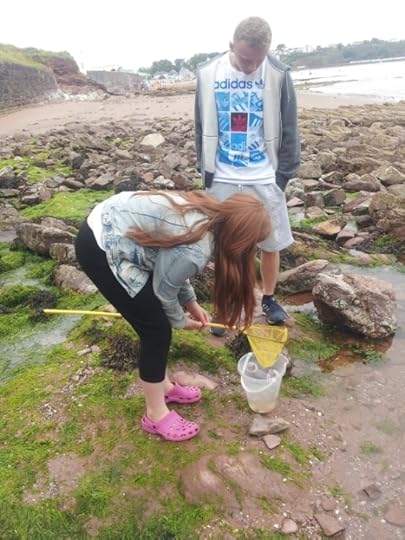
The holiday has also been very educational, Mollie has been to trips to Dinosaur World and Bygones (which was an exhibition about the past and how we used to live). She has also been watching a lot of CBeebies in the mornings, which is not a channel that she would usually select, this has had a lot of educational programmes on it including lots of information about World War One, ‘Horrible Histories’ and wildlife shows. Mollie is also doing lots of drawing, loom band making and writing in the form of her personal diary. We have also being rock pooling which led to discussions about wildlife and the tides. Her increasing knowledge about the world, for her age, is wonderful to see.
She has also being doing lots of arithmetic by managing her own money and insisting on adding up everyone’s crazy golf scores.
She really enjoyed an activity on the campsite which involved holding lots of creepy crawlies, snakes and a few cute and fluffy animals.
The Best Type of Holiday Venue for Mollie
Mollie copes far better in a caravan or bungalow than a hotel room. She needs to feel ‘home from home’ in an environment where she has plenty of room to relax and chill out. She has her home comforts in the form of TV, internet access (which has been intermittent), loom bands, colouring pens and importantly for all of us ‘space’. The space to have time out, from each other, facilitated by separate rooms instead of all being stuck in one hotel room has been vital.
Following an easy couple of first days, perhaps due to the novelty factor and the reduction of anticipation by finally arriving on holiday, the veneer of normality began to slip and we went back to dealing with a child with PDA rather than one who was concealing it remarkably well.
Following difficult days, where every PDA strategy in the book had been needed to be applied and every ounce of mental flexibility and patience had been exhausted to simply maintain the status quo we would try to reflect and identify triggers that could have caused this increase to her internal anxiety thermometer. The same can be said for any meltdowns, these are not as ferocious or as long winded as they used to be and usually take the form of being sworn and shouted at in public while also dodging a flying missile. Not as bad as they used to be but not highly desirable and still rather embarrassing, regardless of how much of a thick skin I try to develop, when you are in a very public place.
We noticed that Mollie was definitely more difficult to deal with when we were not on the caravan site. The site had become home from home and leaving it to go anywhere instantly put her on high alert. She found the unpredictability of it all very difficult to deal with. How long would we be in the car for, what if there were too many people, what if she didn’t like where we were going to and so on. We quickly learned that if we were out that every detail needed to be planned to the last minute. The child that once thrived on novelty now needed very strict routines and to know exactly what would be coming next at all times. Therefore each and every day would be planned by Mollie or we would simply follow her lead or make her a list of possible options that she could choose from.
Following meltdowns we would try to see what triggers had built up during the day to produce the final finale of the meltdown. Sometimes we simply have to guess and to try to work it out for ourselves but sometimes Mollie can help us in this area. This is very dependent on her mood at the time and is not something that I attempt to discuss with her during or immediately after a meltdown. I tend to pick my time carefully and even then it can be hit and miss as to whether she opens up or not.
A day at the beach ended up in a meltdown during the evening, in the bar, due to a build-up of small but anxiety provoking triggers. The following day once calm had been restored I suggested that we wrote our thoughts and feelings down in a thoughts diary, again this method will be hit and miss but it is a strategy worth keeping in my ever growing bag of PDA tricks and strategies.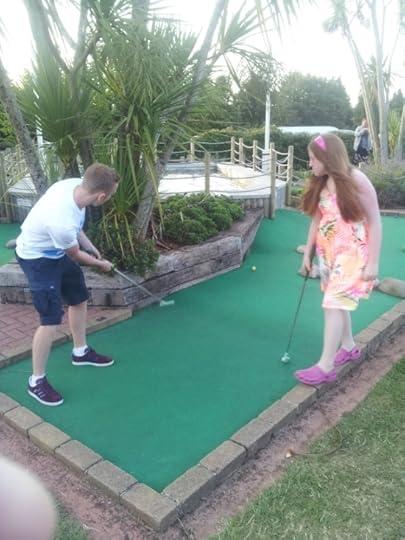
Triggers for the Meltdown Following Our Day at the Beach
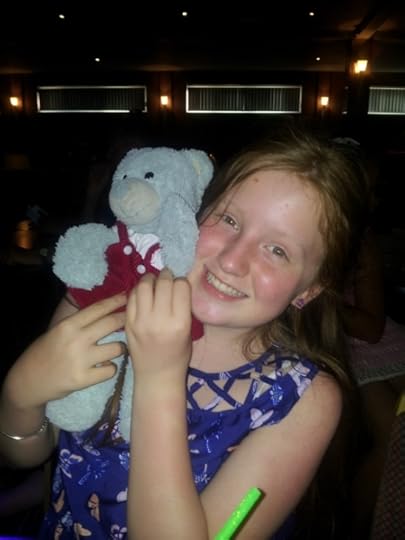
Leaving Blueberry behind because we were afraid of losing her on the beach greatly upset her because she feels much more secure when Blueberry is with her. Blueberry had ceased to be an active part of Mollie’s life but since her reintroduction into the social world Blueberry has mysteriously reappeared following, according to Mollie, a stay at a boarding school. Having Blueberry injected back into our lives can be very difficult because she becomes Mollie’s PDA alter ego for when Moll wants to cause mischief but without putting herself directly in the firing line. It is also very tiresome for Lee ‘who is Blueberrys voice’ to have to keep role playing being Blueberry Bear. This role play is required throughout the day and night.
As soon as we arrived at the beach she was eager to play and even waiting while sun cream was applied, deckchairs were hired and Lee sorting the parking spot out appeared to greatly aggravate her. Like many of our children she is unable to play by herself and needs that constant one on one interaction, meaning that this short amount of waiting filled her with pent up anxiety and boredom.
She wanted to play in the sea for longer than any of us could stand the cold and even though we did it in shifts it still wasn’t long enough. She simply could not cope when we had to call time on remaining in the sea with her.
As the day drew to a close this also stressed her out because she didn’t want the day to end, transitions are difficult for Mollie and this is another reason why leaving the site causes issues. It is the transition of going from one place to another.
At the bar she had now reached the limit and her tolerance level was full. When she needed a drink to wash her food down her dad, according to Mollie, took too long at the bar. The result was frustration and anxiety which she took out by annoying and stressing Jake out. One of my few non- negotiable boundaries is that I do step in when Jake is becoming affected by her behaviours towards him. Of course when I asked her to stop annoying her brother we had the meltdown. My handling of the situation could have been better but my tolerance and patience tank was also by 10.00pm at night running on empty due to the huge amount of mental gymnastics that had been actively employed throughout the day in order to avoid the very thing that was now ultimately happening.
The Other Side of the Coin (Trying to Teach Mollie How Her Actions Affect Others)
I am very keen to try to teach Mollie to have the ability to try to see situations from the other person’s perspective. So I also wrote my thoughts in the thoughts diary so that she could understand and view the day from my perspective.
I wrote down that while I understood how things had built up for her and that we would endeavour to reduce these triggers that the day had also being difficult for me and her dad too. We are often unaware of her worries because she doesn’t discuss them with us so that we can deal with them at the time and that dealing with the subsequent behaviour is exhausting and stressful for us.
While I understand the need for her to have constant attention it would be lovely for her dad and I to be allowed occasional periods of being allowed to have moments of relaxation together instead of having to be relentlessly on the go. Due to Jake being the same as a small child we have now being relentlessly on the go during holidays for fifteen years. It would be nice if Mollie could occasionally accommodate our needs also instead of her needs always being paramount.
Being sworn at and shouted at in public when we do everything that we can to meet each and every need and to provide her with as much support and understanding as possible is really upsetting for us, infact it physically hurts in the same way that a punch does, and it is not always easy to recover and move on from.
Conclusions and Strategies Devised by Mollie and I
Mollie will try, when her anxieties permit, to give Lee and I a small modicum of relaxation.
She will try to tell us her worries so that we can help her deal with them as and when they occur rather than building up inside.
If she feels a meltdown approaching and still has some ability to control her actions she will ask to come back to the caravan.

Since the first meltdown and the success of our negotiation Mollie still had two more meltdowns and so the results are hardly instantaneous. As the holiday continued Mollie’s behaviour became more and more controlling and difficult to manage. I think that she was finding it increasingly difficult to cope with the family dynamics of needing to fit into a four person unit. At home she usually experiences one on one attention within the family unit which is easier for her to cope with. Towards the end of the holiday it was becoming increasingly difficult for us to do or to achieve anything as a family unit due to Mollie’s attempts to fully control everybody, everything and her repeated attempts to kibosh activities that we were trying to do. However each time we go through the same routine of some type of discussion, at some point, about what has happened and measures that we can introduce for the future. Discussion may I add is not straight forward talking as one would usually expect but is often done in a very round-about way and by various means and methods. I suppose the positive isn’t whether or not we reduce meltdowns or triggers but is the fact that we now do have some sort of line of communication open all be it a very alternative one.
As a child I have bended completely to Mollie and given her complete freedom in order to reduce the meltdowns, restore self-esteem and to provide us with calmer waters within which to sail. However as she goes through adolescence and enters adult hood it is so important that I at least try to help her to accommodate the needs of others, to try to see events from the other person’s perspective, to take responsibility for her own actions and how these actions can affect others and to develop some level of empathy. She will need these skills if her progress is to continue into adulthood and although I may fail, or she may simply not be able to achieve these things, I at least need to know that I have tried.
I think that we are seeing some small degree of success in this area but like everything with PDA it is painfully slow. There are now times when her apologies and the sorrow expressed when she has upset someone do appear genuine, rather than simply going through motions of an apology which she doesn’t actually mean. These rare glimpses of true recognition and sorrow at how she has made someone else feel are encouraging signs that I can draw comfort from.


July 11, 2014
Progress On All Fronts!
Well it’s been ages since my last blog post. The truth is that I haven’t had much to report, everything has simply been rolling on in a rather uneventful way. Mollie continues to thrive and she now has a much more varied and positive existence. She is left to do her own thing but with very careful guidance from us it is all working out very positively.
She has even started to do lots of writing, completely under her own steam, in the form of plays, songs and letters to her friends. I have also, in some of her more recent writing, noticed that with no formal teaching at all she has decided to start doing joined up writing. Her literacy skills have vastly improved and have gone from strength to strength by simply learning naturally. Of course, she is extremely dyslexic and so her literacy skills will never be perfect but she now has enough capability and knowledge, in this area, to be able to navigate the written word and to be able to respond with her own written points.
Here is a recent example of Mollie’s writing which for an individual with severe dyslexia, and no formal education to speak of from the age of six, is outstanding progress.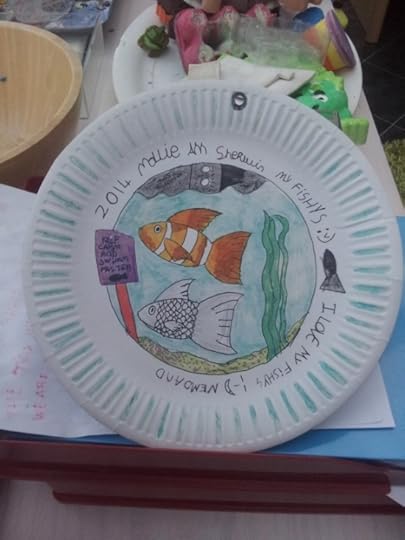
A really important and positive development is that Mollie has decided that she wants to sleep in her own bed!! I thought that the day would never arrive but unfortunately this does mean that I now have to put up with hubbie’s constant snoring and fidgeting instead! She decided, out of the blue, that she would like a fish tank in her room. Once the water had settled Nemo and Flipper promptly arrived and, as long as they continue to thrive in her tank, they should soon be followed by two more fish already named, by Mollie, as Champion and Captain. The desire to watch her fish swim about appeared to prompt her to have a desire to be in her own room at night.
Initially either Lee or myself slept on a mattress on the floor because she was uneasy about the thought of being on her own. After a very short period she declared that she was quite alright to be by herself and so she now goes to bed at about 11.00pm and stays in her own room all night. Of course she may often stay awake all night but she is happy, causes us no trouble and this is progression. None of this was instigated by us it simply came naturally from her, in her own time and of her own volition.
Here are Mollie’s notes on how to look after her fish.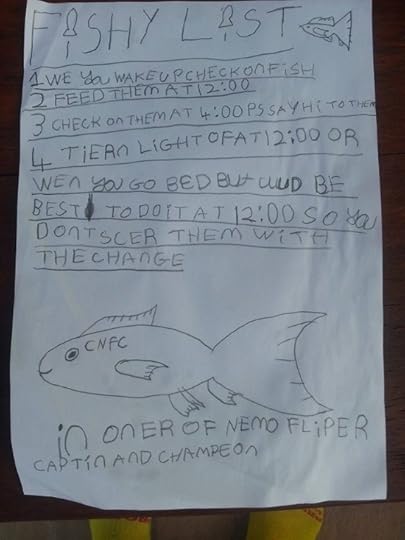
For my reference she drew me a picture so that I could recognise the fish and call them by their correct names.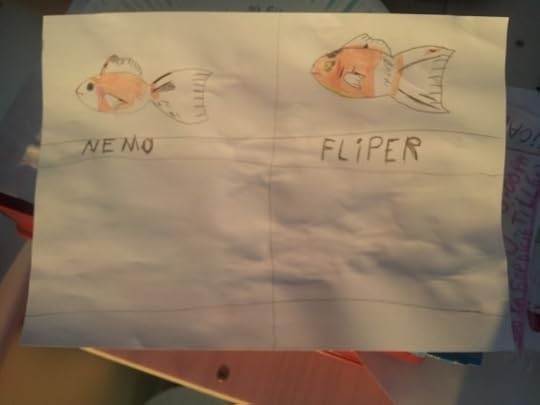
Something that I was dreading with a passion was Mollie starting her periods but I am pleased to announce that it has happened and passed by rather uneventfully. She completely took it in her stride and with added assistance from me she has coped admirably. I think that this is a big worry for many parent of girls with PDA but hopefully your girls will take you by surprise just like Mollie has done with me. She very proudly announced the news to her little group of friends and so those youngsters that didn’t know about periods do now. Thankfully I had already warned the mum in question of what her daughters may be about to learn. As ever she was totally relaxed and cool about things.
Mollie continues to play outside with peers and we now have a little group of about five girls who all knock on to play with her. It is lovely to see her out playing on her bike and her scooter while laughing with other children. However it isn’t perfect because we do have to deal with the stress that this elicits and absorb her anxiety of coping with the outside world when she is in the home. Her resistance to do anything at all in the home and her abruptness towards me has increased but it is much, much better than it used to be. Infact the words please and thank you have, without prompting or requesting, become a very normal and natural part of Mollie’s vocabulary. If she is coping with playing outside and with keeping a lot of the natural her ‘in’ then it is only reasonable to accept that some of this supressed natural Mollie will need to be unleashed inside the home.
While this approach of ‘unschooling’ may not be suitable for all children with PDA I think that it would be hard for anyone to argue with the results that we are achieving by following this very philosophy. I am not against education and my son still attends mainstream school and does well there. It is simply a question of following the path that is most suited to the individual involved. One size does not fit all and I aren’t of the opinion that ‘radical unschooling’ is the best option for every child or every family. However I do think that it is an option that should be given more credence and not so readily dismissed because it simply doesn’t fit in with normal conventions or trains of thought. The proof of the pudding is in the eating and it is the final result that this philosophy should be judged on.
Lots of parents in my street have been supplied with Mollie’s personally tailored PDA aware pack in the hope that this will allow her and us as much tolerance and understanding from others as possible. We only have the odd one or two neighbours that don’t appear to be understanding or tolerant to Mollie’s unique outward presentation and this can cause issues. However the majority are onside and are extremely supportive and understanding. For the odd one or two who aren’t then so be it, I have tried but, as they say, it’s no use knocking if there is nobody in. I am currently cultivating a rhino skin in my airing cupboard so that these few individuals can cease to affect me in the future.
I have sent my letter off to Stoke On Trent’s ‘Clinical Commissioning Group’ requesting that my local authority officially recognise, diagnose and support individuals with PDA. I’m not expecting any miracles any time soon but hopefully it will at least get those who are in professional positions, in my area, to be forced to at least discuss PDA. Simultaneously, the timing could not have been better, a fellow parent in my area recently contacted me with concerns that her child may have PDA. We have collaborated and submitted a complete pack of information re her child prior to her appointment at CAMHS. The case and my proposal for a referral to the ENC for assessment is water tight with every possible avenue explored and answered. Anything that CAMHS may potentially throw back at me re this case I am fully confident that I can quickly, efficiently and with knowledge bounce back, it will be interesting to see what they come back to me with.
I have also been doing loads upon loads of work on my book which has been accepted for publication by Jessica Kingsley Publishers who are quite possibly the main autism publishing house. Fingers crossed my publishers have pencilled in a very tentative publishing date for January 2015. Phil Christie himself, the world’s leading expert on PDA, has agreed in principal to write the forward for my book which I am absolutely thrilled about. Obviously he has to read and agree with the contents of my book before he can fully commit but I do hope that I have done the PDA cause proud and that he feels that he can put his name to my book. I have learned so much about writing a book while simultaneously fearing that I may, at some point, blow my own brains out. Hopefully I can take everything forward that I have learned to my next book. My publishers have given me excellent advice and comments and my book is now looking like a much more polished product as a result of their input. However I am sick of reading the damn thing, it’s my story, I know what’s coming next, there are no surprises on the next page and I’ve read it about fifteen times to date!
Some really exciting news is that Channel four are doing a documentary on childhood behavioural issues and that they will be featuring a slot on PDA. They have already done some filming at the Elizabeth Newson Centre (ENC) and interviewed some of the staff involved in the diagnostic process and Ruth Fidler who is the deputy head at Sutherland House School and speaks at the PDA conferences about the correct education provision for children with PDA. This is an amazing step in the right direction for the PDA movement, at last, some air time on mainstream TV!
The PDA Army marches on for acceptance and understanding, we will get there eventually!


July 5, 2014
Writing about violence from children

Thank you to ‘Holes In The Wall’ blog written by Helen Bonnick, a professional who has dedicated her career to studying and raising awareness of child on parent abuse.
 Originally posted on HOLES IN THE WALL:
Recently I have been contacted by a number of people also blogging about teenage violence, or about diagnoses associated with children exhibiting violence to their parents or others.
Understanding PDA is a website / blog by Jane Sherwin, bringing a wealth of experience about Pathological Demand Avoidance Syndrome, including a helpful booklet which explains the syndrome for professionals as well as parents, and sharing strategies that have worked with her nine year old daughter.
Dinky and Me is another personal story of life with a young child with PDA, the ups and downs and telling interventions that have not gone well because of a lack of sensitivity or awareness by professionals.
Teenage Violence at Home is a relatively new site written by a family who adopted three children who had experienced extreme early trauma some sixteen years ago. They now live with the youngest only, following years of what can only…
View original 123 more words