Dave Kinsey's Blog
April 17, 2019
What is Blockchain, How Does it Work, Who Created it, and Why?
In 2018, an employee from the State Bar of Arizona asked me to write an article to describe Blockchain to lawyers. The only way I could do justice to the topic was to write a book about it. Now that I’ve published that book, I’m going to attempt the nearly impossible feat of condensing it into an article. Adequately describing Blockchain requires a book, but here is my best shot at a reader’s digest version.
A block is a collection of transactions that might look something like:
19x8Vp3WsK3B49FyRw3M6z (1 BTC) → 1f2g9hcB31B3Gyw4KFa9D3V
The above example describes a single Bitcoin transaction. The two long strings of gibberish are called Bitcoin addresses and, in this case, 1 bitcoin was moved from one such address to another. While these addresses are publicly written into the block, there is no linkage back to a person. Therefore, untraceable transactions occur between anonymous parties, which is the reason why Blockchain was created.
Bitcoin is a cryptocurrency (literally “hidden money”) and it is untraceable because no governments are required AND no governments are supposed to be allowed to participate in this system. Bitcoin is the name that was given to the software and the system (the network of systems running the software). It is also the name of the “coins”, or unit of measure. There are no gold coins, all such pictures are strictly marketing. Bitcoins are just numbers in a computer program.
It is the product of a community called the Cypherpunks, that was first established in 1992 to bring about something called Crypto-Anarchy (hidden anarchy). Bitcoin was created to establish a hidden corner of cyberspace where governments (law enforcement and military) cannot see what is going on. Laws, such as anti-money laundering laws, cannot be enforced, and so governments become increasingly irrelevant. One of the stated long term goals of the Cypherpunks is “collapse of governments.” Cypherpunks hope that law irrelevance leads to eventual collapses of ALL governments.
Over the past three decades, a bunch of highly intelligent anarchists developed their vision where governments are replaced by computer systems. In this world, there are no laws, no lawyers, and no law enforcement. Armies are also a thing of the past and are replaced by Assassination Politics, which is crowdfunded murder using untraceable cryptocurrency. Smart contracts, or computer code on a blockchain, is seen as helping maintain some semblance of order in this post-government world.
Sometime after Bitcoin was released, the term Blockchain began to be used to describe anything that is “Bitcoin-ish.” This includes the manner of storing information (“chaining blocks together”) as well as the approach or algorithms that mimic Bitcoin. The many uses of the term Blockchain have become the source of a great deal of confused thinking. Many passionate (and often confused) people have some rather vivid (impossible) dreams of what Blockchain is and what it will do for the world. However, the core use case for Blockchain remains what it was first created for. It facilitates anonymous transactions outside of the visibility of governments. It helps “realize anarchy.” It is great for other anonymizing applications which may not have anything to do with cryptocurrency.
This Blockchain confusion increased even further when IBM and others attempted to create a “less anarchistic” (watered down) version of the technology called “permissioned Blockchain”. The original intent of Blockchain had no concept of “people”. The original design allows everybody to be anonymous. If there are no people, there is nobody to whom one might grant or deny permissions.
To make matters worse, this confusing new variant of the technology that IBM and others created, was also called “Blockchain”, only the word “permissioned” was appended to the name. While the unfortunately named “permissioned Blockchain” shares some traits with the original nation-destroying technology, it is fundamentally different in important ways.
Permissioned (watered down) Blockchain may very likely prove itself to be a worthless technology. Even so, it is currently very important to the story. Associating the name “Blockchain” with reputable companies like IBM and Deloitte provides undeserved validation to the original nation-destroying (permissionless) Blockchain and cryptocurrency. How many bitcoins do the investors and people working on permissioned (watered down) have?
Confused yet? Well, I’m sorry, but that appears to be the plan. This is not my plan, of course, this is the plan of the people who created the technology. One of the creators of Bitcoin, literally published a “declaration of war” against “the state” (all governments on earth) at the same time he was getting ready to announce Bitcoin. He called Bitcoin “a strike at the state from the jungle of complexity” and promised that the state would be confused and not figure this out until it’s too late. Well, I’ve figured it out and some others have figured it out. Yet, he may still be right. State legislatures across the country and the world are being deceived into passing laws that they do not understand.
To understand the whole story, consider reading my book, The Blockchain Code: Decrypt the Jungle of Complexity to Win the Crypto-Anarchy Game. The book has been receiving some rave reviews! The US Review of Books called it, “necessary reading for anyone considering dipping their toe into investing in bitcoin or its peers… Eye-opening in all the best ways and relayed with a quality that few non-fiction books ever reach, this in-depth guide is intriguing, shocking, and informative as it covers three decades of history punctuated by the social and technological explosion of the last ten years.” Aimee Ann declared, “Dave Kinsey has managed to accomplish the almost impossible… he has managed to write a finance book that is not only informative and useful, but entertaining!”
For more information on Blockchain, I will be presenting in two continuing legal education seminars at the State Bar of Arizona annual convention in June 2019. For questions about Blockchain, requests for interviews, or speaking engagements, email me at my author address, dave@modern.expert. For questions about IT, email me at dkinsey@totalnetworks.com. Lastly, you can find The Blockchain Code, in paperback and Kindle, on Amazon.
The post What is Blockchain, How Does it Work, Who Created it, and Why? appeared first on Modern Expert.


January 18, 2019
What do lawyers, lawmakers, and journalists need to know about Blockchain?
As I write this article, in mid-January 2019, the US government is in the midst of its longest shutdown in history. The impact is substantial, though the federal government is still largely operational. Soldiers are still at their post, law enforcement is still running, and many other functions still exist.
Building a Crypto-WorldHowever, some visionaries are hoping that the technology behind Bitcoin may someday completely shutter all governments on earth forever. The Crypto-Anarchist community called the Cypherpunks created Blockchain as a means of facilitating private, untraceable transactions between anonymous parties. The dream is to make governments impotent and obsolete by creating a hidden corner of cyberspace that exists beyond the visibility and reach of governments and law enforcement. The hope is also that lawyers, judges, and courts will eventually be replaced with something called smart contracts (computer code on a blockchain). The anarchists hope that smart contracts and something called distributed autonomous organizations (DAOs) may provide a certain degree of order in a post-government, crypto-anarchist world.
Later, a “less anarchistic” version of the technology, called permissioned Blockchain, was created and adopted by IBM and other companies. The jury is still out on if this will be a viable technology in the long-run. Advocates for both types of Blockchain have big plans to change the world. Hardcore visions of normal Blockchain advocates (not the watered-down permissioned version) are truly breathtaking.
It is important to realize that the Blockchain technology story is generally being told by people who are sold on the technology, often without fully understanding it. Additionally, because almost nobody understands the technology, these stories are being recycled, spreading misinformation on a massive scale. This has allowed advocates of the technology to encourage state legislators across the country to demonstrate that they are forward-thinking and pro-business by hastily passing pro-Blockchain laws that they openly admit they do not even understand.
Laws versus Technological RealityIn Arizona, the Blockchain law approved in 2018 appears to offer very lofty assurances of Blockchain functionality. Within what is supposed to be a legal description, Arizona Revised Statutes (A.R.S.) § 44-7061 states that “The data on the [Blockchain] ledger is protected with cryptography, is immutable and auditable and provides an uncensored truth.” In reality, Blockchain does not assure immutability, auditability, or provide an uncensored truth. The technology does not even match its own legal description. Additionally, the claim that the data on the ledger is protected with cryptography is extremely broad and imprecise to the point of being meaningless at best, misleading at worst.
While many states appear to be blindly endorsing the technology designed to destroy all governments, not all of them are. Tamara Chuang of The Colorado Sun wrote in January 2019, “In one of the more dramatic endings during the last legislative session, a bill aimed at putting Colorado at the forefront of blockchain policy passed by a single vote. But, moments later, it failed after some lawmakers changed their minds.”
While there is substantial confusion everywhere, there are also some voices of reason testifying to the US Congress. One such considered opinion has been provided by economist Nouriel Roubini. In testimony presented to the US Senate Committee on Banking last October, Roubini indicated that blockchain is the most “over-hyped — and least useful — technology in human history.” He also commented that “Crypto is the mother or father of all scams and bubbles.” There is substantial truth in Roubini’s comments, though the full story is much larger and more troubling than even these scathing remarks would imply.
Decrypting the TruthIn my new book, I present the fascinating history of the technology, clearly explaining how it works along the way. Julian Assange, the founder of Wikileaks and author of the 2012 book Cypherpunks, is also featured. Wikileaks released emails obtained from a hack of the Democratic National Party, altering the course of the 2016 US presidential election and setting in motion a series of events that led to the appointment of a Special Counsel to investigate a sitting president of the United States.
There are even some ties between the Blockchain story and the last US presidential election. My book highlights evidence suggesting that at least one Russian Cypherpunk was involved in the development of Bitcoin as early as March 2006. The Blockchain Code helps expose some hidden background information relevant to the ongoing Mueller investigation and the associated political circus.
The Blockchain Code: Decrypt the Jungle of Complexity to Win the Crypto-Anarchy Game is available for purchase in paperback and Kindle on Amazon. For more information, go to modern.expert (my author web page) or blockchainCODEbook.com (book webpage).
All citizens, not just lawyers, lawmakers, and journalists should be aware of what is going on, but these citizens have a particularly strong duty to pay attention to these developments. Please consider reading The Blockchain Code. Thank you.
The post What do lawyers, lawmakers, and journalists need to know about Blockchain? appeared first on Modern Expert.
January 14, 2019
Blockchain – the world’s first “trustless” technology?
A common selling point about Blockchain is that it “trustless”. This is a big deal because trust is the foundation of all human relationships and computer security. A truly trustless system would work something like, “first, hand over all of your money to former Nasdaq Chairman-turned-Ponzi-scheme-fraudster Bernie Madoff….” Nobody would voluntarily use a system that they do not trust. The language used to describe Blockchain is important.
The beginning of trust is knowledge. If you don’t even know someone at all, there is no basis for you to trust them. You must first get to know someone and have them provide reasons for you to trust them. The same is true for technology. If you’ve never even heard of a particular technology, you have no reason to trust it. However, after you learn about it and there are reasons for you to trust the technology, you may begin to trust it. With technology, we don’t always need to understand all of the details of how it works, but the more we understand about the technology, the easier it is for us to determine if we have a reason to trust it or not.
When Blockchain advocates refer to a “trustless” technology, although they may not say it or even realize it, they are indicating that they are trusting computer code and the system this computer code creates to provide a reason to trust unknown, anonymous parties across the internet. This trust may be leveraged to perform untraceable transactions between parties that never know the true name of any other party. The way that Blockchain accomplishes this is unique and clever. It is also not without significant challenges and flaws which may be exploited in certain circumstances to undermine the system. This type of system may be utilized for illicit purposes, such as money laundering or facilitating murder-for-hire. Additionally, there are more legitimate, noble purposes to which the technology may be applied. In all cases, the devil is in the details.
In The Blockchain Code, I attempt to take an honest, balanced look at the pros, cons, and engineering trade-offs inherent in the Blockchain approach.
The post Blockchain – the world’s first “trustless” technology? appeared first on Modern Expert.
ADDED BONUS – Appendix to The Blockchain Code – The Crypto-Story of Meltdown
The Blockchain Code: Decrypt the Jungle of Complexity to Win the Crypto-Anarchy Game is a book about Crypto-Anarchy, Blockchain, and cryptocurrency. Crypto-Anarchy is a real thing and the Crypto-Anarchy Game is a historical event. I believe you will find the truth about the technology and the history to be fascinating and important. Included in the technical background about Blockchain is something called a side-channel.
Permissionless Blockchain applications, such as most cryptocurrencies, are designed to facilitate untraceable transactions between anonymous parties. While the technology is very good at accomplishing this task, it is not flawlessly anonymous. There is always the chance that certain side-channels might reveal some information and the book discusses this in detail, including how Bitcoin transactions may possibly be traced under certain circumstances. A side channel is a way of seeing something that you are not designed to see. It’s a safe-cracker using a stethoscope to listen to the clicks.
Side channels were also in the news at the beginning of 2018 due to the Spectre and Meltdown CPU flaws that allowed the leaking of information on a massive scale via side-channel exploits. However, the Meltdown bug, which affects Intel, but not AMD, is far more interesting than the Spectre bug and this story was not accurately reported in news stories. In the Appendix to The Blockchain Code, the hidden truth about Intel’s Meltdown bug is accurately explained.
The story is important in its own right because:
In August 2018, another Intel-only vulnerability was announced (Foreshadow). Understanding Meltdown is helpful to understand other CPU data breach risks.Several months after Intel knew about the Meltdown bug, but before it was announced, Intel’s then CEO, Brian Krzanich sold all the Intel stock that he could within the constraints of the company’s by-laws. Concerns about this trade were raised by Motley Fool’s Ashraf Eassa, Forbes’ Ken Kam, as well as Mike Murphy, Alicia Ritcey, Melvin Anders, Ted Greenwald, Bret Kenwell, Sean Gallagher, Renae Merle, Troy Wolverton, and others. The list of journalists that raised the concern is extensive. A source from Bloomberg News indicated that an investigation was inevitable. Yet, there has been no SEC investigation into possible insider trading even one year later. Reports from Alicia Ritcey, Anders Melin, and Ken Kam appear to indicate that Krzanich changed his schedule of planned Intel stock sale in October 2017. This would have been in the midst of what should have been the largest crisis in Intel’s history and a couple of months before Intel’s Meltdown flaw was disclosed:
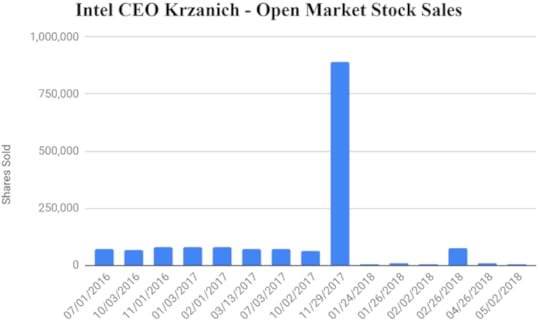
Data compiled from www.nasdaq.com/symbol/intc/insider-trades
The story is important to Blockchain for several reasons:
Regarding the Krzanich stock sale, the manner in which government regulations work and are enforced (or are not enforced) is important to the story of cryptoanarchy and Blockchain.Data leaks threaten to expose sensitive information, and this includes information from cryptocurrency wallets. Leaky wallets can allow others to spend your cryptocurrency.The Meltdown story is a story about side-channel vulnerabilities. While cryptocurrencies are designed to be anonymous and untraceable, the technology is made by imperfect human hands. There will always be potential side-channels that threaten to de-anonymize cryptocurrency actors. Gaining a better understanding of the largest side-channel exposure to date is instructive when considering Blockchain’s side-channel risks.The full story of Meltdown has been largely encrypted (hidden) by a jungle of complexity much like the truth about Blockchain. The Meltdown story is recent, yet the truth has already been heavily spun and hidden. There is much more spin and misinformation about Blockchain and it has been spun for a much longer time.This is a brief sample of some of the information contained in the Appendix to The Blockchain Code, to learn the full crypto-story of Meltdown (and Blockchain, of course), buy the book. Now available in paperback and Kindle on Amazon.
The post ADDED BONUS – Appendix to The Blockchain Code – The Crypto-Story of Meltdown appeared first on Modern Expert.
January 1, 2019
An Unexpected Book
My writing has historically been focused on magazine articles. I attempted to write about Blockchain, but was unable to do justice to the topic in a magazine article. Blockchain was too large and important. So, I ended up writing a full-length book about it. The Blockchain Code became the unexpected focus of my life for the better part of 2018. This is an important story that needs to be heard. I wrote the book, but in a very real sense, this is a book that I found myself compelled or “called” to write.
I have received very encouraging feedback from several early reviewers on the importance of the message and the quality of the book, so after considerable review and editing, I am calling it done and publishing today! I hope you enjoy and find yourself informed by The Blockchain Code. If you have any comments or feedback, please consider leaving a review on Amazon and/or contacting me to let me know.
The post An Unexpected Book appeared first on Modern Expert.