
Susan Hunter's Blog, page 12
September 30, 2015
A Secret Order

my desk, sad but true
My name is Susan, and I have a very messy desk.
I’m hoping that out there is a chorus of people shouting “Hi, Susan,” in recognition, solidarity and non-judgment. Though I’m sure some looking at the actual, real-life photo of my desk that accompanies this blog will be recoiling in horror and disbelief.
I’m a washout in the clean desk brigade. Before anyone calls the health department based on the above picture of my desk, I’d like to say that my appalling ability to allow clutter to build up around me does not extend everywhere in my environment. My used dishes are put in the dishwasher (mostly), my floors are dusted (periodically) and my bathroom is clean and clutter free. Though full disclosure requires that I admit a significant part of that is due to my very tidy husband, who never met a piece of paper he didn’t want to throw away.
The inability to maintain workspace order is a lifelong condition which has followed me from messy lift-top desks in grade school to overflowing desks in college and continued on to extremely cluttered work stations in my various places of employment. The situation became even worse when I was no longer stationed in an office pool with other staff, but had my own office with a door to close when the desk was no longer in condition for public viewing.
When I’m working, whether on a fifth grade book report, a grad school thesis, or a mystery novel, silently, unknowingly, unintentionally I begin piling up detritus, until my desk appears as it did at the recent completion of the final edit of my second book. At that point my work area included, as the sharp-eyed among you can see:
A coffee cup
An overflowing printer
Empty wrapper from a ream of paper
3 water bottles
A camera
2 open file drawers
1 open desk drawer
Stacks of notebooks, reference books and reading books
Pens, pencils, markers
Hand sanitizer
Discarded hoodie
Discarded blanket
But there comes a point in each messy desk growth cycle when the scales tip, and my need to hold that thought, capture that phrase or write that chapter is outweighed by my need to find my cell phone, locate a hastily scrawled message, or retrieve a lost earring. At that juncture, I regroup and declutter by tossing, filing, discarding and/or returning to their proper places all the leavings I’ve deposited, and reclaim my workspace, restoring it to a place of order instead of chaos.
I always intend for it to stay that way, but it never does.
I have finally come to accept that something there is [in me] that doesn’t love a clean desk, and sets about festooning it with notebooks, pens, books, manila folders and piles of paper and doesn’t stop until it once again resembles a hoarder’s paradise. And I will take solace in Carl Jung’s observation, “In all chaos there is a cosmos, in all disorder a secret order.”
However, to all those who shut every drawer they open, file every document they need, discard every used item in its proper receptacle, and sit down to a well-organized workspace every day—I salute you. But I am not one of you, nor will I ever be.


September 17, 2015
Falls the Shadow

A thing of beauty is a joy forever
I have often and sadly noted the distance between what I imagine something will be like, and what it actually turns out to be. Nowhere is the distance between the real and the ideal more clear than in the delirium that periodically makes me attempt to knit a shawl, or take up scrapbooking, or cook a complicated recipe that Martha Stewart has assured me will be a good thing. It never is.
The Merry Christmas wreath I imagined would be suitable for gifting or hanging on my front door emerged from dream to reality as a tangled mass of wire, tattered ribbons and blood-spattered pine cones—the latter due to an unfortunate jab into my thumb instead of a pine cone. The ceramic bowl intended as a decorative item became a misshapen object with collapsing sides, useful only as a conversation piece, and only if the conversation began with “What is that?” The gingerbread house begun with high hopes and plastic canvas faded into the reality of a grubby, forlorn, knotted and bowed creation that looked more like an abandoned shack than a fairytale cottage.
And it was ever thus. I never mastered the basic building blocks of arts and crafts—measuring, cutting with scissors, gluing shiny things to fabric, not to my fingers. I admire very much those who do have such skills. Yet despite all evidence to the contrary, I can still be lured from the land of reality to the place of possibility, where once, just this once, my idea and my result will match.
I’m not involved in any crafty pursuits at the moment, yet the holidays are in the offing, and I know that a faint, siren song will call to me. Why don’t you knit a pair of socks for everyone for Christmas? How hard can it be?
The thing is, I know how hard it can be. And I know how true the T. S. Eliot quote is: “Between the idea and the reality … Falls the Shadow.” So, I’ll try to stop myself, focus on my next book, or maybe just read someone else’s. I’ll leave the box with all the left-over yarn from other, misbegotten projects on the island of misfit crafts, where it belongs. And yet, I can just imagine how good those socks would look …

September 2, 2015
Not in Cursf, please
 I’ve read several articles lately on the debate over teaching cursive writing in schools, or tossing it out. Those in favor of ditching it argue that with texting, tablets and computer keyboards, there’s no need for cluttering up the curriculum with a skill whose time has passed.
On the other hand, advocates of teaching “longhand” point to studies that show students retain more when they take notes in cursive, because cursive writing engages more areas of the brain. In addition, people who don’t learn to write cursive have a hard time reading it. That means personal family journals and letters, as well as historical documents could be indecipherable to future generations without assistance.
The last argument resonates with me because of something that happened years ago, when my children were young. I was frantically trying to finish a writing project with a firm deadline. As the due date approached and true panic set in, I figuratively barricaded myself in my office – as much to keep me in, as to keep others out. I gave instructions to my daughters, then 7 and 11, along the following lines.
“Do NOT come into the office. Do not knock on the door. Do not shout through the door. Do not even approach the door unless someone is bleeding, or the house is on fire.”
“But what if—?”
“No what ifs. I have to get this done. Today. If you hear me open the door, you can talk to me then. Otherwise, I don’t exist. I mean it.”
Being resourceful, independent, and insightful enough to detect when their mother was on the edge of a nervous break down, they took my words to heart and left me to my work. Occasionally, a thud, door slam, cry of outrage or shout of laughter penetrated my fortress of solitude, but I heard nothing that sounded like an in-person intervention was warranted.
After about four hours I had made real progress. As I leaned back in my chair for a good stretch, I heard the sound of hushed debate coming from the hallway. I was about to investigate, when a sheet of lined paper fluttered in under the door and across my office floor.
I stooped to pick it up, and this is the message I read, written by my seven-year-old.
Sorry to buther you. Alex [our dog] has a sore spot on his back. It is bleding. We think it is bad. Sara says, should we call the vet? Please answer.
P.S. Not in cursf
It made me laugh and feel guilty at the same time — both responses my children remain skilled at invoking. I felt bad that I had been so forceful in my demand for peace that they only dared breach it with a note. Though in my defense, I did specify ‘bleding’ as a reason to knock on the door. And I laughed because my daughter feared that even if her negligent mother responded, she might do so in the indecipherable code of cursive writing.
I understand that technology may make cursive writing seem obsolete, but I’ll always favor it, because the thrill of mastering the secret language of ‘cursf’ seems like a rite of passage to me. And yes, pun intended.

August 20, 2015
The lightning or the lightning bug

Grandma Jenny
I like words. I like some just for the way they sound, rolling off your tongue. I like others for the nuances and delicate layers of meaning they convey. And I love to hunt for just the right word to convey what I mean in writing and in speaking.
So, it’s one of those little jokes of the universe that I fell in love with a man who not only doesn’t search for the right word, he blithely makes up his own in order to get his sentences out as quickly as he can. At least that is the only reason I can find for the unintentionally hilarious way he pulls words out of thin air.
Sometimes the word he chooses is a close approximation of the actual one he needs. For example, we attended a Kirtan practice — which is a kind of Hindu devotional singing with chant and response. It wasn’t exactly in Gary’s wheelhouse, but he went because our daughter invited us. The next day he said, “I don’t really think croutons are my thing.” Some might have thought he was saying he didn’t like toasted bread cubes. I knew immediately he meant Kirtan.
Just recently when I was struggling with the ending of the book I’m working on, he offered these encouraging words. “Don’t worry. I know a Tiffany will come, and it will all work out.” I waited all day, and Tiffany did not show up to help me. Neither did an epiphany.
Occasionally, the word he chooses is vaguely related to the one a regular person would choose, but it takes some puzzle solving skills to get it. Awhile ago we were watching a horse race on television, and I asked him who owned the winner. He said he wasn’t sure, it might be a combine. I told him I was pretty sure a combine was a large piece of farm equipment, and then proceeded to try to unravel his meaning. It took a few minutes, but I finally realized he meant meant syndicate — which is a group of individuals or organizations who combine for some purpose. Hence combine, and then it made sense — in a Gary kind of way.
One of my favorite Garyisms fell from his lips years ago, when a friend said he was going to Las Vegas and wanted to see some shows. “Oh, you should see Sigmund & Freud, they’re really good.” Yes, that’s right. He meant Siegfried and Roy.
He presented a tougher word challenge when he told me about a TV show featuring high end automobiles, and how expensive and amazing they were. He was most impressed by the Grandma Jenny. I said, “Gary, stop it. There can’t be a sports car called a Grandma Jenny.” He insisted it was that, or something very close, and then it hit me. A Lamborghini. When I offered that as a possibility, he readily agreed and didn’t really see how what he’d said was that far off.
One of my editors from my newspaper days frequently shared this Mark Twain quote, “The difference between the right word and the almost right word is the difference between lightning and a lightning bug.”
But honestly, if he were always on top of the right word, it wouldn’t be nearly as fun to talk to him. And a conversation with Gary is always entertaining.

August 6, 2015
Nothing gold can stay


I saw a lemonade stand last week. Just a little kid with a sign and a table. It wasn’t remarkable, except for the fact that I realized I haven’t seen one in years. Which got me thinking that it’s been a long while since I drove by a park in the afternoon, and saw it filled with children, and I can’t remember the last time I saw kids dressed up in cast-off adult clothes, playing a game of make believe, or marching down the street in a neighborhood parade.
Times change, and so do customs. Carefully orchestrated play dates and scheduled activities have taken the place of pick up games of baseball or bike rides that ranged all over town. The internet and its unlimited horizons may have eclipsed the joy of exploring neighborhood boundaries. Parents made wary by the 24/7 cable news focus on abductions and other dangers now keep children more tightly tethered than my siblings and I were, or than my own kids were when they were little.
This is not to say that ‘back in the day it’ was better, but it was definitely different. When I was a child, we left the house in the morning, came back for lunch, left again until dinner, then we were outside until the street lights came on. The only thing that brought us back home betimes was grievous personal injury — a serious scrape needing a bandaid and a little sympathy, or maybe a broken bone. Though there were surprisingly few of those, given the many trees climbed, bike miles ridden and forbidden bridges crossed.
And there was endless time on hot summer days to do nothing but lie on a blanket in the shade of a tree and watch the clouds passing by, while the leaves whispered softly overhead. And though my own children had more scheduled activities than I did as a child, they still spent most of their free time with neighborhood friends in self-generated play — producing “radio” shows with a tape recorder, organizing dog circuses with our long suffering pet Carrie, sailing on a pirate ship (that also doubled as our front porch) with their friends.
But in this worrisome world, it may well be a luxury with too high a price for parents to allow their offspring the freedom to ramble. And families that need two incomes must juggle jobs and day care with organized ways to give their children play time. I get it, but still …
I miss the sound of joyful whoops and indignant howls as games are won and lost in neighborhood backyards on long summer nights, and the sight of kids playing dress-up in cast-off formal wear, and the taste of watery lemonade on a hot summer afternoon, handed to me with a chubby, grubby hand, and the happy smile of a young entrepreneur.
At the heart of the matter, I suppose, my longing for the return of free and unfettered play isn’t really for the kids’ loss. It’s for mine.


July 23, 2015
A Loving Heart
 From the desk in my office I can look out across the river. When I do, my eyes are always drawn to a small clearing in the woods on the opposite side.
Sometimes, if I stare really hard, I can almost see my friend Irene standing there. We took a long, meandering walk at least once a week, and often wound up at that spot in Conservation Park. We saw each other often, and spoke almost every day. For a long time after she died, at odd moments I would pause, almost sure that I’d heard the front door open, and her voice calling, “Hi, Susan, it’s Irene.” But of course I hadn’t.
Irene and I were not very alike. She was tall and slender, with shiny black hair and thick-lashed brown eyes. She was the kind of person people noticed. The first time I met her, we were both working at a small daily newspaper. She was in advertising, and I was in editorial. I remember coming in the side door of the office after covering a farming story. I was hot, disheveled and still carrying the faint aroma of the livestock barn I’d been in.
Irene was walking out. She wore a sleeveless beige cotton dress, heels, and her hair was perfect. I gave a perfunctory “Hi,” intent on getting my hands washed, my hair under control and that peculiar odor dispelled. But Irene was having none of that. She smiled and stopped to talk — Irene never met a person she didn’t want to talk to — and proceeded to engage me in conversation, at the end of which I was still hot and tired, but maybe a little less cranky.
Over the more than 25 years that we were friends, I learned many things from Irene, not because of what she said, but because of who she was. She always had time for people, she moved with ease and grace through any social situation, she was kind, she was gentle. But she wasn’t a pushover. If she believed strongly in an issue, she spoke up firmly. If she got angry, she expressed herself. If she placed her trust unwisely, she didn’t repeat the mistake. But she never wished anyone ill. Instead she sent a silent blessing, and moved on.
Because of Irene, I learned to judge less, to trust more, to accept the imperfect in myself and others. Sadly, I don’t do any of those things consistently, but I never stop trying, because of her.
Am I making her sound perfect? She wasn’t. She carried wounds, and was a flawed human being, and did things she was embarrassed by, or ashamed by or felt guilty about, as we all do. I know those things are true, but they’re overshadowed in my memory by the luminosity of her loving heart.
Irene, who gave me so many gifts over the course of our friendship, gave me the last one on the day she died.
That Friday she was on a small plane flying to Mayo clinic, with her husband Don, who was very ill. I’d been out all morning, and when I got home, the message light on our phone was blinking. I picked it up, and heard her familiar greeting, “Hi, Susan. It’s Irene.”
And then in a voicemail that lasted just a few seconds, she told me the plane was going down. She gave me a message for her daughter, said she loved me, then there was only static, and a terrible silence.
If I live to be 100, I will never experience more courage and loving kindness than that. In the last, terrifying moments of her life, she gave me the gift of saying goodbye.
Irene Iseminger Pavlik died five years ago today, July 23, 2010.
Three other people were killed that day, Irene’s husband, Don Pavlik; a physician and friend, Dr. James Hall; the co-pilot Earl Davidson. Their families and friends, I’m sure, mourn them as much as I do Irene.
Down, down, down into the darkness of the grave
Gently they go, the beautiful, the tender, the kind
Quietly they go, the intelligent, the witty, the brave.
I know. But I do not approve. And I am not resigned.
—Edna St. Vincent Millay

July 6, 2015
Cross that off your list

To do list
Today is a very happy day, as anyone who is a list maker will understand. I was able to cross off an item that has shown up on every list I’ve written for a distressingly long time. I finally finished the first draft of my second novel, Dangerous Mistakes.
I’m very partial to lists, not because I’m super organized, but because I’m not. A visual reminder helps keep me on track, and I get a thrill out of all proportion to the action when I’m able to draw a line through an accomplished task.
I keep a list when I’m writing a book that usually spans a week or so (in book time) of all the things my characters need to do: who to see, where to go, what clues they discover, what revelations they have. I usually stay pretty small scale and specific with my tasks. Otherwise, instead of inspiring me to write on with dedication and a sense of purpose, my list has the opposite effect. If the goals are too broad, I get overwhelmed with how far I have to go before I finish even the first draft. Then, I’m inclined to dither the day away, checking online to see what Etsy has to offer, or looking up different versions of my horoscope until I find one I like, or reading other people’s already completed books. The latter is the way to dusty death for my writing plans, because I invariably find other authors’ work infinitely superior to mine, and wonder why I’m even trying to write at all. From there, it’s just a short step to a comforting pint of mint chip ice cream and a Law&Order marathon.
Over the past month or so, I’ve been edging close to the conclusion of the first draft of Dangerous Mistakes. This is the hardest point in writing for me, because it’s the place where all the vague ideas I’ve envisioned leading to the ending must come into focus. No longer can I say, “Well, Leah goes there and blah, blah, blah, somehow she finds the final clue and then yada, yada, yada, whatever, I’ll figure it out. And then the ending happens.” It’s the time when the “blah, blah, blah” and “yada, yada, yada” have to be replaced with coherent, logical actions that lead to a satisfying and hopefully surprising ending.
At last, this is how my list looks today:
Last 20 Pages
Change time frame
Drop grandma
Ross and Leah scene
Rework last page
Finish first draft
Of course, there are miles to go before I sleep in terms of editing, rewriting, proofing and then on to formatting for ebook and print and then publishing, and advertising and — Oh-oh, I’m feeling an urge for mint chip ice cream coming on. But for a few days, I only have one thing on my new list:
RELAX

June 5, 2015
Lone Star State of Mind

Part of my daily ritual is a look at my website, my sales and my book reviews. Most days the numbers for all three are modest, to put it mildly. But, hope springs eternal for the self-published author, so I continue to check my numbers with the same optimistic anticipation a lottery player feels just before he checks the numbers on his ticket. After all, somebody’s got to win, right?
Having accepted that my first book is not likely to support me in the lifestyle to which I’d like to become accustomed, I have adopted smaller scale dreams, and can get quite giddy when I discover I’ve sold four books in one day, or had 8 visitors to my website. But nothing thrills me quite as much as seeing that I’ve garnered a new review. Unless, of course, it’s a bad review.
I’ve heard other authors say that even bad reviews are good, because you can learn something from them. And I know that’s true. I’ve had a few written reviews, as well as several conversations, wherein a reader has pointed out some things she thinks could be better, and why. It’s a little painful at the moment, but in the long run, helpful for the next book. Sort of like when your sister says “Yes, you do look fat in that dress.” Hard to hear, but useful, because it gives you time to make the necessary adaptations: find a new dress, lose 10 pounds, invest in Spanx, or get a new sister.
But the reviews that are of no value, except for purposes of making you feel bad, are the 1-star ratings, with no commentary. You’re left to wonder why the reader relegated your novel to the “This book is terrible” ranks. Was the plot too farfetched? The characters too flat? The dialogue unrealistic? The writing awkward or ungrammatical? It’s easy to fall into a lone-star state of mind, fretting about the whys of a negative review when there are no reasons given.
Recently I received a 1-star rating (not my first) that gave no clue as to why the reader ranked it so low. I decided to try and figure out the reviewer’s rationale myself. I checked other books she ranked, thinking maybe she was just a really hard grader and always gave low ratings. Nope. Her average rating for a book was 4.65. Ok, maybe she just didn’t care for the genre. Uh-uh, not that. She identified mysteries as a favorite type of novel. Well then, perhaps the subject matter was too dark for her. Mmm, don’t think so, she gave high marks to several books with rather gritty themes. Clearly I wasn’t going to find any answers that way.
So next I spent some time researching the ways other writers respond to negative reviews. Most had very sensible advice about accepting that people have different tastes, realizing readers respond through their own experiences and filters, and refusing to take bad reviews personally. All good suggestions. Then I came across an article by an author who really couldn’t let go.
In a story that ran in The Guardian last fall, she detailed her fixation on a bad review of her book. It became an obsession that led her to pay for an online background check of the reviewer, to spend many, many, many hours tracking her down, to call her at work, to show up at her house and to engage in other stalker-like behavior. Ok. Clearly that way madness lies, and a possible segment on Forensic Files. My takeaway from the article was, “Just walk away from the one-star review, Susan. Just walk away.”
And so, my equilibrium restored, I’m resolved to stop trying to find out the why of a bad rating or negative review. Instead, I have internalized a simple truth all authors can embrace: Sometimes, readers just aren’t that into you.


May 10, 2015
Putting Leah in her place
 One of the nice things about writing the first book in a series is that you don’t have to worry about contradicting yourself. Nobody knows anything about your characters, what they look like, or where they live, or what they fear and love. So, you can pretty much make things up on the fly. In Dangerous Habits, the first book in the Leah Nash Mysteries series, I blithely sent Leah and other characters all over the town of Himmel, Wisconsin, making up directions and street names and landmarks as I went.
However, as I started writing the second, I realized that alert readers might notice that a building I’d placed on the north end of town in the first book, I’d accidentally relocated to the south end of town in the second. I decided a map of Himmel was needed to keep Leah in her place. Unfortunately, I am not very good at spatial relations. Lining up streets and intersections and rivers and buildings took me hours and hours and hours, and what I ended up with looked like the drawing of an artistically challenged preschooler. So, I turned to Nancy and Dale Beach, graphic artists who designed and helped me do all the technical things necessary for the book cover of Dangerous Habits.
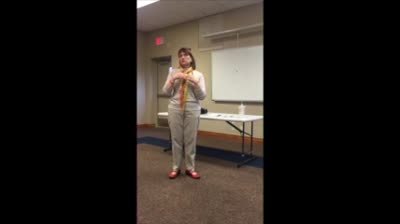
They created a wonderful map of Himmel that I’m using as my guide for future books, as well as a map of DeMoss Academy where much of the action in the first book takes place. Both maps are now on my website, under the heading Leah’s world. You’ll find a short video clip from the presentation I did at the library (The Howdunit of a Whodunit) a few weeks ago there and also at the bottom of this post. In it, I talk a little about how and why I chose the location for Dangerous Habits. And finally, the entire video of the presentation is located on the site under, appropriately enough, the heading Video.
The computer savvy among you would not believe how long it took me to edit and upload those freaking clips! Even with help from a very patient friend. But my technology revels now are ended, and I’m going to return to something a lot less frustrating — working on the last 1/3 of the second Leah Nash mystery.

April 24, 2015
The situational extrovert
 People who know me are aware that my normal introvert inclination toward a social event involving more than a few friends is to search for a polite excuse. I don’t dislike people, I just find large numbers of them gathered in one place somewhat overwhelming. This is especially true when I don’t know most of them. My store of casual chit-chat is rapidly depleted during the “social hour,” often leaving me and my partner in conversation stranded in a stupor of inanity, both (for different reasons) searching for rescue.
Thus you could reasonably expect that I might stutter and stammer and run a hundred miles from a public speaking event. However, I do not, because I have a secret that I suspect other introverts share. I am a situational extrovert. That’s a trendy-sounding term I came across awhile ago that in my case is really just a stand-in for “closet show-off.” I score off the charts on the introvert scale, yet when I’m asked to take center stage, when it’s my role to be the focus of attention, my inner performer rises to the fore.
I spoke last week at a local library event attended by maybe 40 people. The week before that I guested at a well attended book club. Both events were really fun, even though both called on me to function as an extrovert would — circulate before the meeting and be comfortable delivering a program and/or fielding questions. It’s the situation that pulls out the extrovert in me. That’s not to say that public speaking comes as easily to me as it does to extroverts — those friendly souls who speak with easy confidence, even though they may have no idea where their words are going to lead them. It’s quite the opposite for me. I have to think and organize and make sure I’ve got my material down cold. But once I do, I’m ready for my close-up, Mr. DeMille.
Now, I don’t think I could do that 24/7, because part of my pleasure in the whole center stage thing is the blissful retreat to peace and quiet when the event is over. But when I let my undercover extrovert self out for awhile, I’m usually rewarded. At the author event, I reconnected with two women from different work areas of my life that I might never have seen again, had I not accepted the invitation to speak. I also met several nice people and as we talked we discovered unexpected links to each other, in that six degrees of separation way that small towns like mine afford.
So the moral of this story is, we’re not all one thing or the other, neither absolute extroverts nor immutable introverts. There is some of each in all of us, and it’s good to shake things up once in awhile. Let your extrovert flag fly now and then, if you’re inclined toward introversion. Or take a break for some solitary reflection if your usual approach is group engagement. There are satisfying rewards to trying a different way of walking in the world.


