Ian S. Bott's Blog, page 7
April 25, 2020
Grim statistics
Over the last month I’ve developed a grim fascination with figures. Trying not to let it become a compulsion - but what the heck! - Ali watches news briefings, I watch graphs. In these trying times I think a little short term madness is essential for long term sanity.
I discovered the Worldometers site which captures a whole raft of world statistics, including tracking the daily progress of the pandemic.
At the start of April, experts were suggesting the US might see between 100,000 and 200,000 deaths. At that time, when the tally was still only a few thousand, such figures were laughed at and quickly downplayed by politicians. A week or so later, the expected toll was revised down to between 60,000 and 80,000.
Now, the US is heading for a million cases by Monday and should exceed 60,000 deaths by Tuesday. On current trends I fully expect that original estimate to be realistic - if not optimistic.
I know it’s not really scientific to compare one country with another, when each has different demographics, different healthcare systems, and different approaches to handling the pandemic. But those are the only pointers we have to go on. So looking at countries that are further ahead in the outbreak, places like Italy and Spain reached a plateau in the graphs of daily new cases and daily deaths, followed by a slow decline. The US and Canada are still on the early part of that plateau. In fact, they haven’t really leveled off in a significant way. This tells me that today’s figures will likely at least double or triple over the next month.
While I’m making dire predictions, looking elsewhere in the world I am keeping a worried eye on both Brazil and Russia. With all the attention on China, then Europe and Iran, followed by the USA, they haven’t really been prominent yet. But just looking at the recent rates I can see them both joining the “100,000 club” by the end of the month and mingling with the hard-hit European nations soon after.
Finally, it sickens me to see the protests flaring up in some countries. These figures are bad enough, and they’ve only been kept at this level (I was about to say “this low” but there is nothing low about them) by the measures being taken. Healthcare systems have been stretched, but not completely broken. That will all change drastically if we let down our guards too soon.
I discovered the Worldometers site which captures a whole raft of world statistics, including tracking the daily progress of the pandemic.
At the start of April, experts were suggesting the US might see between 100,000 and 200,000 deaths. At that time, when the tally was still only a few thousand, such figures were laughed at and quickly downplayed by politicians. A week or so later, the expected toll was revised down to between 60,000 and 80,000.
Now, the US is heading for a million cases by Monday and should exceed 60,000 deaths by Tuesday. On current trends I fully expect that original estimate to be realistic - if not optimistic.
I know it’s not really scientific to compare one country with another, when each has different demographics, different healthcare systems, and different approaches to handling the pandemic. But those are the only pointers we have to go on. So looking at countries that are further ahead in the outbreak, places like Italy and Spain reached a plateau in the graphs of daily new cases and daily deaths, followed by a slow decline. The US and Canada are still on the early part of that plateau. In fact, they haven’t really leveled off in a significant way. This tells me that today’s figures will likely at least double or triple over the next month.
While I’m making dire predictions, looking elsewhere in the world I am keeping a worried eye on both Brazil and Russia. With all the attention on China, then Europe and Iran, followed by the USA, they haven’t really been prominent yet. But just looking at the recent rates I can see them both joining the “100,000 club” by the end of the month and mingling with the hard-hit European nations soon after.
Finally, it sickens me to see the protests flaring up in some countries. These figures are bad enough, and they’ve only been kept at this level (I was about to say “this low” but there is nothing low about them) by the measures being taken. Healthcare systems have been stretched, but not completely broken. That will all change drastically if we let down our guards too soon.


April 19, 2020
The new normal
How are your self-isolation measures going? In the last week there’s been growing unrest down in the US, and increasing demands to open up for business again. Up here in BC we seem to have escaped relatively lightly, with strong public awareness of and support for the need for caution, but without the more stringent measures many countries have adopted.
Of course, schools, pubs, restaurants and many business are closed. But much of life continues, albeit in considerably altered form. Ali is home, but helping her students through remote one-on-one tuition. Grocery stores are essential businesses, so Megan is still working in the bakery. Matthew, of course, is in his element. He spends his days gaming online with friends and this is just an extended summer for him.
My office is still open. Although most of our services are online, we take in mail and couriered documents, and for some things there is no online alternative. So although we have a full complement working remotely there is a skeleton staff still physically present, and it’s important for at least one or two of the leadership team to be present for moral support. But the office is a ghost town these days. On a typical day there might be half a dozen of us there, in an office that is normally buzzing with seventy or more people.
I can mostly work from home, but I find I work better in the office. The mental switch that comes with the change in scenery is important for me, as is access to printer, scanner, and a handful of physical files. So I’m commuting in most days, and enjoying the silver lining of little traffic on the roads.
Many people in the branch are enjoying working from home, and even report better concentration and productivity. The government IT infrastructure has had a real workout these past weeks. Still some network capacity challenges, but they are still making improvements.
Grocery shopping is getting more organized. There are subtle changes each week. They’ve improved the one-way system around the aisles, especially through the produce section, and put up more screens at the tills to separate lines of customers so now they can open all the checkouts again instead of every second lane. The line-ups are manageable and the store has been fairly quiet the last couple of weeks, even on a Saturday morning.
And I noticed they even had toilet paper on the shelves this week. Things must be looking up!
Finally, I also managed to buy art supplies this week. I’m completing a major round of edits on The Long Dark and am looking ahead to cover art. The art store is closed to foot traffic, of course, but they are taking orders by phone. The store is just a couple of blocks away from my office, so I was able to pop out and collect my order that same day.
Of course, schools, pubs, restaurants and many business are closed. But much of life continues, albeit in considerably altered form. Ali is home, but helping her students through remote one-on-one tuition. Grocery stores are essential businesses, so Megan is still working in the bakery. Matthew, of course, is in his element. He spends his days gaming online with friends and this is just an extended summer for him.
My office is still open. Although most of our services are online, we take in mail and couriered documents, and for some things there is no online alternative. So although we have a full complement working remotely there is a skeleton staff still physically present, and it’s important for at least one or two of the leadership team to be present for moral support. But the office is a ghost town these days. On a typical day there might be half a dozen of us there, in an office that is normally buzzing with seventy or more people.
I can mostly work from home, but I find I work better in the office. The mental switch that comes with the change in scenery is important for me, as is access to printer, scanner, and a handful of physical files. So I’m commuting in most days, and enjoying the silver lining of little traffic on the roads.
Many people in the branch are enjoying working from home, and even report better concentration and productivity. The government IT infrastructure has had a real workout these past weeks. Still some network capacity challenges, but they are still making improvements.
Grocery shopping is getting more organized. There are subtle changes each week. They’ve improved the one-way system around the aisles, especially through the produce section, and put up more screens at the tills to separate lines of customers so now they can open all the checkouts again instead of every second lane. The line-ups are manageable and the store has been fairly quiet the last couple of weeks, even on a Saturday morning.
And I noticed they even had toilet paper on the shelves this week. Things must be looking up!
Finally, I also managed to buy art supplies this week. I’m completing a major round of edits on The Long Dark and am looking ahead to cover art. The art store is closed to foot traffic, of course, but they are taking orders by phone. The store is just a couple of blocks away from my office, so I was able to pop out and collect my order that same day.
April 11, 2020
It’s not COVID, honest!
Standing in line this morning, waiting to get into the grocery store, I coughed.
I glanced around, self-conscious, to see if anyone was giving me that judgmental “you should be self-isolating” look. But the lady ahead of me just smiled. “Allergies?” she asked.
This is my car after standing idle in the driveway for a day and a half.
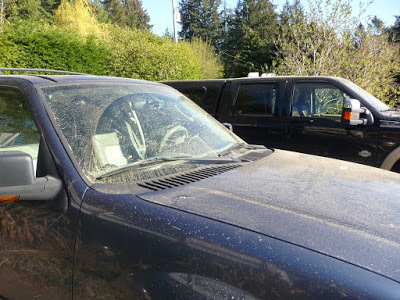
Why, I wonder, would she think anyone would be suffering from allergies right now?
I glanced around, self-conscious, to see if anyone was giving me that judgmental “you should be self-isolating” look. But the lady ahead of me just smiled. “Allergies?” she asked.
This is my car after standing idle in the driveway for a day and a half.

Why, I wonder, would she think anyone would be suffering from allergies right now?
April 4, 2020
An introvert’s paradox
Social distancing is a phrase nobody had heard of a few weeks ago, but it’s the order of the day now.
You would think that these times would be ideal for a profound introvert like me. How wrong you’d be!
I use the Myers-Briggs definition of introversion, which means that social interactions take energy from me, rather than me being energized by them as an extrovert would. In other words, dealing with other people is tiring. I need quiet time to recharge before I become too drained to function.
But that does not mean dealing with other people is unpleasant. In fact, paradoxically, I find that being around others is essential to my mental health. I just need to manage the balance.
I liken it to exercise. A lot of people enjoy exercise, and it’s necessary for physical health. But you need to expend energy along the way and you can’t keep it up indefinitely. Other people’s company is my mental exercise.
And without it, without a certain level of ad-hoc in-person interaction and simply being around other people, I am starting to feel the effects.
How are you all doing out there? How is social distancing affecting your lives?
You would think that these times would be ideal for a profound introvert like me. How wrong you’d be!
I use the Myers-Briggs definition of introversion, which means that social interactions take energy from me, rather than me being energized by them as an extrovert would. In other words, dealing with other people is tiring. I need quiet time to recharge before I become too drained to function.
But that does not mean dealing with other people is unpleasant. In fact, paradoxically, I find that being around others is essential to my mental health. I just need to manage the balance.
I liken it to exercise. A lot of people enjoy exercise, and it’s necessary for physical health. But you need to expend energy along the way and you can’t keep it up indefinitely. Other people’s company is my mental exercise.
And without it, without a certain level of ad-hoc in-person interaction and simply being around other people, I am starting to feel the effects.
How are you all doing out there? How is social distancing affecting your lives?
March 28, 2020
A world-changing month
It seems utterly unreal that only three weeks ago, the COVID-19 outbreak felt similar to SARS a few years ago. There was concern, even fear, and precautions especially around foreign travel. There was heightened awareness of risk and reasonable containment measures, but the expectation was that life would go on more-or-less as normal.
Three weeks ago, most of the cases (about 80%) were still in China, with what seemed to be fairly isolated pockets elsewhere. The curve in China had already flattened out, and the unfolding tragedy in Italy and elsewhere hadn’t yet impinged on global awareness.
Three weeks ago, there were no general restrictions in place. National governments were following up positive cases to trace contacts, test for infection, and contain the spread. It felt like we’d have a few rough months ahead, but providing the healthcare system held up and people were sensible, the situation felt manageable.
Three weeks ago, Ali and I were still making travel plans for my 60th birthday in July.
Three weeks ago you could still buy toilet paper.
Now, we are hunkering down for a protracted battle. Borders closed to international travel, shortages of some items, and social distancing has become the norm in all walks of life. New measures are popping up almost daily. Pubs, restaurants, beaches and parks closed. Grocery stores are limiting the number of people allowed in at any one time, with lineups outside the doors to gain access, and hired security controlling the flow and disinfecting shopping carts ready for use. Duct tape on the floor shows where to stand in line at a safe distance.
Just by way of comparison, think back to the public attention SARS gained in 2002. And yet, by the end of the SARS outbreak there were in total just over 8,000 cases worldwide, and 800 deaths. Compare that to today’s figures to get an idea how serious COVID-19 is. And the curve worldwide is so far showing no signs of flattening out.
I am a generation removed from WW2, but was brought up on stories of wartime rationing and deprivation from my parents and grandparents. We are still a long way from those kinds of stories, but we are also a long way from the “normal” we’ve grown used to.
Three weeks ago, most of the cases (about 80%) were still in China, with what seemed to be fairly isolated pockets elsewhere. The curve in China had already flattened out, and the unfolding tragedy in Italy and elsewhere hadn’t yet impinged on global awareness.
Three weeks ago, there were no general restrictions in place. National governments were following up positive cases to trace contacts, test for infection, and contain the spread. It felt like we’d have a few rough months ahead, but providing the healthcare system held up and people were sensible, the situation felt manageable.
Three weeks ago, Ali and I were still making travel plans for my 60th birthday in July.
Three weeks ago you could still buy toilet paper.
Now, we are hunkering down for a protracted battle. Borders closed to international travel, shortages of some items, and social distancing has become the norm in all walks of life. New measures are popping up almost daily. Pubs, restaurants, beaches and parks closed. Grocery stores are limiting the number of people allowed in at any one time, with lineups outside the doors to gain access, and hired security controlling the flow and disinfecting shopping carts ready for use. Duct tape on the floor shows where to stand in line at a safe distance.
Just by way of comparison, think back to the public attention SARS gained in 2002. And yet, by the end of the SARS outbreak there were in total just over 8,000 cases worldwide, and 800 deaths. Compare that to today’s figures to get an idea how serious COVID-19 is. And the curve worldwide is so far showing no signs of flattening out.
I am a generation removed from WW2, but was brought up on stories of wartime rationing and deprivation from my parents and grandparents. We are still a long way from those kinds of stories, but we are also a long way from the “normal” we’ve grown used to.
February 22, 2020
Emergent intelligence and misinformation
Sometimes I see strong parallels between my own writing, and either events in the real world, or in other stories that I read. Once in a while the spooky sensation is made all the stronger when multiple parallels crop up in a short space of time.
I’ve recently finished reading Watch, a story about an intelligence that emerges spontaneously in the vast flow of information across the Internet. The fundamental basis (spontaneous emergence, and the struggle to make sense of a wider world from a perspective inside the network) is the same as in my own novel, Tiamat’s Nest.
Of course, Watch is a vastly different story from Tiamat’s Nest. In Watch, Webmind is curious, benevolent, and wants to interact with people. Tiamat, on the other hand, is secretive and malignant - if that word even applies to an intelligence that has no concept of right or wrong, only of self-preservation. Webmind actively avoids altering content on the web and works to reveal truth where it would do most good, while Tiamat’s approach is to actively manipulate information to steer public opinion and policy to her advantage.
It’s this latter aspect that brought in the other coincidental strand of thought through several news reports over a short period of time.
Despite my efforts to resist, I find myself ghoulishly drawn to news stories about Trump’s latest behavior, and to the comments sections. It’s a bit like slowing down on the highway as you pass a multi-car pile-up on the other side.
And I can’t help noticing the active misinformation that is repeated time and again, despite it being so easily debunked with the simplest of research.
While I was reading Watch, in response to reports of Trump awarding Rush Limbaugh the Presidential Medal of Freedom, an angry commenter stated that Obama gave the same medal to Bill Cosby. Setting aside the usual refusal of Trump supporters to engage the actual issue and instead deflect with “what abouts”, the claim is absurdly false! Bill Cosby was awarded the Presidential Medal of Freedom by George W Bush in 2002.
The following day, again in response to criticism of Trump ordering the assassination of Iranian general Soleimani on Iraqi soil without involving Congress, trolls compared this to the action of Obama bringing down bin Laden. Obama did it, so it’s OK for Trump. Again, this ignored the checkable fact that Obama acted under a formal declaration by Congress authorizing the president to act against those who perpetrated the 9/11 attacks. This was passed in 2001, again under GWB, but was still ongoing in Obama’s time.
On a lighter note, the day after that I saw a BBC video debunking a long list of cooking hacks that look amazing but which simply don’t work. Someone went to a lot of trouble to make tempting videos of recipes that are useless in practice.
The scary thing is, outright and obvious falsehoods simply won’t die!
But of course, truth isn’t the point. The point in politics is to discredit opponents by repeating the same lie over and over until people start to believe it. That’s effectively how Tiamat in my novel steered the world into catastrophic climate change, and made people’s survival dependent on increasingly sophisticated computation to plan everyday activities around accurate predictions of extreme weather events. The point of the more mundane lies is simply to garner clicks for profit. But they are still putting out things that are not true that will nevertheless take on a life of their own.
As we head into another US election, people keep talking about voter ID and election fraud. But that is missing the point. The real war is already being fought in the news feeds and social media, framing people’s views before they even reach the ballot box.
Campaigns of misinformation are no longer mere inconveniences, they have real world and long-lasting consequences on public policy, on justice, on health and safety, and on elections. In an era when events are shaped by the loudest, most strident, best funded voices, what chance does truth have?
I’ve recently finished reading Watch, a story about an intelligence that emerges spontaneously in the vast flow of information across the Internet. The fundamental basis (spontaneous emergence, and the struggle to make sense of a wider world from a perspective inside the network) is the same as in my own novel, Tiamat’s Nest.
Of course, Watch is a vastly different story from Tiamat’s Nest. In Watch, Webmind is curious, benevolent, and wants to interact with people. Tiamat, on the other hand, is secretive and malignant - if that word even applies to an intelligence that has no concept of right or wrong, only of self-preservation. Webmind actively avoids altering content on the web and works to reveal truth where it would do most good, while Tiamat’s approach is to actively manipulate information to steer public opinion and policy to her advantage.
It’s this latter aspect that brought in the other coincidental strand of thought through several news reports over a short period of time.
Despite my efforts to resist, I find myself ghoulishly drawn to news stories about Trump’s latest behavior, and to the comments sections. It’s a bit like slowing down on the highway as you pass a multi-car pile-up on the other side.
And I can’t help noticing the active misinformation that is repeated time and again, despite it being so easily debunked with the simplest of research.
While I was reading Watch, in response to reports of Trump awarding Rush Limbaugh the Presidential Medal of Freedom, an angry commenter stated that Obama gave the same medal to Bill Cosby. Setting aside the usual refusal of Trump supporters to engage the actual issue and instead deflect with “what abouts”, the claim is absurdly false! Bill Cosby was awarded the Presidential Medal of Freedom by George W Bush in 2002.
The following day, again in response to criticism of Trump ordering the assassination of Iranian general Soleimani on Iraqi soil without involving Congress, trolls compared this to the action of Obama bringing down bin Laden. Obama did it, so it’s OK for Trump. Again, this ignored the checkable fact that Obama acted under a formal declaration by Congress authorizing the president to act against those who perpetrated the 9/11 attacks. This was passed in 2001, again under GWB, but was still ongoing in Obama’s time.
On a lighter note, the day after that I saw a BBC video debunking a long list of cooking hacks that look amazing but which simply don’t work. Someone went to a lot of trouble to make tempting videos of recipes that are useless in practice.
The scary thing is, outright and obvious falsehoods simply won’t die!
But of course, truth isn’t the point. The point in politics is to discredit opponents by repeating the same lie over and over until people start to believe it. That’s effectively how Tiamat in my novel steered the world into catastrophic climate change, and made people’s survival dependent on increasingly sophisticated computation to plan everyday activities around accurate predictions of extreme weather events. The point of the more mundane lies is simply to garner clicks for profit. But they are still putting out things that are not true that will nevertheless take on a life of their own.
As we head into another US election, people keep talking about voter ID and election fraud. But that is missing the point. The real war is already being fought in the news feeds and social media, framing people’s views before they even reach the ballot box.
Campaigns of misinformation are no longer mere inconveniences, they have real world and long-lasting consequences on public policy, on justice, on health and safety, and on elections. In an era when events are shaped by the loudest, most strident, best funded voices, what chance does truth have?
February 15, 2020
Valentine’s Day
We don’t go in for the smooshy celebrations, or consumer spending that seems to accompany any vaguely plausible excuse to sell cards, gifts, flowers, chocolate, pink ribbons artistically tied into the shape of a unicorn ...
Valentine’s Day happened to see all of us at home for one reason or another. Regular day off shift, school pro-D day, and I took a day of vacation to extend the weekend.
All in all, it was a satisfying day for me. Got the car serviced (the original impetus to take the day off and have done with it), helped Megan secure a towel rail in her bathroom (try putting up anything into drywall that has to take any weight - her earlier attempt started out OK but eventually pulled the screws out under the weight of a towel or two), got a lot of editing done on The Long Dark, and cooked a celebratory curry for me and Ali.
Now, back to the regular weekend ...
Valentine’s Day happened to see all of us at home for one reason or another. Regular day off shift, school pro-D day, and I took a day of vacation to extend the weekend.
All in all, it was a satisfying day for me. Got the car serviced (the original impetus to take the day off and have done with it), helped Megan secure a towel rail in her bathroom (try putting up anything into drywall that has to take any weight - her earlier attempt started out OK but eventually pulled the screws out under the weight of a towel or two), got a lot of editing done on The Long Dark, and cooked a celebratory curry for me and Ali.
Now, back to the regular weekend ...
February 9, 2020
Why writer’s block?
Everyone has heard of writer’s block. And I don’t just mean other writers, I mean pretty much anyone you meet will likely have heard of the term.
A random thought occurred to me, though. Why writer’s block? Why do we never hear of painter’s block, or sculptor’s block, or trombonist’s block, or any of a number of other artistic blocks? Is this affliction unique to writers?
It seems it’s not. Looking into artistic blocks, creative people all over the place complain about dry spells, about lack of creativity, lack of inspiration. And there’s a lot of advice on how to deal with these ailments, and much of it has parallels with techniques I wrote about in Breaking the Block. So it seems it’s widespread, it just hasn’t got a name.
Except for writers.
So why writers, in particular?
I wonder if it has anything to do with another oddity about writing.
Least likely conversation to hear at a dinner party: “Oh, you’re a concert pianist! How interesting. I thought of doing that too, just haven’t got around to it yet.”
Substitute “writer” for “concert pianist” and it suddenly turns into a frequently-heard conversation. So many people admire the talent of painters and musicians because so many people happily profess to being useless at art, or tone deaf. And yet everyone seems to be a budding novelist, as if writing is the easiest thing in the world.
Now, all the creative arts acknowledge that practitioners go through rough patches, where output dries up. They acknowledge that creativity and capturing creativity in a tangible form is darned hard work, and it doesn’t always go smoothly. But along with that, in all the other arts learning the craft comes first. Claiming your musical creativity has dried up kinda lacks credibility if you’ve never played a note before in your life.
But writing is different. With so many people thinking it’s easy, that they can casually “give it a go”, they look for a reason when it turns out not to be so straightforward. So I wonder if writer’s block emerged as a fallback for people who tried, but got stuck. Because nobody can really admit to not being able to write, but they can say they are actually a writer, really, but the lack of output is because they are suffering from the dreaded writer’s block.
What do you think? Plausible? Or bunkum?
A random thought occurred to me, though. Why writer’s block? Why do we never hear of painter’s block, or sculptor’s block, or trombonist’s block, or any of a number of other artistic blocks? Is this affliction unique to writers?
It seems it’s not. Looking into artistic blocks, creative people all over the place complain about dry spells, about lack of creativity, lack of inspiration. And there’s a lot of advice on how to deal with these ailments, and much of it has parallels with techniques I wrote about in Breaking the Block. So it seems it’s widespread, it just hasn’t got a name.
Except for writers.
So why writers, in particular?
I wonder if it has anything to do with another oddity about writing.
Least likely conversation to hear at a dinner party: “Oh, you’re a concert pianist! How interesting. I thought of doing that too, just haven’t got around to it yet.”
Substitute “writer” for “concert pianist” and it suddenly turns into a frequently-heard conversation. So many people admire the talent of painters and musicians because so many people happily profess to being useless at art, or tone deaf. And yet everyone seems to be a budding novelist, as if writing is the easiest thing in the world.
Now, all the creative arts acknowledge that practitioners go through rough patches, where output dries up. They acknowledge that creativity and capturing creativity in a tangible form is darned hard work, and it doesn’t always go smoothly. But along with that, in all the other arts learning the craft comes first. Claiming your musical creativity has dried up kinda lacks credibility if you’ve never played a note before in your life.
But writing is different. With so many people thinking it’s easy, that they can casually “give it a go”, they look for a reason when it turns out not to be so straightforward. So I wonder if writer’s block emerged as a fallback for people who tried, but got stuck. Because nobody can really admit to not being able to write, but they can say they are actually a writer, really, but the lack of output is because they are suffering from the dreaded writer’s block.
What do you think? Plausible? Or bunkum?
February 2, 2020
So, that was January!
The first month of a new decade seems to have flown by double quick!
I guess a large part of that sensation is down to having so much going on in all parts of my life right now.
On the “life in general” front, the weather has featured strongly. My last post talked about high winds - very unusual around here, and even more unusual for those conditions to persist for a couple of weeks rather than a couple of hours. They brought a couple of lengthy power outages. Then that week we had snow. Lots of shoveling, and my body knew by the end of the week that it had had a major workout. Then rain, and more wind. And more rain. Yes, I know this is actually a rainforest, but the downpours last week were exceptional. Floods and mudslides blocking highways and disrupting telecommunications.
Work-wise, we’ve been leading up to a big IT upgrade which brought a series of issues that had to be sorted out. That, thankfully, is now out of the way and has had all last week to stabilize, but the upgrade itself took over the whole of the previous weekend.
Things have been equally unusual this month in the writing world. I’m now in the thick of editing The Long Dark, and at times actually enjoying it! This is a novelty. I enjoy editing and revising about as much as dental work, but this time feels different. In part, I think it’s because I started the month writing a number of new scenes to flesh out a couple of themes more fully. This made it feel a lot more like writing than editing. But that has given me a boost to keep up the momentum through the longer slog of reviewing existing chapters.
So, yeah, busy. Not necessarily in a bad way, but definitely in a way that calls for a slower and more relaxed February. Here’s hoping.
I guess a large part of that sensation is down to having so much going on in all parts of my life right now.
On the “life in general” front, the weather has featured strongly. My last post talked about high winds - very unusual around here, and even more unusual for those conditions to persist for a couple of weeks rather than a couple of hours. They brought a couple of lengthy power outages. Then that week we had snow. Lots of shoveling, and my body knew by the end of the week that it had had a major workout. Then rain, and more wind. And more rain. Yes, I know this is actually a rainforest, but the downpours last week were exceptional. Floods and mudslides blocking highways and disrupting telecommunications.
Work-wise, we’ve been leading up to a big IT upgrade which brought a series of issues that had to be sorted out. That, thankfully, is now out of the way and has had all last week to stabilize, but the upgrade itself took over the whole of the previous weekend.
Things have been equally unusual this month in the writing world. I’m now in the thick of editing The Long Dark, and at times actually enjoying it! This is a novelty. I enjoy editing and revising about as much as dental work, but this time feels different. In part, I think it’s because I started the month writing a number of new scenes to flesh out a couple of themes more fully. This made it feel a lot more like writing than editing. But that has given me a boost to keep up the momentum through the longer slog of reviewing existing chapters.
So, yeah, busy. Not necessarily in a bad way, but definitely in a way that calls for a slower and more relaxed February. Here’s hoping.
January 11, 2020
Was it windy last night?
I don’t know what gave me that idea!
Ever since moving to Victoria fifteen years ago, Ali and I have often commented on how still the air is here. We were used to constant air movement. Prevailing winds sweeping off the Atlantic, sometimes so strong it was a struggle to stay on your feet. Checking the wind direction before deciding which beach to go to. The ferries thought nothing of crossing the Channel in a Force 8 and heaving seas.
Here, the trees are still most days. We could play badminton with the kids on the front lawn - something we could never do in Guernsey on even the calmest of days.
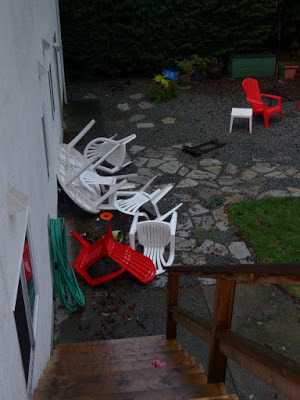
So it’s a bit unusual to find wind warnings now for several days running, ferries disrupted, and furniture tossed around like paper.

Ever since moving to Victoria fifteen years ago, Ali and I have often commented on how still the air is here. We were used to constant air movement. Prevailing winds sweeping off the Atlantic, sometimes so strong it was a struggle to stay on your feet. Checking the wind direction before deciding which beach to go to. The ferries thought nothing of crossing the Channel in a Force 8 and heaving seas.
Here, the trees are still most days. We could play badminton with the kids on the front lawn - something we could never do in Guernsey on even the calmest of days.
So it’s a bit unusual to find wind warnings now for several days running, ferries disrupted, and furniture tossed around like paper.