Douglas Rushkoff's Blog, page 31
March 7, 2016
Interview with The Kernel: Douglas Rushkoff’s vision for a new, better world

By Jesse Hicks on February 28th, 2016
For more than two decades, Douglas Rushkoff has provided incisive commentary on our increasingly connected, digitized, and corporatized world. From Cyberia: Life in the Trenches of Cyberspace to Life Inc.: How the World Became a Corporation and How to Take It Back to his newest, Throwing Rocks at the Google Bus: How Growth Became the Enemy of Prosperity, he’s chronicled both the promise and the peril of of a global society being remade by the Internet and high-tech corporations.
In his new work he argues that, appearances to the contrary, today’s online colossi—think Facebook, Google, Apple, and the like—haven’t truly revolutionized our economy. Instead, they’ve reproduced the Industrial Age corporation at a global scale, with all the benefits of digital innovation. At heart, though, they’re still designed to extract value and to pursue growth above all else. That mission, he argues, is becoming increasingly untenable, and for perhaps the first time there’s an alternative: companies that leverage technology to spread abundance rather than hoard wealth to themselves. But making that happen first requires rethinking some of our most basic assumptions about what corporations do—and why they exist.
Via email just prior to his book launch at SXSW, we discussed why our global economy is stuck in an Industrial Age mindset, why Wall Street considers Twitter a failure, and why Silicon Valley needs to start building companies that aren’t just meant to be sold for a healthy return on investment.
What made you write a book about the failings of the digital economy?
I got the idea the day that Twitter went public, when I saw my friend, one of the co-founders, on the cover of the Wall Street Journal with the number of billions he made that day. I wasn’t sure whether to be happy or sorry for him. Yes, he was rich, and he had disrupted the communications industry—but he was surrendering all that disruption to the biggest, baddest industry on the block: finance.
Worse, Twitter would have to somehow deliver impossible returns to its new investors. They were demanding growth. So even today, Twitter—which earns half a billion dollars a quarter—is considered an abject failure by Wall Street.
Worst of all, this obligation to grow has turned otherwise promising companies into extractive monopolies. In order to grow, they use scorched-earth practices that take value from people and places and turn it into capital for their shareholders. This growth mandate is cause for the increasing disparity of wealth, and it has been energized and accelerated by digital technology. Digital technology was supposed to distribute this wealth to more people, not impoverish the many for the wealth of a few.
The main target of your critique is what you call “the growth trap.” Since at least the birth of the corporation, you argue, our economic thinking has been dominated by an unrelenting drive for growth: Companies have to continue to extract more and more value in order to be seen as successful. You suggest that we’ve reached a point where this is no longer tenable—and that digital technology in particular can enable a new way of thinking. Can you explain the growth trap and how it undergirds our current thinking?
Well, it takes a whole book to explain this properly, because the requirement for companies to grow really traces all the way back to the institution of interest-bearing currency, which requires that the economy grow in order for that interest to be paid back.
Today, the equivalent of those bankers are shareholders. They expect not just interest, but tremendous returns on their initial investments. They witnessed the success of Facebook and Google and want those sorts of returns, too. So they put money into a company like Twitter, and then expect to earn back 100 or 1,000 times on their original investment. The fact that Twitter makes 500 million dollars a quarter is considered an abject failure by the investors. And so Twitter must look for some way to “pivot”—that is, change from a super successful company that lets people send 140-character messages, into something else.
Regular companies are in the same position. Pepsi, McDonald’s, Exxon all have shareholders who demand that the share price go up—that the company grow. And the bigger these companies get, the harder it is for them to grow. They are already worth billions of dollars. In fact, corporate profits over total value have been declining for over 75 years.
The CEOs of these companies read my articles about getting out of the growth trap, and they call me begging for the way out. They all know they can’t keep growing at the rate demanded by their shareholders. They can fake it a while, but in the end, these scorched-earth policies just kill the markets and consumers on which they’re depending. Well, in the real end, they end up extracting all the value out of people and places until there’s nothing left.
Growth depends on expansion. Not just that, but on accelerating expansion. You have to grow faster and faster. And it’s just not possible for companies of this size to do that. They must instead learn to pay shareholders with dividends. Run themselves like family businesses, for the long term.
You noted that at the beginning of the Net, there were serious and deeply felt expectations that it might not become, as you’ve characterized it, a strip mall. Today we have “social media” that basically recruits people to become marketers to their friends, and a “sharing economy” driven by the idea that if you’re not monetizing every bit of your time, you’re wasting it. Does it feel different this time—that this time there might be a role for the Net to play in genuinely reimagining our economic world?
Well, the thing that feels different to me is that pretty much everyone sees that it’s not sustainable. How can everyone get paid to advertise? What’s left to advertise? Marketing has never ever accounted for more than 3 or 4 percent of GDP. And now it’s supposed to be our main industry? That, and finance? They’re both abstractions. When we see a company as successful as Twitter failing, we come to understand that the model itself is broken.
As for “sharing,” Uber drivers taught us that this is a crock. The unemployed gig drivers of Uber are now as smart about labor politics as the cabbies from London. Uber’s monopoly and policies have been rendered so transparent.
And yes, while I’m not a techno-solutionist, I do believe that networking technologies could enable much more distributed prosperity. The digital economy, so far, is just corporate industrialism on steroids: extract value from people and places. Digital companies are like software programmed to take currency out of circulation, and deliver it up to shareholders. They could just as easily—more easily, in fact—be optimized to promote the circulation of currency. Most simply stated, less like Amazon, more like eBay. It’s as simple as letting Uber drivers have shares in the company, proportionate to the amount of work they’ve done. And that would be pretty easy to calculate and authenticate with something like a blockchain. Networking technologies are biased toward more distributed solutions. That’s what they were originally built for.
But the real problem here is that our technology development is driven solely by the needs of capital.
The book’s title comes from an incident in which protesters in Oakland, frustrated by the way Silicon Valley companies are remaking the social fabric of San Francisco, threw rocks at the private buses that ferry Google employees to work. What did that event clarify for you, and why do you think those rocks were aimed in the wrong direction?
I don’t know that rocks needed to be thrown in any direction. Not just yet. The original protests did not involve rocks, and were entirely well-founded. Still are. Google and other Silicon Valley companies are behaving like foreign corporations. Workers move into SF, impacting rents, driving local businesses out of the neighborhood. Then they use public bus stops to take private buses to workplaces outside the city.
And this crisis of poor wealth distribution is both real and symbolic of a bigger disappointment we all have with the poorly distributed gains of the digital economic boom. I try not to blame individuals for this—as if there are some mean people making this happen. They’re not mean so much as clueless. They have built very disruptive—positively disruptive— businesses, but haven’t disrupted the economic operating system on which they are operating. They are not truly digital companies so much as industrial companies running on digital steroids.
You point to the popularity of books such as The Second Machine Age as evidence that despite being in an entirely new economic environment, we’re still saddled with thinking from the Industrial Age. Why is that the case, and what’s the new kind of thinking that we ought to be embracing?
It’s only natural for our first response to be reactionary. Most books on how to thrive in a new economy are really about how to maintain a traditional industrial corporation. The whole “startup” process is really just the old wine of venture capital in a new digital bottle. These companies are built to be sold. And their revenue, when they even have it, is based on the company’s ability to extract value—not their ability to create it.
Where do we look for hope that we can shake off dead ideas and adapt to the new environment we’re in the process of creating?
We look for hope right there in the despair. Every person who can’t get a job at a big corporation is another person who gets to figure out how to create and exchange value in the real world. Every person who can’t get a loan is another person willing to consider how alternative currencies, favor banks, and the commons work. Every town whose economy has been trashed by a corporation is another community about to learn that the only things you need for a thriving economy are people with skills and people with needs.
The moment we stop optimizing the digital economy for the growth of capital, and optimize it for the circulation of value between people, everything will start to get better really fast.
Illustration via Max Fleishman
The post Interview with The Kernel: Douglas Rushkoff’s vision for a new, better world appeared first on Rushkoff.


Six Pixels of Separation podcast: The Failing State of Our Digital Economy
Listen to the audio podcast here
Simply put: Douglas Rushkoff makes my brain hurt, because he is so smart. He recently published his latest book, Throwing Rocks At The Google Bus, and it will make your head spin too. All of our assumptions about disruption, the digital economy, unicorns, valuations, and how all of this technological innovation has evolved will be questioned. Not to be a contrarian for contrarian’s sake, this Media Scholar also happens to understand the underpinnings of our economy, and it will startle you. The book acts as a warning and – as with everything he touches – it will make you think deeply. Rushkoff (for those who do not know) is the person responsible for coining terms like ‘digital natives’, ‘social currency’ and ‘viral media’. If you’ve never heard of Rushkoff, he’s the winner of the Media Ecology Association’s first Neil Postman award for Career Achievement in Public Intellectual Activity, he is an author, teacher, and documentarian who focuses on the ways people, cultures, and institutions create, share, and influence each other’s values. He is Professor of Media Theory and Digital Economics at CUNY, technology and media commentator for CNN, digital literacy advocate for Codecademy.com and a lecturer on media, technology, culture and economics around the world. Trust me, you do not want to miss this episode. Enjoy the conversation…
The post Six Pixels of Separation podcast: The Failing State of Our Digital Economy appeared first on Rushkoff.
March 6, 2016
Spark with Nora Young on CBC Radio: Throwing Rocks at the Google Bus
Listen to the audio podcast here.
In his new book, Throwing Rocks at the Google Bus, media theorist Douglas Rushkoff argues that the digital economy has failed to provide us with the growth and prosperity it promised. But not to worry, he believes we can still fix the startup economy…with new technology!
The post Spark with Nora Young on CBC Radio: Throwing Rocks at the Google Bus appeared first on Rushkoff.
Quartz Reviews Throwing Rocks at the Google Bus
Written by Olivia Goldhill
People are angry at Silicon Valley. In recent years, protestors have slashed the tires of buses hired to transport Google employees. They’ve occupied Airbnb’s headquarters and participated in worldwide demonstrations against Uber.
These tech titans stand accused of destroying industries and livelihoods, sucking up wealth for themselves while failing to distribute any wider benefits to the rest of us. And they’re guilty, according to media theorist Douglas Rushkoff, author of the forthcoming book Throwing Rocks at the Google Bus: How Growth became the Enemy of Prosperity. He argues that unless Silicon Valley’s fundamental model changes, we’re heading for mass social unrest.
Rushkoff points out that basic economy theory, as laid out economist and philosopher Adam Smith, recognizes three factors of production: Land, labor, and capital. But in the current digital economy, only capital is valued.
“The venture capitalist puts down his money and he’s the only one that gets the return,” says Rushkoff. “The land doesn’t get the return—the neighborhoods affected by Airbnb aren’t getting return on that operation. The Uber drivers don’t get return—they’re unemployed people looking for a gig to try and get by another day.”
Today’s start-ups aim for quick and massive growth, so that they can get sold and give original investors a return on their capital. These business practices have been in place since the industrial age. But Rushkoff says they cannot be sustained for much longer.
“It doesn’t work as well when we reach the limits of our planet, the limits of people’s time and attention,” says Rushkoff. “The ability of big companies to make money with their money has been steadily declining for 75 years.”
Rushkoff argues that several major tech companies operate with intentionally unsustainable business models. Amazon and Uber, he says, work by destroying marketplaces and then using their leverage to move into another area. So while Amazon doesn’t make much money off books, the original industry it disrupted, that’s not a concern for them. They make the bulk of their revenue from other products.
“The Uber model doesn’t work as a long-term taxi business—all the drivers would just go broke,” says Rushkoff. “But that’s not the intent. The intent of Uber is to create a monopoly in the taxi business so they can then hop over into something else like logistics or delivery or drones or robotic cars.”
Then there are companies like Tumblr, sold to Yahoo for a billion dollars despite the fact that it generated comparatively little revenue. (Yahoo has since admitted that it overpaid for the blogging platform.) “It didn’t actually do anything, so there was no actual business,” says Rushkoff. “What is that—is that a success or a failure? It’s a success for the original investors who got a billion dollars of money.”
Google was once an innovative search engine, Rushkoff says. But he argues that since morphing into Alphabet, it’s essentially become a holding company that buys and sells technology companies. He’s also skeptical of Facebook. In order for the tech company to fulfill its growth promises, Rushkoff argues that it will have to generate an enormous amount of ad revenue of the United States.
“The thing I wonder about is, if everything we do is supposed to be advertising-based, then who’s left to sell anything?” he tells Quartz.
Rushkoff recommends several changes that could save the digital economy. For one thing, he thinks we needs more peer-to-peer platforms such as eBay, Etsy and Kickstarter. Such companies effectively distribute the means of production and allow people to trade with each other. He also argues that tech workers need real living wages, and that they should have at least partial ownership of the companies they work for. And startups need to do more to share the benefits of their success. This would create sustainable prosperity, in which companies grow wealth among their employees and the neighborhoods where they operate–thus allowing more spending and further growth.
Rushkoff has a history of making accurate predictions about our digital futures. He wrote on viral media in 1994 and is credited with coining the term “digital natives.” He also wrote a book on the internet in 1992 that was rejected by its original publisher, based on the belief that the online phenomenon would be over by 1993.
This time, he says Silicon Valley CEOs and board directors seem to be receptive to alternative ways of doing business, and are looking for ways to become more sustainable.
“Over the next ten years, I think we’ll see either a significant movement in that direction, or we’ll be in a bad place,” he says.
And what sort of “bad place” might we expect if Silicon Valley fails to change course?
“Basically everybody working for 16 to 20 hours a day for very little pay, doing repetitive tasks that for one reason or another, computers can’t do,” Rushkoff says. “And these will be the lucky people, because at least they’re employed.”
The post Quartz Reviews Throwing Rocks at the Google Bus appeared first on Rushkoff.
March 2, 2016
Forbes reviews Throwing Rocks at the Google Bus
Douglas Rushkoff is one of those rare writers and friends. He can ask big gnarly questions, and then before you know it, present a buffet of solutions that leave you with a ravenous appetite to dig into the future.
In Program or Be Programmed, Rushkoff made the compelling case for the need for all of us to be programmers. Choose to program and “you gain access to the control panel of civilization. Choose the latter, and it could be the last real choice you get to make.” Yikes, I read that and immediately went to use my limited HTML skills on my nascent website.
Despite my admiration for his past work, I approach his new book with some trepidation. I guess I thought Rushkoff was going to be the one throwing rocks. Nope. I should have known better. Rushkoff is always more complicated than that.

Photo Courtesy: Author Douglas Rushkoff
In Throwing Rocks At The Google Bus, Rushkoff begins with some powerful truth telling.
The digital economy is breaking things. The media can’t seem to survive digitization. Drivers are losing to Uber. Airbnb is turning neighbors apartments into rentable dorm rooms, and as he lays out the current state of play – event tech visionaries find the demands of the startup economy closing their vision.
But Rushkoff isn’t claiming Google GOOGL -0.96% is at fault. He says: “there is something troubling about the way Google is impacting the world, but neither it’s buses nor the people in them are the core problem; they’re just and easy target. He says we’ve brought a set of industrial age. “We are running a 21st-century digital economy on a 13th Century printing-press era operating system,” writes Rushkoff.
Now it’s not all bad. “On the bright side, millionaires and billionaires are being minted, maybe not enough to compensate for the millions of people being displaced, from their jobs, but they are inspiring just the same.”
Looking for an example, Rushkoff settles on Uber, and he takes on the company with relish. “By calling itself a platform rather than a taxi dispatcher, Uber has been able to work in a regulatory gray area that slashes overhead while inflating revenue. This is how Uber can be valued at over $18 billion dollars while many of its drivers make below minimum wage after expenses.”
The crux of the argument that Rushkoff makes is that the digital economy is a house of cards built on fictional growth metrics that drive companies to raise money, undercut human workers, sell on the public markets and then – almost inevitably – collapse under the weight of public market demands. And he’s not alone in his concern. Quoting Union Square Ventures founder Fred Wilson, the book shares Wilson’s blog post. In it Wilson “worries aloud that digital entrepreneurs are more focused the increasing monopolies and entreating value than they are on realizing the internet potential to promote value creation by many players.”
Growth, it turns out, may be an illusion. “If infinite growth is no longer a possibility or even desirable, then you must shift your sights away from ht big “win” in the form of an IPO, acquisition or growth target” writes Rushkoff. “Think of it less like a war, water total victory is the only option, and a bit more like peace, water eat objective is to find a way to keep it going.”
The core message of the book is that the current state of play in funding, driving, and exiting digital companies is unsustainable. And to bring that point home, Rushkoff shares his stories of Ventureless Capital: the Patience of the Crowds. His example is a good one – his friend, and mine, Scott Heiferman. Heiferman founded Meetup after selling his first startup at the hight of the dot-com boom. Meetup aims to be a civic platform rather than a platform monopoly. “We’re not trying to vertically/horizontally integrate or get into news busses or invent self-driving space elevators. We know what business e want to be in, it’s a big opportunity and we don’t see ourselves and empire-building imperialists.” Meetup aims to be Meetup, and to grow that business – a perfect Rushkoff example.
In Throwing Rocks at the Google Bus, Rushkoff calls on business to:
Accept that era of extractive growth is over.
Reject platform monopolies like Uber in favor of distributed, worker-owned co-ops, orchestrated through collective authentication systems like bitcoin and blockchains.
Resist the short-term, growth-addicted mindset of publicly traded markets.
Recognize contributions of land and labor as important as capital, and develop business ecosystems that invest in the local economies on which they ultimately depend.
“None of us can wave a magic wand and transform the economy from an extractive endgame into a prosperous commons,” writes Rushkoff in his conclusion. “However, I do believe we can reposting our careers and our businesses to become less a part of the problem than participants in the solution. There’s a lot of hope here.”
Steven Rosenbaum is serial entrepreneur, author, and filmmaker. His latest book, Curate This! is in print and ebook on Amazon.com. He is the CEO of Waywire.com (enterprise.waywire.com)
The post Forbes reviews Throwing Rocks at the Google Bus appeared first on Rushkoff.
Harvard Business Review excerpts Throwing Rocks at the Google Bus
Corporations Weren’t Designed to Run on Code
Plants grow, people grow, even whole forests, jungles, and coral reefs grow — but eventually, they stop. This doesn’t mean they’re dead. They’ve simply reached a level of maturity where health is not about getting bigger, but about sustaining vitality. There may be a turnover of cells, organisms, and even entire species, but the whole system learns to maintain itself over time, without the obligation to grow.
Companies deserve to work this way as well.
The post Harvard Business Review excerpts Throwing Rocks at the Google Bus appeared first on Rushkoff.
Does This Make My Customer Rich? Business Tips for the Future Steady-State Economy
Originally published at Fast Company.
First God created Heaven and Earth. Then He created The Market. If you prefer your creation myths more scientific, you might say that after the Big Bang, market forces became the natural law of the universe. This, of course, is not true. In America’s plutocratic economy where net worth is held up as the greatest achievement, there isn’t much that we think the market can’t solve. We say the market is setting low wages for workers, that the market enables Amazon and Walmart decimate local businesses, and even that ideas to help the world’s poor should be market-based.
Douglas Rushkoff’s new book, Throwing Rocks at the Google Bus, reminds us to stop shrugging our shoulders and using the market as an excuse for society’s ills. The market was created—and it can change. “All I ask is that people at the very least acknowledge that the venture capital/startup/financially-driven operating system is a choice, not a preexisting condition of nature,” he says. “The market is a construction. God didn’t make the market.”
To forestall an economic collapse that he sees coming if we keep up business as usual, Rushkoff says we need to “develop local, resilient, human-scaled enterprises that work in a variety of economic landscapes.” The book serves as a sort of prescription for how we might do that. From solutions to the mass unemployment being wrought by automation to alternate currencies designed to keep money circulating locally to new ways to generate value for investors without needing an “exit event,” the book offers examples of what a new economy might look like and how you—no matter what industry you’re in—might help move yourself and your company toward it.
The underlying theme is a new way of economic thinking that eschews the occasional startup whose value explodes in favor of what Rushkoff calls the steady-state economy. The one edict that should govern all businesses: “Does this make my customers rich? If I’m making other people wealthy, then I am supporting the ecosystem that will keep my business alive.”
Right now, our economy is set up to ask the entire opposite question: Does this make our investors rich? Instead of valuing and rewarding the creation of a sustainable economy, we value growth above all other things. Venture capital infuses companies with enough cash that they can expand astronomically and make their founders incredibly wealthy. Look at Twitter, currently besieged by open letters about how to improve its business as its stock tanks. This is the prime example of an economy with the wrong priorities—and the mistakes founders can make by giving into a mindset that growth is the only meaningful goal of business. “Their $500-million a quarter in revenue company is considered a failure by Wall Street. If you make $2 billion a year on 140-character messages, that is such a home run,” he says. Instead, stock holders are demanding more growth, in order to increase the stock price so they can sell; they’re not interested in owning part of a company whose technology has been the underpinning of so much global change, they’re interested in making a profit on the market.
Twitter is just one company, but multiply this attitude across the entire economy and things get scary: To continue growing at a rate that will satisfy their investors, companies are forced to find more and more extractive modes of generating revenue. Eventually, with enough companies mindlessly creating new revenue streams to continue to justify their valuations or appease shareholders, they’ll suck consumers of their remaining cash. This extraction is creating a human toll to the damaging economic system: The digital revolution that was supposed to make our lives easier. But as it’s forced to squeeze more and more value from its users, it’s doing the opposite. “This is why you see Bernie Sanders and Donald Trump alike rising. People are doubly disillusioned. Technology is making us work harder and we earn less. It’s not going well. …But then the double anger is that these companies rose on the pretense of being on our side,” says Rushkoff.
And to do that requires rejecting the idea that the market is a rule of nature that can’t be changed. CEOs need to find ways to operate their company without acquiescing to shareholder demand for constant growth. You (and Milton Friedman) might argue that that is, in fact, the only thing a company should be doing, but in making that argument, you’re buying into a system that doesn’t need to exist the way it currently: “You can’t ignore the development of the modern marketplace. The market has rules that were written by people, in certain moments in history. … Who made that rule? Why did they make it? Who does it favor and who does it disempower?”
The rules, Rushkoff argues, were made not by God, but by aristocrats around the 11th century, intent on preventing the peasants from creating a vibrant economy not controlled by the ruling class. Today, the rules can be whatever we want them to be. Rushkoff doesn’t want a revolution, just a rethinking. “They worked really well for 700 years of colonial expansion,” he says, “but they could use a tweak or two.”
Can we actually get there? Will the people made rich by the current economic system listen to his prophecies and realize their success is built on a crumbling foundation and alter their business models—and the very system that made them successful in the first place? Rushkoff says he thinks we can, and that it won’t take economic collapse or violent revolution, but just common sense (he admits, he’s having an optimistic week). He writes in the book that CEOs he talks to are exhausted by being forced into the short term thinking of quarterly growth, and says that as people are reading the book, they’re relieved, because the solutions within give them a path to a better business model: “I’m getting emails from CEOs from Fortune 50-sized companies saying, ‘I can use this, it’s going to work.’ Because these CEOs have been looking for ways to reconfigure to this slow-growth, new normal economy that we’re actually in without getting fired or sued.”
So just remember, human beings made this system, and human beings can change it. And one thing we all can agree on is that the system isn’t working: “Big business and small business, extreme libertarians and Bernie Sanders people all are looking toward the same solution. … We’re realizing that we don’t really care about our ideologies as much as about the fact that we’ve let a system get out of control.”
The post Does This Make My Customer Rich? Business Tips for the Future Steady-State Economy appeared first on Rushkoff.
The Takeaway on NPR: Why People Throw Rocks
Listen to the audio podcast here.
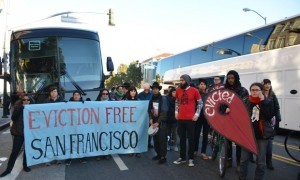
Over the last few years, technology employees have overwhelmed the San Francisco Bay Area’s already-fragile housing market. As rents skyrocket, residents frustrated with their changing neighborhoods have targeted the buses that deliver tech employees to and from Silicon Valley, from San Francisco and Oakland.
In his new book, “Throwing Rocks at the Google Bus How Growth Became the Enemy of Prosperity,” Douglas Rushkoff dissects the protests against those buses, and finds examples of Bay Area frustration throughout the country, where tech companies are growing at all costs—to the detriment, he believes, of CEOs, employees, and communities.
As these companies grow exponentially, Rushkoff says, Americans are taking note, that “all these people are having to drive Uber cars and all these other people are having to rent their apartments on AirBnB.
“People are becoming aware of the fact that the growth of all of these companies is not leading to any sort of participation or distribution of the assets to others,” Rushkoff explains.
The post The Takeaway on NPR: Why People Throw Rocks appeared first on Rushkoff.