Douglas Rushkoff's Blog, page 30
March 11, 2016
‘Throwing Rocks’ Reddit AMA
[AMA] I’m Douglas Rushkoff, author of Throwing Rocks at the Google Bus, ask me anything
Growth is not the answer – particularly not for a digital economy. We can instead reboot our obsolete economic operating system and use the unique distributive power of the internet to break free of the winner-take-all game defining business today. Let’s talk about how to do that.
The post ‘Throwing Rocks’ Reddit AMA appeared first on Rushkoff.



March 10, 2016
SXSW Keynote Live Stream
I’ve been nuts with touring stuff. Lots of links to put in here. I’ll be updating the site as much as possible.
But I just learned that my SXSW talk will be live streamed on the conference’s main channel http://www.sxsw.com/live at noon Eastern (11am Austin time) on Saturday.
This is where I will drop the ideas of the book – with full knowledge that many more people will end up watching this video than actually opening the book. So this is the one.
The post SXSW Keynote Live Stream appeared first on Rushkoff.
Successful By Making Other People Rich

Read this interview at PSFK.com
Douglas Rushkoff is an accomplished media theorist, writer and documentarian, and will take the stage at our 10th annual flagship conference, PSFK 2016. At PSFK 2015, Rushkoff gave a pointed talk about how technology plays us more than we play it, at one point ribbing audience members creating presentations about the presentation they were watching in real time.
This year’s talk comes shortly after the release of his newest book,Throwing Rocks At The Google Bus, which examines the social and economic consequences tech companies impose on the communities they enter. Beginning today, 25 copies of the book are available as a free add-on for conference ticket buyers.
We sat down with Rushkoff to discuss his forthcoming book as well as what to expect from his talk at PSFK 2016 on May 13.
What Prompted Throwing Rocks At The Google Bus?
I’m a big fan of digital technology who is also growing increasingly concerned about how we’re using it. I write books about technology, society and the economy, in hope of making things better. This one is about the way business is using digital technology to exacerbate all the problems of a growth-based, corporate-driven economy instead of distributing more value to more people. Our digital companies are optimized simply to extract value from people and deliver it up to shareholders. These are not sustainable businesses, because they destroy the markets on which they depend.
The book centers around how explosive growth in Silicon Valley has exacerbated wealth inequality in the Bay Area. Is this an inevitable consequence of all fast-growing industries in communities or somehow unique to tech?
It is an inevitable outcome of fast-growing industries whose profits are based on extraction of value from a community rather than building value with a community. Yes, it’s the same effect that Walmart has on a town, where people end up with lower-paying jobs and locals go out of business. But when it’s an Uber putting cab companies out of business all over the country, that effect is magnified.
Why is this problem more pronounced with tech companies?
The rapid growth of digital companies—from nothing to billions in just a couple of years—had changed the expectations on companies to deliver growth quickly. This makes them resort to more extreme tactics, and thanks to the power of digital technology, they have the scale and reach to do it.
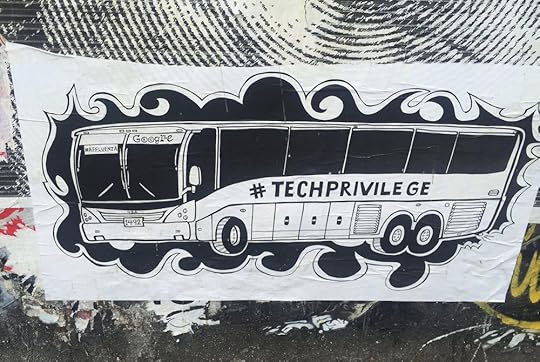
The book also touches on workers losing jobs to automation, investors losing to algorithms, etc. What does this say about society’s view of a person’s worth?
Robots and AI should help us come to recognize what is special and different about humans. Robots may have better productivity than humans—but are we to be valued only for that? Big data doesn’t really say who we are; it just says what marketers want to know about us. AI may solve problems faster than the human mind, but does it have any awareness at all? Does being alive mean anything?
I think we are coming to recognize the quirky, ambiguous parts of human nature that machines will never possess. And we’re coming to value them. That’s why I like to say I’m on ‘team human’.It helps keep things—and technology in particularly—working in favor of human interests.
With all this in mind, are you an optimist or pessimist when it comes to future tech?
Well, it depends who is developing it. If people are developing technology simply to find new ways to extract value from people and places, we’re in a bit of trouble. But even that can’t work forever. We’ll all get poor and there won’t be any customers for the stuff.
I am optimistic that young people no longer buy the VC startup dream, and are becoming more content with the idea of having a profitable, positive company rather than simply “flipping” a fake business for billions.
What do we have to look forward to for your talk at PSFK 2016?
People will get confirmation that the feeling in their gut that tells them something is amiss is actually true. And they will be able to recognize the tremendous pressure to hit some sort of “home run” as the trap that it is. Hopefully, they’ll also come away understanding that the key to a successful digital business is for it to be able to make other people rich.
Starting today, 25 free copies of the book will be available as a free add-on to conference ticket purchases. Select “Free Copy of Douglas Rushkkoff’s New Book” on the checkout page to secure this exclusive offer.
To hear Douglas and other thought leaders inspire Ideas That Transform, join us at the PSFK 2016 conference on May 16 in New York City.
The post Successful By Making Other People Rich appeared first on Rushkoff.
March 9, 2016
Rushkoff on FatCast: Why the Digital Economy Sucks
Listen at Mike Elgan’s Food and Technology podcast.
Don’t throw rocks at the Google bus. You’ll only be hurting yourself (and people like you).
Writer Douglas Rushkoff has a new book called “Throwing Rocks at the Google Bus: How Growth Became the Enemy of Prosperity.” In the book, he lays out why we’re all on that bus together.
The growth-centered digital economy seeks to extract value from people, instead of helping us all create and share value with each other in a trusted, mutually beneficial community.
Rushkoff says there’s a better way, and tells us how to start getting there.
The post Rushkoff on FatCast: Why the Digital Economy Sucks appeared first on Rushkoff.
Here’s How Corporate Growth Is Killing The Economy

Businesses are sacrificed for share price
It’s easy to see it in fast-forward: companies like Twitter and LinkedIn, who leapfrog each other to achieve sky-high valuations, end up incapable of delivering the hundred-fold returns that investors expect. Sure, the companies have terrific revenue. Twitter brings in over half a billion dollars a quarter. But if and when this revenue reaches a plateau–as it has for Twitter–the company may as well be considered dead.
That’s because by taking on too much capital–by selling themselves to the financial markets–they surrender their underlying businesses to the more important imperative of share price. Investors don’t invest in order to own a company; they invest in order to sell it.
And while those of you in more traditional businesses probably can’t help but smile at these flailing upstarts your shaudenfreud may be unearned. If you’re a public company, or more driven by the metrics of your debt structure than those of the markets in which you actually operate, you, too, are caught in the growth trap.
Startups just do all this in fast-motion because they’re pumped up on digital steroids: a developer with a great idea accepts venture capital and a high valuation, at which point the venture capitalists are in charge. The company must pivot away from its original mission in order to grow enough to reach a “home run” in the form of an acquisition or IPO. They’d rather the company die, than live as a moderate win.
This forces startups to adopt scorched-earth policies in order to achieve a complete monopoly over a market–like Amazon did with books, or Uber seeks to with taxis–for the sole purpose of conquering another vertical. It doesn’t matter that they suck their original market dry,; there’s always another on which to feed.
The startup scene may be a tragedy in terms of lost opportunities and irreparably disrupted markets. But it’s just a technologically amplified version of what we see happening to pretty much every member of the S&P 500.
Shareholders incentivize CEOs to push for growth at any cost, even if that means cannibalizing their own companies with write-offs, or stoking expectations with acquisitions that–like 80% of all mergers and acquisitions–lose money for everyone involved.
Growth is the core command of corporate America. I once attended the retreat of a Fortune 100 company where the CEO led a few hundred executives in a chant of “5.3!” their growth target for the coming year. If one of the world’s 100 biggest companies isn’t big enough, than what is?
By valuing capital gains above all others, we end up extracting the value of our marketplaces and rendering them incapable of generating economic activity. As a Deloitte study showed, corporate profits over net worth have been decreasing for 75 years. Corporations are great at accumulating capital, but terrible at deploying it. They vacuum the money off the playing field altogether, impoverishing the markets and consumers–not to mention the employees–on whom they ultimately depend.
Every CEO both knows this, and suspects it will be his undoing. I get more calls from them every year, asking me what they can do. Why me? Because this isn’t a challenge of finance but communication. They need a way to explain to their shareholders that the growth mandate is killing their companies.
It’s also killing our economy, our job market, and our planet. Growth for growth’s sake may have worked for the colonial empires of the 16th Century, but it’s not sustainable–certainly not at the exponential rates shareholders demand in a digital economy.
Rather, we must accept the invitation of a digital age to optimize our businesses less for the accumulation of capital than the velocity of money – the speed and volume of transactions.We need to get money out of the cold storage of share price, and back into circulation.
On a policy level, yes, the easiest fix would be to tax capital gains the same or more than dividends and payroll earnings. If we’re trying to encourage transaction and the deployment of money, we can’t maintain tax policies that punish it.
It would sure make it easier to tell shareholders that the main benefit of owning stock may not be the opportunity to sell it at a higher price, but the dividends of holding it. Dividends are scoffed at on Wall Street as evidence that a company has no more room to grow, when they should be celebrated as proof that the enterprise is alive and well.
Earnings never bothered family businesses, which have historically demonstrated more resilience and longevity than those owned by shareholders. Yes, they make more money in the long term, and do better than their counterparts in every climate except bubbles. That’s because family businesses are obsessed not with growth but sustainability. Instead of thinking how much money they can extract and leave to their grandchildren, the owners of family businesses think about how they can build a business that can continue to provide jobs and revenue for them.
What they realized centuries ago–and what failing growth-based businesses need to learn today–is that the mindless pursuit of growth ultimately demands that you extract value any way you can, whether it’s from labor, the environment, or your customers. By pursuing sustainable revenue instead of relentless growth, companies quickly realize that it pays to make other people rich.
It’s not about redistributing the spoils of business after the fact through taxes or foundations. That’s too late. It’s more about seeing how making other people rich is actually good for business. It’s behind the success of eBay and Paypal, which arose to promote transactions and help others create value, rather than treat their customers like resources to be extracted.
To the business that has escaped the growth trap, the world stops looking like territories to conquer, and more like markets with which to engage.
The post Here’s How Corporate Growth Is Killing The Economy appeared first on Rushkoff.
March 8, 2016
Don’t Blame the Google Bus Riders
Interview by Scott Timberg
Douglas Rushkoff is a polymath who combines documentary filmmaking with an interest in the Middle Ages, suspicion of contemporary banking with a love of cyberpunk, and a fascination with technology with a deep skepticism toward some of the change it’s brought about. His restless mind has slowed down enough to write his new book “Throwing Rocks at the Google Bus,” which came out earlier this week.
Rushkoff’s book, subtitled “How Growth Became the Enemy of Prosperity,” is less inflexible than its title. It looks at the way an obsession with growth entangles us all, no matter where we sit on the digital web. “To use the metaphor of our era,” he writes, “we are running an extractive, growth-driven economic operating system that has reached the limits of its ability to serve anyone, rich or poor, human or corporate. Moreover, we’re running it on supercomputers and digital networks that accelerate and amplify all its effects. Growth is the single, uncontested, core command of the digital economy.” Sherry Turkle calls the book “a challenging and necessary read.”
He closes the book talking about “digital distributionism,” which includes things like crowdfunding, public commons, and collaborative wikis.
Rushkoff – who also teaches at Queens College, CUNY — spoke to us from his home outside New York City. The interview has been lightly edited for clarity.
“Growth” is something that both liberals and conservatives tend to endorse. You see it as the root of some big problems – can you tell us why?
Growth associated with a business that’s getting bigger is not a problem. Joe opens a pizzeria, and more people want to buy pizza where he is, so he does an expansion. That’s growth that’s organic to demand for his product.
But growth as a goal is always going to be an aspect of capitalism: When you invest capital in something, you’re hoping that you’re going to get paid back more than you put in. But when growth is the only objective of your investment – when you don’t see the possibility of a long-term revenue return model — you end up with a business landscape dominated by growth. That tends to be more extractive than generative.
And when you amplify that single core command throughout the entire digital economy, it gets very amplified very quickly.
In the startup community you’re not allowed to earn money – that makes your company look bad. I know a lot of startups that have revenue opportunities, but they turn them down, because they’re not allowed to show revenues on the books. Once they’re showing revenue, it’s as if they’re committed to a business model. What they can earn is no longer infinite. Now future rounds of investors can begin to calculate. You don’t want to look like you’re a business. You want to look like you’re establishing a platform monopoly simply so you can take over others.
Monopoly is an important idea in your book. But let’s talk about your title for a minute. You write, “Google workers are less the beneficiaries of an expanding company than they are its rapidly consumed resources.” What are you saying here?
Most of what I’m saying is that while I completely empathize with laying in front of a bus in order to draw attention to the company’s destruction of San Francisco as a livable place, I also feel for the people in that bus having rocks thrown at them. They’ve gotten out of school, worked however many years to try to get a friggin’ job at Google. And Google the corporation – or Alphabet, the holding company – doesn’t look at the employees as any more human than it does the residents of San Francisco. That these are just the people who are lucky enough to get on the bus, to make six figures a year for three or four years until they burn out, and then they’re done… It’s a tremendous amount of pressure – and I’m sure it’s been algorithmically calculated to get the most value out of them given the turnover and the ability to get new ones.
You look up to the CEO of [tech companies], and they’re answering to shareholders, and the shareholders – maybe this reveals my class – are people like me. I’ve got a retirement plan through the university I teach at. And I’m sure they have Google in their S&P fund. So who’s to blame?
Your point is that it’s a system and not a few evil people. A system that creates chaos for all involved.
It’s sort of the same argument people are making about racism. You don’t have to be a racist – we have systemic institutional racism.
It’s not like there’s some evil capitalist – although there are – but they don’t know it. You talk to any of the guys in VC, they’re doing this rapacious venture capitalism at the same time they have a goatshare and support community supported agriculture and Mars missions for the environment. It’s more about our participation in a system that is eroding our physical and social reality. But it’s so embedded in the way we think…
I talk to business people and bankers and economists all the time, who are like, “Wait a minute, without growth, the middle class can’t keep up with inflation!” So inflation is a principle of nature? Is that what you’re saying?
Speaking of money, you say something is deeply wrong with our currency system, and you hope we can revive local currencies.
I’m hoping we can revive local and other complements to the interest-based central currency.
What’s wrong with our currency and banking system?
Where to start! The reason it was created is to allow people with money to make money simply by lending out money. There were long-distance currencies as far back as ancient Egypt, and the Roman empire… But those ended up hoarded. So they invented market money…
There were barter agents in the medieval marketplace. You know how the Knicks trade to the Cavaliers who trade to the Lakers who trade to that… These five-team trades? The barter agent would have this complicated flow-chart so people could get what they need. They’d do that before they had market money.
So the problem with central currency and banking is that is exists at the exclusion of all other systems. So that when Wal-Mart can get money cheaper than you and I can, they end up with an unfair developmental advantage. In order for people on the periphery to trade with each other, if they need this single form of cash, it’s really tricky.
You’re saying the money system gets in the way of small-scale people cooperating.
That’s right. Interest-bearing currency mandates growth.
I don’t think we can accelerate our rate of growth as fast as we do, and I think it’s ass backwards for our economic health to be dependent on growth rather than growth be a happy by-product of economic activity.
We’re getting into “The Big Short” territory here… That movie does a great job at explaining economics to a “lay” audience.
The weird thing is, it’s not just the lay audience who needs to be educated on this. The premise of the book is that Evan Williams and Jack Dorsey and all these kids made a mistake when they went public with their companies, particularly so early… They ended up chained to a system that will end up destroying their companies.
I keep coming back to this – [Twitter’s] $500 million return, for 140 characters, is such a massive return! Under my old slacker Gen X standards, that would be an obsceneamount of money to have gotten for something so simple. And on Wall Street it’s seen as a failure, and they have to pivot into something more profitable than $2 billion a year.
Yeah it seems like a runaway train when $2 billion isn’t enough…
Let’s talk about the power of monopoly in the digital age.
Amazon took over publishing at a loss! And it’s not just because they hate publishers or don’t like writers. They don’t care!
It’s a business model.
It’s a business model. Once they have full control of a vertical, they can hop over and begin to take over others.
You end by talking about “digital distributionism.” You call it an improvement over the digital life we’ve been living.
Rather than being pessimistic about what we’re going through, I’m trying to be extremely optimistic. This is not a simple revolution, where things turn over. This is not a second machine age… This is a renaissance, where we’re going to have a profound retrieval.
So I looked at philosophy and tried to find people who are consonant with this idea, and duh, it turned out to be [Marshall] McLuhan. I’m a media theorist, so it was like, “Daddy!”
McLuhan was all into this idea called distributionism, which [G.K.] Chesterton and [Hilaire} Belloc were writing about, and they got it from the Pope [Pius XI]. And it’s funny – Pope Francis has been using the same language.
Everybody wanted to the Catholic church to weigh in on Marxism vs. Catholicism and who’s right. And they basically said, “They’re both right – people should be able to get rich. But workers should own the means of production.” So they were really asking for what they thought King Henry VIII screwed up, at the beginning of the [Reformation].
They liked the idea of a community maintained commons, and thought companies should only grow as big as they needed to grow in order to accomplish their purpose – that growth for growth sake should not be allowed. So they were really espousing an almost anarcho-syndicalist idea on the economy.
It could look like small businesses owning their own printing presses and ovens – these cottage-industry things becoming popular in the digital age. And I’d argue, not just some coastal, creative-class thing but as a culture-wide, NASCAR, Martha Stewart, craft/knitting/farming… I think it’s much broader than Ithaca.
Or, on the larger scale, it’s these companies that go out of business and then sell themselves to their workers. Or companies like WinCo, which is bringing down Wal-Mart out West by paying their workers more. And their advantage is they don’t have to pay shareholders. So they end up working so much more efficiently…. Instead of cutting our environmental standards, what if we just cut the investors out?
Has your point of view on digital technology changed?
I’ve always been profoundly optimistic on the possibilities of a digital-media environment. I’ve never been particularly enamored of the tools themselves. But the states of mind, and the possibilities that these kinds of technologies inspire in us… A network of agriculture farms, of people making things in their homes, is to me digitally inspired.
I’m not a digital solutionist. I don’t think we need Bitcoin. But I think Bitcoin helps people see the artificial centrality of the authorities we currently use to conduct our negotiations.
At the very beginning, in [his book] “Cyberia,” I said, I feel like The Internet is more like training wheels, giving us examples of how human beings can operate with each other. More than it is the tool that’s going to take care of it for us.
And that’s where we are now…?
Yeah – but if anything, so far, I’d say that digital technology has not led to a more distributed economic reality.
So far it’s exacerbated [the worst aspects of capitalism]. But I’m hoping we’re at an inflection point now.
The post Don’t Blame the Google Bus Riders appeared first on Rushkoff.
Why Douglas Rushkoff is ‘Throwing Rocks at the Google Bus’
Interview by Dan Ackerman
Author and CUNY professor Douglas Rushkoff has been writing about the digital economy since the early 1990s. Over the course of 16 books, including 1994’s Media Virus, where he codified an early version of the concept of viral media, he’s explored how technology affects us, both culturally and economically.
His latest book, “Throwing Rocks at the Google Bus,” is built around the preface that: “The digital economy has gone wrong. Everybody knows it, but no one knows quite how to fix it, or even how to explain the problem.” As an example, he cites protests over the fleets of private shuttle buses that ferry employees of Google and other technology companies to their Silicon Valley offices.
I talked to Rushkoff via phone on the eve of his book’s release, and this is an edited and condensed version of that conversation.
What is it about the concept of a Google Bus — a private shuttle for employees of one big company — that elicits such a strong response?
It epitomizes how these companies behave like alien life forms invading our reality, rather than companies who are delivering on the promise of bottom-up activity. It reflects their willingness to extract what they want from our communities and from humanity without paying back. San Francisco has become the quaint cultural backdrop. It’s like a stage set for them. It feels like they live in San Francisco, but they’re not. The worst problem is that it epitomizes the way that digital companies extract value without distributing wealth. They’re taking money and value away from us and storing it in share price.
The subtitle of the book is “How growth became the enemy of prosperity.” Despite years of warnings that’s it’s not sustainable, why is growth still held up as the only metric worth pursuing?
I think it’s because a few Internet companies grew really big really fast, so there were a few lottery winners in there, whether it was Steve Case or Mark Zuckerberg or Jack Dorsey. Everybody’s in a race to hit that home run, and what they don’t realize is when there’s so many people and companies doing that, they end up adopting a scorched-earth approach that destroys the underlying economy. The fact is, it’s such a one out of a thousand, or one out of a ten thousand, chance, it’s akin to the people taking their welfare checks and buying lotto tickets at the bodega.
Here’s a company, Twitter. It’s a great product. I love Twitter. I mean I know there’s things wrong with it. I think it’s cool because it doesn’t ask anything of me. It doesn’t like follow me around. It’s not big and heavy and thick and yucky like Facebook or something. It’s almost like texting. It’s just marvelous, and it’s profitable. [But] they went the wrong VC too soon, which demanded them that they go public too soon, and at too high a valuation, and now they’re going to have to kill their company.
I would say, start delivering dividends to your shareholders today. Make all your employees owners of the company. Look for ways to help users create value because if they’re making money off your platform, they’re going to be even more committed to staying with you, and communicate with your shareholders and explain to them that this is a long-term play and a long-term play is not bad, especially if you want to live a long time. Why not balance your portfolio with some actual things that make money instead of all things that just explode?
Does all this feel notably different to you than the days of dotcom 1.0 in the late 1990s, which we both lived through?
It’s different than the dot-com boom, in that the dot-com boom was a bunch of investors being fooled by developers and technologists, and this is a bunch of developers and technologists being fooled by investors. This is the revenge of Wall Street for 1999.
What do you make of this dust-up the other week about the Yelp employee who wrote an open letter to the CEO over the issue of living wages in San Francisco? Does it speak to a lot of the themes that you’re writing about here?
It’s like we’re justifiably angry, but we also have unreasonable expectations. What’s happening is that we’re using technologies that give us instant gratification and instant feedback, and we expect to be able to get that instant return on our investment.
I mean, I lived with people, we lived three or four in a single apartment. We lived in rentals. We did all that. The difference is there wasn’t as much wealth at the top. It was a different, there wasn’t this sense of this girl working at a company where there are billionaires. She’s all the more conscious of the wealth disparity, so on one level, yeah, maybe it’s her problem, but on another level, the company is not making her feel like she’s part of a mission. These are the values that are engendered by the business environment that she’s in. Everyone is in this for a quick payoff, and she’s living in San Francisco, which is not a place you can live as a young up-and-coming person any more.
I have hope, because a digital age makes all of these inequities so much more transparent. This is good. The conversation is out there. Yeah, there’s going to be casualties like that girl, because not everyone is capable of having these conversations without getting really tarred and feathered. It’s dangerous out there, but we’re having the conversation. There’s people lying in front of the Google bus as we speak.
The post Why Douglas Rushkoff is ‘Throwing Rocks at the Google Bus’ appeared first on Rushkoff.
March 7, 2016
Fighting the Digital Giants
Read this piece at BA Business Life
Most businesses’ biggest fear today, in the digital landscape, is disruption. We all witnessed what Amazon did to the book industry, what streaming media did to music, what Uber is doing to taxi services, what Airbnb is doing to hotels, and other young digital platforms are doing to entire sectors. A business owner can’t help but ask, could I be disrupted next?
Instead of adopting a defensive crouch in anticipation of the next upstart or, worse, abandoning your time-tested best practices in order to imitate their ways, it’s time to disrupt the disruptors. You still have the home field advantage.
In reality, these new digitally charged businesses are more examples of market destruction than market disruption. These aren’t genuinely new business plans that promote the best interests of value creators, service providers, or even customers. They don’t create industries so much as replace them with temporary, synthetic and entirely less fertile ones. They are less an example of so-called creative destruction than destructive destruction.
That’s because these companies are not fundamentally disrupting anything. Sure, they can wreak havoc on a particular industry for a time. But they do it by leveraging huge amounts of venture capital. They are not — as they often claim — replacing an inefficient analogue business with a more streamlined and effective digital one. They are simply funding a temporarily competitive advantage with truckloads of cash.
It’s this funding — and the deep pockets and long runways it allows — that gives Uber the ability to lobby so effectively for favourable deregulation and Amazon the ability to price merchandise at a loss. It’s not their revenue driving their success; these are not structured to be sustainable businesses in their own right. They are built to be ‘flipped’ — that is, acquired by someone else, or offered to the public on the stock exchange. They are momentum plays, in which successive waves of funding provide the leverage to undercut competitors in previously sustainable marketplaces.
So all those disruption-threatened businesses — and those yet to come — are imperiled less by some new technology than the heightened power of raw capital itself, amplified by the scale on which businesses can operate in a digital age. It’s traditional capitalism on steroids.
Besides, for all their talk of disruption, not even the most purportedly revolutionary startups consider disrupting the venture funding model driving all this. They’re happy to disrupt journalism or retail or music, but don’t think to challenge the one industry empowering them to do it. The first thing young entrepreneurs do with their business plans is run to the investment banking industry for venture funding and a clear path to acquisition or IPO. In this, they are anything but disruptive. They simply confirm that the more things may appear to change, the more they are ultimately staying the same.
Investors are certainly crucial for the proliferation of almost any business. Land, labour and capital have always been recognised as the main factors of production. But the inflated share prices and 100x windfalls of digital companies (often before they have ever turned a profit or — in some cases — earned any revenue) turn their capital into their primary weapon. And this also gives investors the loudest, or maybe the only voice at the table.
This is why so many startups are forced to abandon their original, legitimate ambitions for pie-in-the-sky dreams of hitting a ‘home run’. With investors taking a shotgun approach to choosing startups, they must compensate for their low odds of success by demanding a massive win from the few that do. Investing in a sustainable, working company is a failure. Only a sale or IPO with a 100x return is deemed acceptable.
So investors push young founders towards aggressive and extractive tactics. People flipping a company treat it differently to those in it for the long run. They don’t need to think about creating a viable business ecosystem, where suppliers, employees and customers exchange value in a sustainable way. Instead, they look for how to extract value from everyone involved — whether as labour (think Amazon Turks), as capital (like Airbnb hosts’ homes) or as land (the publicly funded roads on which Uber depends).
Moreover, most of these businesses are not genuinely profitable. Uber, alone, lost over a billion dollars last year. Such companies are actually a net negative on total economic activity. Digital disruptors employ on average a tenth of the employees of the industries they have replaced. Further shrinking the pie, they leverage their platform monopolies to squeeze, acquire or simply eliminate partners in their supply chains or distribution channels. People in industries now dominated by platforms such as iTunes or Amazon also make less for their work — if anything at all. The supposedly inefficient markets that were disrupted out of existence actually made more money for their participants. Wages are not inefficiency. As Henry Ford understood, your workers need to earn enough to purchase your products!
To disrupt such disruptors, all a good business needs to do is double down on its connection to those who stand to lose when the marketplace is digitised in this way. Instead of figuring out how to extract value from everyone else in the chain of commerce, figure out how to create value for them — or, better, enable them to create value for themselves and exchange it with one another.
This is the real promise of digital business. It’s not about magnifying the extractive nature of industrial age corporatism, but rather expressing the more distributive nature of the digital age.
eBay did this quite explicitly. The auction site wasn’t about destroying some existing industry, but creating a new one based on the peer-to-peer architecture of the net. Thanks to eBay, millions of people began making exchanges that would not have happened otherwise. They weren’t taking business away from anyone so much as enabling new exchanges of the unused items in people’s attics and basements. It’s not extractive, but additive. In this respect, Google’s YouTube, which cuts people in on the ad revenue generated by their videos, is a step above Facebook, which will actually charge you in order to reach all your followers with your content.
This more distributive quality of digital networks ushers in a sensibility very different from the winner-takes-all extremes of industrial capitalism on digital steroids. And it’s a sensibility that informs not just digital businesses. As members of a digital age, we can’t help but be influenced by the environment in which our society is operating. Just as the Industrial Age led us to think in terms of one-size-fits all global solutions and market conquest, the Digital Age leads us to think more in terms of networks, shared resources and distributed processes.
The business landscape in a digital age is correspondingly connected and mutually reinforcing. Things don’t stay still — like money in a bank vault. Everything circulates. Compared with their industrial age counterparts, truly digital investors would come to value flow over growth, ongoing revenue over the accumulation of capital. And to achieve this, all members of the value equation must be served.
The ones who are truly disruptive in a digital age are not those who extract value in extreme ways, but those who are willing to let people in on the winnings. Walmart, for example, is now imperilled by a young upstart — not some digital business scheme, but a company with a digital business sensibility: WinCo, a chain of about 100 stores in the Western United States that operates as a fully employee-owned co-op. As such, it doesn’t have to worry about destroying the local economies in the places it operates, and enjoys goodwill and better employee retention.
In this sense, WinCo better exemplifies business in a digital age than Uber or Amazon. And this is the sort of disruption that can be inflicted on the so-called disruptors: radical efforts at distributing the proposition for value creation.
It’s a matter of exploiting the peer-to-peer emphasis of a networked society, and looking for ways to — dare we say it — help other people make money. No, not the quick-triggered investors who want to pump and dump your business. But your real stakeholders who are in for the long term — and not just because they gave you money, but because they are your workers, your customers, your suppliers and the people who live in your neighbourhood.
The way to connect with them will depend on your particular business, but it will always take the form of acknowledging their status as stakeholders — or making them stakeholders when they’re not.
So what if a cab company employs an app like Uber, but makes its drivers co-owners of the platform? Even if the drivers are merely doing the research and development for a company that will one day use robot vehicles, at least they are participating in the future profits they created.
Why can’t a local supermarket — seemingly threatened by online grocery delivery services — make its parking lot available to the local farmers market on Sundays? It could even charge for space, and then sell unsold produce on its shelves the following week. It’s not surrendering to the competition so much as compensating for its own extractive nature. Yes, a dotcom national food delivery service will win in a war of one extractive enterprise against the other. It has a much bigger war chest. But if the supermarket leverages its connection to the people and neighbourhood in which it operates, it turns itself from just another extractive corporation into part of the fabric of the circulating local economy.
Even local banks — almost an iconic representation of extractive capital — can compete against the peer-to-peer lending platforms by integrating themselves into their communities. They can augment traditional lending with local crowdfunding, using their technology and financial expertise to help communities invest in their own businesses and downtown. Yes, such banks would lose their monopoly on lending, but they would become the locally trusted enabler of investment and inspire the sort of loyalty that could resist the well-funded digital competition of the startups.
These practices may sound like compromises, but they’re actually the long-term strategies that have been employed successfully by family businesses for centuries. They know that their children and grandchildren will have to answer for the tactics they employ today. If they want to be around for the long run, they understand they have to keep their customers, workers, and communities healthy. That means sharing the wealth by enabling distributed prosperity.
If you want to disrupt the disruptors, you’ll have to think that way, too.
Dr Douglas Rushkoff is a lecturer and commentator on media, technology, culture and economics. His latest book, Throwing Rocks at the Google Bus (Portfolio Penguin), is out this month
The post Fighting the Digital Giants appeared first on Rushkoff.