
Victor D. López's Blog: Victor D. Lopez, page 89
October 9, 2013
Book of Dreams 2nd Edition – Preview #2 – To Sleep, Perchance to Dream . . .

Book of Dream, Second Edition
Science Fiction and Speculative Fiction Short Stories
Victor D. López
Copyright 1976-2012 by Victor D. López
No portion of this copyrighted book may be copied, posted, transmitted or otherwise used in any form without the express written consent of the author.
About the Author
Victor D. López is an Associate Professor of Legal Studies in Business at Hofstra University’s Frank G. Zarb School of Business. He holds a Juris Doctor degree from St. John’s University School of Law and is a member of the New York State Bar, New York State Bar Association, The Academy of Legal Studies in Business (ALSB) and the North East Academy of Legal Studies in Business (NEALSB). He has been an academic for more than 25 years and, prior to joining the Hofstra University faculty, served as a tenured Professor of Business, as Dean of Business and Business Information Technologies, and as Academic Dean in urban, suburban and rural public and private academic institutions.
Professor López is the author of several textbooks and trade books and has written poetry and fiction throughout most of his life, some of which has been publishes in anthologies and literary magazines.
Other Books by the Author
Of Pain and Ecstasy: Collected Poems (Printed through Kindle Book Publishing and CreateSpace, Summer 2011)
Intellectual Property Law: A Practical Guide to Copyrights, Patents, Trademarks and Trade Secrets (Printed through Kindle Book Publishing and CreateSpace, Summer 2011)
Business Law: An Introduction 2e, Textbook Media, 2011. (text, test bank, and instructor’s manual) Available at http://www.textbookmedia.com
Business Law and the Legal Environment of Business 2e, Textbook Media 2010. (text, test bank, and instructor’s manual) Available at http://www.textbookmedia.com
Free and Low Cost Software for the PC, McFarland & Company 2000.
Legal Environment of Business, Prentice Hall 1997. (text, test bank and instructor’s resource manual)
Case and Resource Material for the Legal Environment of Business, Prentice Hall 1997.
Business Law: An Introduction, Richard D. Irwin/Mirror Press 1993. (text, test bank and instructor’s resource manual)
Free and User Supported Software for the IBM PC: A Resource Guide for Libraries and Individuals, McFarland & Company 1990. (coauthored with Kenneth J. Ansley)
For Claude, Cathy, Andy and Christina Morell, with love and gratitude for a lifetime of friendship
Table of Contents
Eternal Quest
To Sleep Perchance to Dream
What Price to Live the Dream?
Mergs (Or Why Godot Can’t Come)
Earth Mother
The Day the Dolphins Vanished
Justice
End of Days
To Sleep, Perchance to Dream
I am not insane, of that fact I’m certain. It matters little that nobody reading this will believe me. Frankly, I don’t much care. My death will be hardly noticed. I’m not even sure why I’m writing this; ostensibly it is to leave a warning, some vital information which is quite valuable‑‑if it is believed. But I guess it is also out of a childish need for reassurance that I leave this testimonial. I suppose I’d pray if I believed in God. How comforting that would be, to simply go to bed, close my eyes and put everything in the hands of some benevolent deity. If only I still had even the illusion of hope.
No matter. I just want to make it clear: I am sober, lucid and drug free, facts the blood and urine tests that will doubtless be performed on me post mortem will clearly verify. And I hope this letter will convince you that no illness or natural cause can explain my condition‑‑that the coma I’m sure to lapse into as soon as I am no longer able to remain awake has no physiological cause and is not rooted in some infirmity. Please, please believe that; the hope that you may is the only remaining source of comfort in these waning moments of my life.
I’m sorry if I ramble; I’ll try to be concise. I’m so damned tired, though; I’ve not slept in twenty days. That’s ironic. It’s a new record. Nobody’s been able to stay awake that long before‑‑others who’ve tried cracked in little more than a week. But then, their lives did not hang in the balance between sleep and wakefulness. In any case, it will end soon.
But to the point. It all started just over a month ago. I mean the nightmares‑‑at least that’s what they seemed to be at first. God, it felt good to wake up the first few times and know it was only a dream. I never fully appreciated the absolute bliss that awakening from a bad dream brings in its delectable deliverance from the unimaginable inner horrors of the sleeping mind; there is no pleasure quite like being rent up from the bowels of hell, squeezed up through the narrow, shimmering tunnel of our emerging consciousness to a rebirth in the warm safety of a familiar bed, the light of a new day pushing nightmarish images back into the shadows of the subconscious mind, calming the frenzied hammering in our chest back to blissful quiescence. It had never occurred to me to be thankful at such times before, or even to revel in the delicious feeling of dissipating tension as fear fades, its effects lingering in the awakening consciousness, with adrenaline still pumping and the heart pounding in a chest seemingly too small to contain it. I’d gladly sell my soul, had I one to sell, to experience that indescribable relief once more.
As I said, it appeared to me about a month ago that something was really wrong. I’d had nightmares before, of course, but not like this one. It was so devastatingly real that it took me quite some time to shake it off upon awakening. And it returned the following night, and every night thereafter until I stopped going to sleep after nearly a dozen repeat performances, when it became clear that the inhabitants of my dreams intended to take over my consciousness.
I know how that sounds; I’m not yet quite past the point of reason. I would also dismiss anyone making such a ridiculous statement immediately. But then, when you read this you will have some objective proof‑‑my comatose body. Please keep an open mind.
The nightmares I speak of were recurring, but not repetitive, as if some sort of continuing drama were being played out in my head every night. I don’t want to digress further by giving endless detail. The gist of it is as follows. I am held captive in a windowless, doorless cubicle that constantly changes in size to accommodate the beings who visit me there. I am unable to move and find myself sitting, in a reclined position or lying down, depending on the whim of my captors.
My captors, by the way, are not “nightmarish” creatures; they are for the most part quite human. I can recognize some of the languages they speak‑‑German, Spanish, Catalan, Galician and Italian, among some others I cannot place. They visit me at will, materializing individually and in groups into my little cubicle which expands as needed to encompass them. Some are dressed in almost contemporary garb, others in anachronistic styles and a few sport only a thick pelt of hair over muscular torsos and look more like gorillas than human beings.
The first two nights of my recurring dream, I’d merely spent watching a seemingly endless parade of human and nearly human forms that came to observe me, sometimes caressing, poking or pushing my motionless body as if to reassure themselves of my existence. On the third night, a group approached me and, after discussing me at length among themselves in various languages, one of its members addressed me in Spanish, my native tongue. My questioner identified himself as a Spaniard, yet his version of Spanish was unlike any variant spoken in any region of contemporary Spain. Nor did it bear a resemblance to the many, easily identifiable variants spoken in modern day South and Central America. He questioned me on politics, science, philosophy, and aesthetics. I had to answer; I was not coerced in any way, but I felt a compulsion as though I were under a hypnotic trance, while remaining fully conscious and alert.
The same thing went on for the following two nights: the group questioned me, with the same questioner acting as interpreter. By then I began to have a notion as to the purpose for their queries. From the questions they asked, and from what I could pick up from the discussions they held amongst themselves—at least the ones I could understand in English, Spanish or Galician, I theorize that these beings have lived before. Some part of that which made them unique as individuals apparently remains imprinted in a collective consciousness that is encoded into my subconscious mind, perhaps imprinted in my genetic code itself. I know that makes little sense, but it is nevertheless true. I have untold numbers of past consciousnesses living within me, normally subjugated to my conscious mind, yet nevertheless ever-present and self-aware.
That’s what scares the hell out of me, even now when little matters; in a way, I am thousands, perhaps millions of different people. They, or perhaps more accurately we, coexist and are only marginally aware of each other. Physically, they probably inhabit the major part of our brain, perhaps as large as 90 percent, for which science cannot divine specific use. There is an apparent line of demarcation separating the two‑‑a zone we cannot normally cross. Perhaps this is part of the instinct for self-preservation; without it, we’d go insane. In my case, my partners-in-self broke through in a manner I can’t understand, much less articulate. But I know that they managed to bend the rules, not break them; whatever kink in my psychic armor allowed them through does so only at the level of the subconscious, when my defenses are lowered. They can’t reach me in a state of wakefulness, although I sometimes feel them reaching out when my mind wanders or when I feel myself drifting off into sleep. The separation between the two minds seems clear from my counterparts’ intense interest in, and lack of knowledge about, matters with which I am intimately familiar, such as current events.
Perhaps that is the reason for our need to sleep‑‑a sort of tradeoff to the others within us. The subconscious, from my experience, seems to function on the level of memory. It can allow its inhabitants only an imperfect sense of self, and then only when it is able to function over the watchful eye of the conscious mind. It’s common knowledge that there is no scientific explanation for our need to sleep. Yet I’ve always needed more sleep than most; perhaps that is because my subconscious mind is stronger than the norm, and my conscious mind is proportionately weaker. In that way, my subconscious demands a greater portion of time in which to assume an active role in our mind-sharing relationship.
My experience also gives me some insight into what makes certain people very creative, and why there seems to be a notable correlation between high levels of creativity and mental instability. Highly creative people tend to be less stable than the norm; they appear to be more susceptible to mental illness and addictive disorders. Perhaps the reason is that a strong subconscious allows them access to a sort of collaborative effort as they share the input of consciousnesses not their own. But that is a dangerous and equivocal communion. A thin line separates genius and madness, and I feel certain from what I’ve seen of the others within me that there are forces of both good and evil, the best and worst of all who’ve lived before seems represented. The effect is that the extremes cancel each other out and a sort of ethical nihilism seems to prevail and guide the processes of that huge mind pool. The sense of self, however, is strong within the individual parts that form the whole, and seeks an outlet.
Therein lies the greatest danger, and there the root of my undoing.
[*****END OF PREVIEW # 2*****]
This short story is one of eight short stories in Book of Dreams 2nd Edition and has also been reprinted as a stand-alone short sot for the Kindle reader. You can view additional information about each by clicking on the book covers below. For additional information about other titles currently available through Amazon, you can visit my author’s page by clicking here. Thank you for visiting this page and for your interest in my short fiction.

Tagged: contemporary fiction, science fiction, scifi, SF, short stories, speculative fiction



October 7, 2013
Book of Dreams 2nd Edition – Preview #1 [Eternal Quest]
Book of Dream, Second Edition
Science Fiction and Speculative Fiction Short Stories
Victor D. López
Copyright 1976-2012 by Victor D. López
No portion of this copyrighted book may be copied, posted, transmitted or otherwise used in any form without the express written consent of the author.
About the Author
Victor D. López is an Associate Professor of Legal Studies in Business at Hofstra University’s Frank G. Zarb School of Business. He holds a Juris Doctor degree from St. John’s University School of Law and is a member of the New York State Bar, New York State Bar Association, The Academy of Legal Studies in Business (ALSB) and the North East Academy of Legal Studies in Business (NEALSB). He has been an academic for more than 25 years and, prior to joining the Hofstra University faculty, served as a tenured Professor of Business, as Dean of Business and Business Information Technologies, and as Academic Dean in urban, suburban and rural public and private academic institutions.
Professor López is the author of several textbooks and trade books and has written poetry and fiction throughout most of his life, some of which has been publishes in anthologies and literary magazines.
Other Books by the Author
Of Pain and Ecstasy: Collected Poems (Printed through Kindle Book Publishing and CreateSpace, Summer 2011)
Intellectual Property Law: A Practical Guide to Copyrights, Patents, Trademarks and Trade Secrets (Printed through Kindle Book Publishing and CreateSpace, Summer 2011)
Business Law: An Introduction 2e, Textbook Media, 2011. (text, test bank, and instructor’s manual) Available at http://www.textbookmedia.com
Business Law and the Legal Environment of Business 2e, Textbook Media 2010. (text, test bank, and instructor’s manual) Available at http://www.textbookmedia.com
Free and Low Cost Software for the PC, McFarland & Company 2000.
Legal Environment of Business, Prentice Hall 1997. (text, test bank and instructor’s resource manual)
Case and Resource Material for the Legal Environment of Business, Prentice Hall 1997.
Business Law: An Introduction, Richard D. Irwin/Mirror Press 1993. (text, test bank and instructor’s resource manual)
Free and User Supported Software for the IBM PC: A Resource Guide for Libraries and Individuals, McFarland & Company 1990. (coauthored with Kenneth J. Ansley)
For Claude, Cathy, Andy and Christina Morell, with love and gratitude for a lifetime of friendship
Table of Contents
Eternal Quest
To Sleep Perchance to Dream
What Price to Live the Dream?
Mergs (Or Why Godot Can’t Come)
Earth Mother
The Day the Dolphins Vanished
Justice
End of Days
Eternal Quest
The scent of a freshly cut lawn lingered softly in the air, floating upward with the light haze formed by the morning dew warmed by a rising sun. The sound of a riding mower gently buzzed in the distance as the grounds keeper, an elderly black man dressed in clean, well-worn coveralls, and sporting a frayed, too-large straw hat, slowly wound his way around the expertly and lovingly maintained grounds. Occasionally, he stopped the old mower to uproot an intruding weed that caught his eye. As the man stopped momentarily to retrieve a small fallen apple tree branch, a tiny wren sang tentatively a short distance away. The grounds keeper looked up, wiping his glistening brow with a large, soft cotton handkerchief, smiled, and whistled a short melody in the bird’s direction; it was answered almost immediately by a long, undulating song. The man again replied in kind while continuing his work, and gained an even louder retort from the bird, which might be answering the call or simply trying to attract a mate. After a short while of point and counter point between the two, the man resumed his work as several new voices joined in from various places in the grounds, their songs and calls resulting in a chorus of somewhat dissonant sounds, as other birds joined the impromptu chorus undaunted by the mower’s discordant hum.
In the center of the grounds stood a large, square building, its walls a composite of reddish brown brick and weathered, gray flat stones rising to the height of three stories, with its small, dark-tinted windows and sharp edges striking an incongruous, dissonant note amidst the otherwise pastoral setting. Inside the structure, in a small, private corner room on the uppermost floor, sat an obviously tired yet alert woman in her early thirties. Next to her, in a bed with raised, gleaming steel railings that seemed too large for its current occupant, lay a man who appeared to be several years her senior. The walls were clean, brightly white and spotless, although the paint was somewhat faded in a few places, and hairline cracks and small areas of chipped paint were discernible upon close inspection, particularly on the ceiling. The floor, though freshly polished, showed numerous old scars over its black and white checkerboard pattern tiles in places over which heavy equipment had been moved for many years. A hint of ammonia and alcohol hung in the air, along with more diffuse and less familiar scents which, while not of themselves unpleasant, were somewhat disquieting in their lingering, unnatural presence.
The woman was lean, neither beautiful nor plain, with soft, light-brown hair which fell haphazardly about her shoulders in contrast to her spotless, if somewhat wrinkled, tan silk suit. She sat erect, despite being in obvious need of rest, both feet on the ground, palms resting on her knees. Her hazel eyes, bright and alert if somewhat reddened from lack of sleep, were fixed unblinking upon the man in bed whose eyes were open but unseeing, as he lay connected to a respirator, with wires slithering outwards from his chest, arms, legs and forehead. A number of clear plastic tubes carried fluids to and from his body.
The woman looked up, startled, as the door to the room abruptly opened; she had been too deep in thought to hear a set of approaching footsteps hastily clattering over the marble floor. A man, perhaps two or three years her junior, stood in the doorway. He was dressed in faded blue jeans and sported a pale-blue, sleeveless cotton shirt. He was rather handsome, if a bit portly, with a slightly receding blondish hair and large, clear brown eyes.
“Phil,” she exclaimed upon seeing the man walk in while rising to meet him. She greeted him with a warm embrace. “I’m so very glad you’re here. I was afraid you wouldn’t get my message.”
“I came as soon as I heard. What happened, Chrissie? You said Tom was in a coma. What are they . . .”
“Nobody knows yet, Phil,” she interrupted, gently pulling away from her friend and slowly turning towards the man in bed. Phil followed her glance, taking in the frail figure for the first time. He winced visibly, and barely heard Christine’s voice over the raw wave of emotions that washed over him.
“At first the doctors thought it was a drug overdose. They asked me all kinds of questions about what medication he might be taking. They seemed not to believe that he didn’t even drink or smoke‑‑that ingesting any chemicals that might affect his mental processes would be unthinkable to him. The toxicology results verified that fairly quickly, though.”
“Of course not,” Phil interjected impatiently, turning his attention back to Christine. “What else did they find?”
“Not much, really,” she continued, taking a deep breath and exhaling slowly. “All of his bodily functions are fine. Despite his physical appearance and obvious dehydration, they can’t find anything wrong with him. His vital signs are normal, and his mental activity as evidenced by the EEGs they’ve run seems, if anything, abnormally high.”
“Wait a minute,” Phil again interrupted, “How can he be in a coma and have high levels of brain activity? And why the hell is he in this state of near starvation? God, he looks like he hasn’t eaten in weeks.” Phil’s voice rose in keeping with his growing frustration and anger. “What kind of hick quacks are examining him? How can they . . .”
“Calm down, Phil,” Chrissie interrupted in a soothing, gently admonishing tone, fighting her own weariness while struggling to remain in control of her emotions. “He’s in good hands here, and they’ve already called in two specialists‑‑neurosurgeons, I think‑‑from New York City. They should be here later on tonight. Since last night, they’ve run all sorts of tests on him to try to determine what’s wrong. So far they’ve come up empty, but we’ve got to be patient; they’re doing everything they can for him with very little to go on. “
“But they must have some idea of what might be wrong with him, at least,” he pressed, still angry, but a bit calmer.
“No they don’t. They simply have never seen a case like this. He will not respond to stimuli, and his body will not even carry out its autonomic functions unassisted; he will not breathe without the respirator, his pupils will not dilate, and even his kidneys have shut down, yet his brain appears to be hyperactive‑‑and they can find no physiological reason for his condition.”
“How did they find him,” Phil asked. “And why wasn’t he dead if he needs a respirator and a dialysis machine to live?”
“I found him, Phil,” she replied, looking back at the figure in bed, then continuing with some difficulty in a strained voice. “It’s strange, really. I hadn’t seen him in years, not since . . .”
“I know, Chrissie,” Phil interrupted, the harshness and anger gone as quickly as they had arisen, displaced by a growing tenderness. He gently placed his hands on the woman’s shoulders, and helped her sit down on a chair by Tom’s bed, pulling a chair for himself from several feet away while continuing to speak in a softer tone. “Next to you, I’m the closest friend Tom had, and I hadn’t seen him in at least five years. He was too busy with his work to socialize. Nothing personal, of course‑‑he just had no time for friendship or other distractions,” he trailed off, a touch of bitterness returning to his voice. Then, softly brushing a tuft of hair from Christine’s eyes, he added, “I’m just surprised you stuck around so long.”
Chrissie’s eyes narrowed for an instant, but she held Phil’s gaze and quickly replied in even, restrained tones, “He was the gentlest, kindest friend that you or I have ever had. There was nothing in this world he would not do for us, or for any of his many friends. Have you forgotten the time of your motorcycle accident, how he stayed by your side for ten days while you were near death? They wouldn’t let your father stay, but he alternately pleaded with and threatened first the head nurse, then the doctors and finally the hospital administrator until they let him stay. He slept by your side, strung out over two wooden chairs until they discharged you, and watched over you every minute he could stay awake like an overzealous bodyguard. And that was by no means the first time he’d proven his friendship to you.”
“I know, I know” Phil replied, mollified and somewhat embarrassed. “I guess I just resent his having cast us aside. It’s not easy being told that you’re a distraction. I’m sorry, Chrissie. Please go on. How did you find him?”
“I was driving home from work when I got an urge to see him. I can’t explain it; you know I’m not impulsive. I simply knew that he needed me. It’s as if he had called out to me, drawn me to him. I had thought of him often, but had never felt that way before. I was several miles from his house, down by I88, but I got there very quickly. When I arrived, he wouldn’t answer the door. I knew he had to be in; you know he was a virtual shut-in—he even had his groceries delivered and his dirty laundry picked up by a service. But more importantly, I felt that he was there. When he did not answer the doorbell, I did not ring again. I found his spare key in its usual hidey-hole by the front door and let myself in. I called out to him again, but there was no answer. I could see his study light was on and made my way to the study quickly. He was slumped over his desk, his face on an open book. I touched him; he was warm, but I could not see him breathe, and could not feel his pulse. I dragged him to the floor, laid him on his back and began administering CPR. I couldn’t yell for help, since his nearest neighbor lives about a quarter mile away, but I managed to call for help on my cell phone and continued CPR until an ambulance arrived about 25 minutes later. I rode here with him and called you, leaving you voicemail messages at home, work, and on your cell.”
“Did you see anything while you were there that might explain his condition?”
“No, but I didn’t have much of a chance to look around under the circumstances. But that’s an idea, though. Maybe one of us should go back; we might come up with something that could be of help to his doctors.”
“I’ll go and bring back anything that might offer a clue on his condition.”
With that he rose and waited for his friend to fish out Tom’s key from her purse. After taking the key, he gently half stroked, half petted the back of her head, trying to reassure her that all would be well. He then turned to Tom, grabbed the railing of the bed, and tried to mouth something, but no words would come. The cold, gleaming steel against his sweaty palms sent a shiver through him. Fighting back his emotions again, he turned towards the door and rushed out.
As he exited the hospital, the scent of cut grass and flowers flowed through him, as did the warmth of the sun on his face, letting him realize for the first time that he had been very cold within. The gentle breeze, the sounds of birds, the puffs of white clouds lazily floating high in the sky, the sculptured hedges and carefully tended flower beds with their symphony of color and delightful perfume all helped to soothe his frayed nerves and lift his spirits. He took a moment to take it all in and, for an instant, was transported back to his college days. He could almost hear Professor Greenberg reading from Blake’s Songs of Innocence. Behind him, he knew, were the Songs of Experience‑‑the decay, death, and disappointment of real life, of unfulfilled dreams that are the inevitable legacy of childhood’s end. But if he did not turn around, he could almost deny the unkinder side of nature he was leaving behind, and dwell, if only for a moment, in the calming warmth of his surroundings which evoked a happier, more innocent time. The verdant boughs of heartwarming memories had long ago turned to brown, but he was both surprised and pleased to learn that they were not beyond sprouting tender shoots if he cared to turn his attention there—if he was willing to look beyond the pain and turn his mind to happier times.
As he neared his car, walking down a winding path, he continued reminiscing about the simpler, happier time of his college days, where, in a campus not unlike these pastoral grounds, Tom, Chrissie and he had spent the best years of their lives. Seeing Chrissie again had begun in him a faint welling of emotions he thought he had left behind, or at least learned to keep submerged by years of practice taught by necessity. But she was still the same woman he had loved in silence, never voicing his feelings, knowing that her heart was not and could not be his. Yet he had shared countless dreams and memories far more intimate than the sexual relationship they would never have, and that he could not even fantasize about without engendering strong feelings of guilt and betrayal towards his best friend. Despite the still remembered pain of his secret, unrequited love, and despite his best friend’s withdrawing into an inner world that left no place for him, those years had left him with memories he would not have traded for anything in this or any other world.
Phil reached his car, entered it, mechanically turned it on and began to drive away, his mind still floating in mist of tenebrous recollections. A half hour later, as he approached Tom’s house, Phil felt as if he were awaking from a troubled dream; he became aware of his driving, or the wind rushing through his hair and the soft guttural sounds of his uncharacteristically under-revved Porsche. He shook his head, trying to dispel the fragments of his haunting recollections. Looking at his speedometer, he noticed he was traveling at only 35 miles per hour in a 55 zone–a bit unusual for someone who’d had his license twice suspended for having accumulated an excessive number of speeding tickets.
“Damn, I must be getting old,” he snickered out loud as he turned into Tom’s driveway. He stopped abruptly and gazed around him in disbelief at the want of care evidenced by what had once been painstakingly well tended grounds. Gone were the white rosebushes that had flanked the driveway, and the cherry, apple and peach trees in the orchard to the right were all bereft of foliage, sporting instead dozens of large, ash colored gypsy moth cocoons bulging with the gorged bearers of doom for all nearby vegetation. The lawn had long ago gone to seed, and tall grasses grew from what had been impeccable flower beds. Everything was overrun by weeds, some nearly five-feet tall with dandelions and a wide range of other weeds giving the front lawn a spectral appearance despite the bright sunshine. Sap oozed like honeyed, amber blood from trees whose fallen dead limbs littered the small orchard, some of which had fallen on the driveway and impeded his passage. Gypsy moths were not the only unwelcome guests; Carpenter ants had found a haven here, leaving behind a cankerous wound and gaping hole in a large oak at the end of the driveway, by the front door. Nor had the house been spared; a shutter hung at nearly a 45 degree angle framing a large picture window with an extensive crack running along it diagonally from left to right; this had, at least, been temporarily repaired with several layers of three-inch wide transparent tape. The work of termites could also be observed around the windows and the door frame.
[*****END OF PREVIEW # 1*****]
This short story is one of eight short stories in Book of Dreams 2nd Edition and has also been reprinted as a stand-alone short sot for the Kindle reader. You can view additional information about each by clicking on the book covers below. For additional information about other titles currently available through Amazon, you can visit my author’s page by clicking here. Thank you for visiting this page and for your interest in my short fiction.

Tagged: science fiction, SF, short story, speculative fiction


October 6, 2013
End of Days (Excerpt #2)

End of Days Preview (Excerpt #2)
Unfortunately, scientists are not the only ones who like to play God. They are just more tragic and contemptible in their efforts at doing so because they should know better. They are like amoebas attempting to extrapolate the secrets of the universe by examining in minutest detail the drop of fetid swamp water atop a floating leaf that they inhabit. In a very real sense, scientists are among the smartest amoebas, all hail their boundless wisdom! But others like to play in the hedonistic God sandbox, too. And here is where my prescient dream grows infinitely darker.
It so happens that terrorists pay attention to science. Science, after all, brought us TNT, the A-bomb, the H-bomb, weaponized anthrax and lots of other cool goodies that are wonderful additions to the terrorists’ toolkits. As it happens, one particularly well funded, well connected group in the Middle East thinks it a grand idea to blow Israel off the face of the earth before that even better funded, and better connected state has the chance to do the same to them or to their proxy states. They have acquired a gaggle of disaffected, under-employed Russian physicists and funded them generously to come up with “outside-the-box” ideas for a doomsday device on the cheap. They did not have 17-mile supercolliders to play with, and Jihadist physicists are a rare breed. But not to worry, they had something better: money, lots of it, and the ability to entice scientists who view themselves above pedantic, bourgeois notions of ethics and for whom science is the only religion.
Undaunted by any notions of right and wrong and guided by the simple principle that “if it can be done, it must be done,” these brilliant men and women soon developed a working experiment that presented an elegant solution that their benefactors immediately approved.
Their plan was exquisitely simple and required very little by way of resources beyond two suitcase nukes that could be easily obtained either from Russia (cheap, old-world loose nukes listed simply as “missing” from the former Soviet inventory), or spanking new, state-of-the-art but untried ones from the secret Pakistani stash. They opted for the Russian suitcase nukes, in part because they did not want a trusted ally compromised in the event that their experiment failed to attain the desired end.
The two suitcase nukes have been mounted at precise distances from one another in the cargo hold of a modified Boeing 747 passenger plane from a terrorist-friendly country, and are equipped with the best military-grade timers available, obtained from a close U.S. ally in the region. The simultaneous detonation of these nuclear devices will force the collision of countless billions of subatomic particles accelerated at nearly light speed through the old-fashioned process of nuclear fission to strike one another, thereby creating large numbers of miniature black holes like an endless row of poor-man’s supercolliders working in unison. Granted, the effect will be somewhat messy and difficult to quantify, but these are matters of little consequence to scientists interested in practical results rather than peer-reviewed publications or Nobel prizes in physics.
These black holes will almost instantaneously absorb one another and anything that crosses their diminutive event horizons, growing exponentially into a sizable singularity like billions upon billions of mutually attractive droplets of mercury coalescing into a single, massive uniform mass. The initial devastation of the simultaneous nuclear blasts will pale in comparison to the aftermath of the singularity’s effect as it forms and begins to absorb everything it its path, growing exponentially as it falls to the center of the earth pulled by the earth’s gravity, absorbing matter in ever-greater quantities as falls through the earth’s core and continues beyond it nearly to the earth’s crust on the opposite side of the globe impelled by its accelerated mass, only to yield again to the attracting force of earth’s gravity, falling downward to repeat the cycle in ever decreasing arcs before finally settling at the center of earth’s molten core, devouring it faster and faster as it’s mass grows.
The timescale for the catastrophic end is uncertain, but the effect inevitable in fairly short order. We will perish from cataclysmic, unprecedented earthquakes, volcanoes, and tsunamis long before every atom succumbs to the irresistible pull of the voracious singularity.
The attack has not come yet, but is imminent. I have seen the airplane in a hangar. I know that a simple cover story is being planned to allow this Trojan horse to be welcomed into Israeli airspace. As I write this, unsuspecting Muslim families with school-aged children are being recruited by the terrorist organization aided by an international charitable organization under the auspices of the United Nations. “Children for Peace” will be the name of the organized event that will unite Arab and Jewish families for discussions on initiatives that private citizens of good will can take to bring peace to the region for the benefit of all people, all races, all religions, for all time.
. . .
[End of Excerpt # 2]
[End of preview]
End of Days is available from Amazon for the Kindle. The short story is also available as one of eight short stories in my Book of Dreams Second Edition in both paperback and Kindle versions from Amazon.

Tagged: Armageddon, end of the world, science fiction, scifi, SF, short stories


End of Days (Excerpt #1)
End of Days Preview (Excerpt #1)
God spoke to me last night. No, I am not schizophrenic or a Jesus freak. Nor am I a conspiracy theorist (well, except for JFK’s assassination, of course–unless the principles of quantum mechanics somehow apply to bullets fired from book depositories with inhuman rapidity to perform a dance macabre through the bodies of governors before striking their intended target), but I know precisely the series of events that will result in the end of the world and will eventually give birth to a new universe. It came to me in a dream. No, really, it did.
It all started pretty much like a bad Hollywood disaster flick (sorry, I know that’s redundant) with well funded mad scientists doing what comes natural in fiction as well as in fact. “Build us a big Hadron Supercollider, and we’ll find the elusive Higgs boson God particle. Maybe we’ll even come up with a unified theory that incorporates the pesky behavior of subatomic particles and allows us to demystify quantum mechanics once and for all.” It turns out, not surprising to anyone, other than scientists of course, that a little knowledge is a dangerous thing, and that allowing children to play unsupervised in a chemistry lab or with a super-duper, neat-o particle accelerator is not such a good thing after all. Who’d have thunk it?
The first hint that something was just a bit off-kilter came in the form of assurances by project scientists delivered with the smug expressions and thinly veiled contempt with which they usually approach any communication with the unwashed masses, that yes, miniature black holes could probably be created by subatomic particles accelerated at nearly light speed through a 17-mile circular particle accelerator and forced to collide in a massive release of energy, but such black holes would quickly dissipate. “No,” they smiled complacently, “there is absolutely no danger in these experiments.”
The second hint of a problem (and by hint I mean claxons going off, red lights flashing, and Robby the Robot’s accordion arms waving wildly while proclaiming “danger, Will Robinson!”) came when the Hadron Supercollider suffered some unspecified problems that caused it to be shut down for months on end after its first full-scale test. When the 17-mile supercollider was once again brought back on line, headlines proclaimed the countdown would begin again for the end of the world. Smile, snicker, hah-hah. What was not reported was the actual reason for the shutdown, since no one, including the geniuses running the experiments, knew the real cause: a miniature black hole that did not quickly dissipate in the lab as expected and caused a nearly catastrophic shutdown as it drilled an invisible hole a few molecules wide, eagerly sucking up anything that crossed its tiny event horizon, as it accelerated slowly but inexorably downward, worming its way through the containment chamber, rapidly vacuuming vital bits of the temperamental equipment on its way to the center of the earth.
Not to worry, though, it is still relatively small despite its voracious, unquenchable appetite, though it is exponentially increasing its mass as it swings like a pendulum through the earth’s core and beyond it in decreasing arcs that will eventually settle it at the earth’s core. It will be many months and perhaps years before we begin to feel the cataclysmic seismic effects of its inexorable violation of the earth’s core, and longer still before the entire planet and every living thing in it is sucked into its vortex, followed thereafter by the moon, and then the outer planets as the growing black hole continues its feeding frenzy, eventually consuming the entire solar system and Sol itself.
But that would be many years, perhaps millennia, in the future given the diminutive size of the black hole at present. And scientists still believe that the equipment failure was unrelated to its actual cause since the unreported black hole the initial full-scale test produced dissipated soon after its formation according to their classified reports. Therefore, the supercollider was repaired, and billions or Euros later, the scientists have their plaything once more and science is free to continue its happy march towards oblivion. If it ended here, we’d have little to worry about in the short term, other than perhaps ever-increasing seismic activity. Even the hungriest little black hole needs a great deal of time to ingest a planet from the inside out, and if later laboratory-created black holes don’t ingest other vital pieces of sensitive equipment on their way to joining their older brother down the rabbit hole in their inexorable journey to swallow our blue planet, we’d probably kill off our species through war, pestilence, famine or other forms of humanity’s endless capacity for galloping stupidity long before daddy’s and mommy’s little darlings consumed the world.
If my prescient dream had ended there, I’d shake it off with a smile and go about my day without another thought, compartmentalizing the certain knowledge of future doom in the nether regions of my mind, right next to the knowledge of the unsustainability of our ballooning federal and state deficits and the possibility of an asteroid hit that would once again eradicate most plant and animal life on this planet.
Unfortunately, scientists are not the only ones who like to play God. They are just more tragic and contemptible in their efforts at doing so because they should know better. They are like amoebas attempting to extrapolate the secrets of the universe by examining in minutest detail the drop of fetid swamp water atop a floating leaf that they inhabit. In a very real sense, scientists are among the smartest amoebas, all hail their boundless wisdom! But others like to play in the hedonistic God sandbox, too. And here is where my prescient dream grows infinitely darker.
It so happens that terrorists pay attention to science. Science, after all, brought us TNT, the A-bomb, the H-bomb, weaponized anthrax and lots of other cool goodies terrorists’ toolkits.
[End of preview]
End of Days is available from Amazon for the Kindle. The short story is also available as one of eight short stories in my Book of Dreams Second Edition in both paperback and Kindle versions from Amazon.
Tagged: end of the world, science fiction, short stories, speculative fiction


October 5, 2013
Eternal Quest – Excerpt #2 (preview)

“Not much, really,” she continued, taking a deep breath and exhaling slowly. “All of his bodily functions are fine. Despite his physical appearance and obvious dehydration, they can’t find anything wrong with him. His vital signs are normal, and his mental activity as evidenced by the EEGs they’ve run seems, if anything, abnormally high.”
“Wait a minute,” Phil again interrupted, “How can he be in a coma and have high levels of brain activity? And why the hell is he in this state of near starvation? God, he looks like he hasn’t eaten in weeks.” Phil’s voice rose in keeping with his growing frustration and anger. “What kind of hick quacks are examining him? How can they . . .”
“Calm down, Phil,” Chrissie interrupted in a soothing, gently admonishing tone, fighting her own weariness while struggling to remain in control of her emotions. “He’s in good hands here, and they’ve already called in two specialists neurosurgeons, I think from New York City. They should be here later on tonight. Since last night, they’ve run all sorts of tests on him to try to determine what’s wrong. So far they’ve come up empty, but we’ve got to be patient; they’re doing everything they can for him with very little to go on. “
“But they must have some idea of what might be wrong with him, at least,” he pressed, still angry, but a bit calmer.
“No they don’t. They simply have never seen a case like this. He will not respond to stimuli, and his body will not even carry out its autonomic functions unassisted; he will not breathe without the respirator, his pupils will not dilate, and even his kidneys have shut down, yet his brain appears to be hyperactive and they can find no physiological reason for his condition.”
“How did they find him,” Phil asked. “And why wasn’t he dead if he needs a respirator and a dialysis machine to live?”
“I found him, Phil,” she replied, looking back at the figure in bed, then continuing with some difficulty in a strained voice. “It’s strange, really. I hadn’t seen him in years, not since . . .”
“I know, Chrissie,” Phil interrupted, the harshness and anger gone as quickly as they had arisen, displaced by a growing tenderness. He gently placed his hands on the woman’s shoulders, and helped her sit down on a chair by Tom’s bed, pulling a chair for himself from several feet away while continuing to speak in a softer tone. “Next to you, I’m the closest friend Tom had, and I hadn’t seen him in at least five years. He was too busy with his work to socialize. Nothing personal, of course he just had no time for friendship or other distractions,” he trailed off, a touch of bitterness returning to his voice. Then, softly brushing a tuft of hair from Christine’s eyes, he added, “I’m just surprised you stuck around so long.”
Chrissie’s eyes narrowed for an instant, but she held Phil’s gaze and quickly replied in even, restrained tones, “He was the gentlest, kindest friend that you or I have ever had. There was nothing in this world he would not do for us, or for any of his many friends. Have you forgotten the time of your motorcycle accident, how he stayed by your side for ten days while you were near death? They wouldn’t let your father stay, but he alternately pleaded with and threatened first the head nurse, then the doctors and finally the hospital administrator until they let him stay. He slept by your side, strung out over two wooden chairs until they discharged you, and watched over you every minute he could stay awake like an overzealous bodyguard. And that was by no means the first time he’d proven his friendship to you.”
“I know, I know” Phil replied, mollified and somewhat embarrassed. “I guess I just resent his having cast us aside. It’s not easy being told that you’re a distraction. I’m sorry, Chrissie. Please go on. How did you find him?”
“I was driving home from work when I got an urge to see him. I can’t explain it; you know I’m not impulsive. I simply knew that he needed me. It’s as if he had called out to me, drawn me to him. I had thought of him often, but had never felt that way before. I was several miles from his house, down by I88, but I got there very quickly. When I arrived, he wouldn’t answer the door. I knew he had to be in; you know he was a virtual shut-in—he even had his groceries delivered and his dirty laundry picked up by a service. But more importantly, I felt that he was there. When he did not answer the doorbell, I did not ring again. I found his spare key in its usual hidey-hole by the front door and let myself in. I called out to him again, but there was no answer. I could see his study light was on and made my way to the study quickly. He was slumped over his desk, his face on an open book. I touched him; he was warm, but I could not see him breathe, and could not feel his pulse. I dragged him to the floor, laid him on his back and began administering CPR. I couldn’t yell for help, since his nearest neighbor lives about a quarter mile away, but I managed to call for help on my cell phone and continued CPR until an ambulance arrived about 25 minutes later. I rode here with him and called you, leaving you voicemail messages at home, work, and on your cell.”
“Did you see anything while you were there that might explain his condition?”
[End of Preview #2 - excerpted from Eternal Quest (C) 1978, 2011 Victor D. Lopez]


Eternal Quest – Excerpt #1
 Eternal Quest
The scent of a freshly cut lawn lingered softly in the air, floating upward with the light haze formed by the morning dew warmed by a rising sun. The sound of a riding mower gently buzzed in the distance as the grounds keeper, an elderly black man dressed in clean, well-worn coveralls, and sporting a frayed, too-large straw hat, slowly wound his way around the expertly and lovingly maintained grounds. Occasionally, he stopped the old mower to uproot an intruding weed that caught his eye. As the man stopped momentarily to retrieve a small fallen apple tree branch, a tiny wren sang tentatively a short distance away. The grounds keeper looked up, wiping his glistening brow with a large, soft cotton handkerchief, smiled, and whistled a short melody in the bird’s direction; it was answered almost immediately by a long, undulating song. The man again replied in kind while continuing his work, and gained an even louder retort from the bird, which might be answering the call or simply trying to attract a mate. After a short while of point and counter point between the two, the man resumed his work as several new voices joined in from various places in the grounds, their songs and calls resulting in a chorus of somewhat dissonant sounds, as other birds joined the impromptu chorus undaunted by the mower’s discordant hum.
In the center of the grounds stood a large, square building, its walls a composite of reddish brown brick and weathered, gray flat stones rising to the height of three stories, with its small, dark-tinted windows and sharp edges striking an incongruous, dissonant note amidst the otherwise pastoral setting. Inside the structure, in a small, private corner room on the uppermost floor, sat an obviously tired yet alert woman in her early thirties. Next to her, in a bed with raised, gleaming steel railings that seemed too large for its current occupant, lay a man who appeared to be several years her senior. The walls were clean, brightly white and spotless, although the paint was somewhat faded in a few places, and hairline cracks and small areas of chipped paint were discernible upon close inspection, particularly on the ceiling. The floor, though freshly polished, showed numerous old scars over its black and white checkerboard pattern tiles in places over which heavy equipment had been moved for many years. A hint of ammonia and alcohol hung in the air, along with more diffuse and less familiar scents which, while not of themselves unpleasant, were somewhat disquieting in their lingering, unnatural presence.
The woman was lean, neither beautiful nor plain, with soft, light-brown hair which fell haphazardly about her shoulders in contrast to her spotless, if somewhat wrinkled, tan silk suit. She sat erect, despite being in obvious need of rest, both feet on the ground, palms resting on her knees. Her hazel eyes, bright and alert if somewhat reddened from lack of sleep, were fixed unblinking upon the man in bed whose eyes were open but unseeing, as he lay connected to a respirator, with wires slithering outwards from his chest, arms, legs and forehead. A number of clear plastic tubes carried fluids to and from his body.
The woman looked up, startled, as the door to the room abruptly opened; she had been too deep in thought to hear a set of approaching footsteps hastily clattering over the marble floor. A man, perhaps two or three years her junior, stood in the doorway. He was dressed in faded blue jeans and sported a pale-blue, sleeveless cotton shirt. He was rather handsome, if a bit portly, with a slightly receding blondish hair and large, clear brown eyes.
“Phil,” she exclaimed upon seeing the man walk in while rising to meet him. She greeted him with a warm embrace. “I’m so very glad you’re here. I was afraid you wouldn’t get my message.”
“I came as soon as I heard. What happened, Chrissie? You said Tom was in a coma. What are they . . .”
“Nobody knows yet, Phil,” she interrupted, gently pulling away from her friend and slowly turning towards the man in bed. Phil followed her glance, taking in the frail figure for the first time. He winced visibly, and barely heard Christine’s voice over the raw wave of emotions that washed over him.
“At first the doctors thought it was a drug overdose. They asked me all kinds of questions about what medication he might be taking. They seemed not to believe that he didn’t even drink or smoke‑‑that ingesting any chemicals that might affect his mental processes would be unthinkable to him. The toxicology results verified that fairly quickly, though.”
“Of course not,” Phil interjected impatiently, turning his attention back to Christine. “What else did they find?”
[**** END OF PREVIEW ****]


September 28, 2013
Free for the Last Time: Selected Kindle Short Stories on Sept. 29-30, 2013
I am pulling all of my Kindle books and short stories from the Kindle Select Program as they expire at the end of this month or shortly thereafter, which means that none of my books will be available for promotional free downloads and will no longer be available for free download to Amazon Prime members.
The restrictions on distribution of the books through other channels and on posting samples online was simply not worth the additional sales for me. I do not anticipate re listing any of the books or short stories in the future through the program at this point, which means that these will only be available at their regular price through Amazon for the Kindle (and in paperback versions where available). However, I am making a number of my short stories available for the last time for my readers over the next two days (September 29 and 30 only) as a parting gift to readers old and new. For a current listing, see my Amazon Author’s Page for a current book list here and search for the free titles on the two pages of books here: http://www.amazon.com/Victor-D.-L%C3%B3pez/e/B001KMII74.
Thank you for your continued interest in my books and short stories and for your kind comments and reviews at Amazon, Publishedauthors.org,, Goodreads, Microcerpt, Librarything, Jungleage,, on my various blogs and elsewhere.
Victor


Book of Dreams 2nd Edition – Free for the last time Wednesday, September 18
I’ve opted to not renew any of my books and short stories under


September 16, 2013
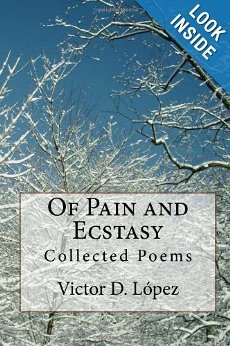
Of Pain and Ecstasy: Collected Poems Free One Last Time 9/17/2013
I will no longer participate in the Kindle KDP Select Program once my current 90 day period expires this month because I would like to make the electronic versions of my books available in more formats than just the Kindle. As a result, my books will no longer be eligible for free download promotions or be available free of charge to Kindle Prime members after the current 90 day period expires, which for most of my books is at the end of this month. So here is probably the last chance to get this book free of charge Tuesday 9/17/2013. You can download the book free on 9/17 by clicking on its cover below.
Here are two sample sonnets from the collection:
Siren’s Song
Poetry is a dangerous siren’s song,
That calls the soul towards a chasm deep,
Dulling the senses and making the heart long,
For that which it may touch yet never keep.
A sonnet is too much the friend of truth,
And leaves no room for self-deluding lies,
It emulates the honesty of youth,
And artifice, through artifice, soon dies.
Essential truths will spill onto the page,
Transpiring through the pores of consciousness,
Leaving exposed the battles that we wage,
To build facades of hope for hopelessness.
I can deny the painful song I hear,
But it’s too late; its message is too clear.
Ode to Innocence
Oh half-remembered, fleeting happy time,
When nothing mattered more than love and play,
Imagination was then in its prime,
And life began anew with every day.
A flower was then a joy, a mystery,
And not a petal, root and simple stem,
And life was full of wondrous fantasy,
Untainted by the intellect of man.
That time is gone now, It cannot return,
The fruit’s been swallowed, its slow poison kills,
And yet my fallen heart will always yearn,
For that ephemeral time of unknown skills.
Oh false god, knowledge, daily you destroy,
All that was holy in me as a boy!
From Of Pain and Ecstasy: Collected Poems (C) 2011 Victor D. Lopez
Various sample readings from of Pain and Ecstasy are available at from YouTube here;


September 15, 2013
Eternal Quest free from Amazon Monday Sept. 15, 2013
This short story is again available for free download for one day only this month: Monday, September 16 2013. You can download it from Amazon in the U.S. here: (Outside of the U.S., just search for the title and my name for the free download page, of by my full name.)
Eternal Quest is one of my first short stories, written when I was 19 for a fiction class in college along with some others that have been lost over the years. Although I’ve lightly reworked it over the intervening thirty years or so, it is largely as I first wrote it and is still my personal favorite among my short fiction. I don’t think I’ve written anything better since then–a hard, sad thing for an author to admit. But I am perfectly happy if I never do as I truly like this story which still reflects more than a little of my own neo-Platonist philosophy and romantic core. It is about sacrifices made for love and friendship too deep for words to describe that can make even unrequited love bearable, about putting the needs of others above our known, about the mindless pursuit of answers in all the wrong places and about lessons learned in life much too late for solace, comfort or salvation.
But it is also about much more than existentialist despair or the irony of a wasted life. Ultimate it is about friendship, about the need to balance what Plato called the Appetites, Reason and the Spirited Element in each of our own lives (what Freud later “borrowed” and renamed the Id, Ego and Superego). More than anything, it is is about transformational friendship and its ability, for those of us lucky enough to experience it, to make us far stronger than we could ever be without the balance it can being to our lives.I blush to admit this, but more than thirty years after writing this story, I still tear up when I read it to the end. The personal subtext is not important, then or now, but the knowledge that there is no greater truth we can learn during our short sojourn through life than that which is taught only by pure, unselfish, love–requited or not–is essential. As is the transformative power of true friendship. I have learned nothing of greater importance since writing this story, and I never will.
Tagged: existentialism, love story, science fiction, scifi, SF, speculative fiction, suspense


Victor D. Lopez

- Victor D. López's profile
- 11 followers


