
Ronald E. Yates's Blog, page 80
April 22, 2019
Some Thoughts on Writing
I have been writing, in one form or another, for most of my life. I learned the techniques and skills of writing by toiling for almost 30 years in the relentless and stressful world of journalism.
I was in some pretty good company. Ernest Hemingway began his writing career as a journalist. So did Rudyard Kipling, George Orwell, Graham Greene, Charles Dickens, Evelyn Waugh, Joan Didion, Norman Mailer, Hunter S. Thompson, Jack London, Annie Proulx, Stephen Crane, John Steinbeck, James Agee, Lillian Ross, and Mark Twain.
For 13 years I taught writing and reporting at the University of Illinois after leaving the world of professional journalism. During that time, I managed to condense my thoughts on writing into a structure suitable for the classroom.
So allow me to share my views on writing.
Writing is both an art and a craft. To be a good writer you must first master the tools of the craft. What are those? They are, vocabulary, grammar, research, style, plot, pacing, and story.
Words are your basic tools. They are your implements in the same way hammers, saws, bubble levels, squares, screwdrivers, and tape measures are the tools a carpenter must possess.
Then comes grammar. Just as carpenters must learn to respect and skillfully master their tools, so too must writers learn to skillfully manipulate words and respect the language.
If you don’t respect the language, you will never succeed as a writer.
You must also give yourself time to learn the art and craft of writing. You don’t learn how to be a writer by sitting alone in a room and squeezing your brain for inspiration the way you wring water from a sponge.
One of the first steps to becoming a good writer is by reading. Read, read, and read. As I used to tell my students, “If you want to write well, read well.”
Learn from the best; imitate (and I don’t mean plagiarize). Listen to the words! Words speak to us from the written page, IF we let them, IF we allow our eyes to open our inner ears.
Gifted writing can’t be taught. It must be learned.
And we learn from doing it; from experience. That’s how we gain confidence.
Let me repeat that, because it is SO VERY IMPORTANT. To be a good writer you need to be confident in your ability to use the tools of the craft: vocabulary, grammar, research, style, plot, pacing, and story.
A confident writer is typically a good writer. We gain confidence by being successful in our work–no matter what work we do. We also learn from failure. Why was a book rejected 40 times? Why isn’t it selling on Amazon or Goodreads or Barnes and Noble? There must be a reason. Find out what it is and learn from it. Then go back to work and make the book better.
[image error] Ernest Hemingway
Once you master the Craft of Writing…the fundamentals, the mechanics, the “donkey” work, then you are ready to move on to the Art of Writing.
I don’t know if those who do not write for a living understand just how difficult writing is. Many believe that writers work from inspiration and that the words simply leap onto the blank page (or into yawning maul of the computer).
Ernest Hemingway once said: “There is nothing to writing. All you do is sit down at a typewriter and bleed.”
In fact, while inspiration is a wonderful thing, it is not what makes a good writer or book. Writing requires significant research, whether fiction or non-fiction. It requires a facility for organization and a keen sense of plot, pacing and story.
I don’t believe writers are “born.”
They evolve over time as a result of significant experience in the craft.
Not all writers are brooding, intractable alcoholics, or unbearable misanthropes who feel their creations contain irrevocable and definitive truths that most of humanity is too obtuse to comprehend.
In fact, most successful writers are excellent storytellers and they like nothing more than to have their stories read by as many people as possible–even if those stories don’t always possess immutable truths.
And storytelling is not limited to fiction. Storytelling in non-fiction or journalism is just as important.
When I was young, I used to write lots of short stories. Were they any good? No. But for a person who wants to be a writer they were my way of practicing. Sort of like practicing the piano or the flute or some other instrument. The more you practice, the better and more accomplished you become.
Somerset Maugham, author of such classics as The Razor’s Edge, The Moon and Sixpence, and Of Human Bondage, had this to say about writing: “If you can tell stories, create characters, devise incidents, and have sincerity and passion, it doesn’t matter a damn how you write.”


April 19, 2019
Musings in a Writer’s Mind When He Should be Writing
I get a lot of strange emails. Sometimes they contain little bits of wisdom and when they do, I file them away on my computer for future reference.
Today, I want to share some of these musings with you. Perhaps you will find them interesting. Perhaps not.
In any case, take a look. You may find something you like.
I had amnesia once — maybe twice.
I went to San Francisco. I found someone’s heart. Now what?
Protons have mass? I didn’t even know they were Catholic.
All I ask is a chance to prove that money can’t make me happy.
If the world were a logical place, men would be the ones who ride horses sidesaddle.
What is a “free” gift? Aren’t all gifts free?
They told me I was gullible and I believed them.
Teach a child to be polite and courteous in the home and, when he grows up, he’ll never be able to merge his car onto the freeway.
Experience is the thing you have left when everything else is gone.
One nice thing about egotists: they don’t talk about other people.
My weight is perfect for my height–which varies.
I used to be indecisive. Now I’m not
How can there be self-help “groups”?
If swimming is so good for your figure, how do you explain whales?
Show me a man with both feet firmly on the ground, and I’ll show you a man who can’t get his pants
Is it me — or do buffalo wings taste like chicken?
Finally, a few interesting facts that you can use to win a bet or two.
There are no clocks in Las Vegas gambling casinos.
There is one slot machine in Las Vegas for every eight inhabitants.
The Mona Lisa has no eyebrows. It was the fashion in Renaissance Florence to shave them off.
The most popular first name in the world is Muhammad.
And this little tidbit for those of us who use keyboards.
The sentence “The quick brown fox jumps over a lazy dog.” uses every letter of the alphabet
April 17, 2019
Key West 2016: Hemingway Would Hate It
[I wrote this post a while back after I made my pilgrimage to Ernest Hemingway’s house in Key West, Florida. Hemingway lived in the house in the 1930s during the apex of his career as a novelist. I hope you enjoy it]
Once upon a time, Key West was known for its fishing, sea salt refining, and salvaging operations. It was also the largest and wealthiest city in Florida.
Today, Key West is primarily known as a trap for tourists—hordes of them. In fact, last year some four million tourists ascended on the 7.4 square mile island and its 25,000 permanent residents that is actually closer to Cuba (90 miles) than Miami (160 miles).
Some tourists come so they can say they visited the southernmost city in America; some are deposited there by giant cruise ships; and some come because they want to visit the place that Ernest Hemingway once called home and where he produced almost 65 percent of his work.
Having just returned from Key West, I am convinced that Hemingway would absolutely hate the place today.
Were he to walk from his house at 907 Whitehead Street to Sloppy Joe’s saloon (his favorite watering hole), Hemingway would have to elbow his way through throngs of tourists, tacky t-shirt stores, cafes, ice-cream stands, street performers, overpriced jewelry shops, shady art galleries, and bars—lots of bars with music blaring at a level Hemingway would no doubt have found annoying.
Hemingway would probably recognize the saloon at 201 Duval Street today. It hasn’t changed too much since 1937 when Hemingway was there knocking back Bacardi light rum Dobles, otherwise known as “Hemingway Hammers.” (Recipe is at the end of this post).
Locals will tell you that today’s Sloppy Joe’s is not the original Sloppy Joe’s. That bar is now called Captain Tony’s. It was there, from 1933 to 1937, that “Sloppy Joe” Russell, a charter boat captain and Hemingway fishing pal, ran a bar that from a building that once housed the city morgue.
In 1937, Russell abruptly moved half a block to the current Sloppy Joe’s location, upset that his landlord raised his rent $6 a month. At midnight, his patrons, including (legend has it) Hemingway, helped him move lock, stock, and barrel to the current location.
Some locals insist that Hemingway provided Russell $5,000 to buy the new bar. Others point out that Hemingway removed the marble urinal from the old bar and took it home.
“I used the damned thing so much I figure I already paid for it,” Hemingway said. He set it up as an outdoor watering trough for his beloved polydactyl (six-toed) cat named Snow White. It is still there behind Hemingway’s house and Snow White’s six-toed descendants—all 40 or 50 of them—still drink from it.
Unlike the 1930s, today’s Sloppy Joe’s features a restaurant and gift shop loaded with Hemingway related souvenirs. It also hosts the annual Hemingway Days Festival and Hemingway Look-Alike Contest.
I have to wonder what Papa would think about all of that.
I also wonder what he would think about the ubiquitous key lime pie shops that abound in the town where the dessert originated in the 1850s. They are everywhere and Key West is rife with arguments about which place has the best key lime pies.
[image error] Key Lime Pie
If there is one take away from Key West and other hallowed places steeped in the nostalgia of bygone days (and nights), it is this: They are not the same unspoiled places they were when their reputations were evolving.
Take, for example, legendary wild-west towns like Virginia City, Nevada, or Dodge City, Kansas, or Tombstone, Arizona. When we visit these places we hope against hope they will be at least a little like they once were.
They are not. Like Key West, they are inundated with tourists surging through t-shirt shops and souvenir shops that sell everything from whoopee cushions to cheap jewelry.
But let’s not stop there. When I think of the venerated historical sites I recently visited in Europe it’s apparent how tourism has impacted them also. Take Rome’s Forum and the Coliseum, where for a few Euros you can have your picture taken with re-enactors dressed as Roman Centurions or Vestal Virgins. And yes, you can buy t-shirts and other junk nearby.
Or how about England’s enigmatic collection of monoliths at Stonehenge and the Tower of London complex along the Thames? More t-shirt shops, more throngs of tourists, more junk in nearby shops.
With increasing numbers of people traveling further and faster than ever before, places with even a modicum of historical significance are now targets for tour operators and their convoys of pervasive buses. Even Machu Picchu, that ancient Inca city high in the Peruvian Andes that was once visited by a handful of hearty travelers, is now teeming with flocks of sightseers.
The reaction of many tourists is often: “Gee, I expected something more authentic with fewer people.”
Wishful thinking.
Key West has done a good job of preserving some of its past. Hemingway’s 165-year-old house, for example, is in surprisingly good condition given the number of tourists who traipse through it to ogle the furniture and other trappings of the renowned Nobel-prize-winning author. It also boasts a cadre of well-informed docents who will lead you through the house and grounds while providing you with running commentaries that are highly instructive and enlightening.
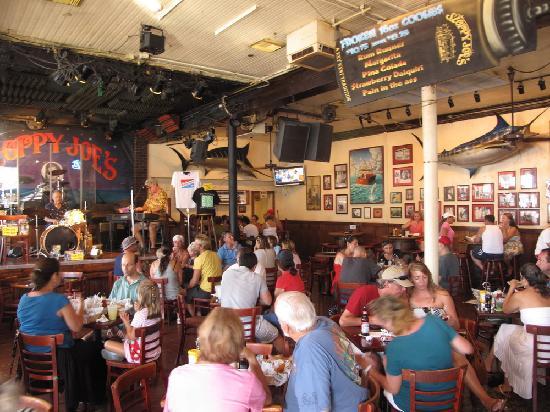 Inside Sloppy Joe’s
Even Sloppy Joe’s, with its ancient, wobbling ceiling fans, jalousie doors and original long curving bar has managed to preserve some authenticity. It seems almost as grungy and cluttered as it was back in the day, and the booze still flows liberally.
And Key West, even with its plethora of overpriced shops, ice cream stands, rubber-wheeled trolleys, conch trains, and street performers, retains a kind of eccentric charm.
Maybe it’s the utter tackiness of the place, the crush of tourists, or the vague mystique associated with Hemingway, it’s most famous resident.
Or maybe it is something Hemingway once said about Key West when asked to describe the place.
“Key West is the St. Tropez of the poor,” he said.
April 16, 2019
A Pilgrimage to Hemingway’s Key West Abode
The house at 907 Whitehead Street in the heart of Old Town Key West looks about the same as it did when Pulitzer and Nobel-Prize winning author Ernest Hemingway lived there from 1931 to 1940.
But that’s where the similarity ends.
The 165-year-old limestone two-story house with its wrap-around veranda and lush gardens of coconut palms, frangipani, bougainvillea, and African tulips, is now a museum offering tours at $13 a head to thousands of tourists who make the 150-mile, four-hour drive from Miami through the Florida Keys to Key West.
[image error] Hemingway’s Home in Key West
Tour guides lead visitors through the house’s modest rooms explaining various architectural features, furniture pieces, and art work. They also point out the 40 six and seven-toed cats that have the run of the house and gardens.
A highlight of the tour is a peek at the upstairs room of the small two-story guest house behind the main house where Hemingway penned such classic works as Death in the Afternoon, The Green Hills of Africa, The Snows of Kilimanjaro, To Have and Have Not, The Short Happy Life of Francis Macomber, and For Whom the Bell Tolls. It was here that he also wrote dozens of short stories, poems, newspaper columns and magazine articles.
[image error] Hemingway’s Office
Hemingway was a prolific writer who rose early and began writing around eight a.m. and usually finished at noon. Then it was often off to Sloppy Joe’s bar for an afternoon of drinking and gabbing with pals or heading out to sea on his fishing boat, The Pilar.
For a journalist and writer like me, visiting the place where Hemingway produced 65 percent of his work, is a bit like making a religious pilgrimage to The Vatican, Jerusalem, or Mecca.
In 1961, after his suicide in Ketchum, Idaho, the unpublished manuscript that would later become the novel Islands in the Stream was found in a vault in the property’s garage.
I have always felt a fragile connection to Ernest Hemingway because of where we both began our journalistic careers. It was at the Kansas City Star. He worked there between 1917 and 1918 cranking out police stories and other articles. I began my career there in 1968 as a summer intern from the University of Kansas’ William Allen White School of Journalism.
While working at the Star, I recall reading some of Hemingway’s clips. In those days, reporters didn’t have bylines, but a reporter who mentored me at the paper let me see Hemingway’s stories on microfiche. His stories were crisp, punchy and filled with insightful description—all elements that would eventually characterize and define his writing.
Years later Hemingway recalled how his training as a Kansas City Star reporter prepared him for a successful career as an author.
“I learned how to use short sentences and eliminate superfluous words,” he said. “These are the best rules I ever learned for the business of writing.”
As many wise young reporters do, Hemingway latched on to a seasoned newspaperman named Lionel Calhoun Moise as a mentor. Moise was probably the biggest influence in Hemingway’s journalistic career.
[image error] Hemingway’s studio
Moise, who was once described by a fellow Star reporter as “a big, brutal, son-of-a-bitch, who loved to drink and brawl,” believed that writers needed to experience what they wrote about. He told Hemingway to write crisply, with a minimum of description. Ultimately, Hemingway learned to let action and dialogue move the story along.
My mentor at the Kansas City Star was a 65-year-old reporter named Harry Hannon. Unlike Moise, Harry was a short, wiry man who walked with a limp. His beat, among other places, was the U.S. Federal Prison at Leavenworth, Kansas, and the Kansas State Prison just down the road in Lansing, Kansas.
Harry not only knew the wardens and many of the guards at both prisons, he knew many of the inmates—including some serving life sentences for murder and other nefarious crimes.
“You want some life experiences?” Harry asked me once as we walked through the Federal penitentiary. “You will hear plenty of those in here.”
Harry taught me things from the old Kansas City Star stylesheet like: “Say he was eager to go, not anxious to go. You are anxious about a friend who is ill;” and “He died of heart disease, not heart failure—everybody dies of heart failure;” and finally, “Don’t say, He had his leg cut off in an accident. He wouldn’t have had it done for anything.”
Hemingway would have been given the Star’s style sheet. I have attached a copy of a 1915 version at the end of this post.
Harry never made the trip to Key West to visit Hemingway’s famous abode. But a few years later, after he retired from the Star, he came to Chicago for the horse races at Arlington Park. At the time, I was a new general assignment reporter for the Chicago Tribune.
[image error] Hemingway doing some self-editing
We had dinner together at the Palmer House hotel where he was staying and then I took him on a tour of the Tribune’s sprawling newsroom where reporters were pounding out stories on big Underwood typewriters for the final edition. The raucous sound of phones ringing, typewriters clacking and agitated reporters yelling “Copy!” at copyboys and copygirls, resounded throughout the vast smoke-filled room.
“Now this is a real newsroom,” Harry said as we observed the kinetic atmosphere that once upon a time defined the city room of a big city newspaper. “I envy you.”
Harry never met Hemingway at the Star. He began his career at the paper a few years after Hemingway moved on.
“I remember some reporters talking about him,” Harry told me. “They remember him as a fresh-faced kid of 18 or 19 who moved to Kansas City from Chicago. He sometimes wore a red and black checkered hunting shirt to work. A lot of folks didn’t like the way the dressed, but hell, he worked mostly out of the office on the street, covering crime, fires, chasing ambulances, riding with the cops, and hanging out in hospital emergency rooms, so who cared?”
[image error] Ernest Hemingway in 1918
As a general assignment reporter for the Chicago Tribune, I covered the same kinds of stories. It was the best training I ever got—my journalism courses at the University of Kansas notwithstanding.
Later Hemingway would cover war and mayhem for various newspapers and magazines, as did I for the Tribune.
Like Hemingway, I learned to write from my experiences. Unlike Hemingway, however, my fiction, while infused with many of my experiences covering wars and revolutions, does not rise to the level of virtuosity that Hemingway displayed.
Am I discouraged by that? Not at all. While Hemingway often said that writing was the hardest work he ever did, he also said telling a good story gave him the greatest joy.
Writing—whether fiction or non-fiction—is storytelling. As long as I can write for the sheer joy of it and tell a few compelling stories now and then, I will be the happiest of hacks.
April 15, 2019
Self-publishing is more than Amazon Reviews & Book Sales
(I recently received the following post from the UK-based Alliance of Independent Authors (ALLI), a non-profit professional association for authors who self-publish. The author of the post, Fiona Cameron of Scotland, makes some excellent points so I thought I would share it with those writers and readers who follow my blog. A short bio of Fiona follows the end of the post. Enjoy)
By Fiona Cameron
It’s time for some real soul-searching.
Although I now have five novels to my name, the whole self-publishing arena is STILL a very steep learning curve for me. I spend not only a lot of time but a lot of money on getting each book out, because I’m paying for professional editing, cover design & formatting, to make sure each is as good as it can be.
[image error] Author Fiona Cameron
I have very few Amazon reviews (although I tend to get some very pleasing direct feedback from readers), and I sell very, very few copies of the eBook versions. I’d say I’d be very lucky if I’m making back 10% of what its cost me to get the book out, in the first year at least.
Any advertising I do (very little), and using facilities like NetGalley (I’m growing fonder of it by the day, BTW) eat up more than that 10% return.
The Relative Value of Amazon Reviews
However, I find it comforting, in a perverse way, to look at the Amazon reviews of some of the books which I would rate as my top ten of modern fiction and non-fiction. Take, for example, Cees Nooteboom’s Roads to Santiago. A princely total of three Amazon reviews, and here’s one of them:
Despite all the hype and OTT reviews, I was disappointed with this book, but if you like reviews of churches, religious artefacts, and architecture, then go ahead and enjoy. Frankly, I feel it gives a very limited image of Spain. Having said that, he has a good writing style, but pity it was not more focused on the many aspects of Spain.’
I assume this reviewer is referring to reviews in the print media, by professional reviewers – and yes, maybe they were OTT, because this is (to my mind) one of the finest travel books ever written. The Amazon reviewer quite clearly didn’t ‘get’ it. Nooteboom’s The Foxes Come at Night gets very positive reviews: a whole TWO of them.
And how about Penelope Fitzgerald’s Offshore? It has 69 Amazon reviews. Here’s one of them:
‘I disliked this book intensely; I finished it because I belong to a book group and wanted to join in the discussion at our meeting. Can’t understand how it won the Booker prize.’
Sally Vickers’ Instances of the Number Three: 29 reviews, including this: ‘This was our latest book club choice. Utter rubbish!’ My fourth book was selected by a book club too, and I know some of them hated it. I’m in great – very great – company.
So would I rather have written a book that garnered more than a thousand Amazon reviews, or would I rather feel I even had my foot on the same ladder as Penelope and Sally?
Guess.
It’s Not Just About Sales
I know I’m lucky, in that I have made a very good living from writing for other people over the past few years (not ghosting, but PR/marketing blurb), and so I can afford to spend on getting my books to the stage I want. I’ll keep on writing as long as I’m physically and mentally up to it, and I’ll go on spending money on perfecting my books, as long as I can afford to.
I’m ecstatically happy for all the ALLI members who sell thousands of books, and make a living from it. But I believe there’s also a community of us for whom that’s far from being the case.
What we’re doing still has value.
One of the greatest benefits of belonging to an organisation like ALLI is that we can share, we can support one another, we can ENCOURAGE one another, and we can believe that there’s more to being a successful writer than garnering Amazon reviews!
OVER TO YOU How do you define self-publishing success? We’d love to hear your views.
Why successful #selfpublishing isn’t defined by book reviews and sales by Fiona Cameron
About Fiona Cameron
Fiona Cameron was born in Glasgow, and has worked as a lecturer, journalist, and PR consultant. She now lives in SW Scotland, and tries hard to fit her writing day around tending cats, dogs and a garden. Her short stories have previously been published in New Fiction collections. The books forming the Balvaig Trilogy are her first full-length novels. www.fionacameronwriter.com
April 12, 2019
12 Things Writers Fear But Can Overcome
(I am sharing this post from http://bookmarketingbuzzblog.blogspot.com/ by Brian Feinblum. In this post, Brian addresses some of the fears and concerns that many writers face as they write and prepare to put their work before the public. I think you will find it as thought-provoking and noteworthy as I did. Ron Yates)
Writers, generally speaking, have strong convictions, wild imaginations, and creative ideas. But they lack the ability to close the door on their fears, insecurities, and late-at-night concerns. They can let things needle them, sometimes letting the stress and pressures of being a writer get to them.
Here are a dozen things many writers fear – and how to put such worries into perspective so they don’t cripple their efforts to write, pursue publication, seek out publicity, and market their life’s work:
Fear of Rejection
Most people will reject, ignore or dismiss your book for any reason. You just need a few yesses – from a literary agent, then a publisher, then from book buyers. Remember, even if you sell 3.2 million copies of a book, 99% of America rejected it.
Fear of Criticism
Many writers have a big ego but nothing deflates you like a bad review. Expect bad reviews. Not everyone will like everything you write. Learn from the critics or dismiss them, but don’t obsesses over a fear of getting a few bad reviews when the vast majority may turn out positive.
Fear of Success
Yes, some believe success will come to them and at too fast of a pace that they won’t be able to handle it. News flash: You would be lucky to have such a problem. Success will come when it chooses – and from when you work hard, smart, and purposely. Go with the flow and grow with whatever success you achieve.
Fear of Not Having Time to Write
Make the time. I don’t care if you get up early, stay up late, steal time from your lunch break, cut down on watching TV, or whatever, but real writers find the time. Even if you write two pages a day, you have a book in less than four months.
Fear of Lacking Time or Ability to Market A Book
This fear is real because you’ll never have enough time to properly market a book, assuming you know how to go about doing it. The solution is that you do what you can and make a real effort to support your writing. Then leave the rest to a professional book promoter.
Fear of Not Being Recognized By Awards
There’s nothing to fear. Apply for the awards and see what happens. There are many awards out there. Find ones that are relevant and where you can be competitive. If you write plenty of books and submit each one to many awards, you have a chance of placing high in some.
Fear of Your Writing Not Changing The Lives of Your Reader
Every book can impact a life, perhaps many lives, just by being informative, inspiring, enlightening or entertaining. Writers contribute to the world in so many ways, on so many levels. We may never truly understand or come to realize our impact on others, but rest assured, good books change lives.
Fear That Your Best Book Is Behind You
Writers aren’t athletes who peak at a young age. In fact, writers do better with age, accumulating experiences, and formulating full, informed views. Your best work is always yet to come.
Fear of Old Age Stealing a Chance To Write One More Great Book
As we age we realize arthritis, bad backs, eye strain, and other ailments settle in. Physically, tomorrow will not be as good as today, so let that urgency fuel your writing now. Don’t wait to write the greatest book as an octogenarian, though writing at any age can be rewarding.
Fear You’ll Recognize Other Books Are Better Than Yours
Someone always has a better, bigger, faster, whatever, but that doesn’t mean you aren’t better than many or most. Who cares about the competition? Write what you know, do your best, and have fun with it. Put your work out there and let the masses determine your fate.
Fear That People Will Stop Buying Books
It’s natural to be concerned about the future of books, considering how much free content is out there, but so far, with all of the competition for a reader’s wallet or time, people continue to spend more on books than they did a year ago. The book world will be here for many years to come.
Fear That You Wasted Your Time Writing About Life, Not Living It
Nonsense. Writing is living. Writers supplement reality with fantasy, philosophy, and selectively focusing on the lives of others. Writing and living are not mutually exclusive – you can live life fully and enjoy being a writer.
Brian Feinblum’s views, opinions, and ideas expressed in this blog are his alone and not that of his employer. You can follow him on Twitter @theprexpert and email him at brianfeinblum@gmail.com . He feels more important when discussed in the third-person. This is copyrighted by BookMarketingBuzzBlog © 2015
March 26, 2019
Can America’s News Media be salvaged?
For the past two years I, along with millions of other
Americans, have watched the mainstream news media essentially self-destruct in
their obsession to remove Donald Trump from the White House.
I saw glimmers of this kind of mania when George W. Bush was president from 2000 to 2008. But the fixation was nowhere near the level it has been since 2016 when Donald Trump flummoxed the know-it-all eggheads who pass for pundits on television and cable networks—not to mention at once esteemed newspapers such as the New York Times, the Washington Post, the Chicago Tribune, and the Los Angeles Times.
According to a recent Gallup poll only 30 percent of the public trust the news media today, contrasted to the 76 percent who trusted the media in 1970 when I joined the Chicago Tribune. As a result, establishment pundits and reporters have lost most of the moral authority they once had.
For two years as the Mueller investigation of collusion and obstruction of justice by the Trump campaign snaked its way into the collective national consciousness, I have witnessed purportedly “objective” reporters blather on about Trump’s guilt without displaying a single shred of evidence to back up those claims.
[image error]Robert Mueller
I have seen congressmen like Adam Schiff and Eric Swalwell “guarantee”
that Trump not only colluded with the Russians, he was actually working for
them and was guilty of treason. Others, such as former CIA Director John
Brennan and former Director of National Intelligence James Clapper, echoed
those charges as paid political contributors to CNN.
Where was the evidence? There wasn’t any, as the Mueller probe proved.
[image error]Adam Schiff
Meanwhile, reporters and pundits behaved like brainless bobble-heads,
agreeing with every negative statement made about President Trump without doing
the most fundamental reporting.
Where were the probing questions? Where was the healthy skepticism
that all reporters used to have built into their DNA? Where were the concepts
of fairness, balance, and impartiality? Where was the honesty, the integrity,
the decency?
Sadly, none of these things were anywhere to be found.
Why? Because the media, unlike they were when I became a reporter in the early 1970s, have fallen victim to media groupthink. The result is a compliant media in which zombie-like reporters adhere to the approved paradigm. Those that don’t are, through dint of social and administrative forces, barred or banished.
The result of this media groupthink is reporting that continually commits bias of omission—that is, facts or information which may conflict or disprove an approved orthodoxy, are conveniently omitted from stories. This is selective reporting. It taints how events and stories are reported and presented.
It also engenders inaccurate and false reporting–or as Donald Trump calls it, “fake news.” Think about Nicholas Sandmann, the Kentucky teenager wearing a red MAGA cap, who was pilloried by the news media for his interaction with Native American activist Nathan Phillips at the National Mall in Washington D.C. in January. Just about every news outlet in the country viciously attacked the 16-year-old for “attacking” Phillips and uttering “racist” and “offensive” statements.
[image error]Nicholas Sandmann & Nathan Philips: The Media got it wrong!
In fact, Sandmann did none of those things. He simply stood his ground and tried to diffuse the situation. Now CNN and the Washington Post have been hit with $275 million and $250 million libel suits, as well they should be.
This event shows that people the media choose to ignore or hide effectively don’t exist, while people they elevate or stories they invent become central in our lives. Rather than attempting to report the news without prejudice, they seem to regard themselves as agents of positive change within the culture, direct from their groupthink perspective. Therefore, any lie, no matter how big or small is okay if it will bring Democrats back to power.
Have you ever wondered why liberals and Democrats can run
afoul of decency and the law with impunity, while the media demand that
Republicans and conservatives respond to perceived misconduct and transgression
by resigning, apologizing, and, if the media hit the jackpot, testifying to a
special counsel, and then going to jail?
I have. All the time. And it makes me sick to see the news
media refusing to perform its “watchdog” role evenhandedly.
Not only does it make me sick, it makes me ashamed—ashamed to
tell anybody I meet that I am a former journalist for fear they will give me
that piteous and doleful look as if to say: “eh huh. . .one of those!”
Yes, I am “one of those.” But I can still look back on my
body of work with pride and without shame. During my 27-year career I worked assiduously
to keep my personal opinions, my biases, and my predispositions out of my
stories.
I wonder how many reporters today will be able to do the
same when they finally hang up their reporters’ notebooks and tape recorders.
Not many, I wager.
Whatever happened to such bedrock democratic principles as equal
protection under the law, the First Amendment, and innocent until proven
guilty? At this point these underlying constitutional
tenets seem like little more than quaint bygone concepts as far as our media
are concerned.
As a result, our national culture, not to mention our
national discourse and our media, are aligned with liberals, socialists, and Democrats
who loathe Republicans and conservatives.
When was the last time YOU watched or listened to a composed,
reasoned, and articulate debate about an issue without one side fulminating,
talking over, or shouting at the other? Can you recall such an occasion in the
last two years?
Me neither.
Our public discourse has devolved into the verbal equivalent
of a UFC mixed martial arts competition with social media and mainstream news organizations
acting as corrupt referees who are making sure the guy in the left corner always
wins. That means you can forget about enjoying a settled, unruffled culture
until Democrats, liberals, and foolish socialists regain total control of
government.
When he was 81 years-old, founding father Benjamin Franklin (yes, AOC, an old white guy!) once told a woman that the United States was “a Republic, if you can keep it.”
[image error]Ben Franklin
“If you can keep it,” are the operative words. The fact is,
we may already have damaged our republic beyond repair by the silencing of
dissent through despotic control of information and the instantaneous social thrashing
of the non-compliant.
I worry that by embracing “groupthink” and discouraging independent
thought on college campuses; by fostering a news media that deceives its citizens;
and by electing dumb people to Congress who are ignorant of our history and our
political systems, we are dooming the republic that Ben Franklin helped create.
So, I find myself asking the question again: Can America’s news
media be salvaged?
I’m not holding my breath.
March 20, 2019
LONG AGO AND FAR AWAY, IN A LAND THAT TIME FORGOT
I have no idea who put this together, but it showed up one day in my mailbox and I thought I would share it with my followers. It talks about a different time in America. Some say it was a simpler time without the complications, apprehensions, and violence our country faces today. Possibly. But as a kid growing up back then, I recall that not everything was nirvana. We had problems, that’s for sure. Nevertheless, I do remember that, unlike today, it was a more innocent era with much more civility and benevolence. I think that is what the author of this nostaligic ode is saying.
LONG AGO AND FAR AWAY, IN A LAND THAT TIME
FORGOT,
BEFORE THE DAYS OF DYLAN , OR THE DAWN OF CAMELOT,
THERE LIVED A RACE OF INNOCENTS, AND THEY WERE YOU AND ME,
FOR IKE WAS IN THE WHITE HOUSE IN THAT LAND WHERE WE WERE BORN,
WHERE NAVELS WERE FOR ORANGES, AND PEYTON PLACE WAS PORN.
WE LONGED FOR LOVE AND ROMANCE, AND WAITED FOR
OUR PRINCE,
EDDIE FISHER MARRIED LIZ, AND NO ONE’S SEEN HIM SINCE.
WE DANCED TO ‘LITTLE DARLIN,’ AND SANG TO
‘STAGGER LEE’
[image error]
AND CRIED FOR BUDDY HOLLY IN THE LAND THAT MADE ME, ME.
ONLY GIRLS WORE EARRINGS THEN, AND 3 WAS ONE TOO MANY.
AND ONLY BOYS WORE FLAT-TOPS, AND ONLY IN OUR WILDEST DREAMS DID WE EXPECT TO SEE
[image error]
A BOY NAMED GEORGE WITH LIPSTICK, IN THE LAND THAT MADE ME, ME.
WE FELL FOR FRANKIE AVALON, ANNETTE WAS OH, SO
NICE,
AND WHEN THEY MADE A MOVIE, THEY NEVER MADE IT TWICE.
WE DIDN’T HAVE A STAR TREK FIVE, OR PSYCHO TWO
AND THREE,
OR ROCKY-RAMBO TWENTY IN THE LAND THAT MADE
ME, ME.
MISS KITTY HAD A HEART OF GOLD, AND CHESTER
HAD A LIMP,
AND REAGAN WAS A DEMOCRAT WHOSE CO-STAR WAS A CHIMP.
WE HAD A MR. WIZARD, BUT NOT A MR. T, AND OPRAH COULDN’T TALK YET, IN THE LAND THAT MADE ME, ME.
WE HAD OUR SHARE OF HEROES, WE NEVER THOUGHT
THEY’D GO,
AT LEAST NOT BOBBY DARIN, OR MARILYN MONROE.
[image error]
FOR YOUTH WAS STILL ETERNAL, AND LIFE WAS YET
TO BE,
AND ELVIS WAS FOREVER IN THE LAND THAT MADE
ME, ME.
WE’D NEVER SEEN THE ROCK BAND THAT WAS
GRATEFUL TO BE DEAD,
AND AIRPLANES WEREN’T NAMED JEFFERSON, AND ZEPPELINS WERE NOT LED.
[image error]
AND BEATLES LIVED IN GARDENS THEN, AND MONKEYS
LIVED IN TREES,
MADONNA WAS MARY IN THE LAND THAT MADE ME, ME.
WE’D NEVER HEARD OF MICROWAVES, OR TELEPHONES IN CARS, AND BABIES
MIGHT BE BOTTLE-FED, BUT THEY WERE NOT GROWN IN JARS.
AND PUMPING IRON GOT WRINKLES OUT, AND ‘GAY’
MEANT FANCY-FREE,
AND DORMS WERE NEVER CO-ED IN THE LAND THAT
MADE ME, ME.
WE HADN’T SEEN ENOUGH OF JETS TO TALK ABOUT
THE LAG,
AND MICROCHIPS WERE WHAT WAS LEFT AT THE BOTTOM OF THE BAG.
[image error]
AND HARDWARE WAS A BOX OF NAILS, AND BYTES
CAME FROM A FLEA,
AND ROCKET SHIPS WERE FICTION IN THE LAND THAT
MADE ME, ME.
T-BIRDS CAME WITH PORTHOLES, AND SIDE SHOWS CAME WITH FREAKS, AND BATHING SUITS CAME BIG ENOUGH TO COVER BOTH YOUR CHEEKS.
[image error]
AND COKE CAME JUST IN BOTTLES, AND SKIRTS
BELOW THE KNEE,
AND CASTRO CAME TO POWER NEAR THE LAND THAT
MADE ME, ME.
WE HAD NO CREST WITH FLUORIDE, WE HAD NO HILL
STREET BLUES,
WE HAD NO PATTERNED PANTYHOSE OR LIPTON HERBAL
TEA
OR PRIME-TIME ADS FOR THOSE DYSFUNCTIONS IN THE LAND THAT MADE ME, ME.
THERE WERE NO GOLDEN ARCHES, NO PERRIER TO
CHILL,
AND FISH WERE NOT CALLED WANDA, AND CATS WERE NOT CALLED BILL
AND MIDDLE-AGED WAS 35 AND OLD WAS FORTY-THREE, AND ANCIENT WERE OUR PARENTS IN THE LAND THAT MADE ME, ME.
BUT ALL THINGS HAVE A SEASON, OR SO WE’VE
HEARD THEM SAY,
AND NOW INSTEAD OF MAYBELLINE WE SWEAR BY
RETIN-A.
THEY SEND US INVITATIONS TO JOIN AARP,
WE’VE COME A LONG WAY, BABY, FROM THE LAND THAT MADE ME, ME.
[image error]
SO NOW WE FACE A BRAVE NEW WORLD IN SLIGHTLY
LARGER JEANS,
AND WONDER WHY THEY’RE USING SMALLER PRINT IN
MAGAZINES.
AND WE TELL OUR CHILDREN’S CHILDREN OF THE WAY
IT USED TO BE,
LONG AGO AND FAR AWAY IN THE LAND THAT MADE ME, ME.
If you didn’t grow up in the 1950s, you missed the greatest time in history. I hope you enjoyed this read as much as I did.
March 12, 2019
Welcome to the Vagaries of Life Blog Tour @Jinlobify#4WillsPub #RRBC
It is my pleasure today to host author Joy Nwosu Lo-Bamajoko on her “Welcome to the Vagaries of Life Blog Tour.” Joy is a member of the Rave Reviews Book Club and the Rave Writers International Society of Authors. Read on, you won’t be disappointed. And don’t forget to play Joy’s tour game!
A Note From Joy:
This is the third day of my ten-day tour. Before I remind you of the rules of my tour game, let me talk a bit about my writing process. I follow as much as I can the rule of Prewrite, Draft, Revise, Edit, Publish with a tweak.
I have always wanted to write as far back as I can
remember. I read voraciously! I also wrote down, on my scrap book any idea that
came into my head. Sometimes, it was just a sentence, and other times, more. This
can pass for prewrite, but I prefer to call it gathering of facts.The one
sentence ideas will usually lose their thread with time, and the longer ones
will develop into short stories.
My ideas can come from anywhere. I dream a lot, or should
I say, I day dream a lot! I can dream
with my eyes open and when I do, my body will be on a spot while my mind is out
wondering. When I dream, my mind travels and I see places and things happening
all around me. I hear unspoken words. I steal into people’s minds and thoughts.
Then when I return to reality, I write about my adventures.
Back to our show! Like I already said, ten days is a very
long time to be on a tour, and I know how hard and even boring it could be to
visit all the stops. But I am spicing things up with this tour.
The
Rules:
I will choose only three winners from the correct
matches. The winner with nine correct matches will be gifted with a $15 Amazon
gift card and an eBook copy of your choice from any of my books. The second
with eight correct matches will be gifted with a $10 Amazon gift card and an
eBook copy of your choice from my books. The third winner with seven correct
matches will be with gifted a $5. Amazon gift card and an eBook copy of your
choice from my books.
Now the catch! If you follow the tour and read the
snippets, I would hope that you would buy and read the complete stories and
leave a review of the book after the tour.
This tour is supported by another of my books; Pregnant Future. If you want to read
that one too, that will be great. However, the focus will be on Vagaries of Life: And Girls’ Talk. Good
reading!
Vagaries
of Life: And Girls’ Talk
The Book Cover
[image error]
Book Excerpt:
Directly in front of Mama’s house, there sat a church which attracted more young people than the old. These young people put on elaborate shows of crying in all forms. The church was appropriately referred to as the “crying church.” During “crying times,” the young would pretend to cry by wailing and rubbing their eyes until they were red, but no tears were ever shed. Some would dramatize a crying scene by rolling on the floor or by pounding the ground as if they were beating drums.
And then, there were those who would even water their eyes with their own saliva to give the appearance that they had actually shed tears. Mama would notice these girls as they emerged from the church discussing their various acts and giggling about it. Overhearing conversation of these simple things are what added pep to Mama’s life. She couldn’t help but smile each time she reflected upon the things that people do, when they think no one is watching.
About the Author
[image error]Joy Nwosu Lo-Bamijoko
Joy has written and published extensively on national and international scholarly journals, magazines, and newspapers.
Her first short story I Come from Utopia was published in African Voices, Spring/ Summer, 2007, pg. 18. Since then, she has published numerous others in RAVE S OUP FOR THE WRITER’S SOUL Anthology , Vols. 1 & 2.
Mirror of
Our Lives: Voices of Four Igbo Women
was published in
2011 and was shortlisted for the Commonwealth Book Contest in 2012. She has
also two books published in the Italian language. The First titled: Io Odio, Tu
Odi, & Cinema E Africa Nera, are both by Edizione, Tindalo.
The Legend of the Walking Dead: Igbo Mythologies , is a journey into the mysteries of life and death of the Igbos of Nigeria was published in 2014
In Pregnant Future: No One Knows What Tomorrow Will Bring, her latest Novel, Justina is the story of every young woman who found herself alone in the world to fend for herself. It is the story of the pitfalls that await such a woman. It is the story of survival.
Her
latest book, A collection of Short Stories, titled: Vagaries of
Life: And Girls’ Talk was published in December, 2018.
Pregnant Future
[image error]
Pregnant Future – Blurb
Justina was a fighter. And, although it seemed the world was against her and her future was destined for failure …she persevered in the face of it all.
The future that was being thrown in her face, was not the one she had dreams of …and if she wanted to get her feet on the right path, she was going to have to show the world her strength. But, does she?
Will she have the will to make it to the end, unscarred?
What would you do if you knew what the future had in store for you?
Would you run towards it with open arms, or would you run away and never look back?
Justina must make a choice …before life chooses for her.
To follow along with the rest of the tour, please visit the author’s tour page on the 4WillsPublishing site. If you’d like to book your own blog tour and have your book promoted in similar grand fashion, please click HERE.
Lastly, Joy is a member of the best book club ever – RAVE REVIEWS BOOK CLUB {#RRBC}! If you’re looking for amazing support as an author, or if you simply love books, JOIN US! We’d love to have you!
Thanks for supporting this author and her work!
Links to Joy’s Social Network:
March 11, 2019
The Sad State of America’s News Media
I spent a significant part of my life in the news media—most of it as a foreign correspondent for the Chicago Tribune. I did my best to report stories accurately and fairly—as did most of my colleagues. It was part of our DNA.
That attention to fairness and accuracy was reflected in the trust the public had in the news media. During the time I’m talking about (the 1970s and 1980s) 76 percent of the public said they trusted the media to be fair and unbiased.
[image error]
Today, that number has been turned on its head. Two recent Gallup
polls have found that almost two-thirds of the American population believe that
the news media are biased, inaccurate, and full of misinformation.
One poll found that 62% of U.S. adults believe that the news
they see in newspapers, on television, or hear on the radio is biased and 44%
say it’s inaccurate.
An accompanying poll found that 40% of Americans believe
that the news they see on television, read in newspapers or hear on the radio
is misinformation, which is defined as “stories
that are made up or cannot be verified as accurate but are presented to readers
as if they are accurate.”
To say that I am disappointed to see this erosion in trust,
is an understatement.
I am also disappointed that the Democratic National Committee has decided to exclude Fox News from hosting its 2020 presidential primary debates because it feels its news division is too close to the Trump administration. That is ridiculous.
As someone who worked as a journalist for 25 years and who taught journalism at the university level, I watch news shows critically. I can tell you that the news division of Fox News is a professional operation—no less so than those at CNN or NBC. There is a Chinese wall between a news organization’s news gathering operation and its opinion/commentary operations. I have seen nothing at Fox that contradicts that.
[image error]
Professionals such as Chris Wallace, Martha MacCallum, and Bret Baier are the equal of, if not better than any reporter CNN or any other network has. (MSNBC, which doesn’t even pretend to be an impartial news organization, does not belong in the same class as the others).
To imply, as DNC Chairman Tom Perez did, that those three Fox reporters cannot be fair to a Democrat candidate during a debate is ludicrous. Sure, they will ask tough questions. That’s their job. Now, apparently, they won’t get that opportunity and the voting public will be less informed because of it.
I am disappointed that the mainstream media are silent and not standing by one of their own when Fox is facing this kind of blatant manipulation and censorship.
Fox has supported CNN reporters when they were banned from the White House. It filed a friend-of-the-court brief in support of the cable news network’s lawsuit over the revocation of reporter Jim Acosta’s press pass. Acosta was accused of behaving disrespectfully during a November 7, 2018 press conference–which he did.
In another case, Fox came to CNN’s defense when a CNN
reporter was barred from attending a Rose Garden press event. CNN White House
reporter Kaitlan Collins, was accused of “shouting” and asking “inappropriate
questions” during President Trump’s meeting with European Union
commissioner Jean-Claude Juncker.
So where is the outrage when the DNC pulls the same stunt on
Fox News?
There is none because CNN, MSNBC, NBC and many other
mainstream news organizations are more concerned about derailing President
Trump’s 2020 reelection than they are about practicing impartial journalism.
The result of that kind of journalism is reflected in those
two Gallup polls.
Meanwhile, the news media continue to lose the trust and
respect of the people they are supposed to provide with accurate and unbiased information.
It is sad to see my old profession falling into such an abyss of dishonesty and incompetence. Unfortunately, the damage appears to be self-inflicted.
[image error]
Where are the cranky editors and the tenacious producers who
once kept reporters from inserting their biases and opinions into stories?
Where are the professional journalism organizations that should be providing direction
when news organizations lose their way? Where are the journalism schools that
should be hammering rectitude and reportorial competence into the craniums of
the next generation of journalists?
Gone—and with them, fair and balanced journalism.


![[image error]](http://ronyates2.productadvancecloud.com/wp-content/uploads/sites/24/2014/07/Hemingway.jpg)
![[image error]](http://ronyates2.productadvancecloud.com/wp-content/uploads/sites/24/2015/08/interesting-facts-1.jpg)
![[image error]](http://ronyates2.productadvancecloud.com/wp-content/uploads/sites/24/2015/08/interesting-facts-9.jpg)
![[image error]](http://ronyates2.productadvancecloud.com/wp-content/uploads/sites/24/2016/05/2646065718-key-west-train-tours.jpg)
![[image error]](http://ronyates2.productadvancecloud.com/wp-content/uploads/sites/24/2016/05/SloppyJoes600-1-1.jpg)
![[image error]](http://ronyates2.productadvancecloud.com/wp-content/uploads/sites/24/2016/05/5154916117_e4f1b066d0_z.jpg)
![[image error]](http://ronyates2.productadvancecloud.com/wp-content/uploads/sites/24/2016/05/hem-home-002.jpg)
![[image error]](http://ronyates2.productadvancecloud.com/wp-content/uploads/sites/24/2016/05/Hemingways-office.jpg)
![[image error]](http://ronyates2.productadvancecloud.com/wp-content/uploads/sites/24/2016/05/Hemingways-studio.jpg)
![[image error]](http://ronyates2.productadvancecloud.com/wp-content/uploads/sites/24/2016/03/hemingway-writing.jpg)
![[image error]](http://ronyates2.productadvancecloud.com/wp-content/uploads/sites/24/2016/05/ernest_hemingway_in_milan_1918_retouched_3.jpg)
![[image error]](http://ronyates2.productadvancecloud.com/wp-content/uploads/sites/24/2016/02/Fiona-Cameron-portrait-212x300.jpg)
![[image error]](http://ronyates2.productadvancecloud.com/wp-content/uploads/sites/24/2014/06/10314507_778504625506885_1505287683546860394_n.jpg)