
L.L. Diamond's Blog, page 18
January 10, 2017
St. Marks Basilica and Venice Conclusion
From the moment we crossed the first bridge, we followed the signs toward the Rialto Bridge and San Marco. Obviously, by my past posts, we did stop places along the way, shopping and sightseeing as we plodded along. Our main goal was to reach what everyone said we had to see.
[image error]
View from the Rialto Bridge (sorry about my son’s head!)
The Rialto Bridge is one of four bridges that cross the Grand Canal, designed by Antonio da Ponte and completed in 1591. In all honesty, you can’t miss it since it’s rather large and in a rather busy and congested portion of Venice as you pass through the Rialto market to get to it. It also has shops, such as the Hard Rock Cafe, on the bridge itself, so you cannot see the Grand Canal from the interior of the bridge, you have to pass through an archway to an outer ramp to take pictures of the Grand Canal.
From the Rialto Bridge, the Piazza San Marco is not far and is one of the main sights of Venice, containing Saint Mark’s Basilica and Doges Palace as well as a few other sites. Our first stop was Saint Mark’s, an Italo-Byzantine church completed in 1092! We’d heard it was a must see and was free to enter, which was lovely. My complaint was it was dark. Not so dark you couldn’t see, but I really would have liked to see the mosaics (Not just regular mosaics either! The background is gold glass tesserae-gold leaf encased in layers of glass.), which cover the wall in more detail, and it was really impossible to see all I wanted. Given the windows in the ceiling, I am certain a bit of it was the poor weather and the time of day since we toured near 5 pm, but we had poor weather both days in Venice. No matter what, our experience would have likely been the same. My other complaint–we weren’t allowed photos.
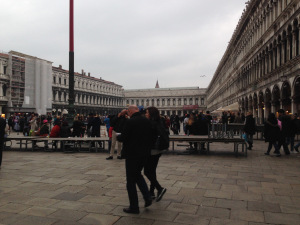
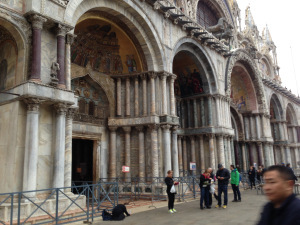
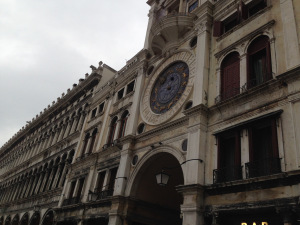
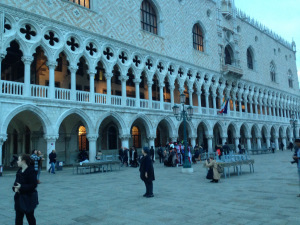
Now, one thing to note on Saint Mark’s! General admission to the building is free, and you can see most of the mosaic’s and the main portion of the church for nothing, but they do have certain artefacts and portions of the Basilica which require admission. For example, the Treasury has antiquities, even including a small animal mummy (My children found it and I don’t remember the animal. Sorry!) and some Greek/Roman pottery. The Presbytery is another part which requires admission.

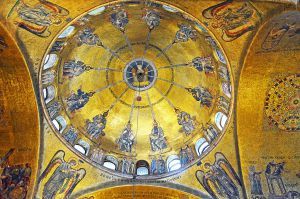
Once we’d seen all of Saint Mark’s, we walked back out to take photos and then, walked down towards the water through the Piazetta and past Doges Castle. We took quite a few photos of the amazing view, though with the weather, though it was a bit foggy. From there, we turned left and walked down a ways before testing our skills and our sense of direction by taking whatever bridges we thought were in the correct direction to make it back to the tram. We ended up using the GPS/SatNav! Venice is a maze!
Our second day in Venice was rainy and more relaxed. We decided to play tourist shopper and walked through a lot of the gift shops and even boutiques (some felt no bigger than a walk-in closet!). I believe I warned everyone in the initial post to beware of the “Made in China” knock-off souvenirs. The handmade Carnivale masks are impressive and if you are looking for something small, not terribly expensive by comparison. There are also many shops touting, real Italian leather handbags. We found a distinct difference in the feel of the bag after shopping in one boutique rather than the touristy shop. Just be aware of what you are buying!
If you are celiac or gluten intolerant. Do not worry about finding food! Many restaurants offer either pizza or pasta, and sometimes both you can eat. We actually had a more difficult time finding bread and other “Sensa Glutine” items at the grocery store. Just beware the bakery windows! They look divine and I kept taking photos! I did enjoy the coffee and espresso drinks immensely, however, much to the chagrin of my nerves.


January 4, 2017
How is it 2017 already?
Seriously! I feel like New Year’s 2016 was just a few days ago and now it’s 2017. Does time have no sense of patience? My children are growing entirely too fast and I never have enough time in the day as it is without speeding things up. Oh well! Father Time
I’ll get over it. I always do.
I don’t know about you, but I don’t make New Year’s resolutions. They always sound nice and I’ve tried to make them in the past but in the end, I forget about them within a few weeks. I have a terrible memory as it is, so it’s just one more thing to try to remember. Though I suppose my vow to get this holiday weight off could be called a resolution. I went to spin last night, but was thwarted in my attempt at exercise this morning by my son. Can’t get to cross-training with an ill child at home–well, some days I can. Just not today. Grrr!
Particular Attachments is up to Chapter 14. I haven’t decided a definitive length yet. I suppose it depends on how the story progresses. I know where I want it to go, but not whether I will use my characteristic 30 chapters to tell it.
Don’t miss Jane in January this month at Austen Variations! I have no idea what I’m going to do, but hopefully, I’ll figure it out soon!!! If you have a suggestion, then feel free to put it in the comments below. I’m always open to suggestions
December 28, 2016
Scuola Grande di San Rocco
As you follow the signs to the Rialto Bridge and Saint Mark’s Basilica, you’ll definitely pass a small square with the Scuola Grande di San Rocco, the Chiesa (church) of San Rocco, and a da Vinci Museum. Now, I can’t comment on the da Vinci museum other than the understanding we had from the description was that it was a compilation of da Vinci’s inventions that were built and on display. I love da Vinci, but I would prefer to see his actual drawings and paintings, so we skipped the da Vinci museum. I was very intrigued, however, by the Chiesa di San Rocco and the Scuola Grande di San Rocco.
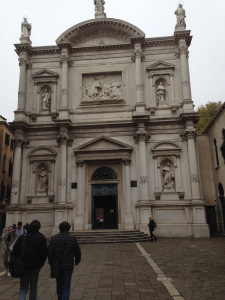
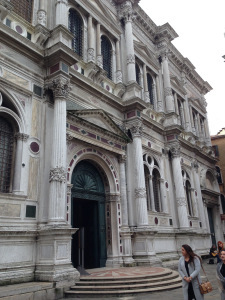
San Rocco (or Saint Roch) was the protector against plague, which had devastated Venice in the 15th century. In 1478, a group of wealthy Venice citizens founded the Scuola Grande di San Rocco.
When I was studying for my art degree, I took a class that I loved called Women in Art and Culture, and one of the artists we studied was Marietta Robusti, also called Tintoretto. Both the Church of San Rocco and Scuola Grande di San Rocco have works from Jacopo Robusti or Tintoretto, her father, who was commissioned in 1564 to produce paintings for the interior. I was curious to see the work of the father as I’d never really studied him in depth, and I didn’t regret the visit!
The church is small and has more artists featured than Tintoretto, but the works are all lovely and the church is by no means unadorned. It is beautiful in its paintings and detail, but doesn’t really hold a candle to the Scuola Grande di San Rocco.
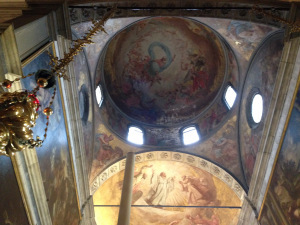
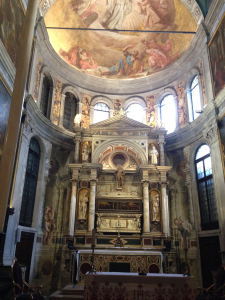
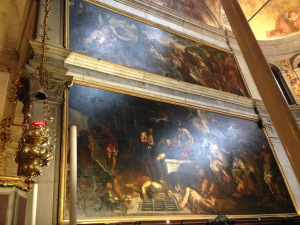

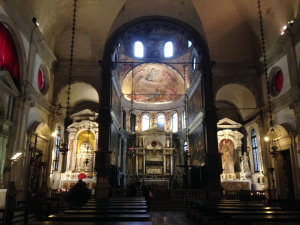
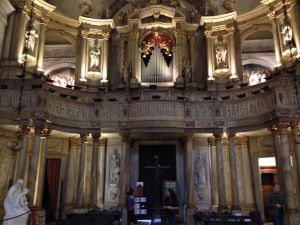
We exited the church and walked across the square. My husband was hesitant due to the admission, but we soon realised children were free, which is always welcomed with five of us–especially as my children aren’t always excited about art museums.
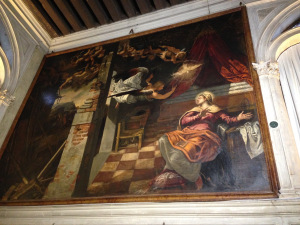
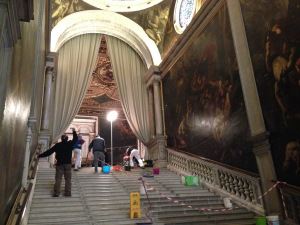
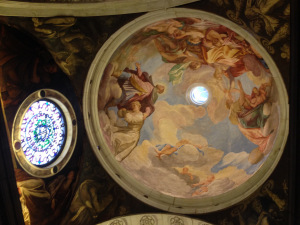
The downstairs (Salla Terra) is a columned room containing a nave and two aisles nothing but the works of Tintoretto adorning all of the walls, depicting scenes from Mary’s life. It’s a lovely room, but once you’ve looked at all of the paintings, which are gorgeous, you walk up a stone staircase with a domed roof to a room that will take your breath away. I find the downstairs deceptive when you first walk in and it makes the upstairs (Sala Superiore (“Upper Hall”)) all the more grand.
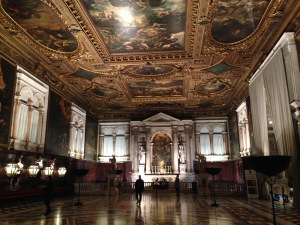
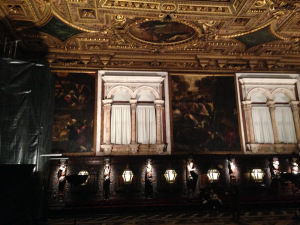
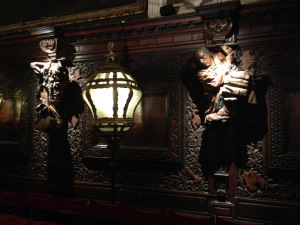

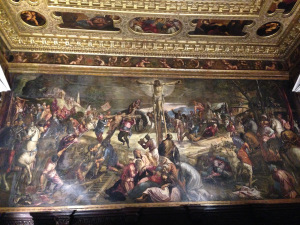
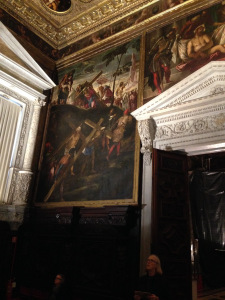
The ceiling and walls are covered by Tintoretto’s paintings trimmed in gold and with sculpture adorning the walls beneath it, including a wooden rendering of Tintoretto himself by Giuseppe Angeli and allegorical figures by Francesco Pianta. The ceiling in the Sala Superiore are from the Old Testament and the walls are depictions from the New Testament. There is also a room off to the side which has paintings depicting Christ appearing before Pilot to Calvary, which adorns an entire wall.
Scuola San Rocco was not something we planned, but was my favourite part of the trip. If you go to Venice, you shouldn’t miss it!
Next: Saint Marks Basilica and the rest of Venice
Sources:
https://en.wikipedia.org/wiki/Scuola_Grande_di_San_Rocco
https://www.lonelyplanet.com/italy/venice/attractions/scuola-grande-di-san-rocco/a/poi-sig/400371/360029


December 13, 2016
La chiesa di San Nicola da Tolentino (Venezia)
Nameplate on exterior
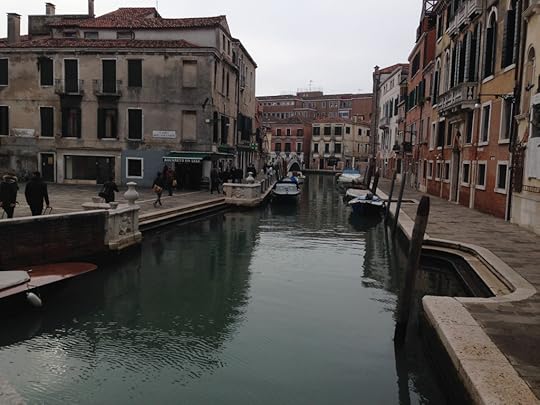
When you cross that first bridge in Venice, La chiesa di San Nicola da Tolentino is at the opposite side of a small square across from the German consulate. The temple facade caught our eye, so we decided to investigate and boy, am I glad we did!
La chiesa di San Nicola da Tolentino translates to The church of St. Nicholas of Tolentino, and has been a Catholic church since the 16th or 17th century (I had to translate the Wiki page on it’s history, so sorry for any issues arising from that!). It was named for an Augustinian friar, who was proclaimed the patron saint of souls in Purgatory by Pope Leo XIII in 1884.
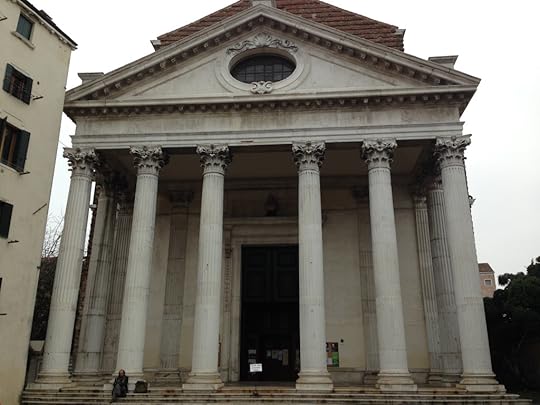
The church was erected between 1591 and 1602, and designed and built by Vincenzo Scamozzi. Between 1706 and 1714, Andrea Tirali added the portico, the tympanum, and six Corinthian columns to the exterior, which had been unfinished.
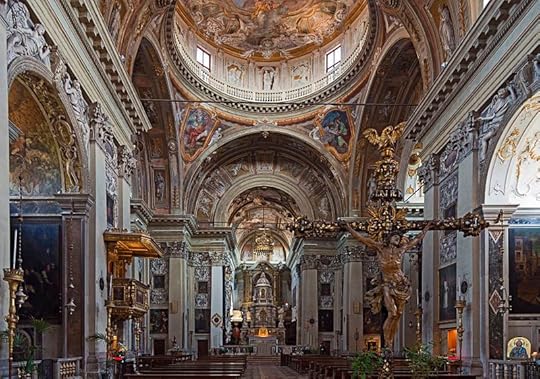
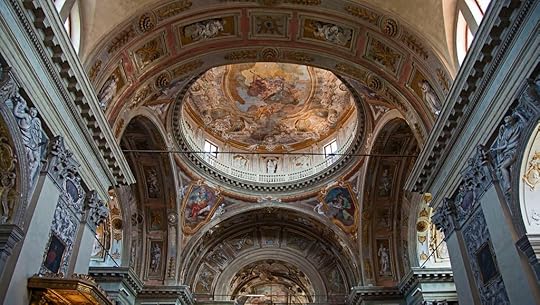
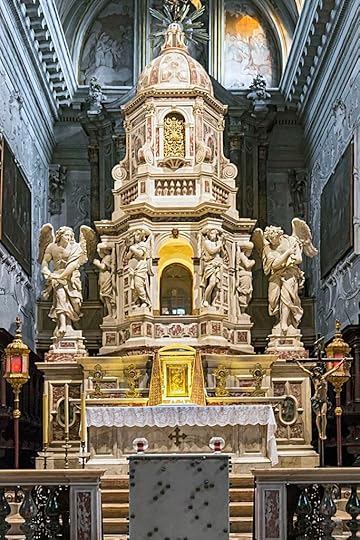
I wish I could’ve taken my own photos inside this beautiful building, but they do not allow it. Thank goodness for Wikimedia Commons, who actually has photos of the stunning insides. I must admit that though the outside is nice, I was not prepared when I entered and caught a glimpse of the interior.
Next stop in Venice: Scuole Grande di San Rocco
Photo credits:
Chiesa di San Nicola da Tolentino in Venice. General view of the interior of the church. Photo by Didier Descouens.
Chiesa di San Nicola da Tolentino in Venice. Ceiling : “Glory of St. Gaetano” of Mattia Bortoloni Photo by Didier Descouens.
Chiesa di San Nicola da Tolentino in Venice. The maine altar alla romana polychrome marble, with a large tabernacle in the shape of small allegory temple of the Holy Sepulcher directed by Baldassarre Longhena. The two worshipers angels and six angels caryatids by Josse de Corte. Photo by Didier Descouens.
References:
https://en.wikipedia.org/wiki/Nicholas_of_Tolentino
https://it.wikipedia.org/wiki/Chiesa_di_San_Nicola_da_Tolentino_%28Venezia%29


December 5, 2016
Venice

My son’s head at the Rialto Bridge
Can you believe it? We finally took a trip out of the U.K.! Not that I don’t love it here or that there is a lack of things to do or places to see, but we’ve been putting off a holiday that requires us crossing a body of water and we finally managed it. Thanksgiving holiday was a bit different when in Italy, but I’m certainly not complaining!
There two are airports you can travel into when travelling to Venice: Marco Polo and Treviso. We booked our tickets into Treviso, which is a bit farther away (only about 30 minutes), but not inconvenient by any means. It is also A. Canova airport, so for this art lover, that was a plus since Antonio Canova is one of my favourite sculptors.
Due to a commitment we had about an hour from Venice, we rented a car. I was advised to use a major company and not one of the smaller outfits you find online by someone who had gone before us. Great advice as the smaller local companies seem good at the outset, but then have smaller charges which appear once you’re there–at least that was how it was explained to me.
November 18, 2016
Glenarvon
 I was playing around, looking for a book to allude to while writing a scene, when I came upon this one. At times, I see something and think, “That would be fun!” and this was one of those times. I do not mention it specifically by name…at least yet, but I couldn’t resist using it.
I knew the name Lady Caroline Lamb. Many who have a fascination with Regency England and literature do, but I knew of her more as the lover of Lord Byron rather than a writer in her own right. Lady Caroline was indeed a writer, though probably considered as scandalous as Byron, she likely also sold as many books as he did.
Glenarvon, the book Georgiana peruses in the story, was first published anonymously in 1816. Now, I say anonymously, but everyone in society knew Lady Lamb was the author. Even Lord Byron commented, “I read Glenarvon too by Caro Lamb….God damn!” Society at the time was well aware of her identity, though it did her no favours.
 While Glenarvon is a Gothic tale, the story was actually that of her own affair with Lord Byron in which she included other prominent members of the Ton, under different names of course, and satirised them in the most unflattering terms.
The book was an undisputed success. The entire first run sold out, and further editions were printed, so one cannot say her efforts were for nothing; however, her already poor reputation was ruined and she became ostracised from the Ton.
The strange part is that Lady Caroline did not become a pariah on account of making her love affair public. The fact that she and Byron were lovers was far from a secret. It was in fact quite well-publicised. Rather, it was her unflattering satirisation of several high-ranking members of the Ton–including Lady Jersey, who led to her downfall (In retribution, Lady Jersey cancelled Lady Caroline’s Almack’s vouchers. By the efforts of family members, she did have her vouchers reinstated in 1819, but it did not do much to repair the damage.)
 Glenarvon has been in and out of print since the 19th century. It’s last printing was in 1995, and has since been called an early work of feminism, though some consider it “hysterical” and incoherent. As Lady Caroline was known to abuse alcohol and laudanum and have mental instability, incoherent is a distinct possibility.
Lady Caroline Lamb published three other works in her lifetime: Graham Hamilton (1822), Ada Reis (1823), and Penruddock (1823).
Sources:
https://en.wikipedia.org/wiki/Lady_Caroline_Lamb
https://en.wikipedia.org/wiki/Glenarvon
http://www.sjsu.edu/faculty/douglass/caro/works_glenarvon.html


November 7, 2016
A Review of Love and Friendship
 To be honest, I don’t know how to give a specific rating for this movie. I keep thinking of Robin Williams in Dead Poets Society saying, “How do you rate poetry?” I’m not saying this movie is poetry, but it’s just something I can’t assign a specific number of stars.
That said, I liked Love and Friendship, though I’m not going to claim it was a flawless masterpiece. I had bits I liked and bits I didn’t. As a Janeite, little things sometimes bug me, and it would seem like a trifling with this movie, but there were a few little things.
I’d watched the hubbub when Love and Friendship hit theatres and watched the trailers, eagerly awaiting its release on DVD. My husband added us to the waiting list at the library when we had word they would have it. We were the first to check out the copy.
Now, one of the first criticisms I heard of Love and Friendship from others was the costuming. I read someone complaining that the characters were wearing Georgian gowns rather than Regency. Most historian’s or Janeites, have a time period in which they associate one of Jane Austen’s works. Lady Susan is believed to have been written in 1794, and I would imagine the artists and fashion designers were attempting a late 18th century look rather than the look we associate with Regency, which began in 1811. Fashion plates from 1794 do feature the more Regency-looking empire waistline gowns, but there are Robes a la Anglaise dated to this time period as well. I suppose, they wanted a consistent look to the movie rather than some wearing more modern gowns versus the older styles. Overall, the costuming was lovely, and to be honest, I didn’t have an issue with it.
My only criticism before watching the movie was the title. The movie Love and Friendship is taken from Jane Austen’s epistolary (in letters) novel Lady Susan, who is Kate Beckinsale’s character in the film. What bugged me about the title change is that another of Jane Austen’s juvenilia is called Love and Friendship, and bears no characters in common and no similarity other than it also being in epistolary form. Try to look up Jane Austen’s actual story online these days, and you get a plethora of posts about the movie rather than the book. Grrr!
November 1, 2016
Bath — Again!
 I know, I gush about Bath on here, but I always have such a great time when I go. I first travelled to Bath last year for the Jane Austen Festival, and then for a family holiday in March. This year, I returned for the festival and to have a girls’ weekend with some friends.

If you haven’t read it, don’t miss out!
As has become my habit, I took the train, which I adore doing. I generally prefer to travel England by train than car, but the method has become how I always go to Bath–it’s become a bit special for that trip. I’m not always a big reader on the train, but I brought along Cass Grafton and Ada Bright’s new book, The Particular Charm of Miss Jane Austen, which kept me entertained as I zipped through the English countryside.
It was no coincidence that my roomie for the weekend (I travelled in on Friday and departed on Monday), was none other than Cass Grafton herself. We first met at Jane Austen Regency Week last year and became fast friends. I’m not a huge fan of staying alone when I travel, and she came to my rescue with a great flat in my favourite part of town. One day, I do want to stay at 4 Sydney Place, but I will never complain about Great Pultney Street!
 Most of my time this trip was spent visiting with Cass and doing a bit of shopping, but we did meet up with a few friends along the way as well. I had a great time at dinner Friday night when Cass and I met up with fellow JAFF author Alexa Adams. Nothing like wine and great conversation to spend an evening! We were staying close to one another, so we even walked back to that part of town, taking a quick stop for a selfie in front of the Abbey.
Saturday was a bit dreary, but we walked up to the Assembly Rooms to watch the promenade and see everyone in their best Regency finery. I always like to bring home special items for my children, so I did a little shopping before I met Cass and an old friend of hers for lunch.

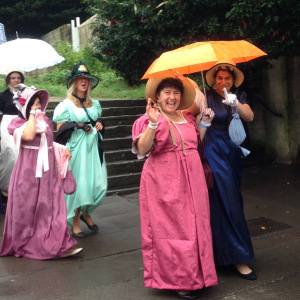
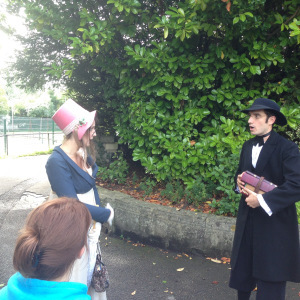
I spent the afternoon on a comedy walk of Bath. Natural Theatre Company does a play called Austen Undone that is performed as the characters take you on a walk through Bath with the Gravel Walk and Royal Crescent being a part of the tour. The performers were excellent and even engaged the spectators so we were a part of the fun. I certainly recommend Austen Undone to anyone who is in Bath for the festival. I laughed so hard and when Alexa Adams and I happened upon the vicar after the performance, he remained in character and held a conversation with us when we wished him luck. It was a great time!
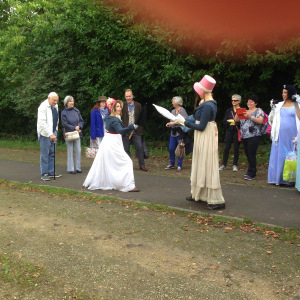
Sunday, we walked down to the public library for a reading of Sense and Sensibility. Jane Odiwe read the second chapter, and she did a brilliant job of capturing the tone and the humour of Austen’s work.
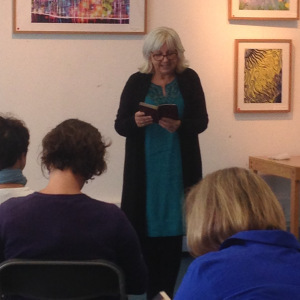

Jane, Cass, and I talked over glasses of wine and dinner. We had a marvellous time and I truly enjoyed the afternoon.
My trips to Bath are always over so quickly, and this one was no different. Before I knew it, I was finishing The Particular Charm of Jane Austen on the train home. I had hoped to stop in Platform 9 3/4 at Kings Cross before I left London, but I didn’t even have time if I wanted a ride home from the train station!
Up next… Honestly, I have no idea!


October 22, 2016
Tintagel
For those who are fascinated with legends of King Arthur, Tintagel Castle on the north coast of Cornwall is a must-see. The site has been dated back to the Romano-British period by the discovery of artefacts dating to that time period. It was definitely a settlement during the medieval period and in 1233, Richard, Earl of Cornwall built a castle on the site.
Geoffrey of Monmouth first claimed Tintagel was the site where Arthur was conceived before Richard built the castle. In Historia Regum Brittaniae, Monmouth claimed Merlin disguised Uther of Pendragon to look like Gorlois, the Duke of Cornwall and husband of Igraine, who was Arthur’s mother. The belief of the link to Arthur was reinforced when Tennyson wrote ‘Idylls of the King’ in the Victorian period.
What remains of Tintagel is located on Tintagel island near the village of the same name and is now operated by English Heritage. There is a great deal of walking and stair climbing involved, which is something to keep in mind. We planned our visit for the last day of hour holiday, which turned out to be rainy and cold.
Parking is plentiful when you arrive, and it’s only a short walk to the English Heritage building where you check in for Tintagel. There is a separately operating shuttle that will drive people closer to the actual castle or you can walk it as we did.
 When you begin the trek upwards, you start with this dirt path (muddy on rainy days) up to where the outer castle wall was. This part isn’t too steep, and you begin to have some lovely views once you reach the first portion of the ruins.
Tintagel Castle, like many old castles and homes in Britain, have different structures and walls from different time periods.
Tintagel at one time had a portion of the castle on the mainland and a portion of the castle or a bridge brought you over the water to the island. Unfortunately, that bit crumbled into the sea at some point, but a bridge has since been constructed so people can cross from the mainland ruins to those on the island. You can still see what is left of the original stairs in the second picture below.
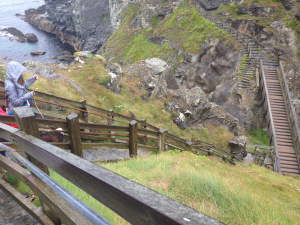
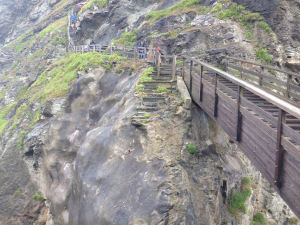
Once you’ve crossed the bridge, you climb up a rocky set of stairs on the side of the island. If it’s wet, I recommend not being in a hurry as some of the steps are steeper than others and if you slip, the rocks would be rather unforgiving.
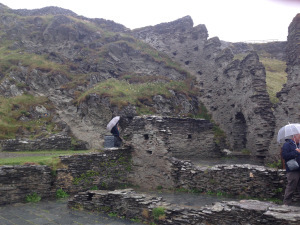
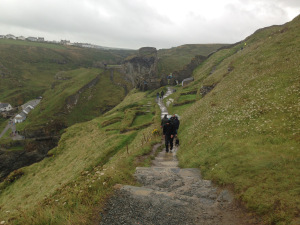
The views and the ruins are definitely worth the hike uphill!
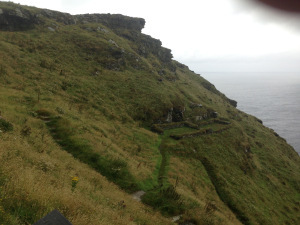
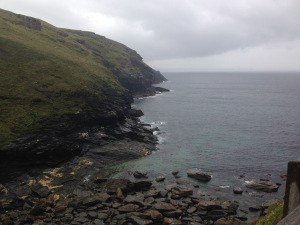
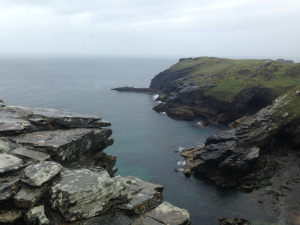
Once you are across there are signs with history just like any English Heritage site as well as plenty of gorgeous views. I did have a fit of nerves watching my fourteen year old, who liked to step near the edge of some of the cliff-like sides. My husband would go with her, but it still made me nervous.
I will say that when you are ready to leave, you have to exit the same way you came in, so back down the crazy length of steps. You can also go down to the beach and go inside “Merlin’s Cave.”
I will say if you’re anywhere near Tintagel, don’t miss it! Legend aside, the different portions and excavations of buildings all built in different centuries if not ages, is fascinating and the views are incredible.
That said, please excuse my finger, which insisted on being in a few of the shots. That is one problem with a rainy day like that–I just won’t bring my nice camera outside. I used my phone and I often get my hands in the way.
Coming up next…Jane Austen Festival, Bath!!!!


October 17, 2016
Update: Yes, I am still in the land of the living…so far.
How is it October already!!! I know, October is more than half-over and I feel as though I started running and suddenly stopped to discover a month had passed. It seems yesterday as I took my almost daily drive to swimming, I would watch the hedgerows along the stretch of road slowly turn from brown to green. As I passed them this weekend and started into town, I was struck by the yellow and brown of the leaves as they fell in the wind and drizzly rain. Autumn has certainly arrived.
I have a lot planned for the next month or so. Here’s just the highlights.


![[image error]](https://lldiamondwrites.files.wordpress.com/2017/01/img_2866.jpg)
![[image error]](https://lldiamondwrites.files.wordpress.com/2017/01/clueless-whatever.gif)