
L.L. Diamond's Blog, page 30
January 3, 2015
Blickling Hall
Blickling Hall in northern Norfolk can only be called fascinating. The property and house both have a long and notable history from the Boleyns to World War II. From the outside, it may seem much the same as many of the grand estates in England, but I must say that the National Trust workers who work there do help in making it an exceedingly interesting tour! I must say as far as National Trust guides, this house boasts some of the best–in my opinion at least.
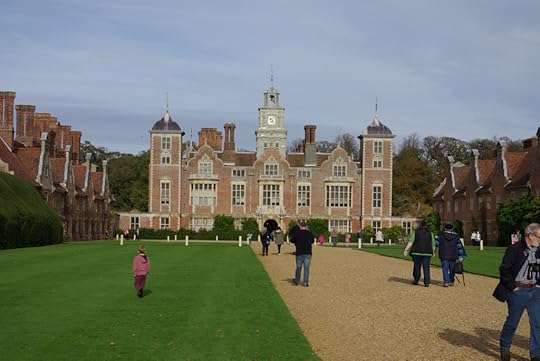
Now, on to some of that history I was mentioning. Blickling Hall is built on what was once the estate of the Boleyn family. (If, for some reason, you aren’t aware of the Boleyns. Henry VIII, who founded the Church of England, wed Anne Boleyn in 1533 after the annulment of his marriage to Catharine of Aragon. Anne was later beheaded due to being found guilty of adultery, treason, and incest.) There is proof that the property was sold in 1459 to Geoffrey Boleyn. It is believed Anne was born at the home on the Blickling property and it is said that every year on the anniversary of her death, her headless ghost arrives at Blickling by a carriage driven by a headless driver and four headless horses. She roams the halls until daybreak.
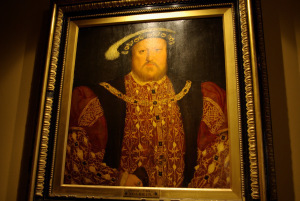
It is also said that Anne’s father, Thomas Boleyn haunts Blickling. It was through his machinations that his daughter wed Henry VII. As a result, he lost his daughter and his son, so as his penance he is required to cross a dozen bridges before cockrow for a thousand years. He has a specific route that is from Blickling to Aylsham to Burg to Buxton Cotishall to Meyton to Oxnead and finally to Wroxham. Like Anne, he was also beheaded and the claim is his ghost carries his head under his arms with flame coming from his mouth, rather than blood.
The next name of note in regards to the property is Sir Henry Hobart, 1st Baronet, who purchased most of the Blickling property in 1596. He did not acquire the house until 1616 and for £5,500. Hobart then brought in Robert Lyminge as architect to build what now stands on the property as Blickling Hall.
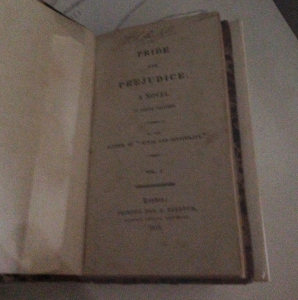
Caroline Hobart, Lady Suffield, inherited Blickling in 1793 and lived at Blickling until her death in 1850. There is a room that houses the first editions of Pride and Prejudice and Sense and Sensibility that explain a great deal about Caroline and her elder sister, who was Lady Harriet. Their father John Hobart, the Earl of Buckinghamshire, had arranged Harriet’s marriage to one Earl, but she ran away with William Kerr, 6th Marquess of Lothian and was disinherited as a result, leaving Blickling to Lady Caroline.
Caroline is noted in much of the house due to her mark on Blickling. She brought in Humphry Repton and his eldest son John Gunton to redesign the gardens and reconstruct the central clock tower. She was also an avid book collector and according to information within the house was responsible for the collection of almost 900 books in the gallery (the name for the library at this home), which included three first edition Jane Austen’s (Pride and Prejudice, Sense and Sensibility, and a reticule sized Pride and Prejudice). Pride and Prejudice and Sense and Sensibility are on display under glass, but the reticule sized was hidden amongst the thousands of books in the gallery. I look forward to returning to see that particular volume!
Royal Air Force Oulton was a bomber base on a portion of the Blickling Estate. Created in 1939, it undertook work vital to the war effort before being closed for operations in 1946. It was decommissioned in 1949. There is a RAF Oulton Museum, but we did not have a chance to explore the museum.
There is also another ghost that is claimed to roam this old house. Sir John Fastolfe was a 15th Century knight on which Shakespeare based his character Falstaff has been seen throughout the old house. There have also been sightings of a “Grey Lady” floating through walls.
Most of the paranormal activity is claimed to occur around May 19, which is the anniversary of Anne Boleyn’s execution.

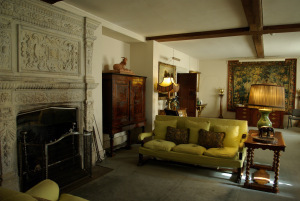
The house is huge, and ornately done, which seems common for Jacobean manor homes. There are sculptural and relief elements crests on the exterior of the home as well as ornately done fireplaces and ceilings on the interior. Upon entering, you find yourself in a large room with a great deal of wood paneling and the large staircase that splits to go up to each side of the upper floor.

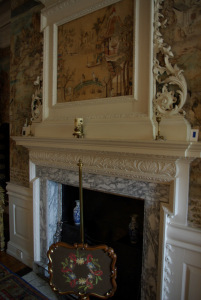
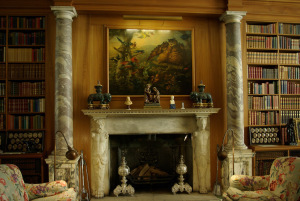
The parlour appears to be a rather comfortably done room. There are lots of antiques, of course, but in these Jacobean homes, the ornate fireplaces and ceilings are what always seem to attract my attention. This one painted rather than an ornate plaster ceiling really attracted my notice. The last fireplace is located in a bedroom that was redecorated in 1767, and has true chinese silk wallpaper. They even have a portion under plexiglass that remains unfaded due to its location that is amazing to see.

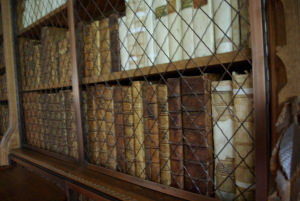
The library, which is referred to as the “Gallery” by the staff at Blickling is probably the most impressive I have seen so far. The National Trust apparently had not even known what they had until they began cataloguing the contents recently. The library at Blickling boasts of three Jane Austen first editions (I know, I mentioned it before) and an Eliot bible, which was the first Bible printed in the United States in 1595. All one has to do is just look at the rows of books to see the age and value of this collection. They have found numerous first editions other than the Jane Austen’s and I think it would be interesting to see a catalogued list of the contents when the curator is done.

Unfortunately, the day we chose to visit was grey and it began to drizzle when we finally made our way to the grounds. I do not have many pictures of the grounds, but I do look forward to returning to see more of the grounds when we have a chance. The gardens look like they are beautiful in the summer and there are 50 acres in the park alone for people to wander. The entire property spans over 4,000 acres. We spotted one temple and I have seen pictures of the mausoleum Lady Caroline had built for her father.

Avid historians and ghost hunters should find common ground with Blickling Hall. It truly has a bit of something for everyone, I think; although, my oldest daughter missed not having any Greek or Roman style sculptures, so I might be mistaken.
Next up….London Baby!!!
Bibliography:
http://www.nationaltrust.org.uk/blickling-estate
http://www.hauntedrooms.co.uk/blickling-hall-norwich-norfolk
Wikipedia


Anglesey Abbey
Anglesey Abbey is a Jacobean style manor house built on the site of a 12th century Augustinian priory located just north of Cambridge. What remained of the priory was purchased by Thomas Hobson around 1600 and was converted to a country home for his son-in-law.
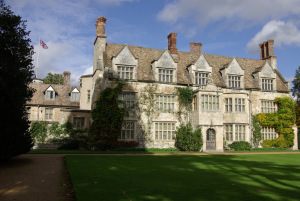
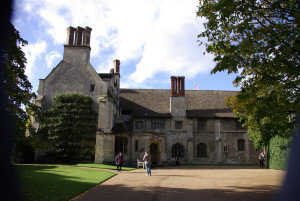
Huttleston Broughton, who became the first Lord Fairhaven, purchased the home in 1926. Anglesey had fallen into disrepair, so Lord Fairhaven renovated the home and began to collect furniture, artworks and statuary. He never married, so when he passed in 1966, he left Anglesey to the National Trust.
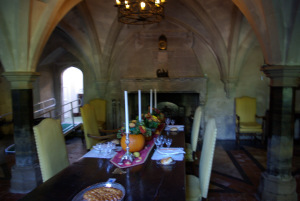
Touring the home today, you can truly get a sense of Lord Fairhaven’s penchant for collecting works of art. There are tapestries hung throughout the home, and works from artists such as Claude Lorrain, John Constable, and Thomas Gainsborough. There are even some of the original arches from the 12th century priory that can be seen in the dining room of the home. The arches are lovely and give the room such an interesting feeling. (I apologize for the quality of the image. I had a hard time with how dark the dining room was. It either didn’t focus or was a bit blurry.)
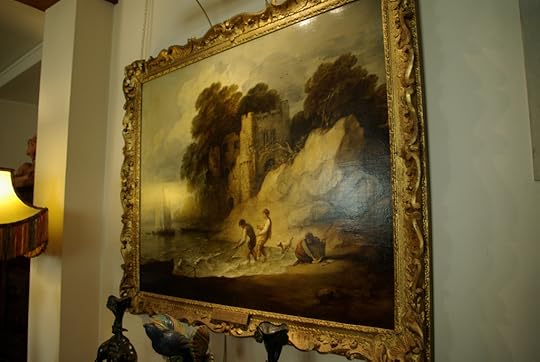
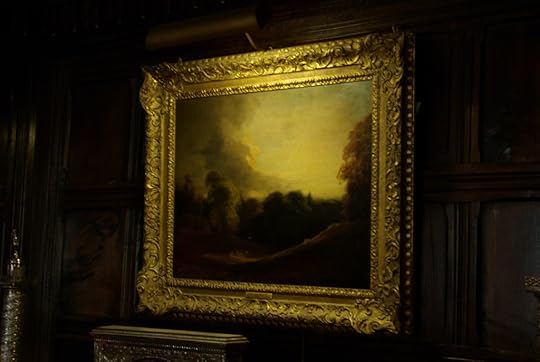
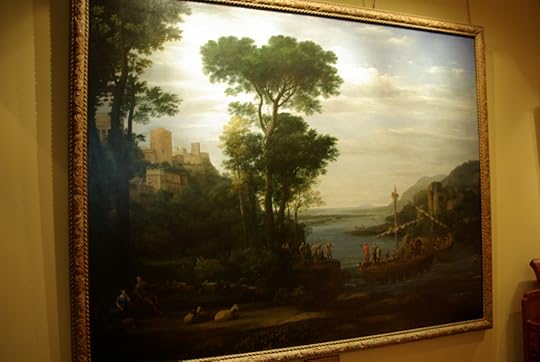
At the moment, they are renovating some of the rooms and artwork, so two of the beds are moved into another room, and I am sure there might be a few prominent pieces of art that may be hidden away as they are restored. That was one of my complaints was all of the bedrooms of the were roped off at the door, and you can see that there are a few amazing pieces, but you cannot truly see the works or the plates that give you the artists name. There is a Constable that is immediately inside one of the doors, but the lighting is dim and the painting is dark. It makes it impossible to see it much less take a photo.
There are multiple libraries. There is a small library off the hallway where Lord Fairhaven’s bedroom is located as well as the main library with his desk and the bulk of the books. One National Trust volunteer claimed there were almost 4,500 books and another claimed between 7,000 and 8,000 books. I am not sure which is correct, but given the gentleman who claimed the higher number could tell you the number of animals in the artwork of the parlour to the number, I would imagine he is not mistaken.
My children and I enjoyed the kitchen and the servants areas. They are as they were in the 1930’s and there are even old bottles of food coloring and extracts that are interesting to view.
The exterior of the house is beautiful. I do truly think it is one of the most interesting exteriors I’ve seen. I enjoy the windows and the chimney pieces. It also fits in very well with the surrounding gardens.
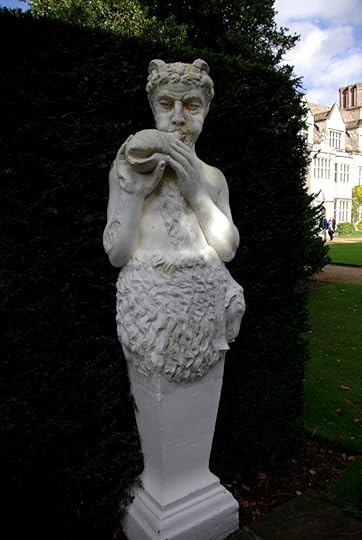
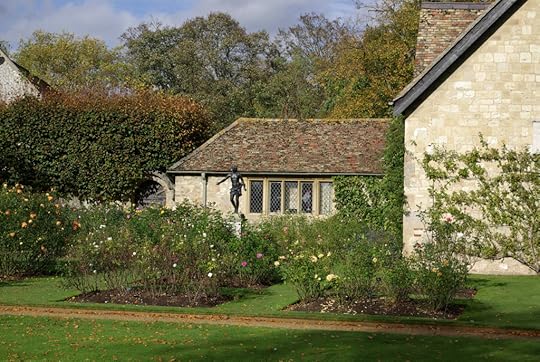
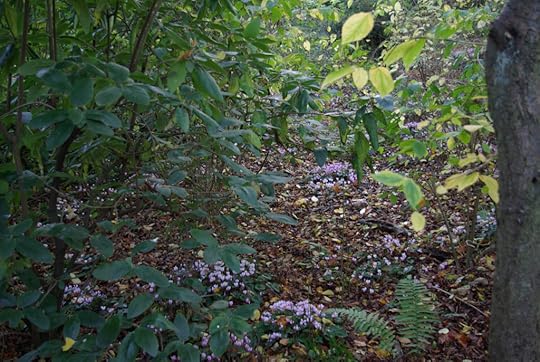
The Gardens! The gardens are stunning! Even in the fall! There seem to be gardens for just about every season with statuary scattered throughout the 114 acres of land. There is even a working mill.
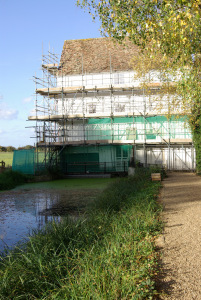
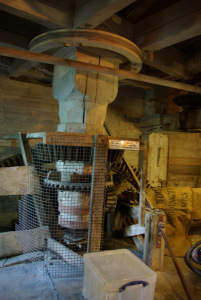
The exterior of the mill was under renovation, but the interior was extremely interesting. Beware the steep stairways/ladders to access the upper floors where there is a small threshing machine and the chutes where the grain flows down into the grinding stones. They still mill flour and oats, and even have smaller stones for children to turn and grind flour by hand. There are bags of flour and oatmeal for you to purchase at the mill and in the gift store before you leave.
When you work your way around the front of the house, there is a rose garden. I know I saw a Dahlia garden on the signs, and then there are the avenues and the winter garden. I know my feet and my children’s feet were a bit sore by the time we called it a day!
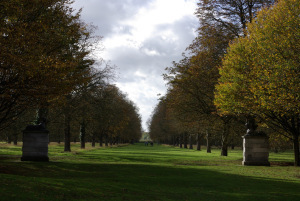
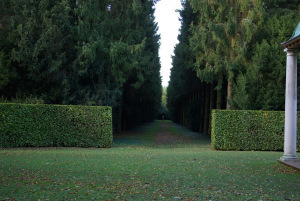
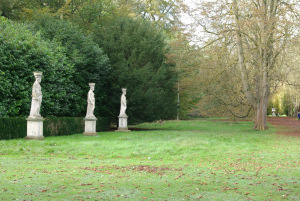
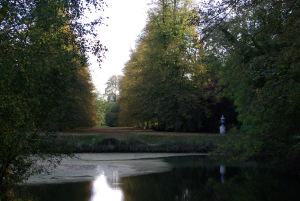
The photo I have labeled “The Main Tree-lined Avenue” is of a lovely avenue planted to commemorate the coronation of King George VI and Queen Elizabeth in 1937. It is a row of horse chestnuts, which copy a similar garden planted in Windsor Great Park. My children loved grabbing “conkers,” which are the actual horse chestnuts. I still have yet to discover how many made it home in their pockets, but I am sure they will turn up around the house eventually.
We loved exploring all of the trails and “avenues” and studying the sculptures. We began trying to guess who many of the sculptures were based on what they were holding or the implements with which they were depicted. Some were not that difficult if you are familiar with Greek or Roman mythology, others gave us quite a run for our money.
There is even a portion called Hoe Fen Trail. If you remember, I explained a fen in the post about Wicken Fen. This section is different than Wicken Fen, but is still a very natural area of the park and has a lot of activities and areas for children to play. Just beware the stinging nettles! They can be found throughout the park, but they were the most prevalent in this portion of the gardens.
I definitely think Anglesey Abbey is worth a day and based on photos I’ve seen, one day several times a year to see these amazing gardens in every season!
Bibliography:
http://en.wikipedia.org/wiki/Anglesey_Abbey
http://www.nationaltrust.org.uk/anglesey-abbey/


