Chris Ferrie's Blog, page 4
August 15, 2017
Daily activities to promote mathematical fluency in kids
If you perform an internet search on some topic of interest, say “math puzzles for kids”, you end up with literally millions of pages. It can be overwhelming. But, just pick one and go! Don’t over-prepare or have high expectations or push too hard—the vast majority of experiments fail. In fact, failure is one of the most important ways we learn.
Below is an outline of a day in my life of practicing mathematical literacy. These are activities I do with all my children, ages 0, 3, 5 and 7. I may spend longer on the more complex information or tasks with my 7 year old, but I don’t shield my 3 year old completely from it.
Numeracy
I try to constantly be aware of when I am internalizing numbers or mathematical concepts and then encourage my children to participate. These are all things I usually do silently and unconsciously, but now ask my children. Just this morning I have done the following: I asked the children to read the clock; add change; discuss routes on our daily errand run; count and weigh fruits and vegetables; ask how long is left in a video; set a timer on my phone; ask how many crossings are required to tie a shoelace; and so on.
Puzzles
There are many puzzles and games you can play that can promote and improve mathematical thinking which are branded or advertised as math games. For example, today we played the following games: Tic-tac-toe, Dots and Boxes, made mazes, played some Lego (classic blocks), and built a dodecahedron with a magnetic construction set.
Books
Attempting to connect young minds with abstract ideas is relatively new. Our bookshelf contains: Introductory Calculus For Infants by Omi M. Inouye; Non-Euclidean Geometry for Babies and The Pythagorean Theorem for Babies by Fred Carlson; and a great deal of children’s and adult reference books and encyclopedias. Of course, some nights we can’t get through enough Harry Potter and the math has to wait.
Videos
YouTube is a blessing and a curse in our house. We don’t generally let the kids watch without supervision as the value seems to be quite low without constant feedback and discussion. Today we watched a few episodes of Amoeba Sisters and I showed them some MinutePhysics, which is directed more toward adults. I keep those sessions short as the language is often too complex.
Drawing
Drawing and coloring are great ways to relax and have many cognitive benefits. Sometimes I need to give them something to imitate by joining in and other times, like today, I just put a blank sheet and some markers out. My 3 year old has recently graduated from scribbling to drawing discernible faces and intentional shapes. The other day, my 7 year old found Art for Kids Hub, a fun and engaging set of drawing tutorials which has boosted her confidence quite a bit.
Coding
Getting children into computer programming has received a lot of attention in the past couple of years. Each of my 3, 5 and 7 years olds play the games and go through the exercises on Code.org. I find it very helpful when they work simultaneously or in a pair. We didn’t do any coding today on the computer, but we did play Robot Turtles, a board game meant to teach coding skills.
We also went to the park and ran around in circles screaming, for no reason in particular.
Phew! Even when I write it all out, it looks like a lot. But, it only adds up to a few hours spread over an entire day—time I would be spending with them anyway. I try to make life rewarding and engaging not only for them, but for me as well.


August 10, 2017
Let kids be kids
Quantum Physics for Babies. Some find it hard to believe. But it is indeed a real book, and other books which introduce abstract scientific concepts to young minds have followed. It’s a quirky idea and I’ve told the story about how it all came about before. And people do love the quirkiness, but the honeymoon is short and sobering questions are soon to arise, like, “Isn’t this a bit much—do we really need another thing to teach children?”
Fear and uncertainty about the daunting task of teaching children about science and mathematics comes to the forefront and then it hits, shot straight from the hip, “Let kids be kids.” You hear that a lot. In fact, it’s said in so many contexts that it’s lost any meaning it might have had, but I think the gist is this: whether guided by gut instinct or scientific research people know the value of play in childhood—but their idea of education as an activity is the exact opposite of play.
I believe this is the wrong way to interpret education. The formal education system that you and I grew up with has existed more-or-less unchanged for several decades. It chops up knowledge into components which are introduced in a linear fashion. Sometimes the paths fork and the major branches are called “careers”. For a time, the system worked quite well—but that time is passed.
This is understandably a source of stress for parents. The education system was supposed to be the rock. Of course we don’t know everything, and so we send the kids to school, which has experts on all topics to fill those gaps. But technology is becoming more and more ingrained into society and everyday life. The problem is that technology is changing so fast that it is nearly impossible to keep up. The idea of having a single career has gone out the window.
This leaves us questioning the role, even the identity, of education. My view is simple: life is education. Maintain that childhood curiosity and drive to ask questions, and whatever you call education will come for free. Besides the obvious things—survival, independence, morality—what is the mark of successful parent? Even ignoring the fact that it is an immense privilege to entertain such a question, this is dangerous territory. But I’ll risk an answer: the goal of parenting is the help your child find their passion, which is that thing that fuels their curiosity.
Are you happy? If so, it’s probably because you do something that you love, at least as a hobby. I’m very lucky in that people pay me to do the things I love. Wouldn’t it be great if I could arrange for that situation to be a little bit more likely for my own children?
So how am I going on helping my children find their passion? I don’t really know. I guess I won’t find out for some time. But here is one step I think can go a long way: variety. Not necessarily for them, but for you. If there is something you avoid, they will never experience it.
I can’t think of any interest my children might have that scares me. But many parents I talk to find mathematics and science scary. Whether it is intentional or not, they steer them away from these topics. The situation is so bad that we discuss when is too young to introduce science to children. Science is just a formalized way of exploring our natural curiosity. You don’t introduce it; you reintroduce it—and only because you’ve taken it away.
Books about mathematics and science for young children are not educational tools for the children. They are reminders for the parents that this is not something to fear. This is something that people derive a lot of passion from. And, if some day your child sees some science topic that interests her, she won’t be afraid of it, because you are not afraid of it.
So, don’t feel you need to read Quantum Physics for Babies because you need to keep up with the Zuckerbergs Joneses. Read it because it’s something you wouldn’t otherwise be exposed to. Read it because you might be curious about the topic. Read it because you had a really cool friend that gifted it to you. Read it because it’s fun. And, if it only leaves you with more questions, good—ask away.
This post originally appeared on the Early Learning Review.

July 1, 2017
Quantum Physics for Babies
It’s great to be back here. That feels a bit awkward to say since it’s only been 6 months since I left and I’m only 10 minutes away. But King and Broadway might as well be the Pacific Ocean for academics. I’m Chris Ferrie. I’m just down the road at the Centre for Quantum Software and Information. It’s an awesome new Centre. We’re on Twitter. You should check us out.
Now, though the title of the talk doesn’t make it obvious, I am a serious, well… maybe not serious, but I am an academic. But I also have a hobby… tennis. No, I write children’s books. Yes, it is a real book. And, yes, I wrote it and self published it several years ago when I was a postdoc. Why, and how, and for what purpose, well… that is the purpose of this talk.
[image error]Measure twice, cut once. So the old proverb goes. It certainly it makes sense if you only have enough material to build a thing. However, and I see this all too often in otherwise very smart people, too much measuring leads to over optimisation and inaction, not enough cutting. Whereas, I like cut several times, toss things out, try new cutting instruments, and so on. I almost never measure. Ultimately, this is the story of Quantum Physics for Babies. I just did it. It wasn’t carefully planned, nor was there a spark or ah-ha moment which spawned the idea. I started, I failed, I started again.
And, for better or worse, the book became popular. Journalists starting asking me, “why did you write this book?” and, more seriously, “why teach quantum physics to babies, why is that important?”
[image error]So, I started to rationalize. Why did I write this book? And, is it important? In particular, is it important for all children, not just my own? (because it is always important to find a way to discuss your passion with your own kids.) I think the answer to “is it important?” is yes. In this talk I’ll walk you through the various levels of rationalisation I’ve went through. Each has an element of truth to it, both for myself personally and what the experts on the topic of early childhood education espouse.
They say he never did like quantum physics. pic.twitter.com/ITD035hLpo
— Chris Ferrie (@csferrie) September 4, 2016
But let me start at the same place I start most things, with a joke. Someone that has known me for only a short time probably wouldn’t be too surprised that I was voted “class clown” in high school. Humor plays a crucial part of almost every aspect of my life. I laugh with my partner, I laugh with my children, I laugh with my friends, and I laugh with other scientists. (Einstein didn’t think it was very funny—but, then again, he never liked quantum physics.) Happiness is the difference between your reality and your expectations. Humor often defies expectation and happiness ensues. So, hopefully you didn’t come to this talk with too many expectations and you’ll leave a little happier then when you came in. At least there’s cake.
There is no denying that I saw the irony as good for a laugh the first time the title popped into my head. Of course, the level of humour I’m talking about is not at all for the advertised audience. I’ve never seen a child laugh at the title of the book. Adults, on the other hand, love the juxtaposition of quantum physics with “for babies”. So I knew that at least a few people would buy it as a gag gift for a nerdy friend having a baby. What I didn’t expect was this nerdy friend getting a copy.
I’ve joked with various people about making other goofy “for babies” books. Why not “contract law for babies” or “geopolitical policy for babies”? Though, the only person in the world that needs to read such a book is too busy tweeting insults at women. But quantum physics—yeah—people seem to agree that is worth being more than a joke, and hopefully I knew something about it.
In the end, I put real thought and effort into the content. The goal became clear enough: how to fill a baby book out with short sentences, no jargon and a coherent description of quantum physics. It was a challenge and there is still probably room for improvement. But I’ve already had people say, “we all had a good laugh, then I started to read it and there was real quantum physics inside.” Many adults even claimed they learned something. But were the children learning?
The unanimous advice for new parents is to read to your newborn. Most say it doesn’t even matter what it is, just read. But, let’s play a little game here. Suppose a parent does read to their child and has no time to add a new book to the rotation. Then, Quantum Physics for Babies needs to replace a book. What book should it be? First, I don’t think it should replace fiction. Fiction and fairy tales serve many purposes and, besides, variety is the spice of life. So we are left with nonfiction, which for baby books is limited solely to only a few types of reference material.
[image error]A huge fraction of any newborn’s library will begin with the word “first”: “First Words”, “First book of numbers”, “First alphabet book”, and so on. One quickly gets the impression that these are essential reference books for the early learner. But beyond the obvious things—letters, numbers, shapes, three letter words—are a myriad of books about animals, and mostly farm animals.
Now, learning is tricky concept to define even for adults. There are numerous models of early childhood cognitive development, and so it is hard to say conclusively what is being “learned” and at what level, but something is clearly happening since every 3 year in the world knows what sound a cow makes. Do you? I think I do. But I have never heard one myself. Maybe there was a time when that was important, or at least relevant, but I don’t think that time is today.
[image error]Here is another example. Do you know what these birds are? My children seem to know and can identify the difference between a penguin and a puffin. Why? Why are there more books about puffins than there are puffins and no books about transistors when you are probably sitting on a billion of them right now. In your phone lives a few billion transistors making up, by the standards of only decade ago anyway, a supercomputer. A child today will probably spend their entire life closer to computer than they will an animal of comparable size. I’m not suggesting than all books on animals be replaced by physics for babies books, but we could maybe replace a few.
I won’t claim my children understand quantum physics, but they certainly understand it at the same level they understand anything else gotten from a book. They will tell you that everything in the world is made of atoms and atoms are made of neutrons, protons and electrons and electrons have energy. I think that is about the same level of understanding as being able to identify a puffin, or should I say Fratercula corniculata for the baby ornithologists in the crowd.
So it seems then that Quantum Physics for Babies is here to stay. But we’re all scientists here and we love nothing more than free cake and to categorize things. So where does Quantum Physics fit? In what aisle of the bookshop does it sit on the shelf? Well, it turns out that it has been shoehorned into the new educational buzzword de jour: STEM.
[image error]
STEM (Science Technology Engineer and Mathematics) started out as an initiative to focus on its namesake topics with the goal of training a workforce ready for the careers that were assumed new technologies would create. Interestingly, the first press mention of the acronym seems to go back to 2008 when The Bill and Melinda Gates Foundation donated $12 million dollars to the Ohio STEM Learning Network, which is still going strong today. Most never looked back. [By the way, much backlash ensued over leaving out the Arts, for example. So you might see STEAM or even STREAM (Reading) out there.]
Now governments all over the world currently have numerous initiatives at all levels of the curriculum to enhance what they called STEM-based learning. This is vaguely and variably defined and can mean anything from simply having access to more technology in the classroom to the design and building of simple machines to solve practical problems. But the motivation and directives that follow are often based on decade-old studies suggesting rises in STEM-related jobs. One recent state-level education department cited a study with data collected prior to the release of the first iPhone (that was only 10 years ago, by the way). The often cited report of the Chief Scientist of Australia contained recommendations citing data accumulated from 1964-2005. Policy is good, but it cannot keep up with the pace of technology.
Disruption! Here are today’s upper middle-class. The fear today—fueled by startups, makers, and ever younger entrepreneurs—is that we just have no idea what jobs will look like in the future. And so STEM, at least for the trailblazers, is now a movement with the audacious goal of graduating creators and innovators. We no longer want graduates who simply have more and integrated technical skills.
What does this look like? Let me give you an example. Here is Taj Parabi, now 17, CEO of his own business which ships DIY tablets. His company, fiftysix, also visits schools and puts on extracurricular workshops for students on technology and… entrepreneuring! That’s right. Your children are competing with 8-year-olds trained to be CEOs of their own companies!
On a topic near and dear to my own heart, a now veteran effort from the Institute for Quantum Computing is the Quantum Cryptography School for Young Students (QCSYS)[image error], which invites international high-school students for a week of intensive training on quantum technology. Indeed, many of these students eventually become PhD students in Quantum Information Theory. Other efforts include school incursions and the new QUANTUM: The Exhibition which is an all-ages, hands-on exploratory exhibit.
[image error]On the other side of the border (remember: the wall is on the souther border), IBM has recently released the “Quantum Experience”, an app that lets you program a quantum computer, a real quantum computer. You create an algorithm and then jump in the queue for it to run on real device housed in IBM’s labs. Here they are video conferencing with a school in South Africa and hosting local students.
So that is the tiniest snapshot of STEM education today. Is Quantum Physics for Babies on par with these efforts? Are the children learning the skills necessary to be quantum engineering start-up entrepreneurs? Of course not. Quantum Physics for Babies, at least as far as reading to actual babies is concerned, is about the parents.
20 years from now, your child might be sitting in an interview for the job of Quantum Communication Analyst or Quantum Software Engineer. How long will it be before such topics feature in the report of the Chief Scientist on the curriculum? How long before it is mainstream in public schools? I’m not holding my breath.
The problem today is that it’s impossible to keep up. Pilot studies, kids maker studios, programming toys and apps, … These are all beautiful, but the growth of STEM education has now outpaced even the technology. The curriculum cannot keep up, and so the onus of STEM education, however you want to define it, is largely on the parents.
Again, the efforts of STEM education researchers are impressive, but a parent cannot assume that their child will happen to be in the school that benefits from these one-off pilot studies or incursions. The education system in most developed countries has been too long taken for granted and is now depleted from underfunding. No doubt there are many great principals and great teachers out there. Two days from now, I’m going to go speak with a dozen principals and teachers about STEM education. But there are almost 1500 primary schools in Sydney alone (over 3000 in New South Wales). There is much that needs to be done at the larger scale—but even if I said that was being done, it is little comfort for parents today.
Learning about Quantum Physics for babies #swsydstem with @csferrie & @janehunter01 @McCallumsHillPS with @LakembaPS @lurlmitchell @thewoni pic.twitter.com/f2AUBDb6mT
— Georgia Constanti (@georgiac) June 22, 2017
So—in the end—this is what I both want and expect from the book: the elimination of doubt and fear. I want quantum physics, indeed all physics and math and science, to be normal for a child to take interest in. When your child asks about going to Canada for a summer school on quantum cryptography, that should be seen as normal request. When she asks to help her set up an account for a quantum cloud computing service, you should be like, no worries I already have one.
Today, when 1 in 3 Americans would rather clean a toilet then do a math problem, when a search for “quantum physics” brings up Deepak Chopra instead of Stephen Hawking, and when the facts pointing to climate change are seen as equally compelling as a celebrity’s argument for a flat earth, we need all the help we can get. And we need to start that conversation as early as possible.
Quantum Physics for Babies was just the beginning…[image error]

May 29, 2017
Am I wrong?
We now absolve ourselves by simply denying guilt. Even the hint of criticism is charged as an offense. This fear of shame has run so rampant that a false feeling of innocence has turned into outright narcissism.
You are not a good person. I am not a good person. Let’s admit our faults, make amends, and try to be better.
Story time.
Two of my children are in an art class together. It’s not going well. The teacher does not have much control over the class and favours the returning and skilled students. My two children tend to stick together (good on them), but often get to acting up. Today was particularly bad. The director of the art school had to speak to us about it after class. Their tone was serious, but also apologetic. The report ended with a complement about the children’s art.
At home we reflected on this a bit and decided to call the school. We told them that we were extremely sorry about the disruption and requested the children be split up into different classes and if that was not possible, we would voluntarily remove them from the class. The director was flabbergasted. We were apparently the first parents not to get immediately defensive about their children’s bad behaviour.
They are so afraid of defensive parents that the facts cannot even be stated without being padded with multiple compliments. We were thanked several times and given a free class in addition to accommodation of our request.
The morale of the story: in today’s culture, all you have to do is not be an asshole to be a hero.

May 10, 2017
Chapter 4: Academic Endgame
Welcome to the UTS Centre for Quantum Software and Information @csferrie – great to have you as part of the team!
— UTS:QSI (@UTS_QSI) February 15, 2017
Well, this is it—academic endgame. I am now a faculty member at the University of Technology Sydney. It’s been quite a journey, but it wasn’t mine alone—and I couldn’t have done it by myself. I met Lindsay at the university bar and it was love at first sight—and I thought she was all right, too 
April 18, 2017
Foray into multidisciplinary research
Nearly two years later, it is finally published: Explaining quantum correlations through evolution of causal models.
This was a truly multidisciplinary effort. What we achieved was to combine ideas from causal modeling and machine learning into a new algorithm to analyze real experimental data from experiments on quantum correlations. The team consisted of researchers from 4 different universities and several distinct disciplines.
multidisciplinaryresearch.png #science #researchhttps://t.co/ePvD4ZvYc1 pic.twitter.com/DBq5e4MdlX
— Chris Ferrie (@csferrie) April 19, 2017
Interestingly, no one researcher on the project had expertise in all of these areas. Moreover, within each discipline, everything from the way research is conducted to how it is disseminated is different. Couple that to the fact that many of us were senior researchers with other demands on our time and you get a 2 year long project!
Anyway, it is done and I’d gladly do it again with this bunch of talent scientists!

April 15, 2017
What does it mean to excel at math?
John von Neumann made important scientific discoveries in physics, computer science, statistics, economics, and mathematics itself. He was, by all accounts, a genius. Yet, here he is saying he “just got used” to mathematics. While this was probably a tongue-in-cheek reply to a friend, there is some truth to it. Mathematics is a language and anyone can eventually learn to speak it.
Indeed,[image error] mathematics is the language by which scientists of all fields communicate—from philosophy to physics. And by mathematics, I don’t mean numbers. Scientists communicate ideas through mental pictures which are often represented by symbols invented just for that purpose. Here is an example: think about a ball. Maybe it is a baseball, or a basketball, or—if you are in Europe—a socc…err… football. Maybe it is the Earth or the Sun. Now try to get rid of the details: the stitching, the colors, the size. What is left? A sphere. You just performed the process of abstraction. A sphere is an idea, a mental image that you can’t touch—it doesn’t exist!
[image error]Why is this important, anyway? Well, if I can prove things about spheres, then that ought to apply to any ball in the real world. So, formulas for area and volume, for example, equally apply to baseballs, basketballs, soccer balls, and any other ball. Mathematics is a very powerful way of answering infinitely many questions at once!
Now, it is said that to become an expert at anything, you need 10,000 hours of practice. While not a hard-and-fast rule, it seems to work out in terms of acquiring modern language—10,000 hours probably works out to mid-to-late teens for an adept student. Usually, we don’t start practicing real mathematics until well after we have mastered our first language, in late high-school or college. Why not start those 10,000 hours now with your children?
Sounds great, but where do you start? The bad news is that there are no simple rules. The good news is that it doesn’t really matter where you start. With your children, you could practice numeracy, practice puzzles and games, read books, watch science videos, try to code, draw pictures, or just sit in a quiet room and think. As you do these things, encourage generalization and abstraction. Ask questions and let your child ask questions. The correct answers are not important—it is the process that counts.
I was asked recently to share some tips for parents who want their kids to excel at math and do well in the classroom later on. The trouble is, doing well in the classroom—that is, doing well on standardized tests—doesn’t necessarily correlate with understanding the language of mathematics. If you want to do well on standardized tests, then just practice standardized tests. However, if you want your kids to have the powerful tools of abstraction at their disposal and possibly also do well on tests, then teach them the language of mathematics.

March 22, 2017
The power of simulation: birthday paradox
The birthday paradox goes… in a room of 23 people there is a 50-50 chance that two of them share a birthday.
OK, so the first step in introducing a paradox is to explain why it is a paradox in the first place. One might think that for each person, there is 1/365 chance of another person having the same birthday as them. Indeed, I can think of only one other person I’ve met that has the same birthday as me—and he is my twin brother! Since I’ve met far more than 23 people, how can this be true?
This reasoning is flawed for several reasons, the first of which is that the question wasn’t asking about if there was another person in the room with a specific birthday—any pair of people (or more!) can share a birthday to increase the chances of the statement being true.
The complete answer gets heavy into the math, but I want to show you how to convince yourself it is true by simulating the experiment. Simulation is programming a computer or model to act as if the real thing was happening. Usually, you set this up so that the cost of simulation is much less than doing the actual thing. For example, putting a model airplane wing in a wind tunnel is a simulation. I’ve simulate the birthday paradox in a computer programming language called Python and this post is available in notebook-style here. Indeed, this is much easier than being in a room with 23 people.
Below I will not present the code (again, that’s over here), but I will describe how the simulation works and present the results.
The simulation
Call the number of people we need to ask before we get a repeated birthday n. This is what is called a random variable because its value is not known and may change due to conditions we have no control over (like who happens to be in the room).
Now we simulate an experiment realising a value for n as follows.
Pick a random person and ask their birthday.
Check to see if someone else has given you that answer.
Repeat step 1 and 2 until a birthday is said twice.
Count the number of people that were asked and call that n.
Getting to step 4 constitutes a single experiment. The number that comes out may be n = 2 or n = 100. It all depends on who is in the room. So we repeat all the steps many many times and look at how the numbers fall. The more times we repeat, the more data we obtain and the better our understanding of what’s happening.
Here is what it looks like when we run the experiment one million times.
[image error]Simulating the birthday paradox. On the horizontal axis is n, the number of people we needed to ask before a repeated birthday was found. We did the experiment one million times and tallied the results.
So what do all those numbers mean? Well, let’s look at how many times n = 2 occurred, for example. In these one million trials, the result 2 occurred 2679 times, which is relatively 0.2679%. Note that this is close to 1/365 ≈ 0.274%, which is expected since the probability that the second person has the same as the first is exactly 1/365. So each number of occurrences divided by one million is approximately the probability that we would see that number in a single experiment.
We can then plot the same data considering the vertical axis the probability of needing to see n people before a repeated birthday.
[image error]Same as the previous plot but now each bar is interpreted as a probability.
Adding up the value of each of these bars sums to 100%. This is because one of the values must occur when we do an experiment. OK, so now we can just add up these probabilities starting at n = 2 and increasing until we get to 50%. Visually, it is the number which splits the coloured area above into two equal parts. That number will be the number of people we need to meet to have a 50-50 shot at getting a repeated birthday. Can you guess what it will be?
Drum roll… 23! Tada! The birthday paradox simulated and solved by simulation!
But, wait! There’s more.
What about those leap year babies? In fact, isn’t the assumption that birthdays are equally distributed wrong? If we actually tried this experiment out in real life, would we get 23 or some other number?
Happily, we can test this hypothesis with real data! At least for US births, you can find the data over at fivethirteight’s github page. Here is what the actual distribution looks like.
[image error]Distribution of births in US from 1994-2014, by day of year.
Perhaps by eye it doesn’t look too uniform. You can clearly see 25 Dec and 31 Dec have massive dips. Much has been written about this and many beautiful visualizations are out there. But, our question is whether this has an effect on the birthday paradox. Perhaps the fact that not many people are born on 25 Dec means it is easy to find a shared birthday on the remaining days, for example. Let’s test this hypothesis by simulating the experiment with the real distribution of birthdays.
To do this, we perform the same 4 steps as above, but randomly sampling answers from the actual distribution of birthdays. The result of another one million experiments is plotted below.
[image error]Simulating the birthday paradox on the true distribution of births. On the horizontal axis is n, the number of people we needed to ask before a repeated birthday was found. We perform the experiment one million times and tallied the results.
And the answer is the same! The birthday paradox persists with the actual distribution of birthdays.
Nerd sniping
The above discussion is very good evidence that the birthday paradox is robust to the actual distribution of births. However, it does not constitute a mathematical proof. An experiment can only provide evidence. So I will end this with a technical question for those mathematical curiosos out there. (What I am about to do is also called Nerd Sniping.)
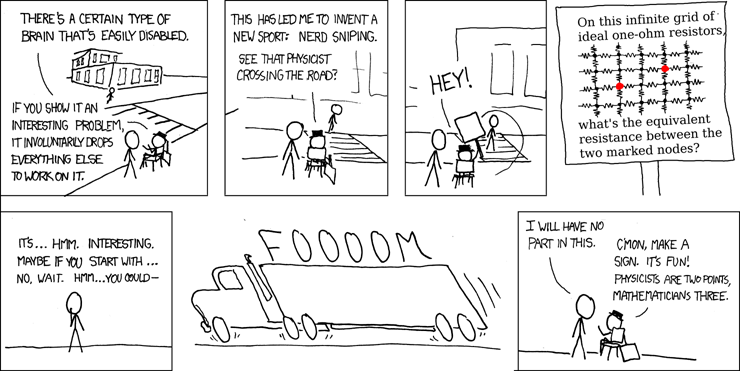
Here is the broad problem: quantify the above observation. I think there is more than one question here. For example, it should be possible to bound the 50-50 threshold as a function of the deviation from a uniform distribution.
(Cover image credit: Ed g2s, CC BY-SA 3.0, https://commons.wikimedia.org/w/index.php?curid=303792)

February 28, 2017
The power of silence
Recently I decided to take the plunge into audiobooks. Since this was a new venture for me, I decided also to listen to something I wouldn’t otherwise read: a parenting book. I’m not implying that I’m a perfect parent by that—I’ve just been blessed by a great partner and four amazing children, such that I haven’t felt the need to seek unnecessary advice.
Whether or not you think you are in the same boat, you should definitely pick up a copy of How to Talk so Your Kids will Listen and Listen so Your Kids will Talk written by Adele Faber and Elaine Mazlish. Now, at this point you might be sarcastically saying, “Thanks for alerting us to the existence of a 30 year old parenting book in its 13th edition that has been referred to as the parenting bible.” But, this post is for those who don’t frequent self-help blogs and the parenting aisle of the bookshop; you might think you have a great relationship with your kids—this book will make it better.
A comment about the audiobook
Before I continue, let me remind you that I listened to the audio version of the book. I have mixed, but still overall positive, feelings about this. First, there are plenty of cartoons in the physical book which obviously don’t translate to audio. I honestly didn’t notice this. Second, there are lots of exercises and places where you are asked to write things down. This is a bit awkward if you are listening to the book while being active. On the other hand, it is narrated by Susan Bennett, otherwise known as Siri. She does an absolutely amazing job capturing the emotion of the authors and, most importantly, the constant dialog in the book between parent and child. In any case, the content is well worth it. The remainder of this discussion will be about the content of the audiobook.
Nitpicking
I noticed that much of dialog in the book was dated in terms of language and subject matter. For example, a situation considered in the book was a child who borrowed and scratched a father’s compact disc. I mean, does anyone even own CD’s anymore? Luckily, this is more of a nostalgic amusement than a distraction.
I also didn’t like how the anniversary edition involved appendices of additions rather than a more streamlined approach. It felt a bit lazy and tacked on. In any case, the additional content was a useful addition to an otherwise great book.
Examples, examples, examples
A large chunk of How to Talk consists of real-life example dialogue between parent and child. These are invaluable. Often, the advice seems obvious in hindsight—validate feelings, for example. But, it’s only after hearing the examples when you really see where improvement can be made. The examples usually begin with a fictitious unhelpful response from the parent, followed by a helpful response. Let me give you an example that actually happened to me when I tried to use the skills on my own children after reading the first chapter: “Helping Children Deal with Their Feelings.” My strategy was to default to silent acknowledgment whenever I couldn’t quickly find an appropriate response.
Situation 1: Child (7) is asked to practice math exercises. After doing a few, she becomes bored and says, “I can’t do it.” Clearly, she can. Here is a typical way this would play out.
Child: I can’t do it.
Parent: Yes you can.
Child: I can’t. I don’t know how.
Parent: Well, you are not leaving the table until it is done.
Child (now crying): But I want to watch a movie!
Parent (voice raised): No movies until you are done all your homework!
Child: You’re mean!
And there is no end to the cycle. But, here is how it actually went:
Child: I can’t do it.
Parent: You feel that question is too hard for you?
Child: Yeah.
Parent: Hmm…
Child: [silence]
Parent: [silence]
Child: I think the answer is 17.
I couldn’t believe how well silence works for acknowledging feelings. Here is another example.
Situation 2: Child (3) is struggling to get his footwear on. He is frustrated that the sandal won’t fit on the wrong foot. Here is the typical way this would have gone.
Child (clearly frustrated): I can’t get it on!
Parent: That’s because you are putting it on the wrong foot.
Child: NO! It doesn’t fit!
Parent: Would you like me to do it for you?
Child: No!
Parent: [forces sandal on correct foot]
Child: [cries]
Here is how it actually went:
Child (clearly frustrated): I can’t get it on!
Parent: I see you are frustrated with that sandal.
Child (calmer): It doesn’t fit.
Parent: That can be so frustrating!
Child: [silence]
Parent: [silence]
Child (probably knowing all along): It’s the wrong foot.
Parent: [silence]
And he took it off the wrong foot and put it on the correct foot!
Bottom line
How to Talk contains seven chapters, the last being titled, “Putting it All Together.” But, to my mind, the first chapter contains the key insights to a better emotional relationship with my children. In the past, I’ve tried to avoid situations like those exemplified above. Accepting and dealing with my children’s emotions has not been that difficult because I have been fairly well in tune with them. This meant that I was able to easily anticipate meltdowns and avoid them altogether. For example, if I sensed that my 3 year old was irritable, I would not ask him to put his own shoes on, thereby avoiding the situation.
But protecting the children from their own feelings is not doing them any favors in the long run, and is becoming ever more difficult with a growing family. So, rather than doing the hard work of anticipating and preventing the emotional distress of my children, I’m now trying to acknowledge and accept how difficult it is to become an autonomous little person in a grown-up world.

January 30, 2017
Milking a new theory of physics
For the first time, physicists have found a new fundamental state of cow, challenging the current standard model. Coined the cubic cow, the ground-breaking new discovery is already re-writing the rules of physics.
A team of physicists at Stanford and Harvard University have nothing to do with this but you are probably already impressed by the name drop. Dr. Chris Ferrie, who is currently between jobs, together with a team of his own children stumbled upon the discovery, which was recently published in Nature Communications*.
[image error]Image credit: Ingrid Kallick
The spherical theory of cow had stood unchallenged for over 50 years—and even longer if a Russian physicist is reading this. The spherical cow theory led to many discoveries also based on O(3) symmetries. However, spherical cows have not proven practically useful from a technological perspective. “Spherical cows are prone to natural environmental errors, whereas our discovery digitizes the symmetry of cow,” Ferrie said.
Just as the digital computer has revolutionized computing technology, this new digital cow model could revolutionize innovation disrupting cross-industry ecosystems, or something.
Lead author Maxwell Ferrie already has far-reaching applications for the result. “I like dinosaurs,” he said. Notwithstanding these future aspirations, the team is sure to be milking this new theory for all its worth.
* Not really, but this dumping ground for failed hypesearch has a bar so low you might as well believe it.