Tero Parviainen's Blog, page 4
January 26, 2014
The Three Watch Depths of AngularJS
There are three different mechanisms for watching a value on an Angular scope: Reference watches, collection watches, and equality watches. The difference between the three is in the depth in which they watch their values.
Choosing the most appropriate watch mechanism is important, not only because the three mechanisms behave differently, but also because they have very different performance characteristics.
This short article describes the differences between the three watch depths.
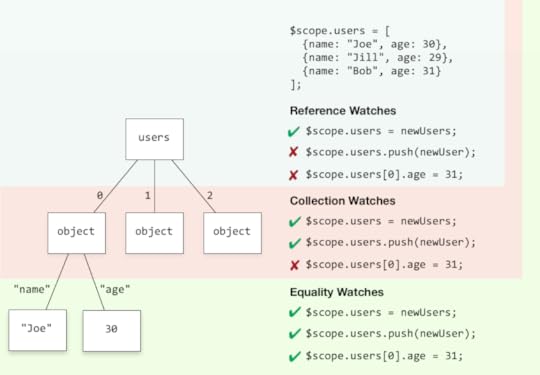
Reference W...


November 26, 2013
Slides And Resources For Immutable Java
I gave a talk at Java Day Riga 2013 about the use of immutable data in Java. Here are the slides and resources for that talk.
Slides
Resources
Building Blocks
JSR-310 Date And Time
For JDK 7 and earlier
JDK 8 Streams
Collections.unmodifiableXXX()
Guava Immutable Collections
Clojure Collections
Java Sources
clj-ds wrappers with generic types for Java
pcollections
Immutable Object Models
final fields
Domain-Driven Design: Tackling Complexity in the Heart of Software - quoted from Chapter 5: A...
November 24, 2013
Speaking At Java Day Riga 2013 Next Week
The Java Day Riga conference is taking place in Riga, Latvia next Thursday. It's a single-day conference organized by the Latvian JUG, and packed with talks about what's going on with Java and the JVM at the moment.
I'm going to give a talk myself, about programming with immutable data in Java. This is a topic I like to discuss, and I've done so before a couple of times in the context of dynamic languages. This is the first time I'll talk about this in relation to Java, which I'm quite excited...
November 20, 2013
Writing A Book About Making Your Own AngularJS
Update: "Build Your Own AngularJS" is now available as an early-access eBook.
I was very happy to see the enthusiastic response to the "Make Your Own AngularJS" article I published earlier this month. It generated a lot of traffic, a lot of discussions, and even two translated versions: One in Chinese and one in Russian.
Several people suggested turning the series into an eBook, and I've decided to go for it. Here's how.
Contents
"Make Your Own AngularJS" will be an eBook all about building your...
November 3, 2013
Make Your Own AngularJS, Part 1: Scopes And Digest
Update: "Build Your Own AngularJS" is now available as an early-access eBook.
Angular is a mature and powerful JavaScript framework. It is also a large framework with many new concepts one needs to grasp before becoming truly effective. As web developers flock to Angular, many of them face the same hurdles. What exactly does the digest do? What are all the different approaches to defining a directive? What's the difference between a service and a provider?
While the Angular documentation is get...
October 18, 2013
What I've Learned About Making ClojureScript Applications With Pedestal
Pedestal is an interesting beast. It aims to provide tools for building single-page ClojureScript webapps with the simplicity and elegance we've become accustomed to in Clojure. It is also perceived as a difficult technology to master with several new concepts to grasp, some of them quite subtle.
I think there's some truth in both claims. In this post I'll share my experiences with Pedestal so far. It is loosely based on a talk I gave at the ClojuTre event earlier this fall.
The Promise of Clo...