
Lucy V. Hay's Blog, page 44
August 31, 2016
5 Crime Fiction Blunders To Avoid
The original article appeared on Women Writers, Women’s Books. Follow them on Twitter as @womenwriters.
In addition to being an author, I am a big crime fiction, psychological thriller and mystery fan.
Though I have always read this genre, I’ve spent the last year absolutely immersing myself in it, reading and reviewing everything I can. In addition, I’ve been discussing the genre with lots of other fans as part of my ‘Best of 3’ blog feature and via my Criminally Good Bookclub on Facebook.
Combining this with my other job working with writers, I have identified five key blunders writers may make (including myself!) when attempting crime fiction. Enjoy!
1) Too Few Or Too Many Characters
An obvious one to start off with: too few characters? If you’re writing a mystery, then it’s going to be too easy to figure out Who Is Behind It All. But the answer is not too many characters either (as tempting as that might seem). Why? Because then the reader’s attention is spread too thin and we won’t be able to invest in the characters’ motivations.
2) Obvious Antagonists
Mistress of Crime Agatha Christie was a superb plotter, with most of her killers introduced within the first quarter of her books. This is a good tactic, because readers can feel cheated if you introduce the real antagonist much later.
However, you don’t want to be too noticeable when introducing the antagonist, either. The best antagonists have a strong motivation for their crimes, but this should be “hiding in plain sight”, not obvious.
3) Sudden Tone Changes
This is the thing. If you’re writing a dark, sexy thriller then – guess what! – it should stay dark and sexy throughout. Equally, if you’re writing the kind of crime fiction that say, includes graphic violence, then you should stick with that.
If you suddenly include farcical or even dry humour in either of the above? It’s going to feel quite weird to the reader! Again, obvious stuff, but in my other job as a script editor, I see these kinds of sudden tone changes in novels and screenplays all the time.
4) Overcooked Red Herrings
In early drafts of crime fiction novels, I’ve noticed sometimes writers will introduce too many possible red herrings, or go overboard with one so it’s ‘obvious’ it can’t be that character because they’ve spent too much time on him or her.
Wikipedia defines a red herring as “something that misleads or distracts from a relevant or important issue … A literary device that leads readers towards a false conclusion.”
Those last two words are the most important, for me. Thinking about what you want the reader to THINK INSTEAD can really help create a good red herring. In other words, it’s not about the *time* you spend with the red herring, but the question mark you place over his/her head!
5) Disatisfying endings
Because crime fiction is plot-driven, a satisfying ending is absolutely paramount. If you rush the ending, then readers will feel ripped off. Equally, if all the revelations are “backended” to the resolution, then you’ll blow the readers’ minds and bamboozle them. This will lead to disatisfaction too!


August 29, 2016
Top 5 Ghostly Narrators In Crime Fiction
This guest post was originally on the awesome CrimeFictionLover site! To view the original, CLICK HERE or on either of the pics below. Enjoy!
‘Narrator’ is defined in the dictionary as ‘a person who narrates something, especially a character who recounts the events of a novel.’ But what if our narrator is not a flesh and blood person at all, but a ghost, corpse, life essence, angel or metaphysical being, instead?
Authors have long explored the notion of an afterlife, whether they believe in it themselves or not. The idea of a world ‘beyond’ the physical realm is rich for potential conflict and character arcs, so it’s no accident the ghostly narrator has become entrenched in crime fiction, past and present.
Here are five ghostly narrators of the last fifteen years or so in crime fiction, which are YOUR favourites? Be sure to let us know in the comments section!
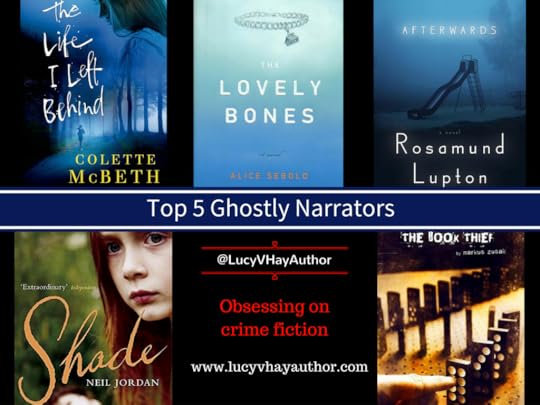
1) The Life I Left Behind by Colette McBeth
NARRATOR: Eve, a journalist. Savvy and capable, Eve doesn’t know when to quit … and this gets her killed, but why? Only the repressed memories of another woman can help Eve rest in peace.
‘I know who attacked her … It’s the same man who killed me’ is the tagline for this impressive novel about an event dating back six years that ultimately ends in murder.
When Melody Pieterson was attacked and left for dead, only a chance encounter with a dog walker saved her life. With Eve looking into the case, she’s not convinced Melody’s neighbor and close friend David Alden is really guilty of the heinous crime. But the evidence is so compelling that even Eve wonders if she’s barking up the wrong tree in her own investigation.
But after meeting with David soon after his release from prison, Eve is murdered in an attack almost identical to Melody’s. Helpless and unable to intervene for the first time in her life, Eve can only hope Melody will remember what really happened six years ago, so her killer might be brought to justice. But Melody has become a virtual recluse since her attack … does she have the strength to unveil the murderer?
Suspenseful and visual, The Life I Left Behind is the perfect ‘whodunnit’ for mystery lovers. Read my full review (no spoilers) HERE or click the title above.
2) The Book Thief by Markus Suzak
NARRATOR: Death. We can all become sick of our jobs and Death is no exception in this story, but he has no replacement so must continue. Claiming he is ‘haunted by humans’, he talks of removing souls and carrying them away.
If you grew up in the eighties and nineties like me, you may think first of Death as the dude from comedy sequel Bill And Ted’s Bogus Journey! But Death in The Book Thief is nothing like that wise-cracking dude with the painted face and black cape.
Death narrates the story of Liesel Meminger, a ten-year-old girl living in Germany during World War II. Unlike many novels set in the time period which are relentlessly bleak, Death describes both the beauty and destruction of the WW2 era, marking it out from many of its contemporaries.
A foster child and grief-struck orphan, Leisl arrives at the home of Hans and Rosa Hubermann. They try and protect Leisl from the horrors of the war and the Nazi regime. As the political situation in Germany deteriorates, The Hubermanns hide a Jewish man named Max, putting the family in danger.
The title refers to Leisl, who steals books The Nazi Party seek to destory. Hans teaches Liesl to read in secret. Recognising the power of language for herself, Leisl shares the books she’s stolen with Max, as well as writing her own. Through a love of the written word, Leisl copes with the trauma of her past and embarks on a journey of self discovery. MORE: Best of 3: Classic Crime Picks
3) Shade by Neil Jordan
NARRATOR: Nina, who might seem generous and ‘respectable’ but she hides a mean streak that has plagued her since childhood and will tear her and her friends apart.
Neil Jordan is perhaps best known for his Oscar-winning screenwriting with The Crying Game in 1992. Jordan has a filmmaking history dating back thirty five years with critical acclaim, not to mention a vast array of awards and accolades … So you could be forgiven for wondering how Jordan fits novel writing in as well!
With a fiction output of six novels (so far!), it’s Jordan’s Shade that brings his work into this list of ghostly narrators. The story is told by Nina Hardy, an actress who is murdered in the opening scene of the book. Whilst her corpse lies hidden in a septic tank, Nina recounts her tale of two pairs of siblings growing up in Ireland in the first half of the century, leading to Nina’s gruesome death in the 1950s.
There are shades of Lenny from Steinbeck’s classic, Of Mice And Men to Nina’s murderer and childhood friend, George. George has been mentally and physically scarred by his experiences in The Second World War and Jordan makes some nuanced commentary about the nature of post traumatic stress disorder on WW2 veterans. What’s most compelling however is Nina’s own acceptance of her own role in her death, because it’s ultimately a murder revealed as the opposite of the senseless crime it seems. MORE: Best of 3: ‘Mental Health Matters’ – Crime Fiction themed around trauma.
4) The Lovely Bones by Alice Sebold
NARRATOR: Susie. Naive and trusting, Susie meets her death one day after school and has to put her faith in her father to discover what really happened, so she might rest in peace.
Is it possible to discuss ghostly narrators without mentioning this book? I don’t think so. The Lovely Bones is the story of a family devastated by a harrowing and terrible murder — recounted by its teenage victim, Susie.
But Susie isn’t ready to release her hold on life just yet. We join her and keep vigil as she watches her family and friends as they struggle to cope with a reality in which she is no longer a part. Lured to an underground hiding place by her murderer, the crime is laid out first. The reader knows what Susie’s family does not and we’re desperate for them to catch up, so Susie’s killer can be found and brought to justice.
Popular culture often paints men as being emotional illiterates, but to her great credit, Sebold has shaped one of the most loving and sympathetic fathers in contemporary literature – his quest for the truth about his little girl’s death is mesmerising. So, whilst upsetting in nature, first-time novelist Alice Sebold takes this difficult material and delivers a compelling and accomplished exploration of a fractured family’s need for peace and closure. MORE: BEST OF 3: ‘Home Is Where The Hurt Is’ – Crime Fiction set in & around the home.
5) Afterwards by Rosamunde Lupton
NARRATOR: Grace. Described in newspaper terms throughout the book, ‘A thirty nine year old mother of two”, Grace struggles with her identity as a wife, mother, friend and human as she tries to find out who tried to kill her daughter in an arson attack on the school.
Taking The Lovely Bones conceit of the ‘angel-like’ narrator and running with it, Lupton introduces a new twist: Grace and her seventeen year old daughter, Jenny are badly hurt in a fire and end up in comas. It’s Grace’s spirit or ‘life essence’, caught in limbo, that narrates the story after she receives a head injury.
Both Grace and Jenny discover they can trail after their loved ones around the hospital. If they can bear the pain, they may leave the hospital and travel to their home and other places too, so Grace builds up her tolerance in order to be with her husband, Mike and her sister in law, Sarah who is a police officer as she tries desperately to find out who would commit arson.
In the hands of a lesser writer, Grace and Jenny would have been entirely passive characters, with events only happening ‘to’ them. But Grace and Jenny perform vital functions in the narrative and are even party to information Sarah is not. Grace must also make one final, devastating choice that seals her character as one who might have lost her way a little in life, but in the ‘netherworld’, she is in control and doing what she does best: being a mother. Read my full review (some spoilers), HERE or click the title above.
CLICK HERE for the original article.
August 26, 2016
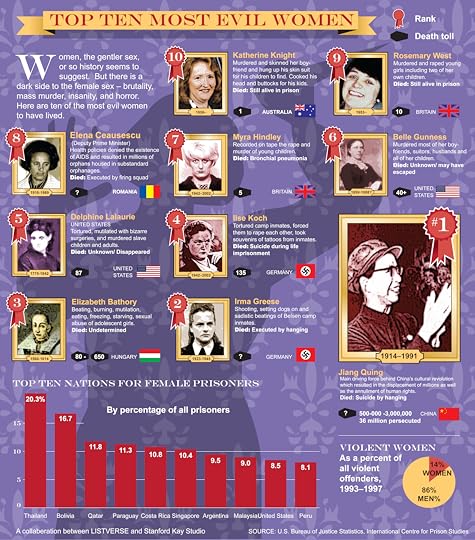
INFOGRAPHIC: Top 10 Most Evil Women
Women are often called the ‘fairer’ or ‘gentler’ or even ‘weaker’ sex, with female characters frequently painted in fiction as innocent victims. But the reality is VERY different!!
Fact is, the female of the species IS as deadly as the male – and history proves it. Click on the infographic below to enlarge the shocking specimens below – is it any wonder women are often the antagonists in crime fiction??
LINKS
BEST OF 3 – Enigmatic Female Leads
8 Female-Centric Biopics That Need Writing NOW
Top 5 Female Character Mistakes
Get a FREE ebook on how NOT to write female characters
From Listverse
August 25, 2016
CRIMINALLY GOOD: Chad Sanborn
 1) So, who are you & what have you written?
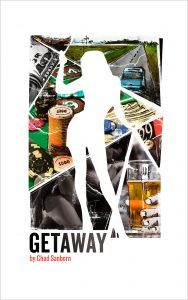
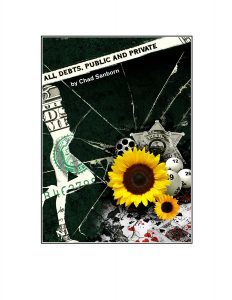
I’m Chad Sanborn, author of The Billy Keene Stories, a taut, fun and fast-moving crime series that follows a young inexperienced small-town sheriff as he grows into his job. Getaway is a crime novella and a prologue to the first novel in the series, All Debts, Public And Private. Both are full of dark humor and redneck vengeance.
You can find me on Twitter as @mrchadsanborn, LIKE my page on Facebook or check out my website, HERE.
 2) Why do you write crime fiction?
I’ve said this before but it’s true: I have a criminal’s mind but a coward’s stomach for actually trying to pull it off. So I figure it’s better to put it in a story than have my ass put in the joint. I’ve always loved reading crime stories. I love writing them because they come with a built in engine that drives the plot yet gives me the freedom to explore characters, relationships and just about any aspect of the human experience I want to play around in.
3) What informs your crime writing?
I think my knack for recognising the criminal possibilities in situations, of seeing the angles, comes from growing up around people who were self-reliant to the point of viewing some laws as suggestions for behavior rather than requirements. Most of the people I grew up around weren’t criminals, a few were, but almost all of them were okay with having all the options on the table when faced with a problem to solve—whether it was something as mundane as getting a car running or something as potentially criminal as how to make some money fast.
 4) What’s your usual writing routine?
I have to work in the morning — outline or write or rewrite, depending on the which phase I’m in — to give the day a shot at being a good one. Otherwise a part of me spends the rest of the day ashamed, nagging at me for being lazy.
I usually work in fifteen minute increments, so I’ll set the timer on my phone and start hacking away. If I’m really grooving when the timer goes off, I shut it off and keep going. If not, it’s a great excuse to get up, move around, get some more coffee, reset the timer, then start grinding on the story again. Then later in the day and evening I may chip away at it if I get a spare fifteen minutes here or there.
5) Which crime book do you wish YOU’D written, and why?
Rum Punch by Elmore Leonard and Layer Cake by J.J. Connolly because they seem like they would have been as much fun to write as they were to read. But for the sheer brilliance of it, The Red Riding Quartet by David Peace. As a reader I was in awe and delighted. As a writer I was in awe and miserable. Like “Hell, why even try? I’ll never come close to pulling off something like this.” But then again that’s the beauty of writing, finding out what you can do in your own way that will delight readers.
August 24, 2016
BEST OF 3: Lynne LeGrow, Book Blogger
Many thanks to book blogger Lynne LeGrow, aka @fictionophile! I love at least two of Lynne’s choices here, so check out my reviews at the bottom of this post and be sure to check out Lynne’s blog, too.
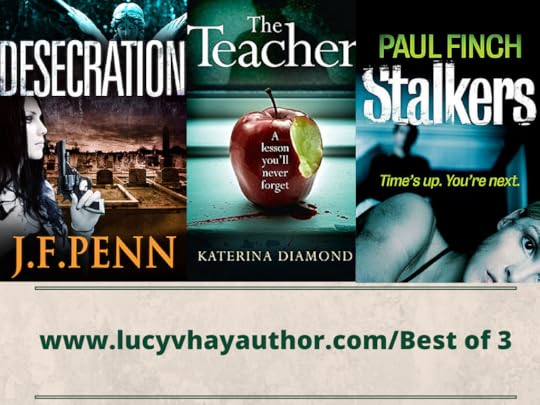
1) I Let You Go by Clare Mackintosh
WHY I LIKE IT: With a gob-smacking plot twist near the middle of the novel and another towards the end, this is a thriller that checks ALL the boxes for me. A very clever plot, charactisation, setting, writing…. Kudos to Clare Mackintosh for a spectacular and very impressive debut which will be on my list of “Best Thrillers EVER Read”. Read my full review, HERE.
2) Little Black Lies by Sharon Bolton
WHY I LIKE IT: An intricately plotted story of how one moment of thoughtlessness can lead to tragedy that impacts upon countless people, Little Black Lies is filled with a pervading sense of loss. There are many surprises in store for the reader. With solid, empathetic characters and jaw-dropping plot revelations, it is a novel that will be appreciated by anyone who admires crime fiction with a psychological bent. It contains all of the elements of a great thriller: betrayal, secrecy, passion, despair, fear – and Sharon Bolton uses these elements in a seamless way that grabs you and won’t let go until the very, very end. Wow! Read my full review, HERE.
3) Under Your Skin by Sabine Durrant
WHY I LIKE IT: Under Your Skin by Sabine Durrant drips with tension. Masterfully constructed with Gaby as narrator, the novel is a page-turner in the truest sense. This psychological thriller is everything you want in a novel. Good characterisation, tight plot, red herrings and a surprising and disturbing ending. Highly recommended! Read my full review, HERE.
@LucyVHayAuthor REVIEWS:
I LET YOU GO by Clare Mackintosh
LITTLE BLACK LIES by Sharon Bolton
August 22, 2016
What Can Screenwriters Learn From Crime Fiction?
Over at Scriptmag, I’ve had a column on screenwriting for several years. To shake things up, I’ve decided to put crime fiction under the spotlight and discover what screenwriters can learn from this genre. Enjoy!
Remember, if you want to read the whole article, CLICK HERE or on any of the pics!
1) Crime fiction has a strong sense of AUDIENCE
If a writer does not know who their audience is, the chances of their story hitting the ‘bullseye’ on this is very limited (and if it does, it’s pure luck – accident, rather than design). Many screenwriters will say their spec screenplays are ‘for everyone’ but crime fiction demonstrates that even within the same broad definition, there are LOTS of potential audiences you can reach. More on this, next.
SUBMISSION TIP: Think about who your screenplay’s audience is and how you can make this story appeal to them. It can only help you, especially as agents and producers will ask this question.
2) They pick one style/ tone and STICK WITH IT
So, Crime Fiction is a very broad umbrella. Stories have to ‘focus in’ on a particular investigation or problem to solve during the course of the narrative. They may do this in any number of ways, including via a steamy dangerous liaison (like the titles in the pic above) or they may include graphic violence (titles in the pic below). Obviously sex and violence CAN mix, but generally speaking if you sign up for a hot love affair, you don’t want torture porn in with it as well – it jars. In comparison, many spec screenplays do not stick to one style or tone as much and as a result, the story and characters’ journeys can be hard to follow.
SUBMISSION TIP: Before you send your screenplay out, run a critical eye over your scenes. Do they all ‘match’ in terms of style/tone, or do any ‘jar’ and/or feel completely out of the left field?
Want to read the rest of the article? CLICK HERE or on the pics …
June 4, 2016
Pre-order THE FORGOTTEN WOMEN SERIES, now!
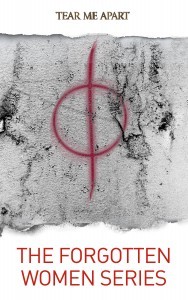
THE FORGOTTEN WOMEN SERIES is now available to pre-order on Amazon! Click on the pic on the left to pre-order your copy to deliver to your Kindle on publication day, Jul 1st 2016, or CLICK HERE.
THE FORGOTTEN WOMEN SERIES is a collection of novellas and a short story, detailing a dystopian near-future when women are dying out and civilisation has completely broken down. My novella, SKYJACK, is in this book!
You can mark it as "to read" on Goodreads, HERE.
Here's a quick blurb:
What if 99% of the female population died out?
This is exactly what happened when The Fall set in motion the mysterious deaths of women. Since then, wars have been waged and civilisation has completely broken down. Feral packs of young men called Raiders scour the land. Violence and disease is rife.
The only way to survive is by dabbling in the black markets – where the highest currency is an increasingly rare commodity:
Women and girls.
But what of the 1% of the women who are left?
What does Φ mean? And who are the Sons of Gaia?
The Forgotten Women is a series of novellas exploring four young women's journeys through the brutal post-apocalyptic world after The Fall.
Those who are not enslaved might find sanctuary in the Havens and Projects, entreating male allies to help protect them from the threat of Raiders. Or they may band together, distrustful of men, creating female-only colonies, looking for their sisters in arms.
But they’re all out there, waiting for us to join them ... Hunted, isolated, it’s not only about staying alive, but discovering who they are in a totally masculine world.
The brutal yet poignant post-apocalyptic world after the Fall plays host to a collective storyworld - TEAR ME APART - that includes a feature film, novellas, animated web comics and more.
For more information, including stills from the feature film, check out www.tearmeapartmovie.com.
May 4, 2016
Pre-order my new novella, SKYJACK - very soon!

EXCITING NEWS. So, my new novella, SKYJACK, will be available on pre-order VERY SOON!!
SKYJACK is a 20K word novella and part of the storyworld of the new and gritty UK Thriller TEAR ME APART by @CannibalFilms. Here's a short blurb:
In the not-too-distant future, women have started dying out due to a mysterious event known as The Fall. SKYJACK follows the fates of Maddy, one of the survivors of the ominous London City Haven where remaining women and girls are rounded up by government scientists.
Escaping to the Westcountry with her father Bill, they create a fort with other women and male allies as their last stand. They feel safe, the roads blocked and Nature creating barriers in the way of the river, the moor and the sea. But what they don’t count on is the air …
Want to be one of the VERY FIRST readers of SKYJACK??
SIGN UP HERE (or click the pic above) and I'll send the first chapter to you FREE as soon as it's available!!
April 13, 2016
Young Mums Defy Stereotypes
Since it's LBF, I thought I'd share something a little different from crime fiction this Writer Wednesday. Here's a look at THE DECISION: LIZZIE'S STORY my YA Novel, published in 2013 by Rowohlt, Berlin in the German Language and myself in English.
A teenage German reader wrote to me recently because she had been reading the German version, BAUCHENTSCHEIDUNG ("Gut Decision") for a school project. She asked me such great questions, especially about the book and its themes, I decided to share my answers here as well. Enjoy!
READ AN EXCERPT OF LIZZIE'S STORY, HERE.
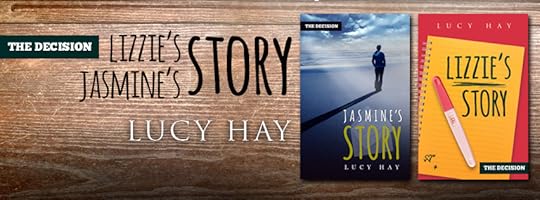
READ MORE AT MY AUTHOR SITE, HERE ...
http://www.lucyvhayauthor.com/my-book...
March 17, 2016
Love Crime Fiction? Me Too!
It has two features: CRIMINALLY GOOD, which is interviews with crime fiction authors, plus BEST OF 3, which is people's crime fiction reading recommendations. Check out the site, today!!!
You can also find reviews, recommendations and articles about crime fiction and crime writing at my Facebook page, CRIME, INK << Click here or on the pic below.
Lucy V. Hay's Blog

- Lucy V. Hay's profile
- 174 followers

