
Becky Wallace's Blog, page 8
May 8, 2014
THE STORYSPINNER’S Full Jacket Cover
Please ignore the squeal-sniffling. I got copies of my the dust jacket for THE STORYSPINNER in the mail. Do you want to see?

Is that too little? Oh…and you might want to see the awesome back of the book. Well the good news is that I have that too, and you can click on it to make it bigger.

I wish you had your own copy to hold. Then you could see the swirling sense of motion and the way the fletching on the feathers looks completely three-dimensional. Not to mention the model’s eyes! And lips! She’s beautiful!
Honestly, I’m so excited with how it turned out! Here’s a bit more if you can’t read exactly what it says.
The Synopsis
In a world where dukes plot their way to the throne, a Performer’s life can get tricky.
All Johanna Von Arlo wants to do is become a Storyspinner. But her options are so limited that she is forced to work for the aggravating and handsome Lord Rafael DeSilva. While in his employ, Johanna is exposed to a dangerous game of thrones, a game where she will discover that the magically inclined Keepers from her stories might be real after all.
The Keepers are searching for an heir to a great power and the key to saving their land. They aren’t alone in their hunt. Girls matching the heir’s description are turning up dead all over the kingdom. Girls who look exactly like Johanna.
The Quote
“As long as the throne is empty, peace will be uneasy. Mark my words, this treaty will not last.”
Other Bits of Awesome You Might Not Know
My editor, Dani Young, asked me to send a collection of pictures of people, places, things and clothing that I felt were representative of my characters and settings. She used what I sent her to set up the photo shoot for the cover. You can see some of those things here.
A few weeks later Dani sent me an email with some photos of a model attached. Dani had recently returned from another photo shoot and felt like she’d seen the perfect Johanna! She was right! The model had the right look, but from the batch of photos I could also tell that she had the right personality. Forgive the Tyra Banks moment, but this model showed a lot of emotion through her eyes. Since Johanna is an actress and story teller, I felt like we needed a model who wouldn’t just take pretty pictures but could also convey a vibrant intensity.
The color scheme–the dark but uneven green on the flaps–actually comes straight from the book! When you read the book, you’ll understand what particular item it represents. But I think it also gives you a sense of the lush, green world. Mango orchards and balsa trees anyone?
The title font has a fade in-out quality that I think has to do with a trick that Johanna performs during one of her stories. And if that wasn’t what the designer intended, it still looks pretty darn cool.
And…I think that’s it! I love it and am so grateful to Dani and the designer, Michael McCartney, for turning my story into such a beautiful book!


May 5, 2014
Editor’s Note: Rori Shay and a Blog Tour stop for her new book ELECTED!
H ey folks! Thanks for dropping in today to read about Rori Shay’s experience with editors (yep, it’s plural), and her new book ELECTED. But before we dive into her interview, there’s another part of Rori’s story that is both heartbreaking and motivating.
Rori received an offer on her manuscript, went through the editing process, got a cover, prepared marketing materials, and then BAM! Her publisher shut their doors just a few weeks prior to her release date. (Remember, the heart break I mentioned? I can guarantee that’s what it would feel like). But, Rori was determined her book would go out on schedule and with the help of Silence in the Library, a small independent publisher, ELECTED released on Earth Day (you’ll understand the significance when your read the synopsis below her interview).
Good story, huh?
All right. On to the interview!
BW: Tell me a little bit about yourself and your book.
RS: Sure! I write only part-time and actually wrote the first two books of the ELECTED trilogy on maternity leave. I live in the Washington, D.C. area with my husband, kid, 90 lb black lab Gerry, and long-haired cat, Misch-misch. I love reading fiction–it’s like eating to me. Storytelling has been in my blood since I was young and my parents read me books each night. I made up stories even all the way back to kindergarten, and my mom wrote them down until I could write them all myself.
ELECTED is about a girl who has to masquerade as a boy to take her country’s presidential role in the future. It’s set in Washington, D.C. after a global eco-crisis left the earth pretty destitute. Aloy has to conceal her gender to take her father’s place as the ELECTED and marry a woman to keep the cover. The story has a love triangle, but instead of the typical girl and two guys, it’s a love triangle with both a girl and boy liking Aloy.
BW: When an offer is made on your manuscript, do you get to talk to the editor right away? Do they give you an overall vision for the story or do they wait till the editorial letter?
RS: In my cases (two publishers) I talked to the editor right away. They’re the ones determining if they want to work with the story and selling it to their publishing team, so they talk to the author early on. Yes, you talk about vision for the story right away so you know as the author if you want to sign on with them. If they want to make drastic changes in storyline you might not be up for that. So it’s a discussion right from the beginning.
BW: Do you have a specific method that helps you work through your editorial letter
RS: This question is a complicated one for me. I’ve had so many different editors, and they never exactly used a “letter”. It was more changes made right in the body of the text, and I look at it all once really quickly and then go through item by item.
BW: How have you seen your writing change as you’ve worked with an editor?
RS: Definitely! I’ve learned so much about style and filling gaps in the storyline. My editors have all been fantastic!
BW: Is there any step/trick/secret you learned with your first novel that you will apply to all the others? Any specific mistakes you know now to avoid?
RS: I learned to write for all five senses so that the writing is more rich for a reader. I want the reader to be able to feel, smell, hear, etc. what I’m describing
BW: Can you give us one special piece of wisdom that will help our manuscripts sparkle? Or maybe a hint of what you think editors are looking for?
RS: Hmmm..one piece of wisdom…I think it’s the answer for number 5–writing for all the senses. Not just saying something happened but showing it and letting the reader picture it all in their imagination.
BW: I love visceral writing! The kind that can make you smell the flowers in the air and taste the macaroons (or…whatever). Thank you so much, Rori!
The Kickstarter to this book will be available today here. You will be able to get a copy of ELECTED in hardcover and/or paperback with a free ebook, a lot of special limited-edition items and other free books. Don’t wait, get your copy today!
ELECTED by Rori Shay
Genre: YA Sci-fi
Publisher:Silence in the Library Publishing
Blurb: It’s the year 2185, and in two weeks, Aloy will turn eighteen and take her father’s place as president of the country. But to do so, she must masquerade as a boy to avoid violating the Eco-Accords, four treaties designed to bring the world back from the brink of environmental extinction. Aloy hopes to govern like her father, but she is inheriting a different country. The long concealed Technology Faction is stepping out of the shadows, and as turmoil grows within her country, cryptic threats also arrive from beyond the borders.
As she struggles to lead, Aloy maintains her cover by marrying a woman, mean-while battling feelings for the boy who knows her secret – the boy who is somehow connected to her country’s recent upheaval. When assassination attempts add to the turmoil, Aloy doesn’t know whom to trust. She understood leadership required sacrifice. She just didn’t realize the sacrifice might be her life.
About the Author: Rori Shay is an author living in the Washington, DC area with her husband, daugh-ters, black lab, and cat – just not quite in the same exciting circumstances as ELECTED’s main character, Aloy. She enjoys running, gardening, reading, doing yoga, and volunteering with the Dwelling Place non-profit. Rori is a member of the Society of Children’s Book Writers and Illustrators (SCBWI).
Author social media links: – Website – Facebook – Twitter – Goodreads
Don’t forget to enter the giveaway!
~Kindle ~Items seen in ELECTED such as a marriage binding (temporary tattoo) ~Hemlock soap ~Necklace as seen in ELECTED ~Signed paperback copy of ELECTED ~Optional FaceTime or Skype session with the author for 1/2 an hour (can be used one-on-one or at the winner’s book club, etc.)
![SilenceInTheLibraryLogo[print]](https://i.gr-assets.com/images/S/compressed.photo.goodreads.com/hostedimages/1397674205i/9309887.jpg)
April 23, 2014
Where I’m At This Week!
This week has been made of awesome! I’ve been bouncing around the internet and doing some interviews, and I thought I’d share a few links!
If you’re interested in seeing the cover reveal of THE STORYSPINNER, you can find it here on Mundie Moms.
If you want to see the cover and read my very first ever author Q&A, you can find it on Hypable!
If you want read about the idea that sparked THE STORYSPINNER, you can find it on A Backwards Story.
OR…if you don’t want to go anywhere, you can scroll down and see the beautiful work of art Simon & Schuster and designer Michael McCartney created for THE STORYSPINNER!
…
…
…
…
…
…
…
…

And next week, I’ll tell you all the secrets of this cover! Lots of fun things to look forward to!
April 18, 2014
How I Got Here: Nicole Castroman
 I’m so, so excited to introduce you all to the brilliant and beautiful Nicole Castroman. We’ve been friends and critique partners for almost three years, and her book BLACKHEARTS is a story I love so much that I wish I could claim it as my own. I’m thrilled Simon Pulse will be publishing it in Spring of 2016! Nicole has worked so hard and I think her story will be an inspiration to anyone trying to break into the publishing industry.
Becky Wallace: So Nicole, tell everyone a little bit about yourself.
Nicole Castroman: A little known fact about me is that I love languages. I do. In high school and later at BYU, I studied German, Russian and Spanish. I’m still fluent in German, I can speak enough Spanish to get myself into trouble, but I can only say a few words in Russian. Very sad, but true. I think that’s why I love to write so much. It’s a way to communicate with people. Learning about other cultures is fascinating for me, which is why I love to travel. I’ve visited most countries in Europe, including Russia and the Republic of Georgia. Yes, there is a country named Georgia. Kind of appropriate that I live in the state of Georgia, no?
BW: Remember when I said she was brilliant? That wasn’t me just being nice. She really is a super smart. *Nicole blushes* And, how long have you been writing?
NC: I’ve been writing for approximately 5 1/2 years.
BW: How did you get your agent?
NC: I signed with my first agent in 2011. At that point, I’d written three (bad) manuscripts, but my fourth one did the trick. It didn’t sell, but I kept writing. Always be working on your next project. I cannot stress that enough. Not only does it improve your technique, but it keeps you from obsessing too much over the submissions process.
After about 18 months of working together, my agent and I decided to part ways. It happens. At the time, it was frustrating, but looking back, I wouldn’t change a thing. I learned so much from her and really, in the end, things worked out for the best. I know several writers who have switched agents, for a number of reasons. It’s a part of the business and that’s exactly what this is. A business.
So, in August 2012, I was agentless. That’s when I started writing BLACKHEARTS. The words literally flew from my fingertips. I loved the characters and the story so much, it really was a joy to write. I’m not sure exactly how many queries I sent out, but I had several requests for partials and fulls. I remember very well the Friday at the beginning of January when I received an email from Quinlan Lee at Adams Literary. She said she was enjoying my story, which at the time was called THE LEGEND OF EDWARD TEACH. She asked me a few questions and said she would read the rest over the weekend and get back to me on Monday. I could hardly sleep all weekend, wondering what part she was reading and whether she liked it or not. On Monday, she asked to set up a time to talk. As soon as I spoke with her on the phone, I knew she was the agent for me, because it felt so natural talking to her. She’s amazing! She’s a great communicator, advocate and is incredibly knowledgeable about the entire industry. It’s an honor to be part of the team at Adams Literary. Josh Adams came up with the amazing title, BLACKHEARTS. Seriously, I love that title! Tracey Adams is so supportive (and a riot on FB) and Samantha Bagood is so nice and gives feedback on my writing as well. I feel very blessed to work with them. And just a little shout out here to my editor, Sara Sargent. I’ve followed her on Twitter and have always thought how great it would to work with her and now I get to. DREAMS DO COME TRUE.
BW: Blackheart is the story about how Blackbeard became a pirate. How did you come up with this idea? What inspired you to write about pirates? What are you working on now?
NC: Why write about Blackbeard? Well, I love history and interestingly enough, there isn’t much information about Blackbeard. In fact, only the last two years of his life are documented. It was believed he came from a wealthy family, because he could read and write. Some accounts have his last name listed as Drummond, although like most pirates, he changed his name to avoid dishonoring his family. Contrary to popular belief, there are no reports of him ever harming or killing anyone he took hostage. Instead, he used psychological intimidation to get what he wanted. He secured burning hemp ropes in his beard and beneath his hat, giving him the appearance of some large, smoking specter. He captured a French slave ship, freeing those on board and renaming it Queen Anne’s Revenge. At one point in his career, he held the entire city of Charleston, SC hostage. His only demand–medicine.
All of those facts inspired me and I simply deconstructed his story, or at least my version of it. Or maybe I should say, I constructed his story.
Right now, I’m working on another historical story, set in New Orleans during the Reconstruction Era, after the Civil War.
BW: If you could give a piece of advice to someone who is trying to get published, what would it be?
NC: Can I give lots of advice? Like, a whole cake worth, not just a piece? I know this sounds cliché, but NEVER GIVE UP! Seriously, if you love to write, keep at it. And read a lot. And write a lot. And find an amazing CP like Becky who will tell you what works and what doesn’t. And then find beta readers who will be honest with you and tell you what works and what doesn’t. I have no filter, so when it comes to critiquing, I’ll pretty much say what I think. If you can handle it, THAT is the kind of person who will help your writing. Not me, per se, but someone who will be completely honest with you. It’s nice to have someone say they enjoy your story, but it’s even nicer to improve your craft. Oh, another piece of advice. Try to develop a thick skin. I could go on and on…
BW: Now tell everyone three reasons you think I’m wonderful. Just kidding.  If you have any questions for Nicole, you can ask them in the questions or tweet them to her @nicolecastroman. She’d love to hear from you!
April 16, 2014
Oh Joy and Happiness!!
I have fantastic, wonderful, giddy-making news! My very good friend and critique partner, Nicole Castroman, just sold her debut novel BLACKHEARTS to Simon Pulse. *dancing ensues* If you’re on twitter, head on over to @nicolecastroman and tell her congratulations. And, she’s agreed to answer a few questions for my new blog series “How I Got Here” tomorrow!
Here are the details of her deal:
Sara Sargent at Simon Pulse has acquired Blackhearts by debut author Nicole Castroman. Inspired by the tale of Blackbeard, it’s the story of a forbidden romance between a servant girl desperate for freedom and the master’s son who dreams of a life at sea. But they are caught up in something bigger than their circumstances: a love that changes the course of history. Publication is scheduled for spring 2016; Quinlan Lee at Adams Literary did the deal for world English rights.
WAHOOOO!!!!
April 9, 2014
Forward Progess
 It’s a football term, but if you’re an American football hater, don’t zone out! I promise Forward Progress, whether football related or otherwise, is a good thing.
Here’s the actual (well as actual as Wikipedia can get) definition and if you’re bored or just don’t care, read the bolded stuff: The exact moment at which the player’s forward progress stops is subject to the judgment of the officials. In particular, for the protection of the quarterback, he is considered down as soon as an official judges that he is in the grasp of an opponent behind the line of scrimmage, and the tackling defensive player(s) will be awarded with a sack. If he is driven backward by the opponent, the ball will be spotted where his forward progress was stopped.
Right now as I write STORYSPINNER’s sequel, I can relate to a running back who gets the crap knocked out of them on a by-down (or daily) basis. I’m moving forward, I’m gaining yardage (word count), I get tackled by a two-hundred-and-fifty pound defensive end (or writer’s block/plot failing/burn out moment), and tumble backward, sometimes beyond where I started.
This morning, for the third day in a row, I deleted more than fifty percent of the stuff I wrote last night.
It felt a little bit like this:
 (FYI: That’s Jadeveon Clowney laying down one of the sickest hits in NCAA history. It hurts me to watch it)
I tell myself to shake it off. Get back in the huddle and be grateful for the progress I did make.
Sometimes it’s hard. Sometimes I want to lay back and give in to the frustration. Or be like that poor Michigan RB and just not get up.
At the time I’m posting this, I’ve written 1451 words today–that’s a positive gain of 780 words since yesterday. By the time I roll into bed, I’ll probably have 1,500 words I’ll keep. That’s forward progress, that’s closer to The End(zone). It’s not important how many words I had to delete to get to the right ones; what matters is that I have the right words now.
March 25, 2014
Lies We Tell Ourselves
By “we” I actually mean me.
Lie: I can totally do (insert tremendous list of time consuming activities) in two hours. Truth: Unless I can bend the laws of science, grow two arms, or have a secret team of helpers hiding in the garage, then no. I can not do a tremendous list of things in that amount of time.
Lie: It’s okay if I didn’t hit my word goal today. I’ll make it up tomorrow. Truth: No, I won’t. Sometimes — like maybe a tenth of the time that I say this — it actually happens. Usually I push the “make up work” off till the end of the week and then am oddly surprised when I have 7,ooo words to write on Saturday.
Lie: I’m not going to let it bother me. Truth: It’s totally going to drive me crazy, but I’m going to suffer in silence, holding the rotten thing inside until it bursts out of me with some ugly rage when I’m actually mad about something else.
Lie: It’s not for me to judge. Truth: I already have.
Lie: I’m so tired. I’ll do the dishes/laundry/blog post/important email in the morning. Truth: I will do those things in the morning, but only after I’ve laid awake all night fretting about them.
Lie: I’ll only have a bite. Truth: I’m going to eat the whole thing and probably lick the plate. Self-control…I have none of it.
Lie: I can not start this new book I’ve been desperately waiting for until I finish my draft/finish my edits/paint this piece of furniture. Truth: I read the whole book while sitting in front of my computer while I was pretending to be writing.
Lie: My kids will never do that. Truth: They already have.
Lie: I’m crafty! I can totally paint this piece of furniture/create artwork for that niche above my fireplace/hang those curtains. Truth: I might be able to do those things, but it will take me months to do them because I always have a dozen more important things (another lie) than this self-assigned project. In all actuality, I’ll put off these projects until the day before my parents come to visit then resort to the first lie on this list.
I’d like to thank my husband for providing the inspiration for this post. He says to me all the time, “Keep telling yourself that and it might actually happen.”
And I totally plan to.
March 18, 2014
Copy Edits: CHECK!
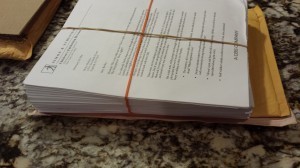 I survived copy edits! They were hard, but magical. It’s amazing to hold a printed copy of your book — even if it’s coverless and sort of a mess. I had nine days to get the ms back to my editor, and managed to read through it completely three times. I felt like I could have gone through it fifty times and still found mistakes. That, by the way, is sort of an awful feeling.
On Thursday, I’ll have an entire post in Editor’s Notes on what I learned and what would have been helpful to know in advance. Until then, I’ll leave you with this beauty:
 That’s my book! And my name! And places it will be published!!!!
If that’s not cool enough for you, how about this?

We went to the Bayou Wildlife Park in Alvin, Texas over Spring Break. The deer become your BFFs if you have food. It was so much fun…maybe a little more fun than copy edits. 
February 27, 2014
Writing is Waiting
My husband works for one of the world’s largest companies. He does not understand the publishing industry whatsoever. When we talk about the wait time between stages in the writing/editing/publishing process he generally says something like, “This business model makes no sense.” I’ve tried to explain it to him — trends, publishing “seasons,” the artistic process — and he rolls his eyes. He’s convinced there is a better, more scientific way to produce books.
Until they (someone, you, the publishing industry as a whole) figures it out this magically faster process, writers pursuing publication have to become excellent waiters…and I don’t mean the kind that bring your dinner. This process is long. Sometimes it’s painful. But waiting doesn’t mean doing nothing. If you’re in query hell, or submission hell, or hoping your beta readers will get back to you eventually, the best advice I can give you is to stop sitting around, checking your email (or watching out your front door, in my case). Do something. Read in or out of your genre. Work on that sparkly new idea. Attend a conference. Read a plotting book.
Writing is waiting, but it’s also an action verb. Continue writing while you wait. Then, no matter what happens with this project, your next one will already be underway.
I swear I’m not looking out my front window for my copyedits to be delivered, but I’ll check again as soon as this posts. I’m writing while I wait, but that doesn’t make me patient.
February 25, 2014
Editor’s Note: Lessons from author Stephen Kozeniewski
 I love this series! It’s been so interesting and insightful to interview my author friends about their editorial experiences. Today, I asked author Stephen Kozeniewski about the process of editing his book, BRAINEATER JONES. You might remember hearing about the novel on my blog here. He tends to be funny and just a little bit snarky, so his interviews are always a pleasure to read. Enjoy!
Me: Tell me a little bit about yourself and your books.
Steve: I am an army veteran of the Iraq war (although somehow in my day job now I work for the Navy – go figure.) I’m going on ten years married to my lovely wife and we are the proud parents of two fur babies, both of the feline or “correct” category.
My first novel is an offbeat tale about a hardboiled zombie detective named BRAINEATER JONES who has to solve his own murder during the Prohibition era while trying to find enough liquor to keep his brain functioning. (I got some good pre-publication notes from a beta reader named Becca…Becky…something. Can’t remember.)
Me: Haha.
Steve: My sophomore effort is a grand guignol hardcore horror masterpiece called THE GHOUL ARCHIPELAGO. It chronicles a power struggle between smugglers, pirates, and robber barons set on the high seas of the South Pacific against the backdrop of the zombocalypse. I’m fond of saying that BRAINEATER is 90% humor, 10% horror and GHOUL is 90% horror, 10% humor.
Me: Pirates! Smugglers! Big words that sound cool! (I just googled guignol. It’s a main character in a French puppet show known for its “sharp wit and linguistic verve.” In other words, it’s going to maintain Steve’s clever, impossible to ignore voice and style).
When an offer is made on your manuscript, do you get to talk to the editor right away? Do they give you an overall vision for the story or do they wait till the editorial letter?
Steve: I believe I had to wait about two months before my first manuscript made it through the editing queue. (Becky can probably tell you this is lightning-fast compared to how long you would wait for a Big 6 editor. One of the advantages of going with a smaller press is speed.) As I recall my content editor introduced herself via e-mail, then after she read the manuscript we had a conference call to discuss the rest of the process. She explained her overall impressions on the call, and pointed out her major, non-negotiable plot holes to fix. The editorial letter was more specific with broad stroke concerns, and listed them from, say, 1-5. Then my manuscript was marked up with individual changes, some of which were linked to one of the numbered concerns. So if one issue was “3 – Be more descriptive” then one of the markups might be “What color are his pants – re: 3.”
Me: As a critique partner and beta reader, I love this editing method! If you go into a manuscript with things you know need to change, and tag the with an associated note and number it would make the process so much easier. For everyone! I’m totally stealing this idea!
Do you have a specific method that helps you work through your editorial letter?
Steve: Well, I think it’s important not to get bogged down on any one change. My first editorial letter was well over five pages and I had something like 200 markups on the manuscript. I started out going in order, fixing each change as it came up, but if I hit a change that I didn’t know how to fix (or, worse, didn’t agree with) I would just skip it and go to the next one. Once I had made, you know, 75% of the bubbles disappear it was less daunting to go back and really dig in on the ones that were giving me heartburn.
Me: That’s how I worked through mine too and it did seem to help. Once I got rid of all the “fix this transition” type things, I had an easier time focusing on the….”kill this character” elements.
How have you seen your writing change as you’ve worked with an editor?
Steve: It’s subtle things. I have author friends who have told me instead of a devil and an angel they now have a content- and a line-editor on either shoulder. It’s not quite THAT extreme for me, but there are times when my conscious mind stops and breaks in on the subconscious rhythms of my writing and says, “You need more description here” or “Is this character serving his own interests or that of the plot?” Now that I’m aware of what an editor would say, I can try to incorporate a poor man’s version of editing into the writing process, rather than just fix it all in post.
Me: Yes! And I think it’s making rewriting and revision a little less painful.
Is there any step/trick/secret you learned with your first novel that you will apply to all the others? Any specific mistakes you know now to avoid?
Steve: Just say no to “just.” Watch out for overuse (or misuse) of parentheticals. My editor also told me, “You can combine dialogue with narrative in a paragraph; you don’t always have to separate it.”
Look, every author has certain bugaboos and tics that slip into their writing. The three above are just a few examples of mine. Trust me, I’ve got a ton more (and my editor would probably tell you more than just a ton, but she’s a known liar.) I think our tics are subconscious for the most part, even when you’re slavishly concentrating on crafting your words. And if you do break yourself of the habit of using a certain turn of phrase it’s probably because you’ve replaced it with another bad habit. And there’s nothing inherently wrong with individual peccadilloes. In fact, it’s just one of those reasons why we need editors, so that another set of eyes can objectively judge your work.
Me: Can you give us one special piece of wisdom that will help our manuscripts sparkle? Or maybe a hint of what you think editors are looking for?
Steve: Don’t use words like “sparkle,” especially if it’s about vampires. No, um…I think editors just want to know that you’ve put the same thought into penning your prose as they are about to put into fixing it. It’s not like they’re ogres. I’ve “won” arguments over wording and even plot points whenever I could justify my choice. Just because you can justify your choice doesn’t always mean you made the right choice stylistically, but it’s better than saying, “Oh, I dunno, I just threw words against the page and saw what stuck.” All of which is a long way of saying, “Know why you wrote what you wrote and be able to articulate it if you don’t want to change it.” I think if you follow that special piece of advice you and your editor should get along just swimmingly. :)
Me: As always, it’s a pleasure to have Steve (and his vocabulary) on my blog! If you want to know more about him, click here or check out BRAINEATER JONES for a sampling of his wicked wit.


