
Barnabas Piper's Blog, page 28
May 16, 2024
Kindle Deals for May 16
A few Kindle deals worth your mind and money today:
When Helping Hurts: How to Alleviate Poverty Without Hurting the Poor . . . and Yourself by Steve Corbett & Brian Fikkert
$3.99
Surprised by Hope: Rethinking Heaven, the Resurrection, and the Mission of the Church by N.T. Wright
$2.99
Rembrandt Is in the Wind: Learning to Love Art through the Eyes of Faith by Russ Ramsey
$4.99

How to Read the Bible Book by Book: A Guided Tour by Gordon D. Fee & Douglas Stuart
$2.99
Basic Christianity by John Stott
$6.00
A Survey of the Black Church in America: Exploring Its History, Ministry, and Unique Strengths by Tony Evans
$2.99


May 15, 2024
Kindle Deals for May 15
A few Kindle deals worth your mind and money today:
The Lincoln Highway: A Novel by Amor Towles
$4.99
The Story of Everything: How You, Your Pets, and the Swiss Alps Fit into God’s Plan for the World by Jared C. Wilson
$.94

The Age of AI: Artificial Intelligence and the Future of Humanity by Jason Thacker
$2.99

The Printer and the Preacher: Ben Franklin, George Whitefield, and the Surprising Friendship That Invented America by Randy Peterson
$2.99

The StoryChanger: How God Rewrites Our Story by Inviting Us into His by David Murray
$4.27

Six Ways to Raise Up People of the Book
As I have talked with pastor friends of mine from around the United States, I’ve found many of us share a common concern. Our people are not very biblically literate. Where once a preacher could make a passing reference to an Old Testament character or story in an illustration or could sprinkle in quotations from Paul’s epistles, we must now explain these references in great detail. People don’t know what the Bible says like they used to.
So when we read of the Bereans in Acts 17:11, and it says, “. . .they received the word with all eagerness, examining the Scriptures daily to see if these things were so,” we find ourselves wishing. If only our congregations approached the Bible with that sort of respect, eagerness, willingness, and familiarity. We want our people to approach the Bible as God’s very words. (2 Timothy 3:16) We want our people to approach life with the Bible as their moral authority and source of confidence (Deuteronomy 6:4-9). We want our people to see scripture as accessible and open to them (John 14:26).
But wishing and yearning won’t make it so. To raise up people of the Book is an act of the Holy Spirit through faithful pastoring. Here are a few steps we can take to lead our congregations in this way.
1. Preach and teach the whole BibleThe Apostle Paul declared in Acts 20 that he preached “the whole counsel of God,” and we are to do the same. This doesn’t mean giving the same emphasis to every passage and every book. I once heard Ray Ortlund Jr. say, “Every verse in the Bible is equally true, but not every verse is equally profound,” so we teach it all and give more time and focus to certain portions. If we fail to do this, our people learn to downplay or overlook parts of the Bible altogether. One common way this happens is that the Old Testament (aside from the Psalms we like and the Christmas passages in Isaiah) is treated as irrelevant, confusing, alien, or even dangerous. We must teach it with the same dignity, honor, and salvific power that Jesus did (Luke 24:27).
2. Preach and teach expositionally and topicallyLet me be frank: the debate about whether to preach expositionally (walking through books of the Bible) or topically (focusing on themes or aspects of life) is stupid. People need both, and the Bible equips us to preach both ways well. If Jesus could preach about money, hell, lust, and many more topics, then we can follow his lead. Just remember, he wrote the Bible, so following his lead means forming all our positions on any given topic according to what he said rather than using the Bible to back an opinion we already have. And, of course, we must teach and preach through books of the Bible so that people learn the whole counsel of God and see how it fits together. This will bring up specific topics to be addressed from the Bible. (eg. You can’t preach Ephesians faithfully without addressing ethnic disunity, marriage, parenting, work, sexual immorality, etc.) Sometimes people need to have the Bible aimed at specific topics like a spotlight, and sometimes they need to have it unpacked like a suitcase. In each case, what they hear is the mind and heart of God.
3. Be clear where the Bible is clear and cautious where it isn’tIf we want our people to rightly respect the Word of God, then we need to model that respect. One way we can do this is to be explicit about where the Bible is. “Do not commit adultery.” (Exodus 20:14). “You cannot serve God and money.” (Matthew 6:24). “Love your enemies.” (Matthew 5:44). “I am the way, and the truth, and the life. No one comes to the Father except through me.” (John 14:6) If God has made no exceptions, then we have no right to do so either. On the other hand – and this is a greater temptation for many of us – we must be extremely cautious about being explicit where the Bible is not. When we are clear about things the Bible leaves opaque, we tend toward legalism or very weird doctrines. Often the Bible leaves things mysterious because they are not for us to know (e.g., the specifics of the end times). Often the Bible leaves blank spaces to fill with wisdom, which we learn from Scripture elsewhere (e.g., “Fathers, do not provoke your children”-Ephesians 6:4) rather than giving specific applications. If we approach scripture this way, it will help us prioritize things “of first importance” (1 Corinthians 15:3) and “avoid foolish controversies” (Titus 3:9). It will guide our people in wisdom, obedience, and a willingness to recognize and respect the mystery of God’s infinity and holiness.
4. Don’t create barriers to understandingAfter our deep study of the Bible, it is easy for us to present it to our congregations in a manner unattainable to them. We can reference the original languages too often, describe what “this word really means,” mention many scholars and commentators, and otherwise make studying the Bible sound like something reserved for experts. The real aim is to study deeply so that we can preach and teach simply. We want to make the deep things of God accessible to our people so that they are drawn to the Bible instead of scared away from it.
5. Reflect on scripture in every meetingWhether it is a staff meeting, elders meeting, prayer meeting, small group leader’s meeting, or any other kind of meeting, spend time reflecting on a passage of scripture. This can be 5 minutes of reflection, 30 minutes of rigorous discussion, or a time of teaching. The point is that God’s Word must underpin and guide all your gatherings. This will shape the culture of the church and whet people’s appetite for Scripture.
6. Create small contexts to study the WordUp to this point, everything I have written depends on the pastor/leader bringing the Word to the people. But they cannot rightly be Berean until they begin exploring it themselves. And they cannot rightly be Berean until they start exploring it together. So whether you call them small groups, discipleship groups, Bible Studies, equip gatherings, or whatever other clever name you can come up with, give your people opportunities to study the Word together. Give frameworks, study questions, resources, and guides –just set them on a course to get into the Word alongside other men and women who want to know God’s Word.
This was originally posted at The Focused Pastor
May 14, 2024
Kindle Deals for May 14
A few Kindle deals worth your mind and money today:
The Hobbit by J.R.R. Tolkien
$1.99

Is God anti-gay? by Sam Allberry
$5.99

Tending Soul, Mind, and Body: The Art and Science of Spiritual Formation edited by Gerald Hiestand & Todd Wilson
$2.99
The Allure of Gentleness: Defending the Faith in the Manner of Jesus by Dallas Willard
$1.99

The Vertical Self: How Biblical Faith Can Help Us Discover Who We Are in an Age of Self Obsession by Mark Sayers
$2.99
On the Incarnation: In Modern, Updated English by St. Athanasius
$.99

The Church History ABCs: Augustine and 25 Other Heroes of the Faith by Stephen Nichols & Ned Bustard (illustrator)
$2.99
May 13, 2024
Kindle Deals for May 13
A few Kindle deals worth your mind and money today:
The Great Dechurching: Who’s Leaving, Why Are They Going, and What Will It Take to Bring Them Back? by Jim Davis & Michael Graham
Becoming Elizabeth Elliot by Ellen Vaughn
$4.99

$4.99

Colossians: A Short Exegetical and Pastoral Commentary by Anthony Thiselton
$2.99
The Seven Sayings of the Saviour on the Cross by A.W. Pink
$1.99

Fullness of Joy
“You make known to me the path of life; in your presence, there is fullness of joy.” (Psalm 16:11:)
I don’t like being told what to do. Being commanded to do just about anything, at best, annoys me. (Usually, it makes me downright angry and resentful, so I start looking for opportunities to rebel.) This means that for the longest time, when I read verses like Psalm 119:47, which says, “for I find my delight in your commandments, which I love,” I had no idea what to do with it. I actually thought David, the Psalmist, might just be crazy.
It was actually another Psalm that helped me see why David was right (obviously), and I was so wrong. Psalm 16:11 says, “You make known to me the path of life; in your presence, there is fullness of joy.” What is this path of life that God shows us? It is living according to his commandments, and that’s where true, deep, fulfilled life is found.
On top of that, it is the path that leads directly to God’s presence, where there is fullness of joy. So, of course, there is a deep delight in God’s commands when we realize they draw us close to Him and his steadfast love.
My heart still bucks against commands. But I see now that following them is actually walking deeper into joy and closer to the heart of God who loves me.
 I originally wrote this post for my church, Immanuel Nashville, in our Daily Pulse email. If you want encouragement from God’s word delivered Monday thru Friday to your inbox, I encourage you to subscribe!
May 11, 2024
Kindle Deals for May 11
A few Kindle deals worth your mind and money today:
A Theology for the Church edited by Danny Akin
$4.99

I Am a Church Member: Discovering the Attitude that Makes the Difference by Thom Rainer
$4.99
J.R.R. Tolkien: Author of the Century by T.A. Shippey
$3.99

The Life and Afterlife of Harry Houdini by Joe Posnanski
$2.99

Jerry Lee Lewis: His Own Story by Rick Bragg
$3.99

Narrative of the Life of Frederick Douglass: An American Slave by Frederick Douglass
$.99

May 10, 2024
Kindle Deals for May 10
A few Kindle deals worth your mind and money today:
Deep Discipleship: How the Church Can Make Whole Disciples of Jesus by J.T. English
$4.99
Christianity’s Dangerous Idea: The Protestant Revolution—A History from the Sixteenth Century to the Twenty-First by Alister McGrath
$3.99

Confronting Jesus: 9 Encounters with the Hero of the Gospels by Rebecca McLaughlin
$5.69
The Pastor In Prayer by Charles Haddon Spurgeon
$3.99
The Ways of White Folks by Langston Hughes
$1.99

Praying with the Psalms: A Year of Daily Prayers and Reflections by Eugene Peterson
$2.99
Clemente: The Passion and Grace of Baseball’s Last Hero by David Maraniss
$2.99

When The Game Was Ours by Larry Bird & Magic Johnson
$4.99

Why I Love the Apostle Paul: 30 Reasons by John Piper
$2.84
Remember God’s Mercy – He Reads Truth
Genesis 6:11-22, Genesis 7:11-16, Genesis 8:1-22, Genesis 9:12-17, Ephesians 2:8-9
When we read the story of the flood in Genesis, “mercy” isn’t likely the first word that comes to mind. It seems like the opposite of mercy. We see God wiping every living thing off the face of the earth, giving the impression of a vindictive God, not a merciful one. If we look more carefully, however, we can see the merciful heart of God through this apocalyptic story.
“Human wickedness was widespread on the earth,” and this was not an overnight occurrence. Since the fall in Genesis 3, people had progressed deeper and deeper into rebellion against God. Creation as a whole had turned against its Creator God. He had been profoundly patient when His created world turned on Him—that is mercy.
Even in the flood, God showed mercy. He could have eliminated all of creation, but He gathered Noah and his family and instructed them how to be saved. What is more, He commanded them to bring “two of everything—from the birds according to their kinds, from the livestock according to their kinds, and from the animals that crawl on the ground according to their kinds” (Genesis 6:20). God’s intent was to redeem creation, not vengefully eliminate it.
After mercifully sustaining Noah’s family and all those creatures on the ark for many months, God then gave visible, tangible symbols of life and promise through the raven and the dove that Noah sent out. God gave proof of life (Genesis 8:11).
In the aftermath of the flood as Noah’s family faced a bleak and empty world, God showed His heart of mercy most clearly. After commanding and blessing Noah to fill the earth and rule over it, God offered the rainbow as a sign that He would never again flood the earth. Then He said, “I will remember my covenant between me and you and all the living creatures: water will never again become a flood to destroy every creature” (Genesis 9:15). He gave a sign, a physical and beautiful manifestation of His mercy. God is not whimsical or capricious. He will not condemn the earth again in this way—He will keep His covenant of kindness to the whole earth, and we can look to the sky on a rainy day for proof.
In this beautiful sign of God’s mercy, we are reminded of His constancy. Our merciful, patient, and restoring God has never changed. He is the same God that came as Christ to redeem His people and creation. Christ and His cross are the ultimate signs of God’s mercy. They are God’s offer of salvation, by grace, to all who believe. So we remember and celebrate God’s unmatched mercy and unwavering faithfulness to wayward people.
I have the privilege of contributing to He Reads Truth, a website of whose purpose is “To help men become who we were made to be, by doing what we were made to do, by the power and provision that God has given us to do it, for the glory of Jesus Christ.” They do this by providing scripture reading plans accompanied by reflections that can be accessed for free online or purchased as print books. This is one of the pieces I wrote for the Encounters with Christ plan.
May 9, 2024
Do You Feel Guilty for Being Happy?
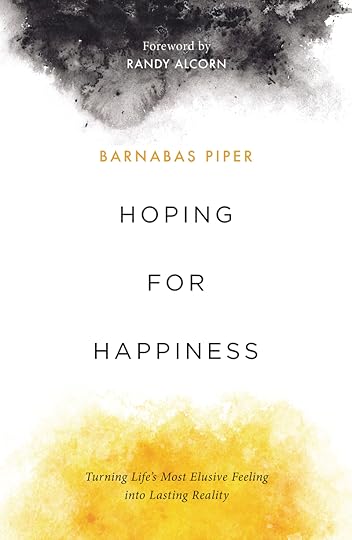 Spoiler alert: I loved Hoping for Happiness.
Barnabas Piper hooked me when he said, “One of the main reasons I wrote this book is because I was tired of wrestling with guilt over having fun and enjoying myself. It seemed strange that God would give so many wonderful gifts only for me to feel guilty for enjoying them.”
I grew up in a home with no knowledge of Jesus or the good news. I was often unhappy, spending night after night listening to music that promised happiness but failed to deliver it. Gazing at the night sky through my telescope, I longed for a connection to the wonders of the universe but couldn’t find it.
When I was in high school, Jesus drew me to himself. Everyone, first my mom, noticed the change. The most obvious difference? I became much happier.
I loved my first-ever church, but it struck me as strange when the pastor said, “God doesn’t want you happy; he wants you holy.” Well, I was holier than I’d ever been, but I was much happier too. Was something wrong with me?
That wonderful pastor often cited Oswald Chambers’ great book My Utmost for His Highest, which I eagerly read. But at the time I didn’t know enough to disagree when Chambers said, “Joy should not be confused with happiness. In fact, it is an insult to Jesus Christ to use the word happiness in connection with Him.”
I certainly didn’t want to insult Jesus by saying he was happy or he made me happy! And I couldn’t for the life of me figure out the difference between joy and happiness. (In fact, they are synonyms for everyone except Christians who’ve been taught otherwise).
After a steady diet of such teaching, I became wary of happiness. Had I seen this book Hoping for Happiness back then, I’d have thought, We shouldn’t hope for what God doesn’t want us to have. I’d never have believed I’d one day write a book titled Does God Want Us to Be Happy? And I would have assumed the answer must be a resounding no!
Like Barnabas, I felt guilty for being happy. The message seemed to be, “You could impress God if you chose a life of miserable holiness.” It took me decades to realize that wasn’t merely a misguided and thoroughly unbiblical idea; it was a lie from the pit of hell. It undermined the “good news of happiness” (Isaiah 52:7, ESV, NASB).
Barnabas writes, “Everyone, whether they believe in God or not, has a deep internal yearning for eternal significance and happiness.” That’s why it’s counterintuitive and counterproductive to pit happiness and holiness against each other. Jesus himself, the most holy human there’s ever been, got invited to parties and was the life of them. (His first miracle was rescuing a wedding celebration that ran out of wine). Children loved him. Had he been stern and unhappy, they wouldn’t have.
Instead of, “Don’t seek happiness,”—a command impossible to obey anyway—why not, “Seek your primary happiness in Jesus, and fully enjoy the derivative happiness in his countless gifts, including family, friends, food, work and play”?
We love and serve one who reveals himself as a “happy God” (1 Timothy 1:11; 6:15). We are to put our hope in “God, who richly provides us with everything to enjoy” (1 Timothy 6:17).
Barnabas calls on us to see God as “a generous Father, who showers you with good things day by day and invites you to enjoy them freely, daily, for your pleasure. “
The years I devoted to researching and writing various books on happiness were life-changing. I discovered Scripture speaks of exactly what I’d experienced: not a flimsy superficial optimism, but a happiness that’s biblically grounded in the rock of Christ’s blood-bought promises. Truth is, the good news should leak into every aspect of our lives, even if we’re not consciously talking about God or witnessing to someone. The “good news of happiness” should permeate our lives with, well, happiness. True holiness is happy-making, and all ultimate happiness is holy-making.
Barnabas couldn’t be more right when he says, “A laughing Christian who relishes good things is a compelling, magnetic Christian—the kind who draws people to truth.”
This echoes what J. C. Ryle wrote 150 years ago:
It is a positive misfortune to Christianity when a Christian cannot smile. A merry heart, and a readiness to take part in all innocent mirth, are gifts of inestimable value. They go far to soften prejudices, to take stumbling blocks out of the way, and to make way for Christ and the gospel.
There is no greater draw to the gospel than happy Christians who are full of grace and truth, quick to laugh and quick to weep for and comfort those who suffer.
My wife Nanci and I have been married 43 years. In the last three, as we have faced her cancer together, we have found a deeper happiness in God and each other than ever before. We have known firsthand the “hopeful, grounded realism” Barnabas writes of. Trusting in Jesus has brought us great happiness in Him, even amidst suffering and the threat of death.
In this delightful book, you’ll see that Barnabas loves Jesus, family, sports, food, fun, God’s creation, and life in general. So do I. We don’t pass our peaks in this life. We don’t even begin to reach them. A New Earth awaits us. I envision Christ’s laugh will be the loudest and longest at all those great feasts ahead of us. But why wait? Why not frontload our eternal happiness into our here and now and give ourselves and others a taste of Heaven?
Hoping for Happiness says, “Hang your happiness on the right hooks, hang your hopes on God’s promises, fear him, and obey his commands—and in this you’ll find happiness, now and forever.”
I know how good this book is. I’ve read it. Now it’s your turn!
This is an excerpt from my book Hoping for Happiness – the foreword by Randy Alcorn. A biblical framework for living a grounded, hopeful, and genuinely happy life, this book gets far beyond the topic of work and helps us to throw off both the unrealistic expectations that end in disappointment and the guilty sense that Christians are not meant to have fun.


