E.J. Russell's Blog, page 9
September 28, 2015
Lost in Geeklandia Release Day
Home
Books
Blog
Lighten Up
About
Contact
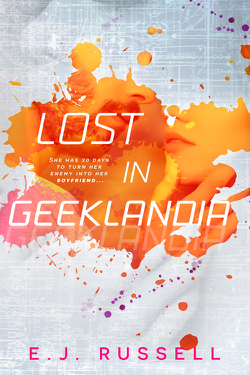 I’m thrilled to announce that Lost in Geeklandia releases today! The heroine, Charlie Forrester, is a data scientist, more comfortable with technology than people, and while I was writing the story, I couldn’t help but think about my own conversion from computer-phobic to computer-dependent – and what a long, strange trip it’s been.
When I was a junior in high school, our algebra class had a computer in it. A. Computer. As in one and only one. I don’t remember a lot about it – it was the approximate size of a dishwasher, had no monitor, and was programmed via punch cards – but I remember I was completely intimidated by it and did my best to avoid having anything to do with it.
For the next ten years, I rarely interacted with anything more advanced than an IBM Selectric typewriter, but then, in graduate school, I learned to use version 1.0 of the Lotus 1-2-3 spreadsheet program on a Compaq “portable” computer (weight just under thirty pounds). The screen was barely larger than one of my dad’s oscilloscopes, but compared to bookkeeping by hand on green ledger paper? Heaven.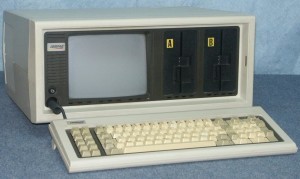
We needn’t dwell on the next thirty years, through more than half a dozen versions of Windows and two sizes of floppy disk drives, as machines shrunk in size and grew in power, but here I am now, with my Macbook Air and iPhone, a total digital convert.
Regardless of the fact that I’m an information technology professional in my day job, computers will always be a second language to me. On the other hand, my daughter, like Charlie, is a digital native. I watch her thumbs fly over iPhone screen faster than I can touch-type on my laptop keyboard. If a question comes up about anything – what restaurant has the best tapas, which movies a particular actor appeared in, where she can find her next workout class – she has the answer almost before the question is asked.
 Although she might not realize it – or at least not express it in so many words – her life is totally data-driven.
Charlie would be so proud. (And so am I.)
Follow E.J


August 31, 2015
Lost in Geeklandia Cover Reveal
Lost in Geeklandia cover reveal!
I’m thrilled to share the cover of my upcoming release, Lost in Geeklandia, available September 28th from Entangled Publishing!
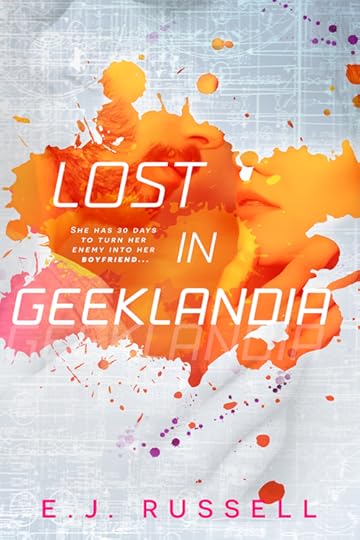
Introverted computer engineer Charlie Forrester has coded an algorithm for love, a nearly flawless matchmaking program. But then she’s challenged to prove its accuracy – on herself. With her dream job on the line, Charlie has thirty days to forge a romantic relationship with her “perfect” match…her ex-friend and now-nemesis, Daniel Shawn. And when fake romance crosses into real chemistry, Charlie’s formula for love might just be the perfect formula for disaster…
July 31, 2015
GRNW
9/26/2015 – Gay Romance Northwest Meet-up
On September 26, 2015, I’ll be attending the third annual Gay Romance Northwest Meet-up at the Seattle Public Library. GRNW is the LGBTQ romance fiction conference in the Pacific Northwest, and is always great fun. There’ll be lots of wonderful PNW authors on hand, as well as some from further afield (including one of my favorites, Jordan Castillo Price). This year’s after party is the performance event Banned! Books in Drag, hosted by the library. If you’re in the Seattle area, put GRNW on your calendar. It’s always a hoot and a half.
–E.J.
August 25, 2014
Blue Balls in the Bookstore
Home
Books
Blog
Lighten Up
About
Contact
One of my good friends – I’ll call him Roger, since that’s his name — is a visual artist and musician. We met when we worked in the same bookstore, back in the day when I was in the process of getting my B.A. in theater.
So a musician/artist and an actor-in-training in a store full of books. What do we talk about?
Blue balls.
No, not that kind. Let me explain.
We were having a discussion **cough** argument **cough** one day about how we visualized things. Roger contended that if he said something like “blue ball” that I would form a mental image of a round blue object – a blue ball.
I said no. I got the image of the words “blue ball.”
He insisted that I must visualize the ball itself.
I countered that I did not.
“Yes you do.”
“No I don’t.”
“Yes you do”
“NO. I DON’T.”
Did I mention he was a close friend?

blue ball
Years later, I took a class on learning styles for writers, and lo and behold, I discovered that we were both right.
The class was based around the work of Dr. Dawna Markova, particularly her books How Your Child is Smart and Open Mind.
AKV
AVK
VAK
VKA
KAV
KVA
In her theories of learning and intelligence patterns, she references the three primary symbolic languages of the brain (visual, auditory, and kinesthetic), which trigger one of three different “thinking states” – conscious, subconscious, and unconscious. Each of us is comfortable with one particular pattern of visual (V), auditory (A), and kinesthetic (K) as they naturally align in our three states of consciousness.
For instance, if you’ve got a K in your “conscious” channel – your “input” channel — you learn most easily by doing; if A, by listening; if V, by reading or watching. Your “unconscious” channel is how ideas are generated: for a K, by movement; for A, by sound; for V, by visions. Your “subconscious” channel is the bridge between the two: for K, movement bridges the outer world and the inner; for A, words are the bridge, and for V, it’s vision.
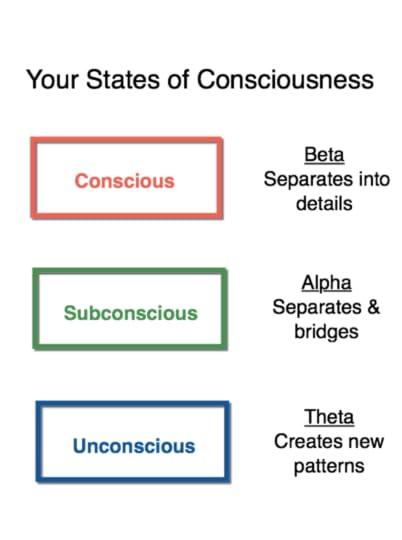
For Roger and me, the way our brains related external input (“blue ball”) to our inner world (what was triggered in our minds by the input) was completely different. I suspect my subconscious channel is A – words are my bridge. For Roger, obviously it’s V.
(Odd that we never actually killed each other, despite the prevalence of box knives in the back room of the bookstore.)
As writers, knowing our learning style can be useful because it can give us insight on why certain writing processes work for us and others don’t. For instance, many writers listen to music while they write, even develop playlists for their current WIP. For me, this way lies madness. I can’t listen to anything other than crickets while I’m writing because it disrupts my train of thought – it burns my subconscious “A” bridge, if you will. This doesn’t mean that playlists aren’t a perfectly reasonable and necessary method for some writers, but it doesn’t mean that my desire for quiet is invalid either.
It’s not only how we write that’s affected by our learning style, but likely what we write – or at least what we write most easily — as well. Here, Patricia C. Wrede (author of two of my favorite fantasy books, The Raven Ring and Sorcery and Cecilia) talks about how one writer might prefer crafting a sentence that sounds perfect in her head, another might get lost in evoking feelings or sensations, while a third might be all about directing a “mental movie” on the page. She takes the paradigm a step further and urges us to consider our readers’ learning styles as well, and be certain we’re delivering something that appeals to all three styles.
So come on. Blue ball. What springs to your mind?
This post originally appeared at See Jane Publish.
Follow E.J
July 24, 2014
Controlling the Knee-Jerk Response
Home
Books
Blog
Lighten Up
About
Contact
Some years ago, my Curmudgeonly Husband got hit up by a very earnest telemarketer. Now, in my opinion, CH has a skewed reaction to telemarketers. While my inclination is to say “Please take me off your call list” and hang up, CH is just as likely to engage them in some kind of bizarre role-playing conversation. In this instance, however, the caller was representing a construction supply company that carried products CH was actually interested in.
CH asked the caller about a specific product he’d been unable to locate. The telemarketer, obviously new to his job, had to struggle to find out if he had the right thing in the catalog. The product he found didn’t fit CH’s needs, so CH said, “No. I’m sorry, that’s not going to work.”
The telemarketer’s response? “Yeah? Well f**k you!”
(Clearly this guy needed a few hints about how to handle rejection, a little remedial customer service training, and perhaps some serious anger management therapy.)
It’s very difficult to separate your work – whether it’s promoting a creative product like a book or selling a line of construction supplies – from yourself. When someone doesn’t like your book, they’re not saying they don’t like you, despite how connected you might feel to what you’ve written. If everyone liked the same kind of book or movie or TV show, we’d only have one kind of book and movie and TV show. (Well, some critics, bemoaning the lack of originality in movies, may say that we already do, but that’s another argument.)

For instance, once I became a voracious reader of romance, I became addicted to the hero’s point-of-view. Consequently, I no longer read books in first person POV. Not because those books are bad, or because thousands of other people don’t like them, but because my reading time is limited, and I’d rather read those stories that have the qualities that I prefer. Likewise, I find present tense extremely off-putting, so I won’t read books written in present tense. (Yeah, that makes me one of the only people in the world who hasn’t read The Hunger Games, but I just can’t get past the first page.)
We need to face the fact that tastes differ. Not everyone likes broccoli. Not everyone likes Tom Cruise movies (um…that would be me). Not everyone will like what you write.
You can’t control what other people think of your work because people’s opinions are subjective – that’s why they’re called opinions and not facts. But you can control your own work. Hone your craft. Write the best book you can.
Some people may not like it, and that’s okay — even expected — so try not to take it personally.
And whatever you do, no matter how you might be tempted, restrain yourself from saying “F**k you.”
This post originally appeared at See Jane Publish when the Janes tackled the subject of how to deal with rejection.
Follow E.J
June 23, 2014
The Right Man for the Job
Home
Books
Blog
Lighten Up
About
Contact
I think our internal romantic preference may be permanently set at the dawn of our adult hormonal lives – in that dim, dark, scary pre-teen place where we transition from total child to official angst-ridden teenager. That’s right. I’m talking middle school, or as we called it back in my day, junior high.
Those were the days when my friends crushed on the latest pop star or celebrity. Bobby Sherman and Davy Jones, simultaneously actors and singers, were popular cross-over hits for a lot of my friends. (Yep. I’m that old.) My tweenager crush?
Mr. Spock.
Not the totally awesome Leonard Nimoy. Mr. Spock. Star Trek TOS debuted the week I started sixth grade and I was totally hooked. Pugnacious alpha Captain Kirk, in his serial shirtless glory, cavorting with alien babes at the drop of the Prime Directive, was never even in the race. Mr. Spock, though, was a guy who knew how to solve problems in ways that didn’t involve mutual concussions, the risk of interspecies STDs, and a prolonged stay in sick bay.
I tell you, I learned how to play chess for Mr. Spock, it was that serious.
Fast forward to the mid-eighties, when I discovered Georgette Heyer’s Regency romances. Heyer was notorious for writing Regency alphas (aka “rakes”) – what she called her Mark I hero. She had some Mark II guys as well – they had a stronger altruistic backbone and less womanizing, but still embodied the Regency masculine ideal, either through military service, excellence in sporting pursuits, or responsibility for the management of their estates.
But she only wrote one Freddy Standen, the hero of Cotillion, and once again, I was in love.
Freddy can’t compare with his Mark I cousin, Jack. He isn’t handsome. He’s not sporting-mad. Although he’ll inherit his father’s title, he has no responsibility for estate management. His entire family consider him to be a fool. Indeed, he says of himself, “Got no brains.”
But he’s a Pink of the Ton. His taste, tailoring, and social address are above reproach, and he has a heart soft enough to allow himself to be talked into a false engagement with the heroine, Kitty, so she can escape her skinflint guardian and enjoy a month in London.
Kitty, who had ulterior motives – and a Mark I fiancé in mind – when she makes her bargain with Freddy, changes her mind about him over the course of the story. She informs Freddy’s incredulous sister that she believes Freddy is the most chivalrous person imaginable.
“I daresay Freddy might not be a great hand at slaying dragons, but you may depend upon it none of those knight-errants would be able to rescue one from a social fix, and you must own, Meg, that one has not the smallest need of a man who can kill dragons!”
Heyer nails it with that statement. The perfect hero is the one who has the tools to help his counterpart – whether heroine or, in the case of M/M romance, co-hero – solve the difficult story problems at hand. Not solve them on his own – because then he’d be a controlling know-it-all jerk – but with the brains to understand the issues and the heart to share the journey.
In spite of the Vulcan mojo, Mr. Spock has a heart the size of the Neutral Zone, and commits it entirely to his missions and his friends. Freddy, in spite of what he believes about himself, has the brains exactly suited to steering naïve Kitty through the complex shoals of Regency London society.
My own Curmudgeonly Husband has recently begun watching past seasons of The Walking Dead. One night at dinner, he looked at me, deadpan, and said, “Don’t worry. If you turn into a zombie, I’ll be sure to shoot you in the head.”
My hero.
This post originally appeared at See Jane Publish in “Who’s Your Hero?” month.
Follow E.J
May 26, 2014
Hooray for Hollywood
Home
Books
Blog
Lighten Up
About
Contact
“To place in the limelight a great number of people who ordinarily would be chambermaids and chauffeurs, and give them unlimited power and instant wealth is bound to produce a lively and diverting result.”
–Anita Loos, A Girl Like I
Several months ago, my publisher, Entangled, put out a call for submissions for an anthology of historical novellas. I’m a sucker for special calls, but I normally stick to contemporary. It made me wonder, however – if I were to write a historical romance, what era would hold my interest long enough to do the required research?
Only one came to mind – Hollywood in the days of silent films.
At first, my thought was to get enough context to frame a story, but I became so fascinated by the milieu that, at one point, I had a dozen library books stacked next to my laptop, and ended up purchasing at least that many to keep.
So many incredible stories, made all the more compelling because so few of these films remain.
 I was able to watch several online, including King Vidor’s Show People, which, like the later Singin’ in the Rain, is a movie about the movies. Marion Davies and William Haines star in the classic “a star is born” story. It includes cameos by a number of well-known actors of the day, including one scene where Marion Davies’ character, Peggy, makes a disgusted face over seeing an actress arrive on the lot. The actress who provokes her scorn? Marion Davies.
The two leads in this film are interesting footnotes in themselves. Marion Davies had a successful career that spanned two decades and over fifty films. However, her most famous part was her real-life role as William Randolph Hearst’s mistress, and she’s remembered more because of the caricature of her Orson Wells contrived in Citizen Kane than for her own work, much of which is lost.
William Haines was notorious in another way. In the late twenties, he was the top male box office draw at MGM. However, Haines clashed overtly with Louis B. Mayer because Haines was gay and lived openly with his boyfriend, Jimmy Shields. His refusal to break with Jimmy (with whom he remained until his death in the 1970s) resulted in the decline of his film career and his eventual departure from MGM.
Here are a few other tidbits:
While Hollywood was a haven for motion picture production because of its clement weather and varied geographical locations, one of its chief attractions to independent filmmakers was its distance from New Jersey and the Wizard of Menlo Park, Thomas Edison. Edison’s trust held the patent on the motion picture camera and strictly controlled the licenses in the east. Filmmakers who tried to bypass the license were the target of officials who occasionally arrived with guns blazing – although they shot the cameras, not the operators.

Many of the successful early scenario writers were women, among them Anita Loos, the author of Gentlemen Prefer Blondes. When she sold her first scenario (to D.W. Griffith at Biograph), she was twelve years old.
By 1920, ads for photoplay training outstripped those for acting, with such hooks as “Millions of People Can Write Stories and Photoplays and Don’t Know It!” and promising “No physical exertion required” and “Learn in five days’ time.” Unfortunately, too many of those people gave it a try and inundated the studios with amateur scripts.
For the film Sparrows, Mary Pickford, holding a squirming child, was directed to walk across a narrow plank over a pool infested with alarmingly active alligators. We’re talking real alligators and a real child. Pickford, worried about the child, demanded a rehearsal using a weighted doll. She’d made six trips across before her husband, Douglas Fairbanks, arrived in righteous pissed-offedness, and ordered the director to use a double-exposure camera effect instead.
This post originally appeared at See Jane Publish, when our topic of the month was research.
Follow E.J
April 28, 2014
HEA — My Drug of Choice
Home
Books
Blog
Lighten Up
About
Contact
The first romance I ever read was a gothic – Menfreya in the Morning by Victoria Holt. I was in 8th grade, and didn’t realize at the time that gothic romance was a genre. I just thought Victoria Holt was awesome, and read all of her books that I could get my hands on.
I didn’t read the quintessential romance, Pride and Prejudice, until after I graduated from college, and then almost by accident – I was visiting my cousin in Indianapolis and pulled the Holy Grail of Romance off her bookshelf because I had nothing to do while she was at work other than read (and try to keep the crazy landlady from soaking the inside of the apartment when she hosed down her aluminum siding every day). Again, no clue about the genre. I just thought Austen was fabulous and read all her books.
 Ditto Georgette Heyer.
At that time – pre-Kindle, and heck, pre-Amazon – I spent most of my reading hours switching between science fiction, fantasy, and mystery, until I got a Regency hankering and re-read P & P and the entire Heyer Regency oeuvre in alternating waves.
I should have gotten a glimmer of a clue, however — even then, regardless of what point I was at in my Circle of Literary Life, the stories that got the most re-read traction always had a romantic subplot or at the very least romantic elements. My craving for the HEA dopamine hit had already begun, and like any addict, I wanted my fix.
Then came Kindle and free books and Suzanne Brockmann. Loretta Chase. Cathryn Cade sent me to Amy Lane, Damon Suede,
March 24, 2014
Free: Not Necessarily a Good Price
Home
Books
Blog
Lighten Up
About
Contact
As a dyed-in-the-CPU geek, I’ve attended beaucoup technical conferences and I can tell you nothing fires up your average nerdy type like free stuff. We stampede the vendor hall to scavenge the giveaways. T-shirts. Water bottles. Tote bags. Orange rubber duckies.
I’ll always grab a XXL t-shirt for Curmudgeonly Husband. I’ll score a water bottle for Lovely Daughter to cart to her daily gym sessions (she just joined a Muay Thai gym…be afraid).
But the problem with most of that stuff? It’s not technical. The most successful swag, in my opinion, is something a tech person would actually use. A USB flash drive (even a piddly 1GB model…pish) beats out a water bottle by a mile. Free software body-slams the Tyvek tote bag every day and twice on Sunday. And as for the t-shirts…well, never mind. No self-respecting geek would ever turn down a free t-shirt.
The point is that swag runs the very real risk of heading directly to landfill if it isn’t a value-add, and it won’t serve its promotional purpose unless the voracious swag consumer actually holds onto the freebie and – dare I suggest it – uses the dang thing.
That’s the problem I have trying to come up with reasonable author swag. My books (current and forthcoming) are e-books. What the hell use is a bookmark when you read on a Kindle or Nook or iPad? It serves no purpose. It adds no value. Unless you are far more organized than I and keep a scrapbook filled with bookmarks and postcards and book cover facsimiles, that stuff goes straight into recycling. Why bother?
But when I attended the Portland Gay Romance Northwest meet-up in January and had the opportunity to chat with the awesome Devon Rhodes, a prolific author of gay romance, she showed me a piece of multi-author swag that actually has a life-after-conference.
 Devon attended the first GRL (Gay Rom Lit Retreat) in 2011. At the author signing event there, authors who wished to participate brought along a bead that they’d selected to represent themselves. Conference attendees could chat with their favorite authors and receive a bead to string onto a leather cord. After the conference, Devon prettied hers up with a higher-end cord, added a clasp, and made herself a terrific charm bracelet, something she wears frequently. And every time she does? She remembers those other authors and the good time they had at GRL.
Now that’s a value-add. Damn. Wish I’d thought of it.
This post originally appeared at See Jane Publish. Our topic? The ever-popular, ever-horrifying, and ever-mysterious world of author marketing.
Follow E.J
February 24, 2014
Foreplay and Afterglow
Home
Books
Blog
Lighten Up
About
Contact
One of my favorite love scenes ever isn’t in a romance novel.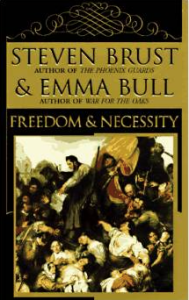
In 1997, Steven Brust and Emma Bull co-wrote Freedom & Necessity, a massive epistolary novel set in 1849 that puzzled me greatly because I expected a fantasy (Brust and Bull write some of the best out there – Bull’s War for the Oaks remains one of my favorite books of all time).
I kept waiting for the magic to occur, but it didn’t — at least not in the hocus-pocus sense. That first love scene between James and Susan though? Now that was magical — unbelievably sensual and touching and gently amusing. It also surprised the hell out of me, set down as it is amidst all the philosophy and political intrigue and convoluted family drama.
The way in which these two people make love – transitioning from friends to lovers in a beautifully evocative ten-page scene — is entirely in keeping with who they are. They don’t check their personalities at the bedroom door. The foreplay – the afterglow – those are the things that make the experience unique to those characters and that’s what I love.
When I read a love scene in a book – whether it’s technically a romance or not – I want to know what makes this event important to the lovers, special to them, crucial for them. Why this man (or this woman), and why now? How does this woman’s (or this man’s) personality, background, and occupation, color the way she or he approaches sex? When it comes (as it were) right down to it, there are only so many ways two bodies can fit together, regardless of the relative genders of the partners. What matters is how these two people feel, and how each of them makes the other feel.
Because the only way I’ll enjoy the scene is if the characters are having a rocking good time as well.
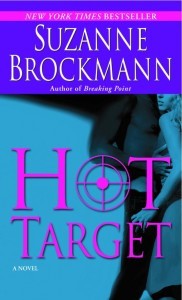 Suzanne Brockmann’s Hot Target has another of my favorite “first time” scenes. Although the book gets a lot of (well-deserved) notice because it contains the first meeting of her popular gay couple, Jules and Robin (plus a lovely dedication to her son, Jason), the central couple, Jane and Cosmo, may be my favorite Brockmann duo. The first time they make love is so damned fun for me as the reader because it’s so much fun for the characters – not because of the way in which the genitalia fit together, but because both of them are absolutely true to the nature Brockmann has established for them.
Jane — scurrying around, setting the stage – and herself – for the seduction as she would dress a scene in one of her movies, defusing her own nerves with her trademark wisecracks. Cosmo — focused on Jane, wanting Jane, but determined to delay his own gratification if there’s a chance he might hurt her. The actual consummation is almost incidental.
Oh, yeah.
Even though I’m notorious in my family for being a product person, love scenes are one place where I insist on process.
That’s what makes it good for me.
This post originally appeared at See Jane Publish. It was February, month of the valentine, and we were all about the love. Love scenes, that is. What makes a love scene memorable? For me, it’s all about the process. I revisited two of my favorite scenes and fell in love with them all over again.
Follow E.J