Katherine Pathak's Blog, page 19
October 12, 2013
SHOULD NOVELS EXIST IN REAL TIME?
When starting my first book, this was one of the most challenging questions I needed to address.
I knew that my storyline was going to move forwards and backwards in time- linking together events from different periods, but I wanted my narrative to be firmly based in the present day.
So, to achieve this shift in timescales, I divided my book into different sections- providing the reader with the date in which each part was set. However, the majority of the novel was written in the first person- from the perspective of my main protagonist. This may sound unnecessarily complicated, but as writers this can be one of the most tricky aspects to get right. You can often find yourself slipping into the wrong tense if you are not clear from the beginning about the where your novel fits within time itself.
For example, many of the most celebrated novelists use the passage of time as a key feature of their story. Take David Nichols’ novel ‘One Day’, which followed the main characters on the same day each year for two decades and it worked brilliantly. It allowed Nichols to explore the social and political changes over those twenty years and to develop his characters accordingly. It had an immediate appeal to those readers- like myself, who had lived through those very same changes. It helped to create an empathy and connection with the protagonists which made the reader really care about what happened to them.
Some authors, on the other hand, like to make their novels almost ‘timeless’. Their main characters stay much the same despite the passage of the years. I am thinking here of Inspector Wexford or Adam Dalgleish who first appeared in mystery novels back in the 1960s but who are still sleuthing, little changed by the ravages of time, to this very day.
Both techniques can work equally well and, as in the case of Wexford, for instance, the world around him does alter with the passage of the years even if he, as a character, does not.
Sometimes it is childrens’ books which deal with the enigma of time the best. the concept of time-travel has been often explored in fiction aimed at the young. Children have a particular fascination with time, I think, as it suggests the promise of new worlds and new possibilities that appear to offer a tantalising taste of freedom that can so often be missing from their own ordered and restricted lives.
The only dilemma that exists if your main characters are young is whether or not they should age from one book to another. This was handled extremely well in the Harry Potter books when J.K Rowling could easily have kept her protagonists forever youthful.
Many books aimed at children deliberately utilize the concept of growth and development so that their characters can age alongside their young readers, giving them a sense that they are not alone in having to face the challenges of reaching each new milestone in life. My daughter particularly likes Jeff Kinney’s ‘Wimpy Kid’ series for that very reason.
Whatever decision you make about your novels’ place in time, it is important to get it straight in your mind before you begin to write and then stick with it throughout the novel. I chose to add dates to the three sections of my first book, in order to help my readers to easily follow what was quite a complex plot. However, with my second novel I have decided not to do this, as I was concerned that adding specific years to the book might, paradoxically, have the result of ‘dating’ the piece. When, for all of us writers, the elusive prize is to create a book that is literally ‘timeless’ and can be read in decades to come, but will still feel totally relevant and contemporary to the reader.


October 5, 2013
BLENDING FACT WITH FICTION

There has long been a tradition in literature of combining the real with the imagined. In fact, as anyone who dabbles in creative writing will tell you, it is quite impossible not to do so. Only if you are creating an entirely new universe where you wish to challenge perceived ideas about everyday life might you avoid having to blend truth and fiction. There is a definite precedence for this within the Sci Fi genre, however, even then, authors will find that they still have to use some elements of the familiar, otherwise their readers will not be able to empathise with these newly imagined worlds.
When writing my first novel, ‘Aoife’s Chariot’, I decided to create a fictional Scottish Island called Garansay which would exist alongside real places. The island is based on the Isle of Arran where my father grew up but there are certain mountain ranges and features that I have added to my island which are entirely ‘made-up’. I am not the first person to do this, of course. In fact, when you think about it there are plenty of locations which exist only in the literary universe: Kingsmarkham, for instance or St Mary Mead. Even 221 Baker Street in London; where the current residents still receive bags full of letters every day addressed to the erstwhile Sherlock Holmes.
So why do writers choose to base their stories in these imaginary places? Why not use real cities, towns and villages in their novels? Well, some authors certainly do. Ian Rankin has made a unique selling point of his use of Edinburgh in the Rebus series. Just as Denise Mina has used Glasgow as the backdrop to hers; the list is endless. I can only speak for myself in explaining why I chose to make the foci of my novels fictional. For me it offered greater scope for plot development. I was able to form a landscape that fitted perfectly with my storyline rather than having to adjust my tale to fit into a real place. Readers get, quite rightly, rather upset if you mess around with the towns and cities that they know and love, so why not avoid the controversy by making up your own?
Another driving force for me was that I had spent over a decade as a History teacher- having to get every date and detail correct. I found it absolutely liberating to write books where I could make it all up! Although I cannot resist adding historical context to my books and I certainly need this to be completely accurate- my background would demand no less!
This addition of historical elements is where my books ‘blend’ or ‘mix’ together the real and the imagined and, if done well, it can make the factual elements of any novel come alive for the reader. I remember a wonderful History teacher of mine recommending Ellis Peters’ ‘Cadfael’ books as they painted a very clear and historically detailed picture of medieval England. It was a great recommendation and I have loved those books ever since.
Whatever genre of fiction you write in, you will find yourself having to integrate real life events and places into your narrative and, as long as it is credible to your reader, allow your imagination to run free!


September 29, 2013
THE TWIST IN THE TALE?
The absolute keystone to a great piece of mystery fiction is the surprise twist at the end. Sometimes this ‘about face’ in the plot can take place somewhere in the middle of the narrative and then it can mark a neat shift in the direction of the story.
When I am setting out to write my novels, the ‘shock’ ending is one of the first elements of the plot that I plan. Then the whole novel can work up to this surprise conclusion. As a writer, you must ensure that you have placed enough clues along the way so that it is at least possible for your readers to guess what is going to happen, but you want it to be very difficult for them to do so. You do not want to deny them your deliciously unexpected resolution. You can always lay some alternative plot lines that you can then resolve at various points in the story- but always leave the best until last.
So why do readers and viewers enjoy the surprise denouement so much? I believe that it is human nature to want to solve puzzles and that is why mystery and detective fiction is so popular. Also, we feel cheated if the solution is perceived to be too easy. We are intelligent beings and we like a good challenge.
So which writers create the best conundrums? As you will know by now, I enjoy Ruth Rendell’s psychological chillers which always have a fantastic twist in the tale- ‘The Chimney Sweeper’s Boy’ and ‘The Blood Doctor’ written under her pseudonym of Barbara Vine are two of my very favourite. I would not dream of spoiling their endings here! The novelist Evelyn Waugh was once attributed the dubious honour of having written ‘the most shocking lines in fiction’ in his 1930s book ‘A Handful of Dust’ again I would not wish to ruin it for any of you as it is a great read and these lines do not appear at the end of the narrative but somewhere in the middle which adds to the interest I think.
Many literary cliché’s have been associated with the classic fictional ‘twist’. For example, the discovery that one of the characters is actually an identical twin, or of babies having been switched at birth are two historically popular literary devices. Another technique that can produce a shock ending is the notion of men dressed up as women and vice-versa, an idea used by writers for hundreds of years. Shakespeare was even at it!
Cliché or not, if the zig-zags of your plot line are well-written and have enough intricate clues and the occasional red herring then they will satisfy your reader. However, beware of succumbing to the totally unbelievable and implausible ending. You will recognise what I mean here, this is a resolution that appears to have been parachuted in from absolutely nowhere. Your readers will be disappointed and feel cheated by this- you have to stay true to the characters you have created and if your book has realistic themes then your conclusion must be realistic too.
Interesting and shocking things occur in real-life all the time so you don’t need to resort to alien invasions or meteors falling out of the sky!
A well- constructed ‘twist in the tale’ can make a good novel truly great- so best of luck!


September 26, 2013
MY TOP 5 FEMALE DETECTIVES IN FICTION
When trying to decide upon my favourite of all fictional detectives I was struck by the realisation that, after the most obvious candidates, there are actually fewer female ‘lead’ detectives in mystery fiction than I had at first imagined. Of course, we all think of Agatha Christie’s Miss Marple and perhaps Josephine Tey’s Miss Pym- who are both classic creations that withstand the test of time. However, my other favourite women sleuths tend to have originated on the small screen; such as Sarah Lund and Jane Tennison- although they remain masterfully penned personalities nonetheless. I also then considered some of my favourite detective writers and their characters. For example, P.D James and Ruth Rendell, who have both certainly created strong female sleuths in their many books are yet best known for their male leads- Adam Dalgleish and Chief Inspector Wexford. I must admit myself that I prefer the Dalgleish novels to those that feature Cordelia Gray, for instance. So this article was more of a challenge to write than I had at first thought, particularly when one considers that the traits we would traditionally apply to female characters seem to fit very well with the role of investigator. For example, we expect our fictional women to be intuitive and interested in people and what makes them tick. Yet male detectives still dominate the genre and even the great female mystery solvers- as you will note in my list below- operate as a ‘side-kick’ to a man. I have tried in my novels to make my female lead (Imogen Croft) the chief character in the book, although her husband does work alongside her and they solve cases as a team. But perhaps I have been influenced by my favourite lady detectives a little too much and have not been bold enough to allow Imogen to sleuth on her own- without a male counterpart. However, I do like the interplay between a husband and wife team of investigators and I enjoy the relationship that this creates (see numbers 3 and 5 of my list). In the end, your all time favourite lady detective is a very personal decision, but here is my top five- feel free to heartily disagree!
1. Jane Marple. (created by Dame Agatha Christie)
An amateur sleuth who needs little introduction. A completely unassuming old lady who possesses razer sharp intelligence. These mysteries are set predominantly in post-war Britain and Marple draws on her experience of the microcosm of human behaviour that she observes in the village of St Mary Mead to solve murder cases that have the police baffled. A creation of pure genius.
2. Nancy Drew. (first created in 1930 by Edward Stratermayer but more recently recognisable in the novels of Carolyn Keene)
The first ‘girl detective’, these novels and stories are a personal favourite of mine. Nancy is feisty and intelligent and has a wonderful group of girlfriends who all have something different to add to the investigation. I read these books from a very young age and spent a great deal of time searching for the next title in the series at my local library. Pure gold.
3. Harriet Vane. (Dorothy L. Sayers)
Harriet Vane appears in the Lord Peter Wimsey novels and in later books she becomes his wife. Although she is not the lead character in Sayers’ mystery stories she plays a pivotal role in the investigations. It takes an extremely strong and intelligent woman to ensnare the highly intellectual, confirmed bachelor Lord Peter and only Vane could do it.
4. Kay Scarpetta (Patricia Cornwell).
Dr Scarpetta is a Chief Medical Examiner who also solves crimes. She is an Italian American who makes great pasta as well as being a tough career woman and unmistakably the main character in this superlative series of books. Kay’s character changes and evolves over time but she never plays second fiddle to a man- something that perhaps American writers achieve better than us British do?
5. Tuppence Beresford (Agatha Christie)
Another Christie character, Tuppence solves mysteries alongside her husband, Tommy. This husband and wife team are very much equals and are touchingly supportive of eachother. This equality is interesting when you consider that these novels first appeared in the 1920s. I had to add Tuppence to my list as these novels were an inspiration for my fictional husband and wife sleuthers- Imogen and Hugh Croft.
That is my list- obviously there are plenty of great women sleuths that I have not mentioned here- so feel free to add some of your own.


September 21, 2013
Beginner’s Guide to Self-Publishing Part 3

Is this lady your target reader? If so- how do you reach her?
Once you have thoroughly exhausted the ways in which you can lure your nearest and dearest into reading and (hopefully) reviewing your book, you now need to consider how to reach a ‘wider’ audience.
The first thing that you must decide upon is your ‘target audience’. It might be a cliched marketing phrase, but it is actually pretty crucial. For example, I spent a bit of time, and a little bit of money in advertising on Twitter. Unfortunately, it got me no extra sales- why? Because that is not where the target audience for my novel is looking- I can’t reach them there and knowing this will save me time and money in the future.
So, what worked best for me? Without a doubt, sending out press releases to the local and national media has worked best for my book. Try to find an angle to use in your pitch. For example, my novel was inspired by my father’s childhood on a Scottish island, so this was the story that I wrote. Try to target newspapers and magazines that reflect the themes of your novel e.g History, hobbies/craft or cooking. Have a browse through the shelves of your local newsagent to get some ideas and jot down the name of the editor- so that you can write an accompanying e-mail and address it straight to them.
Try to engage with your readership face-to-face as much as possible- you want to develop a personal relationship with your readers and they will give you valuable advice about what works in your book and what doesn’t. You can use social media to achieve this, but also get out to local bookshops and ask if you can organise an evening event. You can even try local schools- particularly if you have written a children’s book or a fact book- school librarians are often very keen to take part in ‘outreach’ events.
There are lots of classes available that teach you how to use social media to promote your products, so you don’t need me to tell you any of that. All I can impart are my personal experiences. My main advice is to start local and take it from there; cards in the local shop window can work well if they are nicely designed and tie into a local event.
Don’t try to be too big too quick- it takes time to build up your readership- get them involved in your characters and start to write them more and more books- they will reward you for your hard work in the end!!


September 18, 2013
Can you have a great mystery novel without ‘blood’ and ‘guts’?

I certainly think so, although recently I’ve found it more difficult to find them. The real masters of the genre have never used graphic violence to ‘spice up’ their plots. Agatha Christie, P.D James, Ruth Rendell (writing also as Barbara Vine), Josephine Tey and Susan Hill can create genuine chills through their suspenseful prose, interwoven with just the hint of the worst crimes that mankind (and womankind) are capable of. These great writers avoid stomach churning descriptions of blood and guts but rely instead on very clever storytelling and well observed characterisation. However, now that we expect a certain amount of gore in our T.V dramas and mystery fiction, is it possible to write a top novel in this field without it? Or will we now need to create a whole new genre of fiction for this type of narrative? It’s a large field and I hope there’s room for everyone’s tastes within it- I certainly enjoy a good ‘serial-killer chiller’ myself, but my favourites are those books that tease me along with a labyrinthine plot and a final conclusion that actually seems plausible to me because I feel that I understand the motives of the main characters. I don’t like an ending that just parachutes in from nowhere and makes me feel dissatisfied and cheated. Any suggestions on great writers; new and old who manage to achieve this would be gratefully received.


September 15, 2013
Beginner’s Guide to Self-Publishing: Part Two
Get Creative…
The very best thing about publishing your own novel is that YOU get to decide how it looks and what will go inside it. Once you have a fabulous front cover and a well proofed book- you have some choices to make.
One of your biggest decisions is whether or not you will simply go down the print-on-demand (POD) and downloads route or whether you will invest in having your own private print run.
This is entirely your own decision and depends on your budget and your marketing strategy.
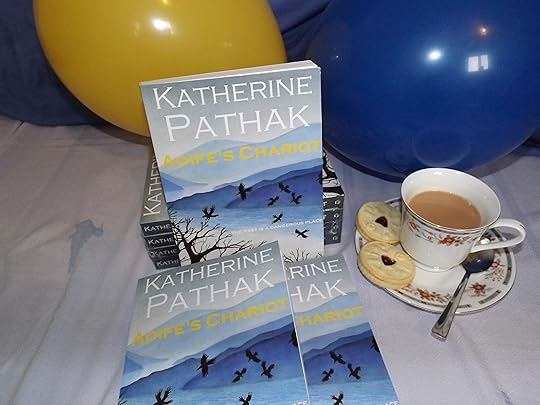
In my case, I am really glad that I decided to have a limited print run of 100 books because the quality was superb and I have used them for launch parties and book signings- people like to see a physical copy of your novel and have a flick through it.
I had a couple of afternoon tea and scones launch parties and they were great. It rewards your core readership- especially those who have taken the time to review your book. It also allows people to buy signed copies for their families and friends.
Try to be creative with your parties- a theme, like scones and cream or blue or pink coloured cakes is good and try to stick to the colour theme of your book’s cover when you are promoting- it helps to build your brand. My kids and I even wore blue for a booksigning, although I’m not sure how much anyone noticed!
Finally, you will need to decided on a price for your promotional copies. Remember, you are not a famous author yet- however brilliant your novel is. The most important thing is that people are reading and talking about your book, so set a price that is reasonable and will make people feel that they got a ‘special deal’ because they were at your event.
Next time: tips on marketing beyond your immediate family and friends.