
Vivek Kaul's Blog, page 15
August 16, 2020
MS Dhoni — Where Will I Get That Adrenaline Rush Again?
Read moreMS Dhoni — Where Will I Get That Adrenaline Rush Again?


August 14, 2020
Why income tax is not going to be abolished anytime soon
Read moreWhy income tax is not going to be abolished anytime soon
June 14, 2020
What do higher household financial savings tell us about the economy?
What do higher household financial savings tell us about economy?
Vivek Kaul
The household financial savings, which form a bulk of the overall savings in the Indian economy, went up in 2019-20. This after they had fallen in 2018-19. The question is how did this happen and what does this mean for the Indian economy in the post-covid world? Mint takes a look.
What was household financial savings rate in 2019-20?
Household financial savings essentially refers to the savings of households in the form of currency, bank deposits, debt securities, mutual funds, insurance, pension funds and investments in small savings schemes. The total of these savings is referred to as gross household financial savings. Once the financial liabilities, that is, loans from banks, non-banking finance companies and housing finance companies, are subtracted from the gross savings, what remains is referred to as net household financial savings. The net household financial savings in 2019-20 rose to 7.7% of the GDP from 7.2% in 2018-19. This primarily happened because the liabilities fell from 3.9% of the GDP in 2018-19 to 2.9% in 2019-20.
What explains this uptick in household financial savings?
The gross financial savings of households in 2019-20 stood at Rs 21.63 lakh crore, marginally better than the gross savings in 2018-19 which was at Rs 21.23 lakh crore. Nevertheless, the net financial savings jumped to Rs 15.62 lakh crore in 2019-20 from Rs 13.73 lakh crore, a year earlier. This was primarily because the financial liabilities reduced from Rs 7.5 lakh crore to Rs 6.01 lakh crore. This pushed up net financial savings. Why did this happen? This happened primarily because the Indian economy has been slowing down from start of 2019. The per capita income in 2019-20 grew by just 6.1% (nominal terms, not adjusted for inflation), the slowest since 2002-03, when it had grown by 6.03%.
How did slow growth in per capita income impact savings?
A double digit growth in per capita income has happened only once since 2013-2014. In 2016-17, the per-capita income grew by 10.39%. Over the last few years, income growth has slowed down, and in 2019-20, it slowed down dramatically to 6.1%. This has led to a slowdown in lending growth. The non-food credit growth of banks in 2019-20 was at 6.7%, the slowest in more than a decade.
What does this tell about the overall state of the economy?
A slowdown in income growth has led to a slowdown in consumption as well as a slowdown in loan growth. What hasn’t helped is the weak financial state of non-banking finance companies, which has added to the lending slowdown. Also, this means that people were looking at their economic future bleakly, even before covid-19 had struck. At an individual level, the good part for them is that they tried to go slow on their borrowing in comparison to the past. But at the societal level, this hurt the economy because it led to a consumption slowdown.
Where will the household financial savings settle in 2020-21?
The period between April and June will lead to higher savings. As a recent RBI research paper states, a spike in household financial savings “is likely in the first quarter of 2020-21 on account of a sharp drop in lockdown induced consumption.” In fact, this explains why bank deposit rates have fallen in the recent past. The money deposited with banks has gone up, while the banks are unable to lend. But this spike in savings is likely to taper in the months to come simply because of “lags in the pickup of economic activity”.
A slightly different version of the piece appeared in the Mint on June 15, 2020.
April 15, 2020
What Happened When Journalist Sonia Dahilya Lost Her Job & Went to Meet Sri Sri Sri Baba Just Dev
[image error](On most days Vivek Kaul makes a living writing on economics and finance. What follows is a figment of his imagination).
Journalist Sonia Dahilya had just got a call from her boss of many years. And she had been fired.
Just like that, her job of 20 years with The Spiritual Express, a weekend supplement of a large selling daily newspaper, had gone in a few seconds.
Not knowing what to do she decided to go visit her guru, Sri Sri Sri Baba Just Dev. Being a journalist who had helped build Baba’s profile over the years, she was able to cut through the queue and go straight to the beginning of the line.
A little birdie told us this is how their conversation went.
“Baba…,” she wailed taking off her mask, as soon as she saw him.
“I know bachcha,” he replied, with Sonia’s boss, who was also a bhakt, having called and given him an advance warning.
“What happened Baba? Why did I lose my job?”
“You know I stopped the Sant Kanti toothpaste ads to The Spiritual Express.”
“But why Baba? You didn’t like the last profile I did of you riding on your new motorbike? We even got a drone shot of you riding the bike through the ghats.”
“No, no, no… That was a lovely profile. Even Basu Judeo Baba called and congratulated me. He even asked, how did I manage to get such plugs done. Pity, he is still building his Fast Moving Consumer Good Business and can’t advertise much. Also, his TV channel doesn’t have the same kind of reach as mine.”
“Then why Baba?”
“Oh, sales of Sant Kanti toothpaste have totally collapsed. No cashflow you see.”
“Why?”
“I don’t know. Maybe people are just staying at home during the lockdown and not brushing their teeth.”
“These men I tell you,” Sonia thought, remembering how her partner of many years had been behaving over the last few weeks.
“But Baba Soulgate continues to advertise,” Sonia said. “And I have to say that toothpaste looks, smells and tastes, so much better.”
“Arre they are foreign MNCs. They have deep pockets,” Baba replied, ignoring the comment on the quality of his product.
“But Baba you also don’t have to pay taxes on your earnings…”
“Ehhh… Let’s not go there. I have other expenses.”
“But Baba, why me?” she asked. “They could have also fired that Aishwariya na… Just sits there all day and keeps promoting your competition.”
“My competition?” Baba Just Dev asked reacting as if this was news to him.
“Arre that Basu Judeo Baba.”
“Oh, that NKOTB…”
“NKOTB?”
“New Kid on the Block. For a journalist, you tend to terribly outdated on the latest lingo.”
“Sorry Baba, I am just stressed. Need to have a grilled Nutella banana sandwich along with an organic strawberry shake made in almond milk, as soon as I get back home and get some sugar into my system.”
“Here’s the thing. I have coined a new slogan for my bhakts.”
“What’s that Baba?”
“Jo karega, zaroori nahi wohi bharega (He who does, will not necessarily be the one who faces the consequences),” in line with the capitalism of our times.
“That’s such a philosophical thing to say Baba. Will be a huge hit with everyone who loses their jobs in the aftermath of covid-19 and is looking to blame someone else for it.”
“You know one does need to constantly keep realigning the value proposition on offer in line with the zeitgeist of the times.”
“Of course, Baba.”
“Which is why I thought let me start with you,” Baba said. “You are one of my original bhakts after all.”
“Thank you, Baba.”
“I am there for you bachcha.”
“Baba, what about my job?” Sonia asked.
“Oh, I have arranged one for you already.”
“I knew, I could count on you Baba.”
“I have spoken to the IT cell. They need an English language editor and could do with some better grammar. They are willing to match your current CTC, with weekends off.”
“Thank you, Baba. I am so thrilled. You know, I had gone to the Amalfi Coast in Italy last year and the EMI for that holiday loan is still on.”
“No, no, I don’t want recovery agents landing up at your door. They can be a nasty bunch. You would know, I had some experience in that line, before I found nirvana.”
“Anything I can do for your Baba?”, Sonia asked, as a matter of courtesy, before taking her leave.
“Oh, yes. I want you to continue ghost writing my columns,” he said. “You just know how to emotionally connect with my bhakts and loosen up their purse strings, like no one else does.”
“Of course, Baba.”
******
Sonia Dahilya took on a job of an editor with the IT cell.
A few days later she was fired with no reason being offered for it. Baba later told her off the record that her good grammar was making their WhatsApp forwards of the IT cell less believable and there had been a huge drop in sharing rates.
******
December 27, 2019
Ranchi is Running to Stand Still
[image error]
January 21, 1994.
Govinda is the reigning kind of the Hindi film industry. His latest film Raja Babu has just arrived.
The first day first show is playing at the Sujata Cinema, the biggest movie theatre in Ranchi, at that point of time. I happen to be there along with a bunch of friends.
It’s around one PM. The house-full crowd is rather subdued. The movie has dragged on for nearly two hours.
And then as often happened in David Dhawan movies, Govinda and Karishma Kapoor, the heroine of the movie, for no rhyme or reason whatsoever, start to dance to a song.
The song on which they are dancing, happens to be sarkaaye leyo khatiya jaada lage, one of the biggest hits of the 1993 and 1994. The crowd at Sujata Cinema is in raptures. There are whistles and catcalls and people are dancing in the aisles. The paisa vasool movement for which many of whom had lined up at eight AM in the morning for an 11AM show, has come.
December 21, 2018.
It’s a cold and a hazy December morning. I happen to be in Ranchi for the 25th anniversary celebrations of the class of 1993 of St. Xavier’s School. Not much is scheduled for the day with the festivities starting only in the late evening. There is time to kill.
Carnival Cinema, one of the many multiplexes to have opened up in the city, since I left it in late 1999, is playing Shah Rukh Khan’s latest release Zero. I walk in and buy a ticket which costs Rs 150. In 1994, a dress circle ticket at Sujata Cinema, cost Rs 11, the most expensive in the city back then. The popcorn cost two bucks more.
SRK in 2018, does everything that Govinda did in 1994, except for singing a double meaning song. He sings. He dances. He tries to woo the heroines. He even goes to Mars. But all this doesn’t impress the audience.
There is no whistling. No catcalls. And no dancing in the isles. All I get to hear is intermittent clapping of the kind the 1994 audience indulged in, when it was bored.
The cinema audience has been gentrified.
*****
In 1999, Ranchi did not have a single multiplex. Now, the big multiplex chains, PVR, Carnival, Fun Cinemas etc., all have presence in the city. The heydays of single screen cinemas is over.
Sujata Cinema (now known as Sujata Picture Palace) is a shadow of its former self. Shree Vishnu Cinema, the one closest to St. Xavier’s College in Ranchi, where I studied, is now a hotel.
It’s at Shree Vishnu Cinema, I realised how big a star Mamata Kulkarni was in the 1990s. When she sang Chudiyan Bajaoongi, Prem Dhun Gaoongi, on the big screen, an entire generation was mesmerised. And then she disappeared from public memory, as if she had never been there.
Sandhya Cinema is now SRS Cinema. Vasundhara Cinema, where Nadiya Ke Paar, the original Hum Aapke Hain Koun, ran for all of 52 weeks, has been broken down and in its place stands a tower.
Capitalism has killed all the places where I built the best memories of my growing up years.
Of course, like any other small city in India, Ranchi had a couple of theatres which only showed adult movies; Mini Sujata and Plaza. While, for an average Indian, roti, kapada aur makaan, still remains an issue, we have no such problems when it comes to cheap bandwidth. Watching porn, which used to be a community activity in a public space, is a very individual activity carried out in the privacy of a home. Ranchi is no different on that front.
*****
I walk out of Carnival Cinema, on to Ranchi’s main road, which is rather imaginatively called, the Main Road (The official name of the road is Mahatma Gandhi road, but try asking for directions using that name).
Right opposite Carnival Cinema stands GEL Church Shopping Complex. Back in the 1990s, this was closest that Ranchi had to a mall. Rather ironically, it was owned by the Church (the Gossner Evangelical Lutheran (GEL) Church to be very precise). It’s here that I was hanging out sometime in 1995 or 1996 perhaps, that I discovered Altaf Raja singing Tum to Thehre Pardesi.
A cassette shop was playing the song in a loop. When I got into the shop to buy the cassette, I was told there was huge demand for the cassette and hence, it was selling at a premium, in black. I paid Rs 25 for a twenty rupee cassette. There’s nothing to be surprised about here, we were still in the 1990s, when, even music cassettes sold in black.
Ranchi had a whole host of cassette shops at that point of time with Chawla Radio being one of the most famous of the lot. Of course, no one buys cassettes or for that matter music anymore. And the record for Tum to Thehre Pardesi being the highest selling non-film Hindi album of all time, still stands. Many of the erstwhile cassette shops have either shutdown or moved on to selling electronic products, everything from TVs to mobile phones. The free market has been at work.
*****
The GEL Church Shopping Complex housed Ranchi’s most famous restaurant Kaveri. I walk into the restaurant and order an American Choupsey and a Paneer Chilli, dishes that I used to feast on, back in the 1990s. The Paneer Chilli is still as divine as it used to be. It will be fair to say, I have eaten better American Choupsey at other places, since then.
While Kaveri is still going strong and even has branches, there are other popular restaurants which have sprung up in the city. A small survey among the locals tells me that the Yellow Sapphire, Breaking Bread, Nirvana and Prana, are quite popular in the city these days.
The other thing that has happened on the food front, is the rise of branded Litti and Chokha stalls, led by the famous Bhola Litti, an eating joint many of my friends swear by. Bhola’s litti is made in ghee and the dough is mixed with curd to soften it. With this, what used to be poor man’s food has been turned into a middle class delight. What do they say about India and jugaad?
Also, Ranchi has proper shopping malls these days, with the Nucleus Mall being the most popular mall of them all.
The city barely had a culture of eating out in the 1990s. Things have changed on this front. The economic growth since 1991 has clearly helped. But more than that Ranchi becoming the capital of the state of Jharkhand in 2000, has played a greater role.
This has had other benefits as well than just people earning more and eating out more often. The roads in the city are much better than they used to be.
I grew up on Kanke Road, the road which ultimately ends in Kanke, where the Central Institute of Psychiatry, Ranchi’s famous mental asylum is located. The road used to be full of potholes and a section of the road was famously referred to as Kharkhardiya Chowk, for the infinite-number of potholes it used to have. All that has disappeared now.
The highway to Patratu, of which Kanke Road is a part, can give any national highway a run for its money on the quality front, and so can the beauty of the drive. The city now also has a ring road to ease the traffic congestions within the city. Old timers say that it used to be possible to move from one end of Ranchi to another in 20-30 minutes. Now it can even take up to two hours. The traffic and the city have both expanded.
The power situation in the city has also improved considerably. The story that one used to here in the 1990s was that the power produced in the power plants of Jharkhand was largely transmitted to north Bihar (now just Bihar). Now the city gets its fair share of power.
The Ranchi I grew up in was constantly facing load shedding. In May 1992, the city saw a 15-day power cut. The power lines from the Patratu Power Plant which supplied power to the city were pulled down due to strong winds and it took more than two weeks for the situation to come back to normal.
*****
I soon see a Café Coffee Day (CCD), in the Capitol Hill building, right opposite where the Ratan Cinema, another single screen theatre, used to be.
A quick Google search tells me Ranchi now has six CCDs. At least, for those who can spend money, dating and hanging out with friends, is now easier. When I was a student of St. Xavier’s College, hanging out meant standing in front of the tea stall outside college, having tea and smoking (for those who did) and watching the world pass by.
Of course, we had ample time back then to waste, with the Ranchi University session running a year late, and a three year graduation taking four years to complete. Ranchi University now largely runs on time. This is yet another benefit of the state of Jharkhand being carved out of Bihar.
Before, the situation started to deteriorate in the mid 1980s, Ranchi was the original Kota, sending many students to the IITs, vis a vis its size. The story goes that in the year 1983, 73 students from St. Xavier’s College made it to the IITs. This was a time, when there were just five IITs. The city was clearly punching above its weight. The IIT baton passed from Xavier’s to DAV Jawahar Vidya Mandir (now just Jawahar Vidya Mandir), with many students from the school regularly qualifying for the IITs, through the 1990s. The trend continues.
*****
I continue walking on Main Road, and see many of Ranchi’s iconic shops, from Ved Textiles to Jevar Jewellers to Frontier Fruitstore to Punjab Sweethouse to Wool House.
They all continue to be in existence. Except for perhaps Frontier Fruitstore, they have all had to slightly rejig their business models over the years to continue to be in existence. Take the example of Wool House. This was the shop women went to buy wool to knit sweaters, as did my mother, my grandmother and my aunt. Of course, no one knits sweaters anymore. So, no one buys wool anymore. Wool House, now sells everything from T-Shirts to sweaters to blankets.
Fine Tailoring, the tailoring shop my father and my maternal grandfather swore by, also continues to be in existence. But along with the old there is the new. Big Bazaar, Shoppers Stop, Manyavar, Pantaloons etc., all have a presence in Ranchi. And that’s another benefit of becoming a state capital. The choice available to people has clearly gone up.
But Ranchi continues to be weak on the industry front, though things seem to be gradually changing. The current chief minister Raghubar Das is betting on making Ranchi a textile hub. Arvind Ltd. has a factory in Ranchi.
Also, Ranchi has a software park (STPI), where business are being established. Having said that the IT industry in Ranchi is at its very nascent stage. This is surprising given that the city has excellent weather and a reasonably good education system in place.
But on the whole, like many other cities of its size, Ranchi remains a city where consumption drives consumption. In that sense, the service sector has expanded in the city over the last two decades, with jobs being created in the banking, insurance and retail sector.
Other than this, Ranchi continues to have offices of public sector companies like Central Coalfields Ltd., Central Mine Planning and Design Ltd., Mecon Ltd., Steel Authority of India Ltd., and Heavy Engineering Corporation (HEC). HEC, which used to be the big PSU operating out of Dhurwa, on the outskirts of Ranchi, has shrunk in size over the years. The turnover of the company was around Rs 683 crore as of 2012-2013. It has since shrunk to Rs 399 crore as of March 2018.
*****
As I keep walking on the Main Road another major change really hits me in the face. The cycle rickshaws have more or less gone and have been replaced by the Chinese e-rickshaws. The rickshaw pullers are rickshaw pullers because they can’t do anything else. And now they can’t even pull rickshaws. I am not being a Luddite here but changing technology does push out a generation or two out of business, something we really can’t do much about.
My walk ends at Firayalals, Ranchi’s most visible landmark, right opposite the Albert Ekka Chowk. Firayalals’ was Ranchi’s original Shoppers Stop, where people went to buy clothes of different kinds. But more importantly, it had two shops selling softy, right at its entrance, Fun n Food and Vishnees.
I have somehow always favoured Vishnees. I order a chocolate softy. In my mind, it is the best softy I have ever had. Only when I start eating it, do I realise it’s probably a vanilla softy mixed with some chocolate powder. But the nostalgia at that moment is so strong that I am in no position to throw the softy and end up licking it to my complete satisfaction. Even a Häagen-Dazs ice cream could not have provided me with the same satisfaction at that moment.
As I stand at Firayalals, I can see the Paramveer Chakra winner Albert Ekka’s statue before me. It’s around five thirty in the evening. The sun has set. And it’s gradually getting dark. The traffic is at its worst. Scooters. Motorcycles. Cars. Chinese e-rickshaws. All mixed up.
From the corner of my eye, on the left hand side of Ekka’s statue, I see a hoarding featuring Mahindra Singh Dhoni advertising one of the many brands that he does.
Ranchi has changed in many ways over the last twenty years. I have talked about better roads, better power, and probably even more job opportunities, with the rise of the private sector. But Ranchi’s biggest change in two decades has been Dhoni.
When I left the city in 1999, the world hadn’t heard about him. I had. But I had no idea that he would become the legend he eventually did. A city which was largely known for its mental asylum and for being a quasi-hill station for the Bengali Bhadralok, was put on the World Map, by a freak who batted, kept and captained, the way he did.
And a freak like Dhoni, could have only come up in a city like Ranchi, which loved cricket, but barely had any conventional cricket coaching available, ensuring he kept batting the way he did.
Dhoni has been Ranchi’s biggest change in the last twenty years. Without him doing what he did, I wouldn’t be writing this piece. And India would have lost out on so much pleasure, without him bursting on to the scene.
(Vivek Kaul is the author of the Easy Money trilogy. He was born and brought up in Ranchi.)
January 20, 2019
Will Low Inflation Spur the RBI to Cut the Repo Rate?
[image error] Source: Reserve Bank of India
In December 2018, consumer price inflation came in at an 18-month low of 2.19%. After this, the government expects the monetary policy committee (MPC) of the Reserve Bank of India (RBI) to cut the repo rate when it meets next, in early February. Repo rate is the interest rate at which RBI lends to banks.
Why does the government expect the RBI to cut the repo rate?
The finance minister Arun Jaitley recently said: “We can’t have real interest rates higher than anywhere in the world”. Real interest rates are basically interest rates adjusted for inflation. If the interest rate on a one year fixed deposit is 6.8%, then the real interest rate works out to 4.61% (6.8% interest minus 2.19% inflation). The government hopes that once the RBI cuts the repo rate, the banks will cut their deposit rates and their lending rates as well. At lower interest rates people will borrow and spend more, companies will borrow and expand. This will benefit the economy.
What’s the problem with this argument?
A major reason why consumer price inflation has been low is because of low food inflation In December 2018, it was in a negative territory (-2.51%). RBI has no control over food inflation. Given this, let’s look at just core inflation (inflation after leaving out food and fuel items). In December 2018, it stood at 5.48%. If we take this rate of inflation into account, then the real rate of interest no longer remains one of the highest in the world, as the finance minister had said. It is at 1.32% (6.8% interest minus 5.48% inflation).
So, basically inflation exists beyond food items?
In December 2018, housing prices went up by 5.32%. Health costs were up 9.02%, whereas education costs went up by 8.38%.
Let’s say the MPC cuts the repo rate, will banks pass on the cut?
Take a look at the accompanying chart. The credit deposit ratio (non-food credit) of banks as on January 4, stood at 77%, after peaking at 77.9%, a fortnight before. Basically, once we take into account a statutory liquidity ratio of 19.25% (the proportion of deposits a bank needs to invest in government securities) and the cash reserve ratio of 4% (the proportion of deposits a bank needs to maintain with the RBI), the banks are already lending out their deposits full tilt.
Which are the sectors leading the lending?
In November 2018, lending to the services sector went up 28.1%, whereas lending to retail went up 17.20%. Even industrial lending growth hit a two-year high of 4%, with lending to medium-level industry growing 11%. Sector wise details are available only up to November. The growth rates in December would have been even faster. In this scenario, banks will need more deposits to keep funding the increase in lending. So, are they really in a position to cut interest rates?
This originally appeared in the Mint on January 21, 2019.
July 18, 2018
A Sense of Melancholy
I have been trying to write this piece for close to an hour now and haven’t managed to get going. It’s one of those days.
A dull and a dark morning in Mumbai has turned into a dull and dark afternoon, and the words just won’t flow.
A couple of cups of coffee haven’t helped. Neither has a cup of kahwa, which happens to be the only Kashmiri thing in my regular daily life, despite my Kashmiri name.
There is a sense of melancholy that has hit me badly, and I just can’t get rid of it. The fact that I am listening to the film songs sung by Jagjit Singh, while writing this, isn’t exactly helping. (Melancholy is bad for work and the idea of making money for daily wage earners).
Scrolling through my Twitter feed today, a small newsitem caught my eye: “Rita Bhaduri dead”. For those who know their Hindi cinema well, would know that Bhaduri was a character actor who acted in movies (and later TV serials) for more than four decades.
She first became famous for her role in the 1975 release Julie, where she played the role of the heroine’s best friend, and appeared in many roles since then.
Dear Reader, you must be wondering by now, why I am reminiscing a veteran actor who wasn’t really a star in any sense of the term, in a Diary, which is dedicated to writing on finance and economics, on most days. Allow me to explain.
A memory that remains etched in my mind is that of a film-poster I saw, sometime in the mid-1980s, on my way to school. This poster featured Rita Bhaduri, who died yesterday. I saw it in front of the Women’s College (Science Block) in Ranchi, the city that I grew up in.
For some odd reason, this memory has stayed with me since then and I find myself thinking about it, now and then, particularly on rainy nights, which one gets dime a dozen, in the city that I currently live in.
Perhaps it reminds me of life, as it used to be. Simple and straight. No decisions to make. No worries about whether one’s earning enough.
Or whether the landlord will renew the contract this year.
Or whether, this publication that I desperately want to write for, will let me write for them.
It reminds me of a life which had no insecurities.
Life was simple. One got up in the morning. Got ready. Went to school. Pretended to be in class, while dreaming about different things. Got caught talking and was made to stand up on the bench a few times (as my friend Adarsh loves to recall every time we meet).
Waiting for the games period at the end of it. Playing quizzes in the bus back home. Playing cricket with my colony friends, once I was back home.
Coming back home. Pretending to study for an hour, which was followed by dinner in front of the television with one TV channel. And one was in bed by 10pm.
Things were rather straightforward back then.
(The other crazy thing that I remember over and over again, is that of the cricketer Venkatesh Prasad, bowling a slow leg cutter).
Getting back to Rita Bhaduri and the poster that I saw. As I remember it, the poster was for a film called Daku Rani Himmat Waali, in which Bhaduri played the role of a dacoit. It turns out that Bhaduri never acted in a film of that name.
Is my memory playing tricks here? I don’t know. Perhaps it is. We all remember some version of what happened, and not necessarily what happened. The same seems to be happening to me right now as I write this. (If you are the kind who loves to read literature, do try reading The Sense of an Ending by Julian Barnes, which basically deals with this concept).
But Bhaduri did act in a film called Phoolan Devi (in Bangla), which as Wikipedia tells me, released in 1985. It was also released in Hindi with the title Kahani Phoolwati Ki. On
the other hand Daku Rani Himmat Waali, was a film that released in 1984. Perhaps, I am mixing up things here. But that is really not the point.
As we live and grow old, there is a world that gets created around us. Or a world that we create around us. A world of books, cinema, music, poetry, people, friends, relatives, parents, siblings, events and so on. And gradually as time passes, this world that we get used to living in, gradually gets destroyed, as we continue to live in it.
We forget the books we read.
The cinema we liked gets outdated, doesn’t fit the present context (try watching the
Amitabh Bachchan hits from the eighties, films like Coolie, Mard, Inquilab).
The same stands true for a lot of music we grow up hearing. Some of the music I loved in the eighties and the nineties, right from songs like Jumma Chumma De De to the music of movies like Dance Dance and Kasam Paida Karne Waale Ki, I am truly ashamed of now.
But I guess that is a journey one has to take. One cannot start appreciating Akhtari Bai Faizabadi (Begum Akhtar) or Pandit Bhimsen Joshi, from day one. One has to listen to a lot of rubbish before one comes to appreciate their music.
Events that happened become irrelevant (wonder how many of us remember the one day when Shivlings across the country drank milk). Friends move on. Siblings get a life of their own.
And people die, all the time. Our idols die. Our parents die. Our relatives die. And people who gave our lives a sense of life and perhaps even a sense of some meaning, also die. But we carry on living, moving towards the only truth in life.
The world that we live and create around us, is also gradually destroyed around us. This includes the memories of actors, singers, writers, etc., who one has liked and/or remembered over the years. Every time, one of them dies, a part of us is destroyed.
But that’s how things are. Time waits for no one. Things change and things will keep changing. There are no constants in life, even though time and again we are tricked into thinking that this time is different. The trouble is, it never is.
The poet Shahryar put it best when he said: “har mulakat ka anjam judai kyon hai, ab to har waqt yahi baat satati hai hamen.”
PS: For everyone who was expecting yet another column on economics and finance filled with data, my apologies. We will get back to all that and much more, in the next issue of the Diary.
The column was originally published in Equitymaster on July 18, 2018.
April 25, 2018
India’s Population Bomb and the Surprising Truth Behind It
[image error]
Debates on many issues in India, ultimately boil down to India’s huge population.
During the course of such debates, many educated Indians feel that India’s population is responsible for a bulk of its problems and needs to be controlled.
They are unable to distinguish between India’s huge population and the need to control it. Allow me to explain.
As per the National Health Survey of 2015-2016, the fertility rate in India stood at 2.2. This basically means that on an average 1000 women have 2,200 children, during their child-bearing years. In 1981, it was at 4.5. In 2001, it was 3.1. Slowly but steadily, things have improved on this front.
People have fewer children once they see their children survive. The infant mortality rate, or the number of infants who die before reaching one year of age for every 1,000 live births during the course of a given year, has been falling. In 2016, the infant mortality rate in India stood at 34. In 1996, this had stood at 75.
As Hans Rosling, Ola Rosling and Anna Rosling Rönnlund write in Factfulness—Ten Reasons We’re Wrong About the World – And Why Things Are Better Than You Think: “Parents in extreme poverty need many children… for child labour but also to have extra children in case some children die… Once parents see children survive, once the children are no longer needed for child labour, and once the women are educated and have information about and access to contraceptives, across cultures and religions both the men and the women instead start dreaming of having fewer, well-educated children.”
In the Indian case, while we can debate the well-educated bit, surely parents are having fewer children.
As mentioned earlier, the fertility rate in India stood at 2.2 in 2016. Not surprisingly, poorer states like Uttar Pradesh, Bihar, Rajasthan and a few states in the North-East, have higher fertility rates. These states also have high infant mortality rates.
As the Roslings write: “Every generation kept in extreme poverty will produce an even larger next generation. The only proven method for curbing population growth is to eradicate extreme poverty and give people better lives, including education and contraceptives. Across the world, parents then have chosen for themselves to have fewer children. This transformation has happened across the world but it has never happened without lowering child mortality.”
As the National Health Survey points out: “Women with no schooling have an average 3.1 children, compared with 1.7 children for women with 12 or more years of schooling.”
The replacement rate or the level of fertility of women at which the population automatically replaces itself, from one generation to the other, typically tends to be at 2.1.
Further, given India’s high infant mortality rate, in comparison to the developed countries, the fertility rate is perhaps already at the replacement level.
In fact, the fertility rate in urban India is at 1.8, whereas in rural India, it is 2.4. Interestingly, as the National Health Survey points out: “Twenty-three states and union territories, including all the states in the south region, have fertility below the replacement level of 2.1 children per woman.”
The broader point here is that India is close to stabilising its population. Of course, this is not going to happen overnight and will take a few decades to pan out. As per the National Population Policy of 2000, India’s population should stabilise at 145 crore in 2045.
Also, the good thing is that India did not adopt a compulsory one child policy like China did. Given the preference for boys, it would have led to selective abortions, like happened in China. This is not to say that selective abortions don’t happen currently, but the situation would have been even worse.
The sex ratio at birth in 2016 was 940 females to a 1000 males. With a one child policy, the sex ratio would have been lower than its current level. And this would have had other repercussions.
To conclude, while India has a huge population, we have clearly reached a stage where the population will stabilise in the next few decades.
The column originally appeared in the Bangalore Mirror on April 25, 2018
April 23, 2018
A Humble Request to the Modi Govt: Paper Money Works on Trust, Don’t Destroy It
[image error]
Money. Money. Money. It’s so funny. It’s a rich man’s world.
Or so sang the Swedish band Abba, many many years back. Rich man or poor man, money essentially functions on trust.
And the trust in Indian money has been destroyed repeatedly since November 2016, when demonetisation was unleashed on the hapless people of this country.
As we explained last week, demonetisation, the need of the Modi government to portray it as a success, and the lack of currency replacement at the pace it should have been replaced, has been responsible for the current currency shortage in large parts of the country.
Let’s look at Table 1, which basically lists the cash withdrawals made at ATMs using debit cards.
Table 1: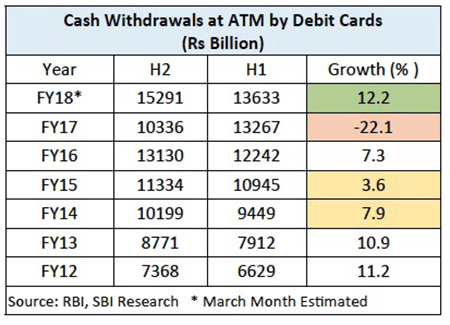 Source: State Bank of India
What does Table 1 tell us? It tells us that more cash is withdrawn from ATMs in the second half of the financial year (i.e. the period between October to March) than in the first half.
There are several reasons for it. The big festivals (Dusshera, Diwali, Christmas, Holi etc.) all fall in the second half of the year. So, does the procurement season for agriculture. This automatically means that the country on the whole withdraws more cash from ATMs in the second half of the year than it does in the first.
Now look at Table 1 carefully. The rate of increase in cash withdrawals has slowed down post 2012-2013. One possible reason for this has been the increase in digital transactions, which have gone up, but are still not big enough.
In 2016-2017, cash withdrawals in the second half of the year fell by 22.1%. This happened because in the aftermath of demonetisation there simply wasn’t enough cash going around in the system.
In 2017-2018, cash withdrawals in the second half of the year, are likely to be 12.2% more than the first half. (We use the term likely because the figure for cash withdrawals for March 2018, is an estimate).
This 12.2% growth is on a much larger base, than 2012-13. The cash withdrawals in the first half of 2012-2013 were around half of the cash withdrawals in 2017-2018.
Why have the cash withdrawals in 2017-2018 been much more? A major reason for this lies around the proposed Financial Resolution and Deposit Insurance Bill. At the core of this Bill, lies the suggestion that the deposits can be used to a rescue a bank or financial firm in trouble. But the truth is a little more complicated than that, as I had explained in a December 2017 piece.
The timing of this Bill coming after demonetisation was all wrong and created suspicions in the minds of people. And after that the university of WhatsApp struck, and many forwards started going around. These forwards wrongly suggested that the government had plans of seizing the money in banks.
But as is wont these days, people tend to believe what they read on their phones than logical and nuanced arguments offered elsewhere.
This fear of the government seizing deposits has to some extent led to people withdrawing more cash from ATMs than they otherwise would. In the four talks that we have given since November 2017 (in Greater Noida, Chennai, Mumbai and Hyderabad), the number one question that we got asked was, will the government seize our money?
This column originally appeared on Equitymaster on April 23, 2018.
This fear has been quite palpable, and the Modi government needs to address it.
The paper money that we use these days has no value of its own. It’s not like the money of yore, like gold or silver or tobacco or many other commodities, which had an inherent value of their own.
When it comes to paper money, it has value because the government of the day says so and people believe in it. It works purely on trust between the government and the citizens.
As Yuval Noah Harari writes in Sapiens—A Brief History of Humankind: “Money isn’t a material reality—it’s a psychological construct… Money is accordingly a system of mutual trust, and not just any system of mutual trust: money is the most universal and most efficient system of mutual trust ever devised.”
And it is this trust that makes money go around. As Harari writes: “Because my neighbours believe in them. And my neighbours believe in them because I believe in them. And we all believe in them because our king believes in them and demands them in taxes, and because our priest believes in them and demands them in tithes.”
This trust in money was first destroyed during demonetisation, when the government set a last date (December 30, 2016) beyond which it wouldn’t accept Rs 500 and Rs 1,000 notes (For the record, the Bundesbank, the German central bank, still converts deutschemark, the German currency before euro became the currency of the Eurozone, into euros).
This trust continues to be destroyed with all the rumours around the FRDI Bill continuing to go around. These rumours need to be addressed, which they haven’t been.
Ultimately, any form of paper money works on trust. And if this trust is destroyed, nothing really is left because ultimately the only difference between a Rs 10 note and a Rs 2,000 note, is the quantity of paper and the ink, used in making these two notes, look different.



![[image error]](https://teekhapan.files.wordpress.com/2020/06/hfs.png)