
Nik Nicholson's Blog, page 2
June 26, 2025
What Did I Expect
I miss my Poppy… I never lost someone who I spoke with frequently. I still have his number and picture saved in my favorites. It feels like he’s somewhere he can’t take calls. Some days, I forget he’s gone and the world feels softer, like when he was around cracking jokes and spreading wisdom. Other days, I wonder about his friends and consider calling them. I don’t.
Today, yesterday, and tomorrow I wish I could call him and tell him all the things. He actively listened, sometimes he’d even research what I said and get back to me.
I’m struggling.
He’s usually the person I call when my heart is broken.
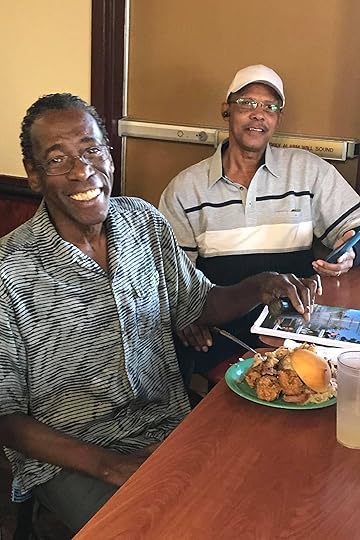 Frazier and my dad were lifelong nemesis. In the end, his cousin loved him deeply.


June 3, 2025
Emotional Regulation
Who taught you how to regulate your emotions? When? How?
Who taught you how to keep your heart from splintering in public? Who showed you how to swallow a lump in your throat before anyone else notices?
I’ll be honest—I’ve never mastered the art of being unbothered. I want to, sometimes. I want to be the person who gets bad news and doesn’t blink, who hears nonsense and doesn’t flinch, who can look betrayal in the eye and just…stay blank. But that’s not me. I feel everything, all the time, way too much. And I practice, I really do, but every time I meet someone who’s got that mask on—smooth, untouched, poker-faced—I wonder what it costs them.
And what it would cost me to be like that.
But here’s the thing: I don’t want to be numb. I’ve seen what happens to people who bottle it all up. It leaks out somewhere, ugly and twisted. Still, I don’t want my feelings to run the show, either. I want to feel like an adult, not a walking exposed nerve.
So, teach me. How do you do it? How do you hear some wild shit—some truly disrespectful, jaw-dropping, “are you kidding me?” mess—and keep your face neutral? How do you keep your hands steady when your heart is going full earthquake under your ribs? Are you faking it? Does it ever actually get easier? Or is it all just acting until you get somewhere private and finally let yourself break?
And let’s be real for a second—I want to hear from the undercover villains, too. The ones who hear about betrayal and don’t just nod politely—they start plotting. The ones whose eyes go cold, but their lips curl into a smile. The people who can stand in a room, heart breaking, and already be building the blueprint for revenge—while never letting anyone see them sweat. How do you do that? Does it feel like power, or does it just eat you alive slower?
Drop your secrets. Tell me your stories. I want to know how you survive the moments that would send someone else over the edge—and whether it’s worth it in the end.
June 1, 2025
What We Remember, What We Forget
Did you know, during the Civil Rights Movement,
some Black folks said, don’t bring that trouble here?
They’d seen the klan ride,
knew there was no army, no law,
to shield them from fire—
just the memory of lynchings,
ash from burned churches clinging to their prayers.
Sometimes, courage was not asking for change,
but surviving another night.
Still, Martin marched.
Medgar, Malcolm, Fred Hampton—names written in blood,
pushing for humanity while others hid,
knowing about East St. Louis, Rosewood, Black Wall Street,
the stories textbooks would one day try to erase.
So when the Palestinian woman cries,
I am not Hamas,
when another mother says she wishes this rain of fire
had never come,
I think of the mothers who watched their children
dragged from bed,
of a people once starved, gassed,
carted off to die because the world decided
their children did not belong to all of us.
I hope for a heart to soften.
I hope someone, somewhere,
remembers how it feels to lose everything
and refuses to let it happen again.
But it has not happened.
Palestinians are being killed as they run,
as they beg for mercy,
as they clutch their children,
hoping the silence of the dead will scream
louder than their mother’s voice
and stop the next bomb.
This is not defense.
Defense is not hunting the unarmed,
not shooting the running,
not starving the trapped.
Even the Mob won’t kill women and children.
I am not saying a country cannot defend itself,
but defense means your enemy is fighting,
not fleeing,
not praying for someone to see their humanity
before the last breath leaves their child’s body.
Maybe one day, someone will remember
that all the children in the world belong to us,
and the silence will finally be enough to save
at least one body,
one baby,
from the fire.
May 25, 2025
Having It All


 View all responses
Having more money than needed to support people and causes I believe in. Resources to bless all the opportunities I’m given to be help. More art. More opportunities to do community art. Being part of a thriving community. Being able to mind my business and that not being negligence or apathy. Being able to have a dinner party and book club at my crib. Maybe even movie nights and then a discussion about the movie if it warrants one.
Being surrounded by compassionate, empathetic, motivated and driven people.
A pool to swim in. A sauna to sweat in. The right mix of oil for my scalp. Enough room for all my projects.
Neighbors who speak when they see me in the yard.
A schedule that allows me to be in constant connection with my highest vibration.
Being able to write and explore all of my creative gifts and earn enough money being creative to live. Have my grifts and disciplines respected, maybe even sought after…
A community of creatives to inspire and soothe my soul. Man cannot live on bread alone. A few artists who let me see their work before they reveal it to the public. I’d love to do collaborations and a few art openings or fifty.
Painful and scary as I know this is… To be led fully by my spirit.
Having enough energy to get all my household chores done or money to pay someone else to assist me.
Great views. A library that is spilling into every open space in the house. Wearing things I made.
A space dedicated to my hobbies, art and building. Surround sound to work to.
More laughter. Sharing good food. Hugging a lot. Holding babies whose parents take them home… Or who come get them before the end of the night.
Regular exercise. Outside events. Poetry readings. Live performances, live music and dancing where there are no wallflowers. I want to be hopeful.
Teeth that work and don’t hurt.
I want to regularly have deep conversations. I want to live in a town where it’s hard to get anything done because I run into so many beloveds.
Someone to regularly do my hair, nails and toes.
Seeing my work in a museum.
Traveling to hang out with my friends a few times a year.
My niece Serena staying with me a few weeks in the summer.
My dad to see me make it.
Me, seeing me make it.
More greens, cornbread, beans and homemade lemonade. More 70’s grooves. More of my great aunts dancing and laughing loud as they act out yesterday. More private jokes between them. More spring and fall days. More love.
Announcing Queen of Non Sequiturs: Poetry at the Edge of Connection
I’m thrilled—and honestly a little in awe—to finally share Queen of Non Sequiturs with the world.
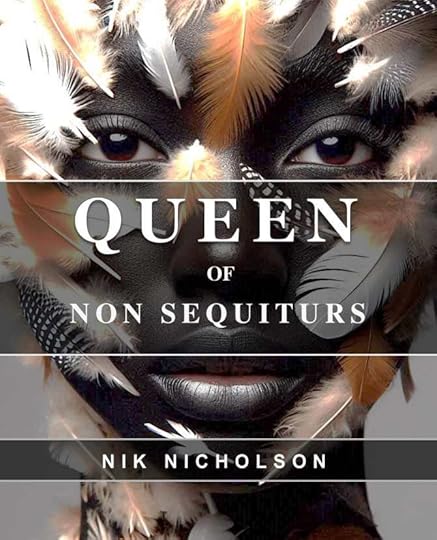 Ebook cover of Nik Nicholson’s latest collection of poetry.
This book has been years in the making. Though I never stopped writing (poetry is my constant), it still surprises me how long it’s been since I last released a collection. In that time, my work has evolved—sometimes circling the same themes from different angles, other times leaping into new territory altogether.
The title, inspired by a dear friend who used to call me the Queen of Non Sequitur, is more than an inside joke. It captures the way my mind works—jumping from idea to idea, sometimes in ways that make perfect sense to me (and other neurodivergent artists), even if the connections aren’t obvious to everyone else. The poems in this collection are snapshots of that process: some wild and scattered, some unexpectedly cohesive, all honest.
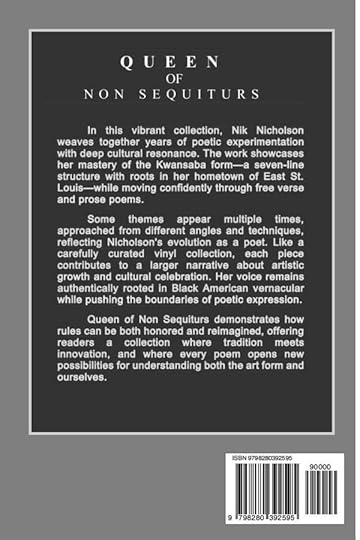
Queen of Non Sequiturs is, at its heart, an exploration of experiment and evolution. I play with a range of forms and techniques—not just for their own sake, but as ways to see the world from new angles. I’m especially proud to feature Kwansaba, a seven-line poetic form with deep roots in my hometown of East St. Louis, Illinois. This form—born in Black cultural expression—lets me celebrate tradition even as I push into new creative territory. Alongside these, you’ll find free verse, paragraph-style poems, and works that refuse to fit any single mold.
If you flip through, you’ll notice poems like “Ink” (three versions!) and “Queen of Non Sequitur” (four takes). The “Ink” poems dig into our tangled relationship with language in the digital age—how autocorrect and autofill change what it means to write, and why there’s still something sacred in putting pen to paper. The “Queen” poems are pure thought process: nonlinear, sometimes messy, but always true to how I experience and shape the world.
This collection is curated like a vinyl record—the poems chosen not just for their individual power, but for how they fit together, echoing and riffing off each other. Some appear in multiple versions, like different takes of the same song, each capturing a unique mood or moment in my development as a poet.
Throughout, my voice is rooted in Black American vernacular, weaving the rhythms and language of my community into a larger narrative about growth, connection, and the strange loneliness of our digital lives. I hope these poems resonate with anyone who’s ever felt out of sync, who craves real connection, or who believes that rules exist to be both respected and reimagined.
Queen of Non Sequiturs is available now on Kindle eBook and paperback. If you pick it up, I’d love to hear what you think—leave a review, send me a note, or share it with someone who could use a little poetry right now.
Thank you for being here, for reading, and for welcoming my words back into the world.
Nik Nicholson
What Happens Tomorrow
They said the universe started with a bang—
all matter, all energy,
rushing out from a single point,
so much pressure that space itself stretched
just to fit the shock.
When I was a kid, they warned us about hairspray,
how CFCs could eat a hole in the sky.
We learned about limits—exhaust pipes,
factory smokestacks,
invisible lines between safe and too much.
Is the atmosphere just a thin shell
holding everything in?
Are we breathing our own history,
filtering yesterday’s mistakes
with every lungful?
Somewhere, governments test weapons
in deserts they call “empty”—
but the world is never empty;
wind moves, water travels,
radiation doesn’t read boundaries.
Cancer stalks men like a silent inheritance.
Natural disasters feel less natural,
more like alarms we keep snoozing.
Are we poisoning something
we barely understand?
Does anyone really know,
or care enough to stop?
Sometimes I wonder about the tools we build—
bombs, chemicals,
campaigns to sell us everything
from cereal to cars to sex toys—
but never a campaign
to stop a war
before it starts.
Is peace just harder to market?
May 21, 2025
KDP IS TRASH
I was a major supporter of Amazon’s Kindle Direct Publishing (KDP). This was especially true when it was paired with CreateSpace for print books. In fact, I published several projects through those platforms and really loved how accessible self-publishing felt.
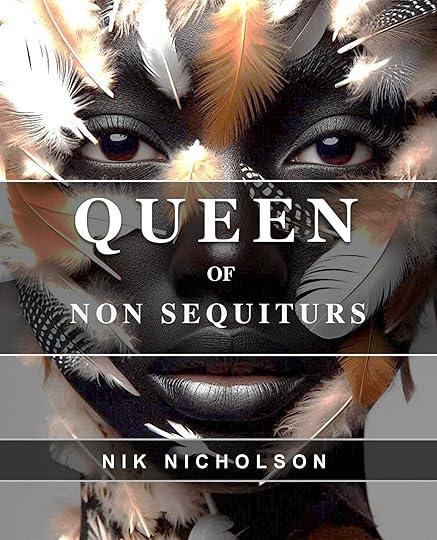
As a poet, I write regularly and have shared my work on stage. After performing my poetry book, Seeking Sex Without Armor, I got some honest feedback from fellow poets. It wasn’t all praise. They said my book had too many poems packed in. This made it feel heavy, like someone talking nonstop for five hours without a break. Ouch. When I attempted to publish my latest collection, Queen of Non Sequiturs, I made sure to keep it concise. It did not have more than 77 pages.
 [image error]
But their point stuck: poetry needs space to breathe. Readers deserve time to contemplate and process what they’re reading, especially when the themes run deep. One friend showed me her book. She created pages in it for readers. They could jot down their own reflections on heavy poems.
After years away from publishing, I returned with excitement as KDP had merged its functions, replacing my former go-to, CreateSpace, which initially handled print.
Having designed covers for other writers, I watched the changes on KDP closely. While other platforms offered more pricing control, I valued KDP’s permanence and all-in-one setup. Plus, being familiar with their tools and standards made publishing feel less intimidating.
That’s been my journey with KDP so far — a mix of learning, adapting, and holding onto the things that make self-publishing feel like home.
Self-publishing is a marathon, not a sprint. There are many steps involved, and trying to do it all alone isn’t realistic. For me, that meant setting a production schedule, coordinating with editors, and gathering beta readers for honest feedback.
Once I started working with editors, I realized how slow the process could get. Some were booked months out or charging more than before, which was discouraging. The excitement faded as the waiting dragged on.
To keep momentum, I started designing book covers for upcoming projects. This forced me to estimate page counts and gave me a visual reminder of my goals every time I logged into KDP. It wasn’t perfect, but it helped me stay accountable while the longer parts of publishing unfolded.
When it comes to editing, I prefer hard copies. Holding a physical book and turning pages helps me focus. My first editor is a beast—in the best way. She doesn’t just fix mistakes; she asks questions in the margins without assuming my intent, pushing me to see my work through a reader’s eyes. That’s incredibly powerful.
Some editors rewrite your work like an AI, replacing your voice with theirs. Not my editor. She preserves my style, guiding me without taking over. Using a hard copy stops me from rewriting on the fly and teaches me to trust myself. When you step away from your work and return later, you might forget why you wrote something a certain way — only to realize what seemed unnecessary is actually essential.
Before sending my manuscript to her, I do my own edits. I print it out, mark it up with a pen, then revise and read it aloud. For novels and stories, I don’t add breath marks, but for poetry, I insert commas and periods to match how I perform each piece. That often means reading a poem several times until it feels right — but that’s a whole other conversation.
When reading a novel, I pace most of it in my head. Still, I add punctuation to reflect how each character speaks. A stuttering character might have commas or extra periods where they don’t normally belong. Fast talkers use commas where others would pause. Thoughtful characters get ellipses for long pauses as they consider their words. For accents, I spell words phonetically, and with a few colloquialisms, you can usually tell who’s talking without dialogue tags.
Editing isn’t just fixing mistakes — it’s shaping voice, rhythm, and character. For me, that all starts with a hard copy in hand.
I was so excited when my edits came back from my last editor, and I carefully incorporated their suggestions. They even organized the edits in a flow that made it easy for me to follow and decide what I agreed with. Once I put the manuscript together, I couldn’t wait to jump on KDP and publish. My plan was to do a print book. I wanted physical copies for in-person events and book clubs. There’s something special about everyone holding the same book.
I submitted the manuscript to KDP, but it was denied. Now, if you know me, you know I make covers for other writers, so I’m familiar with KDP’s book cover templates. The problem? Their cover template doesn’t match the publishing preview. This hadn’t been an issue before because the books I usually formatted were at least 250 pages. For my poetry book, I wanted to end on page 77, and though the actual count was closer to 95 with front and back matter, the table of contents was longer—each poem had its own entry.
When the book was rejected, I thought, okay, I’ll shrink the text and check the print previewer again. But the guidelines in the previewer were so tiny I couldn’t fix the problem — the spine guidelines were basically a single thin line. There was no room to adjust anything, not even at 5-point font.
So, for the first time ever, I called KDP’s publishing support. Right out of the gate, the customer service rep started talking to me like I was crazy. I used to work in customer service, so I know how tough frontline workers can have it. I stayed calm and polite, even trying to lighten the mood with my usual finesse. But this rep was so rude I had to hang up and take a break. It was painful trying to be pleasant while someone clearly found me frustrating. I even felt like I was the one doing the hard work while they acted like the customer. I used every de-escalation tactic I knew: “I understand this could be frustrating. Please take your time,” and “Feel free to put me on hold if you need a moment.” I smiled as much as you can through a phone line — you can hear it, trust me.
But this first rep was mean as hell. It actually hurt my spirit, and my eyes started burning. Maybe I’m a little sensitive, but I didn’t expect that level of hostility. I didn’t get her name.
When I called back, I started fresh, but I wasn’t as friendly. The lesson was still fresh in my mind. The second rep, Cara, told me to just use KDP’s templates. I explained that I was using their templates exactly as instructed. She said, “Well, when I look in the print previewer, I can see where you can fix the text.” I told her on my end, there was no room — the lines were so tight. I also pointed out that the KDP template had more space than the previewer showed.
She insisted, “You have to use our template to be in compliance.” She suggested I ask the KDP community for help. When I reiterated that I was using their template but the previewer was incongruent, she got visibly annoyed and told me, “If you’d used the right template, you wouldn’t have this problem.”
I didn’t want to argue, and I was emotionally drained. I told her I understood her frustration, that maybe I wasn’t explaining myself well. I even asked if she could give me an email address to send screenshots illustrating the problem.
She refused and started yelling, repeating that if I didn’t use the right template, my book wouldn’t be approved. Her escalating anger made me escalate too — but I stayed calm and asked to speak to a manager. I kept apologizing for frustrating her and acknowledged I might be hard to understand.
Her response? “No, I work here. You don’t understand.” I was really telling myself that to stay calm because, honestly, I wanted to curse her out.
That experience crushed me. I never imagined a company I once loved would treat me like that — especially when I’m just trying to publish something meaningful.
Cara initially told me I’d have to wait until the next day if I wanted to speak to a manager. I stayed quiet for a moment, and then she relented with a curt “fine.” Just before putting me on hold, she yelled “I understand” three times, then ended with “You don’t understand,” and clicked off before I could say anything else.
Looking back, it’s hilarious. At the time, it was just shocking.
The manager who finally came on was already irritated. She immediately told me I should use the template if I wanted my book approved. I informed her that I was indeed using the template — but it didn’t match the publishing preview.
She sighed, exhausted and frustrated, then proceeded to tell me where I could find the template. Me — someone who designs covers for other writers and regularly tweaks templates so their books get approved — being told where to find the tool I use all the time? No thanks.
I asked to speak to the next manager up. That’s when things took a strange turn. The manager started threatening me, saying, “You didn’t give me an opportunity to assist you. I’ve already provided a solution. If you’d just listen.” The irony was thick, especially after I’d told her multiple times I was already using their template.
She said she didn’t know when a higher-level manager would get back to me — maybe in a few days, maybe longer. Then she put me on hold for what felt like forever. I hung up, then tried to call back through the system, only to find I was blocked from the number I’d dialed. I was also blocked online.
After some digging, I found the KDP chat feature — something I didn’t even know existed. An hour later, I discovered managers were actually available on chat. But from there, it was the same broken record: “If you just use the template.” They kept sending me links to the template page, which I already knew inside and out. Eventually, they even sent downloads of the exact same templates I’d been using all along. These templates vary based on page count, paper type, and book size — all things I’d been managing from the start.
This frustrating loop went on for literal weeks.
Meanwhile, a friend shared that due to medical challenges, holding and reading a print book was difficult. They needed large text for it to be accessible. So, I decided to upload a Kindle version, expecting another rejection.
Surprisingly, the Kindle version went through on the first try. That was a small win in the middle of a long, exhausting battle.
Finna end this long ass post. I’m literally getting triggered.
After nearly a month of being treated like the village idiot, I finally took matters into my own hands. I added about 30 pages and created a whole new cover. That didn’t immediately fix the problem, because the publishing preview is still wildly inaccurate. So, I sat there—online and in Word—moving the text so slightly you wouldn’t even notice unless you were staring at the grid lines. Five or six times. For hours. I adjusted that cover until it finally, finally matched.
Then I submitted it for approval.
If this crap didn’t work, I was done. Ready to go local, find a publisher who actually gives a damn—because I had zero other options left.
The next day, the book was approved. A KDP manager called, and I got four emails. Two were from execs congratulating themselves on “resolving” the issue. Newsflash: they didn’t. I did. I created the extra binding space and did what I’ve done for countless other writers.
Here’s the bitter truth: KDP’s system is broken. Their customer service is dismissive at best, hostile at worst, and their so-called “help” often feels like gaslighting. If you’re self-publishing with KDP, be ready to fight tooth and nail. Know your tools better than they expect, trust your gut, and don’t let their incompetence kill your momentum. Sometimes you have to do the impossible just to get what should be simple.
This industry owes self-publishers better. Until that day, brace yourself, keep your rage close, and keep pushing. No one else will.
And here’s the last bit of bullshit.
Some knucklehead rep insisted I “just let him explain.” Dude, after 50 emails, countless chats, and phone calls, they still hadn’t fixed their own mess. I refused. I knew he’d just repeat, “Use our templates.”
He wrote a long chat blaming me for not reading carefully and swore they’d sent me a file to fix the problem.
WHAAAAAT? I went looking for that “fixed” cover—because someone promised they corrected it. But KDP rejected that too. Someone even admitted the files were incongruent and said they’d have to get the tech team and publishers involved. Meanwhile, she’d “fix it.” When her “fix” got rejected, I contacted KDP again.
Enter the confident ass hat who claimed he saw the issue and could fix it on the spot. I knew he was lying because I’d been through this circus with these gaslighting con artists before.
I don’t care why your system is broken. I just want my damn book approved. But he needed my help. Two things, he said. I asked, if you know what should have happened, why haven’t the other fifty agents noticed? Lazy? Incompetent? Liars? He couldn’t answer—he hadn’t seen previous emails. He was literally making shit up.
Cool. Since you’re the only one who “knows what’s going on,” don’t explain. Approve it or have a manager who speaks English as their first language call me tomorrow.
He sent a long message saying they’d sent the file from the start, and if I’d just listened, this wouldn’t be a problem. I asked for someone fluent in English—not being rude, but why the hell don’t you understand what I’m saying? I told myself it was a language barrier rather than accept they were just idiots or torturing me for fun.
Over thirty emails later—not counting chats and calls—and before I fixed it myself, I reviewed everything from 4/28 to 5/19. The file they sent? The fucking template.
I hate KDP. And, well… they hate us too.
May 9, 2025
Not To Cry In Front of People


 View all responses
My career plan is not to go postal. Remain present. Not becoming apathetic and disconnected… Some days I lose this war.
Competing Art…
I remember seeing a Pollock on TV once, but that didn’t come close to what it felt like standing in front of one years later. On TV, it was just wild splatters. In person, it hit different—you actually feel something. I thought about how other painters give you faces, landscapes, fruit—things you’re supposed to “get.” With Pollock, I always felt a little lost. People talked about how powerful his work was, but I can’t remember anyone calling it beautiful.
But there I was, in front of two of his paintings, just stuck. The heavy black paint looked like troubled water frozen mid-storm. That feeling was its own kind of beauty. Even writing this, I can’t quite explain it. That’s what makes his work so wild to me—words just don’t get there.
I bring all this up because I don’t love competition, especially not in art. If it’s something you can measure—how far you can jump, how fast you run a mile—I get that. But how do you judge writers, poets, artists? What if a bunch of pieces move you in totally different ways?
I’m not really the competitive type, even though people push me to be. I don’t write to win. I write because my soul needs to spill a little truth. Even writing this blog, I was thinking, “Gawd, I hate competing,” but, well, bills exist. Grants are different—you’re competing, sure, but you’re judged on the work itself, and the money’s meant to help you keep going. You actually have to show what the grant did for your art, which I like, because I’d be making the work anyway.
This competition, though? It’s global, it’s capitalist, and it’s all about sales. Before I knew there was a contest, I figured I’d knock out a few more projects and then do a book release—maybe with a reading, maybe a little party. Now, I have to shift gears: less writing, way more promo. All that matters is how many copies you sell in three months.
With grants, it’s about the art. With this, it’s about numbers. Anyone with a new book out this year can play, no genre splits, just a big free-for-all. I hate that side of writing—the hustle, the business. But if you want to make a living, the business sometimes matters more than the words themselves. And honestly, that’s a tough thing to swallow.


