
Lisa Niver's Blog: We Said Go Travel, page 459
October 30, 2013
Australian Animals
Australia has been one of our favorite countries, continents and cultures to visit. From snow capped mountains, ancient rain forest, red deserts and ever crashing oceans all around it, Australia is a top spot for exploring and finding wildlife.
My husband Chris and I lived in Australia for about two years and the ability to buy a vehicle and head out into their amazing parks and look for wildlife is at your fingertips. If viewing wildlife is one of your passions, book your trip down under today.
Here is a sampling of some of the incredible Australian animals we saw around the continent.
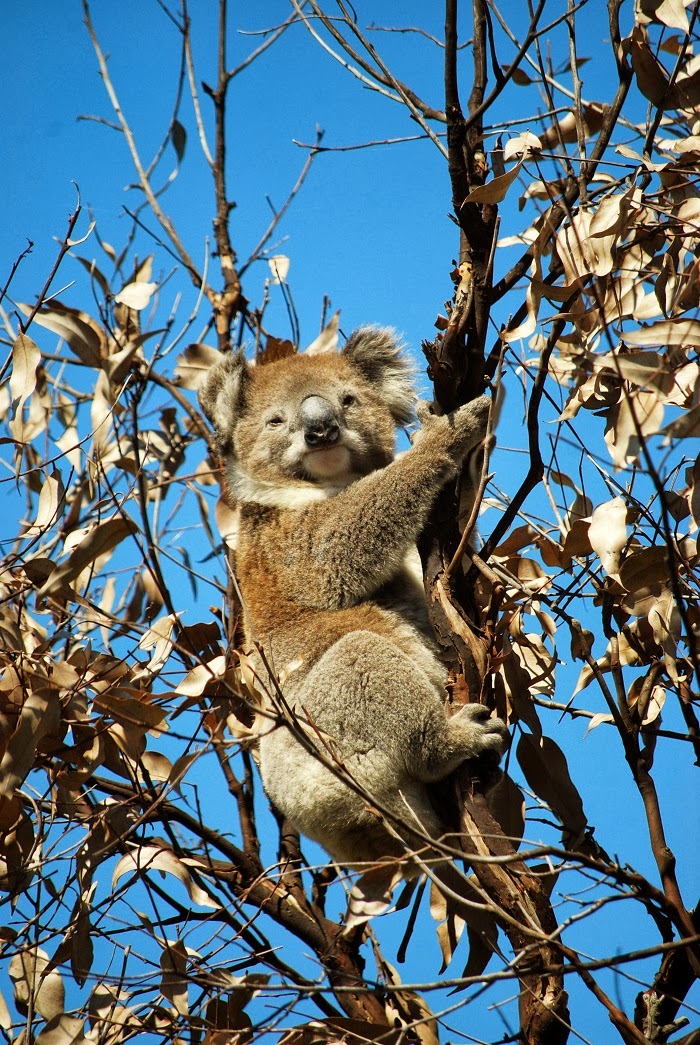
The iconic koala, a must see for Australian wildlife. All the koala’s we observed in the wild were so much more active than any I have ever observed in zoos or wildlife parks. They were alert and keenly aware of our presence. I just loved watching them selectively choose each eucalyptus leaf they would eat. A great place to see wild koala’s is French Island, in Victoria.
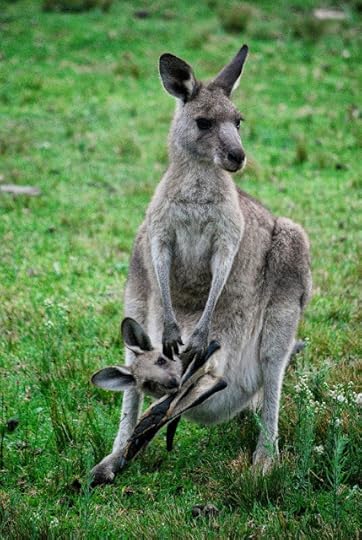
This is an Eastern Grey Kangaroo with her joey, or baby. Female kangaroos are almost always pregnant and if food sources become scarce she can essentially pause the growth of her developing young. In New South Wales, there is a handful of amazing parks for viewing wild life and enjoying the beach and we camped at Pebbly Beach.
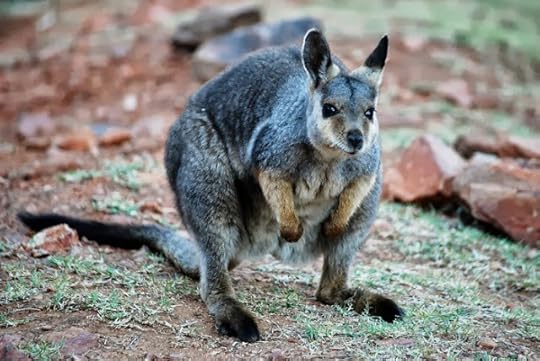
This inquisitive, endangered female is a black footed rock wallaby. You can easily view these guys and gals at Heavitree Gap campground and resort in Alice Springs.
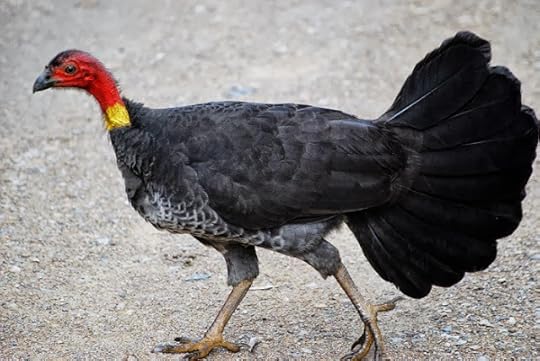
This is a native bush turkey and are quite common to see around New South Wales.
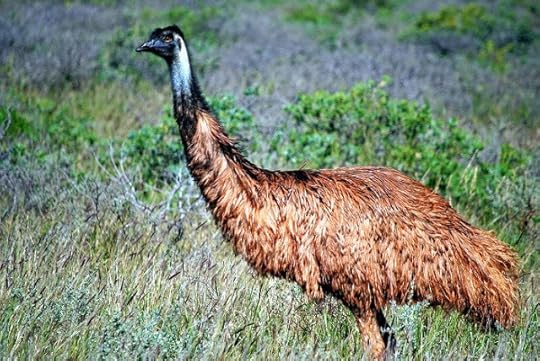
On the coat of arms for Australia, the emu have big, wary eyes. When they run their back feathers fluff up and down. We spent a week in Cape Range National Park in Western Australia and that is a great park for viewing wildlife. We also enjoyed camping at Yardie Creek Caravan Park.
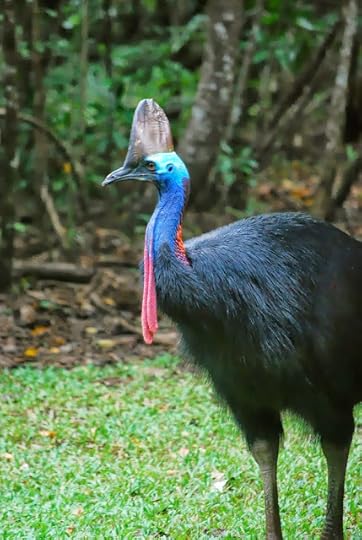
Not to be confused the emu, the critically endangered cassowary is an animal from the Jurassic period. There is an estimated 1000 or fewer cassowaries left in the wild. So get to the Daintree area in Queensland and drive really slow. (Most cassowary deaths are caused by vehicles.) This is an amazing bird to see in the wild.
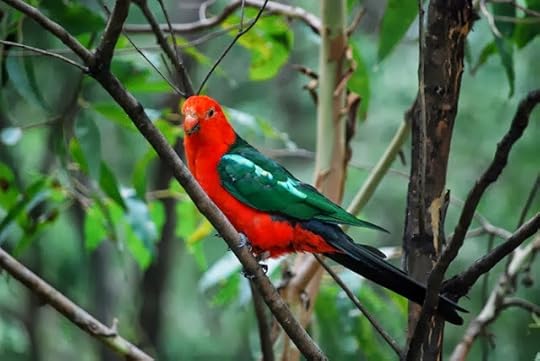
With it’s vibrant red body and green wings, the King Parrot adds a striking splash of color to the forest. Look for them in New South Wales national parks.
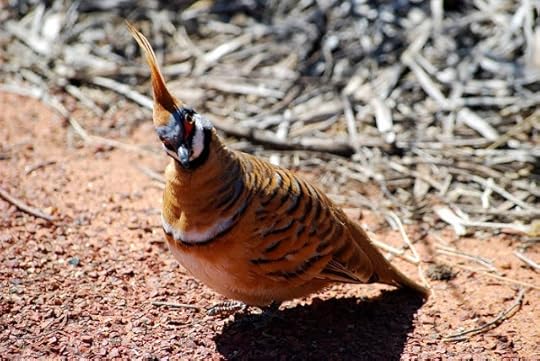
My favorite characteristic of the spinifex pigeon is how they tilted their head to the side to study me and then quickly scurry away into the brush with their head bobbing back and forth the entire time. We saw lots of these guys around the red center in Alice Springs and around Uluru.
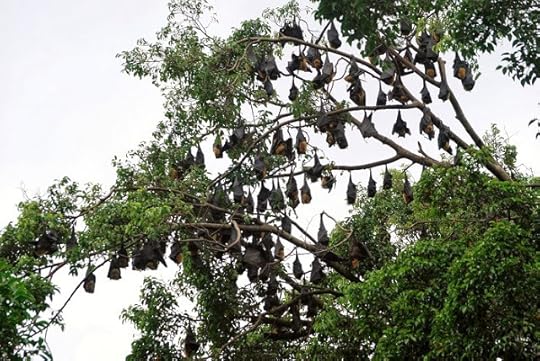
Different from the North American fox, the Australia flying fox is a bat. Visitors can view hundreds of them hanging out in down town Sydney’s Royal Botanic Gardens.
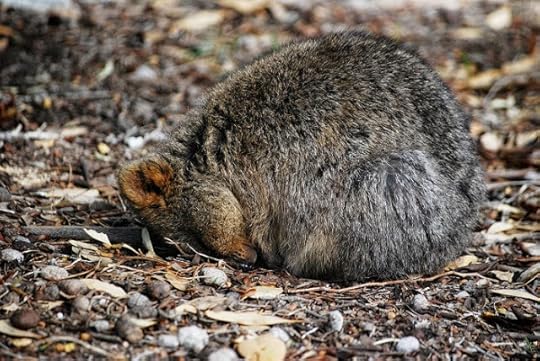
Thriving on Rottnest Island, the quokka is a small marsupial that has adapted helping to keep it’s numbers strong on the island. Visitors usually access the island by ferry from either Perth or Fremantle.
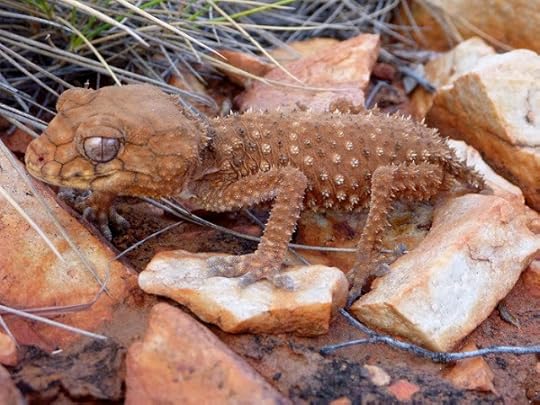
We spent a few nights backpacking on the Larapinta Trail in Central Australia, which is quickly emerging as one of Australia’s most popular long distance hikes. Upon waking one morning, curled in a nook of Chris’ back pack was this knob tailed gecko. He seemed utterly perturbed that we were asking him to move, especially because the morning was cold and I do not think he appreciated being removed from his warm spot. We set him to the side, packed up camp and were on our way.
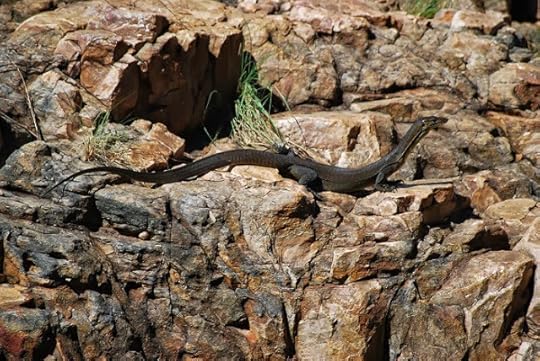
This Mertens water monitor we saw in Litchfield National Park in the Northern Territory. If you ever have a reason to stop in at Darwin, rent a car and get yourself to Litchfield and Kakadu National Parks.
Australia is one of the 17 countries listed as ‘megadiverse’ with over 80% of the mammals, reptiles and flowering plants being endemic, or native, to Australia. Look for the next photo post to show case animals found in the waters surrounding Australia.
The post Australian Animals appeared first on We Said Go Travel.


Deadly Morocco: Time Wounds All Heels
-Wilfred Thesiger, Arabian Sands, 1959
My son Walker wants to join me on an adventure in Morocco. I propose a rash undertaking, a trek to the Riff Mountains, the Mediterranean coastal range where the grass is greener, so they say… Not many tourists yet venture here. Yet it has one of the highest mountains in North Africa, Jbel Tidiquin, 8031 feet above the sea, and I would love to climb it.
We team up with a wonderful driver, Ahmed El Abdi, who takes us first to Tangier for the night, where we are given the room, we are told, used by Bernado Bertolucci when he filmed his version of Paul Bowles novel, The Sheltering Sky. It has a dark-wood chair inlaid with fragments of mother-of-pearl that is exquisitely uncomfortable. Adjacent is a fine bureau with tooled cabriole legs, and when I open one of the miniature drawers there is a scrap of crumpled paper with illegible scrawling…and I wonder if this might be some script notes from the mind of a genius filmmaker.
It reminds me of a moment some years ago when I stayed at Francis Ford Coppola’s Blancaneaux Lodge in the glazed hills of Belize. It was during the off-season, and the eco-resort was near empty, so the manager offered that I stay in Francis’s private bungalow. I looked around his room and saw portraits of his extended family, including Nicholas Cage and Sofia Coppola; piles of scripts, and notes scribbled on scraps of paper. This was a creative retreat for the director, and he came here to find inspiration, the manager said brightly. I happened to be carrying a few of the books I had authored, so I scattered them around the room, and put some in the dresser drawers, hoping Francis might find something he liked and give me a call. I’m still waiting.
So, here, too, I have a couple of my books, and I slip one into the bureau drawer. You never know.
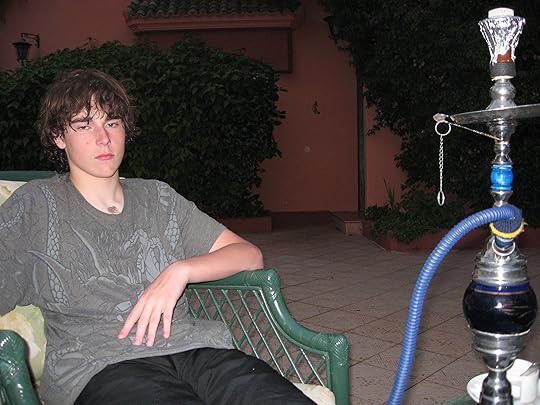
The day following we make the five hour drive from Tangier to the village of Chefchaouen (which means “look at the peaks”). Along the way we stop and Walker enjoys a number of “firsts,” his first camel ride, his first cup of coffee, and his first “monkey shower,” when a road-side handler places the primate on Walker’s shoulder for a photo op. One “first” he refuses is a hookah suck. At the back of a roadside café curved like the shell of a snail, men are drawing conspiratorially on giant hubble-bubble pipes, and so I order up one with two hoses. When it arrives I show him how it works, and the water gurgles, as a cloud of smoke curls the air. But Walker declines the cool smoke, and orders a Coke instead.
We pass cork forest and olive groves, soaring brick minarets trimmed with white, flocks of black goats and off-white sheep, and most provocative to Walker’s eye, shepherdesses in scarlet hats, white tops, boots and bright red knickerbocker leggings.
The sun is burning low and coppery when we pass through the Bab el-Majorrol gate into Chefchaouen, which happens to be a sister city of Issaquah, Washington, where I enjoyed many a hike when I lived in adjacent Redmond, and the two towns, I must say, would seem to have little in common. Up a steep, steep hill we grind, the engine sounding like a spoon caught in a disposal. We pull into the Atlas Riad Chaouen, nestled in a saddle beneath the stark limestone rock face of Ain Tissemlal (3280′) and Jebel el Kelaa (4206′), known together as Ech-Chaoua (the horns). Though in the shadow of these peaks, the hotel at the same time hangs high above the village, like the lair of a Doctor Seuss character. We drop our bags in the room, which is filled with the swish of the wind from the eucalyptus trees outside the single window. We pull back the curtains and are dazzled by a flood of canary yellow light. But when our eyes adjust we gape at a view of medieval houses whitened with a bluish lime — the walls shine in the sun like a glacier.
Walker is restless, and wants to stretch legs, so we decide to take a short hike to the ruins of a 250-year-old Portuguese mosque on a slope across the main river valley. It’s a hot hike, but it feels cooler for the long view from the crumbling tower across the river to the medina. Try to imagine the coolest, most mouth-wateringly liquid blue you’ve ever wanted to drink or dive into on a hot day: the homes in Chefchaouen are painted that color.
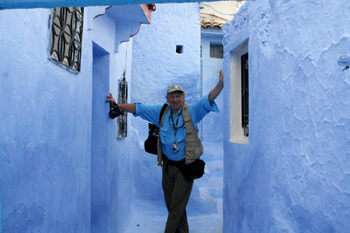
On the way back to the hotel we thread through the eastern gate of the medina, Bab el-Ansar, into the compact, cobalt blue-washed world via its steep and maze-like walkways. Even the stairs are dyed soft blue or cream. It makes the ice cream for sale from little carts irresistible, and we indulge in some soupy blue scoops on cones. Then we divagate the worn cobbled alleyways, some so narrow Walker’s long outstretched arms can touch both walls. We pass beneath tiny balconies, past little shops selling woven blankets, cedar wood antiques, necklaces of silver and red coral, and fennec furs. The tea houses are crowded but breezy with chat and brews. No cell phones here; just a cool, serene atmosphere. Blue is the overriding color; there is no seam between building and the sky…it’s like walking along the bottom of a resort pool.
Originally a fortress town, Chefchaouen was founded in 1471 to halt the advance of the Iberians after their capture of Ceuta to the north (still a Spanish protectorate), and served as a religious sanctuary for Muslims and Jews absquatulating from Granada. A series of dynasties ruled the area, long a center for Sufi mysticism, and the ‘zouia’ brotherhoods still practice their rites and traditions today. Access for Christians, however, was only gained in 1920, when Spanish troops occupied northern Morocco. Before then, the tourist brochure trumpets, only three westerners had ever visited this secret base. The invading Spanish found a time capsule of their own culture.
Now, Hispano-Moorish influence is apparent everywhere: in the clematis-covered archways that span the streets, in the narrow barred windows, and in the studded doorways that open onto sun-drenched patios. The singularly most stunning elements, however, are the blue painted buildings, soaked in different shades of turquoise and azure, producing a semi-mirage effect. The blue wash only came about in the 1930s, when Jewish refugees finally decided to paint over the previously Muslim-green window frames and doors.
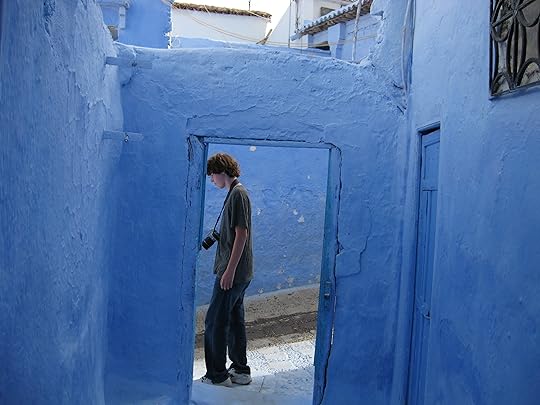
Thirsty, we agree to sit and sip glasses of mint tea at one of the shops, one cluttered with treasure, and weighed down by a mountain of bargains. There are ancient Berber chests, silver teapots, ebony footstools, and weapons once used by warring tribes. Walker’s eyes brighten, and he soon finds himself tangled in the art of negotiating. He has the habit of rationing his conversation, which works to his advantage, as when his silences are long, the salesman breaks the quiet by punching his pocket calculator and lowering his price. Walker ends up buying an antique pistol for $30… the opening price was $3000, so he feels pretty trick about the deal, even though the salesman claims the firearm is older than gunpowder. I submit to a couple of kelims, the short rugs originally made to cushion the knees of the devout when they prayed towards Mecca, but now lining the walls and hallways of the infidels in the west. With our bootie in hand we head back up the hill, beads of sweat popping off our brows like insects. We pass a line of women in red and white striped overskirts and large conical straw hats with woolen bobbles, and they seem cool as cucumbers despite the heat. We beat it back to the hotel, which though modest in most regards, is generous in its air conditioning, and we sit back and enjoy the arctic air.
Almost nobody speaks English here — Arabic and Spanish are the lingua francas — which is in a way refreshing, and it prompts Walker and me to talk in ways we don’t when in restaurants back home. We point to items on the menu, and the waiter hovers like a black and white butterfly, nods, and then flits away. When he returns he serves us in a way that seems almost protective, as though there is a religious dimension to the hospitality, to the supper and succor for strangers.
After dinner I importune the front desk manager, who does speak a crumb of English, if he can help us find a guide to take us climbing tomorrow. “Ah, you want to go up our mountain… here we call it Mount Baldy” he informs, and Walker pulls off my hat and chuckles that it is the appropriate mountain for me.
“Yes. Can you find us a good guide?”
“Of course; the best. Be here in the lobby at 10:00 am.
“Isn’t that a bit late? Its summer…it gets hot. Shouldn’t we start quite early to avoid the midday heat while hiking?
“No, no… you will be fine. Besides my guide doesn’t start before 10:00.”
The sky lightens slowly the next morning, and time seems to pour like treacle as we linger through breakfast. At last, about 10:30 Moroccan Time, Anass Hazim, 27, saunters into the lobby and extends his hand. His skin is parched and rough and feels like the hand of a reptile. He tells us he has been a guide for seven years, and has climbed Mount Baldy many times — we have nothing to worry about. It should take a nice and easy three hours for the whole enterprise. But I am a little leery of his leather leisure shoes, even if it is but a stroll. I ask about water, and he says, not to worry, we won’t need any. But that doesn’t feel right, so I quickly buy four plastic bottles of Sidi Ali water from the restaurant and stuff them into my pack. He piles us into a car, and we drive through twenty shades of moonscape into the Parc National de Talassemtane, to a settlement called Akchour. At the foot of a low dam on the river Kelaa we park. The surrounding mountains are all burnt umber and dusty taupe, scarred with horizontal serrations, jutting up in every direction. Here we shoulder our packs, and start walking up the side of the river, past oleander bushes, through stands of Holm oak and feathery pines, and alongside steep cliffs. It’s steep and hot, following the contours of the gorge, so hot it sends chills down my arms. Walker and I each swallow a bottle of water in the first hour. I’m a little surprised to note that Anass doesn’t wear sunglasses or a hat, and to see that he smokes constantly, but perhaps that is the norm in Morocco. Our guide in the Atlas, Rachid, did as well. But there is something about Anass that doesn’t quite seem guide-like. His eyes are not far-reaching as are the eyes of most of the wilderness guides I have known. He seems to focus more on the surface of the present.
About noon we come to a natural stone arch that crosses the river, the Pont de Dieu or “God’s Window,” and here Walker announces he doesn’t want to go any farther. He wants to wait here in the shade by the bridge.
“It’s too hot, Dad.”
I’m okay with that, and since it must only be a short walk from here to the top, I figure we will be up and back in an hour. But Anass doesn’t want to go any farther either.
“Why not?” I ask. “You’re the professional mountain guide.”
He draws his face into hundreds of little wrinkles, not in a squint, but as if his face is drawing inward to escape a truth.
“I have not guided beyond here before….only to the bridge”
“What?”
“Tourists don’t go past here.”
“Well, I am…you have to come with me…you’re the guide.”
So, I leave a bottle of water with Walker, and tuck the last one in my fanny pack for easy access, and Anass and I start the steep climb. It is a faint trail, zigzagging through the cedars and brush, and after a few minutes I can look up and see what looks like the summit. But suddenly Anass stops.
“We must turn around.”
“I don’t understand. Why? We can see the top.”
“No, that is not the top…there are four more peaks beyond that to the summit, and you have to go up and down steep valleys. It will take three days.” He gives me a glaze like the gleam off a knife.
“But you said three hours.”
“It is too dangerous to continue. It is a technical climb.”
“What do you mean? We’re on a path…let’s keep going.”
I turn and start to hike and Anass follows me grudgingly. I stop after a few minutes, and take a draw on the water bottle, and offer some to Anass…his brow is glistening with sweat as he takes a long drink, and then announces he is turning back.
“You can’t turn back…you are my guide.”
He clearly isn’t gripped with this idea.
“You must turn back with me…there are wild Barbary apes near the top…they will attack you. I know this.”
This gives me pause…the image of fending off a troop of wild macaques, alone on a hot mountain, is not favorable. But I catch myself…this can’t be true.
“I’m going on Anass even without you.”
He screws up his face until his eyes are no more than slits.
“You should not. If I get into trouble that is okay; but if you get into trouble, it is a big problem for me.”
“I’m sorry Anass….you go check on Walker. I’ll hike to the top, and be back soon.”
He gives me a gimlet glare, then turns on his heel and heads down the hill.
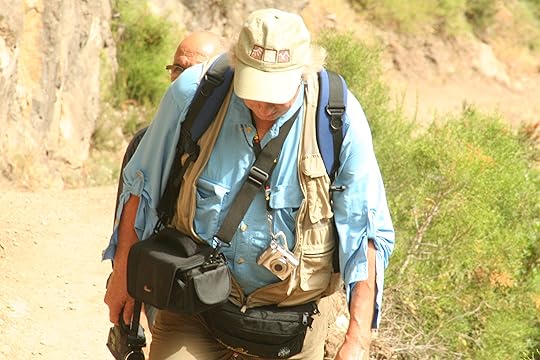
I realize now how brutal the sun is… it is midday, and there is no shade as I continue. But I am convinced it is but a short ways to the summit, and then I can turn back and reunite with Walker and the river.
But as I get closer to the top it seems to roll away, as though on wheels. And then the trail careens off to the side…I follow it, and it takes me over a shoulder that reveals another peak higher than what I had been watching. But it is not so far, so I continue. And I take judicious sips from my water bottle.
After another 30 minutes of hiking I breach another pass, and see there is still another higher peak. I weigh the options, wipe my brow, and decide it’s better to continue…it can’t be that much farther.
But it is…I struggle up a steep section, and rise to another false summit, and stare at a new, higher summit, but this one is across a wide and deep valley. It does look as though it might take days to traverse this route. Anass was right. But the good news, I tell myself, is there are no Barbary Apes in sight.
So, I take a long draw from my plastic bottle, and begin the return hike, now most certainly not overburdened with an abundance of water. Along the way I notice something I had missed coming up… discarded clothing. There is a pair of blue socks; a while later, a sweater. And then at a sharp bend in the path, a pair of trousers. What happened here, I wonder, that people abandoned their clothes on this trail?
It is getting hotter. The heat is rippling, like just out of a kiln. I stop every hundred yards or so and try to rest in the scant shelter of a scrawny cedar. I pull a branch from the tree — it smells like soap — and turn it into a hiking stick. I take the last few sips of water.
Then I start to feel the onset of heat exhaustion: dizziness, muscle weakness and nausea. My throat is dry; my lips cracked. The heat bites at the corners of my eyes. I feel a sweat fever coming on, though I feel no sweat. In a landscape as this one can sweat four gallons a day without realizing it. The sweat evaporates too quickly to be noticed.
I know what happens next….the throat constricts, the body temperature soars. Disorientation, hallucinations, gagging and liver failure follow, and then coma and death. On the upside, I could qualify for a Darwin Award.
The sky is anything but sheltering here, but Paul Bowles would appreciate this setting, I believe. He derived his most famous title from a popular World War I tune, “Down Among the Sheltering Palms.” Because in the Sahara there is only the sky, Bowles omitted the palms, leaving the fine fabric of the sky. Bowles presented the new conditions of modernity, ground rules for the infidel: the sky is the thin membrane between life and death, the traveler’s final frontier, and the last obstacle to repose.
I stop and sit on a lozenge of stone for a spell, and watch as a high-tufted Houbara bustard lands on a crag and struts about. I envy the bird. I want to fly. No, I want to rest, and lower my head into my lap. I can feel my body wilt and meeken. I fight for clarity in the mayhem of my mind. I curl into a little ball with my arms wrapped tightly around my knees and become a pebble on this path. I am, at this place, at this time, unessential to the world. But then I shake my head vigorously, and pull myself up leaning on my stick. I know I have to continue. I’m out of water, and there are no other people on this trail in the summer heat of the Riff. I pull out my cell phone, but there is no service.
So, downwards I stagger, my legs making long steps as if of their own accord. Had I jockeyed my horse into a flaming barn, I wonder? The faint path seems to divide into three, and I take the left one, as I lean that way. But after a time it peters out, and I am thrashing through sharp scrub. I’m lost. This is not the “lost” of the Fès medina. This is a lost that could have serious consequences in short order. I turn around and scrape back up the hill to the tracings of the path, and take the middle way.
After a spell I think I am beginning to hallucinate. I see a pond, and walk towards it, but it wavers away. I think I see a woman hiker and yell to her, but as I get closer I see she has the feet of a goat. She must be Aisha Qandisha, the Moroccan siren who lures people to their doom, causes uncontrollable ecstasy and ultimately destructive obsession. But as I warily move towards her she turns into a tree. I am accompanied only by myself. Having worked as a guide on the Grand Canyon, I know the dangers of heat exhaustion, and I recognize that I am sliding into a dodgy state. But what is the choice?
What was I thinking taking this trek alone in the midday sun? I am not Thesiger and his Bedouin, but a lesser mortal who has spent most of my adventuring on water. Now I am without my favored element, and suffering for it.
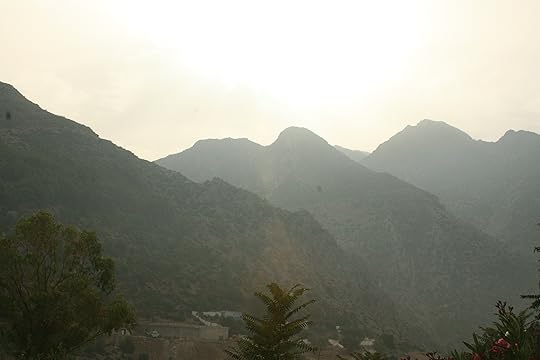
It is said that a Sufi dervish wanders the earth because the action of walking dissolves the attachments of the world, and that his aim is to become a “dead man walking,” a man whose feet are rooted on the ground but whose spirit is already in Heaven. I wonder if I am at this moment a dead man walking, though I can barely take a step, so perhaps it is a dead man stumbling.
At last I see the Kelaa canyon rim, I think… it wobbles rubbery in the heat. I disbelieve my eyes, and strain to refocus them… But the precipice is real, and though it feels as though every molecule of moisture has been sucked out of me, the sight gives me another wind. I totter and lurch downwards, mentally munching nothingness. In most circumstances a bridge is a good trek spoiled, but here it is nirvana. I spy the span, and Walker standing waving back at me. I make it to the bridge, and give Walker a hug, and then find a spot to lay down in some shade. Anass stands above me, his mouth turned down at the corners like a cartoon. He grabs a palm-frond and waves it around my face, like an Orthodox priest blessing me with his thurible. Walker grabs my hand and fixes me with his eyes.
“Dad, I was getting worried… and wanted to call for help, but cell phones don’t work here.”
I can only grimace… my tongue is gluey with shame; my lips round to form my son’s name, but no sound comes forth. My lips feel like dry corn husks chaffing against each other. I feel as though the sun had ruthlessly charged through my body, and left something less than before. It burned my outer layer and left me floating numb, a derelict shell.
Walker fetches me the last of his water, and I drink it greedily. But my throat cries for more. Walker gently pries the water bottle from my rigid fingers. Anass tells me I was gone for four hours, and that he was about to head down to Akchour to find a landline and call for a rescue team.
I take a long rest, and Walker and Anass fetch more bottles of water, which I down as though they are miniatures. Then, with Walker helping me I slowly make my way down the path, like a battle-wounded soldier on retreat. When we get to the Akchour reservoir, both Walker and I pull off our clothes, and jump into the cold, cold waters. There is an overwhelming feeling of Tissir, an untranslatable Arabic word for a state of bliss and luck.
That evening, back in the powder-blue cocoon that is Chefchaouen, we all take dinner at an open-air restaurant in the Plaza Uta el-Hamman, across from toffee-colored walls of the 18th century Kasbah. The legendary ruler Moulay Ismail built this Kasbah, but it is most noted for the hardheaded local chief, Abdu l-Karim, who was imprisoned within the walls in 1926 by Spanish troops. With his fall, the Spanish took over and held northern Morocco for the next 30 years. Now, it is a garden and a tourist attraction.
Between bites of our goat-meat tajine, washed down with freshly-squeezed orange juice (alcohol is prohibited here, though not apparently kif, which grows in abundance in fields surrounding the village), I ask Anass why he lied to me about so many things.
“You are strong, Mr. Richard. But as a guide, as a Moroccan, I was worried about you. I watched you the first hour, and saw someone more proud than wise. I did not think you would listen to my ideas. So, I tried to turn you around. These were my ways. I am sorry.”
But I was glad to be alive, dining in a blue cloud, across from a Kasbah. Like the nomad, when there is no more, it is time to leave.
The post Deadly Morocco: Time Wounds All Heels appeared first on We Said Go Travel.
October 29, 2013
Pondicherry: Memories of a College
 JIPMER, my alma mater, is one of 3 Premier Institutes in India for Medicine. It is located in the quaint former French Colony of Pondicherry on the East coast of India. The acronym stands for Jawarhalal Institute of Postgraduate Medical Education and Research.
I graduated from here in 1999 and throughout those five long years I spent studying, drinking, eating, gossiping and living a typical College life, I had harbored no qualms that these days would eventually end. Nostalgia happens after the fact, not during it, and till I actually graduated, it had never struck me that my own Convocation would hold such bittersweet memories.
This day marked the day I was leaving a College and a city that had embraced me, made me a doctor and captured my soul.
To start with, this nostalgia did not last too long. The practicalities and worries of an undefined career took precedence over any notion of a romantic nostalgia of College life. I had moved on, but nostalgia was never far away.
JIPMER made me a doctor. It was a place where study was intense and marks were always earned. It was where I was introduced to the art and science of medicine, a place where patients were always people and not a disease, the place where I helped bring a new life in the world and also the place where I watched my first patient die in front of my helpless eyes.
I grew up in JIPMER, in girth and otherwise. I made friends who remain my best till today. I met teachers who shaped me in many ways, and as strict and uncompromising as they were, they always had our best interests at heart. I lost my best friend to a highway accident, I was a victim of the rules of class attendance and I was the chief patron of many a bar and restaurants that dot this wonderful city.
And I fell in love with Pondicherry with all its faults and virtues, its French avenues and its roadside shacks, its pristine beaches and its chaotic traffic, the peace of Auroville and the madness of a small South Indian town at peace with its own French heritage. 14 years after I have left, no other city feels more like home.
They say nostalgia and memories bind us to the past and we should let go, move on and live in the present. But how do you move on from something that has become a part of you and in some ways, defines you?
My memories live on in the friends I made and the experiences we shared, in the forgotten traumas of failed exams and the vivid exhilaration of the successful ones. They will live on in the small hostel room I occupied briefly, in the classrooms I was sometimes present in and in those random, seemingly disconnected ways that make up memories. They live on in the conversations we shared in seedy bars and fancier restaurants, in the shared responsibilities of a College Festival and the intangible feel and atmosphere of an Institute that for me, will remain a storehouse for my thoughts and my memories.
But JIPMER has changed. I saw that when I visited it this year and the changes have been sudden and dramatic. New buildings have come up over a campus once blanketed in green, old haunts have disappeared and old faces have long since retired or moved on. My memories of my education-the Dissection Halls, the Labs, the Labour Rooms where we spent 14 straight days and nights-all have moved into newer premises. And they have taken my memories with them too.
In my more idle moments, especially when I sit down and try to complete my own life story in JIPMER in the blog that I write, I lie back and think of my alma mater. I think of an old friend I meet now, sometimes by fate and sometimes by accident, a friend who at least on the outside, changes irrevocably with every meeting, a friend who has lost that familiar dimple, that glint in the eye and that innocence of youth, a friend whose familiar looks have fallen under the surgeon’s knife, and a friend whose personality and character have perhaps changed, but as I stand on those old familiar roads and look at what is still there, I see a soul that is still pure, is still free, and I know in that moment that I will always be welcomed back.
Au Revoir, Jipmer. Till we meet again.
Author Bio: I am a practicing surgeon in Malaysia. I write very occasionally, maintain a blog on my random musings and am passionate about Cambodia and Buddhism. I am also quite weird, according to all the saner friends I have! Twitter: @jipmerdays
The post Pondicherry: Memories of a College appeared first on We Said Go Travel.
Couchsurfing in Langkawi, Malaysia
With 8 dogs and 37 cats, Jeff’s house is not your typical couch surfing pad.
We’d been couchsurfing in Australia and New Zealand, but this was only my second time trying it in Asia. I was a bit nervous because of the cultural differences, but wanted to try it anyway. It would be an adventure, right?
We arrived on the island of Langkawi by a nauseating 3-hour boat ride from Penang. Jeff met us at a pizza shop and showed us to his house, a quaint two bedroom nestled in a little patch of forest. Wild monkeys greeted us from the trees.

Resting on the hammocks on his porch, one of his cats clambered onto my lap, and Jeff told us his story.
Jeff studied to be an accountant and was employed in the USA for 14 years, but spent most of that time traveling – he would work for 1 month and travel for 3. He visited 40 of the 50 states while he was there.
An adventure junkie, he learned how to base jump, skydive, and even tried flying with a wingsuit. He told us about a trip to Peru where he base jumped into a cave and spent 9 days crawling through to get to the other end. He has kayaked down Niagra Falls, swam with sharks in Australia, and base jumped from the KL Tower.
After he grew bored of accounting, he trained in animal behavior. Now he has settled in Langkawi, where he volunteers at the local animal shelter and adopts needy dogs and cats. He makes a income from pet-sitting and takes care of stray dogs who live at temples around the island.
Jeff is one of those inspiring people who decided to make his own path in life. Instead of succumbing to the rat race, he followed his passions, and now lives a life he created for himself. Every time he sees a stray dog, he tries to help in some way. He hosts weary travelers, and even tried to pay for our meals!

Unlike other cochsurfing hosts, who are often too busy to spend much time with surfers, Jeff showed us all around the island. For three days he was our guide, taking us hiking, kayaking and caving. He is a generous and kind person, I’m lucky to have met him.
Couchsurfing.net is a website that connects adventurous travelers with generous locals offering a place to stay at their home. The hosts tend to be adventurers who have traveled themselves and want to feel connected to the traveling community. There is no typical experience since all people are different! Sometimes you literally sleep on couches, but often hosts will have a spare room.
Couchsurfing continues to inspire me and shows me the generosity of the world. There are horror stories out there, and some use it as a hook-up website, but if you are careful and read over people’s profiles and references it is easy to avoid this. I’ve couchsurfed with students in Wollongong, Australia, and one of the hosts slept in her friends bed so I would have my own room. In Kuala Lumpur, Malaysia, the anarchists I was living with cooked me breakfast.

While hostels are a great place to meet other travelers, it is not easy to meet locals there. Couchsurfing has expanded my view of what is possible through travel. It gives me faith in the world and the generosity of people. Even if I got a few dog hairs on me, it’s always worth it.
The post Couchsurfing in Langkawi, Malaysia appeared first on We Said Go Travel.
Indiana: It Is Here
 Suddenly I am there. My end destination lies less than a mile ahead, but this is the piece that will take me there, the piece that has gotten me this far. Without anxiety I move forward. Each movement welling a memory within me. Each passed feature cherished as an old friend.
It is here that I existed among the simplest and yet most profound. It is here that day after day my legs carried me into a world of awe and wonder. It is here that I occasionally hit the ground running, but more often walked slowly.
It is here that I witnessed butterflies alight on morning glories and spiders spin amidst morning dew. It is a here that I heard birds sing a song ever new. It is here that I paused to point out passing caterpillars to the wide-eyed child as we strolled along. It is here that I recognized wonder in eyes so new.
This is where the smallest of insects preformed an orchestrated harmony for an audience of one. This is where I called aloud to the maker of the heavens. This is where I viewed skies of purest blue and clouds of fullest white, sunsets and rises that stopped my feet and fixed my gaze. This is where I witnessed the marvel of seed to stalk, the effects of the sun, the rain, and the shade. This is were the elements coaxed the seed to harvest and my skin to weathered brown. This is where I acknowledged change, from green to red, orange, and yellow, from living to falling slowly down.
It is here that the noise of the world passed only once in a while. It is here that the yearning for silence brought me, where silence communicated the meaning of sound. It is here that I heard the sound of the cricket and acknowledged its unparalleled existence in the world. It is here that I realized that the cry of the cricket paralleled the cry of so much more. It is here that I reflected, with awe and wonder, on the importance of the individual. It is here that I delighted in the existence of humanity.
This is where I came to terms with my state of life; my dreams, my passions, my desires. This is where I begged my heart to let him go. This is where the cracks in the pavement coursed through until tended to and sealed back together. This is where the cracking and sealing, a part of the seasonal routine, made striking resemblance to the condition of my heart. This is where clarity broke me to build up something new.
This is the way I took, driving down and away, when I decided to find rest in an unrestful way. This is the place I left when I didn’t know that to truly come I would have to go.
It is a place that gained my trust and then slowly revealed its beauty. It is a place that repeatedly shook me anew, and continues to shake me. It is a place that beckoned me; be attentive to the smallest of creation.
A welcome site to a weary wanderer. A road I claim as my own. 750 E, Indiana. I am home.
About the Author: Growing up in rural Indiana, Elizabeth longed to explore the “outside world.” As a college student she had the opportunity to study and travel throughout Europe, an experience which opened her eyes to the joys of diversity. As Elizabeth traveled, she was struck with a sense of awe and wonder for the people and places she encountered. Upon returning home she was struck once again.
The post Indiana: It Is Here appeared first on We Said Go Travel.
October 28, 2013
India: Love Madurai
 Whilst in Madurai, a heaving, working, shouting city of blackish earth streets and slow-moving buffalo, we take a rickshaw to Meenakshi Amman Temple. The thirty minute drive lasts for an eternity, and I disembark with a dam of unshed tears. Cycling through the slums, weaving in and out of sloppy wet mud and through rivulets of brown sewage, swerving to avoid mounds of waste and trying not to scrape against corrugate hut walls or bump into clay shacks numbs the senses. The people of India, as Gregory David Roberts writes, ‘know how to shout with their eyes.’
The huts lean against each other almost for support; wiggly, uneven and endless rows of miniature homes that share the same sheets of plastic, ripped apart sacks, coarse pieces of tarpaulin and crunchy edges palm leaves for their walls, floors and roofs. Some are box-shaped, others more like tents- triangular and tucked further back from the path. Everyone seems to be crouching, squatting or kneeling, washing in basins or grinding rice on stones. Ladies scrub at clothes in gutter puddles; men pick at bits of iron or fiddle with spokes and wheels and everywhere, from all corners of the slum village, children peek and smile out at us. They race to catch up with our rickshaw, sprinting in the mud as fast as their rubber soles will carry them and then screeching to a halt, extending a soft black hand or simply opening their faces with one ear-splitting grin.
“Hello! Hello! Namaste!” they shout. Their eyes gleam with excitement and they giggle hysterically when we shout our replies. The parents are less forthcoming, preferring to stay where they are rather than speed into our paths, but their smiles are every bit as jubilant and beautiful as their children’s. They wave at us sheepishly, snickering when we wave back and blinking with the sense of occasion. Some encourage their babies to wave too, prodding them forward and pulling them from behind doorframes to come into view.
When we burst into sunlight again, spiralling out of the slum valleys and back onto roads, traffic roars past us; cars, bikes rickshaws, auto-rickshaws, mopeds, motorbikes. The sound is deafening- a relentless attack of horns and bells and slamming brakes. The rickshaw drivers, barefoot and with calves ripping beneath taut brown skin as they carry the weight of the cart behind them, pedal furiously to keep up with the surging vehicles. We cross a bridge, zipping past line after line of sleeping bodies under loincloths. They are dry, at least. Cows eat their way through the growing, swollen piles of sewage on the roadside.
About the Author: Hannah Thompson-Yates: I traveled to Asia for the first time in 2010. Fresh from university in rainy Wales, I was a fair skinned, weak-swimmer with little tolerance for spicy food, cockroaches or long bus journeys. Six months later and I was hooked. Three years later and I still can’t bring myself to leave this wonderful part of the world. I love to travel, write, teach and indulge in serious amounts of sunshine and naan bread.
The post India: Love Madurai appeared first on We Said Go Travel.
Five must-visit Caribbean resorts
With its glorious weather, sandy beaches and lukewarm turquoise seas, the Caribbean islands are seen as a dream holiday destination for many people. Temperatures tend to range from a minimum of 20C in January to above 30C in July, so you can be sure of getting some sunshine whenever you travel.
The one problem that some tourists may have is deciding which island and Caribbean resorts they want to visit. Here Columbus Direct shares a list of five areas which should certainly be considered by any tourist who fancies veering off towards the Caribbean Sea…

Bathsheba, Barbados
Barbados
Barbados may be one of the smaller Caribbean islands, but it’s home to fun, adventure and paradise that belies its diminutive size. There are more than 70 miles worth of pristine white beaches on which to soak up the sun, enjoy a rum punch or try out some water sports.
The West coast really comes to life at night-time. Its delightful range of bars and restaurants create a carnival atmosphere wherein tourists can eat, drink and dance to jazz, reggae or traditional chart music.
Some of the biggest party nights occur during the island’s annual festivals. The three-day Barbados Food & Wine and Rum Festival begins on November 22nd, whilst the grand celebration of the nation’s independence takes place on November 30. What a perfect excuse to book an end-of-year holiday!
St Lucia
St Lucia could be the perfect choice for those who love the idea of exploring a tropical paradise. The island is covered with miles worth of glorious rainforest to trek through, with plenty of luxury hotels and tourists attractions camped within it.
Visitors are urged to go snorkelling at the foot of the iconic Piton mountains or join a guided tour on a hike up to the top for some of the most incredible views of their surroundings. There’s also the opportunity to try horse-back riding across the beach, take the whole family to a water park or explore the forest wildlife during a relaxing walk on the beach.
Ideally, tourists would visit the island during Carnival celebrations, which run throughout June and July.

Turner Beach, Antigua
Antigua & Barbuda
Antigua is another hugely popular tourist destination in the Caribbean. Once again, glorious coastlines, fine dining and friendly locals are the norm. Visitors have the opportunity to snorkel with stingrays, zip-line through tropical rainforests or relax on a luxury cruise.
Antigua has its own Carnival which takes place in July, yet others could be more excited by the prospect of National Sailing Week, which falls in April.
There are plenty of boat trips to nearby Barbuda as well. With a population of just 2,000 people, it’s often described as the Caribbean’s best kept secret. It can feel like your own personal tropical island getaway.
Dominican Republic
One of the largest and most vibrant areas of the Caribbean, the Dominican Republic is perfect for those who want their holiday to feature a bit of everything.
There’s 250 miles of coastline to enjoy, but so much see and do in the centre of the island as well. Try white-water rafting through Jarabacoa, exploring underground caves in Juan Dolio or riding a cable car almost 800 metres above sea level in Puerto Plata.
Experience the sights on top of the Caribbean’s largest mountain – the 3,000m+ high Pico Duarteis. Marvel at the beauty of the Caribbean’s largest lake – The Enriquillo. You can even cross the border and enjoy the attractions that neighbouring Haiti has to offer. It really is the island that has it all.
Jamaica
Visit Jamaica and find out that the stereotypical relaxed fun-loving stereotype of the locals is completely true to life. The culture is one of easy living, dance, fun and celebration.
The traditional tourist attractions to enjoy include beaches, bars restaurants and the world-famous Bob Marley museum. But the best way to get the most out of the island is to mix with the friendly locals in the capital Kingston, the party city of Montego Bay or the beautiful coastal region of Ocho Rios.
In truth, the majority of Caribbean islands make for the perfect holiday destination. Those who make the effort to visit any of these fantastic nations can consider themselves truly blessed.
About the Author: Sam Jones is a full time writer who loves to travel to exotic places and experience some of the most unusual and brilliant places the world has to offer. Find him on Google+
The post Five must-visit Caribbean resorts appeared first on We Said Go Travel.
What The Kumbha Mela Taught Me
 Curiosity, with certain scepticism, made me say yes, when asked if I would like to come along to the Kumbha Mela, the largest religious congregation of people in the world. Curious because over the years, I have seen innumerable photographs that have captured the Mela and wanted to see for myself its appeal.
To see if the mysticism that gets captured in the photographs is what defines the Mela or is there a bigger story that one has to experience. Sceptical, because I am a person who does not enjoy crowds. I am also a person who believes in praying in private and who finds the throngs at religious places distracting and dare I admit, annoying.
I expected the Mela to leave me with the memory of a kaleidoscope of dramatic and theatrical images. Instead I learnt a subtle lesson from the very crowds of people that I wished to avoid.
It all started as we approached Allahabad, the site of the Mela. As you near the city, you start to notice groups of people, carrying their luggage on their head, making their way purposefully towards their destination, by foot. You don’t know them but understand enough to know that these are people of very modest means, who have made a long and tiring journey with their meagre savings. This is when you first confront the faith that is the bedrock of this Mela.
It is past nine at night when we reach Allahabad and someone suggests a quick look around the Mela grounds. The crowds would have retired for the night and we would get a glimpse of this town that has sprung up for a few weeks, only to be completely dismantled when the Mela ends.
The first thing that will catch your attention when you arrive at the grounds is the sheer size of it. I had read the statistics being bandied about by the media on its size and the logistics involved but when seen with your own eyes; it has the power to stun you into silence. Your eyes will take in the millions of lights and tents that extend as far as your eye can see, the various barricades erected for crowd control, the extensive water and sanitation facilities, the large tents put up by various ashrams and sadhus for their followers, not to miss the gaudy and colourful lights that light up the entrances to these tents. As your eyes take it all in, your ears will pick up strains of an eclectical mix of music emanating from the larger tents that mix with the constant messages, mostly of missing persons, being broadcast by the public announcement system.
But, amidst all that, one sight endures. Around the Mela grounds, you will notice large groups of people, sleeping out in the bitter cold. They sleep huddled together, with their meagre belongings, so desperately poor that they have no choice but to sleep in the open, defenceless and vulnerable. You know that many of them are the same people you saw while entering the city. So compelling is that image that one can’t help think that it must be faith that compels one to endure such hardship to make this journey.
Faith that this journey they make will remove all that is holding them back in life. Faith that compels them to make this journey so that their children can lead better lives. Faith that submits and surrenders to a Higher Power. This is not faith that should be mocked or patronised but rather so pure and simple in its innocence that it is humbling. This is not faith that imposes or interferes but so all-encompassing that it should never be exploited for narrower, parochial aims. This is not faith that tolerates but accepts and accommodates another. This is the faith that defines and explains India. The naysayers will call it blind faith. I call it absolute faith. Such is the power of that image that it mocks your scepticism and melts away your doubts.
So, early next morning, at the time called “Brahma muhurat”, an hour before sunrise, we head towards the Sangam, the point where the rivers Ganga and the Yamuna meet the mythical Saraswati. The place where one takes a dip to wash away the sins of one’s life, present and past.
It is calm and peaceful with an air of expectancy, as we travel by boat. The millions of lights of the Mela grounds shimmering in the water and the river as dark as the pre-dawn sky. Someone jokes lightly, it’s a good thing it is dark, we can’t see how dirty the river is. My thoughts to turn to what my mother had explained before our journey had started, “You may believe that your sins are washed away with the dip, but remember, the person who committed the sins, remains. So, let this dip be symbolic of letting go of all negativity and resolve to be a better person.” A simple sentiment that can never find enough mention.
As we approached the Sangam, there is a line of boats moored, from where one can jump into the waist-deep river. We are among the first to arrive. There is no hesitation, no doubt, no scepticism. I jump into the water, say a prayer for my father and take a dip and surrender. In the largest religious gathering in the world, I would have my moment of private prayer.
On the journey back to the river shore, I would understand why the Kumbha affects so many so deeply. It makes you look inwards and acknowledge your failings. But more importantly, it gives you the hope and resolve, to let go of all negativity and be a better person. In a world where we can be increasingly petty and egoistic, the Kumbha allows us to step back and reassess our lives.
Within an hour, we would leave Allahabad. The crowds of the faithful had only increased. Two days later, I would hear news of a stampede and days later, of heavy rains that would create havoc on the Mela grounds. The images would come back. Of those groups of people and their faith, who had braved all odds to be there. I would say a prayer for them. Because, while I may have gone to assuage my curiosity, they had instead taught me a humbling lesson in faith.
About the Author : Sarvani has learnt that the most unexpected journeys are the most memorable. In the past few years, along with travel, she has developed a passion for baking and writes a blog, ‘Baker-in-Disguise‘
The post What The Kumbha Mela Taught Me appeared first on We Said Go Travel.
October 27, 2013
Florida: Winter’s Tale
 Winter, for some visitors to Clearwater Beach, Florida is a season to escape but for others, especially those in need of inspiration, she’s an animal to seek out.
Named for the season in which she was rescued, Winter is an eight-year-old dolphin who inspires child amputees, Iraqi war vets and medical researchers interested in recent developments in prosthetic limbs.
At two months old, Winter got caught in a crab trap. By the time rescuers from the Clearwater Marine Aquarium found her, she was not expected to last the night, so severe were her cuts from the trap ropes. Fifty percent of the staff voted to euthanize her, but Winter persevered, minus her tail.
The plucky dolphin started swimming like a fish until experts realized these movements would cause spinal damage. Next came the series of prosthetic tails to match her growth spurts and Winter learning to swim all over again.
As a result of her unfortunate accident and amazing recovery, Winter has become a movie star and a media sensation appearing on “Good Morning America”.
Everyday, visitors to the Clearwater Marine Aquarium can watch Winter interacting with her trainer, Allie Stone, as she adjusts to her new tails. The latest one features a stainless steel joint that propels her forward.
To the delight of Winter and her fans, Allie turns the exercise into a play session. Winter swims around the pool for a few minutes before returning to Allie for pettings and a few adjustments. She appears happy with the new appendage, ducking away when Allie tries to remove it.
Totally impressed with the show, visitors including children, have been donating toys to the dolphins and money to build Winter’s new home. The larger, circular pool allows Winter to swim continuously and provide a hospital emergency room for other rescued sea mammals like her dolphin friend, Nicholas.
Nicholas, a 375 – pound victim of severe sunburn caused by beaching, has been at the aquarium since he was orphaned at six months. Today, he shimmies around the pool in a series of comical forward thrusts while maintaining an upright position.
Spectators reach out to pet him before he darts away to grab a fish from Allie. The dark streaks running from his forehead to his dorsal fin are the only evidence of his life threatening sun exposure.
The show’s grand finale finds Nicholas competing with Rudy, a younger male dolphin, to see who can jump the highest and create the biggest splash, soaking the bolder kids who hug the edge of the pool. Who needs theme parks when young and old alike can enjoy the antics of these mammals at a fraction of the price while supporting a good cause?
Clearwater’s love and respect for her dolphins is also evident in the attitude of her tour boat operators. As a static burst of the ship’s radio advises of dolphin spottings at our six o’clock position, northern tourists rush to the back of the boat, anxiously scanning the powder blue and aqua horizon.
“Dolphins are highly intelligent creatures and sometimes they’re just not in the mood to play. If that’s the case, we’re moving on”, Captain Jack announces.
Fortunately, the duo, lured by the wake of the 40 – foot tug seem eager to follow, albeit from a safe distance. Moving along, Captain Jack reminds us of the strict rules protecting Florida dolphins.
Respecting the dolphins makes good business sense. If these Atlantic bottlenose feel threatened or pursued, they will abandon the area, or worse, beach their young. Most times, according to Captain Jack, the dolphins are happy to play in the wake of the boats and seem almost as curious about the visitors as they are about them. Indeed, scientists have made underwater recordings of dolphins mimicking the delighted squeals of tourists.
While visitors will never see Winter or Nicholas performing on the larger stage of Clearwater Bay, successfully rehabilitated dolphins like Rudy, who have retained their hunting skills, will be playing here for years to come thanks to the staff of the Clearwater Marine Aquarium and the generous donations of loyal fans.
About the Author: Sherell Purcell
The post Florida: Winter’s Tale appeared first on We Said Go Travel.
Arigatō to Japan
 Asante! xièxiè! Gracias! Tack så mycket! The first word any traveller learns in their new destination, Thank you! A phrase which shows humility, compassion, and a sincere gratitude used to acknowledge the new cultures, the diverse lifestyles, and the natural beauty of the place which you are exploring. The past few years have taken me to all corners of the globe, thanking people, children, even animals for the experiences they have given me and the warm hospitality they have shown (most of the time!) One place is etched in my mind however for showing me gratitude, showing me a way to give thanks like no other. This place, this experience was in Tokyo, Japan.
March 2013, I ventured solo to Tokyo for a week. I knew this bustling city, bursting at the seams with people would distract me from any feelings of loneliness. I did not expect to find the peace, serenity and awe inspiring silences which I did. Japan, a country of discipline and innovation, could teach us all something.
I signed up for a Traditional Japanese Tea Drinking Ceremony, ironic for the British traveller who does not drink tea, however I knew this would be far more than just a cup of ‘cha’. We were taken to a small wooden house, nestled in the most pristine of gardens, friendly and welcoming in the cool, crisp March air. We circled the centre table, and sat in expectant silence. A petite, shy, yet self-assured lady emerged from the back door, closing it softly behind her without a sound. Her movements were so precise, so intentional, and so silent that they could not be ignored. She sat composed at the small table on the floor in front us, unfazed by her eager audience. The aroma of the tea was mixed with sheer intrigue and anticipation. Each of us was offered a small lilac sweet, to accompany our tea. There was no rush, no hustle, and each sweet was offered and received with a polite, gentle nod of the head. Once the tea had been prepared, the tea drinking customs were demonstrated to us. There were no words in the Tea Drinking Ceremony, no sound at all in fact, just a series of movements, gestures and customs used to show gratitude. Japan was a country where I thought language would be a problem, but sat in this Tea Ceremony, almost 6,000 miles from home I knew exactly what was being said.
I went over the etiquette of tea drinking over and over in my head, desperate to repay gratitude and discipline I had been shown. I felt clumsy and nervous as my jade coloured cup or ‘Chawan’ was handed to me, without a sound in such a confident, yet friendly manner. I was inspired, I was in awe, and I did not want to disappoint. After an intense, yet tranquil few minutes it was time to drink or tea. We all followed intently, turning our cups clockwise twice, taking three smooth sips of our tea, being sure to leave some for the next guest as tradition suggests, placing our cups back down, and wiping the rim. I sat back, and breathed a sigh of relief, amazed at how this silent and composed atmosphere could make all your senses so alert.
The Tea Ceremony came to an end; it was time to thank our host, and our host to thank us. There are two ways to show gratitude in Japan. It can be said verbally, ‘Arigatō!’ But what does this mean, what does this mean to a traveller who doesn’t speak Japanese? As with every country I go to, I had learnt the phrase for ‘thank you’, but in this unique and awe inspiring culture, in made me question language. Anybody can say thank you, but as we are told, actions speak louder than words. We put our hands together, and bought them up to our chest. I lowered my head, I slowly blinked and bought my head back up, making eye contact with the host on the way up. With a slight smile thanks was given, no words, no language needed. Thank you for sharing your Tea Ceremony with me.
About the Author: Kate Chapman, a secondary school Geography teacher originally from the UK. Currently teaching and living in Singapore, I am travelling and eating my way through as much of (South East) Asia as possible.
The post Arigatō to Japan appeared first on We Said Go Travel.
We Said Go Travel

- Lisa Niver's profile
- 57 followers

