
Lisa Niver's Blog: We Said Go Travel, page 42
June 24, 2022
Anchorage to Talkeetna: Dream Trip to Denali
 View from the terrace at Talkeetna Alaskan Lodge, 9pm June 5, 2022
 I spent three summers of my seven years at sea sailing the inside passage of Alaska with Princess Cruises. I heard passengers talk about their pre-cruise adventure in Denali National Park and it has long been on my bucket list!
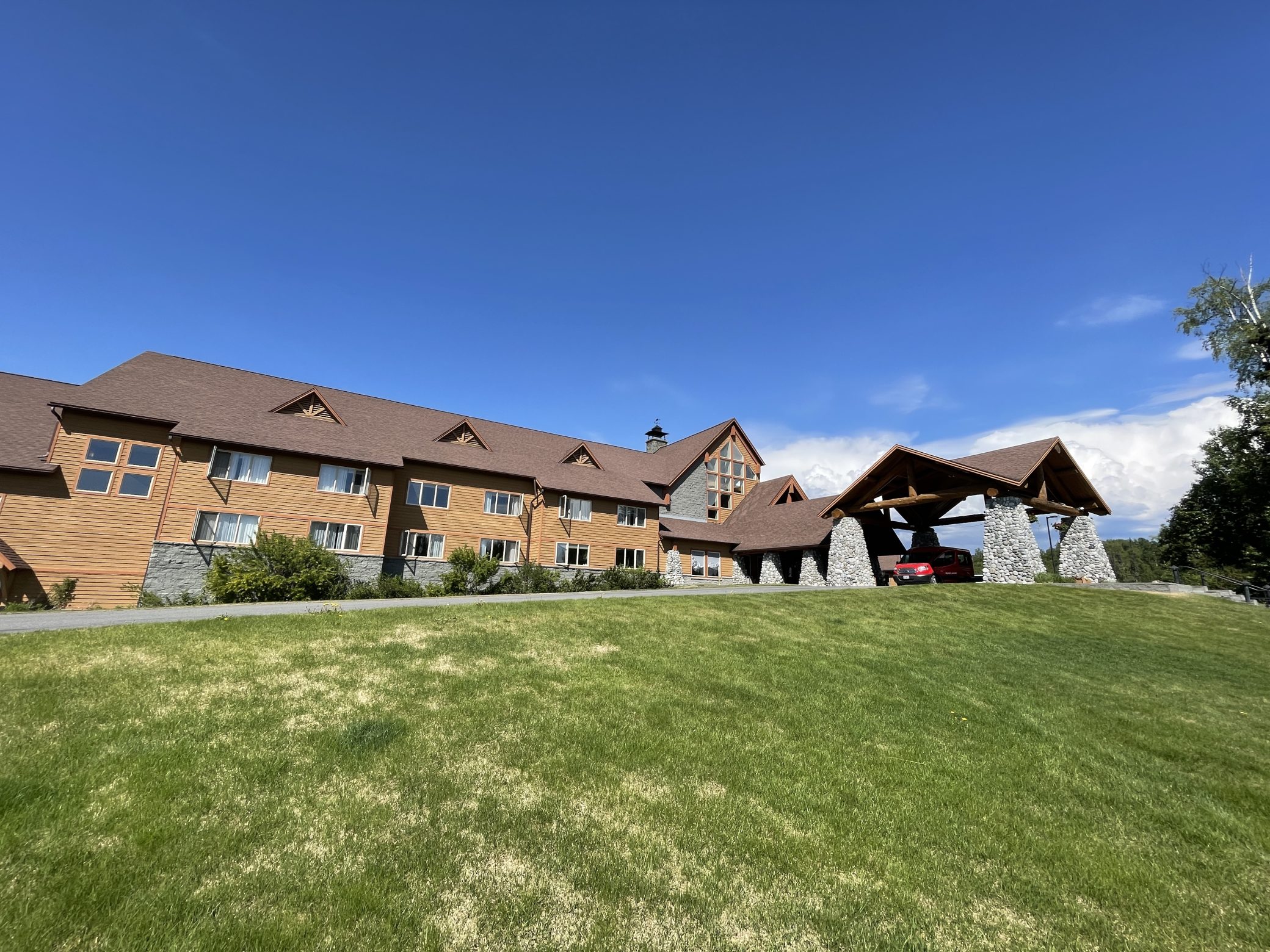 Talkeetna Alaskan Lodge
I absolutely LOVED my road trip adventure to Denali with Pursuit Alaska. View our Anchorage to Talkeetna experiences in the videos below and look for PART TWO with our stay at Denali Cabins, Denali Backcountry Adventure Tour and Moose sightings!
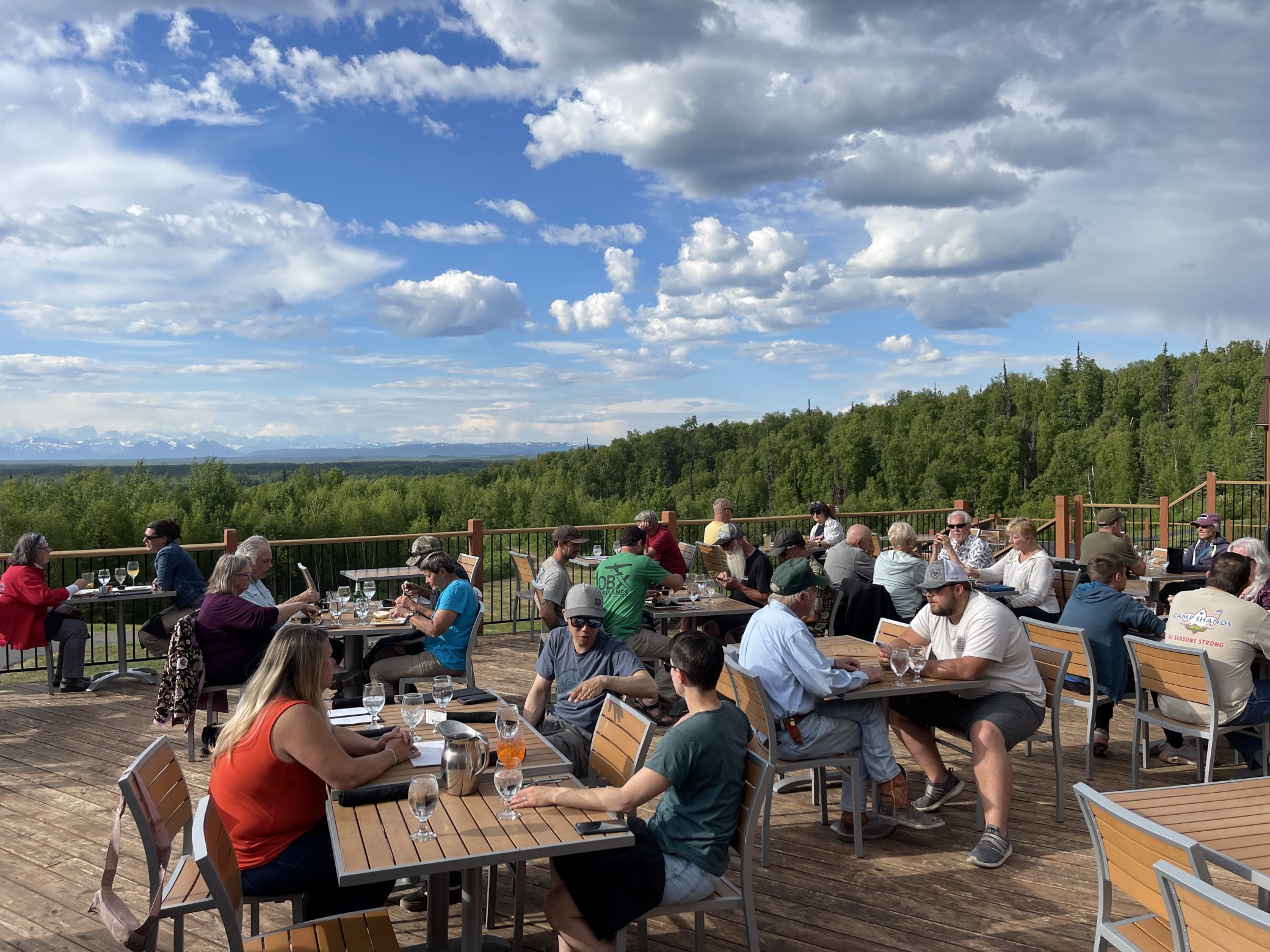 Base Camp Bistro at Talkeetna Alaskan LodgeWHERE to STAY and EAT in TALKEETNA?
The views at Talkeetna Alaskan Lodge were beyond belief! I could not believe how great this location is for seeing the mountains. You can have happy hour at Base Camp Bistro outside-and then move inside to Foraker for dinner.
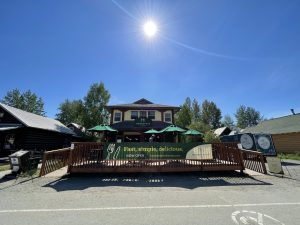
We had lunch at the brand new Homestead Restaurant. Chef Richard Pace is serving hearty dishes with a warm welcome right on Main Street!
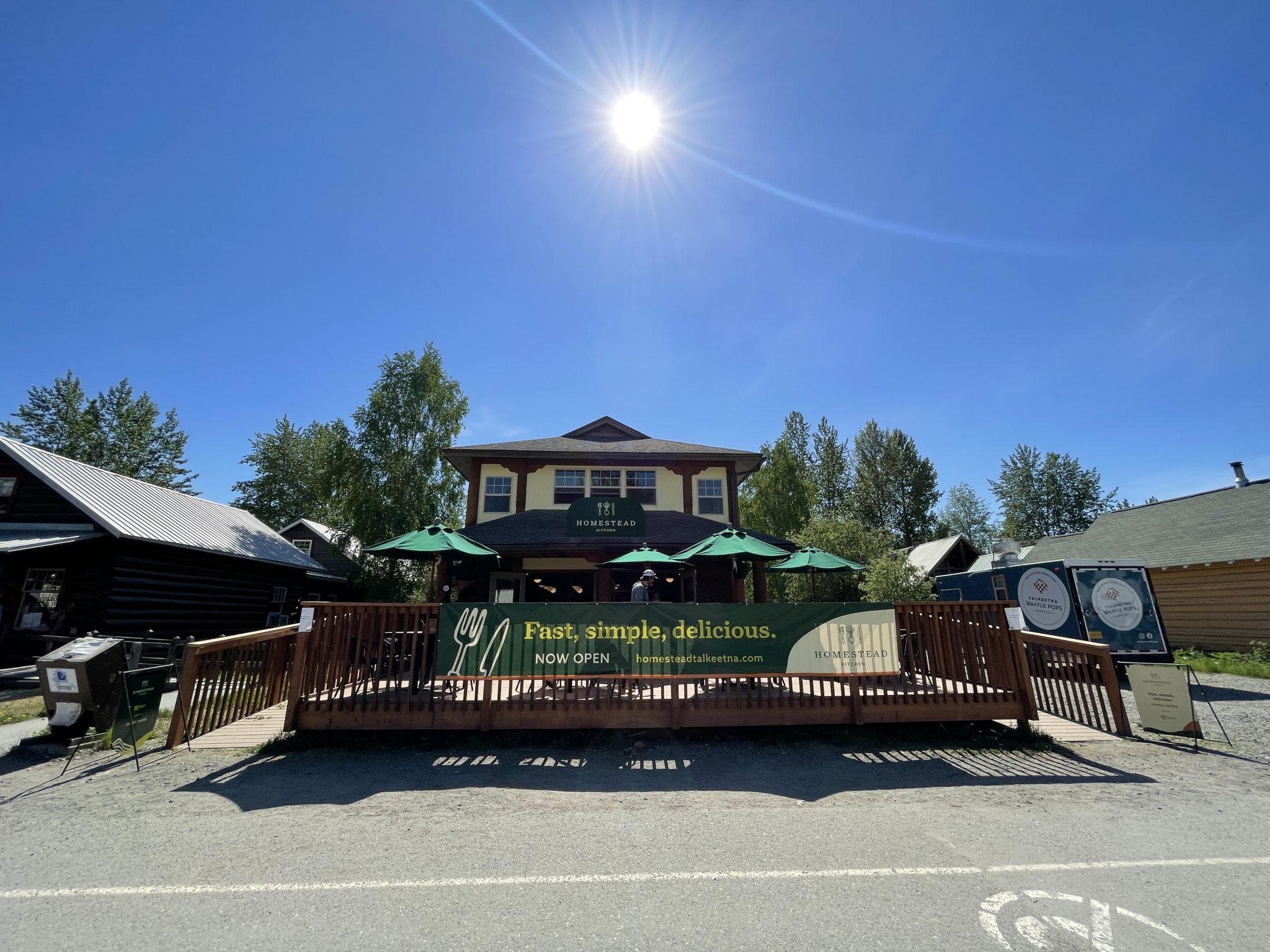 Homestead Kitchen on Main Street, Talkeetna, Alaska
After lunch, I walked on to Talkeetna Riverfront Park at the end of Main Street where three wild rivers, the Talkeetna, Susitna, and Chulitna join to form the “Big Susitna River.” I loved the panoramic view of the Alaska Range! I want to stay in the cabins on the trail. In town, I met the Mayor–a cat named Denali.
Seeing Denali from the air was exceptional! Thank you to our pilot Leon & K2 Aviation for an incredible flight seeing tour, the Denali Experience. It was so awesome! Thank you to Colin Dougan for the photos of me in the Cessna.
 Photo by Colin DouganI flew to Anchorage from Los Angeles on Delta which was also like a flight seeing tour!
Lisa in Anchorage talking about her bucket-list adventure:
What to see in Anchorage?I loved walking the Anchorage Coastal Trail. It is easy to go through the tunnel at Elderberry Park (5th & N) and I strolled along the water to Westchester Lagoon. Next time, I am going kayaking! I saw the planes taking off from the airport and saw a train go by! I also went to Centennial Rose Garden.
WATCH ALL OF MY DENALI ADVENTURE VIDEOS HEREThe post Anchorage to Talkeetna: Dream Trip to Denali appeared first on We Said Go Travel.


June 20, 2022
I am a 2022 Southern California Journalism Awards Finalist!

 Thank you Los Angeles Press Club and Southern California Journalism Awards! I am honored to be a finalist for Book Critic!2022 Finalist: 64th annual Southern California Journalism Awards
B13. CRITICISM OF BOOKS FINALISTS:
Lisa Niver, Thrive GlobalJohn Freeman, Alta JournalM.G. Lord, Los Angeles Times David L. Ulin, Alta JournalChris Willman, VarietyThank you to the Los Angeles Press Club and Diana Ljungaeus, Executive Director!During COVID, I focused on writing about books that helped people cope or felt like a way to escape in literature. Articles on Thrive Global:
Sizzling Summer Reads: Feel ALL Your Feelings
Huge Changes Happen in Tiny Steps: The Way of Integrity: Finding the Path to Your True Self
Is Your Life FULLY CHARGED? with Meaghan Murphy
Changing The World, One Connection at a time with Shelley Zalis from The Female Quotient
Prepare Your Pandemic Pivot with Ken Lindner’s 8C’s
Writing and Rewriting during COVID with Alka Joshi
Deepak Chopra Strategies for Success: Mental Health Awareness Month
Surviving COVID like a Superhero with Lisa Genova’s REMEMBER
Gaby Natale Shares her Steps to Success




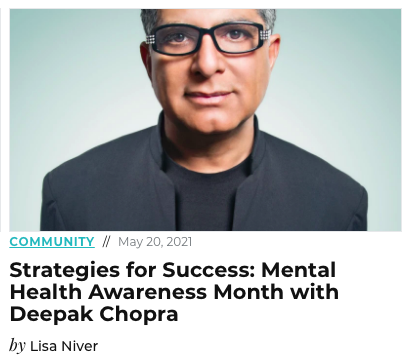


Lisa Niver has won many awards! From 2017 to 2022, in the Southern California Journalism Awards and National Arts and Entertainment Journalism Awards, she has won five times and been a finalist twenty times for a variety of broadcast, print and digital categories.
2021 Finalist: National Arts and Entertainment Journalism Awards2021 Winner: Southern California Journalism Awards for TECHNOLOGY REPORTING 2021 Finalist: Southern California Journalism Awards for BOOK CRITICISM2020 Winner: National Arts and Entertainment Journalism Awards for Book Critic. See all of Lisa’s book reviews here.2020 Finalist: National Arts and Entertainment Journalism Awards for Book Critic2020 Winner: Southern California Journalism Awards for print magazine article: Hemispheres Magazine for United Airlines2020 Five Time Finalist: Southern California Journalism awards2019 Winner: NAEJ Award for KTLA TV segment2019 Finalist: National Arts and Entertainment Journalism Awards in three categoriesCategory H2a. Soft News: Ms. Magazine: Polar Bears Can’t Vote So You Have ToCategory F6a. Soft News Feature – Under 5 Minutes—Film/TV: KTLA TV Oscars Countdown to Gold with Lisa NiverCategory C1b. Business, Music/Tech/Art: My Wharton Magazine article: Four Female Founders Share Their Origin Stories2019 Finalist: Southern California Journalism Awards for Broadcast Television Lifestyle Segment: Ogden Ski Getaway2018 Finalist for three categories of Southern California Journalism Awards:SCIENCE/TECHNOLOGY REPORTING: Smithsonian TRAVEL REPORTING: Popsugar FitnessPERSONALITY PROFILE: Saturday Evening Post2017 2nd place winner for Southern California Journalism Award Print Column “A journey to freedom over three Passovers” and finalist for Travel Reporting.More about Lisa Niver: https://lisaniver.com/awards/
 LOS ANGELES, CALIFORNIA – OCTOBER 16: BJ Korros and guest attend the Los Angeles Press Club’s 63rd Annual Journalism Awards Dinner at Millennium Biltmore Hotel Los Angeles on October 16, 2021 in Los Angeles, California. (Photo by Robin L Marshall/Getty Images)
The post I am a 2022 Southern California Journalism Awards Finalist! appeared first on We Said Go Travel.
June 15, 2022
The post appeared first on We Said Go Travel.
The post appeared first on We Said Go Travel.
June 12, 2022
Second Chances: Two Very Different Visits to the Dead Sea
I was looking forward to many new and exciting experiences when we embarked on our long-delayed tour of Israel and Jordan. One of them was a float in the Dead Sea. At 1,380 feet below sea level, this body of water is the lowest elevation on earth, and is one of the planet’s saltiest bodies of water, nearly ten times more saline than ordinary sea waters. The high salt content of this inland lake makes is unsustainable to any living creatures other than algae and some micro-organisms. However, the high salt content allows a human body to float pleasantly without effort.
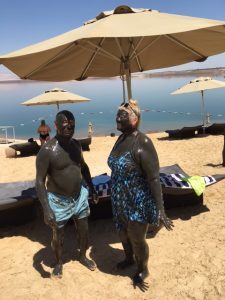
 The author’s husband, Hal Marzell, enjoys a relaxing float in the saline waters of the Dead Sea on a recent stay at the Hilton Dead Sea Resort in Jordan.
Hal and I actually visited the Dead Sea twice during our guided tour. The first time was early in the trip. We were taken to what I surmise is the equivalent of a public beach on the Israeli side of the Sea. We think it was named Kalia Beach. Although I don’t know for certain, this section of shoreline was very likely on the West Bank, an area carved out of the country of Israel that is currently controlled by the Palestinians.
The small beach was filled with energetic vacationers who, like us, were eager for a day away from the hustle and bustle of school, work, everyday lives. These people created a hustle and bustle of their own. Umbrellas constructed of dried palm fronds provided some protection from the sun, and every scrap of shade was inhabited by however many individuals could fit. Gentle misters provided some welcome relief from the heat. People were sipping soft drinks and licking snow cones and ice creams. What surprised me was the large number of teen-aged girls, obviously Muslim, who went to this beach completely covered in floor-length, long-sleeved dresses and hajib head dresses, even in the sweltering heat. Then again, the dark-colored fabrics may have served to keep them cooler, and certainly offered the wearer protection from sunburn. These young women provided an interesting visual juxtaposition from those who walked about in skin-revealing bikinis.
The changing rooms were crowded and chaotic, offering an atmosphere much like that of a high school locker room or a public swimming pool. The facility was not exactly unclean, but a large number of bathers had left piles of clothing laying around on the benches, presumably because they didn’t want to pay the ten shekels it cost for a locker rental.
The distance between the changing rooms and the waterline could be traversed on a small electric cart, the fee for which was included with the admission ticket, but once a sunbather disembarked from the cart, the distance to the short stretch of shoreline was exceedingly hot and discouragingly rocky, making it difficult to navigate on bare feet. And the water was oily—positively slick, and not in a positive way. And it exuded a strong, nasty smell of minerals and petroleum substances.
Neither one of us actually made it into the water.
This was a unique experience, all right, but not the pleasurable float of our expectations.
 Hal and Terry Lee Marzell explore the skin-care benefits of an all-body mud treatment on their recent trip to the Dead Sea in Jordan.
At the end of our guided tour, we visited the Dead Sea a second time. This time, we were staying at a high-end, luxury resort on the Jordanian side. The resort was located directly on the shoreline. We casually strolled from our hotel room down the sandy banks to the water’s edge. I noticed that a section of the lake was cordoned off where hotel guests could bathe, and beyond that area, I observed a hotel employee standing knee-deep in the saline water, collecting handfuls of dark mud from the sea bottom and placing it into a large bucket.
We selected a couple of comfortable lounge chairs shaded by a large, canvas umbrella. Then we skillfully navigated down a gentle incline, over a few rocks, and entered the warm, salty lake. Our bodies were delightfully buoyant in the water. We experimented with floating on our backs, then our stomachs, and then hooked to each other head to foot and head to foot. As instructed, we spent about 15 minutes there, languidly enjoying the buoyancy. The water was certainly salt-laden in the extreme, but was nothing like the oily, petroleum-smelling bilge we experienced on the West Bank side.
After our 15-minute float, Hal and I left the water and made our way up the sandy incline to a small spa hut, where two hotel employees, whose names were Hussein and Amad, bade us sit on a teak bench. Amad then proceeded to slather every exposed inch of us—head to toe, both front and back—with cooling, moisturizing Dead Sea mud. And then Hussein used our cell. phone cameras to take our pictures! After a brief period to allow the mud to dry, we made our way back to the water, where we spent some time washing the stuff off our bodies. Then we returned to the spa hut, where Amad vigorously rubbed each of us down with a salt scrub. He even washed Hal’s hair and massaged his shoulders, arms, and legs. Finally, the man hosed us off, leaving us both with skin as soft as a baby’s bottom.
 After the moisturizing Dead Sea mud and minerals have been washed off, Hal Marzell enjoys a shampoo and massage from a hotel employee at his luxury resort in Jordan.
Later, at the hotel pool, we happened to meet fellow-travelers Patrick and Loren, a couple from the tour group who had been with us during our first visit to the Dead Sea. Only six of the original 29 tour members who had travelled with us through Israel had opted for the Dead Sea extension. Only three of us were willing to sample the body of water on the Jordanian side.
“Did you go down to the shore and get the mud pack?” I asked the pair, describing our experience with enthusiasm.
“Nope!” declared Loren. She said her dip at the West Bank was, to use her word, “icky.” Her bathing suit still smelled like petroleum—in fact, everything in her suitcase was contaminated with the nasty smell—and she refused to get into the water again. No amount of assurance could persuade the two to change their minds, and in any case they were flying home in a few hours and the opportunity had pretty much passed.
The conversation left me feeling very fortunate that Hal and I were open to giving the Dead Sea a second try. I felt sorry for those whose only experience of the Dead Sea was the beach on the West Bank side. They will likely return home never knowing how wonderful it could have been.
“The Dead Sea!” I imagine them telling their family and friends. “That place was horrible!”
I learned an important life lesson from our two visits to the Dead Sea. And this is it: Sometimes you simply must be willing to give things a second chance.
Terry Lee Marzell is Lisa Niver’s (founder of We Said Go Travel) aunt and has written several books! She is an educator with more than 35 years experience in the classroom. Learn more at www.chalkboardchampions.org. AND she wrote about me!
The post Second Chances: Two Very Different Visits to the Dead Sea appeared first on We Said Go Travel.
June 8, 2022
The post appeared first on We Said Go Travel.
The post appeared first on We Said Go Travel.
The post appeared first on We Said Go Travel.
The post appeared first on We Said Go Travel.
June 5, 2022
My in-person @strandbookstore panel Friday 6/10 launches...
My in-person @strandbookstore panel Friday 6/10 launches the brilliant debut #SEENHEARDPAID by @WIRED's @halophoenix with luminaries @leighnew @ZibbyBooks @yayamilee @petercatapano @nytimes @fischerharbage @KaitWells DaniellePerez #writing #publishing #nonfiction #fiction #kidlit pic.twitter.com/GwQeVBPm4M
— Susan Shapiro (@Susanshapironet) May 29, 2022
The post appeared first on We Said Go Travel.
SEEN, HEARD and PAID by Alan Henry, Book Excerpt: Microaggressions

I am honored to share this excerpt from Alan Henry’s new book, Seen, Heard and Paid: The New Work Rules for the Marginalized. Alan is my incredible editor at WIRED!
 Alan Henry, Photo by Jack WallaceABOUT ALAN HENRY:
Alan Henry is a journalist and editor who writes and commissions stories that help readers make better use of their technology and embrace a healthier relationship with it in their lives. He is currently senior editor at Wired. He was previously the Smarter Living editor at The New York Times, and before that the editor in chief of the productivity and lifestyle blog Lifehacker.
 SEEN, HEARD and PAID: Microaggressions
Microaggressions are subtle, deniable actions that undermine a person or exclude or malign the individual. The actions are easily explained away by forgetfulness, ignorance, or anything but the malice that often inspires them. Perhaps a more blatant and specific example comes from my friend and colleague Hahna Yoon, who wrote a guide on how to deal with microaggressions for the New York Times. Yoon opens the piece by describing the time a friend’s boyfriend went out of his way to explain the concept and history of American Thanksgiving to her, as though she hadn’t been raised in the United States. She shared her experiences with online dating and being regularly approached by men who claim to love Asian women almost as a fetish, as though her entire self-had been reduced to her ethnicity. We could, as she explains, sit and argue over whether those people meant anything harmful by their actions. We could even discuss whether their actions are racist (they are) or whether their actions make those people racist (unclear, but that’s not the point). The point is that the actions are born from racial ignorance and result in behavior that’s actively harmful to the person it’s inflicted on.
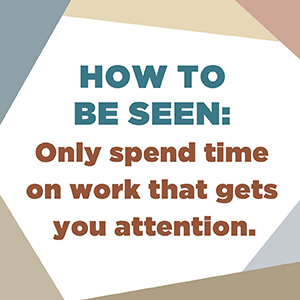
MICROAGGRESSIONS ARE SO INSIDIOUS BECAUSE THEY ARE HARD TO PIN DOWN
Their fleeting nature is key to why microaggressions are so difficult to pin down, examine, and respond to. People who face microaggressions struggle to find the right way to respond to them, because—and this is part of the malice—responding directly or overtly can be perceived as flying off the handle or playing into negative stereotypes of “bitchy” women workers or “angry Black” workers or cultural stereotypes where someone may not understand the subtleties of how badly they’ve been treated. Instead of focusing on the action and how the action was hurtful, the focus shifts immediately back to the intention of the perpetrator and whether that person meant to do harm, bypassing the need for apology or self-reflection on their part, entirely. In short, the man who approaches Yoon on a dating site and says “Wow, I love Asian women! Do you want to go out sometime?” may think he’s being flirtatious and approachable, but instead he has reduced Yoon’s entire self to the way he perceives her ethnicity as a tangible thing to be desired and obtained. He may not understand that this behavior is exploitative and racist, but it is. He may not have intended it to be this way, but that doesn’t change the fact that it is. And because he is opening with this microaggression, Yoon then has to either ignore it entirely or confront him on his behavior.

THE POWER OF “WHAT DO YOU MEAN BY THAT?”
One technique that has worked for me in moments of microaggression is to ask someone, completely seriously, “What do you mean by that?” Forcing another person to halt the flow of the conversation and reflect on exactly why you asked them what they meant— and forcing them to examine the meaning behind their words— is often enough to signal that they said something wrong. The question signals that they should probably stop short and think again before making a comment like that around you.
I’ve particularly found this technique helpful when talking with people who will make comments about a group I’m not a member of, or at least not visibly so. If someone makes an anti-Semitic comment, for example, a little stone- faced “What do you mean by that?” or “How did you come to think that?” goes a long way. In most cases, the reaction is embarrassment rather than defensiveness, and that’s enough. It’s not truly corrective, in that I don’t dispel the notions that caused the person to believe what they’re saying. But it’s certainly enough to make them aware that I don’t share their sentiment and I’m not the kind of person they should say such things to.

If you prefer an approach that focuses a bit more on educating the person or trying to correct their behavior for the long term, consider, first, letting them know that you’re sure their intentions weren’t malicious. This approach gives them the benefit of the doubt (although, frankly, some people don’t deserve it) and will help stave off the defensiveness. Then you let them know that what they said is harmful and explain why. Ruchika Tulshyan also has a suggestion. “In terms of making people aware,” she says, “I like to name behaviors and actions rather than label people. So I have found moderate success with saying ‘When you don’t invite me to meetings, I feel excluded. Could it be because I’m the only person of color?’ rather than, ‘You’re a racist for not inviting me to these meetings.’ ” I can vouch for this idea— unfortunately many people, especially privileged ones, perceive the possibility of being labeled racist, sexist, or otherwise discriminatory as somehow worse than the actual harmful treatment they inflict on others. Tulshyan continues, “Some re-search shows people with privilege can be so immunized by it, they may not even know they’re being biased. But if you’re met with anything else than genuine desire to learn and improve from the other person, I wouldn’t push the issue. It’s not the marginalized person’s problem to fix!”
Excerpted from SEEN, HEARD, AND PAID copyright © 2022 by Alan Henry. Used by permission of RodaleBooks, an imprint of the Crown Publishing Group, a division of Penguin Random House LLC, New York. All rights reserved. No part of this excerpt may be reproduced or reprinted without permission in writing from the publisher.

View this post on InstagramA post shared by Alan Henry (@halophoenix)
From Kirkus Reviews: “For members of minorities who want to navigate the corporate jungle, this book is an essential guide.”
Buy Alan Henry’s new book, Seen, Heard and PaidSeen, Heard, and Paid: A Q&A with #ASJA2022 Keynote Speaker Alan Henry
My in-person @strandbookstore panel Friday 6/10 launches the brilliant debut #SEENHEARDPAID by @WIRED's @halophoenix with luminaries @leighnew @ZibbyBooks @yayamilee @petercatapano @nytimes @fischerharbage @KaitWells DaniellePerez #writing #publishing #nonfiction #fiction #kidlit pic.twitter.com/GwQeVBPm4M
— Susan Shapiro (@Susanshapironet) May 29, 2022
The post SEEN, HEARD and PAID by Alan Henry, Book Excerpt: Microaggressions appeared first on We Said Go Travel.
June 3, 2022
We Said Go Travel

- Lisa Niver's profile
- 57 followers

