Matthew C. Mitchell's Blog, page 90
October 8, 2015
A Christian Prayer Catechism
 Introduction
This little catechism has been designed to help you learn a biblical theology of prayer. Each of the 27 questions and answers has been written so that anyone can memorize them and is accompanied with a few comments on the biblical basis for each answer.
I recommend that families memorize the questions and answers together. Individuals can do it in small groups, as well, to hold each other accountable. The key thing is to internalize this theology and to utilize it in your prayer life.
The Prayer Catechism is organized around four key questions:
A. What Is Christian Prayer?
B. Who is the God of Christian Prayer?
C. Does Christian Prayer Work?
D. How Should A Christian Pray?
It is my prayer that this little booklet will deepen your understanding of Christian Prayer and motivate you to engage in prayerful communion with God.
In His Grip,
- Pastor Matt
A Brief Theology of Christian Prayer: Questions and Answers
A. What Is Christian Prayer?
#1. Q. What is Christian Prayer?
A. Christian Prayer is personal communication between a Christian and God.
Christian Prayer is not getting God to do what we want. It is talking with God about the whole of our life and concerns and receiving the best answers from God, in God’s timing, and in God’s wisdom. W. Bingham Hunter says, “Prayer is an offering up of our desires to God for things agreeable to His will, in the name of Christ, by the help of His Spirit, with confession of sins, and thankful acknowledgment of His mercies” (From class notes on the “Theology and Ministry of Prayer;” an amalgam of the Westminster Larger & Shorter Catechism answers to the questions on prayer.) Bob Bakke says, “Prayer is essentially communion with God” (The Power of Extraordinary Prayer, pg. 17).
#2. Q. Why should a Christian Pray?
A. God wants all Christians to pray and uses our prayers to grow our relationship with Him and accomplish His will in the world.
Prayer is not optional. It is commanded and expected of all Christians (ex. 1 Tim 2:1-2, Col. 4:2, 1 Thess. 5:17, etc.). In fact, prayer is described in the Scriptures as a mark of being a genuine Christian (ex. Acts 9:11). Prayer is used by our Heavenly Father to increase our dependence and trust in Him, as well as our love for and fellowship with Him. Prayer is absolutely good for us! And it is good for the world because God allows our prayers to be used in carrying out His kingdom purposes (ex. Luke 11:2).
#3. Q. What is the most important priority in Christian Prayer?
A. The most important priority in Christian Prayer is to know God.
Prayer does not exist to tell God what we need or to twist His arm into doing it (Matthew 6:8). Prayer is primarily a means of relating to God (John 4:19-24). God is the greatest Person in the universe–worthy of all of our attention (Rev. 4:11, 5:12). The Ruler of the Universe has invited us to communicate with Him and grow in our conscious dependence on and love for Him. Prayer is a means of knowing God in Christ (Phil. 3:8-11).
#4. Q. How can I approach a holy God?
A. I can approach a holy God only through the death and resurrection of Jesus Christ.
The Gospel of Jesus Christ’s death and resurrection is what makes Christian Prayer Christian. We can now approach God in prayer through the one mediator between God and man, the man Christ Jesus (1 Tim. 2:5). All real Christian prayer is, therefore, “cross-centered.” Through Jesus Christ alone, we now have access to the Father by one Spirit (Ephesians 2:18).
#5. Q. How should we approach God?
A. We should approach God with reverence and awe, as well as confidence and boldness.
God is holy and should not be trifled with (Eccl. 1:5-7, Hebrews 4:13). “Therefore, since we are receiving a kingdom that cannot be shaken, let us be thankful, and so worship God acceptably with reverence and awe, for our ‘God is a consuming fire’” (Hebrews 12:28-29). The priestly work of Jesus Christ, however, assures us of access to God and answers from God (Hebrews 4:14-16). Both attitudes of reverence and confidence should characterize our prayers simultaneously.
B. To Whom Does the Christian Pray?
#6. Q. Why do we pray to a sovereign God?
A. We pray to a sovereign God because prayer is one of the ways God expresses His sovereign rule over His creation.
Because God is sovereign, prayer makes sense. Why pray to someone who can’t accomplish His will? Because God rules everything, it is appropriate to ask Him to do things (Ps. 5:2). God does not rule His creation, however, in such a way that our prayers are not necessary. God has ordained that our prayers are one of the means He uses to effect His sovereign will. He has given us the dignity of being a causation of what happens in His world. Therefore, our prayers to the Sovereign Lord are very significant and accomplish much (James 4:2, 5:16, Luke 11:9-10, etc).
#7. Q. Does prayer change God’s mind?
A. No, prayer does not change God’s mind, but mysteriously, God responds to our prayers.
The relation of God’s plans to our prayers is one of the deepest mysteries of the Bible and must be held in trusting tension. The “secret will” of God is unchanging and immutable (Num. 23:19). But on the level of our divine-human interaction, God is responsive to the prayers of His people (ex. Exodus 32:9-12, 2 Chron. 7:14, 1 John 1:9). Amazingly, God has designed His world in such a way that He remains unchanging and responsive at the same time (Romans 11:33).
#8. Q. Why do we pray to an omniscient God?
A. We pray to an omniscient God because we can tell Him anything.
W. Bingham Hunter has pointed out that the Western mindset says that we need not bother to tell anything to a God who knows everything. The biblical mindset, however, is that an omniscient God knows everything already so there are no barriers to our sharing anything with Him. Because of Christ, we need not fear sharing our hearts with God. He knows them already (1 Samuel 16:7, Luke 16:15, 1 John 3:20, etc). The Bible assumes and encourages prayer to an omniscient God (Psalm 139:1-23, especially v. 4).
#9. Q. Does God get tired of listening to me?
A. No. God never tires of listening to His children’s prayers.
God never gets tired (Isaiah 40:28, Psalm 121)! When we ask this question, we might be assuming a faulty understanding of our relationship with God. We are God’s children through faith in Christ Jesus (1 John 3:1). How could God the Father tire of communicating with His children who are in His beloved Son (Ephesians 1:3-6)? Does God get tired with Jesus?
#10. Q. Whom do we address in prayer?
A. We directly address God the Father in the name of God the Son by the empowering of God the Spirit.
Most instances of prayer in the Scriptures are directly addressed to God the Father (most notably, the prayer the Lord taught His disciples in Matthew 6 and Luke 11, see also John 16:23). It seems that this should be the normative pattern for our prayers. All prayer is Trinitarian, however, in that the entire Trinity is involved in each of our prayers, and each member of the Godhead is equally God and equally worthy of our worship (Ephesians 5:20, 6:18). It is, therefore, acceptable to pray to the Son and/or the Spirit at times when it seems appropriate.
C. Does Christian Prayer Work?
#11. Q. Does prayer work?
A. No, prayer does not “work,” but God works when His people pray!
We need to constantly fight against the idea that prayer is a mechanical system that somehow wrangles God into conformity with our will. On the other hand, we need to constantly remember that God wants us to ask for things and uses our asking to effect His will (Matthew 7:7). In this sense, prayer does “work”–“The prayer of righteous man is powerful and effective” (James 5:16). We also need to remember that prayer is much more than asking but that asking is a major part of prayer.
#12. Q. Why are some prayers unanswered?
A. No prayers are unanswered; God always answers, “Yes, No, or Wait.”
In this sense, Christian prayers are always answered every time. In another sense, of course, we don’t always know what the answers are or when the “Yeses” will come. Waiting on God for these is a big part of how God uses prayer in our sanctification (Ps. 130:5-6, Isa. 38:9-20). One purpose of so-called “unanswered prayer” is how it motivates us to persevere in prayer. W. Bingham Hunter says, “Unanswered prayer may be God’s way of staying in touch with you” (Class Notes).
#13. Q. What hinders prayer?
A. A problem in my relationship with God or with others will hinder my prayers.
If I harbor unconfessed sin or live in disobedience, I cannot expect God to bless my prayers (Psalm 66:18-20, Matt 6:12, Psalm 19:12, etc). The same is true if I am not living a life of love for those around me, especially those in covenant with me (ex. 1 Peter 3:7).
#14. Q. What makes prayer effective?
A. The prayer of a righteous man is powerful and effective.
God responds to who I am, not just formally to what I say (James 5:16). He listens to the totality of my life, not just my words. I am not righteous in myself (thankfully!), but in Christ and in His “positional righteousness,” I am to grow in practical righteousness. The more I grow in Christ through repentance and faith, the more conformed I am to the image of Christ and the more I pray according to His will. The more I pray according to His will, the more effective my prayers become. W. Bingham Hunter has called this “The Prayer/Obedience Cycle” (The God Who Hears, 214). It is not a “magic formula,” but rather, a description of God’s active work of conforming us to the image of His Son and conforming our prayers to be efficacious like His, as well (Romans 8:26-31).
#15. Q. Does God hear the prayers of nonChristians?
A. God hears all prayers but has only promised to bless the prayers of His children.
Nothing goes unnoticed by God (Hebrews 4:13). And God in His common grace has used the prayers of nonChristians in the Bible and in human history (ex. Acts 10:31). God has not, however, promised to bless the prayers of nonChristians like He has for His children (Matthew 7:9-11).
#16. Q. What has God promised us to do with our prayers?
A. God has promised to answer our prayers!
We need to remind ourselves again and again that God has told us to persevere in prayer and that He will faithfully answer (Matthew 7:7, Luke 18:1ff).
#17. Q. What does it mean to “pray without ceasing?”
A. Praying without ceasing is living our lives “on speakerphone” with God.
Praying “without ceasing” is not being constantly on our knees and disengaged from the rest of the world. It is, however, maintaining a vital connection with God through directed thoughts, meditation, simple spoken and unspoken prayers, and conscious and unconscious dependence on God in Christ throughout our days (Neh. 2:4, 1 Thess. 5:17).
#18. Q. What does it mean to pray “in the Spirit?”
A. To pray “in the Spirit” is to pray knowing God is present and active in my life.
God the Spirit is on site and constantly at work in every believer’s life. We need to pray, therefore, in dependence on Him and His work. It’s not some “spooky” trance, but it is supernatural. Wayne Grudem says, “To pray ‘in the Holy Spirit’ then, is to pray with the conscious awareness of God’s presence surrounding us and sanctifying both us and our prayers” (Systematic Theology, pg. 382).
#19. Q. What does it mean to pray “in Jesus’ name?”
A. Praying in Jesus’ name is praying in Jesus’ authority through Jesus’ sacrifice for Jesus’ will.
Jesus has asked us to pray in His own name (John 14:13-14, 15:16, 16:23-24). This is not a “magic formula” for us to be certain to say at the end of each of our prayers, but it is important. A name in Scripture stands for a person and their authority (Acts 3:6, 4:7, 16:18, 1 Cor 5:4, Prov. 22:1). Therefore, to pray “in Jesus’ name” means to pray with the authorization of our Lord. This authorization comes because of the death and resurrection of Christ. He has authorized us through His Crosswork. Wayne Grudem adds, “[It is] also praying in a way that is consistent with his character, that truly represents him and reflects his manner of life and his own holy will” (Systematic Theology, pg. 379). What a privilege and what a responsibility!
#20. Q. What does it mean to pray “in faith?”
A. Praying in faith is resting on God’s ability to do what He promises and anything else that He wants to do.
We are called to unconditionally trust in God’s promises. Faith is believing that God is trustworthy. We are also called to trust that God knows what is best and to submit our requests to Him for His consideration. We don’t presume upon God in areas where He has not revealed His will, but we do trust Him with them (Mark 11:24, James 1:6, Matt. 21:22). We need to believe that God has omnipotent power and is willing to use it for our benefit and His glory (Heb 11:6). Our faith must be absolute that God will act if He has specifically and unconditionally promised to do so (ex. James 1:5, 1 John 1:9), but it must also be confident that God will act in wisdom when a request seems consistent with God’s will but is not specifically promised in Scripture.
#21. Q. How much faith is required to receive answers in prayer?
A. A little bit of faith in a very big God is required to receive answers in prayer.
It is the object of our faith, not the subjective amount, that counts (Matt. 17:20). We are to have faith in God, not faith in our faith. Our confidence must be in God and not in getting “answers.” A lot of faith in an inch of ice will get us cold and wet. But a little bit of faith in three feet of ice will support an SUV crossing a lake.
D. How Should A Christian Pray?
#22. Q. What should we pray for?
A. We should pray for whatever concerns us and those we are called to love.
The Bible gives us a host of things to pray for (ex. Matt. 6:9-15, 1 Tim. 2:1-2, Col 4:2-5). Nothing in life is off-limits for prayer. We need to pray for ourselves, loved ones, church family, for the advance of the Gospel, for government, for health and healing, for spiritual warfare, etc.
#23. Q. What should we NOT pray for?
A. We should not pray for our lusts.
“When you ask, you do not receive, because you ask with wrong motives, that you may spend what you get on your pleasures” (James 4:3). God will not be used.
#24. Q. What should characterize our prayers?
A. Our prayers should be characterized by confession, repentance, adoration, thanksgiving, intercession, supplication, dependence, patience, love, and forgiveness.
Prayer is a means of relationship with God. Therefore, all of our heart’s attitudes toward God need to find expression in our prayers. They should be characterized by confession and repentance because though we are already forgiven in Christ, we need to appropriate that forgiveness and grow in intelligent repentance (1 Jn 1:9, Mt. 3:8). We should adore God for Who He is and thank Him for all that He has done (ex. Psalm 8, 1 Thess 5:18). We are called to pray for others and ourselves (ex. 1 Sam. 12:23, Mark 14:36). We need to trust God in waiting for answers. Prayer is a practical way of loving others:“As faith without works are dead, so is prayer without love dead” (Bing Hunter, Class Notes). This is often expressed in forgiveness and forbearance (Mt. 6:14-15, 18:21-35).
#25. Q. What should be our posture in prayer?
A. We are to pray in all postures but especially on our knees.
The Bible repeatedly calls us to bow down before God. We are in the throne room of the Worthy King of the Universe (Eph 3:14). We also sit and stand before Him, raise holy hands, prostrate ourselves, and pray on our beds. All of these postures and more are appropriate at various times when they are done in faith.
#26. Q. Should we fast when we pray?
A. Yes, fasting adds an “exclamation mark” to our prayers.
There are many appropriate times to fast and pray (see the long biblical list in Spiritual Disciplines for the Christian Life, chapter 9 [pgs. 159-180]). Fasting is expected by our Lord (Mark 2:19-20, Matt. 6:16-18, etc), but it is not a means of wrestling God to our point of view or holding him hostage by a hunger-strike. Fasting is a way of intensifying our prayers so that we increasingly say to ourselves and to God that we really believe what we are praying. “This much, O God, I want you” (A Hunger for God, 23).
#27. Q. After we have prayed, do we have a responsibility?
A. Yes, after we have prayed, our responsibility is to look for any answers, be faithful in obedience to any answers, and be willing “to be the answers.”
“Prayer is not a labor-saving device” (W. Bingham Hunter, Class Notes). Whenever God reveals how, we are to take an active role in being the “answer to our own prayers.” We never want it said of us, “Why do you call me Lord, Lord, and not do what I say?” (Luke 6:46).


October 5, 2015
Yo estoy resistiendo el chisme!
The CLC Colombia team sent me these photos from the launch of Resistiendo el Chisme at the international book fair in Bogota last spring. I love it!
(Scroll down to the bottom for a translation.)
 (l-r) Lorenzo Rincon, Colombia Sales Department Manager, Iris Vargas, Public Liaison of CLC Colombia, Carlos Galeano, Colombia Seller of Editorial and Marketing, Maria del Carmen Castañeda, CLC Mexico Director; David Pabón Serrano, CLC Colombia Director, Ruben Reyes, Wholesale Assistant in Miami Warehouse.

Blanca Garzon, the publisher of CLC Colombia, translates for me:
"The phrases are: (front picture) 1,3,5,6 and 7 T-shirts tell:
Did I tell you a gossip? (¿Te cuento un chisme?)
The answers in the back T-shirts 1,3,5,6 and 7 tell:
I am resisting the gossip! (Yo estoy resistiendo el chisme!)
The phrases in front picture, people 2nd and 4th are:
You know what is coprolalia? It is the pathological tendency to dirty talk, rude words and double meanings.
The answers in the back T-shirts 2nd, and 4th are:
Speak well, live well!"
(Scroll down to the bottom for a translation.)
 (l-r) Lorenzo Rincon, Colombia Sales Department Manager, Iris Vargas, Public Liaison of CLC Colombia, Carlos Galeano, Colombia Seller of Editorial and Marketing, Maria del Carmen Castañeda, CLC Mexico Director; David Pabón Serrano, CLC Colombia Director, Ruben Reyes, Wholesale Assistant in Miami Warehouse.
Blanca Garzon, the publisher of CLC Colombia, translates for me:
"The phrases are: (front picture) 1,3,5,6 and 7 T-shirts tell:
Did I tell you a gossip? (¿Te cuento un chisme?)
The answers in the back T-shirts 1,3,5,6 and 7 tell:
I am resisting the gossip! (Yo estoy resistiendo el chisme!)
The phrases in front picture, people 2nd and 4th are:
You know what is coprolalia? It is the pathological tendency to dirty talk, rude words and double meanings.
The answers in the back T-shirts 2nd, and 4th are:
Speak well, live well!"
October 4, 2015
[Matt's Messages] "Get to Work!"
 “Get to Work!”
Working for the Lord - Fall 2015
October 4, 2015 :: 2 Thessalonians 3:6-15
This is our fifth message in our series on “Working for the Lord.”
The first week, we learned what Dan just taught us again, that is “It is the Lord Christ you are serving.” Our work is to be worship!
The second week, we asked the question, “Is Work – Good or Bad?” And the answer was that it is complicated. Work was made to be good but was cursed when we fell into sin, but Jesus is reworking work to be good again, and someday, He will reverse the curse and make work perfect forever.
The third week, we asked the question, “Why Work?” and the answer was NOT to be saved or to bring glory to ourselves so that we could boast but we work BECAUSE we are saved, and to bring glory to God and to serve our neighbors in love. The Lord has prepared in advance good works for us to do.
Last week, we started to get even more practical. Pastor Kirk Albrecht from First Free McKeesport taught us about working at witnessing and witnessing at work. Using the delightful story of the young Israeli slave girl who kept her message simple and simply said what she knew in the course of her work day, Kirk reminded us that God can use ordinary workers like you and me to reach others for Christ on the job if we are bold enough to speak His name.
Now, in today’s message, I want to raise the issue of hard work, of diligence at work, the concept of industriousness.
Our memory verse says, “Whatever you do, work at it with all your heart...”
Give it your all. Throw yourself into your work. Be diligent, busy, industrious, hard-working.
Or to put it this way, here’s our title: “Get to Work!”
Now, some of you may not need this message today.
Some of you are already hard workers. In fact, you may even be working too hard. Some of you are workaholics who don’t know how to take a break.
And others of you have tender consciences and will feel like this message is for you, but it’s really not. You just are easily shamed.
“I know, I know, I need to work harder.”
What’s difficult about a preaching a message like this one is that often the wrong person hears it and takes it heart and the one who really needs it blows it off.
Next week, I plan to preach on work and rest. And some of you will need that message more than this one.
But most of us need this message from time to time and haven’t heard very many sermons on it–though it’s a big theme in the Bible: “Get to work!”
Work hard. Get off your duff. Roll up your sleeves. And get to work.
In this letter to the church at Thessalonika, the apostle Paul has taught them many things. He’s taught about the return of Christ, and the end times, and the importance of evangelism. And he’s encouraged the believers that God has not abandoned them and will strengthen and protect them from the evil one.
And then Paul ends his letter with an exhortation for all of the believers to get to work and stay at work at their jobs.
It was apparently an ongoing problem at Thessalonika because Paul had said something similar in 1 Thessalonians. The believers needed to encourage each other to not be idle and to keep at their work.
The basic idea here is very obvious: Get to work!
Believers in Jesus Christ are not to be idle but to be busy.
And not just busy in gospel ministry but busy in everyday work. V.12
“Such people we command and urge in the Lord Jesus Christ to settle down and earn [work for] the bread they eat. And as for you, brothers, never tire of doing what is right.”
Get to work and keep at it.
Notice that Paul stresses that this is a Christian command. V.6
“In the name of the Lord Jesus Christ, we command you, brothers...”
And v.12, “we command and urge in the Lord Jesus Christ...”
Being industrious and diligent is a Christian duty. “It is the Lord Christ you are serving.”
Again, not to be saved but because we are saved, the Lord Jesus Christ commands us to get to work.
Do you hear the Lord telling you that today?
Are you hard worker?
Let me ask you this question. How would you answer it? Truthfully?
Did you work hard this week?
Or did you hardly work this week?
Did you recognize it as your Christian duty to be industrious and diligent about your work?
Apparently, there were professing believers at Thessalonika who did NOT see it that way. V.6 again.
“[W]e command you, brothers, to keep away from every brother who is idle and does not live according to the teaching you received from us.”
V.10 says that Paul has heard that there were some who call themselves Christians who were “idle. They are not busy; they are busybodies.” Great play on words.
These guys were using their time to get into other people’s business not mind their own business and not be busy in business.
And Paul says that it needs to stop.
Application point:
#1. REPENT OF LAZINESS AND GET TO WORK.
V.12 again. “Such people we command and urge in the Lord Jesus Christ to settle down and earn the bread they eat.”
Repent of laziness and get to work.
Now, this is a major theme in what book of the Bible?
The Proverbs, right?
There is this major cartoonish character who appears in the proverbs again and again, and he gets funnier and funnier every time.
What’s his name?
“The sluggard.”
We might call him, “Lazybones.”
Or in our modern language, “Slacker.”
The slacker.
Have you ever worked with a slacker? I know I have.
Have you ever been a slacker? I know I have.
Turn with me to Proverbs 6, and we’ll see a little bit about what the Proverbs teach us on this kind of guy. Proverbs 6:6. We’ll come to back to 2 Thessalonians, so you might want to put a finger there. But turn to Proverbs 6:6 and see what it says:
“Go to the ant, you sluggard; consider its ways and be wise!”
That’s an interesting start, isn’t it? How would you like to be told that you need to follow the example of a little squishy bug? You’re not cutting it. You need to go to Ant-School!
Well, obviously, this slacker needs it. “Go to the ant, you sluggard; consider its ways and be wise! It has no commander, no overseer or ruler, yet it stores its provisions in summer and gathers its food at harvest.”
It’s got nobody to tell it what to do, yet it still does it!
Hmm.
Do you have to be told what to do or you don’t do it?
Do you have to be told “Get to work!” or you don’t get to work?
That’s the mark of a slacker.
Ben Schiefer wisely said last year in our youth boys’ class that the point of the Proverbs is to “not be that guy.”
You don’t want to be that guy.
Repent of being a slacker.
Don’t wait around for someone to tell you to do it. Just do it!
Notice also that the ant stores its provisions when? When they are needed?
No, in the summer it stores and in the harvest it gathers.
The idea there is what we call “delayed gratification.”
You work now, and it pays off later.
Now, that’s not easy to do, but it’s good to do. Our culture loves instant gratification, but that’s actually laziness.
Be like the ant. Choose delayed gratification. V.9
“How long will you lie there, you sluggard? When will you get up from your sleep? [Get to work! Here’s the attitude]... A little sleep, a little slumber, a little folding of the hands to rest–[bam!] and poverty will come on you like a bandit and scarcity like an armed man.” You won’t see it coming.
Do you see how the slacker doesn’t feel like working?
I don’t know about you, but I often don’t feel like working.
This guy just feels like napping. “A little sleep, a little slumber, a little folding of the hands to rest...” what could it hurt?
It definitely does hurt. Don’t be that guy.
Proverbs 20, verse 4 says, “A sluggard does not plow in season; so at harvest time he looks but finds nothing.”
Let’s look at another one about the sluggard. Turn with me to Proverbs 19, verse 24.
“The sluggard buries his hand in the dish; he will not even bring it back to his mouth!”
Now, that’s lazy! Alistair Begg calls the sluggard “Crazy Lazy.”
He starts something good, but doesn’t finish it.
He puts his hand into the bowl of nachos but falls asleep and forgets to feed himself.
Now, that’s ridiculous. It’s meant to be ridiculous.
But don’t we all know someone who has started something good but never got around to finishing it?
I have piles of things like that in my office back there.
“The sluggard buries his hand in the dish; he will not even bring it back to his mouth!” He just can’t be bothered. He’s too lazy. He doesn’t care.
Let’s look at another. Proverbs 22:13.
“The sluggard says, ‘There is a lion outside!’ or, ‘I will be murdered in the streets!’”
What are those? Those are ridiculous excuses.
Is there a lion outside? No. He’s just saying whatever he can come up with to get out of work.
“If you make me go outside, I’ll die! I’ll get murdered in the streets!”
Do you know someone who is full of ridiculous excuses for not working?
Have you been full of ridiculous excuses for not working?
One last one. Turn over to chapter 26. Proverbs 26.
Verse 13 repeats the silly excuses that we’ve seen already.
Verse 14 is new. “As a door turns on its hinges, so a sluggard turns on his bed.”
That’s hilarious. “The lazy man can’t get himself out of bed, or off the couch. He does as much work as a door on a hinge – limited range and limited usefulness. He looks like one, too, as [he] turns over repeatedly to keep on resting and sleeping.
It’s not that lazy people sleep all day necessarily, but that they are given to self-indulgence, easy, and frivolity. They don’t take up challenges; they live life aimlessly and like it that way.” (Daniel Holmquist, “Lampooning the Ludicrous Life of the Lazy.”)
Do you get the picture?
Verse 15 is like 19:24. Look at verse 16. It’s very interesting.
“The sluggard is wiser in his own eyes than seven men who answer discreetly.”
Do you catch that?
Is the sluggard wise? Is the lazy man a wise man?
The guy with his hand in the dish, his hinge in the bed, his lion in the street? Is he wise?
He thinks he is.
Do you know someone who says that he’s working smart, but he’s really not working at all?
And he’s got an answer for everything? An objection for everything? An excuse for everything?
A slacker thinks they’re smarter than everyone else. Than seven discreet men.
Repent of being a slacker!
Why do you think the proverbs spend so much time on this?
That’s not all of the verses about the sluggard in the Proverbs.
Why is that so prominent a theme?
I’m sure there’s lots of reasons, but here’s one. We are all prone to fall into the slacker trap.
Sinners like to drift.
How about you? Probably most of us here aren’t as extreme as the sluggard. Though there may be some parents or teachers who could tell a few stories if they had a chance!
But do you have some laziness to repent of?
Excuses?
Instant gratification?
Easy pay off?
Sloth?
And a prideful answer for everything?
Repent of laziness and get to work.
Don’t be that guy.
#2. GET TO WORK AND SET AN EXAMPLE.
Turn back with me to 2 Thessalonians chapter 3 and see this point in what Paul says about himself and his co-workers. V.7
“For you yourselves know how you ought to follow our example. We were not idle when we were with you, nor did we eat anyone's food without paying for it. On the contrary, we worked night and day, laboring and toiling so that we would not be a burden to any of you” (vv.7-8).
Paul worked very hard when he was with them.
He’s not asking them to do anything that he was not willing to do himself.
In fact, that was the very reason why he worked so hard. V.9
“We did this, not because we do not have the right to such help, but in order to make ourselves a model for you to follow.”
Paul, as a gospel-worker could have asked for support. Just like you support me in full-time vocational gospel ministry, Paul could have gotten that from the Thessalonians. At other times, he does just that.
But when he was with them, Paul worked night and day to provide them with a model and example to follow of hard work.
Now, there’s a lesson there for pastors like me. We should be willing to work hard as an example for the flock.
But there is also a lesson for all of us. We need to work hard because others are watching us.
Parents, you need to work hard because your kids are watching.
They will pick up on your work ethic.
Christians, you need to work hard because the world is watching.
If the world gets the idea that Christ has a bunch of slackers on His hands, then we are not making the gospel attractive to the world, and we’re telling a lie about our Savior.
I remember one time that I was asked by some co-workers to stop working so hard.
Have you ever had that problem? I’ve been told many times to “get to work,” as well, but when I was a college student, I worked for a temp agency that placed me in a clean-up operation of a department store that went out of business.
And it was our job to clean this place out from top to bottom during one of my spring breaks. That was hard work. But my co-workers felt that I worked too hard.
Now, one way that I worked too hard was not working smart. I would carry these great big shelving units by hand one by one from one end of the shop to the other.
And the other guys working with me, just laughed at me and showed me how we had these carts that would do it for us.
But they also took me aside once and asked if I would slow it down some because I was making them look bad.
I couldn’t do that. I could try to find ways to make them look good and be their friends but I needed to set an example and stay diligent because it was the Lord Christ that I was serving.
What about you? Are you setting an example at work?
How about you students who are in second, third, or fourth grade?
Are you working hard at your school work? Other people are watching and they will take their cues from you.
What about you who are retired? Do you work hard? There are still people watching you. It doesn’t matter if you are being compensated. It matters if you are contributing with your hard work. Same with you are who are disabled.
If you don’t need to be compensated that only means that you have more ability and freedom to focus your work on where you feel the Lord wants you to contribute.
What about you who are unemployed right now?
You don’t have a job right now.
Your main job is to seek a job. I tell guys who aren’t working that they should spend an eight hour workday in seeking a new job.
It won’t be long until you have one if you are working at it for a full day every day.
Paul says in verse 10 that the rule for the Christians he laid down is “If a man WILL NOT work, he shall not eat.”
The question is whether or not he’s willing to work. If he’s a total slacker, then the church should not enable him.
But someone who is willing to work and doing what they can, that’s another story all together.
And when we work hard, the people around us are watching and will learn.
We need to set an example.
What kind of work did Paul do?
What kind of work did Paul do when he wasn’t preaching. Anybody remember?
The Bible says he was a tentmaker. He worked hard with his own hands.
Let’s recognize those of you who work with your hands.
Would you stand if you are a craftsman or a laborer or something like that where your work is with your hands. Maybe a mechanic? Or a builder? Someone who installs things. Or is retired from that kind of work?
Would you stand so that we can celebrate you?
Thank you!
One of my goals for this sermon series is celebrate the hard work of every different kind of worker that we have here.
Thank you for working with your hands just like the apostle Paul.
And just like Jesus.
Did you know that Bible calls Jesus, “The Carpenter.” Not just the “Carpenter’s son,” but the “Carpenter” himself.
Jesus worked with wood for many more years than He preached and acted as the Messiah.
Isn’t that profound and thought-provoking?
How God blessed work by the God-Man being a worker? And working with his hands. Working with the creation. With wood.
Bending over a piece of wood. Sweat on his brow. Jesus.
#3. WARN OTHERS TO GET TO WORK.
Did you catch how serious this is to Paul?
Verse 6 says tells the believers to “keep away from every brother who is idle and does not live according to the teaching” that Paul had passed on to them.
That’s serious. V.14 repeats it.
“If anyone does not obey our instruction in this letter, take special note of him. Do not associate with him, in order that he may feel ashamed. Yet do not regard him as an enemy, but warn him as a brother.”
We laugh about the sluggard, but this is serious stuff.
Christians should not let other Christians just get away with being lazy.
That’s one of the reasons for today’s sermon.
Followers of Jesus warn each other of the dangers of sloth and laziness.
At least, we’re supposed to.
We are much more likely to complain about each other’s laziness than we are to confront each other and encourage each other to change.
But the Bible says that we should care about our brothers and sisters in Christ enough to alert them to the perils of idleness.
Is there someone you need to talk to this week?
#4. GET TO WORK AND EXPECT A REWARD.
It’s not so much here in 2 Thessalonians as it is back in the Proverbs about laziness and hard work.
But even here, it’s the ones who are NOT idle who get to eat.
If you work hard, there is normally a payoff.
It doesn’t normally come right away, but it comes.
If you work hard at your schoolwork, you get the better grades.
If you do the overtime, you get the time and half.
If you take the time to do the job right, you don’t have to do it over again.
Listen to these Proverbs. Don’t turn there, just listen.
Proverbs 10, verse 4. “Lazy hands make a man poor, but diligent hands bring wealth.”
Proverbs 13, verse 4, “The sluggard craves and gets nothing, but the desires of the diligent are fully satisfied.”
The slacker wants lots of things but isn’t willing to work for them. But the diligent tend to get what they work towards.
Proverbs 15:19, “The way of the sluggard is blocked with thorns, but the path of the upright is a highway.”
The way the slacker chooses looks easier but is actually harder. But the way of the diligent righteous upright worker seems harder on the face of it, but actually gets you there.
Get to work and expect a reward.
God has worked that principle into the fabric of His world.
Worship at the Lord’s Table
In fact, it’s part of what happened to Jesus on the Cross.
We often call what Jesus did on the Cross, the Work of Jesus.
Or His CrossWork.
What is the reward for His work on the cross?
It was a different kind of work. It wasn’t a job He undertook for wages or compensation.
He took, in fact, our wages, the wages of sin is death.
He took our death in our place on the Cross.
And when He did that, He purchased our salvation.
And then He was resurrected and got His reward. Philippians 2.
“[Jesus] made himself nothing, taking the very nature of a servant, being made in human likeness. And being found in appearance as a man, he humbled himself and became obedient to death–even death on a cross!
Therefore God exalted him to the highest place and gave him the name that is above every name, that at the name of Jesus every knee should bow, in heaven and on earth and under the earth, and every tongue confess that Jesus Christ is Lord, to the glory of God the Father.”
That’s part of His reward for His work.
And He shares it with us! We who don’t deserve it one little bit.
Jesus earned our salvation and our eternal joy with Him forever on the Cross.
It is at this table that we remember His work and His reward.
Messages in this Series
01. Working for the Lord
02. Is Work - Good Or Bad?03. Why Work?04. Working at Witnessing05. Get to Work!
October 3, 2015

October 2, 2015
Shut Yo Face - Christ's Church Camden Learns About "Resisting Gossip"
One of the surprising joys of authoring
Resisting Gossip
has been learning about pastors who preach sermon series informed and inspired by my work.
This week, I found these sermons by Scott Clevenger of Christ's Church Camden in Kingsland, Georgia (near Jacksonville) and listened to a good bit of them.
The series is called, "Shut Yo Face" (not sure I'd have the temerity to use that title!) and is divided up along the outline of my book: Recognizing, Resisting, and Responding to gossip.
Pastor Scott is easy to listen to, funny, and has good illustrations.
I love that my book is helping people around the world. What a joy to be useful to the Church!
SEP. 13, 2015: Shut Yo Face - Recognizing Gossip from Christ's Church Camden on Vimeo.
SEP. 20, 2015: Shut Yo Face! - Resisting Gossip from Christ's Church Camden on Vimeo.
SEP. 27, 2015: Shut Yo Face! - Responding To Gossip from Christ's Church Camden on Vimeo.

This week, I found these sermons by Scott Clevenger of Christ's Church Camden in Kingsland, Georgia (near Jacksonville) and listened to a good bit of them.
The series is called, "Shut Yo Face" (not sure I'd have the temerity to use that title!) and is divided up along the outline of my book: Recognizing, Resisting, and Responding to gossip.
Pastor Scott is easy to listen to, funny, and has good illustrations.
I love that my book is helping people around the world. What a joy to be useful to the Church!
SEP. 13, 2015: Shut Yo Face - Recognizing Gossip from Christ's Church Camden on Vimeo.
SEP. 20, 2015: Shut Yo Face! - Resisting Gossip from Christ's Church Camden on Vimeo.
SEP. 27, 2015: Shut Yo Face! - Responding To Gossip from Christ's Church Camden on Vimeo.
October 1, 2015
Merveilleux! “Resisting Gossip” in Montreal
 I had a wonderful experience last weekend in Quebec.
Dave Almack (the US director of CLC Publications) and I traveled together to Montreal for the launch of Résister à la Médisance . This was my first time in Quebec, and I can sum it up with one word: "Merveilleux!"
Dave did a great job of describing our time there in his article, “A Fifteen Minute Walk to the Cross.” He explains the cultural and spiritual context that surrounded our trip and why our book launch was a day of small but significant beginnings.
 While in Montreal, I got to meet Antoine Roberge, the director of CLC Canada (which has been in existence for 60 years!), and his ministry associate Rod. Antoine and Rod gave us a tour of this beautiful French-speaking city. We got to visit two attractive CLC stores, an open air market, two seminaries, the downtown of the Old City, and the overlook of Mount Royal (for which the city was named by Jacque Cartier himself). I was also treated to a traditional French dinner of cassoulet. Next time, poutine!
 On Friday evening, I got to speak to a gathering of people interested in resisting gossip at the SEMBEQ headquarters, hosted by my friend Daniel Henderson. It was my first time being translated as I speak–I thoroughly enjoyed the experience of bilingual communication. Afterward, I signed books and tried to chat with folks on my own. They were all much better in English than I am in French!
One lady who attended the book launch event told me that she had experienced deep injustice in her past and needed help knowing whether or not talking about her hardships with others was gossip or not. I think my teaching that night really helped to both reassure her that her seeking help was not gossip and be reminded that our Lord will ultimately right all wrongs. What a rich time sharing the gospel!
 I think I might have acquired a taste for international travel from this trip. It would be neat to get to travel to other countries to talk about winning the war of the wagging tongue in still other languages and cultures. Who knows? Maybe France, Colombia, Korea, or Belarus might be next?
Merveilleux!
#27. After we have prayed, do we have a responsibility?
 Christian Prayer Catechism: Question #27
Q. After we have prayed, do we have a responsibility?
A. Yes, after we have prayed, our responsibility is to look for any answers, be faithful in obedience to any answers, and be willing "to be the answers."
"Prayer is not a labor-saving device" (W. Bingham Hunter, Class Notes). Whenever God reveals how, we are to take an active role in being the "answer to our own prayers." We never want it said of us, "Why do you call me Lord, Lord, and not do what I say?" (Luke 6:46).
September 26, 2015

September 24, 2015
#26. Should we fast when we pray?
Christian Prayer Catechism: Question #26
Q. Should we fast when we pray?
A. Yes, fasting adds an "exclamation mark" to our prayers.
There are many appropriate times to fast and pray (see the long biblical list in Spiritual Disciplines for the Christian Life, chapter 9 [pgs. 159-180]). Fasting is expected by our Lord (Mark 2:19-20, Matt. 6:16-18, etc), but it is not a means of wrestling God to our point of view or holding him hostage by a hunger-strike. Fasting is a way of intensifying our prayers so that we increasingly say to ourselves and to God that we really believe what we are praying. "This much, O God, I want you" (A Hunger for God, 23).
September 21, 2015
"After Acts" by Bryan Litftin - Book Review
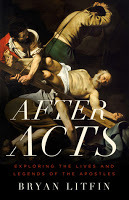 I had hoped to be able to read
After Acts
devotionally and also recommend it to small groups for spiritual growth. The topic is interesting and unique--what happened to the apostles in history after the Bible finishes telling their story? The author is an evangelical professor at my alma mater and really knows his stuff.
I had hoped to be able to read
After Acts
devotionally and also recommend it to small groups for spiritual growth. The topic is interesting and unique--what happened to the apostles in history after the Bible finishes telling their story? The author is an evangelical professor at my alma mater and really knows his stuff.Yet while this book is definitely worthwhile to read, it's not the book I was hoping it would be. The main problem is just how difficult it is to faithfully reconstruct the history of the apostles. Take this paragraph about Peter for example:
"Since the early Christina were aware that Peter had followed in the footsteps of the Savior to the same kind of death, it wasn't long before fictional narratives emerged that purported to recount the whole epic story. These tales are filled with holy saints and vanquished heretics, giving us reasons to view them critically. Yet just because the texts have a legendary, even lurid, flavor doesn't mean they don't have a historical kernel of truth. The trick is to separate fact from fiction!" (pg. 149).
Yep, that's the trick. And while Litfin does a yeoman's work of trying to untangle those things, it makes the book difficult to read and the end result is unsatisfying if you're only moderately interested in the historical method.
On the other hand, I'm glad that someone has done this work and that it's here in a readable format. As an accessible reference work, it's very good. The best feature is a scorecard at the end of each chapter assigning a grade to each historical assertion about the apostles for how likely the "facts" about them truly are. For anyone who wonders if Peter was crucified upside down or where Paul is buried or if Thomas made it to India, this book will do the best job of summarizing the evidence. But if you're looking for a lot more fodder for your own personal spiritual growth, turn back to Acts.