Matthew C. Mitchell's Blog, page 81
May 22, 2016
[Matt's Messages] "A Breathtaking King"
 “A Breathtaking King”
The King of Kings in the Books of Kings
May 22, 2016 :: 1 Kings 9:1-10:29
Our current sermon series is called “The King of Kings in the Books of Kings” and this is our fifth message in this series on the story of the kings of Israel.
We’ve been learning about King Solomon who succeeded his father David, prayed for wisdom, ruled a prosperous kingdom, and built an amazing temple.
Last time, we attended the astonishing dedication service for the new and glorious temple. An innumerable amount of sacrifices were made, and King Solomon prayed a magnificent prayer of dedication thanking the Lord for giving the temple to him and to Israel and asking the Lord to hear the prayers offered at and towards the temple, and then hearing those prayers from heaven to provide merciful divine answers.
Remember that? We only got through chapter 8.
In chapter 9, the LORD answers Solomon’s prayer! God shows up personally and gives him both a reassurance and a warning.
And then the rest of chapters 9 and 10 tell the story of the midpoint and the beginning of the second half of Solomon’s reign over Israel.
I’ve entitled this message, “A Breathtaking King” because in chapter 10 there is a royal visitor to Israel whose breath was taken away by what she saw in this kingdom and in this king.
Among other purposes, these two chapters of holy Scripture are here in our Bibles to give us a glimpse of the glory of God as He revealed it the rule of King Solomon.
And it’s breathtaking! At least it should be.
Now today, I want to do things a little differently than we normally do.
Normally, I read a little bit and then preach a little bit and then read a little bit more and then preach that little bit, right?
Today, I want to read and explain some things as we go along through both chapters, but I want to wait until the end to fully draw our life-lessons out of the text. Okay?
So there will be three points of application today, but we’ll wait until the end to draw them together. Okay? So stay with me.
So in chapter 9, the LORD Himself shows up and speaks to Solomon a second time. Chapter 9, verse 1.
“When Solomon had finished building the temple of the LORD and the royal palace, and had achieved all he had desired to do, the LORD appeared to him a second time, as he had appeared to him at Gibeon.”
Remember the first time? That was back in chapter 3. That was at the beginning of Solomon’s reign when God offered Solomon anything he wanted.
What did Solomon pick at that time?
W-I-S-D-O-M.
And that pleased the Lord. And so He promised to give the king that wisdom and to also give him the things he might have asked for. Like what? Riches, and honor, and victory from his enemies, and a long life.
Well, now the LORD has appeared a second time, not to ask Solomon what he wants, but to tell him that He has heard Solomon’s prayer at the temple.
Verse 3.
“The LORD said to him: ‘I have heard the prayer and plea you have made before me; I have consecrated this temple, which you have built, by putting my Name there forever. My eyes and my heart will always be there.”
That’s a “yes” by the way. That’s a big “yes.” The Lord is saying “yes” to everything that Solomon prayed in chapter 8.
And that “yes” comes with some instructions. Verse 4.
“‘As for you [Solomon], if you walk before me in integrity of heart and uprightness, as David your father did, and do all I command and observe my decrees and laws, I will establish your royal throne over Israel forever, as I promised David your father when I said, 'You shall never fail to have a man on the throne of Israel.'”
Do you see what he’s saying there? He’s saying that He is looking for another king with a heart for the heart of God. Another man who is a man after God’s own heart. Another David.
And if Solomon will be another David, he will experience the blessings promised to David.
Like we said before, “You’ve got one job.” The king of Israel has many duties, but just one job. To walk with God keeping His covenant and leading the people to do the same.
But.
But the Lord also has a warning for King Solomon. If he doesn’t do his one job, there will be consequences. V.6
“‘But if you or your sons turn away from me and do not observe the commands and decrees I have given you and go off to serve other gods and worship them, then I will cut off Israel from the land I have given them and will reject this temple I have consecrated for my Name. Israel will then become a byword and an object of ridicule among all peoples.
And though this temple is now imposing, all who pass by will be appalled and will scoff and say, 'Why has the LORD done such a thing to this land and to this temple?'
People will answer, 'Because they have forsaken the LORD their God, who brought their fathers out of Egypt, and have embraced other gods, worshiping and serving them–that is why the LORD brought all this disaster on them.'’”
Those are ominous words. They are not new thoughts. This is the deal that they have had ever since Deuteronomy.
This is the same deal that Solomon just prayed from in the last chapter.
But this is the high point of the Old Testament. The apparent climax of the story that started back in Genesis! All of the promises of God seem to be coming together in one place!
And the question is: will it last?
Or will it all fall apart?
Will Solomon and his sons be thumbs up or thumbs down kings?
Because it matters.
What is in their heart matters. V.8
“And though this temple is now imposing...” It’s high. It’s tall. It stands out–it won’t matter if your hearts are not where they should be.
There is no substitute for a heart for God.
Even the past blessings of God are no substitute for a heart for God.
Yes, the temple is glorious. But where is your heart, Solomon?
That’s the question that confront him and the question that plays out over the next 3 chapters.
What has been the answer so far? Thumbs up or thumbs down?
It’s been thumbs up! We’ve seen a few hints of a storm brewing, but by and large, Solomon has done very well.
And you know what, most of chapters 9 and 10 tell the same story.
But there are few more storm clouds gathering on the horizon here, and then chapter 11 will tell what Paul Harvey was call “the rest of the story.”
V.10 “At the end of twenty years, during which Solomon built these two buildings–the temple of the LORD and the royal palace–King Solomon gave twenty towns in Galilee to Hiram king of Tyre, because Hiram had supplied him with all the cedar and pine and gold he wanted. But when Hiram went from Tyre to see the towns that Solomon had given him, he was not pleased with them. ‘What kind of towns are these you have given me, my brother?’ he asked. And he called them the Land of Cabul [good-for-nothing], a name they have to this day. Now Hiram had sent to the king 120 talents of gold.”
I think this story is a little mixed. Solomon ends up in a good place. He gets lots of gold. Like 4 whole tons of it.
And he seems to continue to have the upper hand with the neighboring kingdoms. He comes out on top in this deal.
But this is the first time there seems to be a crack in his relationship with Hiram. Before it was all hunkey-dorey. Now, not so much.
The thing that worries me the most is that Solomon seems to be selling off parts of Israel to another nation, and the king of Israel should never do that. This is the Promised Land. Not something that Solomon can rightfully sell.
And I’m not sure what to make of the next section dealing with forced labor. It seems both good and bad, too. V.15
“Here is the account of the forced labor King Solomon conscripted to build the LORD's temple, his own palace, the supporting terraces, the wall of Jerusalem, and Hazor, Megiddo and Gezer. (Pharaoh king of Egypt had attacked and captured Gezer. He had set it on fire. He killed its Canaanite inhabitants and then gave it as a wedding gift to his daughter, Solomon's wife. And Solomon rebuilt Gezer.) He built up Lower Beth Horon, Baalath, and Tadmor in the desert, within his land, as well as all his store cities and the towns for his chariots and for his horses–whatever he desired to build in Jerusalem, in Lebanon and throughout all the territory he ruled.
All the people left from the Amorites, Hittites, Perizzites, Hivites and Jebusites (these peoples were not Israelites), that is, their descendants remaining in the land, whom the Israelites could not exterminate–these Solomon conscripted for his slave labor force, as it is to this day.
But Solomon did not make slaves of any of the Israelites; they were his fighting men, his government officials, his officers, his captains, and the commanders of his chariots and charioteers. They were also the chief officials in charge of Solomon's projects–550 officials supervising the men who did the work.
After Pharaoh's daughter had come up from the City of David to the palace Solomon had built for her, he constructed the supporting terraces.”
Again, this is a little ambiguous.
It shows that Solomon was wise and skillful in the use of a large work force and that the covenant people of God were not enslaved. Solomon wins again.
But it’s interesting that he also never completed the work of purifying Israel himself. Just like in Judges, Solomon didn’t completely drive out the Canaanites. Interestingly, Pharaoh seems to be able to do that in Gezer, but Solomon can’t.
I think that relationship with Pharaoh and his daughter is not really good for Solomon or for Israel.
And yet Solomon is walking with God at this time. And he’s faithfully fulfilling the worship obligations of the covenant. Verse 25.
“Three times a year Solomon sacrificed burnt offerings and fellowship offerings on the altar he had built for the LORD, burning incense before the LORD along with them, and so fulfilled the temple obligations.”
Solomon was doing his “one job.”
And he was being blessed. V.26
“King Solomon also built ships at Ezion Geber, which is near Elath in Edom, on the shore of the Red Sea. And Hiram [good old Hiram, they’re still friends] sent his men–sailors who knew the sea–to serve in the fleet with Solomon's men. They sailed to Ophir and brought back 420 talents of gold, which they delivered to King Solomon.”
That’s at least 14 tons of gold.
And “gold” was not just a key word for the temple but for all of Solomon’s reign.
It was truly a golden age. And the rest of the nations took notice.
Chapter 10, verse 1.
“When the queen of Sheba heard about the fame of Solomon and his relation to the name of the LORD, she came to test him with hard questions.”
Do you know this story?
Some of us have heard of the Queen of Sheba, or the Queen of the South, but we don’t know that much about her.
While there is a diversity of opinion, most scholars today believe that the country of Sheba was located at the southern tip of the Arabian peninsula. Where modern day Yemen is located.
She was the Yemeni Queen.
And she had heard about this King Solomon and was amazed at what she heard.
And perhaps Ophir from verse 28 of the previous chapter, Ophir was perhaps in or near her land. And she had gold there and Solomon and Hiram’s navy had been down the Red Sea to pick up some of her gold.
And she was amazed that the order was 14 tons of gold and wanted to see what kind of a king could need or want that much gold for his kingdom.
So she makes the more than 1000 mile trek from Sheba to Israel. Maybe as much as 1500 miles around 1000 BC. That’s one long trip for a head of state!
But she wants to take the tour herself.
And notice this. She wants to investigate Solomon not just because of his fame, but also because of the NAME of the LORD. She’s investigating God.
And she’s got some hard questions, some riddles, some puzzlers that she wants to run by Solomon because supposedly he’s wise. Do you see that? In verse 1?
Verse 2 tells us that she is an important person herself. A real big wig. V.2
“Arriving at Jerusalem with a very great caravan–with camels carrying spices, large quantities of gold, and precious stones–she came to Solomon and talked with him about all that she had on her mind.”
Can you imagine what this was like?
Her procession and entourage pulling into town?
She takes the tour. She looks over everything that Solomon has built and she asks him her toughest questions. She gives Solomon the test. And he passed; with flying colors! V.3
“Solomon answered all her questions; nothing was too hard for the king to explain to her. When the queen of Sheba saw all the wisdom of Solomon and the palace he had built, the food on his table, the seating of his officials, the attending servants in their robes, his cupbearers, and the burnt offerings he made at the temple of the LORD, she was overwhelmed.”
Is that what your version says?
The old King James says, “there was no more spirit in her.”
Some of the new versions say, “There was no more breath in her.” She was breathless.
In other words, she found this king and his kingdom absolutely breathtaking.
This wealthy powerful woman was speechless and amazed.
She was overwhelmed.
Wow!
I can just see her gulping for air.
And this is what she says. V.6
“She said to the king, ‘The report I heard in my own country about your achievements and your wisdom is true. But I did not believe these things until I came and saw with my own eyes. Indeed, not even half was told me; in wisdom and wealth you have far exceeded the report I heard.
How happy your men must be! How happy your officials, who continually stand before you and hear your wisdom!
Praise be to the LORD your God, who has delighted in you and placed you on the throne of Israel. Because of the LORD's eternal love for Israel, he has made you king, to maintain justice and righteousness.’”
You are a breathtaking king!
What you have accomplished here is nothing short of miraculous!
You are so wise and your people must be so happy!
You answered my questions!
And this must come from your God.
Isn’t that interesting? Isn’t interesting that she drew the connection between all of thing blessing the LORD?
Solomon must have been doing his job right at that point.
Because this breathtaking king was pointing this pagan queen to his generous promise-keeping God.
She couldn’t believe what she was seeing. And she left a big gift. V.10
“And she gave the king 120 talents of gold (another 4 tons), large quantities of spices, and precious stones. Never again were so many spices brought in as those the queen of Sheba gave to King Solomon.”
And the author of our book kind of builds from there saying, in effect, you haven’t seen nothing yet. V.11
“(Hiram's ships brought gold from Ophir; and from there they brought great cargoes of almugwood and precious stones. The king used the almugwood to make supports for the temple of the LORD and for the royal palace, and to make harps and lyres for the musicians. So much almugwood has never been imported or seen since that day.)
King Solomon gave the queen of Sheba all she desired and asked for, besides what he had given her out of his royal bounty. Then she left and returned with her retinue to her own country.
The weight of the gold that Solomon received yearly was 666 talents [that’s like 23 tons every year v.15] not including the revenues from merchants and traders and from all the Arabian kings and the governors of the land.
[What did he do with all that gold?]
King Solomon made two hundred large shields of hammered gold; six hundred bekas of gold went into each shield. He also made three hundred small shields of hammered gold, with three minas of gold in each shield. The king put them in the Palace of the Forest of Lebanon.
Then the king made a great throne inlaid with ivory and overlaid with fine gold. The throne had six steps, and its back had a rounded top. On both sides of the seat were armrests, with a lion standing beside each of them. Twelve lions stood on the six steps, one at either end of each step. Nothing like it had ever been made for any other kingdom.
All King Solomon's goblets were gold, and all the household articles in the Palace of the Forest of Lebanon were pure gold. [Do you hear a pattern?] Nothing was made of silver, because silver was considered of little value in Solomon's days.
The king had a fleet of trading ships at sea along with the ships of Hiram. Once every three years it returned, carrying gold, silver and ivory, and apes and baboons [for fun!].
King Solomon was greater in riches and wisdom than all the other kings of the earth.
The whole world sought audience with Solomon to hear the wisdom God had put in his heart. [Not just the Queen of Sheba but the whole world.] Year after year, everyone who came brought a gift–articles of silver and gold, robes, weapons and spices, and horses and mules. Solomon accumulated chariots and horses; he had fourteen hundred chariots and twelve thousand horses, which he kept in the chariot cities and also with him in Jerusalem. The king made silver as common in Jerusalem as stones, and cedar as plentiful as sycamore-fig trees in the foothills. Solomon's horses were imported from Egypt and from Kue–the royal merchants purchased them from Kue. They imported a chariot from Egypt for six hundred shekels of silver, and a horse for a hundred and fifty. They also exported them to all the kings of the Hittites and of the Arameans.”
No wonder the queen was overwhelmed!
Think about walking around seeing that temple, seeing those shields and those chariots and those horses and that throne. And all of that gold.
And on top of that, Solomon had answer to the toughest questions she had ever asked.
He was at that moment truly a breathtaking king.
So what?
How does story affect our lives today?
We know it does. It’s the Bible. So it’s useful for teaching, rebuking, correcting and training in righteousness.
But how in this case?
Why are these two chapters in our Bibles?
Let’s close with three points of application. Number one.
This story is in our Bibles as:
#1. A PROOF OF PROMISES KEPT AND PRAYERS ANSWERED.
What was the message that God had for Solomon when he showed up in chapter 9?
V.3 “I have heard the prayer and plea you have made before me.”
And verse 5, I’m doing what I “promised David your father.”
This breathtaking kingdom comes from the hand of a faithful and prayer-answering God.
Do you need to hear that this morning?
This breathtaking king and his kingdom show that God is faithful to all of His promises and that He listens when His people pray.
Do you need to hear that?
I do. Because it doesn’t always seems like God is keeping His promises or that He listens to prayer.
But think about this. This was a long time in coming.
Some of what you see in 1 Kings chapters 3 through 10 are the partial fulfillment of promises God made over a thousand years before this in the book of Genesis.
So, yeah, sometimes it seems like God’s never going to come through.
But He always does at the right time and the right way.
Guaranteed.
So keep on trusting. And keep on praying.
Here’s the second one.
This story is in our Bibles as:
#2. A WARNING OF THE DANGERS OF TURNING AWAY.
Even though it’s a glorious time in Israel, you can feel that there are storm clouds gathering.
Solomon prayed like that last week.
And God says it right out in chapter 9 verses 6 through 9.
There’s a warning.
Walk with God and lead the nation to do it, too, or there will be consequences. Bad consequences.
“Even though you have the temple and you have My love, if I don’t have your hearts, if you forsake Me and turn away from Me, it will not go well for you.”
And we saw a few of the fault lines where the cracks seem to be inching out.
The relationship with Pharaoh and his daughter.
The strained relationship with Hiram and selling him some of the Promised Land, worthless or not.
And what about all of this gold?
We already said that there was a problem with a king multiplying horses. Deuteronomy 17 said that Israel’s king was not to do that.
It also says that the king of Israel “must not accumulate large amounts of silver and gold” (Deut. 17:17).
I think that means, for himself. It’s one thing to deck out the temple in it, but it’s another to stick it into your own personal bank account.
I’m not sure.
When I read this chapter, I think that, in the main, the author approves of all of this gold and sees it as a sign of God’s blessing (and the promise He made Solomon in chapter 3).
The Queen of Sheba certainly did, and I think that God did, too.
Because there is nothing sinful about money.
But the love of money, that’s another story.
There’s probably a warning in there somewhere. A caution.
Don’t worship it!
Don’t come to love the gold of the temple instead of the God of the temple!
We just heard about that in Sunday School this morning.
Don’t forsake the Lord your God who brought you out of Egypt.
Warning! Danger ahead. Don’t turn away!
Do you need to hear that today?
It’s sad. Because of what we’re going to read in the very next chapter.
Don’t turn away.
And don’t think that turning away is something you just do all of a sudden.
It can really creep in on you.
As the book of Hebrews says, “Hold firmly to the faith we profess.”
Don’t turn away.
As a pastor, the people I worry about the most are those who have made some kind of a start with the Lord, but then turned their back on Him.
That’s a scary place to be.
Do you know what happens to this temple and these people by the end of 2 Kings?
Do you know where this story is going?
This is a warning of the dangers of turning away.
And we need that warning when things are going well.
When we’ve got life by the toe, that’s often when we can mess the whole thing up.
We get our eyes off of the Lord and turn our own way.
Listen. Don’t.
Learn the lesson from the breathtaking king. Keep your eyes fixed on the Lord.
And number three.
This story is in our Bibles as:
#3. A FORETASTE OF THE BREATHTAKING KINGDOM TO COME.
This is just a preview of coming attractions.
Queen of Sheba, you ain’t seen nothing yet!
You think that Solomon’s kingdom left you gasping for air?
Wait until you see the kingdom of King Jesus!
I mean it. I believe that God has given us this story to make us long for the kingdom to come.
There are hints of that already in the Old Testament.
Read Psalm 72 this afternoon.
Do you know who wrote Psalm 72?
A King named Solomon.
And he might be praying about himself, but I think it’s clearly prophetic, as well.
If I had time, I’d read it to you. It’s a prayer for the ultimate king of Israel in terms that are partially fulfilled here in 1 Kings 10, but not fully.
Somebody else has to come and fill these prayers up.
Somebody breathtaking!
Or read Isaiah chapter 60 this afternoon. That’s written long after Solomon had died, but the language of the predictions of the kingdom to come are drawn right out of 1 Kings 10. Even Sheba bringing gold to the king! Read it.
The point is that this is just a foretaste of the kingdom to come.
It’s to make you hunger and thirst for that kingdom.
Like the gold.
Think about the streets in the New Jerusalem. What are they paved with?
That’s more gold than Solomon had!
Silver might not have had any value but gold was valuable.
But in the New Jerusalem, it will be so “worthless,” they’ll pave the streets with it.
Solomon was a king like no other, blessed by God.
But there is a King to come to whom Solomon does not hold a candle.
That King will be breathtaking on an unimaginable scale!
Do you want to see Him?
Do you want to be a part of His kingdom?
Oh how happy you’ll be!
Oh how happy we’ll be!
To belong to that kingdom!
There’s only one way to get into that kingdom.
It’s to know, trust, and love King Jesus.
You know Jesus didn’t look like Solomon when He walked the earth.
He didn’t look glorious. He wasn’t impressive.
Even to other Jews.
And many are not impressed with Him today.
But He’s the only way.
Jesus told the unimpressed Pharisees, “The Queen of the South will rise at the judgment with this generation [of Israel] and condemn it; for she came from the ends of the earth to listen to Solomon's wisdom, and now one greater than Solomon is here.”
Jesus is greater than Solomon.
Solomon was just a foretaste of the glory to come.
And those Israelites couldn’t or wouldn’t see it. So they rejected their Messiah.
Don’t you do that, too.
Put your faith and trust in King Jesus and prepare to be overwhelmed with the breathtaking beauty of His Kingdom forever.
***
Questions for Group Discussion:
1. Review. Last week’s message was about the incomparable King of the temple. What did you learn last week that was really encouraging or helpful to you?
2. Read 1 Kings 9:1-9. In today’s message, the Lord appeared to Solomon a second time. What was His message(s) for Solomon?
3. Read 1 Kings 10:1-13. The other major visitor to Solomon’s king in today’s message was the Queen of Sheba. What did she experience on her tour of Israel?
4. Pastor Matt said that this set of stories is in our Bibles to be at least 3 things for us. What were they (hints: 1. Evidence 2. Peril 3. Future)? Why do you think this story is in your Bible?
5. What was the application of each of these 3 items for our lives today? How will you live differently because you have taken 1 Kings 9-10 to heart?
***
Messages in this Series:
01. Who Will Be King?
02. The Wisdom of the King
03. The Temple of the King
04. The Incomparable King of the Temple


May 21, 2016

May 15, 2016
[Matt's Messages] “The Incomparable King of the Temple”
 “The Incomparable King of the Temple”
The King of Kings in the Books of Kings
May 15, 2016 :: 1 Kings 8:1-66
And we’re back to our new sermon series that we’re calling “The King of Kings in the Books of Kings.”
We’ve had three message in this series so far.
In the first message, King David passed on the throne to his son King Solomon.
In the second message, King Solomon asked the Lord for wisdom and the Lord gave it to him in spades. In his wisdom, Solomon set up a kingdom in Israel like there never had been and never has been since.
And last time we were in this series, King Solomon built as the crowning achievement of his wisdom a glorious temple for the Lord.
Do you remember that? The temple of the king?
All of that gold and shining splendor?
Chapters 5, 6, and 7 of 1 Kings were full of those details of this fantastic temple being built for the glory of God.
Now in chapter 8, this temple is going to be dedicated. It’s the grand ceremony to dedicate the temple. The grand opening ceremony of this unparalleled building.
I think that this event is the absolute highest point in the story of Solomon, and in many ways, the highest point in the history of the Old Testament!
If we had to decide at this moment if Solomon was a thumbs up or a thumbs down king, we would give him 3 thumbs up at this moment. He is at his all-time best.
The prayer that Solomon prays at the dedication of this temple is some of the wisest things he ever says. And that saying a lot.
You know how we said last time that the point of the temple of the king is not the temple of the king but the king of temple?
Well, Solomon understood that.
Solomon got it. He understood at this moment Who his God really was.
And it’s revealed in his prayer of dedication of the temple.
Solomon understands that his God, the LORD, is the incomparably great King of Kings and Lord of Lords.
The temple has been completed. It has taken 7 years.
And now it’s time to open it for business. To dedicate it.
And if this building is like no other building, this ceremony of dedication is like no other ceremony of dedication.
Every college graduation commencement going on around the nation this week is nothing compared to this.
The inauguration of our new US president next January is nothing compared to this.
This is a phenomenal worship service attempting to be worthy of the King of Kings in dedicating His unique temple. Chapter 8, verse 1.
“Then King Solomon summoned into his presence at Jerusalem the elders of Israel, all the heads of the tribes and the chiefs of the Israelite families, to bring up the ark of the LORD's covenant from Zion, the City of David.”
Do you remember the ark? What did it stand for?
It was like a movable throne to symbolize the presence of God among His people.
And it contained the two stone tablets with the 10 commandments on it standing for the whole of the covenant that God had made with His people.
And it was going to come up and rest in the Holy of Holies.
Do you remember how David brought it up to Jerusalem and the trouble he had when he did it wrong? Solomon learned from that. V.2
“All the men of Israel came together to King Solomon at the time of the festival in the month of Ethanim, the seventh month. [A enormous number of people. Enough to be able to say that the whole country was there. “All the men of Israel”] When all the elders of Israel had arrived, the priests took up the ark, and they brought up the ark of the LORD and the Tent of Meeting and all the sacred furnishings in it. The priests and Levites carried them up, and King Solomon and the entire assembly of Israel that had gathered about him were before the ark, sacrificing so many sheep and cattle that they could not be recorded or counted.
The priests then brought the ark of the LORD's covenant to its place in the inner sanctuary of the temple, the Most Holy Place, and put it beneath the wings of the cherubim. [Remember those?] The cherubim spread their wings over the place of the ark and overshadowed the ark and its carrying poles. These poles were so long that their ends could be seen from the Holy Place in front of the inner sanctuary, but not from outside the Holy Place; and they are still there today. [When this was written down for the first time. You can fact check it, the author is saying. This happened. This actually happened. V.9]
There was nothing in the ark except the two stone tablets that Moses had placed in it at Horeb, where the LORD made a covenant with the Israelites after they came out of Egypt.”
Can you imagine this moment?
All of those sacrifices?
Leading up the ark to the temple and then placing it in the Most Holy Place.
All of those people crowded around?
And what does God think?
Is He pleased? Will He show it? Will He show up?
V.10
“When the priests withdrew from the Holy Place, the cloud filled the temple of the LORD. And the priests could not perform their service because of the cloud, for the glory of the LORD filled his temple. Then Solomon said, ‘The LORD has said that he would dwell in a dark cloud; I have indeed built a magnificent temple for you, a place for you to dwell forever.’”
God showed up!
Just like He did in Exodus chapter 40 when Moses built the tabernacle.
God shows up in this mysterious cloud.
I think it’s interesting that He is both present and still hidden.
Isn’t that interesting?
He shows up in a glory cloud, but you don’t see Him face to face.
He’s still mysterious even as He reveals Himself.
He’s holy, holy, holy.
And He’s come to dwell with His people.
Wow!
And Solomon knows that this a big moment and he makes a big speech. V.14
“While the whole assembly of Israel was standing there, the king turned around and blessed them. Then he said: ‘Praise be to the LORD, the God of Israel, who with his own hand has fulfilled what he promised with his own mouth to my father David. For he said, 'Since the day I brought my people Israel out of Egypt, I have not chosen a city in any tribe of Israel to have a temple built for my Name to be there, but I have chosen David to rule my people Israel.'
‘My father David had it in his heart to build a temple for the Name of the LORD, the God of Israel. But the LORD said to my father David, 'Because it was in your heart to build a temple for my Name, you did well to have this in your heart. Nevertheless, you are not the one to build the temple, but your son, who is your own flesh and blood–he is the one who will build the temple for my Name.'
‘The LORD has kept the promise he made: I have succeeded David my father and now I sit on the throne of Israel, just as the LORD promised, and I have built the temple for the Name of the LORD, the God of Israel. I have provided a place there for the ark, in which is the covenant of the LORD that he made with our fathers when he brought them out of Egypt.’”
That is all very true. Solomon has hit the nail on the head.
God has kept His promises. All of them.
Land, Offspring, Blessing, Temple. King.
And now Solomon’s prays the prayer of dedication. V.22
“Then Solomon stood before the altar of the LORD in front of the whole assembly of Israel, spread out his hands toward heaven and said: ‘O LORD, God of Israel, there is no God like you in heaven above or on earth below...”
God is incomparable.
The LORD is unique. He stands alone.
He is in a class by Himself.
He doesn’t just break the mold. There is no mold for Him.
Solomon gets it exactly right when he says, “O LORD, God of Israel, there is no God like you in heaven above or on earth below...”
That’s not hyperbole. He’s not exaggerating.
God is stands in a category of His own.
There is no God like Yahweh!
And that comes out in the rest of Solomon’s prayer, big-time.
As we read it, I’ve got four major headings to place God’s incomparableness under.
#1. FAITHFUL.
The Lord is INCOMPARABLY faithful. V.23
“O LORD, God of Israel, there is no God like you in heaven above or on earth below [why?]–you who keep your covenant of love with your servants who continue wholeheartedly in your way. You have kept your promise to your servant David my father; with your mouth you have promised and with your hand you have fulfilled it–as it is today.”
I love that. Do you see what he does with mouth and hand in verse 24?
“with your mouth you have promised and with your hand you have fulfilled it...”
There is no disjunction between what God has said and what God does.
Mouth to hand.
There is no one as faithful as the Lord.
God always, always, always keeps His promises.
... And you know what? That’s unique!
The other so-called-gods of the ancient world could not be counted on in this way.
And neither are the gods of today so dependable.
And you and are certainly not, either.
How many have been let down by somebody this week?
How many have let somebody down this week?
Maybe in large ways and maybe in small ways, but none of us is completely faithful.
... But the Lord is.
With his mouth he promises and with His hand He fulfills it. Every time and right on time.
Do you need to hear that today?
The Lord is incomparably faithful. So trust Him.
That’s what Solomon does. Because the Lord has been faithful, He now prays for the Lord to be faithful. V.25
“‘Now LORD, God of Israel, keep for your servant David my father the promises you made to him when you said, [2 Samuel 7] 'You shall never fail to have a man to sit before me on the throne of Israel, if only your sons are careful in all they do to walk before me as you have done.' And now, O God of Israel, let your word that you promised your servant David my father come true.”
Do you see how he prays based on God’s word?
Do you we do that? Do we pray the promises of God?
Some people think that because God has promised something, there is no need to pray about it. But the opposite is actually true. God invites us to pray His promises back to Him.
“You said you would, Lord! So please do it!”
“I’m holding You to Your promises. I’m expecting You to act!”
God is faithful.
But He’s also uncontainable. V.27
#2. UNCONTAINABLE
Solomon asks, “‘But will God really dwell on earth? The heavens, even the highest heaven, cannot contain you. How much less this temple I have built!”
Do you see why I’m saying that Solomon is at his best?
Yes, God is going dwell on earth. He’s going to live in this temple.
But not really!
He doesn’t fit in this box. This beautiful golden box.
He doesn’t fit on earth.
He doesn’t fit in the heavens! With the clouds and the birds.
He doesn’t even fit in highest heavens with the sun, the moon, the stars!
Solomon gets it.
At this moment in Solomon’s life, he gets it.
He gets how big and free and uncontainable God is.
You can’t put God in a box.
You can’t put God on a leash.
God cannot be controlled.
God cannot be tamed.
God cannot be contained.
He is incomparably uncontainable.
God will not be used.
God will not be manipulated.
Even though God has condescended to take up residence in this temple, the people of Israel should not assume therefore that everything they do will be blessed no matter what or that God only loves them and not others in the world who don’t have the temple or that they now have God by the tail.
God is so much bigger than that!
Do you need that reminder today? That God is bigger than the highest heavens?
That means that God is bigger than any of your problems.
And we just learned that He’s faithful to all of His promises.
On Wednesday nights at Prayer Meeting, we’ve been learning to pray using the Lord’s Prayer as our guide.
And this last Wednesday, we thought about that phrase, “Our Father IN HEAVEN.”
And we read this verse. “The heavens, even the highest heaven, cannot contain you. How much less this temple I have built!”
That’s the God whom you are praying to when you pray rightly.
Not some genie in a bottle.
But a Father above the heavens!
Isn’t that encouraging?
This is a strange prayer for the dedication of a temple, isn’t it?
Because it’s not really about the temple of the King. It’s about the King of the temple.
And how inadequate this temple is!
As amazing and glorious as this temple was, like the first thing that Solomon prays is that, “I know it’s too small.”
And “I know that it doesn’t do You justice.”
And “I know that it does not control You.”
... And yet.
And yet the very next thing Solomon says is that He asks and expects that this uncontainable God will hear and answer prayer. V.28
“Yet give attention to your servant's prayer and his plea for mercy, O LORD my God. Hear the cry and the prayer that your servant is praying in your presence this day. May your eyes be open toward this temple night and day, this place of which you said, 'My Name shall be there,' so that you will hear the prayer your servant prays toward this place.
Hear the supplication of your servant and of your people Israel when they pray toward this place. Hear from heaven, your dwelling place, and when you hear, forgive.”
That’s amazing!
He goes from saying that God is too big to live here to saying this same God listens to pleas and prayers.
In other words, the Lord is incomparably:
#3. ACCESSIBLE.
You might think that because God is so big that He wouldn’t have time for little guys like you and me. Maybe Solomon but not you and me.
But Solomon thinks BECAUSE God is so big He can listen to us.
God is listening.
God is attentive.
God is personal and accessible.
Now, at this time in redemptive history, Solomon asks that his temple be a kind of focal point for focusing on God in prayer.
Almost like a earthly headquarters for God’s throne.
You can pray wherever you are, but Solomon says, “Use this temple as a focal point for those prayers.” Praying at or towards this temple will be like a direct line to the heavenly throne room.
Did anybody ever do that in the Bible? Sure. Daniel does, right? When Daniel prays with his windows open where he does he face? Towards Jerusalem.
Now, you can see how this temple might become a problem, right? How it might become an idol itself for the people?
It wouldn’t have to be, but they do fall into that problem from time to time.
The point, however, is that God is listening.
God isn’t just up there somewhere minding His own business.
He is accessible. He is listening to His people’s prayers.
Do you need to hear that this morning?
Even though there is no earthly temple to pray towards today, God is still listening. He still hears. His eyes are open to you.
Do you pray? Are you praying?
I think we talk about praying more than we pray. I know I do.
This God that Solomon is praying to is listening. His ears are open to you.
He’s accessible.
More now than ever because of the work of Christ on the Cross.
Ephesians 2:18 says that through Jesus we have access to the Father by one Spirit!
Prayer isn’t just for super kings at the dedication of the temple.
It’s for you and me.
Did you notice what Solomon asked God to do at the end of that prayer?
“And when you hear...what?”
“Forgive.”
Forgive. Solomon knows that God will have to be forgiving of His people because they are sinners. God may keep His promises, but His people will not always.
Forgiveness is the theme of the whole rest of the prayer. He’s just getting warmed up, but that’s what he asks for again and again from here to the end.
It’s because Solomon knows that God is incomparably:
#4. MERCIFUL.
Starting in verse 31, Solomon gives 7 “for instances,” 7 examples or case studies of when God would need to be merciful to His people.
They are all drawn from covenant. You can find the examples in Deuteronomy, especially chapters 28 and 31.
These are problems that Israel will probably fall into, and will need God’s help. V.31
“‘When a man wrongs his neighbor and is required to take an oath and he comes and swears the oath before your altar in this temple, then hear from heaven and act. Judge between your servants, condemning the guilty and bringing down on his own head what he has done. Declare the innocent not guilty, and so establish his innocence.”
Do you see what’s going on?
Somebody has done wrong, but the evidence is lacking. You can’t tell by looking.
Even Wise Old Solomon with his cut the baby in half tricks can’t solve this one.
So he comes to this temple and there is prayer at this temple, and Solomon says, “Hear from heaven and act.” Be merciful on your people by bringing true justice. Show us who is in the wrong and who is in the right.
Notice that you pray at the temple, but God answers from where? From heaven.
The second one is bigger. More mercy needed. V.33
“‘When your people Israel have been defeated by an enemy because they have sinned against you, and when they turn back to you and confess your name, praying and making supplication to you in this temple, then hear from heaven and forgive the sin of your people Israel and bring them back to the land you gave to their fathers.”
Number three. V.35
“‘When the heavens are shut up and there is no rain because your people have sinned against you, and when they pray toward this place and confess your name and turn from their sin because you have afflicted them, then hear from heaven and forgive the sin of your servants, your people Israel. Teach them the right way to live, and send rain on the land you gave your people for an inheritance.”
This is how God promised to deal with His people back in Deuteronomy. They had a special covenant with God. If they obeyed, there would be blessing on Israel. If they disobeyed, there would be curses fall on them.
Solomon says, “Be merciful!”
Number Four. V.37
“‘When famine or plague comes to the land, or blight or mildew, locusts or grasshoppers, or when an enemy besieges them in any of their cities, whatever disaster or disease may come, and when a prayer or plea is made by any of your people Israel–each one aware of the afflictions of his own heart, and spreading out his hands toward this temple–then hear from heaven, your dwelling place. Forgive and act; deal with each man according to all he does, since you know his heart (for you alone know the hearts of all men), so that they will fear you all the time they live in the land you gave our fathers.”
Be merciful.
You know us. You know us so well.
You know what’s in our hearts!
Forgive and act.
And not just for us. But also for those who are not like us. Number 5. V.41
“‘As for the foreigner who does not belong to your people Israel but has come from a distant land because of your name–for men will hear of your great name and your mighty hand and your outstretched arm–when he comes and prays toward this temple, then hear from heaven, your dwelling place, and do whatever the foreigner asks of you, so that all the peoples of the earth may know your name and fear you, as do your own people Israel, and may know that this house I have built bears your Name.”
Solomon knows that God is not just the God of Israel.
He’ll be the God of any and all who call on Him in faith.
He’s a missionary God.
He wants the peoples of the earth to know His name and fear Him like we do.
That’s why He’s given us the Great Commission. Like we talked about last week.
Go and make disciples of all nations.
Number six. Verse 44.
“‘When your people go to war against their enemies, wherever you send them, and when they pray to the LORD toward the city you have chosen and the temple I have built for your Name, then hear from heaven their prayer and their plea, and uphold their cause.”
Be merciful. And last, number 7. V.46
“‘When they sin against you–for there is no one who does not sin–and you become angry with them and give them over to the enemy, who takes them captive to his own land, far away or near; and if they have a change of heart in the land where they are held captive, and repent and plead with you in the land of their conquerors and say, 'We have sinned, we have done wrong, we have acted wickedly'; and if they turn back to you with all their heart and soul in the land of their enemies who took them captive, and pray to you toward the land you gave their fathers, toward the city you have chosen and the temple I have built for your Name; then from heaven, your dwelling place, hear their prayer and their plea, and uphold their cause.
And forgive your people, who have sinned against you; forgive all the offenses they have committed against you, and cause their conquerors to show them mercy; for they are your people and your inheritance, whom you brought out of Egypt, out of that iron-smelting furnace.
‘May your eyes be open to your servant's plea and to the plea of your people Israel, and may you listen to them whenever they cry out to you. For you singled them out from all the nations of the world to be your own inheritance, just as you declared through your servant Moses when you, O Sovereign LORD, brought our fathers out of Egypt.’”
What’s he talking about?
He’s talking about the possibility, the fearful possibility of EXILE.
Of the undoing of the promises. Of the land being taken away from them. And them being taken away from the land.
At the very moment, the highest moment in Old Testament history, Solomon recognizes the very real possibility of exile because of Israel’s unfaithfulness.
And He pleads with God for mercy.
Based on the priory mercy of God. Because God had saved them before. From Egypt.
Because these people were (v.51), God’s people and God’s inheritance.
Not because they deserved it. They certainly didn’t.
And they wouldn’t, if God sends them into exile.
But because God is incomparably merciful.
He is gracious and abounding in mercy.
That’s Who God is.
God is just. He is righteous. He is justice itself.
But He is also incomparably merciful.
A second Exodus would still be possible. Even if they went into exile.
And of course, if you know the story, you know that they do.
What a prayer! What a God to pray to! V.54
“When Solomon had finished all these prayers and supplications to the LORD, he rose from before the altar of the LORD, where he had been kneeling with his hands spread out toward heaven.”
Isn’t that interesting? When he started this prayer, he was standing. But apparently by the end he’s on his knees. Was it the weight of what He was praying? V.55
“He stood and blessed the whole assembly of Israel in a loud voice, saying: ‘Praise be to the LORD, who has given rest to his people Israel just as he promised [FAITHFUL!]. Not one word has failed of all the good promises he gave through his servant Moses. May the LORD our God be with us as he was with our fathers; may he never leave us nor forsake us. [ACCESSIBLE] May he turn our hearts to him, to walk in all his ways and to keep the commands, decrees and regulations he gave our fathers. And may these words of mine, which I have prayed before the LORD, be near to the LORD our God day and night, that he may uphold the cause of his servant and the cause of his people Israel according to each day's need [MERCIFUL], so that all the peoples of the earth may know that the LORD is God and that there is no other.
But your hearts must be fully committed to the LORD our God, to live by his decrees and obey his commands, as at this time.’
Then the king and all Israel with him offered sacrifices before the LORD. Solomon offered a sacrifice of fellowship offerings to the LORD: twenty-two thousand cattle and a hundred and twenty thousand sheep and goats. So the king and all the Israelites dedicated the temple of the LORD.
On that same day the king consecrated the middle part of the courtyard in front of the temple of the LORD, and there he offered burnt offerings, grain offerings and the fat of the fellowship offerings, because the bronze altar before the LORD was too small to hold the burnt offerings, the grain offerings and the fat of the fellowship offerings [UNCONTAINABLE].
So Solomon observed the festival at that time, and all Israel with him–a vast assembly, people from Lebo Hamath to the Wadi of Egypt. They celebrated it before the LORD our God for seven days and seven days more, fourteen days in all.
On the following day he sent the people away. They blessed the king and then went home, joyful and glad in heart for all the good things the LORD had done for his servant David and his people Israel.”
What a prayer!
What an incomparably great God.
***
Messages in this Series
01. Who Will Be King?
02. The Wisdom of the King
03. The Temple of the King
May 14, 2016

May 8, 2016
[Matt's Messages] "Mission Minded Moms"
 “Mission Minded Moms”
Matthew 28:18-20
May 8, 2016
We’re going take a break for one week from our study of the Books of Kings to stay on the theme of motherhood since it’s Mother’s Day.
But we are staying on the theme of the year.
Some of you will remember that on the first Sunday of 2016, we focused on this particular passage of Scripture together and reminded ourselves that we have been given, as a Church, one great mission, one great Commission, our marching orders to make disciples of Jesus Christ to the glory of God.
We are sent on a mission.
The teens going to their Challenge Conference this Summer are going to be taught on this theme all week long.
We are SENT on a mission.
And that mission that Jesus has sent us on determines and shapes every area of our lives.
Including our callings in life. The things that God calls us to do.
And that brings us back to motherhood.
Those of you who are both mothers and Christians need to connect the dots between the two.
Your calling as a mother is shaped by the mission that Jesus has given to His church.
Have you ever thought about that?
Have you ever seen your calling as a mother as a part of Jesus’ mission for the church?
Today’s sermon is entitled, “Mission Minded Moms.”
And I don’t mean first off foreign missions, though we’re going to get there.
I mean that moms who are doing what God wants them to be doing as moms will fulfill their callings as moms by keeping in mind the mission that the Lord has given to us.
So, of course, this is a message for all of us whether we are moms or not. Because the mission is for all of us. But I’m especially thinking today about those of you who someone calls, “Mommy” and how this mission applies to your very very very very very important job.
Whether you are a new mom whose baby was just dedicated today or you have been a mom for 50 or 60 years, this mission is for you.
Let’s read it and then we’ll pray and start applying it to everyday life for the moms among us.
In Matthew 28, the recently resurrected Jesus is talking to his 11 remaining apostles on a mountain in Galilee. V.18
“Then Jesus came to them and said, ‘All authority in heaven and on earth has been given to me. Therefore go and make disciples of all nations, baptizing them in the name of the Father and of the Son and of the Holy Spirit, and teaching them to obey everything I have commanded you. And surely I am with you always, to the very end of the age.’”
Moms, you have a mission.
Christian moms, you have a mission, and you should choose to accept it.
Moms, do you remember how you felt that moment when you first found out that you were expecting?
The pregnancy test came back positive.
Gulp! “What have I gotten myself into?” Right?
Do did you feel?
Excited, right?
And also probably a little apprehensive.
And maybe a little uneasy about the new responsibility that you were just entrusted with.
What a responsibility it is to have a child!
To feed, to clean, to provide for, to teach everything they need to know to get started in life. To superintend their education. To oversee their health and well-being.
It’s such a weighty responsibility.
And for the first several years it’s so demanding.
There’s always responsibilities, but eventually they grow up. At least you hope so.
But when they are little...
There’s a reason we have a ministry called “Mothers of Preschoolers” and not “Mothers of College Students” (though that’s not a bad idea!).
Because those early years are tough. And it’s 24/7.
My hat is off to young mothers.
It’s a lot of work.
Well-done, ladies. And keep up the good work.
But I want to add to that pile of responsibility this morning.
Because Christian motherhood is more than just feeding, cleaning, medicating, educating, and preparing children for life.
Christian moms have a mission to make disciples of their children and the rest of the nations for Jesus Christ.
Christians moms are meant to be mission minded.
Now, I’m sorry if that feels like an added burden to you who already have so much to do in your work.
But the good news is that this focuses your efforts. Its focuses your work.
Because if you are a mission minded mom as you are called to be, keeping that mission always before you will help you to make critical choices as you do your mothering.
Did you ever notice that children don’t come with instruction manuals?
If you buy a weed-wacker, it comes with an instruction manual.
Here’s how to start it, run it, use it, keep it running. Do this, don’t do that. And so on.
Kids, not so much. Right?
Moms often don’t know what to do.
So, they need to pray for wisdom. But they also can and need to evaluate the parenting choices in front of them based on whether or not and how it will help to achieve the mission.
Some things are mission-critical and they must be done. They must happen.
Other things can aid the mission but are optional.
Some others things can hinder the mission.
Christian moms need to be mission-minded.
And what is our mission? To make disciples of Jesus Christ to the glory of God.
V.19 “[G]o and make disciples of all nations, baptizing them in the name of the Father and of the Son and of the Holy Spirit, and teaching them to obey everything I have commanded you.”
Those are our marching orders as the people of God, and mothers have a critical role to play.
Now, I’m not saying that only mothers do this or that mothers do all of it.
For example, I don’t think that mothers do the baptizing of their children. The church does the baptizing, normally through the pastors and elders.
But it should be every Christian mother’s aim to see their children grow to be believers in Jesus Christ, disciples of Jesus Christ, and baptized into the name of the Father, the Son, and the Holy Spirit.
And it should be the aim of every Christian mother to see their children turn around and also be used to make disciples of others in the same way.
Mission minded moms.
Do you get a sense of what I’m talking about?
I’ve got just three quick points to make today.
Here’s number one:
#1. MISSION MINDED MOMS REMEMBER THAT JESUS IS LORD. V.18
“Then Jesus came to them and said, ‘All authority in heaven and on earth has been given to me.”
Let’s not forget that.
Jesus has come back from the dead and has claimed to possess by divine gift ALL authority in heaven and on earth.
That’s everything. That’s ALL authority.
Jesus is Lord.
And that’s helpful to remember when you’re a mom.
Jesus is Lord.
He’s Lord over your motherhood.
He decides when you become a mom, not you.
You’ve got a part to play, but Jesus rules.
And Jesus decides what motherhood should look like.
We don’t get to pick and choose from an unlimited list of mothering ideas.
There are biblical concepts that Christian mothers should employ when parenting.
Jesus is Lord.
And He’s also Lord over your child’s future.
He’s sovereign over where they live, when they live, and when they die.
He gets to rule their lives. Not you or me.
So Jesus is Lord and we are not.
Moms, have you tried to pretend you’re the Lord?
Maybe taken some prerogative or privilege that is His alone?
Jesus has risen dead and because He lives, we can face tomorrow.
But because He lives, we also need to live for Him.
And sometimes that means releasing our children into the world in ways we’d rather not.
Our world is a dangerous place. But children are arrows.
Psalm 127 says that children are arrows, and arrows are meant to be loosed at the proper time.
Jesus is Lord. So when He calls for your child–maybe to go into missionary service and make disciples of some Hindus or Buddhists or Muslims in some dangerous part of the world, it will be time for you to pull back the string and let them fly.
Because we have a mission, and Jesus is Lord.
I believe that we like to play it safe with our kids.
And we do need to protect them when they are small and teach them to make prudent choices when they are grown.
But we don’t keep them to ourselves. We ready and aim them to fire into the world.
Because we have a mission and Jesus is Lord.
Jesus said, “All authority in heaven and on earth has been given to me. Therefore....” what? V.19
“Go and make disciples of all nations.”
I’ve been reading an excellent new book by Gloria Furman on this topic called Missional Motherhood.
And she opens Part 2 of her book with this title, “Therefore, Go, and Mother Disciples.”
That’s great.
Or in other words, Christian mothering is discipling.
If you are a Christian mom, it should be your aim to make disciples of your children and the rest of the nations.
Because Jesus is Lord. That’s what He’s called us to do.
All of that authority and what does He want? Make disciples.
#2. MISSION MINDED MOMS FOCUS ON MAKING DISCIPLES.
 And who better to start with than those little creatures that live in your home?
Kids don’t come out of birth as Christians, did you know that?
But Christian moms have the goal of reaching them for Christ and seeing them fully discipled as Christians from before birth. If they have their mind on their mission.
Now, that’s going to look different at different times and with different kids.
Here’s the mission-minded mom at our place on the day of Robin’s dedication, 16 years ago.
Back then discipling Robin was mainly just praying for her.
And setting your mind and heart on Christ yourself.
Being a disciple yourself.
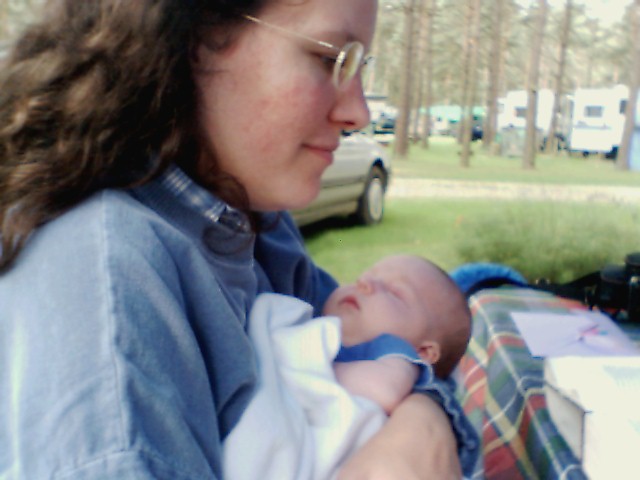 Here’s a picture of them a month later. Heather’s reading something, probably her Bible. Stocking up her heart with what she will teach Robin as Robin gets old enough to begin to understand.
But it’s not long until she’s got armfuls like this.

Mother’s Day 2005. Just 5 years later.
And being a mission minded mom meant something very different then.
Than it does today.
And how it will look in 20 years or 40 years from now.
But the mission stays the same.
 Mission minded moms focus on making disciples.
What are you doing to disciple your kids?
Now, does this mean indoctrinating them? Forcing them to become Christians?
No. It’s impossible to force someone to become a Christian.
Becoming a Christian is the work of the Holy Spirit.
You can’t make it happen.
These apostles in verse 19 were not commanded to go out and force people to convert to Christianity.
They were to preach it, teaching it, model it, explain it, defend it, pray it into people’s lives.
They were to be, in a word, missionaries.
And as missionaries reach the people they are sent to with the gospel of Jesus Christ so that it transformed them by its power and make disciples of them.
So, moms, you are missionaries. But you aren’t necessarily sent around the world. You are sent to your kids.
Take the gospel to them.
And don’t stop sharing the gospel with them until either they die or you die.
Again, it looks different at different ages and with different kids.
If you are the mother of a prodigal son or daughter and they are out of your home and far from God, you are not going to get out a Bible storybook and make them sit on your knees and have devotions with them each night.
It don’t work that way.
But you are still called as a missionary in their life to love them for Jesus’ sake and seek to share the good news with them when they open to hearing it.
Keep your mind on the mission.
Focus on making disciples.
And of course, not just of your own kids.
As mothers, especially of young kids, they are your first priority as a mission field.
But your kids will have friends, too. Guess what? They’re mission-field, too.
And those kids will have parents that you will come into contact with.
Mission field!
Potential disciples!
And verse 19 says, “all nations.” So that’s not just people like us right here.
It’s not just whitebread Americans. It’s people all over the world who need Jesus.
Moms, we’ve got to keep our focus on making disciples of all nations.
And that might involve aiming your kids at the nations.
It might involve aiming your whole family at the nations.
We look at John and Becky and think, “I could never do that. Uproot my whole family and move to Oaxaca.”
Never say never. Remember that Jesus is Lord, and He gives the marching orders.
What can you do to raise the awareness of the mission in your household?
Mom, does everybody in your household know the mission?
Do they know that your whole family has a mission?
Could they answer the question, “The mission of our family is...” what?
Mission minded moms keep the mission in front of their families.
Of course, this is a Christian dad’s responsibility even more because he’s called to lead. But this isn’t Father’s day.
Mission minded moms keep the mission in front of their families.
They are praying for missions.
They are praying for disciplemaking opportunities.
They are strategizing as a family how they can make disciples.
Mission minded moms focus on making disciples.
And that involves a lot of teaching. V.20
This making disciples involves not only baptizing new converts but, “teaching them to obey everything I have commanded you.”
Moms, you are a teachers.
When you were given a child, you were given a calling to be a teacher.
That doesn’t mean that you will teach them algebra, but it does mean that you will teach them Jesus’ commands.
“Everything I have commanded you.”
Moms, have you been teaching your kids what Jesus commands?
When was the last time you said, “Jesus says we need to...” whatever?
“King Jesus commands us to...” what?
“Our Lord says....” what?
Do your kids know what Jesus commands and that He expects obedience?
V.20 says “teaching to obey” not just “teaching to know.”
Jesus is Lord and expects us to follow His directions.
And one of your jobs, Mom, is to teach Jesus’ directions to your little disciples.
So much more could be said about that.
It’s the main way that Moms disciple their children is to teach them.
Don’t assume that someone else is going to do that for you.
Don’t assume that Sunday School or Kids for Christ or Children’s Church will do tha for you.
Don’t assume that Youth Group or Miracle Mountain Ranch will do that for you.
Don’t assume that a Christian college will do that for you.
Partner with all of those ministries to help.
But you are the Mom. You are called to teach your children the gospel and what Jesus wants from them and for them.
What do we say around here?
The main thing is to keep the main thing the main thing.
And the main thing in mothering is the gospel.
Mission minded moms keep the focus on making disciples of Jesus Christ.
One last point and then we’re done.
#3. MISSION MINDED MOMS KNOW THAT YOU ARE NOT ALONE. V.20
“And surely I am with you always, to the very end of the age.”
I love that Jesus doesn’t just send us on a mission, He goes with us on that mission.
And that’s true for all of you moms, as well.
You are not alone.
Jesus is on this mission with you.
I know that it feels heavy at times.
I think I’ve added to that heaviness today by emphasizing how weighty is the responsibility of being a Christian mom.
But you don’t have to do it on your own. You couldn’t if you tried.
Jesus goes with you.
He’s not talking to just one Mom named Shirley.
“And surely I am with you always, to the very end of the age.”
That words means certainly. You can bank on it.
It’s for sure. To the uttermost.
He will see you to the end.
Now, that means you gotta go.
You gotta get out there and complete your mission.
But you don’t have to do it alone.
Abby, you don’t have to do it alone.
Emigh, you don’t have to do it alone.
Stephanie, you don’t have to do it alone.
Church, you don’t have to do it alone.
You just have to do it.
‘All authority in heaven and on earth has been given to [Jesus.] Therefore go and make disciples of all nations, baptizing them in the name of the Father and of the Son and of the Holy Spirit, and teaching them to obey everything [He has] have commanded you. And surely [Jesus is] with you always, to the very end of the age.’”
May 7, 2016

May 1, 2016
[Matt's Messages] "The Temple of the King"
 “The Temple of the King”
The King of Kings in the Books of Kings
May 1, 2016 :: 1 Kings 5:1-7:51
Our series is called “The King of Kings in the Books of Kings” because for all of the details of these two historical books full of places, countries, people, prophet, priests, and kings, if we keep our eye on the Lord, the King of Kings, then we’ll get the message that we are supposed to receive.
We’ve have two messages so far in this series.
In the first sermon, who became the king after King David?
His son Solomon became king.
And what kind of a king was King Solomon? Thumbs up or thumbs down?
Well...it’s complicated.
He’s basically been a two thumbs up king and yet there are some troubling signs of a storm brewing on the horizon.
But in the second sermon we saw that he was a two-thumbs up ruler at the beginning of reign because he asked God for ... what?
Wisdom. The wisdom of the king.
And God gave it to him. There had never been someone as wise as King Solomon.
He knew what to do.
He had skill for decision-making.
And he took this kingdom to places that it had never been before.
And in these next 5 chapters, Solomon will achieve what is arguably the greatest work of his surpassingly exceptional wisdom. He will build the temple.
“The Temple of the King”
Now, I don’t know about you, but I tend to skim over the next 3 chapters. Fix, six, and seven.
I’m not a builder. I’m not an engineer. I’m not a craftsman. I’m not a contractor.
I’m not an architect. And I’m not all that interested in descriptions in literature.
My eyes tend to glaze over.
I don’t see it, when I read it.
Some of you probably love these three chapters–five, six, and seven. They just jump off the page for you.
But for many of us, we tend to hurry through these details and maybe even skip them altogether.
I was tempted to NOT read these chapters to you today and just summarize.
“Oh, yeah, and Solomon built a beautiful temple. Let’s move on...”
But as I studied it this week, I realized that for the first readers of this book, this was like the highlight of the whole book, and in many ways the high point of the whole Old Testament!
Solomon’s kingdom has spread to its broadest dimensions. Everybody in the kingdom is experiencing blessing.
Do you remember this?
Chapter 4, verse 20?
“The people of Judah and Israel were as numerous as the sand on the seashore; they ate, they drank and they were happy.”
Remember, they were getting taxed, and they were still happy? Life was that good under Solomon.
Because of his wisdom. Chapter 4, verse 29.
“God gave Solomon wisdom and very great insight, and a breadth of understanding as measureless as the sand on the seashore.”
And here’s the proof of that. Solomon decides to build a house for God.
A temple.
The temple.
An amazing, breathtaking, magnificent, glorious temple for the King of Kings.
That’s what we’re going to read about today.
The temple of the king.
Chapter 4 ended with these words, “Men of all nations came to listen to Solomon's wisdom, sent by all the kings of the world, who had heard of his wisdom.”
And that included Solomon’s neighbor, King Hiram of Tyre. Chapter 5, verse 1.
“When Hiram king of Tyre heard that Solomon had been anointed king to succeed his father David, he sent his envoys to Solomon, because he had always been on friendly terms with David.”
We’ve met King Hiram before. He is the king of Tyre which is the capital city of Phoenicia and he was friendly with David.
He wants to be friendly with Solomon. And Solomon sends back a message of how Hiram can be a help to him. V.2
“Solomon sent back this message to Hiram: ‘You know that because of the wars waged against my father David from all sides, he could not build a temple for the Name of the LORD his God until the LORD put his enemies under his feet. But now the LORD my God has given me rest on every side, and there is no adversary or disaster.
I intend, therefore, to build a temple for the Name of the LORD my God, as the LORD told my father David, when he said, 'Your son whom I will put on the throne in your place will build the temple for my Name.'
‘So give orders that cedars of Lebanon be cut for me. My men will work with yours, and I will pay you for your men whatever wages you set. You know that we have no one so skilled in felling timber as the Sidonians.’”
Every word in that message is important.
Let me summarize it like this. Point #1 of 3 this morning.
Solomon’s temple was:
#1. BUILT ON THE PROMISES OF THE KING.
This temple was built on the promises of the Lord God.
Solomon remembers that his father wanted to build a temple for the Lord but had been told, “No.”
Do you remember that story?
David felt bad that he lived in a house, but the King of Kings only had tent?
So he wanted to build a house for the Lord, but the prophet Nathan said, “No. God is going to build a ‘house’ for you.”
It’s all in 2 Samuel 7. What we often call the Davidic Covenant, the promises God made to David.
One of those promises was rest from all of his enemies. No temple until the enemies are subdued. What does verse 4 say?
“But now the LORD my God has given me [Solomon] rest on every side, and there is no adversary or disaster.”
Notice that word, “GAVE.” That rest is a gift. It came from God’s promise.
And what else did God promise David?
A son, right? A son to sit on the throne. And who will build the temple for the Lord.rd. V.5
“I intend, therefore, to build a temple for the Name of the LORD my God, as the LORD told my father David, when he said, 'Your son whom I will put on the throne in your place will build the temple for my Name.'”
This is not just Solomon’s big idea.
This is God’s idea. And it’s God’s promise.
And you know the Bible says about God’s promises?
God always keeps his promises.
This temple rests on the foundation of God’s promises.
Solomon is going to undertake a massive building program here. This is going to take years to complete. We’re going to see that it’s at least 7 years from start to finish.
How do you start something that big?
How do you keep on going?
What do base it upon?
You base it upon the promises of God.
So one of the life lessons we get from reading about the construction of the temple is simply to learn to put our faith in the faithfulness of God.
Do you know the promises of God?
Are you trusting them?
Solomon was basing this entire building project on God’s promises. That’s why he expected to succeed.
So he asks Hiram for some two-by-fours.
The best wood is from the cedars of Lebanon, that’s like the Pennsylvania of the Middle East. And there weren’t better any lumberjacks than the Sidonians from the next town over from Tyre.
And that pleased Hiram. V.7
“When Hiram heard Solomon's message, he was greatly pleased and said, ‘Praise be to the LORD today, for he has given David a wise son to rule over this great nation.’
So Hiram sent word to Solomon: ‘I have received the message you sent me and will do all you want in providing the cedar and pine logs. My men will haul them down from Lebanon to the sea, and I will float them in rafts by sea to the place you specify. There I will separate them and you can take them away. And you are to grant my wish by providing food for my royal household.’ [How’s that for a deal? V.10]
In this way Hiram kept Solomon supplied with all the cedar and pine logs he wanted, and Solomon gave Hiram twenty thousand cors of wheat as food for his household, in addition to twenty thousand baths of pressed olive oil. Solomon continued to do this for Hiram year after year.
The LORD gave Solomon wisdom, just as he had promised him. [There’s our word again.]”
This temple was built on the promises of God.
And it was a BIG job. V.12
“There were peaceful relations between Hiram and Solomon, and the two of them made a treaty. King Solomon conscripted laborers from all Israel–thirty thousand men. He sent them off to Lebanon in shifts of ten thousand a month, so that they spent one month in Lebanon and two months at home. Adoniram was in charge of the forced labor.
Solomon had seventy thousand carriers and eighty thousand stonecutters in the hills, as well as thirty-three hundred foremen who supervised the project and directed the workmen. At the king's command they removed from the quarry large blocks of quality stone to provide a foundation of dressed stone for the temple. The craftsmen of Solomon and Hiram and the men of Gebal cut and prepared the timber and stone for the building of the temple.”
Wow. That’s a big workforce!
Imagine feeding them all!
Chapter 6, verse 1.
“In the four hundred and eightieth year after the Israelites had come out of Egypt, in the fourth year of Solomon's reign over Israel, in the month of Ziv, the second month, he began to build the temple of the LORD.”
That’s an important verse. Think about it.
When did this happen?
480 years after the Exodus. After the events we just learned about today in Sunday School.
480 year later. That’s a long time. But God has been faithful all along and now He’s keeping this part of His promise.
Now, the people of Israel are moving into a new epoch. No longer will they be unsettled and wandering. They are fully settled because even their God has a permanent home.
He is moving from tent to temple.
That’s big. He moves at His own pace. Never too quick and never too slow.
But He always keeps His promises.
And here He is allowing Solomon to build a temple for His name.
And what a temple it is! We start with the outside dimensions. V.2
“The temple that King Solomon built for the LORD was sixty cubits long, twenty wide and thirty high. The portico at the front of the main hall of the temple extended the width of the temple, that is twenty cubits, and projected ten cubits from the front of the temple. He made narrow clerestory windows in the temple.
Against the walls of the main hall and inner sanctuary he built a structure around the building, in which there were side rooms. The lowest floor was five cubits wide, the middle floor six cubits and the third floor seven. He made offset ledges around the outside of the temple so that nothing would be inserted into the temple walls.”
Now, I have a hard time picturing all of this, but it’s clear to me that this is about twice that the tabernacle was.
It’s built with a similar floor plan, the same kinds of general dimensions, but proportionally bigger.
But here’s what I really find amazing. They built it without tools. V.7
“In building the temple, only blocks dressed at the quarry were used, and no hammer, chisel or any other iron tool was heard at the temple site while it was being built.”
Can you imagine?!
No, “chink, chink, chink.”
I think that’s so that there was a worshipful kind of silence at the building site. Reverence and awe as they worked together. V.8
“The entrance to the lowest floor was on the south side of the temple; a stairway led up to the middle level and from there to the third. So he built the temple and completed it, roofing it with beams and cedar planks. And he built the side rooms all along the temple. The height of each was five cubits, and they were attached to the temple by beams of cedar.”
And then God showed up and interrupted the work.
Verse 11. “The word of the LORD came to Solomon: ‘As for this temple you are building, if you follow my decrees, carry out my regulations and keep all my commands and obey them, I will fulfill through you the promise I gave to David your father. [There’s our word again.] And I will live among the Israelites and will not abandon my people Israel.’”
Those are three really important verses for understanding this temple.
Let me summarize it this way.
Solomon’s temple was:
#2. DWELT BY THE PRESENCE OF THE KING.
The whole point of this temple is not this temple.
The whole point of this temple is whom this temple is for.
They are building it as a place for God to dwell among His people.
Remember that that was the point of the tabernacle, too?
Where was the tabernacle in Israelite camp?
It was in center, right? The dead center.
Israel was to be God-centered and have God dwell in their midst.
This is making that arrangement permanent. From tent to house. From tabernacle to temple.
And God stops the building project in the middle of everything to make this clear.
The point of the temple of the king not the temple of the king!
It’s the king of the temple.
I’ll bet you can see all kinds of ways of applying that to your life.
For example, you are a temple of the King.
And that means that God dwells in you. That’s amazing and should be celebrated.
But don’t get to thinking that you’re all that and a bag of chips.
The point of the temple of the king is not the temple of king, it’s the king of the temple.
We’re going to see that this temple was amazing! Ah-may-zing.
But it was going to be useless and meaningless without the Lord dwelling in it and blessing it.
The Israelites kept making that mistake with the temple. By the time of Jeremiah, they believed that nothing could touch their kingdom because they had the temple. They even had a slogan, “The temple, the temple, the temple!”
But the Lord was going to bring judgment on them because they had failed the test of verse 12. So they didn’t get the blessings of verse 13.
Verse 12 again.
“As for this temple you are building, if you follow my decrees, carry out my regulations and keep all my commands and obey them, I will fulfill through you the promise I gave to David your father.”
In other words, “Solomon, you’ve got one job. Keep the covenant and lead others to keep it, too.”
Walk with God. If you do, then the Lord will dwell in the temple all will be well.
But if you don’t then, there will be negative consequences.
Now you and I are not the anointed king of Israel, but I think the principle is still true that God is calling each of us to walk with Him in obedience and that will connect us with blessing.
Are you doing that?
Are you walking with God?
Are you obeying what you know of His will?
Are you trusting in His promises and obeying His commands?
That’s where blessing lies.
That’s the path towards blessing.
Not that we earn God’s blessing by being obedient.
But that we connect with God’s blessing through our obedience.
We trust His promises and obey His command, and we’re happy in Jesus.
Now in verse 14, the work commences again and the author gives us glimpse inside.
I never thought about this before, but one of the books I read this week pointed out that most average Israelites never got inside of this building. Especially into the holiest places.
So they would see it in Jerusalem from the outside, but they never got to see inside.
Just like us! That’s why the author tells us so much about what it’s like inside.
And in a word–it’s glorious. V.14
“So Solomon built the temple and completed it. He lined its interior walls with cedar boards, paneling them from the floor of the temple to the ceiling, and covered the floor of the temple with planks of pine. He partitioned off twenty cubits at the rear of the temple with cedar boards from floor to ceiling to form within the temple an inner sanctuary, the Most Holy Place.
The main hall in front of this room was forty cubits long. The inside of the temple was cedar, carved with gourds and open flowers. Everything was cedar; no stone was to be seen.
He prepared the inner sanctuary within the temple to set the ark of the covenant of the LORD there. The inner sanctuary was twenty cubits long, twenty wide and twenty high. [A perfect cube.] He overlaid the inside with pure gold, and he also overlaid the altar of cedar.
Solomon covered the inside of the temple with pure gold, and he extended gold chains across the front of the inner sanctuary, which was overlaid with gold. So he overlaid the whole interior with gold. He also overlaid with gold the altar that belonged to the inner sanctuary. [Are you hearing a theme word here?]
In the inner sanctuary he made a pair of cherubim [fierce looking angels] of olive wood, each ten cubits high. [15 feet high!] One wing of the first cherub was five cubits long, and the other wing five cubits–ten cubits from wing tip to wing tip.
The second cherub also measured ten cubits, for the two cherubim were identical in size and shape. The height of each cherub was ten cubits. He placed the cherubim inside the innermost room of the temple, with their wings spread out. The wing of one cherub touched one wall, while the wing of the other touched the other wall, and their wings touched each other in the middle of the room. He overlaid the cherubim with gold.
On the walls all around the temple, in both the inner and outer rooms, he carved cherubim, palm trees and open flowers.
He also covered the floors of both the inner and outer rooms of the temple with gold.”
Did you catch that?
I think I’ve counted 17 times that the book uses the word “gold” or “golden” in this chapter and the next.
He covered the floors with gold!
If you walked on the floor in those rooms, you were walking on gold!
We’re remodeling the basement in our home right now. We’re trying to move the boys downstairs into a bigger bedroom while still having a guest room down there.
And I’ve been looking at floor coverings at Carpet One and Lowes.
And the cheapest stuff makes me swallow hard.
If my calculations are right (and that’s nothing to go on, I know), I think this is about 2700 square feet. Of pure gold.
And gold everywhere you look.
Here’s point #3 of 3 of this morning.
Solomon’s temple was:
#3. REFLECTING THE GLORY OF THE KING.
There is all kinds of stuff going on here in design of this temple.
I don’t comprehend it all. There is a lot of symbolism here. Like the cherubim and the palm trees, and the flowers, and the pomegranates and the water, lampstand and everything.
At least partly, it’s supposed to take you back to the garden of Eden. Where the cherubim guard the gate. And everything is lush and beautiful and alive and flowing.
And glorious. V.31
“For the entrance of the inner sanctuary he made doors of olive wood with five-sided jambs. And on the two olive wood doors he carved cherubim, palm trees and open flowers, and overlaid the cherubim and palm trees with beaten gold.
In the same way he made four-sided jambs of olive wood for the entrance to the main hall. He also made two pine doors, each having two leaves that turned in sockets. He carved cherubim, palm trees and open flowers on them and overlaid them with gold hammered evenly over the carvings.
And he built the inner courtyard of three courses of dressed stone and one course of trimmed cedar beams. The foundation of the temple of the LORD was laid in the fourth year, in the month of Ziv. In the eleventh year in the month of Bul, the eighth month, the temple was finished in all its details according to its specifications. He had spent seven years building it.”
To reflect the glory of God.
Can you imagine this building?
I’m not good at picturing things, but this is pretty amazing.
I don’t know if this helps you, but here’s an artist’s rendering of the temple from the ESV Study Bible.
If you look in that Study Bible, it has this picture with a lot of details like the measurements and stuff in our measuring system, not cubits.
The artist has to imagine lots of things and fill in the gaps, but I think he captures some of the amazingness of this building that took Solomon 7 years to complete.
What skill! What craftsmanship! What beauty got worked into all of those details!
Why?
To reflect the glory of God.
God is worth it, friends.
There is no more precious metal than gold, and here it is thrown around God’s house.
You know, we sometimes make the mistake of calling church buildings, “God’s house.”
This is not God’s house. Though we are God’s house together and invidivually as believers.
But this was God’s house! This was a special earthly headquarters for God.
And He deserved only the best.
And all that symbolism was pointing at Him, too.
God deserves our worship. And God deserves our best, friends.
Because He is glorious.
In chapter 7, it just gets more detailed. In chapter 7, we get the contents of God’s house.
We’ve heard about the outside dimensions, the inside coverings, now here are the furnishings. Chapter 7, verse 1.
“It took Solomon thirteen years, however, to complete the construction of his palace.
[Now, some people think that Solomon has his priorities out of whack here. And that’s possible. If so, it’s just hint of that storm that is still to come. But I’m not sure about that. The author doesn’t make much of it and it’s really a description here of the rest of the temple complex because the palace is right next door. V.2]
He built the Palace of the Forest of Lebanon a hundred cubits long, fifty wide and thirty high, with four rows of cedar columns supporting trimmed cedar beams. It was roofed with cedar above the beams that rested on the columns–forty-five beams, fifteen to a row.
Its windows were placed high in sets of three, facing each other. All the doorways had rectangular frames; they were in the front part in sets of three, facing each other. He made a colonnade fifty cubits long and thirty wide. In front of it was a portico, and in front of that were pillars and an overhanging roof. He built the throne hall, the Hall of Justice, where he was to judge, and he covered it with cedar from floor to ceiling.
And the palace in which he was to live, set farther back, was similar in design. Solomon also made a palace like this hall for Pharaoh's daughter, whom he had married.
All these structures, from the outside to the great courtyard and from foundation to eaves, were made of blocks of high-grade stone cut to size and trimmed with a saw on their inner and outer faces. The foundations were laid with large stones of good quality, some measuring ten cubits and some eight. Above were high-grade stones, cut to size, and cedar beams. The great courtyard was surrounded by a wall of three courses of dressed stone and one course of trimmed cedar beams, as was the inner courtyard of the temple of the LORD with its portico.”
As beautiful as that is and as much work as it took to create, it wasn’t covered with gold like the LORD’s house was.
And Solomon only got the best for his craftsman. V.13
“King Solomon sent to Tyre and brought Huram, whose mother was a widow from the tribe of Naphtali [half-Israelite] and whose father was a man of Tyre and a craftsman in bronze. Huram was highly skilled and experienced in all kinds of bronze work. He came to King Solomon and did all the work assigned to him.
He cast two bronze pillars, each eighteen cubits high and twelve cubits around, by line. He also made two capitals of cast bronze to set on the tops of the pillars; each capital was five cubits high. [That’s high. Like 34 feet high.] A network of interwoven chains festooned the capitals on top of the pillars, seven for each capital.
He made pomegranates in two rows encircling each network to decorate the capitals on top of the pillars. He did the same for each capital. The capitals on top of the pillars in the portico were in the shape of lilies, four cubits high. On the capitals of both pillars, above the bowl-shaped part next to the network, were the two hundred pomegranates in rows all around.
He erected the pillars at the portico of the temple. The pillar to the south he named Jakin [established] and the one to the north Boaz [mighty].
The capitals on top were in the shape of lilies. And so the work on the pillars was completed.
He made the Sea of cast metal, circular in shape, measuring ten cubits from rim to rim and five cubits high. It took a line of thirty cubits to measure around it. Below the rim, gourds encircled it–ten to a cubit. The gourds were cast in two rows in one piece with the Sea.
The Sea stood on twelve bulls, three facing north, three facing west, three facing south and three facing east. The Sea rested on top of them, and their hindquarters were toward the center. It was a handbreadth in thickness, and its rim was like the rim of a cup, like a lily blossom. It held two thousand baths. [That’s 11,500 gallons!]
He also made ten movable stands of bronze; each was four cubits long, four wide and three high. This is how the stands were made: They had side panels attached to uprights.
On the panels between the uprights were lions, bulls and cherubim–and on the uprights as well. Above and below the lions and bulls were wreaths of hammered work.
Each stand had four bronze wheels with bronze axles, and each had a basin resting on four supports, cast with wreaths on each side. On the inside of the stand there was an opening that had a circular frame one cubit deep. This opening was round, and with its basework it measured a cubit and a half. Around its opening there was engraving. The panels of the stands were square, not round.
The four wheels were under the panels, and the axles of the wheels were attached to the stand. The diameter of each wheel was a cubit and a half. The wheels were made like chariot wheels; the axles, rims, spokes and hubs were all of cast metal.
Each stand had four handles, one on each corner, projecting from the stand. At the top of the stand there was a circular band half a cubit deep. The supports and panels were attached to the top of the stand. He engraved cherubim, lions and palm trees on the surfaces of the supports and on the panels, in every available space, with wreaths all around. This is the way he made the ten stands. They were all cast in the same molds and were identical in size and shape.
He then made ten bronze basins, each holding forty baths and measuring four cubits across, one basin to go on each of the ten stands. [Mobile water stations.] He placed five of the stands on the south side of the temple and five on the north. He placed the Sea on the south side, at the southeast corner of the temple. He also made the basins and shovels and sprinkling bowls. So Huram finished all the work he had undertaken for King Solomon in the temple of the LORD: the two pillars; the two bowl-shaped capitals on top of the pillars; the two sets of network decorating the two bowl-shaped capitals on top of the pillars; the four hundred pomegranates for the two sets of network (two rows of pomegranates for each network, decorating the bowl-shaped capitals on top of the pillars); the ten stands with their ten basins; the Sea and the twelve bulls under it; the pots, shovels and sprinkling bowls. All these objects that Huram made for King Solomon for the temple of the LORD were of burnished bronze.
The king had them cast in clay molds in the plain of the Jordan between Succoth and Zarethan. Solomon left all these things unweighed, because there were so many; the weight of the bronze was not determined. Solomon also made all the furnishings that were in the LORD's temple: the golden altar; the golden table on which was the bread of the Presence; the lampstands of pure gold (five on the right and five on the left, in front of the inner sanctuary); the gold floral work and lamps and tongs; the pure gold basins, wick trimmers, sprinkling bowls, dishes and censers; and the gold sockets for the doors of the innermost room, the Most Holy Place, and also for the doors of the main hall of the temple. When all the work King Solomon had done for the temple of the LORD was finished, he brought in the things his father David had dedicated–the silver and gold and the furnishings–and he placed them in the treasuries of the LORD's temple.”
Bronze, bronze, bronze. More than you can be counted.
Gold, gold, gold. More than you will ever see in your lifetime.
Imagine what it must have been like when the sun came out?!
Reflecting the glory of the king.
And you know it’s not enough?
The only time the New Testament talks about this glory of Solomon’s was to say that it’s nothing compared to what God does daily for the birds and flowers.
All of that glory was still just dim shadow of the glory of God!
And what did they do with all of those gold instruments?
What are golden tongs for?
What are the golden sprinkling bowls for?
What is the golden altar for?
It’s for blood.
It’s for sacrifice.
Because that’s what took place in the tabernacle and then in the temple.
The sacrifices to make things right with the King.
Because of sin, there needs to be sacrifice.
Which takes us to this table.
Which stands for an even better sacrifice.
We’re out of time or I’d take you to Hebrews chapter 9 where the author starts to explain what some of these things in temple stand for.
And then he says, “When Christ came as high priest of the good things that are already here, he went through the greater and more perfect tabernacle that is not man-made, that is to say, not a part of this creation. He did not enter by means of the blood of goats and calves; but he entered the Most Holy Place once for all by his own blood, having obtained eternal redemption. The blood of goats and bulls and the ashes of a heifer sprinkled on those who are ceremonially unclean sanctify them so that they are outwardly clean. How much more, then, will the blood of Christ, who through the eternal Spirit offered himself unblemished to God, cleanse our consciences from acts that lead to death, so that we may serve the living God!”
That’s what this table stands for.
The perfect sacrifice that perfectly fulfilled what all of those sacrifices stood for.
And so that once and for all we are cleansed to serve the living God.
And as we eat this memorial meal, we celebrate His perfect sacrifice.
***
Questions for Group Discussion
1. Review. What has surprised you the most so far in this series on the Books of Kings? What has been the most helpful thing you've learned or been reminded of?
2. Read 1 Kings 5:2-5. What did Pastor Matt mean when he said that "The Temple of the King Was Built on the Promises of the King?" How does that apply to our life today? What are some of the most precious things that the King has promised you? How do they affect your day to day life?
3. Read 1 Kings 6:11-13. The temple is kind of house made for God's presence to dwell in. In what ways could the Israelites make the mistake of thinking that point of the temple of the king was the temple instead of the king of the temple? How do we make similar mistakes today? What can we do to remind ourselves that the point is the King?
4. Discuss the description of the temple's construction and furnishings. What stood out to you? How did it reflect God's glory? What questions do you have about the design or the story? What do you wish you knew more about? What lessons can we learn for our lives from how glorious the temple was? How can our lives reflect His glory today?
5. Read Hebrews 9:1-28. In what ways is the New Covenant in Jesus Christ better than the Old Covenant? What lessons does the author of Hebrews draw for our lives today from a quick glance at the tabernacle?
6. What is your biggest takeaway for your life from this study?
***
Messages in this Series
01. Who Will Be King?
02. The Wisdom of the King
April 30, 2016

April 23, 2016

April 21, 2016
Happy 75th Birthday, CLC!
 This weekend, I get to travel to Fort Washington, Pennsylvania to visit the headquarters of CLC USA, the publishers of
Resisting Gossip
.
This weekend, I get to travel to Fort Washington, Pennsylvania to visit the headquarters of CLC USA, the publishers of
Resisting Gossip
.I'm excited about this trip because CLC is celebrating their 75th anniversary as a mission with a special conference, and they've asked me to speak about how BIG our God is.
Dave Almack asked me write them a letter and Bible study to help prepare all of our hearts for this event. Here's what I wrote:
***
Dear CLC Friends,
Greetings in the name of our Lord and Savior Jesus Christ!
I am eagerly anticipating our time together at your upcoming annual conference. As a CLC author and friend of the ministry, I am excited to share God’s Word with you as you celebrate your 75th anniversary.
The theme for your historic conference is “Our Big God,” and Dave Almack asked me to send some Scriptures on this theme to reflect upon as we prepare our hearts for our time together.
I suggest spending some extended time contemplating Isaiah 40 before the conference. Few chapters in the Bible can match Isaiah 40 in their depictions of the greatness and grandeur of our Lord. Isaiah both comforts and challenges his readers to place their hope in this great big God.
Here are a few questions to ruminate upon as you pray over this passage:
A. THE LORD IS COMING :: ISAIAH 40:1-11
1. What came before this chapter in Isaiah’s prophecy? Why did the people of Israel need the comfort of Isaiah 40?
2. What are the word pictures Isaiah uses to describe the coming of the Lord? How do they encourage God’s people to hope in Him? When and how will these prophecies be fulfilled?
3. In verse 6-8, we are reminded of our transitoriness in contrast to the enduring power of God’s Word. What are some of the implications and applications of this truth to our lives today? How does it chasten and also encourage us?
4. Reflect on the concurrent character of the God who is coming, simultaneously both a powerful king and gentle shepherd (vv.9-11). How does that make you feel? In what ways does it help you to hope in Him?
B. THE LORD IS AWESOME :: ISAIAH 40:12-26
5. Why does Isaiah shift gears in verses 12-26? How does he challenge the people of God in the second part of the chapter to believe in the comfort that was promised in the first part?
6. Think about each of the word pictures that Isaiah uses to illustrate the incomparable awesomeness of the LORD. How does each one convey how big, smart, tough, and worthy He is? How does this lead you to worship? What do you wish you understood better or saw clearer about Who God is?
C. THE LORD GIVES STRENGTH :: ISAIAH 40:27-31
7. Why do you think the last paragraph of this prophecy includes a gentle rebuke (vv.27-28)? Do you need to hear that yourself right now? Why?
8. The upshot of this whole chapter is a call to hope in the Lord, to wait on Him. “To wait” is to live out a “resolute, expectant longing.” What might that look like in your life?
9. When we hope in the Lord in this way, He gives us the strength to go on (vv.28-31). This strength is supernatural and often surprising. How have you experienced this in the past? In what ways do you need it today? Spend some time asking God for a vision of His greatness and the hope to keep trusting and waiting on Him.
Further Resources for Studying Isaiah 40
Follow this link to listen to a sermon I preached on Isaiah 40 on my 15th anniversary as pastor of Lanse Free Church. Or you can read the manuscript of that message here.
May the Lord bless you as you prepare your hearts for the conference.
I look forward to being with you.
- Matt Mitchell