Matthew C. Mitchell's Blog, page 64
September 15, 2017
“Generational Sins” (PG-13)
 My film-making friend Spencer Folmar* has a brand new feature-length movie coming out in just 3 weeks. It’s called Generational Sins, and I was privileged to attend a special advanced screening.
Generational Sins is Spencer’s best and most artful production so far. I can’t begin to imagine what kind of work goes into directing a major movie project like this–shepherding all of the complex details from the idea stage all the way to the big screen.
The two principal actors clearly know what they are doing. Daniel MacPherson, who plays the central character of Drew Caldwell, is
Many of the other actors are familiar faces to me because they are actually neighbors and friends from around here in Clearfield County, Pennsylvania where most of the story takes place. It’s fun to see all of them (including a sweet little girl from our church family) and lots of our local landmarks, especially some great aerial shots! Spencer himself even pulls a Hitchcock and shows up in his own movie as a waiter at a local eatery.
An Explicit Gospel Message
As you might guess from the title, this movie deals heavily with spiritual and theological themes. Spencer is a Christian and has a deep desire to portray the glory of the gospel of Jesus Christ in his films. In one key scene in Generational Sins, a compassionate pastor explains the good news explicitly, referencing the death and resurrection of Jesus and the power of forgiveness to change a person’s life. And there is a general (yet realistically zig-zaggy) movement in the story arc from darkness to light.
Spencer’s theology is orthodox. Unlike some other big-budget faith-based movies, there is no heretical false teaching to be worried about in Generational Sins.
Not for Everyone
That doesn’t mean, however, that Generational Sins is a movie for every person to watch.
Spencer is trying to create something different than most other Christian films out there these days. He calls his new genre “hard faith” movies, films that go to greater lengths to fully depict the brokenness of our fallen world. You can look at the line-up of movies that Spencer intends to make and see the kinds of heavy subjects he wants to interact with through his art.
Generational Sins is rated PG-13 and for good reason. It is intense, dark, and gritty. The main characters are unhappy, unlikable, and angry with each other and God for most of the movie. The story revolves around jagged realities like child abuse, rage, lust, addiction, fear, and suicide. And there is a good bit of crass and coarse language from beginning to end (even from the saintly mother character!). If your conscience won’t allow you to watch other movies like that, you’ll want to give this one a pass, too.
This week, a group of Christian women asked me if I thought they ought to attend the world premiere of Generational Sins. They had gone to other movies in the “faith-based” genre like God’s Not Dead, The Case for Christ, and War Room. I told them what I’ve written here–that Generational Sins is like those movies in being explicitly Christian, but it’s also significantly unlike those movies in both content and style. Ultimately, they decided to split into two groups that night: one that went to the movie prepared for what they’re going to see and another that is going out together for dessert and fellowship. I thought that was very wise.
Generational Sins will open in US theaters the weekend of October 5-8.
*Spencer was the genius behind the camera and the computer for the Resisting Gossip Trailer and Video Teaching Series.


And the Winner Is....
 ... Amy M (whom I believe is also an M.D.)!!!
Congratulations on winning a copy of Descriptions and Prescriptions by Michael Emlet, M.D. Send me your address so that the generous folks at New Growth Press can send you your free book.
Thank you, everyone who participated! If you want to buy your copy, visit WTSBooks, New Growth Press or any other book retailer today.
September 11, 2017
Win a Copy of "Descriptions and Prescriptions" by Michael Emlet
Mike Emlet, M.D., was one of my favorite CCEF teachers when I did my doctorate at Westminster Theological Seminary. Soft-spoken yet passionate, nuanced yet not timid, brilliant yet not proud, Mike taught me so much in his class on Counseling and Physiology*. I draw from the framework he provided us nearly every week in my pastoral ministry.I'm excited that that framework is now available to everyone in a short book he has written entitled Descriptions and Prescriptions: A Biblical Perspective on Psychiatric Diagnoses and Medications which just came out last week from New Growth Press.
Too Hot, Too Cold, Just Right?
Mike sets the book up this way in his introduction:
What do you think when someone you know is diagnosed with a psychiatric disorder? Or has started to take a psychoactive medication? Do you say to yourself, “Finally, he is getting the help he really needs!” Or do you feel skeptical about either the diagnosis or the solution (or both), and wonder if what the person really needs is simply to trust in Jesus more?
It doesn’t take too many conversations in the church to realize that there are widely divergent views regarding the diagnosis and treatment of mental health issues. Like many, you may find yourself falling into one of two camps. Let me call this the Goldilocks Principle. What do I mean?
You may be someone who is “too cold” toward psychiatric diagnoses. Perhaps you’re highly suspicious of using these labels. You believe that they are secular understandings of the person that compete with biblical categories and solutions. At best you don’t think they’re helpful, and at worst you believe they are harmful and dehumanizing.Does that "Goldilocks" dilemma sound familiar to you? Is it possible to find a "just right" third way somewhere in the middle? That's what Mike is trying to guide readers into in Descriptions and Prescriptions. Mike writes,
There is no doubt that many people suffer greatly with emotions and patterns of thinking that bring grave hardship to them and to their loved ones. The pressing issue is how best to know and understand their struggles. And then, having understood, how best to provide compassionate and wise help. After all, we are called to “bear one another’s burdens and so fulfill the law of Christ” (Galatians 6:2). Psychiatric diagnostic classification and psychoactive medications provide a way to understand and help those who are burdened in particular ways. This book assesses the limitations and benefits of understanding and helping people using that lens.What's amazing to me is that the book can be so helpful on these complex issues while being so short!
I haven't been able to read the whole thing yet, but I appreciated this review by Phil Monroe, a professor of Christian counseling whom I highly respect. And the breadth of endorsements is impressive and encouraging. This is a really good book by a highly qualified author.
Win Your Own Copy
Starting today, I'm offering starting a contest to win a copy of Description and Prescriptions. The good folks at New Growth Press will send a copy to the winner picked at random.
Entering this contest is very simple:
1. Leave a comment on this post (either here or on Facebook) with your name on it.
2. Wait to see if you win. I'll be drawing the names out of a hat. It's that easy! (Don't forget to check back or subscribe to updates to find out if you win--I'll need your mailing address if you do.)
You can also increase your chances of winning by posting about this contest on your social media page (FB, Twitter, Blog, Pinterest, etc.). Just send me an email or leave a comment with the link so that I know that you've expanded the reach of the contest. For each time you link to the contest, you get your name added to the hat one more time (limit of 7 chances, the contest ends at 11:59pm EST on Thursday night, September 14th).
I'll announce the winner on Friday.
* Mike was also one of my official readers at WTS for my doctoral project and one of the first endorsers of Resisting Gossip. He has been a great encourager to me!
Are you interested in reading a few of my book review papers from Mike's class? Here they are (but don't blame him for my verbose writing style!):
CCEF Paper Counseling and Physiology - Listening to Prozac
CCEF Paper Counseling and Physiology - Blame It on the Brain
CCEF Paper Counseling and Physiology - Where Is the Mango Princess?
September 10, 2017
[Matt's Messages] "Abraham Had Two Sons"
 “Abraham Had Two Sons”
Galatians: The Truth of the Gospel
September 10, 2017 :: Galatians 4:21-5:1
Our current series is called “The Truth of the Gospel” because that’s what Paul was trying to preserve for and in the Galatians.
The Galatian churches, founded by Paul himself, were on the brink of spiritual disaster. False teachers had snuck into these churches and had just about convinced the Galatians to believe a different gospel than the one Paul had taught them.
What was it?
The Galatians were being taught that they had to add keeping the Law of Moses to their faith in Jesus to be right with God.
These Gentile Galatians were being told that they had to get circumcised. They had to eat kosher. They had to observe special days, months, seasons, and years. They had to obey the Ten Commandments to be justified and to stay justified.
But Paul says, “That’s not how it works!”
And for four chapters, he’s been trying to convince them that believing this alternative gospel would be disastrous for them. Ruinous.
He’s come at it from lots of different ways. Last week (in verses 11-20), he pleaded with them. He reminded them of their long warm history together and warned them that the false teachers were just flattering them for their own selfish purposes. And he opened his heart to them about how perplexed and concerned he was for their spiritual well-being.
And Paul is not done trying to win the Galatians back to the truth of gospel of grace.
In this next paragraph, he takes yet another tack.
He goes on the offensive against the false teachers and takes the battle right to them.
And he goes back to Father Abraham.
Paul is a careful and deep student of his Old Testament, and he knows that the false teachers must had been drawing heavily from their Old Testaments. Especially the Law, the Torah, the Pentateuch, the first five books of the Old Testament.
So Paul goes back to the Old Testament, back to the Pentateuch, back to Father Abraham, whom they were undoubtably proud to be connected to, and shows again how Abraham’s story proves the truth of his gospel, not theirs.
And he does it in a very surprising, unexpected way.
Paul has already talked about Abraham’s faith in the promises of God and how they came before the Law.
But now he draws from another story in Abraham’s life. And I would have never thought to do it this way. He draws from the story of Abraham’s first two sons.
I’m going to call this sermon, “Abraham Had Two Sons,” from verse 22.
Of course, Abraham ended up having more than just two sons, but these two sons were the two potential heirs of all of God’s promises in the Abrahamic Covenant.
That word “heir” has been pretty important in this letter so far, hasn’t it?
And these two potential heirs were two very different sons because they came from very different mothers in very different ways.
And Paul sees in these two sons a recognizable pattern that appears again and again in the Bible and corresponds to the two different gospels that are duking it out in the Galatian churches in Paul’s day.
It’s very surprising and little hard to follow, but the upshot is very obvious.
It’s the same upshot that has been running through this whole letter.
And Paul spells it out verse clearly in verse 1 of chapter 5, so we will read through to that as our conclusion this week.
Before we try to understand Paul’s argument here, I think it would help to back up and remind ourselves why this whole thing is so important.
I mean, Paul obviously thinks it’s important or he wouldn’t go to all of this trouble to make these arguments.
What is he so concerned about?
He’s concerned about the truth of the gospel.
Remember the gospel is the power of God for salvation (Romans 1:16).
Salvation comes from believing the gospel.
So it’s very important.
What happens if you don’t have the gospel?
You don’t have salvation!
What if you believe the wrong gospel?
You don’t have the power of God for salvation.
That’s why it’s so important.
Paul is afraid that these Galatians are going to throw out the truth of the gospel for legalism and the results will be spiritually disastrous.
And that’s not just for the Galatians.
That’s for us today.
We need to get the truth of the gospel right so that we have the power of God for the salvation of all who believe.
It is that important.
So Paul says (v.21) right after confessing his perplexion with the Galatians, “Tell me, you who want to be under the law, are you not aware of what the law says?”
You want to talk Old Testament? You want to talk Torah?
Okay, let’s go back to Genesis. V.22
“For it is written that Abraham had two sons, one by the slave woman and the other by the free woman.”
What are the names of those two sons? Do you know this story?
What was the name of Abraham’s first son? Ishmael. Right. What was the name of his mother? Hagar.
What was the name of Abraham’s second son? Isaac. Who was his mother? Sarah.
Which of those mothers was a slave woman? Hagar. Right.
So Sarah was a the free woman.
These two sons had the same father, but that was just about the only things they had in common. V.23
“His son by the slave woman was born in the ordinary way [literally “according to the flesh”]; but his son by the free woman was born as the result of a promise.”
Do you remember the story of how their births came about?
It’s not a pretty story. It’s kind of like a Soap Opera or an episode of Jerry Springer or Doctor Phil.
If you have time, go back and read Genesis 16 through 21 this afternoon and refresh your memory.
Basically, Abraham married the slave woman Hagar and had a baby by her because of unbelief.
It was actually Sarah’s idea!
Which of these two ladies had been promised a son?
Sarah had. But ten years had gone by and she was 90 years old and she didn’t really believe that God was going to do it.
Maybe God needed some help. So, she got Hagar involved believing, I think, that “God helps those who help themselves.”
I think that’s what Paul means by saying that Ishmael was “born in the ordinary way” or “according to the flesh.” Now that “flesh” could mean born through physical means or even by sinful means. “Flesh” is used in both of those ways.
But I think Paul is emphasizing that Ishmael was born by these people taking matters into their own hands. Ishmael was conceived by works. By doing.
Not by faith. Not by trusting in God’s promises, but by the opposite.
By making God’s promises come true by forcing His hand through their efforts.
You see that?
See what he contrasts it. Verse 23 again.
“His son by the slave woman was born in the ordinary way; but his son by the free woman was born as the result of a promise.”
Not nature but super-nature.
Not naturally but supernaturally.
Not by works but by faith.
Not by what God does but by what these people did.
Do you see that?
But when Isaac came about, he was the result of God’s promise. He was a gift. He was grace.
He was not what Abraham or Sarah deserved. Clearly!
But He was what God had promised.
Do you see that?
Now, Paul makes a big deal out of their social statuses. Of the mother.
Which mother was a slave? Hagar.
And Paul has been harping on this idea of slavery. Hasn’t he?
Look where he goes with it. Verse 24.
“These things may be taken figuratively, for the women represent two covenants. One covenant is from Mount Sinai and bears children who are to be slaves: This is Hagar.”
Now just a sec.
It’s easy to get lost at this point. Especially if you have a translation like the King James or the ESV that uses the word “allegory” in that verse.
The Greek word is “allaygoroumena” where we get our word “allegory” from and it means to use one set of things to speak of another set of things.
But we tend to use the word “allegory” to mean using “one set of things that is not real” to speak of “another set of things that is real.”
Like maybe a parable or something.
The greatest allegory in English literature is Pilgrim’s Progress.
A fictional story where everything stands for a spiritual reality.
But that’s not how Paul is using the word here.
He is using one set of things to speak of another set of things but the first set of things is historical and real.
Paul discerns a real recognizable pattern here in the Bible that he then lines up all of the points of correspondence so that we can see the pattern for ourselves.
That’s what he means by “allegory” here. It’s stronger than the old NIV makes it. It’s not just that these thing can be taken figuratively. It is that these things are to be seen as lining up in this way.
That’s why the 2011 NIV says, “These things ARE BEING taken figuratively.” Because they do represent a recognizable pattern.
Let’s see what it is:
“These women represent two covenants. One covenant is from Mount Sinai and bears children who are to be slaves. This is Hagar.”
Got it?
Hagar stands for the old covenant. The Mosaic Covenant.
The Law that was given at Mount Sinai.
And if you think that the Law is going to give you freedom, you’ve got another think coming. V.25
“Now Hagar stands for Mount Sinai in Arabia and corresponds to the present city of Jerusalem, because she is in slavery with her children.”
Now THAT would have flabbergasted the false teachers!
They would have never associated themselves with Hagar. Not in a million years!
But Paul says, “Oh yeah, that’s who those guys are. They are the children of Hagar.”
Why?
Because Hagar’s children come from the flesh (according to the flesh, according to works and getting things done for God), and they are slaves.
They love the Law and the Law does not free. The Law actually makes slaves.
Not because the Law is bad. We always have to add that.
But because we are sinners, and we can’t keep the Law. The Law shows us that we need Christ. But it doesn’t justify us. Because by works of the Law no one will be justified.
And if you add Lawkeeping, you will be slave.
Hagar is your momma.
“Now Hagar ... corresponds to the present city of Jerusalem, because she is in slavery with her children.”
Jerusalem should be the center of faith, but that’s where the Lawkeeping trouble is coming from.
Now, those are fighting words.
I’m sure that they would have infuriated the false teachers who had infiltrated the Galatian churches, but they needed to be said.
Legalism is a false gospel, and it enslaves.
But. V.26
“But the Jerusalem that is above is free, and she is our mother.”
Do you see the contrast?
He’s lining up Sarah (when she’s got her faith on!) and the heavenly Jerusalem, the Jerusalem that is still to come, the people of God who believe the promises of the Abrahamic Covenant and the New Covenant ratified by Jesus’ blood.
And he says, that’s all us.
“But the Jerusalem that is above is free, and she is our mother.”
If you believe the gospel of grace in Jesus Christ, you belong to this side of the column!
Do you see how he’s got everything in columns?
In the one column is Ishmael, Hagar, the flesh, Sinai, the Law, the Old Covenant, the present Jerusalem, slavery.
In the other column is Isaac, Sarah, the promise, the Jerusalem above, the New Covenant, and freedom.
And he’s asking: Which one do you want?
And he pulls out another stop in the Old Testament. Isaiah 54, verse 1.
The first verse after the amazing chapter about the Suffering Servant in Isaiah 53. V.27
“For it is written: ‘Be glad, O barren woman, who bears no children; break forth and cry aloud, you who have no labor pains; because more are the children of the desolate woman than of her who has a husband.’”
Now, that’s from a different time period.
Isaiah is prophesying to the people of God in exile.
And he’s promising them that even though it looks like they are barren (Jerusalem was destroyed) God had plans for a great reversal.
He is still going to bring all of His promises to fruition.
The exile will end and through the suffering of the Servant, there will be massive blessing unleashed on the people of God.
I think Paul draws from this Isaiah here because in the context it talks about Sarah and she also was a barren woman who was eventually given a promised child over against a woman who temporarily had the affections of her husband.
The point is that God is in the business of surprising people with the miraculous keeping of His promises and bringing blessing where it never seemed possible.
Even from the suffering of Jesus on the Cross!
“Be glad, O barren woman” because you’re going to have a baby when you least expect it.
Trust in God and His promises and you will be children of promise. V.28
“Now you, brothers, like Isaac, are children of promise.”
That’s who you are!
If you believe.
If you put your faith in Jesus and Jesus alone.
Do you see how Paul is dead set on helping these people to see who they really are?
Sons in the Son.
Heirs of the promises.
Known by God!
If you believe the true gospel, the one about grace, the you are “like Isaac, children of promise.”
You’re on this side of the ledger!
And it’s gonna hurt.
Just because you’re on the right side of the ledger, doesn’t mean that it’s all a bed of roses.
In fact, it’s the opposite.
You can expect persecution for believing the gospel of grace. V.29
“At that time the son born in the ordinary way [Ishmael] persecuted the son born by the power of the Spirit. It is the same now.”
It’s gonna hurt.
Ishmael mocked Isaac and gave him a hard time in Genesis chapter 21.
It’s part of the consequences of sin that these conflicts come.
Those who are legalists and are trying to be justified by their law-keeping will not like it if you hold to the gospel of grace.
So in the short run, you’re going to have trouble.
And lots of it.
Don’t be surprised if you believe the right gospel and have a very hard life.
Don’t expect to have your best life now.
Jesus said to expect trouble.
“In this world you will have trouble.”
Paul says elsewhere, “everyone who wants to live a godly life in Christ Jesus will be persecuted” (2 Timothy 3:12).
“It is the same now.”
But that’s just the short-run. See what happens? V.30
“But what does the Scripture say? ‘Get rid of the slave woman and her son, for the slave woman's son will never share in the inheritance with the free woman's son.’”
That’s what happens to those who believe the false gospel of law-keeping.
Do you see how important this is?
Do you see what’s at stake?
Paul quotes Genesis 21:10 which were Sarah’s words (perhaps sinfully motivated), but were authorized in the end by the Lord Himself (cf. Genesis 21:12).
“...the slave woman's son will never share in the inheritance with the free woman's son.’”
Which do you want to be? V.31
“Therefore, brothers, we are not children of the slave woman, but of the free woman. [That’s why Jesus died! Chapter 5, verse 1] It is for freedom that Christ has set us free. Stand firm, then, and do not let yourselves be burdened again by a yoke of slavery.”
Two points of application this morning.
They’re both the logical conclusion of Paul’s allegorical argument from Genesis.
#1. STAND FIRM ON CHRIST ALONE.
Paul says “Jesus died to set us free.”
Believe that and live free!
Stand firm on Christ alone.
You are a child of promise.
You are child of the free woman.
You are a citizen of the Jerusalem above that is still to come.
She is your mother!
That’s who you are!
I love that Paul gets that from a very careful detailed study of the Old Testament.
There is so much in the Old Testament to get.
We will never exhaust the riches of our Bibles.
Especially if we don’t study them!
I can’t believe how many professing Christians don’t bother to read their Bibles carefully.
Look what Paul found just by reading his Bible!
God doesn’t help those who help themselves.
That’s not in your Bible!
Don’t do things the Hagar way.
Trust in Jesus Christ and Jesus Christ alone.
Trust in the Suffering Servant and the Suffering Servant alone.
“He was pierced for our transgressions, he was crushed for our iniquities; the punishment that brought us peace was upon him, and by his wounds we are healed.”
And that’s enough!
So that we are free!
“It is for freedom that Christ has set us free.”
Stand firm.
Have you put your faith and trust in Jesus Christ and Him alone?
There is no greater thing.
Like a 90 year old barren woman who then miraculously gives birth in total joy!
Stand firm.
Live out of your identity in Christ.
Remember what column you are in and live like it.
Stand firm in Christ alone.
#2. DON’T GO BACK TO SLAVERY. V.1
“Stand firm, then, and do not let yourselves be burdened again by a yoke of slavery.”
Don’t go back.
Don’t go back to sin.
And don’t go back to the Law.
Don’t trust in Law-keeping for your justification!
You want to be tossed out on your ear?
You want to be associated with Ishmael?
I’m sure that rankled the false teachers! To be lumped in with Hagar and Ishmael when they surely saw themselves as the heirs of Abraham and Isaac.
But they weren’t. They were the children of the slave woman.
Because they were choosing slavery all over again.
Don’t let that be you.
Don’t go back to sin, don’t go back to the Law, don’t go back to the elementary principles of the world.
Put your faith in Jesus Christ alone and stand right there.
Don’t back down.
Don’t go back to slavery.
Paul is not done yet. He has some of the strongest words he ever written yet to come.
Next week we will look at that.
At more of the consequences that come when you go back to slavery.
It’s really bad.
That’s why Paul is worked up.
Because this is all important.
Who and what you are trusting in for your justification before God is very important.
Don’t trust in your own obedience.
Don’t trust in your church-going.
Don’t trust in your relationship with some organized religion.
Don’t trust in your good works.
Don’t trust in your law-keeping.
Trust in Jesus Christ alone and what He did for you on the Cross.
Because that’s where freedom is.
It is for freedom that Christ has set us free.
Messages in this Series:
01. To the Churches in Galatia
02. Turning to a Different Gospel
03. Preaching the Faith He Once Tried to Destroy
04. So the Truth of the Gospel Might Remain With You
05. Acting in Line with the Truth of the Gospel
06. I Live By Faith in the Son of God
07. You Foolish Galatians!
08. You Are All Sons of God Through Faith in Christ Jesus
09. So You Are No Longer a Slave
10. I Plead With You
September 9, 2017

September 8, 2017
Four Years of "Resisting Gossip"
Rejoice with me!
This week marked the fourth anniversary of the publishing of Resisting Gossip: Winning the War of the Wagging Tongue . What a joy it has been to be see it continue to be read by people all around the world.
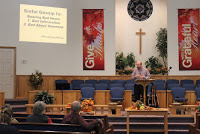 Here are eight important milestones from the last 12 months:
 1. I got to speak about resisting gossip and using our words for good at the 2016 Deep and Wide Conference at Faith EFC in Mountain Lake Park Maryland.
2. The Spanish version, Resistiendo el Chisme , is now available as an e-book in multiple formats.

3. The Korean version,험담을 멈추라, was released by CLC Korea.
4. CareLeader republished my article on Keeping Gossip Out of Prayer Requests.
5. The Russian version, Противостоять сплетням, was released by CLC Belarus and (another first!) they produced a Russian version of the original book trailer.

6. The Romanian version, Lupta împotriva bârfei, was released by CLC Romania (doesn't "bârfei" look like a great word for gossip?!).
 That brings the total number of languages up to 6 (including the original English, the only one that I actually understand)!
7. Resisting Gossip was included among a group of terrific books in a new free guide for discipling youth by Reformed Youth Online.
8. I was interviewed by two pastors for their curiously named "Walrus and Carpenter Podcast" about the 4th anniversary of the book.
Thank you to those who have helped with this and prayed for the influence of our little book. I'm thankful to my Lord for the blessing of being involved in this ministry and grateful for stories of people who are learning to win the war of the wagging tongue.

This week marked the fourth anniversary of the publishing of Resisting Gossip: Winning the War of the Wagging Tongue . What a joy it has been to be see it continue to be read by people all around the world.
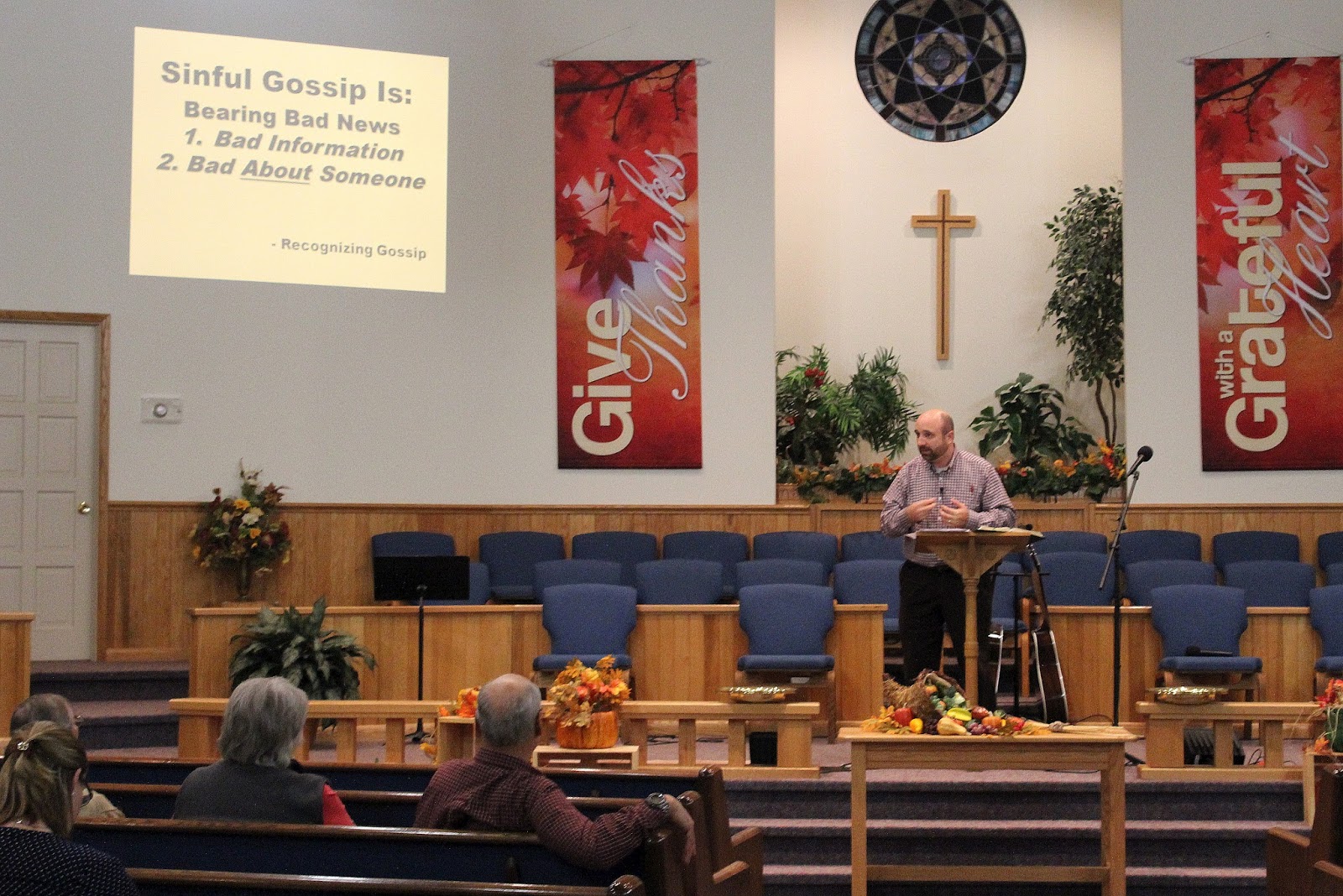 Here are eight important milestones from the last 12 months:
 1. I got to speak about resisting gossip and using our words for good at the 2016 Deep and Wide Conference at Faith EFC in Mountain Lake Park Maryland.
2. The Spanish version, Resistiendo el Chisme , is now available as an e-book in multiple formats.

3. The Korean version,험담을 멈추라, was released by CLC Korea.
4. CareLeader republished my article on Keeping Gossip Out of Prayer Requests.
5. The Russian version, Противостоять сплетням, was released by CLC Belarus and (another first!) they produced a Russian version of the original book trailer.

6. The Romanian version, Lupta împotriva bârfei, was released by CLC Romania (doesn't "bârfei" look like a great word for gossip?!).
 That brings the total number of languages up to 6 (including the original English, the only one that I actually understand)!
7. Resisting Gossip was included among a group of terrific books in a new free guide for discipling youth by Reformed Youth Online.
8. I was interviewed by two pastors for their curiously named "Walrus and Carpenter Podcast" about the 4th anniversary of the book.
Thank you to those who have helped with this and prayed for the influence of our little book. I'm thankful to my Lord for the blessing of being involved in this ministry and grateful for stories of people who are learning to win the war of the wagging tongue.

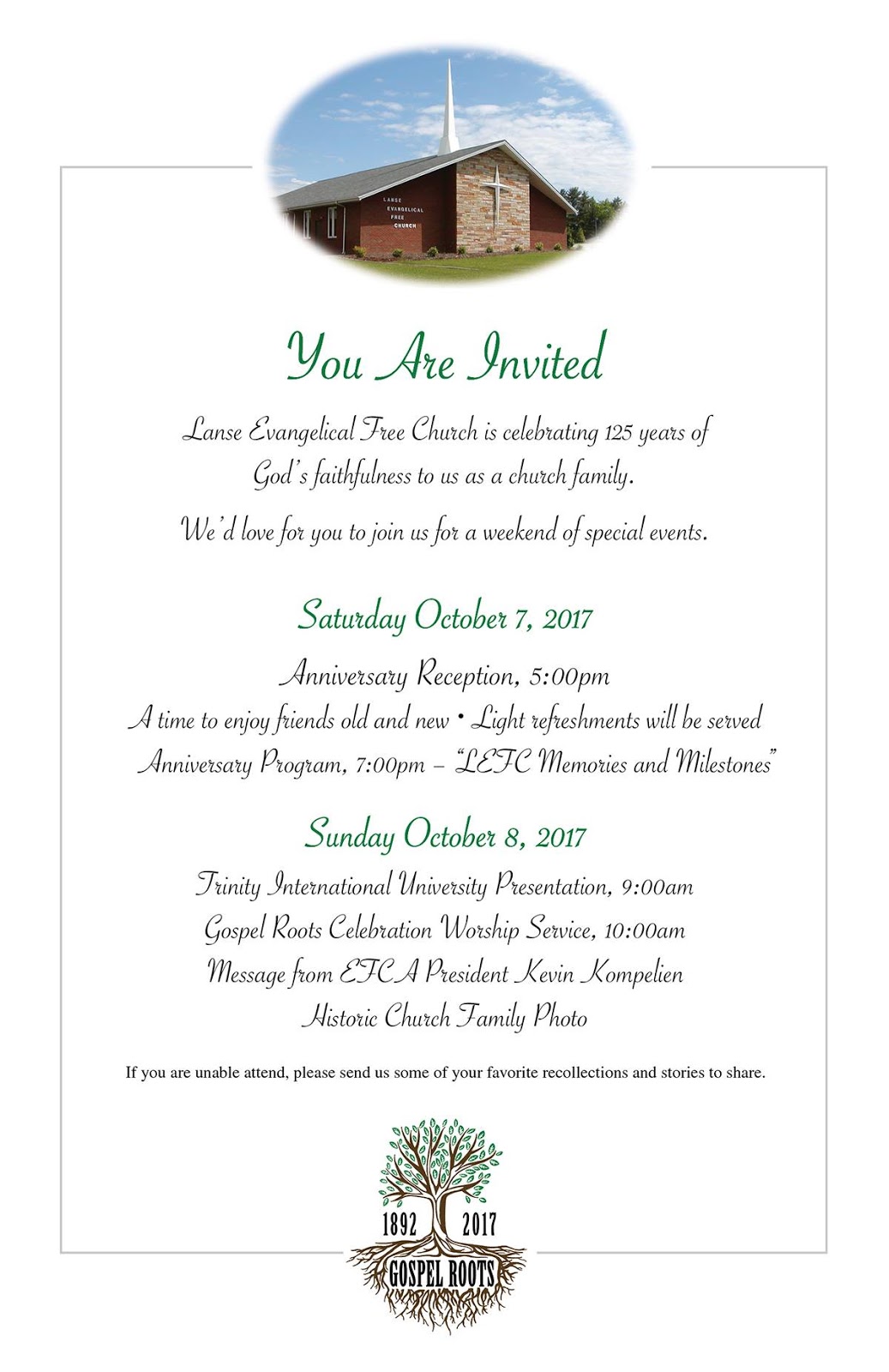
125th Anniversary Celebration at Lanse Evangelical Free Church
In just one month, our church family will be celebrating our 125th anniversary with a special weekend of events. As the longest serving pastor (19 years and counting), it is a great privilege and pleasure to see this special event come together.
I look forward to fellowshiping with people from various eras of the church's history and am especially excited to have EFCA President Kevin Kompelien on our campus.
If you have a connection (old or new) with our church, we'd love for you to attend or to send in some favorite memories to share. Happy birthday, Lanse Free Church!
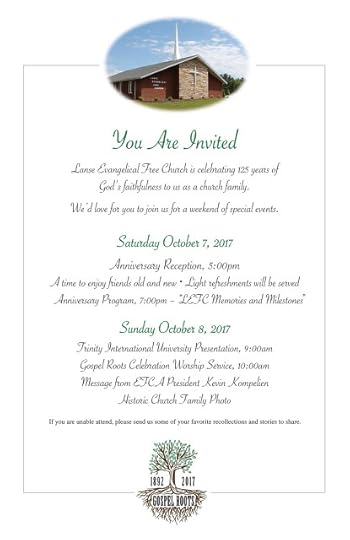
I look forward to fellowshiping with people from various eras of the church's history and am especially excited to have EFCA President Kevin Kompelien on our campus.
If you have a connection (old or new) with our church, we'd love for you to attend or to send in some favorite memories to share. Happy birthday, Lanse Free Church!
September 3, 2017
[Matt's Messages] "I Plead With You"
 “I Plead With You”
Galatians: The Truth of the Gospel
September 3, 2017 :: Galatians 4:12-20
Our current sermon series is called “The Truth of the Gospel” because that’s exactly what was at stake.
The apostle Paul was writing these churches because they were in danger of losing the truth of the gospel.
Paul had been to Galatia and helped to establish these churches on the gospel of grace alone, the gospel of faith alone in Jesus Christ alone.
But some false teachers had crept in and were turning the heads of the Galatians. These false teachers were convincing them of a false gospel.
They were telling the Galatians that faith alone in Christ alone was not enough.
You also needed the Law. You needed to keep the Law of Moses for your justification to stay justified. To be right with God you need Jesus and you need to obey the Law.
That’s a false gospel. That’s a bomb ready to go off and blow up these churches.
And so Paul writes his letter.
For the last 3 chapters, Paul has been dismantling that false gospel. Disarming that heretical explosive device so it doesn’t go off in their faces.
If...they will accept what he is saying in his letter.
Paul has pulled out some of the strongest words he’s ever used in his letters, and some of the strongest words are still to come in this one.
He’s reminded them about his personal testimony.
He’s reminded them about his personal authority, as an apostle of Jesus Christ.
He’s reminded them that his gospel came directly from the Lord Jesus Christ.
He’s shown them how foolish it is to think that you can start being justified by faith and then turn around and finish being justified by observing the law.
He’s shown them how the Law was never meant to be the means of our justification. It was temporary and was meant to lead us to Christ that we might be justified by faith.
And he’s reminded them that they are no longer slaves. They are sons of God, and heirs of God, and known by God and–not because they obeyed the Law! Not because they were circumcised or observed special days, months, seasons, and years!
But because they put their faith in Jesus Christ and Jesus Christ alone.
And now, Paul is going to ask something from them.
It’s funny. This here is actually the first call to action in this whole letter. Not until chapter 4!
It’s all been implicit until now, but now he makes it explicit.
He says, “I plead with you, brothers...”
That’s the title of today’s message, “I Plead With You.”
He’s been laying out his case, piece by piece by piece, and now he makes it personal and he asks them to take it all to heart and to change their minds.
Some people think of the apostle Paul as a cold fish.
He’s so incredibly smart, and he writes such complicated theology.
Paul knows his Old Testament backwards and forwards.
Paul writes these theological treatises like Ephesians an Romans.
So he’s really smart. But if you think of Paul as a cold, calculating, dispassionate theological machine, you’ve got him all wrong.
Paul is incredibly passionate! Paul cares deeply.
Paul is full of emotion. It’s emotion that comes from the truth of the gospel, from the depths of his theology, but he’s very emotional and very personal.
These are some of the most gut-wrenchingly personal words in the New Testament.
They reveal Paul’s heart.
It’s very much a pastor’s heart. It’s what a pastor’s heart should be like.
As I read it again and again this week, I was encouraged and convicted by what I could see of Paul’s pastoral heart for these people in spiritual danger.
And what he pleads for them.
Do you feel his anguish?
Do you see how emotional Paul can be?
“I am perplexed about you!”
That’s why he pleads with them.
He’s disturbed. He’s a loss. He almost doesn’t know what to do with these folks.
Verse 11 said that he was worried about them. He said, “I fear for you, that somehow I have wasted my efforts on you.”
I know how he feels. As a pastor, I often don’t know what to do.
I know that because I’m up here preaching and I seem to have my thoughts together that I can give the impression that I have all of the answers.
But often, as pastor, I don’t know what to do.
I care deeply about my people, but I am often at a loss to know what to say or what to do to help people be the people that they are supposed to be in Christ.
So Paul does what he knows to do, and that’s plead with them. V.12
“I plead with you, brothers, become like me, for I became like you.”
#1. BECOME LIKE ME.
Become like Paul.
Paul says, “I plead with you, brothers, become like me, for I became like you.”
What does he mean?
In what way does Paul want them desperately to become like him?
He wants them to be like him in trusting in Jesus Christ alone for their justification and not adding law-keeping to the gospel. Right?
That’s what he’s been driving at all along.
He wants them to be free of the Law.
He wants them to throw off the slavery that he was talking about in the previous section.
And to embrace their new identity as sons in the Son, as heirs of the promise, as known by God.
That’s how he is and that’s what he wants for them.
“I plead with you, brothers, become like me, for I became like you.”
Isn’t it interesting and ironic that a Jew like Paul would be trying so hard to convince these Gentiles that they didn’t need to observe the Law of Moses?
“I became like you.”
Which, by the way, is a very wise thing for a pastor to do. If he wants his flock to become like him spiritually, he needs to become like them in as many ways as he can.
Now, Paul is going to appeal to their prior relationship. He’s going to base his pleading on their shared history.
And he’s going to get very personal.
He starts by saying that things between them used to be very different than they are today. End of V.12 “You have done me no wrong [back then you were great]. As you know, it was because of an illness that I first preached the gospel to you. Even though my illness was a trial to you, you did not treat me with contempt or scorn. Instead, you welcomed me as if I were an angel of God, as if I were Christ Jesus himself.”
Things used to be really different between this church and this apostle.
When he first came to them, he was a wreck.
Apparently, the reason he first met them was because of (literally) “a weakness of the flesh” which was probably a “bodily ailment” like an illness.
It’s possible that he came beaten and bloodied by the persecution that followed him everywhere he went.
But it’s more likely that he got something like malaria and was laid up and had to get nursed back to health among these Galatians.
We don’t know exactly because Luke doesn’t tell us this story in the book of Acts.
Whatever it was, maybe it was an eye-problem. Paul seems to have trouble with his eyes. And maybe it was the same problem as his “thorn in the flesh” from 2 Corinthians 12, we don’t know.
Whatever it was, he wasn’t a pretty sight.
His illness was (v.14) “a trial” to them.
But that didn’t stop them from loving him. V.14 “You did not treat me with contempt or scorn.”
They didn’t turn up their noses at him or spit on him as accursed by God.
“Instead, you welcomed me as if I were an angel of God, as if I were Christ Jesus himself.”
That’s what we call the royal treatment.
They heard Paul’s gospel and they received Paul as the messenger of the gospel of Jesus Christ.
And Jesus said, “He who receives you receives me, and he who receives me receives the one who sent me” (Matthew 10:40).
But something has changed. Something has gone wrong. V.15
“What has happened to all your joy?”
Or what has happened to the satisfaction, to the “blessing you felt” in relationship to me?
“I can testify that, if you could have done so, you would have torn out your eyes and given them to me” (v.15).
“Where did that go?
I didn’t change!
I feel the same way about you.
My gospel hasn’t changed.”
V.16 “Have I now become your enemy by telling you the truth?”
“I was telling you the truth before. And you loved it.
And you loved me.
I’m still telling you the truth, but now you don’t seem to love me.
You must not love the truth.”
By the way, this is another thing that a faithful pastor will do. He will continue to give people the truth even when they don’t want to hear it.
It’s one of the parts of pastoring that I struggle with the most.
I like to be liked. And I don’t like to be disliked.
So I’m tempted to trim the truth to get the likes.
But I’m committed to giving people the truth even when they don’t want to hear it.
Because that’s true love!
And the same is true for a church with it’s pastor.
Don’t tell me what I want to hear. Tell me what I need to hear. In love.
“Have I now become your enemy by telling you the truth?”
I plead with you, “Become like me.”
Put your faith in Jesus Christ alone, not in anything else, including your own good works.
I plead with you.
#2. BEWARE OF FLATTERERS.
Proverbs 27:6 says, “Wounds from a friend can be trusted, but an enemy multiplies kisses.”
Paul has been giving them trustworthy wounds, but these other people have been multiplying the kisses. V.17
“Those people [the false teachers] are zealous to win you over, but for no good. What they want is to alienate you from us, so that you may be zealous for them.”
These guys have been doing the full-on sales job with the Galatians.
You know what I mean? They have rolled out the red carpet. They have “fawned and fussed” over the Galatians (John Stott’s phrase).
They have played up to them and promised them the moon.
That’s what false teachers do. They make you feel good about yourself.
And they promise you all kinds of things that they don’t plan to deliver on.
That’s what the prosperity gospel does.
People who teach that God wants you healthy, wealthy, and prosperous in this life.
Just follow these steps!
Just send your check to this address.
They never say anything that you don’t want to hear.
They never say anything difficult or hard to accept.
And they make you feel good about yourself.
And what would feel better than to know that you have had a hand in your own justification because you have obediently kept the Law and secured all of its blessings?
And they play up to you like that to turn you away from the truth of the gospel.
And to turn you away from the true church.
And to turn you away even from the one who brought you the gospel in the first place.
And to turn you to themselves....
Paul says, “What they want is to alienate you from us, so that you may be zealous for them.”
Now, Paul wouldn’t care a bit if they had found other true teachers teaching them the true gospel. And maybe he faded away in their memories.
But these folks are trying to get a following for themselves.
Watch out for spiritual leaders like that. Beware of flatterers.
They want something. Often it’s your money.
But they also want control of your lives. They want to use you.
This is how cults get started and how they thrive.
Now, Paul says, it’s not bad to be zealous for somebody, but there is a right way and a wrong way to go about it. V.18
“It is fine to be zealous, provided the purpose is good [provided that it’s about the truth of the gospel], and to be so [zealous] always and not just when I am with you.”
These false teachers were one way when they were with Galatians and another when they were not.
Paul felt and acted the same towards them whether he was there or he was far away.
That’s another mark of a good pastor, of a good Christian leader.
Do we care about our people in the same way when we are not with them as when we are?
Beware of flatterers.
Can you think of someone that has tried to win you over to them at the expense of what you know to be true?
Watch out for people like that.
And if I ever start acting like that, give me the boot.
Paul is hurting. Paul is in so much pain because of the spiritual danger looming over these Christians whom he loves so much.
Look how he pleads with them. V.19
“My dear children, for whom I am again in the pains of childbirth until Christ is formed in you, how I wish I could be with you now and change my tone, because I am perplexed about you!”
Those are shocking words.
Paul is a guy talking about being in labor.
He’s trying to figure out how he can describe how much anguish and agony he’s feeling for these Galatians.
And he’s seen a woman who is giving birth.
“That’s how I feel!”
But I feel like I’m having to do it all over again.
Ladies, can you imagine giving birth to the same child a second time?
“I thought we did this already!”
Brings new meaning to the phrase, “Labor Day.”
“Again?
I thought I taught you the truth of the gospel the first time.
Well, I’ll just keep on going until I know you’ve got it.”
“Until Christ is formed in you.”
#3. BE FULL OF CHRIST.
That’s what I’m suffering for.
I’m doing all of this to know that “Christ is formed in you.”
That you have trusted in Christ and are trusting in Christ so that Christ is transforming you into His own image.
I plead with you! Be full of Christ and Christ-likeness.
That’s the whole point.
By the way, that’s what should be the goal of every pastor and every Christian leader.
That should be the goal of all of our labors, all of our suffering and work.
Not that people should be formed in our image (though we want them to become as we are), but that Christ should be formed in them.
That Christ should be formed in you.
Paul wishes that he could stop the letter right there and look them in the eye and see if it’s made any difference.
He wishes that he didn’t have to keep on going with these strong words. He’s probably afraid that they will take it the wrong way. V.20
“...how I wish I could be with you now and change my tone, because I am perplexed about you!”
“That’s why I am pleading with you.
Because I care!
I’m like your Mom. I gave you birth.
And I just want what’s best for you. And that’s Jesus!”
Worship at the Lord’s Table
That’s what this table is all about.
It’s all about Jesus.
And being full of Jesus and Jesus being formed in us.
It’s not a very flattering table.
Don’t come to this table to feel good about yourself.
This table says that you are a sinner.
That you have not kept God’s law. You have broken it.
And the punishment is death.
This table is not here to make you feel good about yourself.
But this table also says that Someone has come and taken your punishment for you.
His body was broken for you.
His blood was poured out for you.
And this table says that all you have to do is place your faith and trust in Him alone and you will be justified.
“Believe on the Lord Jesus Christ and you will be saved.”
If you do that, then you will become like Paul.
And you will in time be full of Christ. Christ will be formed in you.
That’s the gospel. And it never disappoints!
If you are trusting in Jesus Christ and Christ alone for your justification, you are invited to eat and drink this memorial meal with us.
If you are not trusting in Jesus Christ and Christ alone for your justification, then please don’t eat and drink with us.
I plead with you!
I plead with you to repent and place your faith in Jesus.
He is so wonderful. So sufficient. So glorious and merciful and sweet.
I’m zealous for everyone here to know and trust Him.
And for Him to be formed in each one of us.
***
Messages in this Series:
01. To the Churches in Galatia
02. Turning to a Different Gospel
03. Preaching the Faith He Once Tried to Destroy
04. So the Truth of the Gospel Might Remain With You
05. Acting in Line with the Truth of the Gospel
06. I Live By Faith in the Son of God
07. You Foolish Galatians!
08. You Are All Sons of God Through Faith in Christ Jesus
09. So You Are No Longer a Slave
September 2, 2017

September 1, 2017
Student Discipleship Guide from RYM
 John Perritt and Josh Byers of RYM have created an excellent guide for discipling students using sold gospel-centered Christian books.
I really like how clear it is with easy-to-follow instructions and graphics, including the covers of the books for quick identification.
The best news is that this guide is absolutely free!
They write:
As Christians, we are to pass the faith on to the next generation. Whether we are parents or grandparents, church staff or volunteers, we have been tasked to make disciples (Matthew 28:19). One of the primary ways we can be discipling the next generation is by encouraging them to be readers.
We serve a God who created all things by using words (Genesis 1-2) and a Savior who calls himself the Living Word (John 1:1-14). Christians are also called to be a people of the Word and to meditate upon God’s Word day and night (Psalm 1).
Not only should we – and our children – feed upon God’s Word, but we should also be feeding upon other words. That is, we should be reading. We should be reading theological books, classics, fiction, etc. Teaching our children to be readers in many different genres and categories will foster a deeper appreciation for the various genres and categories found in Scripture.
However, simply saying that we should disciple our students to be readers can seem like a daunting task. Where do we begin? What books should we focus on? At what ages should this begin? These questions led to the creation of the following plan.I was greatly encouragement to find that they had listed Resisting Gossip as a suggested book for 10th graders to read (see pg. 9 of the PDF version).
It's easy to recommend this resource to anyone who has or works with teens. Check it out at RYM's website.