Matthew C. Mitchell's Blog, page 22
February 20, 2022
“Shepherds of God’s Flock” [Matt's Messages]
 “Shepherds of God’s Flock”As Foreigners and Exiles - The Message of 1 PeterLanse Evangelical Free ChurchFebruary 20, 2022 :: 1 Peter 5:1-4
Being a pastor can be a very hard job, but when it’s done right, it’s totally worth it.
The title of this message is lifted from verse 2 of the NIV which says, be “Shepherds of God’s Flock.” And there are two kinds of shepherds of God’s flock mentioned in these four verses.
There’s the Chief Shepherd there in the last verse, verse 4. That’s Jesus Christ. He is the Chief Shepherd of God’s flock, the church. He is the Lead Pastor of the Church.
And then there are these other men who are called to also be shepherds, or another word for “shepherd” is “pastor.” There are these other men who are also called to be pastors of God’s flock, and they are called “elders.”
And this passage is particularly addressed to them.
[VIDEO WILL BE EMBEDDED HERE]
“To the elders among you.”
That’s a certain group of church leaders. The New Testament refers to them over and over again. Acts, 1 Timothy, Titus, James. 2 John. 3 John.
The elders (or in Greek the “presbuterous” You can tell what English words we get from that!) are the chief leaders of the New Testament churches.
Whenever a new church was established in the New Testament, one of the marks of the health of the new church was the installation of godly elders to lead it.
And apparently, the churches scattered throughout Pontus, Galatia, Cappadocia, Asia and Bithynia (remember chapter 1, verse 1?) were led by these “elders.”
And now Peter wants to talk directly to them. And he talks to them as one of them. V.1
“To the elders among you, I appeal as a fellow elder...”
“I’m one of you. Yes, I’m an apostle, and what I say to you is authoritative. But I’m coming to you as one of you. As ‘a fellow elder,’ so what I’m about to ask you to do is something that I am also doing. I’m not asking you to do something which I do not understand how hard it is or which I am not willing to do myself.”
I think that Peter comes in like this because he knows that he’s asking them to do something difficult.
He knows that leading the church, especially during times of persecution, is really really hard.
We cannot forget the context here.
Remember what Peter has just told all of them: “[Beloved,] do not be surprised at the painful trial you are [unjustly] suffering...”
Do not be surprised that you are being persecuted.
Instead: rejoice, represent, and re-commit, right?
One of you texted me this week and said that is your “new mantra” as you go to work out there in the big bad world each day. “Rejoice, represent, and re-commit” in the face of unjust suffering for the name of Christ.
And Peter ended that section by saying, “Those who suffer according to God's will should commit themselves to their faithful Creator and continue to do good” (4:19).
And then he goes right into talking to these elders in particular.
He actually says in the Greek, “therefore” or “SO to the elders among you I appeal...” There is a direct connection
Who is probably going to get hit with the first blast of persecution? The leaders, right? They’ll go after the leaders. If it’s “time for judgment to begin with the family of God” (4:17), then it will probably start with the leaders of that family, the elders.
It certainly started with the top leader in the first place. Peter says that he is not only a fellow elder, but he’s also (v.1 again), “a witness of Christ's sufferings and one who also will share in the glory to be revealed...”
Jesus doesn’t ask the elders of the church to do anything He’s not been willing to do first, either. Jesus was willing to suffer unjustly. He was willing to be crucified.
Peter saw that with his own eyes.
But Peter also knew that Jesus’ sufferings were not the end. How many times has he said something like this in this letter?
First, suffering. Then, glory.
That’s the pattern. Jesus suffered and was raised victorious and will return in glory. And so will Peter, and so will we.
Peter saw the suffering, and he knows that he will share in the glory. And so will all of the faithful elders. It’s a hard job! But it’s worth it.
The elders of our church right now are Keith, Joel, Cody, Abe, and myself.
Abe has been an elder now for almost two whole months, and he might be a little worried now that he’s heard verse 1!
These other guys have been in the battle a little longer. Keith and I are the only two men still on the Elder team who were on the team then when I preached this text before, twenty years ago.
At our first Elders meeting this January 2022, we started the year by reading and praying over this passage to remind ourselves what we have gotten ourselves into and what we are supposed to be doing as elders.
In many ways, this passage basically is my job description as a vocational elder.
This passage along with a short list of other key passages in the New Testament gives me my job description as a church elder by vocation. This is what I’m supposed to do. As well as all the other church elders and, in principle and by extension, all other church leaders.
And I see about 4 main things that Peter is saying to us here.
#1. BE SHEPHERDS.
Be shepherds of God’s flock.
That’s what Peter says to the elders in verse 2.
Elders among you, “Be shepherds of God's flock that is under your care...”
That’s the main thing that a church elder is supposed to do. We are supposed to shepherd or another word for that is “pastor” God’s flock.
The Greek word is “poimanate.” To care for a flock.
Yesterday, at Shannon Allen’s memorial service, I talked about shepherds and sheep.
Sheep need shepherds. They need to be fed and led. They need to be cared for, comforted, and protected.
Sheep need tending. People need pastoring. And, in the church, that’s the job of the elders, at least to see that it gets done. Be shepherds.
The most important thing that we do as elders is not develop a budget or lay out vision or hire a new administrative assistant or make policy decisions–though all of that can be a key part of faithfully leading a flock. The most important thing we do as elders is to act as shepherds of God’s sheep.
When the pandemic began two years ago, I put four goals in front of myself to remind myself of my most important job as everything was changing.
#1. Number the sheep. So we tried to make sure we had a good list of everybody that called this church their home. We updated the church directory and the all church notification email list. And we divided up all of the families in lists under each one of the elders. Number the sheep. We just did that again at the first of the year. Updated the directory. And made sure that each family had an elder that was responsible for shepherding it. Number the sheep.
#2. Feed the sheep. No matter what, we all need the Scripture taught to us. So when the pandemic began, I made those sermon videos and tried to get them in front of your eyes. Feed the sheep. That’s what I’m doing right now, right here, trying to feed you the Scriptures for your spiritual growth. Feed the sheep. That’s what Stay Sharp is all about starting tomorrow, trying to make sure that our churches are fed with thee good stuff. Feed the sheep.
#3. Tend the sheep. When the pandemic began, that was phone calls, and texts, and messaging, and emails, and video chats, and Zoom fellowships, and porch and driveway visits. And now it’s home visits again and nursing homes and funeral homes and hospital rooms and playing fields. And it’s thinking of all of what our flock needs and trying to lead them to it. Tend the sheep.
#4. Repeat. Number, feed, tend, repeat. Number, feed, tend, repeat. Number, feed, tend, repeat.
Be shepherds.
How am I doing? For me, the hardest part of covid has been trying to shepherd well and knowing just how often I failed to do that.
Elders, be shepherds.
You know, the most important words in that phrase in verse 4 are not the command but who the command is about. “Be shepherds” of whom? Of “God’s flock that is under your care.”
That is so important for church elders to remember.
The flock is not yours.
It is God’s!
This church is not mine. It’s God’s.
This church is not Keith’s or Joel’s or Cody’s or Abe’s. It’s God’s.
This church is Jesus’ church. He bought it with His blood!
Now, sometimes, I’ll say, “At my church, we do it this way.” And you’ve probably said, “I go to Pastor Matt’s church.” And we all know what we mean by that. We say this is “our church.”
I say, you are my beloved flock. But what I better mean by that is that you are “the flock under [my] care.” And I better treat you that way, as God’s flock. I don’t get to do with you what I want. I only get to do with you what I know God wants.
Elders, be shepherds.
#2. BE EAGER.
Be eager to serve God’s flock.
I get that also from verse 2. “Be shepherds of God's flock that is under your care, serving as overseers–not because you must, but because you are willing, as God wants you to be; not greedy for money, but eager to serve...”
Be eager.
This one can be really hard because church leadership is not always fun.
Especially in times of persecution!
Church leadership has been hard during the pandemic. I read a reputable statistic yesterday that 38% of pastors in the US have seriously considering quitting the pastorate during the pandemic. Nearly 2 out of every 5 have seriously thought about quitting.
But if we thought that pastoring in a pandemic was hard, just wait until we find out what pastoring during persecution is like!
Peter says that these elders should pastor as overseers, the Greek word for that is “episkopountes” (and you can tell what English words we get out of that, overseers).
The elders should give oversight to the whole church, providing direction and leadership. Not just doing everything but seeing that everything gets done.
But they should only do that work of overseeing only out of a certain kind of heart! Look at verse 2.
“Not because you must, but because you are willing.”
Not because of compulsion.Not just because it’s your duty.Not just because it’s your job.Not just because you signed up for it or they elected you to do it or your name is on some list.
But because you really want to.
You see why that’s tricky? Because we don’t always want to, do we?
Church leaders don’t always want to lead churches! But God doesn’t want us to do it begrudgingly. He wants our hearts to be in it.
And not in it for the money. Verse 2 again. “...not greedy for money, but eager to serve...” There are some really twisted reasons why some people get into church leadership. Or stay in church leadership.
They do it for the money. Or perhaps some other form of payment like the popularity or the power trip.
At Lanse Free Church, I am currently the only elder who is on staff and receiving a salary for being a vocational elder. So this could be a major temptation for me.
You guys support me really well, and I could fall into the temptation of doing my shepherding so that the paychecks keep coming. Writing the next sermon or going to the next meeting just because you’re paying me.
Please don’t stop paying me well just to test me!
But I have to interrogate myself on a regular basis to make sure that my heart is in it. Because my job description says that I need to shepherd God’s flock eagerly. And that’s true for all church leaders. We all need to make sure we’re doing it for the right reasons.
And if we are not...we need to have our hearts changed.
We don’t just say, “I don’t feel like it any more. So I quit.”
We say, “I don’t feel like it any more. So I repent.”
“...not because you must, but because you are willing, as God wants you to be...”
See how God is going after your heart? Yes, if you are not really willing and eager, then you should get out of that leadership position. We don’t want people to serve in church leadership who are not eager. But don’t miss that God wants you to be eager!
And in verse 4, He’s going to give us a much better motivation.
But first there’s verse 3.
And that’s the third way that He wants elders to shepherd.
#3. BE EXAMPLES.
Be examples for God’s flock. Verse 3.
“Be shepherds, serving as overseers...not lording it over those entrusted to you, but being examples to the flock.”
One of the major ways that pastors pastor and shepherds shepherd and elders...eld?
Is to lead by example.
One my pastor friends pointed out to me long ago that sheep cannot be driven, they have to be led. The shepherd goes first and the sheep follow. You can’t get behind of bunch of sheep and say, “Go, go, go!” and they go where you want them to go. No, they scatter. The shepherd has to show them where he wants to go.
Peter remembered when Jesus said, “You know that those who are regarded as rulers of the Gentiles lord it over them, and their high officials exercise authority over them. [That’s the corporate structure!] Not so with you. Instead, whoever wants to become great among you must be your servant, and whoever wants to be first must be slave of all. For even the Son of Man did not come to be served, but to serve, and to give his life as a ransom for many” (Mark 10:42-45).
Even Jesus led by example!
If anyone could rightly lord it over someone else, it would be Jesus. But even He showed the way by being a servant.
Keith, Joel, Cody, Abe, and I want to be good examples for you. We are not perfect. Oh boy, are we not!
But we desire to live lives worthy of emulating. We desire to set the pace.
I want to live my life as an example for you. It makes me tremble to say it, but watch me. I’m trying to show you how it’s done. Be like me.
I’m trying to live as foreigner and exile and abstain from the sinful desires that wage war against my soul. I’m trying to live such a good life among the pagans that though they accuse me of doing wrong, they may see my good deeds and glorify God on the day He visits us.
Be like me.
By the way, if you are not an elder, you can apply this passage to yourself in lots of different ways.
Some of you should aspire to being a church elder (1 Timothy 3:1).
Whether or not you ever actually serve on the official church elder team, guys, you should want to be this kind of a godly man.
Or if you are lady, you can take these principles and apply them to the areas of church leadership to which you might be called.
But another way to apply this to your own life–if you are not currently an elder–is to flip around each point and think about how to help your elders do their job–as one of the sheep in God’s flock.
So if we are supposed to be shepherds, you could say to yourself, “Am I allowing myself to be shepherded? Am I a good sheep?” Have you asked yourself that?
If we are supposed to be eager to serve, you could ask yourself, “Am I making it easy for them to be happy to serve us? Am I supportive?”
If we are supposed to be examples for you, you could ask yourself, “Am I following the example they are setting for us? Am I trying to be like them?”
In verse 5, Peter will tell the younger church members to be submissive to the elders.
The sheep should regularly ask ourselves if we are allowing ourselves to be shepherded. The flock should regularly ask ourselves if we are allowing ourselves to be led. And, remember, except for the Chief Shepherd, all human shepherds are sheep, as well. We all need pastored. And we all need to ask ourselves if we are allowing ourselves to be pastored.
Are we allowing ourselves to be numbered?Are we eating what our shepherds are feeding us?Are we following their lead?
Because we are God’s flock.
We are entrusted to certain shepherds.
Did you see that in verse 3 again?
“Not lording it over those entrusted to you.”
Abe and Cody and Joel and Keith and I all noticed that repetition when we studied it in January. And we felt it deeply. We have been given a trust to keep. May we be found faithful to shepherd this particular group of sheep.
Because if we are faithful, we be rewarded. That’s the last point.
#4. BE REWARDED.
Be rewarded by the Chief Shepherd of God’s Flock, verse 4.
“And when the Chief Shepherd appears, you will receive the crown of glory that will never fade away.”
I’m not sure exactly what that means, but I want to find out! I want that unfading crown of glory.
The world’s rewards and accolades will all fade away. But Jesus who loves His flock–like nobody loves a flock[!]–is offering unfading rewards to those who love His flock for Him.
We will “share in the glory to be revealed” (v.1)!
Being a pastor can be a very hard job, especially when the persecution hits, ut when it’s done God’s way, it is totally worth it.
***
Previous Messages in This Series:
01. "Elect Exiles" 1 Peter 1:1-2
02. "A Living Hope" 1 Peter 1:3-7
03. "Angels Long To Look Into These Things" 1 Peter 1:8-12
04. "Be Holy In All You Do" 1 Peter 1:13-16
05. "Live Your Lives As Strangers Here In Reverent Fear" 1 Peter 1:17-21
06. "Love Each Other Deeply, From the Heart" 1 Peter 1:22-2:3
07. "But Now You Are..." 1 Peter 2:4-10
08. “As Foreigners And Exiles” 1 Peter 2:11-12
09. "Submit Yourselves For the Lord's Sake 1 Peter 2:13-17
10. "Follow In His Steps" 1 Peter 2:18-25
11. "Do What Is Right And Do Not Give Way To Fear" 1 Peter 3:1-7
12. "Inherit a Blessing" 1 Peter 3:8-12
13. "Even If You Should Suffer For What Is Right" 1 Peter 3:13-16
14. "To Bring You To God" 1 Peter 3:17-22 (esp. 18)
15. "To Suffer for Doing Good" 1 Peter 3:17-22
16. "Done with Sin" 1 Peter 4:1-6
17. "The End Of All Things Is Near" 1 Peter 4:7-11
18. "Do Not Be Surprised" 1 Peter 4:12-19


February 13, 2022
“Do Not Be Surprised” [Matt's Messages]
 “Do Not Be Surprised”As Foreigners and Exiles - The Message of 1 PeterLanse Evangelical Free ChurchFebruary 13, 2022 :: 1 Peter 4:12-19
“Do Not Be Surprised.”
The Apostle Peter wants his readers to not be shocked or astonished or taken aback at the unjust suffering that they were currently experiencing and could continue to expect in Asia Minor.
Peter doesn’t want them to be floored, or confused, or flabbergasted that things have gotten tough in following Jesus Christ.
He’s really been saying this all along, ever since chapter 1. Peter’s been helping them to get ready for persecution and telling them how to live under persecution. And encouraging them to keep on doing good even when they get accused of doing bad.
Like our memory verse, right?
“Dear friends, I urge you, as foreigners and exiles, to abstain from sinful desires, which wage war against your soul. Live such good lives among the pagans that, though they accuse you of doing wrong, they may see your good deeds and glorify God on the day he visits us.”
[VIDEO WILL BE EMBEDDED HERE]
Notice that in our verse 12, Peter addresses them the exact same way as he did in 2:11, “Dear friends.” In Greek that’s “agapatoi,” and you hear the word “agape/love” in there. “Loved ones.” “Beloved.”
Peter has some hard things for his readers to receive in this paragraph, but he’s saying them all in love, out of his great love for them. “Dear friends [beloved], do not be surprised.”
In the previous paragraph that we studied last week, Peter reminded them that time was short, that the end of all things is near and so we should keep calm and pray and show love for each other and practice hospitality and serve each other with whatever gifts we’ve been given so that Jesus Christ gets all the glory. And then he couldn’t help but praise Jesus: “To him be the glory and the power for ever and ever. Amen.”
But Peter wasn’t done in verse 11.
He comes down off of that doxology, returns to what he’s been trying to get across for the last 4 chapters, and really drives it home.
“Dear friends, do not be surprised at the painful trial you are suffering, as though something strange were happening to you.”
Beloved, do not be perplexed. Do not be dumbfounded. Do not be absolutely shocked that you are suffering a painful trial–and he’s not talking about just any suffering (covid or cancer or an accident). He’s talking about unjust suffering. Suffering for the name of Christ.
Do not be surprised.
The word there for “painful” in verse 12 could be translated “fiery.” “Purosis” a fiery ordeal, a painful test.
Peter says that this kind of suffering is not strange.
It’s normal.
Now, I’m not happy about that. That’s not how I would want it. I don’t like suffering.
And I’ll bet you don’t either. And the foreigners and exiles in Asia minor didn’t like it either. And Peter didn’t like it!
One time, Jesus told Peter He was going to suffer, and Peter rebuked Jesus for saying it! Yes, you heard me right. Peter rebuked Jesus. Not smart! But Jesus said to Peter, “Get behind me, Satan...you do not have in mind the things of God, but the things of men” (Matthew 16:23).
Well, Peter got the message. And now he’s telling the things of God to the beloved people of God.
Unjust suffering is normal.
Do not be surprised.
And yet, we still often are. There’s something about suffering that almost always surprises us.
Even though even Jesus told us to expect it. “In this world you will have trouble...” (John 16:33).
I think that one good reason for that is that we know in our hearts the way things ought to be. We have vestiges of Eden in our hearts, and we have longings for the Kingdom.
We know that unjust suffering is un-right, and we feel it in our bones.
But during this present age, unjust suffering is not actually strange. It’s normal for disciples of Jesus Christ.
One of the reasons why so many of us Americans are surprised when it happens to us is that Christians (at least white Christians) have enjoyed an exceptionally favored status in the short history of the United States.
Some Christians played a role in the founding of our nation, and some Christian concepts and ideals provided a few of its original foundations. And for a long while we benefitted from a privileged status.
But that’s actually unusual in the history of the world, and over time it almost always comes unraveled.
It’s not what we should expect. In fact, most of the time, we should expect the exact opposite. “Do not be surprised at the painful trial you are suffering, as though something strange were happening to you.”
Don’t expect a Christian nation. Expect persecution, Christian.
We are strangers here, so suffering shouldn’t be strange to us.
Are you ready to suffer because you are a follower of Jesus Christ?
In the next seven verses, Peter tells us how we should respond when we experience this kind of unjust suffering.
What he says might surprise you. We shouldn’t be surprised when we experience unjust suffering, but we should respond in perhaps surprising ways.
I see at least 3.
#1. REJOICE.
Do not be surprised, but instead rejoice. Look at verse 13.
“Dear friends, do not be surprised at the painful trial you are suffering, as though something strange were happening to you. But rejoice that you participate in the sufferings of Christ, so that you may be overjoyed when his glory is revealed.”
“Rejoice.”
That is surprising, isn’t it? I mean it shouldn’t be. Our Lord Jesus taught us this in His Sermon on the Mount. Peter is just echoing the teaching of His master.
But it’s still shocking, I think, to read. Because it’s so counterintuitive. Don’t be surprised that you are hurting, instead rejoice that you are hurting!
Now, of course, Peter doesn’t baldly say, “Rejoice that you are hurting.” What does he say?
“[R]ejoice that you participate in the sufferings of Christ...”
Participate. The Greek is “koinoneite” a sister word of “koinonia.” Fellowship.
Yesterday, I read my sermon on this passage from 20 years ago, and I said it this way then, “Suffering for Christ is Suffering With Christ, So Rejoice In It!”
It’s fellowship. When they hurt you, He is with you. Just like when they hurt Him, you were with Him.
Suffering FOR Christ is suffering WITH Christ, and that’s so worth rejoicing in!
I would rather be suffering with Christ and in Christ than having a “pain free existence” outside of Christ, wouldn’t you?
So, Peter says don’t just endure this suffering. Rejoice!
Not just now, but forever. Did you catch that in verse 13?
“[Re]joice that you participate in the sufferings of Christ, so that you may be overjoyed when his glory is revealed.”
We live now in light of then.
Rejoice now for greater rejoicing then.
Because, remember, Jesus didn’t just suffer and die. He was raised to life and vindicated. And now He’s reigning in glory.
And when Jesus Christ is revealed, we will be vindicated and share in His glory.
We learned this back in chapter 1. Remember when Peter said, “In this [inheritance] you greatly rejoice, though now for a little while you may have had to suffer grief in all kinds of trials. These have come so that your faith–of greater worth than gold, which perishes even though refined by fire–may be proved genuine and may result in praise, glory and honor when Jesus Christ is revealed.” (1:6-7)?
When Jesus Christ is revealed, we who have rejoiced to suffer with Him now will be overjoyed then!
Which gives us all the more reason to rejoice now!
How’re you doing at that?
Anybody here taking some flak for following Christ?
If we aren’t taking any flak, maybe we’re doing it wrong. Don’t go looking for it! But be ready for it. And be ready to rejoice. Look at verse 14.
“If you are insulted because of the name of Christ, you are blessed, for the Spirit of glory and of God rests on you.”
Wow! I don’t want to suffer. I don’t relish the idea of persecution, but I sure love that word “blessed.” I want that! And I want the “Spirit of glory and of God” to rest on me! Yes, I do.
The same Spirit that rested on Jesus (cf. Isaiah 11, Matthew 3).
This is important to understand because it is not obvious. It’s not the way it seems. When you and I experience persecution, it might feel like the Spirit has left us.
If you go into your public school and live as a Christian, you might feel alone.If you go into your secular workplace and live as a Christian, you might feel alone.If you go visit with your unbelieving family and live as a follower of Christ, you might feel abandoned.
But this says what’s really true. You are not alone. Quite the opposite. You are with and in Christ and the Spirit of glory and of God is resting on you!
“If you are insulted because of the name of Christ, you are blessed!”
Now, I almost want to be insulted for the name of Christ, just to have another reason to rejoice.
Do not be surprised, but instead rejoice.
#2. REPRESENT.
Do not be surprised at the painful trial you are suffering, but instead faithfully represent Jesus Christ to the watching world.
Those words “because of the name of Christ” in verse 14 are super important. We aren’t supposed to rejoice just because we are in pain. We are not masochists. But we are supposed to rejoice because we wear His name. This is the point of verses 15 and 16.
“If you suffer, it should not be as a murderer or thief or any other kind of criminal, or even as a meddler. However, if you suffer as a Christian, do not be ashamed, but praise God that you bear that name.”
Do you see the logic?
Peter says that if we suffer, it shouldn’t be because we deserve it.
It’s not a blessing to suffer the consequence of your own sin. Whether it’s extreme criminal stuff like murder, robbery or something like or garden variety sins like being a busybody or some other kind of meddlesome troublemaker.
It’s not persecution if you deserve it.
That is poorly representing Jesus.
And, sometimes, we will be accused of all of those things even if we haven’t done them.
But Peter says don’t be accused of them because you have done them!
That’s not where the blessing is. The blessing is suffering when you don’t deserve it. When all you’re doing is good in the name of Christ. When that happens, don’t be ashamed (v.16), “but praise God that you bear that name.”
“Praise God that you bear that name.” Represent. Bear that name. Fill your mouth with that name. And don’t be ashamed.
You know it’s easy to feel shame when you’re being persecuted. The whole point of persecution is to make you feel shame. They were heaping shame on Jesus at the Cross. And at the exact same time, He was unashamed.
You know there are only three places in the Bible that use this word “Christian” (like in verse 16). You and I go by a lot of names in the Bible, “disciple,” “believers,” “brothers and sisters,” and so on. Only 3 places where the word “Christian” is used.
And interestingly, it could be a negative word hurled at us by the world. “You Christians.”
I think it’s likely we’re going to see more and more hostility towards Christians in this country.
Of course, as I said last week, I am a not a prophet, nor the son of a prophet, and I work for a non-profit organization (thanks, Walt Kaiser!).
But genuine biblical prophets have told us to expect persecution because we bear the name of Christ.
So I think it likely that more of that is on the way.
Right now in our neighbor to the north, in Canada, there is a new law that criminalizes certain practices that aim to challenge a person’s homosexuality or aid a person with gender dysphoria to live in alignment with their biological sex.
Now, it’s possible that this law is only aimed at coercive treatments called “reparative therapy,” and I think they are an ineffective and unhelpful way to go.
But the law is sufficiently vague and potentially ominous enough that many pastors in Canada are concerned that it may end up criminalizing all Christian teaching and counseling on sexual ethics. Making it illegal to teach that “God created human beings uniquely in His image as male and female, and He has designed marriage to be a covenantal relationship between one man and one woman” (EFCA Resolution on Biblical Sexuality and the Covenant of Marriage).
Our Lord Jesus taught us that (Matthew 19:1-6), and we must be faithful to continue to teach it to our children and to the Lord’s church. No matter what the world says.
Now, hopefully, it’s not as bad in Canada as it might seem to some.
And, thankfully, it hasn’t even reached that point here in the US as of yet. [Though see this ordinance that was recently proposed in Indiana.]
But there is no reason to believe that it won’t.
And in some parts of the world, it is simply illegal to teach any Christian doctrine including the gospel of Jesus Christ.
And right now in our nation, even if we have all kinds of legal freedom of speech and legal freedom of religion, we still have hostile neighbors.
There are lots of ways to “suffer as a Christian,” not just as the hands of the government, but Peter says to not be surprised and to not be ashamed, but to praise God that you bear that name.
Represent Him well.
By the way, that includes how we teach about Christian sexual ethics. We better not be getting into trouble over sexuality and gender because we have been rude or impatient or unkind or envious or boastful or proud or self-seeking or easily angered.
We better not be getting into trouble over sexuality and gender because of a cold-hearted failure to love.
But only because we are full of love for God and full of love for our sexually struggling friends, neighbors, and loved ones (re-read verse 15!).
Represent Him well.
And then if you get into trouble, rejoice.
“Do not be ashamed, but praise God that you bear that name.”
In verse 17, Peter says judgment is coming and has already started. Verse 17.
“[Praise God that you bear that name.] For it is time for judgment to begin with the family of God; and if it begins with us, what will the outcome be for those who do not obey the gospel of God? And, ‘If it is hard for the righteous to be saved, what will become of the ungodly and the sinner?’”
I get tripped up on these verses because I always think that judgment is a bad thing. I equate it with condemnation which is one outcome of judgment.
But Peter knows that God’s judgment is perfect.
Remember just few verses ago he said the Lord is “ready to judge the living and the dead” (v.5).
And I think that he’s saying that these trials reveal how real we are. Just like he said in chapter 1, verse 7. “These [trials] have come so that your faith–of greater worth than gold, which perishes even though refined by fire–may be proved genuine [judged genuine, judged to be real] and may result in praise, glory and honor when Jesus Christ is revealed.”
So, mysteriously, as the world comes in and brings their fiery persecutions, God is using them to both purify us and confirm us in our faith.
It’s painful. So painful that we say, “It’s hard for the righteous be saved.” It hurts!
But it shows that we are real, that we really love Jesus.
And that we really are done with sin and really living for Jesus.
And, of course, it shows the opposite, as well.
That’s what Peter means when he says “what will the outcome [of this judgment] be for those who do not obey the gospel of God? And, [paraphrasing Proverbs 11:31] ‘If it is hard for the righteous to be saved, what will become of the ungodly and the sinner?'”
Eternal punishment, that’s what.
Justice is coming, and all will be revealed.
So here is how we should live:
#3. RECOMMIT.
Do not be surprised at the painful trial you are suffering, but instead rejoice that you participate in the sufferings of Christ.
Do not be surprised at the painful trial you are suffering, but instead represent well the name of Christ.
Do not be surprised at the painful trial you are suffering, but instead recommit yourself to your Creator and recommit to doing good. Look at verse 19. Last verse.
“So then, those who suffer according to God's will should commit themselves to their faithful Creator and continue to do good.”
There he goes again with that “doing good” thing! [agathopoiia]
Peter’s a broken record.
Continue to do good.Continue to do good.Continue to do good.
“Live such good lives among the pagans that, though they accuse you of doing wrong, they may see your good deeds and glorify God on the day he visits us.”
Continue to do good.Continue to do good.Continue to do good.
Even when you suffer for it.
Especially when you suffer for it.
It’s not easy. If it was easy, Peter wouldn’t have written this letter for us. But it’s what we are called to. “Continue to do good.”
And the only way we can do that is to trust that God knows what He’s doing.
It sure doesn’t seem like it sometimes. I mean, this verse says again that it is sometimes “God’s will” that we would suffer this kind of persecution.
Not that He says to our persecutors, “Go, hurt my child.” He actually says the opposite to them. But, mysteriously, that pain is still in His plan for us as His children.
And so we have to believe that He is sovereign, and He knows what He’s doing.
He made us, and He is faithful.
He is our faithful Creator, and we can trust Him.
We can put ourselves in His hands.
And continue to do good.
Beloved, do not be surprised at the painful trial you are suffering or are about to suffer. It’s not strange. It’s normal. It’s to be expected.
Instead of being surprised, be thankful. Rejoice that you are in Christ and His Spirit rests on you.
Represent Him well. Do not be ashamed, but praise God that you bear His name.
And recommit yourself to trusting yourself to Him because you know that He knows what He’s doing and continue to do good.
***
Previous Messages in This Series:
01. "Elect Exiles" 1 Peter 1:1-2
02. "A Living Hope" 1 Peter 1:3-7
03. "Angels Long To Look Into These Things" 1 Peter 1:8-12
04. "Be Holy In All You Do" 1 Peter 1:13-16
05. "Live Your Lives As Strangers Here In Reverent Fear" 1 Peter 1:17-21
06. "Love Each Other Deeply, From the Heart" 1 Peter 1:22-2:3
07. "But Now You Are..." 1 Peter 2:4-10
08. “As Foreigners And Exiles” 1 Peter 2:11-12
09. "Submit Yourselves For the Lord's Sake 1 Peter 2:13-17
10. "Follow In His Steps" 1 Peter 2:18-25
11. "Do What Is Right And Do Not Give Way To Fear" 1 Peter 3:1-7
12. "Inherit a Blessing" 1 Peter 3:8-12
13. "Even If You Should Suffer For What Is Right" 1 Peter 3:13-16
14. "To Bring You To God" 1 Peter 3:17-22 (esp. 18)
15. "To Suffer for Doing Good" 1 Peter 3:17-22
16. "Done with Sin" 1 Peter 4:1-617. "The End Of All Things Is Near" 1 Peter 4:7-11
February 6, 2022
“The End of All Things Is Near” [Matt's Messages]
 “The End of All Things Is Near”As Foreigners and Exiles - The Message of 1 PeterLanse Evangelical Free ChurchFebruary 6, 2022 :: 1 Peter 4:7-11
Last week, we entered into chapter 4 of 1 Peter where the apostle urged his readers to arm ourselves with the attitude of Jesus Christ, that is, to be willing to suffer for doing good and in doing so we would be effectively, decisively “done with sin.” Over it. To decide in advance to make a break with sin and to follow Jesus and to desire to do God’s will. To make a break with our past, expecting to take some flack for that from the world, but deciding in advance to not turn back.
Because it’s all worth it. Following Jesus is worth it. Forever!
Because of the gospel. Because Jesus Christ who is “ready to judge the living and the dead” was Himself dead and is now living! So that now, even if we become dead through persecution and martyrdom, we will always be living because of Jesus and His Spirit. And having brought up the final judgment, Peter now finds himself saying something about how near we all are to it.
He says in verse 7, “The end of all things is near.”
[VIDEO WILL BE EMBEDDED HERE.]
Perhaps somewhat ironically, this is the fourth time that I can remember preaching this particular passage to this church family.
On January 6, 2002, exactly twenty years and one month ago (241 months ago), I preached a message entitled, “What To Do When the End Is Near” as we walked through 1 Peter together back in the day. Then on November 27, 2005 I preached a message entitled, “The End Is Near” on this very passage. We were doing a study of the end times, and said that this is how we should live in light of them.
And then on March 15, 2020, I preached a sermon with the very same title as my message today, drawn right out of verse 7, “The End of All Things Is Near.” And that was the last Sunday before we stopped meeting in person for 12 weeks. Remember that? Some of you were here that day and many of you were not.
In many ways, it felt like the end of the world.
Of course, it also didn’t feel like that on March 15, 2020. It felt like perhaps a great overreaction. At the beginning of that message I said, “I’m actually thinking that in a few months, we’ll all be worrying about something else than this novel coronavirus. We will have, Lord-willing, moved on. I hope.”
Sadly, I was wrong about that one. I am not a prophet nor the son of a prophet, and I work for a non-prophet organization (as the great Walt Kaiser is wont to say).
We have not moved on, though we have not been stopped. We continue to be on the move with our mission as we said last Sunday at our vision meeting.
If anything, that feeling that the end of all things is near has grown for many of us. These days, I am regularly asked by people if I think we are living in the end times.
And, of course, the answer is “yes.” We have been living in the end times for about 2,000 years. Peter wrote this nearly 2,000 years ago. “The end of all things is near.” The “culmination” of all things is at hand. Time is short. We are closer than ever to the day when God visits us (2:12).
And that was true when Peter wrote it.And it was just as true when I preached it in 2002.And it was just as true when I preached it in 2005.And it was just as true when I preached it in 2020.
And it is just as true today. And maybe even true-er because we closer than ever.
Now, are we at the end of the end times? I have no idea. I do not know the day or the hour. And none of you do, either. Our Lord Jesus did not know when He was going to return when He taught us about His return! Of course, we don’t know when.
The New Testament emphasis on the nearness of the end of all things is not on date-setting but on godly living.
We know that it is coming and soon.We don’t know when, so we live ready.Because...“We’re almost home! We’re almost home.”
“The end of all things is near.”
Our inheritance is almost here. It can “never perish, spoil or fade.” It’s “kept in heaven for” us “who through faith are shielded by God's power until the coming of the salvation that is ready to be revealed in the last time” (1:4-5).
“The end of all things is near.”
People laugh that we have been saying this for 2,000 years. But it’s just as true now as ever and even more true because we are so much closer than ever. We are almost home, and “the end of all things is near.”
So, if that’s true then how should we live now? That’s what Peter gives us in the next five verses. These are some priorities we should set because the end of all things is near. And they might be little surprising to you and me. Not because they are so crazy, but because they are so...normal.
Let’s look more closely at them together. Verse 7 again.
“The end of all things is near. Therefore be clear minded and self-controlled so that you can pray.”
I’ve got four points this morning, and they are all very simple even if they are not all very easy. Here’s number one.
The end of all things is near, therefore:
#1. THINK CLEARLY AND PRAY.
Does that sound kind of anticlimactic?
“The end of all things is near!”
Therefore, “Keep calm and pray on.” Like the red British posters?

“Keep calm and pray on.”
Peter says that his readers should be “clear minded and self-controlled.” They should keep their wits about them. They should be sober-minded.
In the Greek these words mean, “Don’t freak out!”
Not really, but that’s the basic idea. Don’t let yourself panic.
I think that that’s the exact opposite of what we think we ought to do when we’re living in the end-times!
Things are spinning out of control, so we should be out of control.
No, we should be self-controlled. The opposite of how the world acts (as we saw last week in verses 3 and 4).
Are we known for that?
Are followers of Jesus known for being clear minded and self-controlled?
Peter says that the goal of that kind of clear thinking is prayer. “So that you can pray.”
Don’t freak out. Focus.Don’t panic. Pray.
How does that hit you this morning? Were you hoping for something a little more...exciting? Peter’s readers were suffering, and he reminded them what he’s reminding us, everything is coming to a head, and we need to stay clear minded and self controlled so that we can pray.
One of those sinful desires that wage wars against our souls is the desire to be frantic and anxious and worry and fret and let ourselves lose it over how bad things are. I have done it again and again.
But Peter says, “Settle down. Keep calm and pray on.” Not because everything is okay, but because everything is going to be okay. Right? Ultimately. You are loved and the One who loves you is in control. And He has invited you to pray to Him asking Him for things. He wants you to. So settle down and ask.
Anybody need to hear that this morning. Can I get an amen? Can I get a honk-amen?
The end of all things is near, therefore think clearly and pray.
#2. LOVE DEEPLY AND FORGIVE. V.8
“Above all, love each other deeply, because love covers over a multitude of sins.”
That’s an interesting priority when the world is ending! “Love each other deeply.”
Peter says that this a top priority. “Above all...” Whatever you do as the world is coming to its end, make sure you love other Christians deeply, fervently.
The first one was internal and upward, right? Clear mind, prayerful heart.
This one is external and side-ward. Loving each other.
Look around at the people in this room right now. Go ahead.
If you are outside, look at the people in the cars next to you or across the way.
Peter says that end of ALL THINGS is near and because of that he wants you and me to show love to each other. One reason is because we’re all going to be together forever. We probably ought to start loving each other now!
And, remember, love is not primarily a feeling (though feelings are involved), love is a heart commitment to seeking the best for others even at a personal cost. This means action. This means doing stuff. Love is a verb. It’s something you do.
How are you showing love to the other Christians in your life right now?
Remember, we are foreigners and exiles, and foreigners and exiles gotta stick together. We need each other. How many used your church directory this week to reach out and show love to another Christian in your church family? How many sent a text or made a call? Or shoveled a walk? Or whatever?
Love takes many forms. For the last two years, it has often taken the strange form of keeping your distance or wearing a mask. And, of course, more often in history love has meant not keeping your distance and moving towards someone else to meet their needs. Seeking their best interests even at a personal cost. Just like Jesus did.
Notice how we are not supposed to be passive even if the world is falling around our ears. We don’t just sit back and grab the popcorn and watch the world end. We get busy loving each other.
The kind of love that Peter emphasizes here is a forbearing, forgiving love. Did you hear that in verse 8?
“Above all, love each other deeply, because love covers over a multitude of sins.”
He doesn’t say that love “covers up” sins. This is not sweeping sin under the rug or making excuses for someone or hiding sins from those who need to know about them.
This is loving somebody and forgiving them, often before they even ask! He’s emphasizing how love overlooks an offense. I’ll bet that many of you have done that this morning already. Somebody has sinned against you, and you have already unilaterally forgiven them and are treating them freely as if they have not offended you. I’ll be that’s going on right now in this very room.
Love is a powerful force.And eternity is really long.And time is really short.Too short to be nursing grudges.
King Solomon said, “Hatred stirs up dissension, but love covers over all wrongs” (Proverbs 10:12).
Time is short. Whom do you need to forgive?
The third priority is another specific way of showing love to one another. Hospitality. Look at verse 9.
“Offer hospitality to one another without grumbling.”
Peter says the world is going to end so open up your homes.
#3. SHARE FREELY AND HOST.
Think clearly and pray.Love deeply and forgive.Share freely and host.
Peter tells his readers that they (and therefore we) ought to offer hospitality to one another.
And that means to open up your home and share your personal resources with others. In the first century, it often meant giving a fellow Christian a night’s lodging. Being a bed and breakfast for them as they journeyed. Offering hospitality means opening your hearts and your homes to other Christians.
Of course, this can take different forms in differ circumstances. And it doesn’t mean that every single time somebody needs a place to sleep or dinner that you have to open your door for them. But it does mean that we ought to regularly be opening our doors to other Christians! And sharing of personal resources.
This week, you all showed hospitality when you helped pay for a night in the Kwik Fill motel for a family that was just about stranded here traveling along route 80. I got a call on Friday about a family with 5 adults and 3 little ones (and 2 dogs) who had been burned out of their home in Massachusetts and were moving across country in a moving van pulling a truck behind them trying to get to Missouri where they have family. Anybody remember what the weather was like on Friday?
I got up there and met the folks and bought them dinner and a tank of gas from your compassion fund here and then they got back on the road the next day. That’s hospitality.
And Peter says that we need to show it “without grumbling.”
I admit that I did a little grumbling when I got that call. The weather is bad, and I have to go out in it because of these people? But I repented of that attitude and went and came back joyful and blessed.
“The end of the all things is near.” That’s scary, isn’t it? Well, we Christians need to stick together and pool our resources and host each other in our homes. As we are able and as it is loving to do, we need to have each other over.
Maybe you don’t have a houseful of people right now. Some of you will. But especially if you are meeting someone else’s need, open your hearts and open your homes.
Twenty years ago, when I first preached this passage we had not yet moved into our home in Lanse. It was almost done, and we were going to move in first week of February. And we couldn’t wait to open it up to you.
And you had just bought us a big dining room table as a housewarming gift. It opens up to 10 feet long! And over the years, it has been our joy to have so many of you around that table. And we look forward to many more.
Yes, hospitality is costly. And we don’t always feel like it. It’s easy to get tired of guests. Heather’s grandfather used to say that guests were a lot like fish. After 3 days they stink.
But Jesus opened His heart and His veins for us. We can open our hearts and our homes.
#4. SERVE FAITHFULLY AND PRAISE.
Apparently Peter’s emphasis on hospitality has prompted more thoughts about serving. Look at verse 10. “Each one should use whatever gift he has received to serve others, faithfully administering God's grace in its various forms.”
The world is ending, and Peter wants us to serve each other.
Notice that he does not say, “if you have received a gift, use it.” He assumes that everyone has received a gift, and says that we are to use whatever gift we have received to serve others in love.
Our gifts, everybody’s got them, are not for ourselves. They are for others. My gifts are not for me. They are for you. Your gifts are not for you. They are for others. So we don’t use them selfishly, but faithfully. We are stewards of them. Managers. And we use them for the good of the whole body.
I love that it says that these gifts come in various forms. King James Version says, we are to be “good stewards of the manifold grace of God.”
There are so many gifts in this room. You all have received gifts, not to hoard, not for yourself, but for the whole church.
Some are obvious up-front loud gifts. I’ve got some of those. And if you have them, too, we have a great responsibility in how we use them. V.11 “If anyone speaks, he should do it as one speaking the very words of God.” That’s a weighty responsibility!
But speaking gifts are only one kind of gift. There are lots of different gifts to be used in service of the Body of Christ. V.11 again. “If anyone serves, he should do it with the strength God provides, so that in all things God may be praised through Jesus Christ.” The gifts are from God and so is the strength to use them faithfully.
We trust in the Lord to empower us to serve others. Are you doing that? How are you using your gifts to serve other followers of Christ?
Church is not a spectator sport. We are not supposed to be fans in the stands, but players in the game.
Time is short. Really short. We don’t know how long.
And so we need all hands on deck. So that God gets all the glory.
Did you see how this all ends up? V. 11 again.
“If anyone serves, he should do it with the strength God provides, so that in all things [like the end of all things? In all things...] God may be praised through Jesus Christ.” And that’s where all this is headed.
“To him be the glory and the power for ever and ever. Amen.”
“This journey ours togetherWe’re almost homeUnto that great foreverWe’re almost homeWhat song anew we’ll sing ‘round that happy throneCome faint of heartWe’re almost home
Almost homeWe’re almost homeSo press on toward that blessed shoreO praise the LordWe’re almost home” ("Always Home" by Matt Boswell, Matt Papa, Laura Papa)
We’re not there yet.
But we’re closer now than ever before.
So we should think clearly and pray,we should love deeply and forgive,we should share freely and host each other in homes,and we should serve faithfully with our gifts whatever they are so that Jesus Christ is praised.
“To him be the glory and the power for ever and ever. Amen.”
***
Previous Messages in This Series:
01. "Elect Exiles" 1 Peter 1:1-2
02. "A Living Hope" 1 Peter 1:3-7
03. "Angels Long To Look Into These Things" 1 Peter 1:8-12
04. "Be Holy In All You Do" 1 Peter 1:13-16
05. "Live Your Lives As Strangers Here In Reverent Fear" 1 Peter 1:17-21
06. "Love Each Other Deeply, From the Heart" 1 Peter 1:22-2:3
07. "But Now You Are..." 1 Peter 2:4-10
08. “As Foreigners And Exiles” 1 Peter 2:11-12
09. "Submit Yourselves For the Lord's Sake 1 Peter 2:13-17
10. "Follow In His Steps" 1 Peter 2:18-25
11. "Do What Is Right And Do Not Give Way To Fear" 1 Peter 3:1-7
12. "Inherit a Blessing" 1 Peter 3:8-12
13. "Even If You Should Suffer For What Is Right" 1 Peter 3:13-16
14. "To Bring You To God" 1 Peter 3:17-22 (esp. 18)
15. "To Suffer for Doing Good" 1 Peter 3:17-22
16. "Done with Sin" 1 Peter 4:1-6
January 30, 2022
“Done with Sin” [Matt's Messages]
 “Done with Sin”As Foreigners and Exiles - The Message of 1 PeterLanse Evangelical Free ChurchJanuary 30, 2022 :: 1 Peter 4:1-6
I lifted the title for this message out of the last three words of verse 1 in the NIV:
“Done With Sin.”
Which sounds either really good or really scary, right? Or maybe both.
I mean it sounds really good to be done with sin. Oh, for that day when we are finally and fully done with sin forever! Holiness forever! “Done with sin.”
But when you read the words right before it, it can get a little scary, “because he who has suffered in his body is done with sin.”
Does that mean that it’s going to take some bodily suffering to do away with our sin problem? So that if we are still struggling with sin, what we really need is some good old fashioned torture? Or disease? Or whatever kind of suffering to deal with it?
I don’t think so. I don’t think that’s where Peter is going with this.
The idea is more like our phrase, “Over it.”
We all use it, right, “I’m so over it.” How many times have we said that about covid for the last two years?! “I’m over it.” “I’m done with it.”
When I was writing my report this week, I said to Heather that dealing with covid the first year was so hard because it was so new. And then it was so hard the second year because it had gotten so old.
Well, I think that’s the basic idea here with sin. The principle that Peter is putting forward is that the person who has chosen this kind of suffering for Christ is “over it” when it comes to sin.
It’s not that he or she is now perfect or sinless, of course not. It means that he or she has made a decisive break. Their love affair with sin has ended. The blush is off the rose. The shine is gone from sin. The priorities are radically reset. They are “through with it.” They are “done with sin.”
Now, doesn’t that sound good? Not as good as it will get when we all get to heaven, and what a day of rejoicing that will be. But the goodness of a new way of living in the here and now while we wait for that day to come.
[VIDEO WILL BE EMBEDDED HERE.]
“Done with Sin.” That’s what this passage is all about.
How do we get there and how to do stay there?
I’ve got four points of application to try summarize the teaching here. Number one.
#1. DECIDE UP FRONT.
Decide in advance to be done with sin. Look again at verse 1.
“Therefore, since Christ suffered in his body, arm yourselves also with the same attitude, because he who has suffered in his body is done with sin.”
Now the “therefore” ties this directly to the passage right before this one. The one we spent two Sundays studying together, especially chapter 3 verse 18.
“It is better, if it is God's will, to suffer for doing good than for doing evil. For Christ died for sins once for all, the righteous for the unrighteous, to bring you to God. He was put to death in the body but made alive by the Spirit...”
Jesus died on the Cross for our sins, the ultimate unjust suffering for good.
We can’t imagine what He went through in His crucifixion!
And Peter says since He did that, “arm yourselves also with the same attitude.” The same mind-set as Jesus’.
“Arm yourselves.” But not with a Glock or a Winchester or an AK or an AR. That’s not what he’s talking about here. He’s talking about arming yourself with an attitude.
We say, “Getting your game face on.” Preparing your mind. Getting ready. Deciding in advance to have the same attitude as Jesus.
What was His attitude? “I will suffer for doing good.”
“I am willing to suffer as I do the right thing.” Because Jesus did!
He was our example, and we are called to follow in His footsteps.
Another word for “attitude” here could “resolve.”
Arm yourselves with the same resolution as your Lord. Decide up front.
Here’s why. When you do that, it’s much easier to be “finished with” sin. “Over it” with sin. Look at the second half of v.1 again.
“...arm yourselves also with the same attitude, because he who has suffered in his body is done with sin.”
Now, some Bible scholars have thought that “he” there is Jesus. Since Jesus has suffered his body, He has solved our sin problem. And that’s a possible interpretation.
Some have thought that “he” there is us in Christ. Since we are in Jesus and Jesus has suffered in his body for our sins, we are no longer bound by sin. And that’s true, but I don’t think that’s what is getting at.
I think what he’s saying is that if you have the mind-set of Jesus to be willing to suffer in your body as you follow Him, then you have clearly chosen the side of holiness. You’ve “ceased from sin.”
The old writer Samuel Johnson famously said, “When a man knows he is to be hanged in a fortnight, it concentrates his mind wonderfully.”
When you say, “I will follow Jesus even if I must be tortured for it,” you are done with sin. Not perfectly but genuinely.
In fact, this what Peter says it looks like in practice. Verse 2.
“As a result, he does not live the rest of his earthly life for evil human desires, but rather for the will of God.”
Decide up front to live for the will of God.
Of course, even when we do that, it’s still an uphill climb.
Point number two is to make a clean break.
#2. MAKE A BREAK.
Make a break with sin. Make a break with your past.
It’s interesting, isn’t it, how this circles back to the first verse of our Hide the Word?
“Dear friends, I urge you, as foreigners and exiles, to abstain from sinful desires, which wage war against your soul.”
There’s that war theme again. Arm yourselves and fight against your intern sinful desires. Don’t live for them, but rather live for the desires of God.
Make a break with your sinful past. Look at verse 3.
“For you have spent enough time in the past doing what pagans choose to do–living in debauchery, lust, drunkenness, orgies, carousing and detestable idolatry.”
Peter says, “You’ve had enough of that! You’ve had enough of the party-hearty-lifestyle of your neighbors.”
Unbridled sex, food, alcohol and other un-controlled substances. Lack of self-control. Wild living.
Or maybe the sins of your past seem more tame on the outside. Add your sinful desires to his list.
You have “spent enough time,” in...unbridled worry, unbridled greed, unbridled deception and lying, unbridled gossip. You’ve “spent enough time” in cold-heartedness to people’s needs, in swallowing down worthless entertainment, and in loving the things of this world.
Maybe you don’t dive into debauchery, lust, drunkenness, orgies, carousing, and detestable idolatry, but your Netflix history says that you love to binge watch it.
Peter says you’ve “spent enough time” living like the rest of the world.
Remember, you are a foreigner here. You are an exile.
Yes, you live here. And you have to do your best to love your neighbors and fit in. But not like that.
You used to go in for all of that, but now you’ve changed. You’re done with sin. Make a break.
And when you make that break, don’t expect that to go easy either.
#3. EXPECT ATTACK.
And not just from your own heart trying to tug you back. But from your old friends and your neighbors trying take you down with them. V.4
“They [the pagans around you] think it strange that you do not plunge with them into the same flood of dissipation, and they heap abuse on you.”
Has anybody experienced this? Your old friends are not happy for you that Jesus has found you.
They don’t like how you’ve changed. They think you’re now a goodie-two-shoes and you think you’re better than them. When you know that you certainly are not!
They actually can feel betrayed by you. They are shocked. They “think it strange.” They are surprised at how you are living your life now as foreigner and an exile.
What do we do with foreigners? We make them as uncomfortable as possible! We laugh at them. Foreigners are often the butt of jokes. They are ridiculed and maligned. And Peter says, “That’s who you are in this story. Be that foreign guy. And be ready for the abuse.”
The world is going to say that one thing is “normal,” and you and I are not going to conform to that. We can’t go there. We live by the “normal” of the kingdom to come.
And so there is going to be tension with our neighbors even though we’re just trying to do good!
Be ready for it.
If you haven’t experienced yet, just wait. It’s coming. Sometimes, it’s their guilty consciences coming out. They attack you because they know down deep that they are doing wrong. And they will put pressure on us to conform. To go back to sin. To be “done with holiness” instead of done with sin.
Sometimes it will be subtle. And sometimes it will be a steam-roller.
If it’s not happening you, if you don’t feel this pressure at all, then that should be a warning sign, too. They don’t think you’re strange because you just plunge along with them into the same dissipation, and they heap praise on you. If that’s your story, beware.
If we are living as we ought, we will feel pressure from the world to live like the world.
And we will be tempted at times to give up and given in.
Which leads to point number four and our last.
#4. DON’T TURN BACK.
Decide up front. Make a break. Expect attack. And don’t turn back.
They may put all kinds of pressure on you. In fact, the pressure may be crushing. They may even kill you. Don’t turn back. Verse 5.
“They heap abuse on you. But they will have to give account to him who is ready to judge the living and the dead.”
The world doesn’t get the last word. And there will be a reckoning.
Sometimes it seems like there is no justice in the world. And there isn’t enough justice in the world. But perfect justice is on the way.
God is ready to judge the living and the dead. Nobody gets away from justice.
Well, there is one way to get out from under justice and that is God’s grace through what Jesus did for us on the Cross. V.6
The judge is coming. “For this is the reason the gospel was preached even to those who are now dead, so that they might be judged according to men in regard to the body, but live according to God in regard to the spirit.”
Now, that sounds a little confusing, and just like last week’s passage, good theologians throughout church history have come up with different interpretations of what it means.
It might even be like one of those interpretations last week where Jesus is preaching to human spirits after their death about His glorious victory.
But I think it is actually just saying this:
The gospel of salvation by grace through faith in Jesus Christ was preached to people who came to believe it and then they died maybe even a martyr’s death.
So they might have been judged according to the human standards and came up short so that they were persecuted and condemned and even killed for living as Jesus wants them to, like Jesus Himself did.
But that was the not end of their story because of the gospel of salvation by grace through faith in Jesus Christ!
Because of the gospel, they live according to God in regard to the Spirit. They are more alive now than when they were alive in the body.
And because Jesus came back from the dead through the power of the Spirit (we saw that last week), these believers will also come back from the dead through the power of the Spirit.
So you know what that means?
It means that it’s all worth it.
Don’t turn back. Don’t let them bully you into go back into sin. They will have to answer for that. And because you belong to Jesus, no matter what they do, everything will be okay.
Even death is not end. Don’t turn back.
I know that is hard. It is hard to live the way that Peter wants us to, the way that God wants us to. But Jesus has shown us the way and walked the hardest path. He suffered in his body! Like we cannot imagine.
And that not only provides us with salvation but also with a perfect example to follow.
Decide up front, right now, to arm yourself with His attitude.
And make a break with your old life.
What have you “spent enough time in the past doing” that needs you to be done with?
Make a break with it.
And don’t turn back.
Even when they turn on you.
Because as Jesus has also shown us, death is not the end. It’s just the middle.
About 10 years ago there was this phrase that entered into our vocabulary, YOLO. You Only Live Once.
It’s a lie. The world says it all of the time to get you to do what they do. But we know that you only once and then there is a judgment. And then there is whole other life for believers. Death is not the end. The worse they can do is kill you, and death’s something that we are all headed for anyway!
That was Jesus’ mind-set as He went to the Cross with the joy set before Him.
Arm yourself with that attitude.
And you will be done with sin.
***
Previous Messages in This Series:
01. "Elect Exiles" 1 Peter 1:1-2
02. "A Living Hope" 1 Peter 1:3-7
03. "Angels Long To Look Into These Things" 1 Peter 1:8-12
04. "Be Holy In All You Do" 1 Peter 1:13-16
05. "Live Your Lives As Strangers Here In Reverent Fear" 1 Peter 1:17-21
06. "Love Each Other Deeply, From the Heart" 1 Peter 1:22-2:3
07. "But Now You Are..." 1 Peter 2:4-10
08. “As Foreigners And Exiles” 1 Peter 2:11-12
09. "Submit Yourselves For the Lord's Sake 1 Peter 2:13-17
10. "Follow In His Steps" 1 Peter 2:18-25
11. "Do What Is Right And Do Not Give Way To Fear" 1 Peter 3:1-7
12. "Inherit a Blessing" 1 Peter 3:8-12
13. "Even If You Should Suffer For What Is Right" 1 Peter 3:13-16
14. "To Bring You To God" 1 Peter 3:17-22 (esp. 18)15. "To Suffer for Doing Good" 1 Peter 4:1-6
January 29, 2022
My 2022 Annual Report for Lanse Free Church
Lanse Evangelical Free Church exists to glorify Godby bringing people into a life-changing relationship with Jesus Christthrough worship, instruction, fellowship, evangelism, and service.
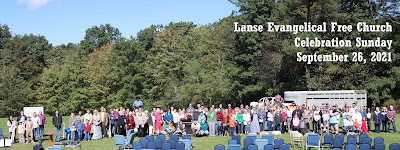 Celebration Sunday Photo by John Kristofits
The Annual Pastoral ReportPastor Matt MitchellYear in Review: 2021
Dear Church Family, “Through many dangers, toils, and snares[We] have already come;‘Tis grace hath brought [us] safe thus far,And grace will lead [us] home.” - John Newton (1779) Praise God! Once again, our Lord has faithfully carried us through yet another difficult year by His amazing grace.
We began 2021 wondering how, when, and even if the unique challenges of ministry during a global pandemic would resolve. As the year unfolded, many things did improve greatly–though often more slowly than we might have wanted. In the pages of this report from our church leaders, you can read about some the encouraging gifts that the Lord gave us along the way (including two new missionary families and a remodeled ladies’ restroom!). Some things at LEFC got back more towards how they used to be such as Family Bible Week, the Good News Cruise, in-person congregational meetings and fellowship dinners, candlelit Christmas Eve worship, the regular observance of the Lord’s Supper, and just one single worship time on Sundays. Other things we used to employ and enjoy have not yet returned, and their future is still not clear. It is clear that the pandemic will continue to have significant effects on our church long into the future.
Of course, covid is only one of the “dangers, toils, and snares,” we experienced in 2021. The world in which we minister is fraught with trouble, just as our Lord forecasted, yet, thankfully, He has overcome the world (John 16:33). So we take heart because we know that our Great Shepherd is carrying us in His powerful arms close to His heart (Isaiah 40:9-11). I consider it a deep honor, true privilege, and sweet joy to serve this precious flock as one of His undershepherds (1 Peter 5:1-4).
We Were the Church in 2021
My vision statement for our congregation in 2021 was simply, “Be the church.” Regardless of the pressures upon us, we are called to stay faithful to the mission the Lord has given us. The main thing is not for us to get things back to “normal.” The main thing is to keep the main thing the main thing–the gospel of Jesus Christ.
I believe that’s what we did in 2021. Through it all we remained focused on bringing people into a life-changing relationship with Jesus Christ through worship, instruction, fellowship, evangelism, and service even though it often looked different from how we did it in years past. This year, the Lord continued to bless our church family with amazing unity, creativity, innovation, persistence, resilience, diligence, and faithfulness. Thank you for your generosity and for your service in ministry.
Numerically, our church family has grown remarkably. It doesn’t always seem like it because we are so spread out inside and outside on Sunday mornings, because many of our families have been participating more sporadically, and because some, sadly, have left our fellowship. However, we have more total families participating than I can ever remember, many of them new. Even with some households doubling up and sharing space, all of our “mailboxes” in the foyer are taken! We are blessed to see so many new faces.
Our average Sunday attendance on campus across 2021 was 114 people per week and 122 per week for the second half of the year (when we returned to one worship time). That was a 22% increase over the previous year and an 88% return to our pre-pandemic weekly average. But those encouraging statistics can also obscure the greater reality that across a three week period we regularly have had 170-200 different people worshiping on campus with us! In fact, we have counted about 240 regular worshipers that call LEFC their church home which means that about half of the church family may not be on campus on any given Sunday. We are twice as big as it might seem! This presents all kinds of challenges, especially for building community and keeping us all moving forward together on mission, but it is also exciting to see how the Lord is drawing people together in worship of Him. Our highest attended Sunday in 2021 was Resurrection Sunday with 184 people gathered out in the parking lot to praise our risen Lord.
Servant Leaders
As your pastor, I am incredibly grateful for the many leaders, volunteers, and staff who worked so hard to serve the church family in 2021, often in thankless ways behind the scenes. All of our church ministry teams continued to show up week after week and did what needed done, and they did it with love. It was a joy to be able to retire the “Clean Team” midway through 2021 as we no longer had multiple services to prepare for. Thank you to Cindy Green for leading that team and for her ongoing work of keeping our facility looking sharp each week.
For the last decade, Marilynn Kristofits has served our church family with cheerfulness, compassion, wisdom, and excellence as our Administrative Assistant. We have all come to rely on her support and help in getting just about anything done around here! As she has now taken a full-time job at Penn State she will be transitioning out of the church office over the new few months. I am immensely thankful for her ministry of details over the last ten years and especially the last twenty four months as we have navigated a world changed by covid. I am especially grateful for her wise and earnest counsel as we partnered in church ministry, and I look forward to seeing what the Lord does through Marilynn in the future, both in her new work at PSU and in her ongoing ministry as a vital member of our church family.
I also praise the Lord that I got to serve with our 2021 Church Elders Team–Keith Folmar (chairman), Bob Gisewhite, Todd Dobo, and Joel Michaels. The breakneck pace of change continued to be relentless in 2021, and I am grateful for the hard work these men put into absorbing the details of the various health guidelines and government mandates, praying together, and then making wise (and sometimes hard and always to some degree imperfect) decisions about how to keep people safe, be submissive to authority, and be supportive of families’ different choices all at the same time. I’m happy to report that though the five of us often came from very different perspectives, we always reached complete unity on our decisions together–praise the Lord!
Pastoral Ministry
Being a pastor during a pandemic like this one is hard even with a wonderful church such as ours. In 2021, I was often unsure of how to faithfully fulfill the key responsibilities of my ministry–preaching the word, equipping the saints, and shepherding the flock (2 Timothy 4:1-5, Ephesians 4:11-13, 1 Peter 5:1-4). I frequently felt disappointed, discouraged, and stymied in my efforts. At the same time, I knew that I was deeply loved by the Lord and His people and was being shepherded myself by God’s amazing grace. As the year progressed, the Lord gave me many gifts in each key area of pastoral ministry.
Preach the Word
Getting to preach from the fortifying truth of the Psalms was one of the highlights of 2021. The Psalms beautifully and evocatively express and transform every movement of the believer’s heart. I don’t know how I could have gotten through the last two years without them, and it was a high and holy privilege to teach them to you.
In September, we turned back to the New Testament, and I started our current series, “As Foreigners and Exiles: The Message of 1 Peter.” Interestingly, I preached this same letter exactly twenty years ago in 2001, sometimes even the same particular passages on the corresponding weekend exactly two decades later! Apparently, the Lord has some things He wants us revisit and relearn right now.
 I got to preach in many different ways in 2021. When we had multiple services, I would preach up to three times each Sunday morning. I continued to pre-record video messages until we went back to one worship time, and then we began recording a live video of the teaching to share afterwards for those who missed it or need a review. Between video and FM transmission (also begun in 2021) to the parking lot, the tent, and the far reaches of our building, I’ve learned to preach to people I can’t actually see. Often, I got to preach outdoors. I will never forget standing on a folding chair so I could see to the furthest car in the parking lot on Resurrection Sunday and proclaiming and exclaiming about how good we have it because Jesus was not abandoned to the grave! And I’ll never forget how you all honked your horns in a great, “Amen!”
We had some terrific guest preachers in 2021, as well. Not only did Joel Michaels, Kerry Doyal, Rich Hoyt, Matt Cox, Abe Skacel, and Chris Grella give me a much appreciated break, but they gave us all the priceless gift of God’s Word.
Equip the Saints
In 2021, I got to come alongside and help all of our ministry teams be as effective as they could be in their work. This meant many meetings, phone calls, emails, and texts to help to solve problems and empower our church leaders to make the decisions they needed to restart their ministry, keep it going, or keep holding it back for the right time. We even started new ministries in 2021 like sending out a team for Christmas caroling on a Sunday afternoon!
 The top highlight of equipping in our church this year for me was leading a LEFC Membership Seminar in October. With twelve participants, we had the biggest class I can remember, and we had at least twelve other people interested in taking it next time. The highlight of the seminar was listening to Vera Edgren teach on the 129 years of our church’s interesting history!
This year, I got to return to a ministry of equipping beyond our local church body. One day I was able to teach in the Miracle Mountain Ranch School of Discipleship. I continued to lead our Allegheny District Constitutions and Credentials Board (CCB) and participate in both a licensing examination and an ordination council over Zoom! Representing the CCB, I was privileged to travel to the Rochester area to teach in one district church and speak at the welcoming service for our newest district church in Marion, New York. I also continued to serve on the EFCA Spiritual Heritage Committee which provides theological resources for equipping our entire association of churches.
Surprisingly, my book Resisting Gossip continues to have a wide equipping reach, as well. Last spring, I was interviewed about gossip and whistleblowing by Christianity Today as a source for the cover article of their May/June issue, and I was also honored to contribute a short essay for DesiringGOD on a biblical definition of gossip. Thank you for supporting me in these broader endeavors.
Shepherd the Flock
The words “SAFE FROM ME DAY” are marked in big letters outlined in red on May 11th of my 2021 personal calendar. That was the day that I was officially two weeks past my second vaccination shot against covid, and it represented to me a turning point in the pandemic when, because of increased immunity (and while still being careful), I no longer had to keep so much distance from other people out of love for them. I could, once again, increasingly move towards people to shepherd them. I praise God for that day and every day since that I have been able to be near to my flock. I love to visit you in your homes and workplaces and to see you in person if you are at the hospital or in the nursing home.
One of the highlights in 2021 was being with many of you on playing fields. This autumn, I got to attend several football, soccer, and volleyball games, and I’m looking forward to basketball, wrestling, and cheer in the winter as well as baseball, softball, and track in the spring. I look forward to concerts and theater performances soon, too. I’m eager to be with you all as the Lord leads.
I made a lot of shepherding phone calls, sent a lot of shepherding texts, and wrote a lot of “pastor pen pal” letters to church kids in 2021, but I still often felt disconnected. There are a lot of you and only one of me. In fact, one of the things I miss about having three services on Sunday was that I had more personal time with many of you because you showed up in smaller, more manageable, shifts! Thank you for your patience and understanding. Please continue to stay in touch with me and tell me how I can be praying for you.
In 2021, we celebrated the births of three precious girls: Blair, Lucy, and Eden. We rejoiced because of the weddings of Joshua & Schenley and Miles & Jennifer. We also mourned the deaths of several loved ones. I had the solemn privilege of leading nine funerals: Gail Wagner, Larry O’Connor, Jolena Hampton, Velma Francisko, Pat Quick, Howard Hall, Beverly Lumadue, Jane Ann Goodman, and Cliff “Whitey” Knaul.
 One of my favorite moments of 2021 was getting to baptize Beverly O’Connor and Charles “Copper” Crumrine in the portable pool we set up out in the field for Celebration Sunday. Not only did I get to be near these sheep, we got to splash together in the waters that celebrate our great salvation! May the Lord give us gifts like that more and more in the days to come.
A Personal Note:
I want to thank you for praying for me and my family in 2021. Pretty soon all four of our kids will be adults, and it’s a sweet joy to have them still at home or nearby. Who knows where in the world they will all be a short time from now? Heather and I appreciate your intercession for our whole family–not only for our health as we recently had our own brief bout with covid in our home–but for growth in wisdom, love, and holiness as we walk into the days ahead.
Thank you also for your financial support. Many churches are struggling these days to make ends meet, and ours not only continues to improve our facilities, but to take on new missionaries and fully support their pastor with generous pay and benefits.
Thank you, as well, for supporting the district and national ministries of the EFCA. I have never been so glad to be a part of an association of churches like ours (and I have always valued it in the past!) as I am right now. I have been well-shepherded myself by our district superintendent, Kerry Doyal, during these turbulent months, and I am very grateful.
2022 Vision - “The Lord Has Promised Good”
My hope and prayer for the year ahead of us is simply that it will be GOOD.
Good Deeds
We are learning from the Apostle Peter that God wants us to be known in our neighborhoods for doing good deeds. He said, “Live such good lives among the pagans that, though they accuse you of doing wrong, they may see your good deeds and glorify God on the day he visits us” (1 Peter 2:12). The Lord wants us to do those good deeds even if we are persecuted for them because even then we will be blessed.
Our good deeds might be things we do for one another in the church family. Our church has many needs, and everybody can find a way of using their gifts to help fill those needs (1 Peter 4:8-11). Our good deeds may also be things we do for others out in the world. We need to remember that we are living in a fishbowl, and the world is watching us swim. What do they see?
It’s easy to get worn down and stop doing what we know we ought to be doing. In 2022, let’s keep encouraging each other to “not become weary in doing good, for at the proper time we will reap a harvest if we do not give up. Therefore, as we have opportunity, let us do good to all people, especially to those who belong to the family of believers (Galatians 6:9-10).
Good News
Our methods may change, but may our message never change. We have the best news there ever was to share. In 2022, let’s fill our mouths with the gospel. The Lord Jesus Christ has come, has died for our sins once for all, the righteous for the unrighteous, to bring us to God (see 1 Peter 3:18)! That good news is greater than any of the problems and troubles we will face this year, and that good news saves those who believe in Him.
Recently, I have changed from always capitalizing “COVID-19" to using lowercase letters to write about the virus that has disrupted our lives. It’s a little symbolic thing, but I’ve made this change not because I expect the virus to disappear in 2022 (though I certainly hope its negative effects are greatly diminished as this year progresses), but because I don’t want it to capture my focus and occupy an outsized proportion of my thoughts. Instead, I want to be even more focused on the GOSPEL-22. Come along with me.
Good Plans
We have a lot of planning to do. We need to prayerfully search for our church’s next Administrative Assistant. We have a team coming together to re-think, re-imagine, and re-tool children, youth, and family ministry to make disciples of the next generation. We need to prepare for the Wild Game Dinner that is roaring back this March. We need to plan out new ways of building community and growing in fellowship with one another. We need to plan for improvements to our facility and campus. We need to plan for more ways to get our life-changing message out into the world.
But we cannot trust in our plans. If the Lord has been teaching us anything through covid, it is that we need to hold our plans lightly and trust in His.
Thankfully, His plans for us are very good. I’m hoping to begin preaching the Prophecy of Jeremiah this year. Jeremiah reminded the Israelites heading into exile that the LORD had plans to prosper and not harm His people, plans to give them a hope and a future (Jeremiah 29:11). And that is true in a greater sense for us today and forever because He plans to give us Himself, and there is nothing better.
“The Lord has promised good to [us]His word [our] hope secures;He will [our] shield and portion be,As long as life endures.”
In 2022, we can count on the Lord carrying us through another year of dangers, toils, and snares by His amazing grace until we are safely home.
In His Grip,Pastor Matt
Celebration Sunday Photo by John KristofitsThe Annual Pastoral ReportPastor Matt MitchellYear in Review: 2021
Dear Church Family, “Through many dangers, toils, and snares[We] have already come;‘Tis grace hath brought [us] safe thus far,And grace will lead [us] home.” - John Newton (1779) Praise God! Once again, our Lord has faithfully carried us through yet another difficult year by His amazing grace.
We began 2021 wondering how, when, and even if the unique challenges of ministry during a global pandemic would resolve. As the year unfolded, many things did improve greatly–though often more slowly than we might have wanted. In the pages of this report from our church leaders, you can read about some the encouraging gifts that the Lord gave us along the way (including two new missionary families and a remodeled ladies’ restroom!). Some things at LEFC got back more towards how they used to be such as Family Bible Week, the Good News Cruise, in-person congregational meetings and fellowship dinners, candlelit Christmas Eve worship, the regular observance of the Lord’s Supper, and just one single worship time on Sundays. Other things we used to employ and enjoy have not yet returned, and their future is still not clear. It is clear that the pandemic will continue to have significant effects on our church long into the future.
Of course, covid is only one of the “dangers, toils, and snares,” we experienced in 2021. The world in which we minister is fraught with trouble, just as our Lord forecasted, yet, thankfully, He has overcome the world (John 16:33). So we take heart because we know that our Great Shepherd is carrying us in His powerful arms close to His heart (Isaiah 40:9-11). I consider it a deep honor, true privilege, and sweet joy to serve this precious flock as one of His undershepherds (1 Peter 5:1-4).
We Were the Church in 2021
My vision statement for our congregation in 2021 was simply, “Be the church.” Regardless of the pressures upon us, we are called to stay faithful to the mission the Lord has given us. The main thing is not for us to get things back to “normal.” The main thing is to keep the main thing the main thing–the gospel of Jesus Christ.
I believe that’s what we did in 2021. Through it all we remained focused on bringing people into a life-changing relationship with Jesus Christ through worship, instruction, fellowship, evangelism, and service even though it often looked different from how we did it in years past. This year, the Lord continued to bless our church family with amazing unity, creativity, innovation, persistence, resilience, diligence, and faithfulness. Thank you for your generosity and for your service in ministry.
Numerically, our church family has grown remarkably. It doesn’t always seem like it because we are so spread out inside and outside on Sunday mornings, because many of our families have been participating more sporadically, and because some, sadly, have left our fellowship. However, we have more total families participating than I can ever remember, many of them new. Even with some households doubling up and sharing space, all of our “mailboxes” in the foyer are taken! We are blessed to see so many new faces.
Our average Sunday attendance on campus across 2021 was 114 people per week and 122 per week for the second half of the year (when we returned to one worship time). That was a 22% increase over the previous year and an 88% return to our pre-pandemic weekly average. But those encouraging statistics can also obscure the greater reality that across a three week period we regularly have had 170-200 different people worshiping on campus with us! In fact, we have counted about 240 regular worshipers that call LEFC their church home which means that about half of the church family may not be on campus on any given Sunday. We are twice as big as it might seem! This presents all kinds of challenges, especially for building community and keeping us all moving forward together on mission, but it is also exciting to see how the Lord is drawing people together in worship of Him. Our highest attended Sunday in 2021 was Resurrection Sunday with 184 people gathered out in the parking lot to praise our risen Lord.
Servant Leaders
As your pastor, I am incredibly grateful for the many leaders, volunteers, and staff who worked so hard to serve the church family in 2021, often in thankless ways behind the scenes. All of our church ministry teams continued to show up week after week and did what needed done, and they did it with love. It was a joy to be able to retire the “Clean Team” midway through 2021 as we no longer had multiple services to prepare for. Thank you to Cindy Green for leading that team and for her ongoing work of keeping our facility looking sharp each week.
For the last decade, Marilynn Kristofits has served our church family with cheerfulness, compassion, wisdom, and excellence as our Administrative Assistant. We have all come to rely on her support and help in getting just about anything done around here! As she has now taken a full-time job at Penn State she will be transitioning out of the church office over the new few months. I am immensely thankful for her ministry of details over the last ten years and especially the last twenty four months as we have navigated a world changed by covid. I am especially grateful for her wise and earnest counsel as we partnered in church ministry, and I look forward to seeing what the Lord does through Marilynn in the future, both in her new work at PSU and in her ongoing ministry as a vital member of our church family.
I also praise the Lord that I got to serve with our 2021 Church Elders Team–Keith Folmar (chairman), Bob Gisewhite, Todd Dobo, and Joel Michaels. The breakneck pace of change continued to be relentless in 2021, and I am grateful for the hard work these men put into absorbing the details of the various health guidelines and government mandates, praying together, and then making wise (and sometimes hard and always to some degree imperfect) decisions about how to keep people safe, be submissive to authority, and be supportive of families’ different choices all at the same time. I’m happy to report that though the five of us often came from very different perspectives, we always reached complete unity on our decisions together–praise the Lord!
Pastoral Ministry
Being a pastor during a pandemic like this one is hard even with a wonderful church such as ours. In 2021, I was often unsure of how to faithfully fulfill the key responsibilities of my ministry–preaching the word, equipping the saints, and shepherding the flock (2 Timothy 4:1-5, Ephesians 4:11-13, 1 Peter 5:1-4). I frequently felt disappointed, discouraged, and stymied in my efforts. At the same time, I knew that I was deeply loved by the Lord and His people and was being shepherded myself by God’s amazing grace. As the year progressed, the Lord gave me many gifts in each key area of pastoral ministry.
Preach the Word
Getting to preach from the fortifying truth of the Psalms was one of the highlights of 2021. The Psalms beautifully and evocatively express and transform every movement of the believer’s heart. I don’t know how I could have gotten through the last two years without them, and it was a high and holy privilege to teach them to you.
In September, we turned back to the New Testament, and I started our current series, “As Foreigners and Exiles: The Message of 1 Peter.” Interestingly, I preached this same letter exactly twenty years ago in 2001, sometimes even the same particular passages on the corresponding weekend exactly two decades later! Apparently, the Lord has some things He wants us revisit and relearn right now.
I got to preach in many different ways in 2021. When we had multiple services, I would preach up to three times each Sunday morning. I continued to pre-record video messages until we went back to one worship time, and then we began recording a live video of the teaching to share afterwards for those who missed it or need a review. Between video and FM transmission (also begun in 2021) to the parking lot, the tent, and the far reaches of our building, I’ve learned to preach to people I can’t actually see. Often, I got to preach outdoors. I will never forget standing on a folding chair so I could see to the furthest car in the parking lot on Resurrection Sunday and proclaiming and exclaiming about how good we have it because Jesus was not abandoned to the grave! And I’ll never forget how you all honked your horns in a great, “Amen!”We had some terrific guest preachers in 2021, as well. Not only did Joel Michaels, Kerry Doyal, Rich Hoyt, Matt Cox, Abe Skacel, and Chris Grella give me a much appreciated break, but they gave us all the priceless gift of God’s Word.
Equip the Saints
In 2021, I got to come alongside and help all of our ministry teams be as effective as they could be in their work. This meant many meetings, phone calls, emails, and texts to help to solve problems and empower our church leaders to make the decisions they needed to restart their ministry, keep it going, or keep holding it back for the right time. We even started new ministries in 2021 like sending out a team for Christmas caroling on a Sunday afternoon!
The top highlight of equipping in our church this year for me was leading a LEFC Membership Seminar in October. With twelve participants, we had the biggest class I can remember, and we had at least twelve other people interested in taking it next time. The highlight of the seminar was listening to Vera Edgren teach on the 129 years of our church’s interesting history!This year, I got to return to a ministry of equipping beyond our local church body. One day I was able to teach in the Miracle Mountain Ranch School of Discipleship. I continued to lead our Allegheny District Constitutions and Credentials Board (CCB) and participate in both a licensing examination and an ordination council over Zoom! Representing the CCB, I was privileged to travel to the Rochester area to teach in one district church and speak at the welcoming service for our newest district church in Marion, New York. I also continued to serve on the EFCA Spiritual Heritage Committee which provides theological resources for equipping our entire association of churches.
Surprisingly, my book Resisting Gossip continues to have a wide equipping reach, as well. Last spring, I was interviewed about gossip and whistleblowing by Christianity Today as a source for the cover article of their May/June issue, and I was also honored to contribute a short essay for DesiringGOD on a biblical definition of gossip. Thank you for supporting me in these broader endeavors.
Shepherd the Flock
The words “SAFE FROM ME DAY” are marked in big letters outlined in red on May 11th of my 2021 personal calendar. That was the day that I was officially two weeks past my second vaccination shot against covid, and it represented to me a turning point in the pandemic when, because of increased immunity (and while still being careful), I no longer had to keep so much distance from other people out of love for them. I could, once again, increasingly move towards people to shepherd them. I praise God for that day and every day since that I have been able to be near to my flock. I love to visit you in your homes and workplaces and to see you in person if you are at the hospital or in the nursing home.
One of the highlights in 2021 was being with many of you on playing fields. This autumn, I got to attend several football, soccer, and volleyball games, and I’m looking forward to basketball, wrestling, and cheer in the winter as well as baseball, softball, and track in the spring. I look forward to concerts and theater performances soon, too. I’m eager to be with you all as the Lord leads.
I made a lot of shepherding phone calls, sent a lot of shepherding texts, and wrote a lot of “pastor pen pal” letters to church kids in 2021, but I still often felt disconnected. There are a lot of you and only one of me. In fact, one of the things I miss about having three services on Sunday was that I had more personal time with many of you because you showed up in smaller, more manageable, shifts! Thank you for your patience and understanding. Please continue to stay in touch with me and tell me how I can be praying for you.
In 2021, we celebrated the births of three precious girls: Blair, Lucy, and Eden. We rejoiced because of the weddings of Joshua & Schenley and Miles & Jennifer. We also mourned the deaths of several loved ones. I had the solemn privilege of leading nine funerals: Gail Wagner, Larry O’Connor, Jolena Hampton, Velma Francisko, Pat Quick, Howard Hall, Beverly Lumadue, Jane Ann Goodman, and Cliff “Whitey” Knaul.
One of my favorite moments of 2021 was getting to baptize Beverly O’Connor and Charles “Copper” Crumrine in the portable pool we set up out in the field for Celebration Sunday. Not only did I get to be near these sheep, we got to splash together in the waters that celebrate our great salvation! May the Lord give us gifts like that more and more in the days to come.A Personal Note:
I want to thank you for praying for me and my family in 2021. Pretty soon all four of our kids will be adults, and it’s a sweet joy to have them still at home or nearby. Who knows where in the world they will all be a short time from now? Heather and I appreciate your intercession for our whole family–not only for our health as we recently had our own brief bout with covid in our home–but for growth in wisdom, love, and holiness as we walk into the days ahead.
Thank you also for your financial support. Many churches are struggling these days to make ends meet, and ours not only continues to improve our facilities, but to take on new missionaries and fully support their pastor with generous pay and benefits.
Thank you, as well, for supporting the district and national ministries of the EFCA. I have never been so glad to be a part of an association of churches like ours (and I have always valued it in the past!) as I am right now. I have been well-shepherded myself by our district superintendent, Kerry Doyal, during these turbulent months, and I am very grateful.
2022 Vision - “The Lord Has Promised Good”
My hope and prayer for the year ahead of us is simply that it will be GOOD.
Good Deeds
We are learning from the Apostle Peter that God wants us to be known in our neighborhoods for doing good deeds. He said, “Live such good lives among the pagans that, though they accuse you of doing wrong, they may see your good deeds and glorify God on the day he visits us” (1 Peter 2:12). The Lord wants us to do those good deeds even if we are persecuted for them because even then we will be blessed.
Our good deeds might be things we do for one another in the church family. Our church has many needs, and everybody can find a way of using their gifts to help fill those needs (1 Peter 4:8-11). Our good deeds may also be things we do for others out in the world. We need to remember that we are living in a fishbowl, and the world is watching us swim. What do they see?
It’s easy to get worn down and stop doing what we know we ought to be doing. In 2022, let’s keep encouraging each other to “not become weary in doing good, for at the proper time we will reap a harvest if we do not give up. Therefore, as we have opportunity, let us do good to all people, especially to those who belong to the family of believers (Galatians 6:9-10).
Good News
Our methods may change, but may our message never change. We have the best news there ever was to share. In 2022, let’s fill our mouths with the gospel. The Lord Jesus Christ has come, has died for our sins once for all, the righteous for the unrighteous, to bring us to God (see 1 Peter 3:18)! That good news is greater than any of the problems and troubles we will face this year, and that good news saves those who believe in Him.
Recently, I have changed from always capitalizing “COVID-19" to using lowercase letters to write about the virus that has disrupted our lives. It’s a little symbolic thing, but I’ve made this change not because I expect the virus to disappear in 2022 (though I certainly hope its negative effects are greatly diminished as this year progresses), but because I don’t want it to capture my focus and occupy an outsized proportion of my thoughts. Instead, I want to be even more focused on the GOSPEL-22. Come along with me.
Good Plans
We have a lot of planning to do. We need to prayerfully search for our church’s next Administrative Assistant. We have a team coming together to re-think, re-imagine, and re-tool children, youth, and family ministry to make disciples of the next generation. We need to prepare for the Wild Game Dinner that is roaring back this March. We need to plan out new ways of building community and growing in fellowship with one another. We need to plan for improvements to our facility and campus. We need to plan for more ways to get our life-changing message out into the world.
But we cannot trust in our plans. If the Lord has been teaching us anything through covid, it is that we need to hold our plans lightly and trust in His.
Thankfully, His plans for us are very good. I’m hoping to begin preaching the Prophecy of Jeremiah this year. Jeremiah reminded the Israelites heading into exile that the LORD had plans to prosper and not harm His people, plans to give them a hope and a future (Jeremiah 29:11). And that is true in a greater sense for us today and forever because He plans to give us Himself, and there is nothing better.
“The Lord has promised good to [us]His word [our] hope secures;He will [our] shield and portion be,As long as life endures.”
In 2022, we can count on the Lord carrying us through another year of dangers, toils, and snares by His amazing grace until we are safely home.
In His Grip,Pastor Matt
January 25, 2022
LEFC Worship Ministries 2021 Report
Worship Ministries Report(Part of the 2021 Annual Report for Lanse Evangelical Free Church)
"We gather together to ask the Lord���s blessing;���He chastens and hastens his will to make known;The wicked oppressing now cease from distressing.Sing praises to his name; he forgets not his own.��� (Anonymous 17th century hymn from the Netherlands. Translated from the Dutch original by Theodore Baker.)
 In 2021, our church family came together more and more to seek and to celebrate the blessings of our Lord. As we entered a second year of worship amidst the challenges of a global pandemic, we remained undaunted in our efforts to gather to praise our God while simultaneously endeavoring to protect each other from a dangerous disease.
Gathering together well in 2021 required even more creativity, flexibility, diligence, and faithful service.
Coming Together Outside
 In January, we added a new tool to our worship toolbox that greatly increased our options and brought us closer together���FM transmission. On Sunday mornings, in addition to worshiping inside at 8:00, 9:30, or 11:00, under the tent borrowed from Troop 46, or at home utilizing our online resources, families could now also choose, in all weather, to participate in worship from their vehicles listening to 89.5 ���WLFC��� in the parking lot. It was initially weird but also wonderful to hear people ���honk��� their ���amens��� to remind us that we are all together as one worshiping family.
Coming together to worship outdoors was one of the chief highlights of 2021. On Palm Sunday and Resurrection Sunday, we all gathered at one time to commemorate the atoning death and victorious resurrection of our Lord Jesus. Our hearts soared as the sun rose over all of our vehicles, and our voices soared together across our big parking lot as we sang, ���Christ the Lord is risen today! Alleluia!���
We all worshiped outside together on the last Sunday of each month throughout the late spring and early autumn, including Graduation Sunday, Family Bible Week Finale, and Back-2-School Sunday. Our series of total outdoor worship gatherings culminated in a beautiful Celebration Sunday in September featuring an engaging MMR ���Message from the Mount��� and wonderful outdoor baptisms.
 Matt & Jenni Cox of Miracle Mountain Ranch
 Proclaiming Our Faith!
 Joyful baptisms!
Coming Together Inside
As the year unfolded, we began to come together indoors increasingly, as well. In April and May, as pandemic restrictions began to recede across Pennsylvania, we removed constricting barriers inside of the building. In June, we consolidated to two worship times, 9:00 and 10:30, and restarted the prayer corners ministry. In July, we celebrated the end of statewide restrictions and added a half hour of coffee and sweet fellowship between worship times. There were more and more handshakes, hugs, and folks standing nearer to each other as we sang. Then in August, we returned to one worship gathering at our old familiar time of 10:00am!
Having a single worship time once more provided us with the opportunity to add back in a number of things we had very much missed during the previous year. Throughout the autumn, we again enjoyed special music offerings, presentations from visiting missionaries, ���worship at work��� interviews, longer sermons, and, especially, the routine observance of the Lord���s Supper. On Christmas Eve, we once again came together in candlelight to rejoice that Emmanuel has come and shall come again.
Coming Together Yet Still Spread-Out
 As the year began to wane and winter approached once more, it became increasingly obvious that surging variants of the original virus were still not going to make it easy to return to the way things used to be, so we continued to focus on providing creative options for worship while still gathering together.
In November, we took advantage of the church���s original loudspeaker system and replaced the outdoor worship tent with small ���spread-out��� indoor seating areas sprinkled throughout our facility. Inside and outside on Sunday mornings there is a place on our campus for anyone and everyone to gather in safety and comfort to worship Christ the Lord.
���Sing Praises to His Name���
In 2021, we sang mostly older songs that have stood the test of time as we are being tested in our time. We did learn one new song that has a timeless message, ���Yet Not I But Through Christ In Me.��� We continued to incorporate classic statements of truth drawn from creeds, confessions, and catechisms to emphasize our unity with the whole church throughout the world and throughout the ages. And we memorized and recited Scripture together: Philippians 4:4-8, Psalm 100, and 1 Peter 2:11-12.
Coming Together Through Faithful Service
 I am incredibly grateful for everyone who helped make our worship gatherings possible in 2021. Amy Jo, Anita, Misty, and Darla all took turns at the keyboard in lots of varying circumstances���sometimes under a canopy in misty rain or blazing sun and other times at three different services on the same Sunday! Our talented Tech Team did the same, often running cables in multiple directions indoors and outdoors. The Clean Team sanitized and straightened when we had multiple services. Guys showed up early and stayed late to open the tent, wheel out chairs, and then wheel them back and close it up again. Our growing team of greeters made people feel welcome as we all came together to worship.

Joe and Cody stepped up to the microphone multiple times to lead us all in singing. Numerous faithful ladies sang melodies and harmonies in the worship choir while several different folks strummed accompanying guitars. At least six different men did the announcements over the course of the year. (And while the Lord ���forgets not his own,��� I have probably missed some key people in this list.) Our whole church can be thankful for every single person who blessed our church family with their faithful service in gathered worship.
Coming Together to Worship Jesus Christ
Because it was such a pivotal year, this report has focused on the different ways we worshiped in 2021. But, of course, who we worshipped in 2021 is much more important than how we worshiped in 2021. And while we progressed through many changes as we came together in worship, thankfully, we were worshiping an unchanging Savior:
���What gift of grace is Jesus my redeemerThere is no more for heaven now to giveHe is my joy, my righteousness, and freedomMy steadfast love, my deep and boundless peace
To this I hold, my hope is only JesusFor my life is wholly bound to HisOh how strange and divine, I can sing, ���All is mine���Yet not I, but through Christ in me��� (Jonny Robinson, Rich Thompson, Michael Farren, 2018)
Whatever may come in 2022 and beyond, may we hold fast to Him!
-Pastor Matt
"We gather together to ask the Lord���s blessing;���He chastens and hastens his will to make known;The wicked oppressing now cease from distressing.Sing praises to his name; he forgets not his own.��� (Anonymous 17th century hymn from the Netherlands. Translated from the Dutch original by Theodore Baker.)
In 2021, our church family came together more and more to seek and to celebrate the blessings of our Lord. As we entered a second year of worship amidst the challenges of a global pandemic, we remained undaunted in our efforts to gather to praise our God while simultaneously endeavoring to protect each other from a dangerous disease. Gathering together well in 2021 required even more creativity, flexibility, diligence, and faithful service.
Coming Together Outside
In January, we added a new tool to our worship toolbox that greatly increased our options and brought us closer together���FM transmission. On Sunday mornings, in addition to worshiping inside at 8:00, 9:30, or 11:00, under the tent borrowed from Troop 46, or at home utilizing our online resources, families could now also choose, in all weather, to participate in worship from their vehicles listening to 89.5 ���WLFC��� in the parking lot. It was initially weird but also wonderful to hear people ���honk��� their ���amens��� to remind us that we are all together as one worshiping family.Coming together to worship outdoors was one of the chief highlights of 2021. On Palm Sunday and Resurrection Sunday, we all gathered at one time to commemorate the atoning death and victorious resurrection of our Lord Jesus. Our hearts soared as the sun rose over all of our vehicles, and our voices soared together across our big parking lot as we sang, ���Christ the Lord is risen today! Alleluia!���
We all worshiped outside together on the last Sunday of each month throughout the late spring and early autumn, including Graduation Sunday, Family Bible Week Finale, and Back-2-School Sunday. Our series of total outdoor worship gatherings culminated in a beautiful Celebration Sunday in September featuring an engaging MMR ���Message from the Mount��� and wonderful outdoor baptisms.
Matt & Jenni Cox of Miracle Mountain Ranch
Proclaiming Our Faith!
Joyful baptisms!Coming Together Inside
As the year unfolded, we began to come together indoors increasingly, as well. In April and May, as pandemic restrictions began to recede across Pennsylvania, we removed constricting barriers inside of the building. In June, we consolidated to two worship times, 9:00 and 10:30, and restarted the prayer corners ministry. In July, we celebrated the end of statewide restrictions and added a half hour of coffee and sweet fellowship between worship times. There were more and more handshakes, hugs, and folks standing nearer to each other as we sang. Then in August, we returned to one worship gathering at our old familiar time of 10:00am!
Having a single worship time once more provided us with the opportunity to add back in a number of things we had very much missed during the previous year. Throughout the autumn, we again enjoyed special music offerings, presentations from visiting missionaries, ���worship at work��� interviews, longer sermons, and, especially, the routine observance of the Lord���s Supper. On Christmas Eve, we once again came together in candlelight to rejoice that Emmanuel has come and shall come again.
Coming Together Yet Still Spread-Out
As the year began to wane and winter approached once more, it became increasingly obvious that surging variants of the original virus were still not going to make it easy to return to the way things used to be, so we continued to focus on providing creative options for worship while still gathering together. In November, we took advantage of the church���s original loudspeaker system and replaced the outdoor worship tent with small ���spread-out��� indoor seating areas sprinkled throughout our facility. Inside and outside on Sunday mornings there is a place on our campus for anyone and everyone to gather in safety and comfort to worship Christ the Lord.
���Sing Praises to His Name���
In 2021, we sang mostly older songs that have stood the test of time as we are being tested in our time. We did learn one new song that has a timeless message, ���Yet Not I But Through Christ In Me.��� We continued to incorporate classic statements of truth drawn from creeds, confessions, and catechisms to emphasize our unity with the whole church throughout the world and throughout the ages. And we memorized and recited Scripture together: Philippians 4:4-8, Psalm 100, and 1 Peter 2:11-12.
Coming Together Through Faithful Service
I am incredibly grateful for everyone who helped make our worship gatherings possible in 2021. Amy Jo, Anita, Misty, and Darla all took turns at the keyboard in lots of varying circumstances���sometimes under a canopy in misty rain or blazing sun and other times at three different services on the same Sunday! Our talented Tech Team did the same, often running cables in multiple directions indoors and outdoors. The Clean Team sanitized and straightened when we had multiple services. Guys showed up early and stayed late to open the tent, wheel out chairs, and then wheel them back and close it up again. Our growing team of greeters made people feel welcome as we all came together to worship.
Joe and Cody stepped up to the microphone multiple times to lead us all in singing. Numerous faithful ladies sang melodies and harmonies in the worship choir while several different folks strummed accompanying guitars. At least six different men did the announcements over the course of the year. (And while the Lord ���forgets not his own,��� I have probably missed some key people in this list.) Our whole church can be thankful for every single person who blessed our church family with their faithful service in gathered worship.
Coming Together to Worship Jesus Christ
Because it was such a pivotal year, this report has focused on the different ways we worshiped in 2021. But, of course, who we worshipped in 2021 is much more important than how we worshiped in 2021. And while we progressed through many changes as we came together in worship, thankfully, we were worshiping an unchanging Savior:
���What gift of grace is Jesus my redeemerThere is no more for heaven now to giveHe is my joy, my righteousness, and freedomMy steadfast love, my deep and boundless peace
To this I hold, my hope is only JesusFor my life is wholly bound to HisOh how strange and divine, I can sing, ���All is mine���Yet not I, but through Christ in me��� (Jonny Robinson, Rich Thompson, Michael Farren, 2018)
Whatever may come in 2022 and beyond, may we hold fast to Him!
-Pastor Matt
January 23, 2022
���To Suffer for Doing Good��� [Matt's Messages]
 ���To Suffer for Doing Good���As Foreigners and Exiles - The Message of 1 PeterLanse Evangelical Free ChurchJanuary 23, 2022 :: 1 Peter 3:17-22
This is the exact same passage as we looked at last time I got to preach, and I said back then that this is hardest passage in all of 1 Peter to interpret and it���s one of the hardest passages in the whole Bible to understand.
The great theologian Martin Luther once said about it, ���This is a strange text and certainly a more obscure passage than any other passage in the New Testament. I still do not know for sure what the apostle means.���
If every paragraph in the Bible was this difficult to interpret, I would probably give up trying to understand it at all. Thankfully, most of the Bible is not this tricky. Most of the Bible is much more clear and straightforward.
At the same time, even the tricky parts are the Word of God. Even the parts of the Bible that make us scratch our heads were given to us by the Holy Spirit. And we are blessed if we study them and apply them to our lives.
So I���m not going to have all of the answers to all of the questions, but that doesn���t mean that we can���t get what God wants to say to us today.
It does mean that we are not going to focus so much on the part that is hard to understand but on the part that is actually hard to do.
The title for this message is taken right out of verse 17, talking about what is sometimes the will of God for our lives as followers of Christ:
���To Suffer For Doing Good.���
That is not hard to interpret, but it is hard to live, isn���t it? Nobody in their right mind likes to suffer. But it���s even harder to suffer for doing good.
Yet that���s been what Peter has been beating the drum about all along, hasn���t he?
That���s what Peter wants us to do because we���ve read his letter.
To do good...even if it means we suffer for it.
What���s our key memory verse?
���Dear friends, I urge you, as foreigners and exiles, to abstain from sinful desires, which wage war against your soul. Live such good lives among the pagans that, though they accuse you of doing wrong, they may see your good deeds and glorify God on the day he visits us��� (1 Peter 2:11-12, NIV 2011).
Peter says that we are foreigners and exiles in this world. We���re not from around here.
And we are supposed to abstain from sinful desires and live good lives doing good deeds even though the people around us accuse us of doing bad. We live that reputation down, and we do good deeds instead.
Peter keeps using this one word over and over again. We learned it last time, ���agathopoiuntas��� ��� good-deed-doing.
He used it in chapter 2, verse 15. ���[I]t is God���s will that by doing good you should silence the ignorant talk of foolish men.���
He used it in chapter 2, verse 20. ���[I]f you should suffer for doing good and you endure it, this is commendable before God.���
He used it in chapter 3, verse 6. ���[D]o what is right [agathopoiountas] and do not give way to fear.���
And he said in chapter 3, verses 13 and 14, ���Who his going to harm you if are eager to do good [agathou]. But even if you should suffer for what is right, you are blessed.���
And now chapter 3, verse 17, ���It is better if it is God���s will, to suffer for doing good [agathopoiountas] than for doing evil [kakopoiountas ��� doing bad].���
The point of this whole passage, 3:17-22, is that God wants us to do good even when it hurts.
Even when people want to hurt us because we are doing good.
Now, I wish that wasn���t a thing, but it most certainly is.
In fact, Peter says that it is sometimes God���s will. It���s part of God���s plan not only that some of us get covid or cancer or in a car wreck, but that some of us get persecuted and oppressed and treated unjustly even for doing good.
I think this morning of our sisters and brothers that serve at the Pregnancy Resource Clinic. I���m guessing��� correct me if I���m wrong���but not everybody in State College loves what you���re doing, am I right? You���re doing good work in Jesus��� name, but I���ll bet you get some pushback from some people in the community.
The Apostle Peter says keep up the good work.
What kind of good deeds does Peter envision for you and me? In chapter 2 and the first part of chapter 3, he talked about submission to human authorities and respecting human authorities even though they are often bad themselves.
How are we doing at that? What have we been posting about on social media? And how have we been posting? Are we following chapter 2, verse 17 with every push of the share button? ���Show proper respect to everyone: Love the brotherhood of believers, fear God, honor the king.��� Share.
In chapter 3, Peter talked about repaying evil with good and insult with blessing, bearing up under unjust suffering. #BlessThemBack. How are we doing at that?
Peter says that we should be ready to share the reason why we are hopeful even when people are furious at us. Even when they hate us, as Christians, we have hope. How are we doing at that as we are now almost a month into 2022?
How are we doing at living as foreigners and exiles, citizens of the kingdom to come as we live in the kingdom of right now? Waiting for the kingdom to come.
I���ll tell you right now that, most of the time, we are not going feel like it. Most of the time, we will not feel like doing good if it means suffering as a result. That���s not natural. That���s not normal.
We will naturally want it to get easier. We will feel like quitting.
Sometimes we don���t feel like doing good even when it does not hurt. Right? We often feel like doing bad. We have evil desires within us that we need to fight! ���Abstain from sinful desires which wage war against your soul.���
But when it gets hard, then we really don���t feel like doing good. And that���s why Peter is writing to these elect exiles, to this beloved family of foreigners.
He wants to encourage them to keeping on doing the right things even when they suffer for doing good.
And his argument proceeds in three big steps. Here���s number one.
#1. TO SUFFER FOR DOING GOOD IS BETTER THAN SUFFERING FOR DOING BAD.
Look again at verse 17.
���It is better, if it is God's will, to suffer for doing good than for doing evil.���
Everybody is going to suffer some in this life, and Peter says that it is much better to suffer for doing good than for doing evil.
We said last time that on one level, that���s obvious. If you suffer for doing evil, then you���ve kind of asked for it. ���Do bad, get bad.��� But on another level, it���s not obvious. If you���re doing good, how could it be good to suffer for it? ���
"Do good, get bad?��� It kind of makes you wonder if you���re really doing it right. And it makes you wonder if it���s really worth it. I mean, at least if you suffer for doing bad, you at least got to enjoy doing bad first.
But Peter says that it���s better to suffer for doing good. In fact, he���s just said in 3:14 that if you do, you are ���blessed.���
How is that for a thought?! That is a distinctively Christian thought. You don���t get that in other philosophies in the world.
You are blessed if you suffer for doing good.
Our Lord taught us this in His Sermon on the Mount. It���s kind of upside-down.
���Blessed are the poor in spirit, for theirs is the kingdom of heaven.Blessed are those who mourn, for they will be comforted.Blessed are the meek, for they will inherit the earth.Blessed are those who hunger and thirst for righteousness, for they will be filled.Blessed are the merciful, for they will be shown mercy.Blessed are the pure in heart, for they will see God.Blessed are the peacemakers, for they will be called sons of God.Blessed are those who are persecuted because of righteousness, for theirs is the kingdom of heaven. Blessed are you when people insult you, persecute you and falsely say all kinds of evil against you because of me [Our Lord said]. Rejoice and be glad, because great is your reward in heaven, for in the same way they persecuted the prophets who were before you��� (Matthew 5:3-12).
Oh yes, it is much better to suffer for doing good!
And we know that especially because it���s the way that Jesus lived.
#2. TO SUFFER FOR DOING GOOD IS EXACTLY HOW JESUS SAVED US.
Look at verse 18.
���It is better...to suffer for doing good than for doing evil. [v.18] For Christ died for sins once for all, the righteous for the unrighteous, to bring you to God.���
That���s what we focused on last time. Remember? The greatest blessing that ever came to us came from the worst injustice, the greatest miscarriage of justice ever.
Jesus Christ the Holy One died for sins once for all the RIGHTEOUS for the unrighteous.
Talk about unjust suffering?! Talk about suffering for doing good?!
And doing good through suffering. This is how we were saved.
Now, here���s where it gets a little weird. Second half of verse 18.
���He [Christ] was put to death in the body but made alive by the Spirit, through whom also he went and preached to the spirits in prison who disobeyed long ago when God waited patiently in the days of Noah while the ark was being built.���
Here���s where it gets really tricky. Every phrase here has trickiness to it.
The biggest questions are:
1. Who are these spirits in prison?2. When did Christ go preach ���to the spirits in prison?���3. And what did Christ preach ���to the spirits in prison?���
There are 3 major interpretations in the history of the church, and I���m really not sure which one of them is right, if any off them.
There about 40 variations on those 3 major interpretations. And one scholar has calculated there are actually 180 different combinations of various details coming together here.
I don���t know what you have been taught. I can see all three of the major interpretations being right, and I can also see all three of them being wrong.
Passages like this are good at keeping us humble.
One leading interpretation with a lot going for it says that the spirits are fallen angels that sinned before the flood in the book of Genesis and that Jesus Christ, after His resurrection, went to where they are forever held in prison and preached to them His victory over sin, death, and their boss Satan.
The words in verse 19 translated, ���through whom��� can actually also be translated, ���after which.��� So after the resurrection, Jesus would have proclaimed to these disobedient demonic spirits their ultimate demise.
People who adopt that interpretation point out historical parallels in the extra-biblical book 1 Enoch which the Apostle Peter quotes directly in his second letter, 2 Peter.
I won���t get into the weeds of this, but let me point out to you how this interpretation fits Peter���s bigger point.
Jesus was put to death in the body, yes, suffering���unimaginable suffering���for doing good and doing good through His suffering, but that was not the end.
Jesus was defeating death and demons on the Cross and when made alive by (or in) the Spirit, He got to proclaim it over all of the demons!
To suffer for doing good is exactly how Jesus won and saved us.
A second major interpretation says that these spirits are human spirits of disobedient humans from the days of Noah kept in prison in ���Sheol,��� Hebrew for the place of the dead, also sometimes called ���Hades��� in Greek. And in this interpretation, Jesus Christ���between His death and His resurrection (so basically on the Holy Saturday between Good Friday and Resurrection Sunday, our Lord)���descended to the place of the dead and preached the good news of His victory to those sinful humans.
Now, that doesn���t mean He was giving them a second chance. Just like in the first interpretation with the permanently fallen angels, Jesus would be proclaiming His vindication and victory to those who had irrevocably rejected Him. And there are a lot of passages like that in the book of Revelation. This is the interpretation that jives the most with John���s Revelation.
And it also fits with the phrase in the Apostle���s Creed, ���He descended to the dead.���
Not to suffer there but to announce His victory and the reversal of the great injustice.
You see how this interpretation fits with Peter���s main point?
The un-justice will be un-done. And we will be saved!
To suffer for doing good is exactly how Jesus won His victory and saved us!
The third major interpretation is also quite ancient, but it���s a little different from the other two. This is the one I came to adopt twenty years ago when I preached 1 Peter the first time. I���m probably a little less confident in it these days, but it still makes sense to me. Let me share it with you. See what you think.
In this interpretation, the spirits are also human spirits the ones who disobeyed back in the days of Noah, Genesis chapter 6.
But the time when Christ preached to them was back then in Genesis chapter 6. Christ preached to them by the Holy Spirit. See how you could get that in verses 18 and 19?
���He was put to death in the body but made alive by the Spirit, through whom [the Spirit] also he went and preached to the spirits [who are now] in prison who disobeyed long ago when God waited patiently in the days of Noah while the ark was being built.���
So they are in prison now because they disobeyed then, but Christ was preaching to them then BY THE SPIRIT through Noah when Noah was preaching to them about the judgment to come.
Do you see how that would work?
It kind of sounds like chapter 1, verse 11 that we read this fall. When it said that the ���Spirit of Christ��� was speaking through the Old Testament prophets. And it draws on what Peter says about Noah in his second letter, when he calls him ���a preacher [same word for ���preaching���] of righteousness [doing right]��� (2 Peter 2:5).
Christ was preaching by the Spirit through Noah in the days of Noah while God was being so incredibly patient. And he was preaching the judgment to come on sin and salvation to all who would come into the ark with him and be rescued.
Now this interpretation has problems, too, but think about the parallels between Noah���s situation and the situation of the readers of Peter���s letter:
Noah was trying to do good, and he was suffering for it. The people around Noah were evil and ungodly, and they weren���t listening. And I���m sure that Noah often felt like giving up. I���m sure he felt alone. Noah and his family were such a small minority in a great big sea of ungodliness.
They were ���foreigners and exiles,��� so to speak. They were probably persecuted. They were probably laughed at and insulted for trusting God and building a mammoth boat. The Christians to whom Peter was writing were receiving insult and evil and perhaps ridicule, as well. I���m sure they often felt like giving up.
And I���m sure that Noah often felt like giving up.
But he kept on doing good, and he was saved. V.20
���In it [the ark] only a few people, eight in all, were saved through water..." Noah, Mrs. Noah, Shem, Ham, and Japehth, and Mrs. Shem, Mrs. Ham and Mrs. Japheth. Just 8 people were saved.
But eight people were saved through water. They made it by coming into the ark.
Now, see where Peter goes next. He is intent on connecting this to our salvation. V.21
���...and this water [of judgment] symbolizes baptism that now saves you also���not the removal of dirt from the body but the pledge of a good conscience toward God.���
This verse is also difficult to interpret. [Not nearly as difficult as verses 19 and 20!] But try to follow his train of thought.
���and this water [of death that was safely traversed by the people in the ark] symbolizes baptism that now saves you also...���
He���s saying that the waters which Noah���s ark went through were symbolic. I think he means like foreshadowing or typology. They pointed to something greater that was somehow like them.
The waters were like baptism. We know that that is also a symbol of salvation. But it is such a symbol that you can use the symbol itself to refer to the actual thing.
I think that���s what Peter means when he says that ���baptism now saves you.��� He doesn���t mean that getting dunked confers salvation like some kind of magic trick. He means that baptism pictures that salvation so perfectly that you can use it as shorthand for your salvation itself.
That���s why he immediately explains his statement to eliminate the wrong ideas about it. V.21, ���baptism that now saves you���NOT the removal of dirt from the body.��� Not an external washing. Not the physical rite itself. Don���t get the wrong idea. ���But the pledge of a good conscience toward God.��� Or [the Greek here is hard to translate, it could also be translated...] ���The prayer for a good conscience from God.���
Water baptism therefore is a heart thing. It ultimately points to the heart of the one being baptized. Either it says, ���In my baptism I now thank You for my salvation and I pledge to live out of it with a good conscience, doing good.��� or it���s says, ���In my baptism I now picture my asking You for salvation, a cleansing of my conscience, forgiveness of my sins.��� Either way, baptism is a heart thing symbolized by going down into the waters of death in Christ and coming back out safe in Christ.
You see how that���s like the ark? Everybody went into the water in Genesis 6. But only 8 people came out of it alive. Only those who had come into the Ark were saved.
And that���s a picture of what baptism pictures.
Everyone dies, but only those who are dead in Christ will come out of it truly alive!
Now, don���t miss the big forest for the tricky trees. Do you see how this advances Peter���s main point?
To suffer for doing good is exactly how Jesus saved us. He was put to death in the body, and that brought us safely to God. Like the ark. His suffering saved us. If you are saved at all, this is how you were saved.
Are you saved? We are saved by grace through our faith in Jesus Christ and what He did for us on the Cross. Verse 18 again. ���Christ died for sins once for all, the righteous for the unrighteous, to bring you to God.��� Have you been brought to God?
If you have never trusted Jesus Christ as your own Savior, I invite you to do so right now. He was put to death in the body for your sins. He suffered for doing good and by suffering He was doing good. He was saving you. And that���s what baptism pictures.
Have you been baptized? Some people treat baptism as optional, something only some people do if they really feel like it. That���s the exact opposite of how the Bible treats it. The Bible says that baptism is commanded by our Lord of all of His disciples. The Bible assumes baptism of all believers.
It���s super important! It���s not magic. There���s nothing in the water that cleanses us. Peter says, it���s not the removal of dirt from the body. It���s not the rite or the ritual.
It���s what baptism pictures that saves us. It���s a symbol of what God has done and is doing in our hearts. But what a powerful symbol and what a symbol of power! Because it���s not just the suffering and death of Christ that is pictured, it is also the resurrection! Coming back out of the water. Coming back up to life. Go back to verse 21.
���It saves you by the resurrection of Jesus Christ[!]���
Not by what you or I have done or will do, but by what Jesus has done for us in dying and rising again. Now that is power!
���Praise be to the God and Father of our Lord Jesus Christ! In his great mercy he has given us new birth into a living hope through the resurrection of Jesus Christ from the dead...��� (1 Peter 1:3).
You see what that means for suffering for doing good?
It means that it���s all worth it. It was worth it for Jesus, and it will be worth it for you and me forever.
#3. TO SUFFER FOR DOING GOOD IS WORTH IT FOREVER.
And Jesus has shown us the way.
I���m sure that Jesus did not feel like doing good and suffering on the Cross.
Just like Noah didn���t feel like it.Just like Peter���s readers didn���t feel like it.Just like you and I often don���t feel like doing good and suffering for it.
But Jesus saw where it was all going.
Jesus saw how His suffering would bring us to God.Jesus saw how His suffering would not be the end.Jesus saw how His suffering would actually win the victory over sin, death, and Satan and his minions.
And Jesus saw that He would, on the third day, rise again.
And then be exalted forever. V.22.
���[Christ] has gone into heaven and is at God's right hand���with angels, authorities and powers in submission to him.���
He won! He was vindicated. He triumphed. He stands in the place of ultimate blessing.
He is exalted above all, at God���s right hand (just like Psalm 110 predicted that we read the last summer) with angels, authorities and powers in submission to Him.
Jesus submitted to evil rulers and even died at their hands.
But now every knee will bow and every tongue confess that Jesus Christ is Lord.
Suffering is the path to glory.
Especially suffering for doing good.
We don���t like it. We don���t have to like it.We aren���t called to enjoy suffering.We are called to do good. And to keep on doing good.And sometimes to endure suffering for doing good.
But it is worth it, brothers and sisters.
Jesus knew it. It was predicted in the Old Testament. The Spirit of Christ was predicting ���the sufferings of Christ and the glories that would follow��� (1 Peter 1:11).
The glories of being in heaven at God���s right hand���with angels, authorities, and powers in submission to Him. Crowned with every crown.
It was worth it for Jesus, and He says that it will be worth it for us, as well.
So let���s keep on doing good no matter what.
***
Previous Messages in This Series:
01. "Elect Exiles" 1 Peter 1:1-2
02. "A Living Hope" 1 Peter 1:3-7
03. "Angels Long To Look Into These Things" 1 Peter 1:8-12
04. "Be Holy In All You Do" 1 Peter 1:13-16
05. "Live Your Lives As Strangers Here In Reverent Fear" 1 Peter 1:17-21
06. "Love Each Other Deeply, From the Heart" 1 Peter 1:22-2:3
07. "But Now You Are..." 1 Peter 2:4-10
08. ���As Foreigners And Exiles��� 1 Peter 2:11-12
09. "Submit Yourselves For the Lord's Sake 1 Peter 2:13-17
10. "Follow In His Steps" 1 Peter 2:18-25
11. "Do What Is Right And Do Not Give Way To Fear" 1 Peter 3:1-7
12. "Inherit a Blessing" 1 Peter 3:8-12
13. "Even If You Should Suffer For What Is Right" 1 Peter 3:13-16
14. "To Bring You To God" 1 Peter 3:17-22 (esp. 18)
“To Suffer for Doing Good” [Matt's Messages]
“To Suffer for Doing Good”As Foreigners and Exiles - The Message of 1 PeterLanse Evangelical Free ChurchJanuary 23, 2022 :: 1 Peter 3:17-22This is the exact same passage as we looked at last time I got to preach, and I said back then that this is hardest passage in all of 1 Peter to interpret and it’s one of the hardest passages in the whole Bible to understand.
The great theologian Martin Luther once said about it, “This is a strange text and certainly a more obscure passage than any other passage in the New Testament. I still do not know for sure what the apostle means.”
If every paragraph in the Bible was this difficult to interpret, I would probably give up trying to understand it at all. Thankfully, most of the Bible is not this tricky. Most of the Bible is much more clear and straightforward.
At the same time, even the tricky parts are the Word of God. Even the parts of the Bible that make us scratch our heads were given to us by the Holy Spirit. And we are blessed if we study them and apply them to our lives.
So I’m not going to have all of the answers to all of the questions, but that doesn’t mean that we can’t get what God wants to say to us today.
It does mean that we are not going to focus so much on the part that is hard to understand but on the part that is actually hard to do.
The title for this message is taken right out of verse 17, talking about what is sometimes the will of God for our lives as followers of Christ:
“To Suffer For Doing Good.”
That is not hard to interpret, but it is hard to live, isn’t it? Nobody in their right mind likes to suffer. But it’s even harder to suffer for doing good.
Yet that’s been what Peter has been beating the drum about all along, hasn’t he?
That’s what Peter wants us to do because we’ve read his letter.
To do good...even if it means we suffer for it.
What’s our key memory verse?
“Dear friends, I urge you, as foreigners and exiles, to abstain from sinful desires, which wage war against your soul. Live such good lives among the pagans that, though they accuse you of doing wrong, they may see your good deeds and glorify God on the day he visits us” (1 Peter 2:11-12, NIV 2011).
Peter says that we are foreigners and exiles in this world. We’re not from around here.
And we are supposed to abstain from sinful desires and live good lives doing good deeds even though the people around us accuse us of doing bad. We live that reputation down, and we do good deeds instead.
Peter keeps using this one word over and over again. We learned it last time, “agathopoiuntas” – good-deed-doing.
He used it in chapter 2, verse 15. “[I]t is God’s will that by doing good you should silence the ignorant talk of foolish men.”
He used it in chapter 2, verse 20. “[I]f you should suffer for doing good and you endure it, this is commendable before God.”
He used it in chapter 3, verse 6. “[D]o what is right [agathopoiountas] and do not give way to fear.”
And he said in chapter 3, verses 13 and 14, “Who his going to harm you if are eager to do good [agathou]. But even if you should suffer for what is right, you are blessed.”
And now chapter 3, verse 17, “It is better if it is God’s will, to suffer for doing good [agathopoiountas] than for doing evil [kakopoiountas – doing bad].”
The point of this whole passage, 3:17-22, is that God wants us to do good even when it hurts.
Even when people want to hurt us because we are doing good.
Now, I wish that wasn’t a thing, but it most certainly is.
In fact, Peter says that it is sometimes God’s will. It’s part of God’s plan not only that some of us get covid or cancer or in a car wreck, but that some of us get persecuted and oppressed and treated unjustly even for doing good.
I think this morning of our sisters and brothers that serve at the Pregnancy Resource Clinic. I’m guessing– correct me if I’m wrong–but not everybody in State College loves what you’re doing, am I right? You’re doing good work in Jesus’ name, but I’ll bet you get some pushback from some people in the community.
The Apostle Peter says keep up the good work.
What kind of good deeds does Peter envision for you and me? In chapter 2 and the first part of chapter 3, he talked about submission to human authorities and respecting human authorities even though they are often bad themselves.
How are we doing at that? What have we been posting about on social media? And how have we been posting? Are we following chapter 2, verse 17 with every push of the share button? “Show proper respect to everyone: Love the brotherhood of believers, fear God, honor the king.” Share.
In chapter 3, Peter talked about repaying evil with good and insult with blessing, bearing up under unjust suffering. #BlessThemBack. How are we doing at that?
Peter says that we should be ready to share the reason why we are hopeful even when people are furious at us. Even when they hate us, as Christians, we have hope. How are we doing at that as we are now almost a month into 2022?
How are we doing at living as foreigners and exiles, citizens of the kingdom to come as we live in the kingdom of right now? Waiting for the kingdom to come.
I’ll tell you right now that, most of the time, we are not going feel like it. Most of the time, we will not feel like doing good if it means suffering as a result. That’s not natural. That’s not normal.
We will naturally want it to get easier. We will feel like quitting.
Sometimes we don’t feel like doing good even when it does not hurt. Right? We often feel like doing bad. We have evil desires within us that we need to fight! “Abstain from sinful desires which wage war against your soul.”
But when it gets hard, then we really don’t feel like doing good. And that’s why Peter is writing to these elect exiles, to this beloved family of foreigners.
He wants to encourage them to keeping on doing the right things even when they suffer for doing good.
And his argument proceeds in three big steps. Here’s number one.
#1. TO SUFFER FOR DOING GOOD IS BETTER THAN SUFFERING FOR DOING BAD.
Look again at verse 17.
“It is better, if it is God's will, to suffer for doing good than for doing evil.”
Everybody is going to suffer some in this life, and Peter says that it is much better to suffer for doing good than for doing evil.
We said last time that on one level, that’s obvious. If you suffer for doing evil, then you’ve kind of asked for it. “Do bad, get bad.” But on another level, it’s not obvious. If you’re doing good, how could it be good to suffer for it? “
"Do good, get bad?” It kind of makes you wonder if you’re really doing it right. And it makes you wonder if it’s really worth it. I mean, at least if you suffer for doing bad, you at least got to enjoy doing bad first.
But Peter says that it’s better to suffer for doing good. In fact, he’s just said in 3:14 that if you do, you are “blessed.”
How is that for a thought?! That is a distinctively Christian thought. You don’t get that in other philosophies in the world.
You are blessed if you suffer for doing good.
Our Lord taught us this in His Sermon on the Mount. It’s kind of upside-down.
“Blessed are the poor in spirit, for theirs is the kingdom of heaven.Blessed are those who mourn, for they will be comforted.Blessed are the meek, for they will inherit the earth.Blessed are those who hunger and thirst for righteousness, for they will be filled.Blessed are the merciful, for they will be shown mercy.Blessed are the pure in heart, for they will see God.Blessed are the peacemakers, for they will be called sons of God.Blessed are those who are persecuted because of righteousness, for theirs is the kingdom of heaven. Blessed are you when people insult you, persecute you and falsely say all kinds of evil against you because of me [Our Lord said]. Rejoice and be glad, because great is your reward in heaven, for in the same way they persecuted the prophets who were before you” (Matthew 5:3-12).
Oh yes, it is much better to suffer for doing good!
And we know that especially because it’s the way that Jesus lived.
#2. TO SUFFER FOR DOING GOOD IS EXACTLY HOW JESUS SAVED US.
Look at verse 18.
“It is better...to suffer for doing good than for doing evil. [v.18] For Christ died for sins once for all, the righteous for the unrighteous, to bring you to God.”
That’s what we focused on last time. Remember? The greatest blessing that ever came to us came from the worst injustice, the greatest miscarriage of justice ever.
Jesus Christ the Holy One died for sins once for all the RIGHTEOUS for the unrighteous.
Talk about unjust suffering?! Talk about suffering for doing good?!
And doing good through suffering. This is how we were saved.
Now, here’s where it gets a little weird. Second half of verse 18.
“He [Christ] was put to death in the body but made alive by the Spirit, through whom also he went and preached to the spirits in prison who disobeyed long ago when God waited patiently in the days of Noah while the ark was being built.”
Here’s where it gets really tricky. Every phrase here has trickiness to it.
The biggest questions are:
1. Who are these spirits in prison?2. When did Christ go preach “to the spirits in prison?”3. And what did Christ preach “to the spirits in prison?”
There are 3 major interpretations in the history of the church, and I’m really not sure which one of them is right, if any off them.
There about 40 variations on those 3 major interpretations. And one scholar has calculated there are actually 180 different combinations of various details coming together here.
I don’t know what you have been taught. I can see all three of the major interpretations being right, and I can also see all three of them being wrong.
Passages like this are good at keeping us humble.
One leading interpretation with a lot going for it says that the spirits are fallen angels that sinned before the flood in the book of Genesis and that Jesus Christ, after His resurrection, went to where they are forever held in prison and preached to them His victory over sin, death, and their boss Satan.
The words in verse 19 translated, “through whom” can actually also be translated, “after which.” So after the resurrection, Jesus would have proclaimed to these disobedient demonic spirits their ultimate demise.
People who adopt that interpretation point out historical parallels in the extra-biblical book 1 Enoch which the Apostle Peter quotes directly in his second letter, 2 Peter.
I won’t get into the weeds of this, but let me point out to you how this interpretation fits Peter’s bigger point.
Jesus was put to death in the body, yes, suffering–unimaginable suffering–for doing good and doing good through His suffering, but that was not the end.
Jesus was defeating death and demons on the Cross and when made alive by (or in) the Spirit, He got to proclaim it over all of the demons!
To suffer for doing good is exactly how Jesus won and saved us.
A second major interpretation says that these spirits are human spirits of disobedient humans from the days of Noah kept in prison in “Sheol,” Hebrew for the place of the dead, also sometimes called “Hades” in Greek. And in this interpretation, Jesus Christ–between His death and His resurrection (so basically on the Holy Saturday between Good Friday and Resurrection Sunday, our Lord)–descended to the place of the dead and preached the good news of His victory to those sinful humans.
Now, that doesn’t mean He was giving them a second chance. Just like in the first interpretation with the permanently fallen angels, Jesus would be proclaiming His vindication and victory to those who had irrevocably rejected Him. And there are a lot of passages like that in the book of Revelation. This is the interpretation that jives the most with John’s Revelation.
And it also fits with the phrase in the Apostle’s Creed, “He descended to the dead.”
Not to suffer there but to announce His victory and the reversal of the great injustice.
You see how this interpretation fits with Peter’s main point?
The un-justice will be un-done. And we will be saved!
To suffer for doing good is exactly how Jesus won His victory and saved us!
The third major interpretation is also quite ancient, but it’s a little different from the other two. This is the one I came to adopt twenty years ago when I preached 1 Peter the first time. I’m probably a little less confident in it these days, but it still makes sense to me. Let me share it with you. See what you think.
In this interpretation, the spirits are also human spirits the ones who disobeyed back in the days of Noah, Genesis chapter 6.
But the time when Christ preached to them was back then in Genesis chapter 6. Christ preached to them by the Holy Spirit. See how you could get that in verses 18 and 19?
“He was put to death in the body but made alive by the Spirit, through whom [the Spirit] also he went and preached to the spirits [who are now] in prison who disobeyed long ago when God waited patiently in the days of Noah while the ark was being built.”
So they are in prison now because they disobeyed then, but Christ was preaching to them then BY THE SPIRIT through Noah when Noah was preaching to them about the judgment to come.
Do you see how that would work?
It kind of sounds like chapter 1, verse 11 that we read this fall. When it said that the “Spirit of Christ” was speaking through the Old Testament prophets. And it draws on what Peter says about Noah in his second letter, when he calls him “a preacher [same word for “preaching”] of righteousness [doing right]” (2 Peter 2:5).
Christ was preaching by the Spirit through Noah in the days of Noah while God was being so incredibly patient. And he was preaching the judgment to come on sin and salvation to all who would come into the ark with him and be rescued.
Now this interpretation has problems, too, but think about the parallels between Noah’s situation and the situation of the readers of Peter’s letter:
Noah was trying to do good, and he was suffering for it. The people around Noah were evil and ungodly, and they weren’t listening. And I’m sure that Noah often felt like giving up. I’m sure he felt alone. Noah and his family were such a small minority in a great big sea of ungodliness.
They were “foreigners and exiles,” so to speak. They were probably persecuted. They were probably laughed at and insulted for trusting God and building a mammoth boat. The Christians to whom Peter was writing were receiving insult and evil and perhaps ridicule, as well. I’m sure they often felt like giving up.
And I’m sure that Noah often felt like giving up.
But he kept on doing good, and he was saved. V.20
“In it [the ark] only a few people, eight in all, were saved through water..." Noah, Mrs. Noah, Shem, Ham, and Japehth, and Mrs. Shem, Mrs. Ham and Mrs. Japheth. Just 8 people were saved.
But eight people were saved through water. They made it by coming into the ark.
Now, see where Peter goes next. He is intent on connecting this to our salvation. V.21
“...and this water [of judgment] symbolizes baptism that now saves you also–not the removal of dirt from the body but the pledge of a good conscience toward God.”
This verse is also difficult to interpret. [Not nearly as difficult as verses 19 and 20!] But try to follow his train of thought.
“and this water [of death that was safely traversed by the people in the ark] symbolizes baptism that now saves you also...”
He’s saying that the waters which Noah’s ark went through were symbolic. I think he means like foreshadowing or typology. They pointed to something greater that was somehow like them.
The waters were like baptism. We know that that is also a symbol of salvation. But it is such a symbol that you can use the symbol itself to refer to the actual thing.
I think that’s what Peter means when he says that “baptism now saves you.” He doesn’t mean that getting dunked confers salvation like some kind of magic trick. He means that baptism pictures that salvation so perfectly that you can use it as shorthand for your salvation itself.
That’s why he immediately explains his statement to eliminate the wrong ideas about it. V.21, “baptism that now saves you–NOT the removal of dirt from the body.” Not an external washing. Not the physical rite itself. Don’t get the wrong idea. “But the pledge of a good conscience toward God.” Or [the Greek here is hard to translate, it could also be translated...] “The prayer for a good conscience from God.”
Water baptism therefore is a heart thing. It ultimately points to the heart of the one being baptized. Either it says, “In my baptism I now thank You for my salvation and I pledge to live out of it with a good conscience, doing good.” or it’s says, “In my baptism I now picture my asking You for salvation, a cleansing of my conscience, forgiveness of my sins.” Either way, baptism is a heart thing symbolized by going down into the waters of death in Christ and coming back out safe in Christ.
You see how that’s like the ark? Everybody went into the water in Genesis 6. But only 8 people came out of it alive. Only those who had come into the Ark were saved.
And that’s a picture of what baptism pictures.
Everyone dies, but only those who are dead in Christ will come out of it truly alive!
Now, don’t miss the big forest for the tricky trees. Do you see how this advances Peter’s main point?
To suffer for doing good is exactly how Jesus saved us. He was put to death in the body, and that brought us safely to God. Like the ark. His suffering saved us. If you are saved at all, this is how you were saved.
Are you saved? We are saved by grace through our faith in Jesus Christ and what He did for us on the Cross. Verse 18 again. “Christ died for sins once for all, the righteous for the unrighteous, to bring you to God.” Have you been brought to God?
If you have never trusted Jesus Christ as your own Savior, I invite you to do so right now. He was put to death in the body for your sins. He suffered for doing good and by suffering He was doing good. He was saving you. And that’s what baptism pictures.
Have you been baptized? Some people treat baptism as optional, something only some people do if they really feel like it. That’s the exact opposite of how the Bible treats it. The Bible says that baptism is commanded by our Lord of all of His disciples. The Bible assumes baptism of all believers.
It’s super important! It’s not magic. There’s nothing in the water that cleanses us. Peter says, it’s not the removal of dirt from the body. It’s not the rite or the ritual.
It’s what baptism pictures that saves us. It’s a symbol of what God has done and is doing in our hearts. But what a powerful symbol and what a symbol of power! Because it’s not just the suffering and death of Christ that is pictured, it is also the resurrection! Coming back out of the water. Coming back up to life. Go back to verse 21.
“It saves you by the resurrection of Jesus Christ[!]”
Not by what you or I have done or will do, but by what Jesus has done for us in dying and rising again. Now that is power!
“Praise be to the God and Father of our Lord Jesus Christ! In his great mercy he has given us new birth into a living hope through the resurrection of Jesus Christ from the dead...” (1 Peter 1:3).
You see what that means for suffering for doing good?
It means that it’s all worth it. It was worth it for Jesus, and it will be worth it for you and me forever.
#3. TO SUFFER FOR DOING GOOD IS WORTH IT FOREVER.
And Jesus has shown us the way.
I’m sure that Jesus did not feel like doing good and suffering on the Cross.
Just like Noah didn’t feel like it.Just like Peter’s readers didn’t feel like it.Just like you and I often don’t feel like doing good and suffering for it.
But Jesus saw where it was all going.
Jesus saw how His suffering would bring us to God.Jesus saw how His suffering would not be the end.Jesus saw how His suffering would actually win the victory over sin, death, and Satan and his minions.
And Jesus saw that He would, on the third day, rise again.
And then be exalted forever. V.22.
“[Christ] has gone into heaven and is at God's right hand–with angels, authorities and powers in submission to him.”
He won! He was vindicated. He triumphed. He stands in the place of ultimate blessing.
He is exalted above all, at God’s right hand (just like Psalm 110 predicted that we read the last summer) with angels, authorities and powers in submission to Him.
Jesus submitted to evil rulers and even died at their hands.
But now every knee will bow and every tongue confess that Jesus Christ is Lord.
Suffering is the path to glory.
Especially suffering for doing good.
We don’t like it. We don’t have to like it.We aren’t called to enjoy suffering.We are called to do good. And to keep on doing good.And sometimes to endure suffering for doing good.
But it is worth it, brothers and sisters.
Jesus knew it. It was predicted in the Old Testament. The Spirit of Christ was predicting “the sufferings of Christ and the glories that would follow” (1 Peter 1:11).
The glories of being in heaven at God’s right hand–with angels, authorities, and powers in submission to Him. Crowned with every crown.
It was worth it for Jesus, and He says that it will be worth it for us, as well.
So let’s keep on doing good no matter what.
***
Previous Messages in This Series:
01. "Elect Exiles" 1 Peter 1:1-2
02. "A Living Hope" 1 Peter 1:3-7
03. "Angels Long To Look Into These Things" 1 Peter 1:8-12
04. "Be Holy In All You Do" 1 Peter 1:13-16
05. "Live Your Lives As Strangers Here In Reverent Fear" 1 Peter 1:17-21
06. "Love Each Other Deeply, From the Heart" 1 Peter 1:22-2:3
07. "But Now You Are..." 1 Peter 2:4-10
08. “As Foreigners And Exiles” 1 Peter 2:11-12
09. "Submit Yourselves For the Lord's Sake 1 Peter 2:13-17
10. "Follow In His Steps" 1 Peter 2:18-25
11. "Do What Is Right And Do Not Give Way To Fear" 1 Peter 3:1-7
12. "Inherit a Blessing" 1 Peter 3:8-12
13. "Even If You Should Suffer For What Is Right" 1 Peter 3:13-16
14. "To Bring You To God" 1 Peter 3:17-22 (esp. 18)
January 10, 2022
Great Commentaries on the Psalms
The Psalms got me through 2020-2021.
When the pandemic hit, I was finishing up a multi-year study of the Gospel of Matthew and immediately jumped back into the Letter to the Philippians--my go-to book for understanding the essentials of gospel ministry (3rd time through from this pulpit!).
But when we were done with Philippians, I wasn't at all sure where to go next, and a dear saint from our church family suggested we turn to the Psalter, the songbook in the center of our Bibles. After some initial hesitation, it was clear that this was exactly where the Lord wanted me to find Him for the next year.
I ended up preaching 45 messages from the Fortifying Truth of the Psalms, not quite a third of the whole thing, but just about every Sunday for a whole year. I hope it was good for our church. I know it was exactly what I needed--rich songs to express the entire sweep of everything going on my heart--good, bad, ugly, sad, everything.
The soundtrack of my sermon prep nearly every week was the amazing EveryPsalm project from Poor Bishop Hooper. One time, Jesse Roberts even sent me the next song a week early so that I had it in my head and heart for preaching (thanks, Jesse!).
And these guys, through their books, were my constant companions as I studied and wrote each week. Let me say a few words about each of them. I read some others, too, but these were my favorites, and most helpful to me. Though I've only met two of them, they all feel like old friends:
John Stott, Favorite Psalms
I've owned this one the longest. It actually belonged to my Grandma Mitchell, my Dad's mom, and I inherited it when she died in 1999. It has short but substantive exposition of Stott's most favourite (I'm sure the Anglican pastor would have included the British "u" in his original manuscripts) psalms with full color pictures that match each of the inclusions.
I got to meet Dr. Stott at a conference at Elmbrook church in the late 1990's. A wonderful experience. It may be because of how many times I've referenced this book over my pastoral ministry, but I've found that most of his favourite psalms have become my favorite psalms.
Derek Kidner, Psalms 1-72, Tyndale OTC (vol.14a) & Psalms 73-150, Tyndale OTC (vol.14b)
Of course, Stott's book doesn't cover all of the Psalms. To do that you need bigger longer books. Strangely enough, Derek Kidner covers all of the Psalms in two very short books. As I always say, Kidner is precise, concise, and incisive. I've worn out my copies and bought new ones for Heather to use at home. If you can only have two commentaries on the Psalms, I'd make it these two. I have referenced them the most for the last two decades of ministry.
Tremper Longman, Tyndale Old Testament Commentary: Psalms (vols.15-16)
If Kidner's were the books I have referenced for the Psalms the most over the last two decades, Tremper Longman's was the one I have referenced the most in the last 5 years. He covered the same ground as Kidner with this newer one-volume tome. I'm constantly amazed at his ability to summarize the text, connect it to other places in the Bible (especially the New Testament), and do it without academic jargon. I don't always agree with every single one of his interpretive decisions, but his treatment is the ones I want to read first.
Timothy Keller, The Songs of Jesus
Keller's little book isn't a commentary. It's a devotional. He's read commentaries such as Kidner's and then distills the insights into 3 short paragraphs that retain the mood and tone of the psalm and quickly move into highly relevant application for our hearts and lives today. I've read through it several times now, and each time I get numerous new things out of it. Sometime in 2021 I got my hands on Dane Ortlund's In the Lord I Take Refuge: 150 Daily Devotions through the Psalms which is similar and similarly good.
Alec Motyer, Psalms By the Day: A New Devotional Translation
Motyer's book is also not a commentary, per se. It's more of a rich translation based on Motyer's advanced scholarship and knowledge of Hebrew. Even better than the translation, however, are the many footnotes (often going for pages beyond the text!) that explain his translation. And then at the end of each section is a devotional thought that draws it all together. Very satisfying to read carefully while taking notes!
Dale Ralph Davis, The Way of the Righteous in the Muck of Life (Psalms 1-12). Slogging Along in the Paths of Righteousness (Psalms 13-24), and In The Presence of My Enemies (Psalms 25-37)
Here's some good free advice for you if you are a preacher: Read everything that Dale Ralph Davis writes on the Old Testament. His sermons-turned-into-commentaries are some of the bestest things I've read on Judges, 1-2 Samuel, and 1-2 Kings. And he's also great on the Psalms as these 3 volumes demonstrate. I've said it before, and I'll say it again: His books are perfectly delightful concoction of pungent wordsmithing, scholarly erudition, homespun storytelling, and warm-hearted piety. They are how devotional-level commentaries ought to be written. Did I mention that you should read them?
Willem A. VanGemeren, The Expositor’s Bible Commentary, Rev. Ed, Psalms (vol. 5)
And last but not least, I loved using Dr. VanGemeren's big book on the Psalter. In my seminary days, I had Dr. VG as a professor for classes on the Prophetic Books of the Old Testament, and I believe he was working on this updated version of the EBC at the time (it came out about 10 years later). I can hear his soft Dutch accent in my mind as I read his erudite scholarship on each psalm. While it is much more academic than the others I've listed above, it is also very readable and has a surprising amount of practical application sprinkled within its pages.
In addition to these commentaries, I also found the notes in the CSB Study Bible, ESV Study Bible, NIV Study Bible, NIV Biblical Theology Study Bible, and the online NET Bible truly helpful, as well.
Year from now, if the Lord gives me length of days, when I look back on the era of COVID-19, I'm certain now that one of the major things I will be certain then is that God used the Psalms in these months to shape and reshape who I am by giving me songs to sing about Who He is.
When the pandemic hit, I was finishing up a multi-year study of the Gospel of Matthew and immediately jumped back into the Letter to the Philippians--my go-to book for understanding the essentials of gospel ministry (3rd time through from this pulpit!).
But when we were done with Philippians, I wasn't at all sure where to go next, and a dear saint from our church family suggested we turn to the Psalter, the songbook in the center of our Bibles. After some initial hesitation, it was clear that this was exactly where the Lord wanted me to find Him for the next year.
I ended up preaching 45 messages from the Fortifying Truth of the Psalms, not quite a third of the whole thing, but just about every Sunday for a whole year. I hope it was good for our church. I know it was exactly what I needed--rich songs to express the entire sweep of everything going on my heart--good, bad, ugly, sad, everything.
The soundtrack of my sermon prep nearly every week was the amazing EveryPsalm project from Poor Bishop Hooper. One time, Jesse Roberts even sent me the next song a week early so that I had it in my head and heart for preaching (thanks, Jesse!).
And these guys, through their books, were my constant companions as I studied and wrote each week. Let me say a few words about each of them. I read some others, too, but these were my favorites, and most helpful to me. Though I've only met two of them, they all feel like old friends:
John Stott, Favorite Psalms
I've owned this one the longest. It actually belonged to my Grandma Mitchell, my Dad's mom, and I inherited it when she died in 1999. It has short but substantive exposition of Stott's most favourite (I'm sure the Anglican pastor would have included the British "u" in his original manuscripts) psalms with full color pictures that match each of the inclusions.
I got to meet Dr. Stott at a conference at Elmbrook church in the late 1990's. A wonderful experience. It may be because of how many times I've referenced this book over my pastoral ministry, but I've found that most of his favourite psalms have become my favorite psalms.
Derek Kidner, Psalms 1-72, Tyndale OTC (vol.14a) & Psalms 73-150, Tyndale OTC (vol.14b)
Of course, Stott's book doesn't cover all of the Psalms. To do that you need bigger longer books. Strangely enough, Derek Kidner covers all of the Psalms in two very short books. As I always say, Kidner is precise, concise, and incisive. I've worn out my copies and bought new ones for Heather to use at home. If you can only have two commentaries on the Psalms, I'd make it these two. I have referenced them the most for the last two decades of ministry.
Tremper Longman, Tyndale Old Testament Commentary: Psalms (vols.15-16)
If Kidner's were the books I have referenced for the Psalms the most over the last two decades, Tremper Longman's was the one I have referenced the most in the last 5 years. He covered the same ground as Kidner with this newer one-volume tome. I'm constantly amazed at his ability to summarize the text, connect it to other places in the Bible (especially the New Testament), and do it without academic jargon. I don't always agree with every single one of his interpretive decisions, but his treatment is the ones I want to read first.
Timothy Keller, The Songs of Jesus
Keller's little book isn't a commentary. It's a devotional. He's read commentaries such as Kidner's and then distills the insights into 3 short paragraphs that retain the mood and tone of the psalm and quickly move into highly relevant application for our hearts and lives today. I've read through it several times now, and each time I get numerous new things out of it. Sometime in 2021 I got my hands on Dane Ortlund's In the Lord I Take Refuge: 150 Daily Devotions through the Psalms which is similar and similarly good.
Alec Motyer, Psalms By the Day: A New Devotional Translation
Motyer's book is also not a commentary, per se. It's more of a rich translation based on Motyer's advanced scholarship and knowledge of Hebrew. Even better than the translation, however, are the many footnotes (often going for pages beyond the text!) that explain his translation. And then at the end of each section is a devotional thought that draws it all together. Very satisfying to read carefully while taking notes!
Dale Ralph Davis, The Way of the Righteous in the Muck of Life (Psalms 1-12). Slogging Along in the Paths of Righteousness (Psalms 13-24), and In The Presence of My Enemies (Psalms 25-37)
Here's some good free advice for you if you are a preacher: Read everything that Dale Ralph Davis writes on the Old Testament. His sermons-turned-into-commentaries are some of the bestest things I've read on Judges, 1-2 Samuel, and 1-2 Kings. And he's also great on the Psalms as these 3 volumes demonstrate. I've said it before, and I'll say it again: His books are perfectly delightful concoction of pungent wordsmithing, scholarly erudition, homespun storytelling, and warm-hearted piety. They are how devotional-level commentaries ought to be written. Did I mention that you should read them?
Willem A. VanGemeren, The Expositor’s Bible Commentary, Rev. Ed, Psalms (vol. 5)
And last but not least, I loved using Dr. VanGemeren's big book on the Psalter. In my seminary days, I had Dr. VG as a professor for classes on the Prophetic Books of the Old Testament, and I believe he was working on this updated version of the EBC at the time (it came out about 10 years later). I can hear his soft Dutch accent in my mind as I read his erudite scholarship on each psalm. While it is much more academic than the others I've listed above, it is also very readable and has a surprising amount of practical application sprinkled within its pages.
In addition to these commentaries, I also found the notes in the CSB Study Bible, ESV Study Bible, NIV Study Bible, NIV Biblical Theology Study Bible, and the online NET Bible truly helpful, as well.
Year from now, if the Lord gives me length of days, when I look back on the era of COVID-19, I'm certain now that one of the major things I will be certain then is that God used the Psalms in these months to shape and reshape who I am by giving me songs to sing about Who He is.
January 2, 2022
���To Bring You To God��� [Matt's Messages]
 ���To Bring You To God���As Foreigners and Exiles - The Message of 1 PeterLanse Evangelical Free ChurchJanuary 2, 2022 :: 1 Peter 3:17-22
We���re going to take at least 2 weeks to study this passage in depth. One reason is that this is���by far���the most difficult passage in all of 1 Peter to interpret. Just about everybody thinks so! The great theologian Martin Luther once said about this paragraph, ���This is a strange text and certainly a more obscure passage than any other passage in the New Testament. I still do not know for sure what the apostle means.���
So, I feel like I���m good in company in needing more time to study it and more time to explain what I think Peter is saying here.
The other reason we���re going to take so much time on this paragraph is that I want us to really slow down and simply marinate our minds in the truth of verse 18.
There are some words in verse 18 that I want us to set our minds on as we enter into the year 2022.
But first, let���s recite together our memory verses from chapter 2. They���re on the back of your worship bulletin. All Fall and now all Winter, we have been trying to embed 1 Peter 2:11-12 in our minds and hearts. It���s been a few weeks. Is it still in there? I hope so.
���Dear friends, I urge you, as foreigners and exiles, to abstain from sinful desires, which wage war against your soul. Live such good lives among the pagans that, though they accuse you of doing wrong, they may see your good deeds and glorify God on the day he visits us.���
Now, let���s look at our passage for today in chapter 3.
You���ll quickly notice the connection between this passage and our memory verses.
The connection is the idea of doing good.
Peter urges us as a family of foreigners, as God���s elect exiles, to live good lives among our unbelieving neighbors���such good lives that though they want to label us as trouble-makers they have to admit we are not trouble-makers. We are, in fact, good-deed-doers! If we are living as we ought, they will all have to say that on the last day. And some of them will be drawn to the good news of Jesus because of our good deeds in Jesus��� name.
The main thing I want us to dwell on this morning are 5 glorious words nestled in the middle of verse 18 in the NIV. Five glorious words that beautifully express the purpose and result of the suffering of Jesus Christ on our behalf.
These words are perfect for us to dwell upon on a communion Sunday.
And they are perfect for us to dwell upon on the first Sunday of the new year.
The main thing I want us to dwell on this morning are the words, ���To Bring You To God.��� Peter says that is why Jesus suffered and died������To bring you to God.���
I want us to sit with those words and let them really sink in.
That���s the main thing I want us to dwell upon this morning.
But it���s not main the point of this bigger passage. The main point of this whole passage is to encourage us, as foreigners and exiles, to keep on doing good even in the face of unjust oppression and persecution.
Peter has been banging this drum all along:
���Live such good lives...that they may see your good deeds.��� Chapter 2, verse 12. Our memory verse.
Chapter 2, verse 15. ���[I]t is God���s will that by doing good you should silence the ignorant talk of foolish men.��� Greek word, ���agathopoiountas.��� ���Doing good.���
Chapter 2, verse 20. ���[I]f you should suffer for doing good [agathopoiountas] and you endure it, this is commendable before God.���
Chapter 3, verse 6. ���[D]o what is right [agathopoiountas] and do not give way to fear.���
Chapter 3, verses 13 and 14 that we looked at last time. ���Who his going to harm you if are eager to do good [agathou]. But even if you should suffer for what is right, you are blessed.���
The big point of this passage in front of us���including all of the tricky parts that we���re going to look at more closely next week���is that Peter wants us to keep on doing good...even when it hurts.
Even when people hurt us for doing good.
I wish that were not a thing, but it definitely is a thing. And Peter wants us to know it. And be ready for it. And keep on doing good even when evil is coming at us. #BlessThemBack, right?
Look at verse 17 and catch Peter���s logic.
���It is better, if it is God's will, to suffer for doing good than for doing evil.���
Same word. ���agathopoiountas.��� ���Doing good.���
Sometimes it���s God���s will for us to suffer. Our suffering is never outside of His sovereign control.
I���m thankful for that, though I do wish that it was His will that I never suffer. Someday that will be true. But I���m glad that if I have to suffer these days, it���s always within His sovereign control.
But Peter says that���s it���s better to suffer for doing good than for doing evil.
On one level, that���s obvious, right? I mean if you suffer for doing evil, then you���ve kind of asked for it.
But on another level, it���s not obvious. I mean, if you���re doing good, how could it be good to suffer for it?
It makes you wonder if you���re really doing it right. And it makes you wonder if it���s really worth it. I mean, at least if you suffer for doing bad, you at least got to enjoy doing bad...
But Peter says that it���s better to suffer for doing good. In fact, he���s just said that if you do, you are ���blessed.���
And now he���s going to give the greatest example of this principle that ever was���our Lord Jesus Christ. V.18 ���For [it is better...to suffer for doing good...FOR] Christ died for sins once for all, the righteous for the unrighteous, to bring you to God.���
There���s your example! There���s your proof!
Jesus suffered for doing good, and look where that got Him.
We���ll look at the details more next week, but verse 22 says that not only did Jesus suffer and die, but He rose again and has ���gone into heaven and is at God���s right hand���with angels, authorities and powers in submission to him.���
There���s your proof that it���s better to suffer for doing good! And there���s your example follow! It IS worth it.
It doesn���t mean it doesn���t hurt. It sure does. Those nails hurt. That Cross hurt.
But the end result was victory!The end result was vindication. The end result was glory!
And that���s the main point of this whole passage.
Which should sober us as we enter into 2022. We should ready ourselves for suffering and commit ourselves to doing good no matter what.
In the name of Christ and following the example of Christ.
For the glory of Christ. ���All glory be to Christ our King. All glory be to Christ!���
And we���ll see that even more next week.
But right now I want us to slow down and just focus in even more on the words of verse 18.
Because the result of Jesus��� suffering was not just His glory; it was our good.
It wasn���t just His vindication; it was our salvation. V.18
���For Christ died for sins once for all, the righteous for the unrighteous, to bring you to God.���
Let���s think about that for a while.
Peter has been thinking about the suffering of Christ for a long time. Ever since that rooster crowed, I think. Peter���s been thinking about the suffering of Christ.
His thinking here proceeds in three steps.
Number one. Christ died for sins:
#1. ONCE FOR ALL.
���Christ died for sins once for all.��� That means here once for all time. Meaning that Jesus Christ���s death was a unique. It was distinctive. It was unrepeatable.
It only had to happen once and it only happened once.
Like it says in the Letter to the Hebrews (chapter 9, verse 28), ���Christ was sacrificed once...���
Yes, we are called to suffer (for doing good) as well, but His suffering was also unique. It was special. It was unlike any other suffering that ever was or ever will be.
That���s why we keep singing about it. ���Nothing But The Blood of Jesus.���That���s why we keep memorializing it at the table with the bread and the cup.
It was unique. It was once for all. Everything that needed to happen at that Cross happened at the Cross.
Number two. Christ died for sins...
#2. THE RIGHTEOUS FOR THE UNRIGHTEOUS.
He did not deserve it.
Talk about suffering for doing good! Jesus was perfectly righteous. Remember how Peter quoted Isaiah in the last chapter? ���He committed no sin, and no deceit was found in his mouth��� (2:22).
But the righteous One took the place of the unrighteous on that Cross. Jesus substituted Himself for us.
May we never get used to that idea!
���The righteous FOR (in the place of) the unrighteous.���
Put your name in there. ���The righteous for the unrighteous __________.���
To put your name in there, you have to admit you are unrighteous. You have to admit that you do deserve this suffering, this death. But when you do, you realize that Jesus has already suffered FOR YOU.
���We all, like sheep, have gone astray, each of us has turned to his own way; and the LORD has laid on him the iniquity of us all��� (Isaiah 53:6). ���The righteous for the unrighteous.���
And here���s the result. Number three.
Christ died for sins...
#3. TO BRING YOU TO GOD.
Just think about that!
You were far from God.You were His enemy.You were separated from Him.
And you couldn���t do anything to bring yourself to God.
The distance was too great. The chasm un-crossable.
But Christ died for sins, a sin offering, once for all, the righteous for the unrighteous and the result was that you and I get to be with God!
In His presence.In His love.In relationship with Him. His child!
In Christ, we have been brought to God.
That���s what I want us to dwell upon this first Sunday of 2022.
And as we do, let me suggest three points of application.
#1. Be brought to God.
If you have not yet already, now is the time to come to God.
Jesus Christ has died for sins once for all the righteous for the unrighteous to bring you to God.
Have you come to God? Has the purpose of Christ���s death been applied to your own life?
Repent and put your trust in Jesus. Be brought to God.
Put your faith in what Jesus did on the Cross on your behalf.
Put yourself in that phrase, maybe for the first time, ���the righteous (Jesus) for the unrighteous (you!). Pray, ���Lord Jesus, thank you for dying in my place. I trust and receive you. Bring me to God. Bring me to the Father. I believe you are the way, the truth, and the life. No one comes to the Father except through you. Bring me to the Father.���
What a great way that would be to start 2022!
And for all who have, the second application I want to suggest is simply:
#2. Give thanks that you were brought to God.
Thank God that you were brought to God!
That���s what we���re going to do right here at this table in just a minute.
The Bible calls it ���the cup of thanksgiving��� (1 Corinthians 10:16).
We should thank God every single day for what Jesus did for us.
���Thank you, Lord, for suffering.Thank you, Lord, for suffering an unrepeatable death.Thank you, Lord, for suffering in my place.Thank you, Lord, for bringing me to God.���
And number three and last...and lasting forever:
#3. Enjoy being brought to God.
Enjoy everything that it means to be brought to God.
Think about what that means!It means peace with God.It means eternal life with God.It means heaven with God.It means hope.
All of what Peter was saying in chapter 1 about that ���living hope.���
We have been brought to God, we have everything to look forward to.
The Bible says, ���Therefore, since we have been justified through faith, we have peace with God through our Lord Jesus Christ, through whom we have gained access by faith into this grace in which we now stand. And we rejoice in the hope of the glory of God��� (Romans 5:1-2).
You���ve been brought to God!
I want you to think about how bad 2022 might be for just a second.
Two years ago, as we were heading into 2020, everybody joking about ���2020 vision,��� and it was a lot easier to say, ���This is going to be my year!��� and expect great things.
And some of you awesome optimists are doing that for 2022 already. That���s cool! I hope it���s everything you���re feeling right now.
But for many of us, we are looking at 2022, and we can be filled with dread. We can be anxious. We are worried about covid, about cancer, about politics (it���s another election year, did you know that?). We���re worried about finances and supply chains and freedoms and a whole host of things including potential persecution.
Some of you know what you���re facing in 2022, and some of you don���t.
But go ahead right now and imagine the worst.
Now put that up next to this sentence, ���I have been brought to God.���
���I have been brought to God.���
Not for judgment. But for atonement.Not for punishment. But for blessing.Not for condemnation. But for adoption. For fellowship!
For love.
���I have been brought to God.���
That doesn���t mean that 2022 won���t also be bad.
But it can���t touch the goodness of ���I have been brought to God.���
The Bible says, ���Who shall separate us from the love of Christ? Shall trouble or hardship or persecution or famine or nakedness or danger or sword? ... No, in all these things we are more than conquerors through him who loved us. For I am convinced that neither death nor life, neither angels nor demons, neither the present nor the future, nor any powers, neither height nor depth, nor anything else in all creation (or in all of 2022), will be able to separate us from the love of God that is in Christ Jesus our Lord��� (Romans 8:35-39).
���I have been brought to God.���
���Bearing shame and scoffing rude,In my place condemned He stood���Sealed my pardon with His blood:Hallelujah, what a Savior!���
***
Previous Messages in This Series
01. "Elect Exiles" 1 Peter 1:1-2
02. "A Living Hope" 1 Peter 1:3-7
03. "Angels Long To Look Into These Things" 1 Peter 1:8-12
04. "Be Holy In All You Do" 1 Peter 1:13-16
05. "Live Your Lives As Strangers Here In Reverent Fear" 1 Peter 1:17-21
06. "Love Each Other Deeply, From the Heart" 1 Peter 1:22-2:3
07. "But Now You Are..." 1 Peter 2:4-10
08. ���As Foreigners And Exiles��� 1 Peter 2:11-12
09. "Submit Yourselves For the Lord's Sake 1 Peter 2:13-17
10. "Follow In His Steps" 1 Peter 2:18-25
11. "Do What Is Right And Do Not Give Way To Fear" 1 Peter 3:1-7
12. "Inherit a Blessing" 1 Peter 3:8-12
13. "Even If You Should Suffer For What Is Right" 1 Peter 3:13-16