Matthew C. Mitchell's Blog, page 21
April 24, 2022
“The Word of the LORD Came to Me” [Matt's Messages]
 “The Word of the LORD Came to Me”Uprooted - The Words of JeremiahLanse Evangelical Free ChurchApril 24, 2022 :: Jeremiah 1:1-19
 If you have a bookmark, you might want to move it to Jeremiah, because, Lord-willing, we will be here for quite a while. Probably a year or more if we take breaks along way.
Studying Jeremiah on Sundays as a church gets us kind of back on track with our big project that we have been pursuing for the last twenty years. Starting in 2003, I began to preach through the Big Story of the Bible, kind of systematically working our way through the Big Story in the Old Testament, and then toggling over some to the New Testament and then back again.
Some of you have been along for the whole ride. Others of you have come in along the way. And some of you are new and don’t know what I’m talking about!
In 2003, we started in Genesis. In 2005, it was Exodus. In 2007, it was Numbers (because that’s where the story carries on). Then in 2009, it was Joshua. And after each of the Old Testament books, we did a New Testament book. And some of those took awhile like Luke and Acts and Romans and Matthew.
But we’ve been returning on a pretty regular basis to the Big Story in the Old Testament. After Joshua, we did Judges. Then Ruth. Then 1 and 2 Samuel. And then in in 2016 and 2017, we did 1 and 2 Kings.
Does anybody remember 1 and 2 Kings? Remember: thumbs up and thumbs down? Those kings had just one job–keeping their kingdoms strong in the covenant, but they failed again and again.
And then the nation split into two. North and South.
Do you remember how many thumbs-up kings there were in the north? The kingdom called “Israel.” 10 Tribes. How many thumbs-up kings? ZERO! And so eventually, the Lord destroyed them through the Assyrians.
The southern kingdom was called what? “Judah.” And they had some thumbs-down but they also had some thumbs-up kings.
And they also had a prophet who lived at the very end of the tragic time of 2 Kings, and his name was “Jeremiah.”
So getting into Jeremiah kind of merges us back into our big overarching study project.
Like so many other things, covid disrupted our project, and while I enjoyed returning to Philippians and 1 Peter and marinating in the Psalms for a couple of years, I think it’s time to get back into and moving forward in that epic Big Story.
Another one of the reasons I decided to preach Jeremiah right now is that I know we need more of the prophets in our spiritual diet. I have not preached very much from the Old Testament prophets. Aside from Hosea and Jonah, I haven’t preached any of them all the way through. In fact, I can only remember one message I’ve done from the Book of Jeremiah in twenty-four years here as your pastor!
And it’s not like the book of Jeremiah is small or insignificant.
Jeremiah might be the longest book in the Bible. Depending on how you count. If you are going, not by pages or chapters or verses, but by Hebrew words, it IS the longest book in the Bible. It’s about 5% of your Bible! With 66 books out there, 5 percent is a big percentage of real estate!
As we read it, there will be lots of familiar things. Some crazy stuff, too. Maybe stuff you’ve never heard before buried in there–like the time Jeremiah was supposed to bury and then dig up some of his clothing. But lots of familiar things are in there like the most famous verse–Jeremiah 29:11, “‘I know the plans I have for you,’ declares the LORD...” We’ll get there.
And even more foundational–Jeremiah is the book that our Lord Jesus quotes at His Supper when He talks about the “New Covenant.” That’s from Jeremiah chapter 31. “The New Covenant.” It’s so important! No salvation without it.
But often Jeremiah is ignored and goes un-preached.
How many of you have heard a sermon series that went all the way through all 52 chapters of Jeremiah? Anybody?
Some of you, all you know that Jeremiah was a bullfrog.
That’s actually a different Jeremiah! But many of us know all the words to that song by Three Dog Night and don’t know hardly anything about the real Jeremiah in our Bibles, God’s Word.
We need to fix that.
So let’s go back in time, more than 600 years before was Jesus was born, and read the first three verses of Jeremiah chapter 1 which set the stage for the whole thing. Jeremiah chapter 1, verse 1.
[VIDEO WILL BE EMBEDDED HERE.]
Jeremiah is not an easy book to study. It’s challenging.
Partially, because it’s so long. It’s hard to wrap your mind around something so big.
And it’s not just long, it’s from long ago. Just reading those first three verses, I’ve probably already gotten most of you lost. “Who are all of these people and when did all of this go down?” “Jehoiakim? Zedekiah?”
To complicate things further, Jeremiah does not proceed in chronological order. Fifty two chapters, but the order is not chronological! Not even close. In fact, it’s hard to figure out what the order actually is.
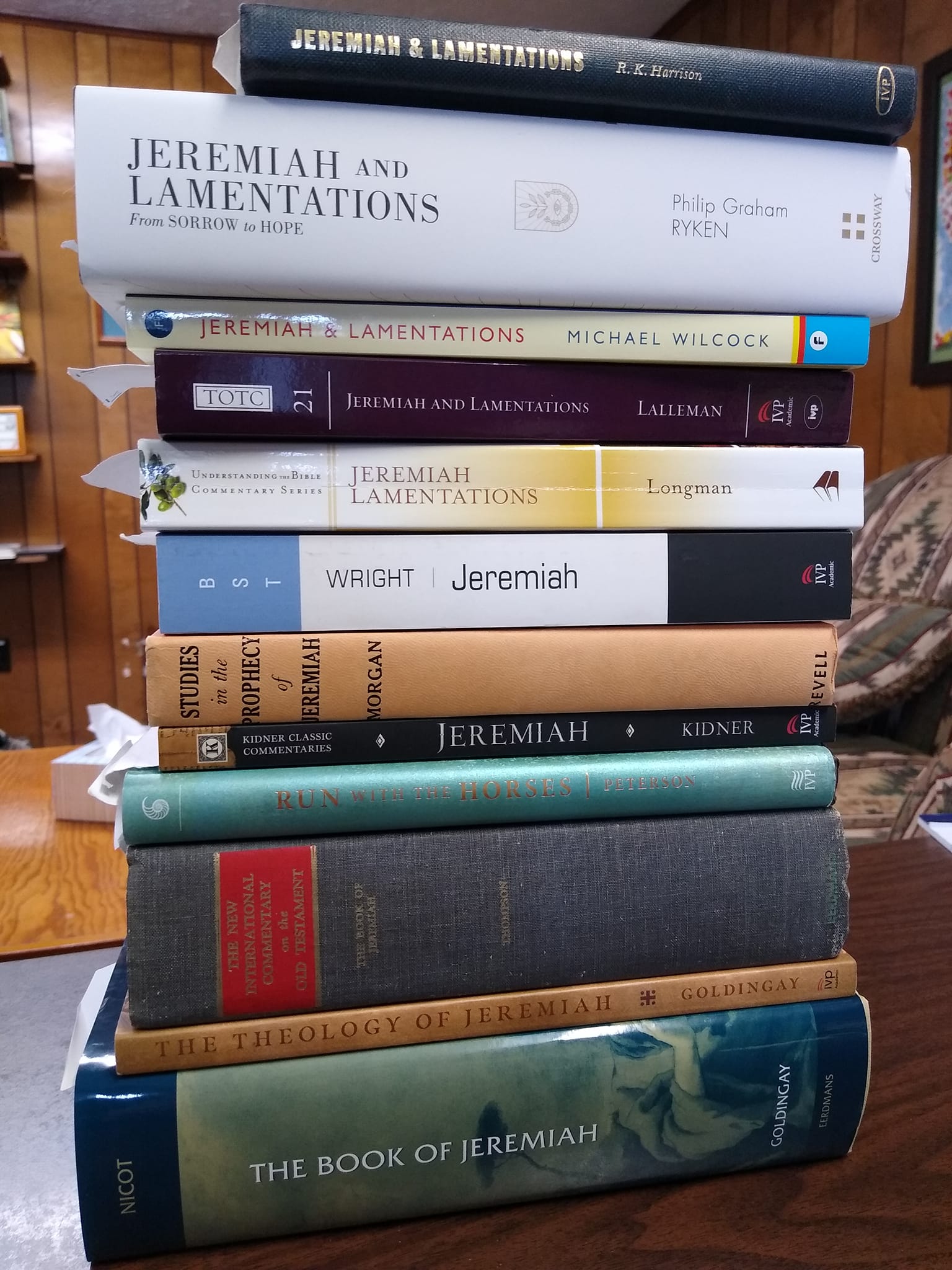 For the last several months, I’ve been reading a stack of books on Jeremiah to get ready for this series, and all of the commentators seem have their own idea of how the book is structured. Some of them actually try to rearrange it into a different order. People have been doing that with this book for 2,000 years.
I’m not going to rearrange it for you into chronological order. I believe it’s a work of art that isn’t supposed to be read chronologically. It’s more like a music video or a movie with flash backs and flash forwards or a panorama that hits you in different ways as it speaks to you as you read through it.
But everybody agrees that chapter 1 is chronological. It’s a great starting place and gives a good chronology for us. Chapter 1 tells the story of the calling of the prophet Jeremiah into his prophetic ministry. It’s his “start date.”
And the first three verses also tell us about the beginning, middle, and end of his ministry. It definitely does orient us, so let’s look at it more closely. V.1
“The words of Jeremiah son of Hilkiah, one of the priests at Anathoth in the territory of Benjamin.”
So this book is full of Jeremiah’s words. And we learn that this Jeremiah was the son of a priest (so he might have become a priest himself, though there is no record of it). And he’s from Anathoth, a city about an hour’s walk north and east from Jerusalem. In the territory of Benjamin. Modern day “Anata.” In the southern kingdom of Judah.
And verse 2 says, “The word of the LORD came to him.” That’s really big. More on that big thought in a second.
When did the word of the LORD come to him? When did he start in ministry? V.2
“The word of the LORD came to him in the thirteenth year of the reign of Josiah son of Amon king of Judah...”
Okay. Anybody remember if Josiah was thumbs-up or thumbs-down?
Josiah was the very last thumbs-up king in Judah.
His grandfather was the very worst king Judah ever had. Manasseh. And his daddy Amon was awful, too. But Josiah was basically thumbs-up.
He was really young. He started at age 8. And he was a reformer. It was during his reign that they found the book of the law in the temple. Do you remember that story? Josiah began to clean things up. It didn’t last long. The people weren’t really into it. We know that because of what they went right back to doing right as soon as he died.
But Jeremiah began his ministry in the thirteenth year of Josiah’s reign which we can date to 627 BC.
The word of the LORD came to him.
And stayed with him. Jeremiah then was a prophet for 40 years. Look at verse 3.
“...and through the reign of Jehoiakim son of Josiah king of Judah, down to the fifth month of the eleventh year of Zedekiah son of Josiah king of Judah, when the people of Jerusalem went into exile.”
There are actually 2 other kings of Judah during that time period, “Jehoahaz” and “Jehoiachin,” but they each only lasted 3 months. These three are the big three. Josiah, Jehoikaim, and Zedekiah.
Josiah was king from 640 BC to 609 BC. Jeremiah started in 627. And Jehoiakim was king from 609 to 597 BC, and he was absolutely terrible. Two thumbs down. He’s going to show up as a villain in this book again and again. Wait till you hear what he does in chapter 36! And then Zedekiah, who was also terrible but in a different way because he couldn’t make up his mind, was king from 597 to 586 BC.
And so that means that Jeremiah was a prophet in Judah from 627 to part way through 586, and that’s about 40 years.
40 years of prophecy.40 years of decline.40 years of speaking God’s word but people not listening to him.40 years of steady, gradual, tragic decline.
And then the exile happened.
One of the worst moments in all of the Old Testament.
When all of the promises of the Abrahamic Covenant: offspring, land, and blessing–all of those promises were pulled back, seemingly cut-off.
The people were taken out of the land out blessing and into cursing.
The exile was one of the worst moments in the Bible since Adam and Eve ate the forbidden fruit.
The Book of Jeremiah tells us in its first three verses, that this book is a prophecy of a tragedy.
Jeremiah is going to faithfully prophecy for 40 years, and it will not change the course of history. They will still go into exile. That’s kind of depressing.
I think that’s one of the reasons why Jeremiah does not get preached very often.
Because it’s very sad.
Jeremiah himself is very sad. This is a very personal book. We get to find out what it is like to be a prophet. Jeremiah tells us what it’s like, especially in how he talks to the LORD.
But frankly, what it’s like is kind of painful.
Jeremiah is often called the “Weeping Prophet.” The sad one. He probably also wrote Lamentations, about the Fall of Jerusalem in 586 and the exile. No wonder he was sad.
It’s hard to be a prophet. At least to be a true and faithful one in an age of decline.
Because prophets tell us what we need to hear, not what we want to hear.
But that’s one of the reasons why we should read this book. Because it tells us what we need to hear, not what we want to hear.
The first thing that the LORD told Jeremiah was that he was going to be a prophet, and he didn’t have any choice about it. Look at verse 4.
“The word of the LORD came to me, saying, ‘Before I formed you in the womb I knew you, before you were born I set you apart; I appointed you as a prophet to the nations.’”
There’s our title for today’s message, “The Word of the LORD Came to Me.”
That’s one of Jeremiah’s favorite phrases. I think he uses it more than any other prophet does.
The word for “came to me” could be translated, “happened to me.”
Yahweh showed up and started talking to Jeremiah. And He gave Jeremiah something he had to say. It wasn’t something he chose.
It wasn’t like, “What do you want to be when you grow up, Jerry?” And Jerry’s like, “I want to be a prophet.”
No, Jeremiah was minding his own business, and the LORD hit him with it.
“The word of the LORD came to me...” BAM!
Notice how personal this is. “Came to me.” We get the inside story, from Jeremiah’s own personal perspective.
The LORD speaks directly to Jeremiah and tells him that He has always known him, and always chosen him to be a prophet. “Before I formed you in the womb I knew you, before you were born I set you apart; I appointed you as a prophet to the nations.”
“This isn’t something you have a choice about, Jeremiah.” The word for “appointed” is more like “given.” “I’ve given you to be a prophet since before you were born.”
Now, that’s really encouraging and also kind of scary. What’s really encouraging is that the LORD knows us from before we are born and from before we can do anything good or bad. And this knowing is not just information, it’s election [like we saw in 1 Peter 1!]. Jeremiah was chosen by God before he was even formed in his mother’s womb.
And that also reminds us of the sanctity of human life. That unborn people are people, too. And that they matter like the PRC is always telling us.
But it’s also a little scary for Jeremiah, because it’s clear that this is something he’s not going to get out of.
He’s been appointed a prophet, or a spokesman for God, a prophet to the nations. Not just a prophet to Judah or about Judah (though that will be most of his work) but to and about the nations around Judah, as well. They will factor in heavily in this books, especially in chapters 46 through 51.
But it’s not an accident that Jeremiah is going to be a prophet. It didn’t just happen to him. This was Yahweh’s plan from the beginning. And Jeremiah is going to do it!
But, surprisingly, Jeremiah doesn’t want to do it! He doesn’t feel qualified. Look at verse 6.
“‘Ah, Sovereign LORD,’ I said, ‘I do not know how to speak; I am only a child.’”
And he might have been very young. This isn’t just an excuse. Some scholars think that he might have been in his early teens. Like 13 or 14 at this time.
The Hebrew word here means “youngster,” and it could stretch from infant to young adult. He’s saying, “I’m just a kid.” I’m not “a speaker.” Not yet.
What’s really interesting to me here is that Jeremiah talks back to God!
Jeremiah is not afraid to tell the LORD what he is thinking and feeling. We’re going to see that again and again. He’s not saying, “No.” He’s not a Jonah here, running the other way.
But he is hesitant. And he does tell the LORD what he is thinking. He is thinking, “I am only a kid.”
Verse 7. “But the LORD said to me, ‘Do not say, 'I am only a child.' You must go to everyone I send you to and say whatever I command you. Do not be afraid of them, for I am with you and will rescue you,’ declares the LORD.”
That’s really important.
I have three points for you this morning as we come down to the end of this message. Three things the LORD is saying to Jeremiah about His words in this chapter.
#1. SPEAK MY WORDS.
The LORD says to Jeremiah, “You must go to everyone I send you to and say whatever I command you.” “You don’t get to choose your audience, and you don’t get to choose your message. As my prophet, I want you to speak my words.” [Insight from C.J.H. Wright]
But you don’t have to be afraid! Because you are speaking my words, you don’t have to be hot stuff yourself. You’re not on your own. Don’t say, “I am only a child.” Say, “The LORD will be with me.”
Do you see how that changes everything?
What are you tempted to put into verse 6 of your life?
“Ah, Sovereign LORD...I can’t do that thing you want me to. I am only ________.”
Maybe you feel too young.Maybe you feel too old?Maybe you feel too quiet. You’re an introvert.
“I’m only a single. I’m not married.”“I’m new to the faith. I’m not mature yet.”“I am poor.”“I am only...” what?
The LORD says, don’t say that. Say, “The LORD will be with me.”
Because He will!
Now, you and I are not prophets. Jeremiah had a special unique calling.
But you and I can speak God’s words. And do it without fear.
Last week, there were two points of application to the message on Resurrection Sunday: Believe and Tell.
Believe that Jesus Christ is risen today.And tell others that Jesus Christ is risen indeed.
Did you do that this week?
If not, why not?
“Because I am only....”
“Because someone might...”
V.8 “Do not be afraid of them, for I am with you and will rescue you,’ declares the LORD.”
He says that 168 times in this book. “Declares the LORD.”
That’s like a divine mic drop.
“I will be with you.” “Declares the LORD.”
The Lord says the same thing to you and me, doesn’t He?
“I am with you always to the very end of the age.”
Therefore, “speak my words.” Look at verse 9.
“Then the LORD reached out his hand and touched my mouth and said to me, ‘Now, I have put my words in your mouth. [I wonder what that was like?!] See, today I appoint you over nations and kingdoms to uproot and tear down, to destroy and overthrow, to build and to plant.’”
This is where I have gotten the title for our whole series on Jeremiah.
We’re going to call it, “Uprooted.”
Because that’s what Jeremiah’s words are going to do.
Jeremiah is appointed or given as a prophet over nations and kingdoms–not as a king but as a prophetic spokesman for God. And when he speaks for God, then nations and kingdoms are going to be 6 things:
uprootedtorn downdestroyedoverthrownrebuiltand replanted.
Notice that four of those are destructive and two of them are constructive. Four of them are negative and two of them are positive in outcomes. The first four are about devastation, and the last two are about restoration.
And that’s how this book will be. It will be like 2/3 doom and then 1/3 hope.
And the hope will shine all the brighter because of the darkness of the gloom.
The joy is greater because of the sadness.
By the end of the book, the whole kingdom of Judah will be uprooted.
Heather Joy has been weeding her garden recently. It’s that time of the year. She had a whole wheelbarrow of weeds one day this week. Heather joy takes a great joy in ripping those things out, roots and all. Dirt flying everywhere. Gleeful look on her face. And rightfully so. I’m happy for her.
But imagine, for a second, being the plant. Ripped up, roots and all.
When we started 1 Peter this fall, we were thinking about Afghani refugees. Now we also think of Ukrainian ones. Ripped up, roots and all.
And Jeremiah was getting his people ready to be uprooted, as well. You know how Peter was writing to the exiles and foreigners?
Jeremiah is getting his people ready for exile, too. This book is a perfect follow-up to our last one. And prepares us for being uprooted, too. Or to realize that we are already uprooted as we try to live godly lives in an ungodly world. Citizens of the kingdom of heaven while we sojourn through the kingdoms of this world.
And look forward to the time when we are fully replanted. When our joy is made full.
These 6 verbs–uproot, tear down, destroy, overthrow, build, and plant–will show up over and over again as we read Jeremiah. Because this was the mission Jeremiah was chosen for. To speak God’s words to the nations and watch things happen.
Except they don’t always. It often seems like God is not keeping His word.
Jeremiah is going to prophecy doom and destruction for 40 years! And not only does his preaching not bring revival, but it doesn’t bring total destruction for 40 years. So, from the beginning the Yahweh had to make it clear to Jeremiah that He would be bringing all of His words to pass. Look at verse 11.
“The word of the LORD came to me...”
He says it again. This happens three times to Jeremiah in chapter 1.
“The word of the LORD came to me: ‘What do you see, Jeremiah?’ ‘I see the branch of an almond tree,’ I replied.”
There are a lot of almond trees in Anathoth, and they are spring trees. They are the among the first to bud in the spring.
Which trees tell you that the spring has come? We are waiting for the spring to really come, right? When do you know that that’s happened? I like the forsythia. When I see those yellow buds open up and the daffodils, too. Then I know that spring has come.
The Hebrew word for “almond” is “shaqed.” Well, the LORD has a pun planned for Jeremiah. What do you see, Jeremiah? I see a “shaqed.” v.12 "The LORD said to me, ‘You have seen correctly, for I am watching to see that my word is fulfilled.’” The word for “watching” is “shoqed.”
You see a shaqed? Well, I am shoqed. Just as you know that when you see an almond branch, that spring will come, you can know that I am going to see that my words are fulfilled. It’s not always going to seem like it. But I’m going to see to it myself. “Shoqed.”
#2. WAIT FOR MY WORDS.
Yahweh says, trust that my words will be fulfilled. Wait for them. Watch for them. Because I am watching for them. The Lord takes this personally. He is not going to leave it up to chance. He is not going to leave it up to someone else.
Did your mom ever ask you to do something, and then watch you to make sure you do it? “I’m not leaving until you put that away.” The LORD is doing the same thing with His words.
Do you believe that? I’ll bet that it feels to some of you in this room right now like the Lord has dropped the ball.
“When is He going to do what He said?”
It felt like that many times to the people of Israel living through the story of the Old Testament. But this is the truth right here, “I am watching to see that my word is fulfilled.”
Remember how Jesus fulfilled God’s words even as He hung dying? Even while He was dead?
“I am watching to see that my word is fulfilled.”
The LORD Himself is supervising the perfectly-timed enacting of His words.
Wait for it.
Wait for His promises to be fulfilled.
And His threats! Look at verse 13.
“The word of the LORD came to me again: ‘What do you see?’ ‘I see a boiling pot, tilting away from the north,’ I answered.”
Do you see the picture in your mind’s eye?
There is a big boiling pot with spaghetti in it. Or maybe chicken stew. I don’t know what’s in it.
But it’s tilting your direction. You’re sitting to the south of the pot. And the boiling pot is tilting away from the north and towards you. What do you think is going to happen? Y
ou’re going to get burnt. You’re going to get scalded.
That’s what the vision was for Jeremiah.
“The word of the LORD came to me again: ‘What do you see?’ ‘I see a boiling pot, tilting away from the north...’” Verse 14.
“The LORD said to me, ‘From the north disaster will be poured out on all who live in the land. I am about to summon all the peoples of the northern kingdoms,’ declares the LORD. ‘Their kings will come and set up their thrones in the entrance of the gates of Jerusalem; they will come against all her surrounding walls and against all the towns of Judah. I will pronounce my judgments on my people because of their wickedness in forsaking me, in burning incense to other gods and in worshiping what their hands have made.”
Now, He doesn’t say here who is coming from the north. It’s maybe too early in Jeremiah’s ministry to reveal that.
It’s not the South though. It’s not Egypt. The enemies will be coming from the North, and we know now that eventually it was Babylon.
From the beginning of his ministry, Jeremiah knew that the LORD was going to bring judgment on Judah.
All he had to do was wait. The boiling pot was going to be poured out. Yahweh has declared it. They can expect siege warfare. They can expect disaster. They will be scalded.
And here’s why. Not because of the geopolitical realities of the day. The LORD uses those politics, but it’s not why Judah would be scalded.
They will be judged because they had forsaken the LORD. They had worshiped idols. They had worshiped “what their hands had made.”
We’re going to see this again and again in the book of Jeremiah.
There is painted in this book a beautifully ugly portrait of sin. Jeremiah poetically and powerfully explains to us what sin really is.
And it’s what brought Judah down. God wasn’t just having a bad day when the exile came. The exile was the judicial results of hundreds of years in the making of forsaking the LORD.
What’s amazing is that He was so patient and waited so long! But He was watching to see that He word was fulfilled.
And that’s true of the happy and hopeful promises of Jeremiah, as well. In many ways, we are still waiting for them to come to fruition.
The New Covenant has been inaugurated in the blood of Jesus and ratified by the resurrection of Jesus. But we are still waiting for the return of Jesus and the kingdom that He promised.
We are still in some ways uprooted and waiting to be planted forever in the kingdom.
But it will happen. Just wait and see. And while you wait, stand with God’s Word.
#3. STAND WITH MY WORDS.
Yahweh says in effect:
"Speak my words." I’ve put them in your mouth.
"Wait for my words." I’m watching to see that they will be fulfilled.
And "stand with my words." Stand up for them. Fight for them. Don’t back down from them. No matter what anybody says. Look at verse 17.
“‘Get yourself ready! Stand up and say to them whatever I command you. Do not be terrified by them, or I will terrify you before them.”
The ESV translates this, “Dress for work,” Jeremiah.
This is just like what Peter said in his letter to the exiles.
“[P]repare your minds for action; be self-controlled; set your hope fully on the grace to be given you when Jesus Christ is revealed” (1 Peter 1:13).
Roll up your sleeves (Ryken). And don’t back down. If you cower before men, I will give you something to cower about. V.18
“Today I have made you a fortified city, an iron pillar and a bronze wall to stand against the whole land–against the kings of Judah, its officials, its priests and the people of the land. They will fight against you but will not overcome you, for I am with you and will rescue you,’ declares the LORD.”
I love that. I want that.
I want to be a fortified city.I want to be an iron pillar.I want to be a bronze wall.
I want to be ready to stand with and for God’s word against all comers.
That’s one of the biggest reasons why I’m tackling the prophecy of Jeremiah with you, because I need to grow in this.
I do not like being unpopular.
I like to be liked. I’ll bet that you do, too. But Jeremiah was set from the beginning to be unpopular.
Notice who he has to be prepared to stand against! Verse 18
“...against the kings of Judah, its officials, its priests and the people of the land.”
That’s everybody. That’s everybody inside. It’s not the nations that Jeremiah has to contend with. It’s his own people!
This is the story of the book. Jeremiah did not like being unpopular either.
But he was prepared to do it because the word of the LORD had come to him.
He felt those words. He had them inside of him. He says that they were like a fire burning in his bones (20:9). He had to speak them. Whether people wanted to hear them or not.
You and I need to prepare ourselves to be uprooted.
And to say what needs to be said [with love!] whether people want to hear it or not.
Jeremiah had a backbone. Jeremiah had a spine.
He was not “only a child.” For 40 years, he was a fortified city, a iron pillar, and a bronze wall. He was unpopular, but he was invincible. Not because he was so great, but because (v.19), the LORD was with him and rescued him.
And that same God will be with us if we will stand with His words.
“Declares the LORD.”


April 17, 2022
“I Have Seen the Lord!” [Matt's Messages]
 “I Have Seen the Lord!”Lanse Evangelical Free ChurchApril 17, 2022 :: John 20:1-18
Jesus was dead and buried.
Over the last two Sundays, we have been reading about the crucifixion and burial of Jesus Christ. Two weeks ago, we started in chapter 19 as Jesus was made to carry His own cross to His own execution.
And then He was nailed to it and then He fought to breathe. Fighting against asphyxiation while hanging there nailed to the wood.
Excruciating pain and anguish and agony and thirst and horror and shame. And then death.
True death. Not faked. Not almost there. But certifiably dead. His executioners knew their business, and they had accomplished their mission. Jesus was killed.
And then He was buried. A couple of disciples who had been “secret disciples” stepped out of the darkness and at some risk to themselves took possession of the lifeless corpse, the body of Jesus, and laid it nearby in a freshly dug tomb that had never yet been used by the owners. Everybody knew where it was.
It was close to Skull Hill where Jesus was killed, in a little garden nearby–very easily locate-able even in the dark.
Even though He had died with nothing and treated as less than nothing, in His burial, He had been treated royally wrapped with 75 pounds of spices intertwined in linen strips. But it had been done hastily because the sun was going down and the Sabbath was beginning.
And all night Friday and all day Saturday, nothing happened.
Jesus was dead and buried.
And with Jesus, all of His disciples’ hopes were dead and buried, as well.
Jesus was dead and buried.
And then came Sunday morning!
[VIDEO WILL BE EMBEDDED HERE.]
Look with me at the historical record. John chapter 20, verse 1.
“Early on the first day of the week, while it was still dark, Mary Magdalene went to the tomb and saw that the stone had been removed from the entrance.”
It’s early early on Sunday morning. Mary was one of the women that was there on Friday and had to watch that monstrous thing happen to Jesus. She went to the tomb, the other gospels tell us, with those with other women to finish the rush job that Joe and Nick had done on Friday evening as the Sabbath fell.
And as the sun starts to come up, Mary sees that the stone had been rolled away from the entrance.
What does she think? Does she think, “Hooray! Christ has risen indeed!”
No. That’s not where her mind goes.
She thinks of one thing only, “Grave robbers.”
“Those guys put 75 pounds of expensive spices in that tomb. Myrrh and aloes. Somebody’s probably made off with the body. I better go tell Peter.” v.2
“So she came running to Simon Peter and the other disciple, the one Jesus loved, and said, ‘They have taken the Lord out of the tomb, and we don't know where they have put him!’ [“It’s terrible. He’s not only dead, but now His body is stolen.”] So Peter and the other disciple started for the tomb.”
Remember, the “other disciple” is probably John the guy writing this story out for us. He’s so bowled over by the idea that Jesus loved Him. He can’t get over it. And he’s full of grief.
He and Peter run to the tomb, leaving Mary behind. V.4
“Both were running, but the other disciple outran Peter and reached the tomb first. He bent over and looked in at the strips of linen lying there but did not go in. [I love those “eyewitness” details. There’s not deep spiritual point to that. It’s just history. It’s just how it all actually happened. John got there first but for some reason stayed outside. Maybe he couldn’t bring himself to look. V.6] Then Simon Peter, who was behind him, arrived and went into the tomb. [Classic Peter, right?!] He saw the strips of linen lying there, as well as the burial cloth that had been around Jesus' head. The cloth was folded up by itself, separate from the linen. [This does not look like the work of grave robbers. They left the valuable spices in the linens?! They folded up the head cloth?! I don’t think so. V.8] Finally the other disciple, who had reached the tomb first, also went inside. He saw and believed. (They still did not understand from Scripture that Jesus had to rise from the dead.)”
Peter has seen it with his own eyes, but he’s not sure what he’s seen. The other gospels tell us that he went away marveling over this and trying to figure it all out.
But John says that at moment, he got it. He got it. He understood.
Jesus is alive!
John didn’t understand that the Old Testament had always pointed towards the Messiah dying and rising again. Like Psalm 16, verse 10 that we studied last year on Resurrection Sunday out there in the big parking lot. Where David wrote (ultimately for the Christ), “You [LORD] will not abandon me [CHRIST] to the grave, nor will you let your Holy One see decay.”
John says he didn’t understand all of that, but he did believe that Jesus was alive again. And so should we.
I want to give out two points of application this morning, summed up in just two words. And here’s the first one:
#1. BELIEVE.
Like John here in verse 8, believe that Jesus of Nazareth has come back from the dead. This isn’t a myth. It’s not a fable or a fairy tale. It’s not just a metaphor. A nice story to explain how sweet the season of Spring is. This is reality. This is historical fact. And it changes everything.
Believe that Jesus has risen from the dead.
Christ is risen!He is risen indeed.
Indeed. For real, in other words.
Ryen, Jordan, and Leo have come to believe that Jesus is alive again and that’s why they are going through with baptism.
None of them want attention. None of them love to speak in public.All three of them believe that Jesus is alive.All three of them believe Jesus was dead and buried and is alive once more.
Watch them show it by being buried in the water and coming back out again themselves!
Do YOU believe?
I love how John has not yet seen the Risen Jesus and yet he already believes. Because that’s like us, right?
Have you seen the Lord? It would be wonderful to see Him with our own eyes, and one day we will. Somebody is just about to in the next part of the story.
But you don’t have to see it to believe it. Later on in this chapter, Jesus says, “[B]lessed are those who have not seen and yet have believed.”
Do you believe? Here’s how blessed you are if believe: John said earlier in chapter 1, “[T]o all who received [Jesus], to those who believed in his name, he gave the right to become children of God...” (1:12).
Ryen, Jordan, and Leo have become children of God!
They believe that Jesus died for their sins and came back to life to give them eternal life with Him.
Believe!
Mary did not yet believe. She didn’t understand what had happened. Apparently, she made her way back to the garden and missed Peter and John and everybody else. And she just stood there outside the tomb and cried. V.10
“Then the disciples went back to their homes, but Mary stood outside the tomb crying.”
The Greek word for “crying” there might be better translated “wailing.” She was sobbing. She was overwhelmed with emotion. I’ve only cried like that a few times in my life. One time was 23 years ago today. 23 years ago this weekend our oldest daughter, Charis, died in utero. And I wailed in that hospital room like I had never wailed before.
Mary’s Lord was just as dead, and now His body was stolen. She was inconsolable. And then she saw something mysterious and amazing. V.11
“As she wept, she bent over to look into the tomb and saw two angels in white, seated where Jesus' body had been, one at the head and the other at the foot. They asked her, ‘Woman [madam], why are you crying?’ ‘They have taken my Lord away,’ she said, ‘and I don't know where they have put him.’ [v.14]
At this, she turned around and saw Jesus standing there, but she did not realize that it was Jesus.”
Why was that, do you think?
It might have been because it was still early and dark.It might have been because she was looking through tears.It might have been because she didn’t look very closely.It might have been because she was somehow kept from recognizing Him.It might have been because He looked different after having been tortured, either he looked worse or He looked better than she had just seen Him a couple of days ago.
We don’t know.
Personally, I think it’s just because she didn’t expect to see Jesus!
Jesus was dead.
And then He speaks. Verse 15.
“‘Woman,’ he said, ‘why are you crying? Who is it you are looking for?’ [I see a twinkle in His eye. He can see what’s going to happen when the light dawns for her.] Thinking he was the gardener, she said, ‘Sir, if you have carried him away, tell me where you have put him, and I will get him.’ [She saw what she expected to see. But He was not what she expected to see. Verse 16.] Jesus said to her, ‘Mary.’ [Just like He always did! [an insight from D.A. Carson] She turned toward him and cried out in Aramaic, ‘Rabboni!’ (which means Teacher).”
What a moment!
Can you imagine?Can you imagine what she felt like?
His sheep know His voice.
It was Him!It was the Teacher.It was the Lord!
It was Jesus back from the dead.
In my mind, she falls at His feet and grabs Him around the knees.
I can’t imagine how I would have felt if our daughter had come back to life.
I wouldn’t have ever let go of her.
But Jesus says, “Let me go. Okay. Let me go.” Verse 17.
“Jesus said, ‘Do not hold on to me, for I have not yet returned to the Father. Go instead to my brothers and tell them, 'I am returning to my Father and your Father, to my God and your God.'’”
I think the point there is, “It’s okay, Mary. I’m not going anywhere just yet. I am going to be ascending to the Father, but there is still more time for us to be together. It’s understandable, but you don’t have to cling to me.”
“Instead, I have a mission for you. Go tell my brothers (the disciples) that I am ascending to my Father.
But He’s not just my Father. He’s your Father.
He’s not just MY God (even though He’s mine like nobody else’s), but He’s also YOUR God.
You disciples are children of God because you believe in me.
Go tell them that!
And that’s our second and last point of application this morning:
#2. TELL.
Believe that Jesus has risen indeed. And tell others that Jesus has risen indeed!
Mary did. Verse 18. “Mary Magdalene went to the disciples with the news: ‘I have seen the Lord!’ And she told them that he had said these things to her.”
That’s what you and I are supposed to be doing with our lives in 2022.
Just like Mary. We’re to go and tell the brothers, like everybody here, and go also and tell the world that Christ has risen indeed.
And that’s what Ryen, Jordan, and Leo are prepared to do right now.
***
Messages in this Mini-Series:
1. "Here They Crucified Him" - John 19:17-30
2. "They Laid Jesus There" - John 19:31-423. "I Have Seen the Lord!" - John 20:1-18
April 15, 2022
"Misquoted" by Russell Muilenburg
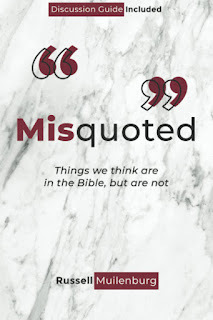
My friend Russell Muilenburg has published his first book!
Russell and I have known each other for more than a quarter of a century, having met during summer Greek (also known as "suicide Greek") at Trinity Evangelical Divinity School back in the day. Then in our first semester at TEDS, we had the exact same schedule and got to spend a whole lot of time together. After seminary, we've stayed in touch and have continued to encourage each other as we walk through the ups and downs of ministry in the 21st century.
Russell is a good thinker and a gifted teacher. I've always profited from reading (and, with permission, copying from) his sermons. I'm glad that he's started to provide resources for a wider audience (check out his website: eatthisword.com).
It was a joy to provide my endorsement for this new release:
"'Everything happens for a reason,' including you picking up this thoughtful little book by my friend Russell Muilenburg. In Misquoted, Russell interrogates several of the hackneyed sayings we Christians have been known to overuse. But Russell doesn't just dunk on and debunk Christian cliches--he also shows how each trite adage can also reveal a kernel of biblical truth and how we can be more discerning in what we say to each other, especially when we are going through hard times. I recommend that you 'just follow your heart' and start reading Misquoted today."
April 10, 2022
“They Laid Jesus There” [Matt's Messages]
 “They Laid Jesus There”Lanse Evangelical Free ChurchApril 10, 2022 :: John 19:31-42
In this story, from the beginning to the end of this message today, our Lord Jesus Christ will be dead.
We know that Jesus is not dead right now. That’s what we’re getting ready to celebrate next Sunday. Amen? “Raise your joys and triumphs high!”
But in this story, in the passage of Scripture that we are considering this morning, John chapter 19 verses 31 through 42, Jesus. is. dead.
Totally dead.
No breath in His lungs. No beating in His heart. No brain-waves in His skull.
Last week, we read about His dying. We started in verse 17 and watched Him carry His own cross to His own execution. And we read about His crucifixion. Nailed to a cross. Fighting against asphyxiation. Excruciating pain and anguish and agony and horror.
Shame. The execution squad gambling for His last stitch of clothing.
A mocking placard pasted above His head charging Him, in effect, with sedition and insurrection and rebellion.
Incredible thirst. And then He cried out, “It is finished,” and He gave up His spirit. And He died.
He wasn’t pretending. He wasn’t faking. He wasn’t acting.
After He died, nobody yelled, “Cut!” And then He smiled and got down from the cross. It wasn’t an act. It wasn’t just a show. No, Jesus was executed and died. Jesus laid down His life, and He died.
He was now a corpse. Nailed to a cross.
And He’s going to stay a lifeless corpse throughout this message. He’s not going to do anything. Say anything. Teach anything. His body is just a carcass.
In fact, when we go to sing our closing song this morning, we are only going to sing the first three verses. And not the one about the resurrection.
You’ll have to come back next week if you want to sing more about the resurrection.
Today, in this story, Jesus will stay dead.
[VIDEO WILL BE EMBEDDED HERE.]
I think it’s good for us to think about Jesus being truly dead. The Bible emphasizes it. It gives us these twelve verses in John’s gospel and more in the others about what happened on Friday night and all day Saturday.
And the Bible emphasizes that Jesus not only truly died but was buried.
The Apostle Paul said that Jesus’ burial was an essential part of the gospel of first importance (1 Corinthians 15:3-4). It matters that He was buried. The Apostles’ Creed that we’ve been confessing with the whole church throughout space and church history is very concise, but it makes sure to include that Jesus “...was crucified, dead, and buried.”
We all want to get to the resurrection, but we have to through the death first. And the burial first.
Most of the pronouns change at this point in the story. There are a lot fewer “he’s” and there are more “it’s” to describe His body. John keeps saying, “the body of Jesus.” Because He has given up His spirit.
This body is a corpse.
Just hanging there suspended in the air, nailed to the cross.
He is dead.
Now, they don’t all realize it at first.
Nobody is checking His pulse. He could be hanging on. Victims of crucifixion could last for days.
But this was a holy week for the Jews, and they wanted the whole thing hurried up. Look at verse 31.
“Now it was the day of Preparation [the day before the Sabbath of Passover Week], and the next day was to be a special Sabbath [the Sabbath of Passover Week, the beginning of the Feast of Unleavened Bread]. Because the Jews did not want the bodies left on the crosses during the Sabbath, they asked Pilate to have the legs broken and the bodies taken down.”
They wanted things sped up.
The Romans liked to leave the criminals on the cross until the vultures ate them off.
The crucified were a warning to others. They were billboards hanging there saying, “This is what happens when you rebel against the power of Rome!”
But the Jews (who did not normally participate in crucifixions, they didn’t have the power to do that. The Jews could stone somebody but not crucify them at this time. The Jews) were taught by Moses to never leave someone hanging overnight.
[Read Deuteronomy chapter 21 to see that and how they followed that law in the book of Joshua chapter 8.]
And they especially didn’t want that mess hanging there during the Passover. How gauche! How tacky! How unholy and unclean.
So they asked Pilate to have the three criminals’ legs broken.
What would that do? If you can’t push up on the stake, you die much more quickly of asphyxiation. Look at verse 32.
“The soldiers therefore came and broke the legs of the first man who had been crucified with Jesus, and then those of the other. But when they came to Jesus and found that he was already dead, they did not break his legs.”
“This one is already checked out.”
Think about this. The men on either side of Jesus are still struggling to breathe and might for days. The other gospels tell us that they deserved to be there and had heaped abuse at Jesus. But then one of them repented and asked Jesus to save him right then and there, and He did!
Jesus died, and that guy was still alive. But he won’t be for long because the soldiers have broken have legs.
But they didn’t have to break Jesus’ legs. He was dead already.
He was dead already.
Further proof? Verse 34.
“Instead [of breaking his legs], one of the soldiers pierced Jesus' side with a spear, bringing a sudden flow of blood and water.”
Did that hurt Him?
He just got pierced in the side with spear. Did that hurt?
No. It didn’t hurt because He was already dead.
And apparently, “the blood from the heart mingled with the fluid from the pericardial sac to produce [a] flow of blood and water” from out of Jesus’ side (Carson, 623).
I don’t know why the soldier did it. Perhaps to confirm His death which it assuredly did. But maybe just out of cruelty and brutality and perversity?
Either way, it proved that Jesus was dead.
He didn’t flinch. He just flowed. His fluids just flowed out His side.
The color would have drained out of His skin.
He was gone. And His body still nailed to the cross.
Look at what John says in verse 35.
“The man who saw it has given testimony, and his testimony is true. He knows that he tells the truth, and he testifies so that you also may believe.”
I think that John is talking about himself. He’s saying that he saw this monstrous thing with his own eyes and, he’s telling us this so that we might know the truth from an eyewitness so that we might believe.
And here’s what we need to believe–Jesus was dead. Totally and truly dead.
John says, “Don’t believe anyone who says that it was faked. Jesus didn’t just pass out. Jesus didn’t just ‘swoon.’ He died. He was so dead they didn’t break His bones. And blood and water came pouring out of His side. I saw it. Believe me. He was dead.”
That historical fact will be very important when we get to chapter 20!
But, amazingly, just because Jesus is dead doesn’t mean that He isn’t doing anything!
Jesus is so wonderful that even though He was truly dead, He was still accomplishing great things!
Today, I want to point out two and apply them to our lives in 2022.
#1. EVEN THOUGH HE WAS DEAD, JESUS WAS FULFILLING SCRIPTURE.
That’s the point John makes in verses 36 and 37.
“These things happened so that the scripture would be fulfilled: ‘Not one of his bones will be broken,’ and, as another scripture says, ‘They will look on the one they have pierced.’”
Here He is dead, and Jesus is still fulfilling holy Scripture.
Just like Psalm 34:20 predicted, the Messiah had no broken bones.
He was just like the Passover Lamb. According to Exodus chapter 12, the Israelites were not to break the legs of the Lamb of the Passover. And guess what Jesus was?!
And Zechariah chapter 12, verse 10 predicted that the guilty, “will look on the one they have pierced.” [That’s quoted again in Revelation chapter 1, verse 7 for a greater fulfillment still yet to come.]
Did these soldiers know what they were doing?
Were they trying to fulfill Scripture?
No. And they probably never realized that they were!
But John could see that the Lord was doing it through Jesus even though He was dead.
John keeps pointing this out again and again in his gospel. God is keeping His promises. God is fulling the Scriptures. Everything that He said was going to happen did.
And not even the death of Jesus would stop it!
In fact, the death of Jesus just carries it all along to its inevitable fulfillment.
Even though He was dead, Jesus was fulfilling Scripture.
Now, think about that and apply it to your life.
Just how committed is the Lord to fulfilling all of the Scripture?
Do you know what the Scripture says is going to happen?
If not, why not? It is more trustworthy than anything else you could rely on.
What is the weather going to be tomorrow? You reach for your weather app, right? How trustworthy is that? And yet you reach for it.
Have you reached for your Bible to see what is going to happen to the world? To you? What has God promised you? And how sure is that?
Even in His death, Jesus was fulfilling the Scriptures that pointed to His coming and the manner of the death that He would die on our behalf.
Do you see how powerful this Lord is? Someone might say, what kind of power is it that suffers through crucifixion? And I would say, what kind of power is triumphant even through the tragedy of crucifixion? More than that, what kind of power predicts ten hundred years before the fact that a certain man would die a certain way, with no broken bones? What kind of powerful sovereignty is it that makes a promise to a rebellious people that they would see a pierced God and then goes through with the painful reality of it five hundred years later?
This is God, friends. Only God does this.
And He was doing it while Jesus was dead!
And John says he saw this with his very own eyes and has told us so that we also may believe. Do you believe?
What are you counting on?
What are you counting on for your salvation?
So many count on such flimsy things like their own goodness, their own good works, their net worth, their family connections, their denomination.
What if we counted on something much more powerful that looked powerless?
What if we counted on the fulfillment of Scripture by a dead man?
Remember 1 Peter 3:18? “For Christ died for sins once for all, the righteous for the unrighteous, to bring you to God.”
Even though He was pierced and dead, Jesus was bringing you to God.
“The man who saw it has given testimony, and his testimony is true. He knows that he tells the truth, and he testifies so that you also may believe.”
#2. EVEN THOUGH HE WAS DEAD, JESUS WAS INSPIRING BOLD WITNESS.
Look at verse 38.
“Later, Joseph of Arimathea asked Pilate for the body of Jesus. Now Joseph was a disciple of Jesus, but secretly because he feared the Jews. With Pilate's permission, he came and took the body away.”
I think this is truly amazing.
The other gospels tell us that Joseph of Arimathea was a wealthy man and a member of the ruling class in Israel. He was actually a member of the Sanhedrin, the Jewish Ruling Council, and had disagreed with their verdict in the trial of Jesus.
In fact, he was a disciple of Jesus. He was one of Jesus’ disciples.
But verse 38 says that he was a secret disciple.
Is that a thing? It can’t be for long. A secret disciple is an oxymoron.
Joseph feared his fellow Jews.
Until Jesus died. And now he steps out into the open and asks Governor Pilate for permission to take the body of Jesus off of the cross.
This is something that the Romans didn’t normally do. Sometimes if a family asked, they would let them have the body for a burial. But often the family would not ask because asking would associate them with the convicted criminal!
The Jews wanted the bodies down and hidden away. Who knows what they would have done with the body if Joe hadn’t shown up and asked for it. A shallow grave in a ditch somewhere, maybe. Or somewhere His disciples could not gain access.
But here is Joe from Arimathea publicly asking for permission to take the body and bury it himself.
And it’s not just Joe. It’s also Nick. Remember Nick at Night? V.39
“[Joseph] was accompanied by Nicodemus, the man who earlier had visited Jesus at night [John chapter 3].” Nicodemus was the man whom Jesus told, “You must be born again.”
“You must be born again.”
And I think he was. But he too was a secret disciple until this moment. He, too, was as leader among the Jews. A teacher!
But he had come in darkness and stayed in the darkness until Jesus was dead.
And now, Nick has stepped into the light and is putting his life at risk to identify with and bury the body of Jesus.
This is bold witness!
Let me ask you:
Are you trying to be a secret disciple?
“Oh, yeah, I follow Jesus, but I never talk about Him.
I follow Jesus, but I never raise the flag. I’m just quiet about it. I don’t make a big deal about it.
I don’t try to get others to follow Him. I’m not a fanatic.
I’m a secret follower of Jesus.”
The people who are getting baptized next Sunday have come to believe that they need to tell the world that they belong to Jesus now.
They are no longer going to be silent or secret.They are going to be public and visible and audible.
Out of the darkness and into the light.Out of secret and in the open.
They are going to witness to Jesus as their Lord.
How about you?
This week is a great week to go public.
This is a great week to start a conversation. This is a great week to hand someone a yellow Easter book and offer to get together with them to talk about it.
It’s probably going to get harder in our culture to admit that you follow Jesus. At one time, it was seen as a good thing. And then it was a neutral thing. And in some quarters now it’s a negative thing.
And, to a great extent, Christians have done the damage to our own reputation. Many who have professed faith in Christ have lived lives that did not show the true beauty of Christ and given Him a bad name.
We need to truly follow the true Christ.
But we need to do it publicly and without fear of reprisal. Joe and Nick did it when Jesus was dead!
How much more should you and I do it when we know the rest of the story?!
Even though He was dead, Jesus was inspiring bold witness.
And not just bold witness but bold worship.
Look at what they did for this body. Verse 39 again.
“Nicodemus brought a mixture of myrrh and aloes, about seventy-five pounds. Taking Jesus' body, the two of them wrapped it, with the spices, in strips of linen. This was in accordance with Jewish burial customs. At the place where Jesus was crucified, there was a garden, and in the garden a new tomb, in which no one had ever been laid. Because it was the Jewish day of Preparation and since the tomb was nearby, they laid Jesus there.”
That’s a whole lot of spices!
Seventy five pounds! They must have had servants come with them to carry all of that to the burial and help with the body.
That was a weight of perfume that was reserved for royalty. This was an anointing fit for king.
And a King He was! Nicodemus had come to recognize that. Joseph of Arimathea ha come to recognize that.
They recognized King Jesus’ worth.
Their fear of the Jews had turned to faith in Jesus, and they put their money where their faith was and witnessed to and worshipped Him.
Even though He was dead.
Even though they were burying Him.
Notice that they buried Him nearby. Very near where He was crucified.
The garden was very close. The sun was going down. There wasn’t much time until the Sabbath began and the work would cease.
They had to get Jesus buried. There was a new tomb there. It was probably owned by Joseph of Arimathea himself. The rich would cut these tombs into the side of a rocky hill and put a whole family in there over time. This one was completely empty. Nobody in there yet.
Except Jesus.
Interestingly, this probably also fulfills Scripture, right? Remember Isaiah 53? Prophesied 700 years before Jesus was even born:
“We all, like sheep, have gone astray, each of us has turned to his own way; and the LORD has laid on him the iniquity of us all. He was oppressed and afflicted, yet he did not open his mouth; he was led like a lamb to the slaughter, and as a sheep before her shearers is silent, so he did not open his mouth. By oppression and judgment he was taken away. And who can speak of his descendants? For he was cut off from the land of the living; for the transgression of my people he was stricken. [Verse 9] He was assigned a grave with the wicked, and with the rich in his death, though he had done no violence, nor was any deceit in his mouth.”
He was dead then buried in a rich man’s grave.
Near where he was crucified. A very findable spot. Easy to locate. They all knew where Jesus was laid.
That historical fact will be very important when we get to chapter 20.
But we will leave that for next week.
This week, let’s just simply ponder what Jesus could accomplish even while there was no life in His body.
He was still fulfilling Scripture. And that means that nothing can stop the Scripture from being fulfilled. Count on it. Believe.
And He was still inspiring bold witness and worship. Count on it. And join the ranks of public disciples like Joe and Nick.
Having the courage to follow Jesus out in the open in the light, come what may.
***
Messages in this Mini-Series:
1. Here They Crucified Him - John 19:17-30
April 3, 2022
“Here They Crucified Him” [Matt's Messages]
 “Here They Crucified Him”Lanse Evangelical Free ChurchApril 3, 2022 :: John 19:17-30
“When I Survey the Wondrous CrossOn Which the Prince of Glory DiedMy Richest Gain I Count But LossAnd Pour Contempt On All My Pride” (Isaac Watts, 1707)
The authors of the four gospels do not spend hardly any time on the sheer horror of the crucifixion.
They don’t describe it.They don’t give the details.
I think that one of the reasons for that is that everybody in the Roman world knew what crucifixion was. You didn’t have to describe how awful it was.
Everybody knew.
I think another reason is so that we don’t get fixated on the gore. We can sometimes take a perverse pleasure in picturing pain and miss the point. The gospel writers never miss the point.
But everybody knew.
All John has to say is what he says in verse 18, “Here they crucified him,” and everybody knew how unthinkably awful was what happened there to Jesus.
D.A. Carson describes it this way, “Here, in this public place where all could see him, the soldiers crucified [Jesus]. In the ancient world, this most terrible of punishments is always associated with shame and horror. It was so brutal that no Roman citizen could be crucified without the sanction of the Emperor. Stripped naked and beaten to pulpy weakness, the victim could hang in the hot sun for hours, even days. To breathe, it was necessary to push with the legs and pull with the arms to keep the chest cavity open and functioning. Terrible muscle spasm wracked the entire body; but since collapse meant asphyxiation, the strain went on and on” (PNTC, pg. 610).
That’s what was going on in verse 18. That’s what was happening to Jesus. And we saw it live and in person, we would probably puke.
I don’t know about you, but I’m tempted to not think about that. I’m tempted to turn my mind away to “nicer” things. But I believe that we should not look away. We should survey the wondrously awful Cross.
“See from His head, His hands, His feet,Sorrow and love flow mingled down;Did e’er such love and sorrow meet,Or thorns compose so rich a crown?”
And there was so much going on when Jesus was crucified.
So much more than just a painful gasping and the agony of the nails.
The Apostle John, in reflecting back on those crucial hours, saw many things coming together around and through Jesus as He was crucified there.
I want to point out four of them that I’ve noted in verses 17 through 30.
[VIDEO WILL BE EMBEDDED HERE.]
As they crucified Him...
#1. JESUS WAS BEING PROCLAIMED AS KING.
Jesus has lived His perfect life, and done His amazing miracles, and taught His kingdom teaching, and for all of that goodness He has been feared, hated, arrested, flogged, judged, dragged from court to court, from Jewish court to Roman court, beaten, spat upon, mocked, yelled at, and scourged.
And now He’s been made to carry His own cross. V.17
“Carrying his own cross, he went out to the place of the Skull (which in Aramaic is called Golgotha). Here they crucified him, and with him two others–one on each side and Jesus in the middle.”
The part of Jesus’ Cross that He probably had to carry was the crossbeam. See here on the sculpture Josh has shared with us, his artwork, again this year, this part that goes horizontally. Often the vertical piece was permanently in the ground as a stake.
And the victim was made to carry His own crossbeam to the place of execution which was called Skull Hill (“Kranion” in Greek). “Golgotha” in Aramaic. Later “Kranion” or “Skull” would be translated into “Calvary” in Latin. That’s where we get that word.
This is the place outside of Jerusalem where Jesus died. “Here they crucified him.”
And, just as Isaiah predicted, He was “numbered with the transgressors” (Isaiah 53:12). He was crucified in between two bad guys. Probably rebel insurrectionists, terrorist guerrilla fighters.
Each of them, all three of them, nailed to their crosses and struggling to breathe and slowly dying.
It was a common practice to put up a placard either hanging around the neck or nailed above the head of the criminal being crucified with the charge inscribed on it–that which you were convicted of and being executed for.
This would be a deterrent for other criminals. “See what happens to you if you do this?!”
What was Jesus’ crime? Look at verse 19.
“Pilate [the Roman governor] had a notice prepared and fastened to the cross. It read: JESUS OF NAZARETH, THE KING OF THE JEWS. Many of the Jews read this sign, for the place where Jesus was crucified was near the city, and the sign was written in Aramaic, Latin and Greek.”
The language of the natives, the language of their overlords, and the trade language spoken by everybody. It was proclaimed in such a way that everybody who could read knew what it said, “JESUS OF NAZARETH, THE KING OF THE JEWS.”
Oh boy, the Jewish leaders were not happy about that. They were happy He was dying. But they had pretty much manipulated the situation so that He would. Pilate didn’t want to execute Him, but he was weak and felt like his hands were tied. So he washed his hands and had Jesus crucified.
But he was going to do it his way. Verse 21.
“The chief priests of the Jews protested to Pilate, ‘Do not write 'The King of the Jews,' but that this man claimed to be king of the Jews.’ Pilate answered, ‘What I have written, I have written.’”
That doesn’t mean that he believed it. But it does mean was stubborn and wasn’t going to be manipulated any further. He was going to proclaim what he was going to proclaim. He probably thought it was ironic!
And it was ironic, just not in the way Pilate thought.It was ironic because it was true.It wasn’t just ironic; it was prophetic.
Pilate was unwittingly witnessing to the true identity of the “Prince of Glory.” He was (and IS!) the “King of the Jews.” And, more, the King of the whole world!
What is the right application of that except to bow?
To worship Jesus as King. He was being enthroned as King even as He was being crucified. He may be the strangest King there ever was, but He’s the greatest King there ever will be! And He was being proclaimed as King, universally proclaimed as King, even as they crucified Him there. Worship Him.
“Were the whole realm of nature mine,That were a present far too small (to give to Him):Love so amazing, so divine,Demands my soul, my life, my all.”
And not just worship Him, but proclaim Him now, as well.
Tell somebody about Jesus in the next month. Do some evangelism. Be bold and share about your faith in your Lord. Tell somebody that Jesus is your King.
As they crucified Him...
#2. JESUS WAS FULFILLING THE SCRIPTURES.
I love how John could see how these people who were doing such evil things were unwittingly accomplishing God’s plans at the very same time. Look at verse 23.
“When the soldiers crucified Jesus [don’t forget what’s happening, don’t look away, when this four man execution squad crucified Jesus], they took his clothes [robe, belt, sandals, head-covering], dividing them into four shares, one for each of them, with the undergarment remaining. This garment was seamless, woven in one piece from top to bottom. [It was a “tunic” like an undershirt that went from neck to knees. And woven like that, it was too valuable to cut into four pieces. V.24] ‘Let's not tear it,’ they said to one another. ‘Let's decide by lot who will get it.’”
“I’ll roll you for it. This guy won’t be needing it any longer.”
Don’t miss how awful this is. When this little game of chance was over, our Lord was hanging there exposed. But even in that shaming act, these soldiers were carrying out God’s plan.
The Apostle John saw in their gambling, God’s promises. His mind went back to Psalm 22, the one that begins, “My God, my God, why have you forsaken me?” We read it together just about one year ago out in that parking lot right there in the drizzle.
The John says, “That’s Psalm 22, verse 18!” Look at v.24. John writes, “This happened that the scripture might be fulfilled which said, ‘They divided my garments among them and cast lots for my clothing.’
King David wrote that 1000 years before Jesus was born. It’s terrible, and it’s wonderful at the same time. Because it means that nothing can stop the promises of God, even the scariest of them. And that means that you and I can trust in the promises of God, even the sweetest and most unbelievable of them.
God can use all kinds of horrible things to effect His good plan for His children.
I mean, on a grander scale, that’s what was happening as Jesus was crucified, right? This was a terrible injustice. This Man hanging on the Cross. This shouldn’t have happened!
And yet it was also God’s plan being carried out. On the day of Pentecost, the Apostle Peter told the gathering, “This man [Jesus] was handed over to you by God's set purpose and foreknowledge; and you, with the help of wicked men, put him to death by nailing him to the cross” (Acts 2:23).
They should not have done that, but praise God they did. These soldiers should not have gambled for His clothes, but praise they did. V.24, “So this is what the soldiers did.”
Praise God that no matter how He does it, He always keeps His promises, Amen?
Let’s trust those promises! Do you know His promises? Do you know what He has promised to do? Nothing will stop Him from keeping them. In fact, He will use everything, even the bad things, to bring them to fruition.
Even these soldiers stealing his last earthly possessions. At this moment, He had nothing. No things. And He’s about to lose His family. Because He’s about to lose His life. V.25
“Near the cross of Jesus stood his mother, his mother's sister, Mary the wife of Clopas, and Mary Magdalene. [We’ll hear more from here when get to chapter 20. Right now, of the four women, Jesus focuses on His mom. V.26] When Jesus saw his mother there, and the disciple whom he loved standing nearby, he said to his mother, ‘Dear woman, here is your son,’ and to the disciple, ‘Here is your mother.’ From that time on, this disciple took her into his home.”
Most Christians scholars believe that this disciple is John the Apostle and gospel-writer himself. He’s too humble to say his name, too bowled over to have been so beloved like this.
Jesus saw his mother who is about to have that sharp sword of grief pierce her soul (Luke 2:35), so He tenderly arranges an adoption for her. He provides for her and really for John, as well. Likely, Joseph has died and Jesus’ half brothers don’t believe in Him yet, so He puts these two together to watch out for each other.
Here’s what I am amazed at here:
That He’s thinking about them at all.
I don’t know about you, but if I were being crucified, I’d be thinking about being crucified. I would be full of terror and rage at what was happening to me.
But Jesus is full of love!
Even as they crucified Him...
#3. JESUS WAS CARING FOR HIS LOVED-ONES.
His beloved mother, and His beloved disciple. And you know that He was caring for you and me, too.
I think it’s terrible that these women had to be there watching this monstrous thing happen.
Yet Jesus was in control. He was in charge even as He hung dying. He was making arrangements.
He was making arrangements! He was making arrangements for His loved-ones. Including arrangements for you and me.
Even as they crucified Him, Jesus was caring for His loved-ones.
#4. JESUS WAS COMPLETING HIS MISSION.
I love how John knows that Jesus knows exactly what He’s doing.
Pilate didn’t realize what he was doing.The Jews didn’t realize what they were doing.The soldiers didn’t realize what they were doing.
But Jesus knew exactly what He was doing. Look at verse 28.
“Later, knowing that all was now completed, and so that the Scripture would be fulfilled, Jesus said, ‘I am thirsty.’ [He knows exactly what He’s about. He’s fulfilling Scripture on purpose. Psalm 22 also says “My strength is dried up like a potsherd, and my tongue sticks to the roof of my mouth...” Psalm 69:21 which we also look at a year ago sings, “They put gall in my food and gave me vinegar for my thirst.” Jesus is doing this on purpose. He’s genuinely thirsty because they’re crucifying Him here, but He says this now to make sure that we understand that He’s fulfilling Psalm 22 and Psalm 69. And so are the soldiers once again. V.29] A jar of wine vinegar [cheap sour wine] was there, so they soaked a sponge in it, put the sponge on a stalk of the hyssop plant, and lifted it to Jesus' lips.”
He knows that this moment has come. The completion moment, when He’s bringing everything together.
And now His mouth is moistened so that He yell out with a loud cry. V.30 “When he had received the drink, Jesus said, ‘It is finished.’ With that, he bowed his head and gave up his spirit.”
In Greek, it’s just one word, “Tetelestai.” It takes three in English to say it, “It is finished.”
He’s not saying, “I am finished” as in “I’m a goner” or “I have lost.”
He’s saying that His mission is accomplished.He’s saying that He’s won the victory.He’s saying that His suffering is over and Has accomplished its purpose.He’s done what the Father sent Him to do.
Just a few hours earlier, He had prayed to His Father, “I have brought you glory on earth by completing the work you gave me to do” (John 17:4).
And now that work is completely done. And so Jesus can lay down His life and give up his spirit.
He’s in control even of the moment of His death. With these words on His lips, “It is finished.”
March 27, 2022
“Impress Them On Your Children” [Matt's Messages]
 “Impress Them On Your Children”Lanse Evangelical Free ChurchMarch 27, 2022 :: Deuteronomy 6:1-25
While you’re turning to chapter 6, I’ll say a brief word about why we are dipping into Deuteronomy today.
We just finished 1 Peter and next week, we will turn towards the Cross as we get near to Passion Week.
So I thought we’d use this Sunday in between to focus a little bit on what the Family Discipleship Vision Team has been emphasizing in their meetings.
As you know, we have a small team of volunteers in our church family who have been meeting every few weeks this year to review our ministries to children, youth, and parents with an eye on the future. Our church has a rich history of ministry to kids, especially to school children from busses to clubs to camp to classes to Family Bible Weeks.
And this team has been praying and talking about what should be the focus and approach in the next chapter of our church’s story. What does the Lord have for us for the future of family discipleship at Lanse Free Church?
And as you might expect, this team has spent some time together in Scripture, and one of the key passages we looked at was Deuteronomy chapter 6. The whole chapter. After that team looked at it, the Elders looked at it, too. And both groups agreed that it would be good for the whole church to study it together some Sunday, as well. So here we are.
“Deutero” means “second” (in Greek), and “nomos” means law so Deuteronomy is Moses’ restatement of the Law to the second generation of Israelites right before they moved into the Promised Land. They are on other side of the Jordan and just about ready to cross over into Canaan, and Moses preaches the whole Law to them again.
In chapter 5, Moses preached the 10 Commandments to them a second time. The “10 Words” first appeared in Exodus chapter 20. But Moses restated them in Deuteronomy chapter 5. And now, in chapter 6, he’s going to build off of them.
We're going to study the whole chapter, but drill down on verses 6 through 9 especially because what Moses told the parents of the children of Israel there I think teaches us some of the most important things for us to focus on as we teach our children here today.
[VIDEO WILL BE EMBEDDED HERE.]
“Impress them on your children.”
Our Lord has given Christian parents the great privilege of being the primary discipling influence in their children’s lives.
Dads and Moms who believe in Jesus are called by their Lord to pass on the faith to the next generation. To “impress” it on their children.
This is not just an Old Testament idea. It’s clear in the New. The Apostle Paul said in Ephesians chapter 6, “Children, obey your parents in the Lord, for this is right. ‘Honor your father and mother’–which is the first commandment with a promise–‘that it may go well with you and that you may enjoy long life on the earth.’ [That’s actually quoting Deuteronomy 5, and then Paul says...] Fathers, do not exasperate your children; instead, bring them up in the training and instruction of the Lord.”
And not just Dads. Paul reminded Timothy how his Mom and his Grandma[!]–probably in the absence of a believing father–how those faithful women, Lois and Eunice, passed on their faith to him, as well (2 Timothy 1:5, cf. 3:14-17).
One of the key concepts that the Family Discipleship Vision Team has focused upon is the importance of parents in making disciples of the next generation. Parents. So whatever we come up with, we know that parents are a key factor in the equation.
Moms and Dads, this is your job.
It’s your job to teach your kids the faith. It’s your calling. It’s your responsibility.
More than that–it’s your great privilege!
To teach your children about your Lord. “Impressing” the faith on your children.
Now, of course, it’s not just Moms and Dads who do that. Pastors and Children’s Church Teachers and Youth Group Leaders and people next to you on the pew can all play an important role. And there are wonderful Christian schools like Clearfield Alliance School or Christian Servant Academy and wonderful camps like Miracle Mountain Ranch to come alongside Christian parents and help.
And when there are children with no Christian parents in the equation, the rest of the church needs to step it up and take their place.
You’ve heard, “It takes a village to raise a child.” Well, it takes a whole church family to raise a disciple.
But the primary people the Bible talks to about teaching the next generation are the parents of the next generation. “Impress them on your children.”
Moses told the Israelites in verse 6, “These commandments that I give you today [the 10 Commandments and all the rest of this biblical teaching] are to be upon your hearts.” So it starts in the hearts of the parents’ generation. It’s gotta be in our hearts first.
And then we need to try to pass it on towards their hearts.
“Impress them on your children.”
The Hebrew word there translated “impress” is from a root word that means “to sharpen.”
So we might say, “Engrave,” this teaching on your children.
Drill it in there!
The King James Version says, “teach them diligently.”The Christian Standard Bible says, “repeat them to your children.”The New Living Translation actually says, “Repeat them again and again.”
“Impress them on your children.”
Parents, you should be a broken record!
Your job is to impress biblical teaching on your children.
You cannot make them accept that teaching. You cannot make them believe that teaching. You cannot guarantee that they will embrace that teaching all of their life.
But you can make sure they hear it again and again and again–from you.
Now, of course, that looks different with different kids and with different parents and especially at different times in their lives. It will look one way when they are really little and an almost completely different way when they are older. Heather and I are still trying to impress the faith on our children today, but at 21, 20, 18, and 17, it looks really different from when they were 5, 4, 2, and 1!
The point is to be at it. Continually.
As parents, it’s our job to not just to feed and shelter and protect and provide and make sure they learn to read, write, and do arithmetic.
It’s our job to continually teach them about the Lord.
“Impress them on your children.”
And to do that, we have to open our mouths. Verse 7.
“Talk about them when you sit at home and when you walk along the road, when you lie down and when you get up.”
I think that’s a way of saying, “all of the time,” right?
The Israelites were to remind their children when they sat at home and when they were out on the road.
We would say, “When you are out in your mini-van.”
When you are taking them to school or to soccer practice.
“When you lie down”–bedtime.“When you get up”–breakfast time.
Bedtime and breakfast time are key moments for discipleship!
And everything in between!
This is one of the reasons why parents are called to be the primary disciplers–they get their kids for some of the best times to learn about the Lord.
Parents, you may not have them all of the time, but all of the time you have them, you should be discipling them.
Impressing the faith on your children.
You’ve got them when they go to bed and when they get up. When they are sitting at home and when you are out with them on the road.
One of things we’ve noticed is that families are really busy these days. Lots of activities. And sometimes that means they are at church or church programs less than they used to be.
And while I think it’s good and right to ask parents to constantly monitor their family’s priorities and make sure that participating in spiritual community is a high priority–because the Lord calls us to do this together as a church!–yet no busy schedule should ever keep parents from discipling their children.
You don’t need this building to impress the faith on your children. You just need to open your mouth and continually connect everything in life to the Lord.
You can do this! There are lots of ways to do it.
When they are little, there are Bible story books.
We have a bunch in the church library.
Heather just bought 3 more children’s books for the library, and they are beautiful.
Read a Bible story to your kids every night. Read a missionary biography.Pray at the table every meal.Sing with your kids at bedtime every night.Pray with your kids at the table every morning.Talk about Jesus as you drive to school in the morning.When you pick them up, ask your kids about their day, and then bring the Lord into the conversation.
You can do this!
Discipleship doesn’t just happen in a classroom.
Or another way to say it is that everywhere is the classroom for discipleship.
“Impress them on your children. Talk about them when you sit at home and when you walk along the road, when you lie down and when you get up. Tie them as symbols on your hands and bind them on your foreheads. Write them on the doorframes of your houses and on your gates.”
Now, Orthodox Jews have taken that literally, and they actually have written down Scriptures and put them in little boxes that they wear on their bodies and attach to the doorframes of their houses. They touch them as they leave home and touch their mouths. And while I don’t think that’s what Moses meant, I applaud how seriously they take it!
I think Moses meant to do whatever you can to keep the Scriptures in front of your eyes. Use whatever memory devices to get it into your kids’ minds.
Heather has chalkboards set up around our house with Scripture on it and posters and little pieces of writing paper stuck on cupboard doors. If I close my eyes, I can see Scripture all over our house.
The point is to do this everywhere and all of the time.
“Impress them on your children.”
Maybe use a catechism? Our kids memorized questions and answers from before they could understand them and they have given them hooks to hang truth on as they grew up.
I could ask them a question right now (I won’t because I don’t embarrass them that way, right? But I could ask them a question right now, and the answer would be on their lips.
“Q. What is sin? A. Sin is thinking, wanting or doing what displeases God.
Q. Is there only one God?A. Yes, there is only one God and He exists in three Persons–the Father, the Son, and the Holy Spirit.”
If you want recommendations for good catechisms, I’d be glad to help you pick something out.
Even more importantly, memorize Scripture together.
On your way to church on Sunday, practice the “Hide the Word” verse in the car. Say it over and over again. Turn it into a song. Take turns. Make it a game. Flash cards!
“Impress them on your children.”
Parents, you can do this.
Now, some of you are like, “I don’t want to preach to my kids and tell them what to believe. It was forced down my throat, and I’m not doing that to my child.”
And there are lots of ways to do this badly, but one of worst ways is to not do it at all.
The Lord tells us to do it. So if He’s our Lord, we need to do it!
And we don't do this with math, do we? We don't say, "I don't want to preach to my kids all of this 2+2=4 stuff and tell them what to believe. All that math was forced down my throat, and I'm not doing that to my child."
That Jesus is Lord is just as true as 2+2=4. We need to teach the truth to our kids!
I think the key is to be living it out ourselves as we try to impress it on our children. It has to be “upon our hearts” first (v.6). Our kids will easily sniff out the hypocrisy if we are telling them one thing and then doing the exact opposite ourselves.
We’ve all seen it done poorly.
But we’ve all seen it done well, too, right? Who are your models for family discipleship?
I think this is where the rest of the church can really help. If you have already been down this road, what can you do to help a younger parent travel it now?
I want to recommend another resource. This is a book I’ve been reading this Spring. It’s called, Family Discipleship: Leading Your Home Through Time, Moments, and Milestones by Matt Chandler and Adam Griffin, foreword by Jen Wilkin.
Time, Moments, and Milestones.
Time is quantity and quality time. You have to have both. Setting aside time to get your family into the Bible together.
Moments are like v.7 sitting at home and walking along the road.
Milestones are big events like baptisms and church camp and Challenge Conference and things like that.
Time, moments, and milestones. This book encourages parents to leverage all of those things to impress the faith on your children. And the authors also have a podcast where they talk about practical ideas for doing it well.
You can do this! And you are doing this! You are here with your kids right now.
If you are trying to disciple your family, the Lord bless you and your efforts. Keep it up! Keep going! We’re all with you!
And we’re all learning from you. I thought about walking around with a microphone today and asking all of the parents to tell us a story of how you are doing this right now. What your strategies are. But I didn’t want to put anybody on the spot. Maybe we’ll do that another Sunday.
The key is keep doing it. Everywhere and every day, all of the time.
“Impress them on your children.”
Now, what are we supposed to impress on our children. I want to briefly summarize Moses’ message in three short points. (And we all need these things impressed on us, not just the children.)
#1. IMPRESS ON YOUR CHILDREN WHO THE LORD IS.
Let’s back up to verse 1.
“These [what he just gave them in the preceding chapters and what he’s going to give them in the chapters to come] are the commands, decrees and laws the LORD your God directed me to teach you to observe in the land that you are crossing the Jordan to possess, so that you, your children and their children after them [notice the generations there!] may fear the LORD your God as long as you live by keeping all his decrees and commands that I give you, and so that you may enjoy long life. [There is blessing with obedience. Let’s teach that our kids! V.3] Hear, O Israel, and be careful to obey so that it may go well with you and that you may increase greatly in a land flowing with milk and honey, just as the LORD, the God of your fathers, promised you. [This is the essence of the Old Covenant. With obedience comes blessing. Now, here’s where Moses teaches something essential about God’s identity. V.4]
“Hear, O Israel: The LORD our God, the LORD is one.”
The Jews call this the “Shema” from the Hebrew word to “Hear.”
And the Orthodox Jews recite it three times every day.
This is just as fundamental as what Kim Cone read to us last week about the LORD being the “I Am.”
The LORD (Yahweh) our God, the LORD is one.
Impress that on your children.
“The LORD is one.”
Yes, that means that all Christians parents are theologians.
Mom and Dad, you are the resident theologians in your home.
The question is not whether or not you will be the resident theologian, but if you will be a good one or a not so good one. Be a good one! Learn about your Lord and impress it on your children.
For example, the LORD is one.
What does that mean? Well, it clearly means monotheism to start with. As my kids have memorized, there is only one God.
All the other gods out there are not God with a capital “G.” They are not the self-existent transcendent Creator above all things.
There is only One of Him.
Now, we learn in the rest of the Bible that while there is only One God, the One God is triune. Yahweh eternally exists in three Persons.
But there is Only One God.
And more than that, I think it means that He is consistent. Not only is He in a class by Himself–He alone is God–but He isn’t one kind of god one day and another kind of god the next. He is unchanging. He is perfectly unified.
The LORD is one.
Impress that on your children.
Parents, what do your kids know about God? What have they learned from you about Who He is?
What have you insisted and instilled in them?
I have this thing with my boys when we went hunting together, I knew almost nothing about hunting when I did. I still don’t know that much about hunting. But I do know about hunting safety. And I would ask them, “Is there a bullet in the chamber? Is your safety on? Where are you pointing that? Is there a bullet in the chamber? Is your safety on? Where are you pointing that?”
I want it so that when my boys go hunting, I want them to hear my voice in their heads. “Is there a bullet in the chamber? Is your safety on? Where are you pointing that?”
But that is nothing compared to this. “The LORD our God, the LORD is one.”
“The LORD our God, the LORD is one.”
That’s Who he is.
#2. IMPRESS ON YOUR CHILDREN WHAT THE LORD WANTS.
If there is only one God, then He deserves one thing–all of our love. V.5
“Love the LORD your God with all your heart and with all your soul and with all your strength.”
The Lord Jesus Christ said that this was the greatest commandment in the whole Law. If you have this and the second one like it, you have the whole thing!
“Love the LORD your God with all your heart and with all your soul and with all your strength.”
That’s what He wants. He wants all of you.
Your heart, which is much more than your emotions. It’s really the center of you. Like your mind and your desires and your reverence and your worship.
And your soul. That’s not just the immaterial part of you. That’s like your whole being.
And your strength, your might. That’s all of your efforts. All of what you throw yourself into.
The LORD wants you to love Him with all that you are.
Impress that on your children.
Tell them again and again in all of the ways you can think of that the LORD is worthy of their worship and calls them to love Him supremely, above all things, with all of their beings.
It’s easy to forget.
The reason why we have to be broken records is that our minds are broken, too.
And we easily get tempted to forget that the LORD is worthy of our worship and start to drift off to worship other things.
Skip down to verse 10. Moses says, “When the LORD your God brings you into the land he swore to your fathers, to Abraham, Isaac and Jacob, to give you–a land with large, flourishing cities you did not build, houses filled with all kinds of good things you did not provide, wells you did not dig, and vineyards and olive groves you did not plant–then when you eat and are satisfied, be careful that you do not forget the LORD, who brought you out of Egypt, out of the land of slavery.”
Don’t forget. When things get easy, it’s easy to forget. V.13
“Fear the LORD your God, serve him only and take your oaths in his name. [The LORD is one!] Do not follow other gods, the gods of the peoples around you; [Love the LORD your God with all your heart...] for the LORD your God, who is among you, is a jealous God and his anger will burn against you, and he will destroy you from the face of the land. Do not test the LORD your God as you did at Massah [the place of testing, Exodus 17]. Be sure to keep the commands of the LORD your God and the stipulations and decrees he has given you. Do what is right and good in the LORD's sight, so that it may go well with you and you may go in and take over the good land that the LORD promised on oath to your forefathers, thrusting out all your enemies before you, as the LORD said.”
Impress on your children what the LORD wants, and what He wants is YOU!
All of you!
He is jealous for your love. And that’s a good thing.
It would be terrible if He didn’t care if you worshipped Him or not.
It would mean that He wasn’t worthy of all of your worship if He did.
But the LORD is one.
Impress that on your children.
Do you know Who memorized this passage (probably as a child) and then used it powerfully when He grew up?
Jesus! When Jesus fought with the devil in the wilderness, he pulled out Deuteronomy 6 and started fighting back with it. He knew what the LORD wanted!
And maybe even more important than knowing what the LORD wants is knowing what the LORD has already done.
#3. IMPRESS ON YOUR CHILDREN WHAT THE LORD HAS DONE. V.20
“In the future, when your son asks you, ‘What is the meaning of the stipulations, decrees and laws the LORD our God has commanded you?’ tell him: ‘We were slaves of Pharaoh in Egypt, but the LORD brought us out of Egypt with a mighty hand. Before our eyes the LORD sent miraculous signs and wonders–great and terrible–upon Egypt and Pharaoh and his whole household. But he brought us out from there to bring us in and give us the land that he promised on oath to our forefathers. The LORD commanded us to obey all these decrees and to fear the LORD our God, so that we might always prosper and be kept alive, as is the case today. And if we are careful to obey all this law before the LORD our God, as he has commanded us, that will be our righteousness.’”
Notice that a good parent doesn’t just talk. They also listen.
Kids are curious. They have questions. That’s a good thing!
If your kid has stopped asking theological questions, that’s a warning sign.
All of that talking when you are at home and when you are on the road and at bedtime and at breakfasttime. That’s not all you talking, parents. That’s all of your family talking.
And sometimes the kids ask hard questions. Questions you don’t know the answer for.
That’s why I’m here. That’s why Heather’s here. That’s why we have church elders. Why we have teachers. And a church library full of resources.
But this question should be an easy. When they say, “Why do we do all this stuff, Dad?”
“Why do we go to church?”“Why do we do pray all the time?”“Why do we open up our Bibles as a family?”“Why do you make us memorize catechism questions?”“Why do we sing the same worship songs over and over again?”
The answer is “Because of what the LORD has done.”
For the Israelites it was the Red Sea Rescue.
For us, it’s the Cross of Jesus Christ.
And it’s all of grace!
“Son, daughter, we don’t do all of these things to impress God. We don’t do it to earn His favor. We don’t do it to rack up ‘godpoints.’ We love Him because He first loved us. That’s where our righteousness comes from.”
Remember that land with large flourishing cities? We didn’t build those.Remember that house filled with good things? We didn’t provide those.Remember that gardens with all those good things to eat? We didn’t plant them.
We don’t deserve them.
But they are gifts of God’s faithful grace.
Parents, let’s make sure that we are motivated by grace and teaching grace to our kids, from start to finish.
Often family discipleship goes wrong when we somehow convey that we do these things because we are so great or to somehow get God’s attention or earn His approval.
No, we do all of this out of and because of the grace of God. And we know the grace of God because of the Cross of Jesus Christ. Let’s bring our kids back to Cross, back to His sacrifice, back to His gift, back to the gospel over and over again.
Don’t forget it, and don’t let them forget it either.
Our Lord has given Christian parents the great privilege of being the primary discipling influence in their children’s lives. Be a broken record of grace.
Impress God’s grace on your children!
March 13, 2022
"As Foreigners and Exiles" - The Message of 1 Peter
 A sermon series on 1 Peter preached from August 2021 to March 2022 for Lanse Free Church.
01. "Elect Exiles" 1 Peter 1:1-2
02. "A Living Hope" 1 Peter 1:3-7
03. "Angels Long To Look Into These Things" 1 Peter 1:8-12
04. "Be Holy In All You Do" 1 Peter 1:13-16
05. "Live Your Lives As Strangers Here In Reverent Fear" 1 Peter 1:17-21
06. "Love Each Other Deeply, From the Heart" 1 Peter 1:22-2:3
07. "But Now You Are..." 1 Peter 2:4-10
08. “As Foreigners And Exiles” 1 Peter 2:11-12
09. "Submit Yourselves For the Lord's Sake 1 Peter 2:13-17
10. "Follow In His Steps" 1 Peter 2:18-25
11. "Do What Is Right And Do Not Give Way To Fear" 1 Peter 3:1-7
12. "Inherit a Blessing" 1 Peter 3:8-12
13. "Even If You Should Suffer For What Is Right" 1 Peter 3:13-16
14. "To Bring You To God" 1 Peter 3:17-22 (esp. 18)
15. "To Suffer for Doing Good" 1 Peter 3:17-22
16. "Done with Sin" 1 Peter 4:1-6
17. "The End Of All Things Is Near" 1 Peter 4:7-11
18. "Do Not Be Surprised" 1 Peter 4:12-19
19. "Shepherds of God's Flock" - 1 Peter 5:1-4
20. "Under God's Mighty Hand" - 1 Peter 5:5-7
21. "The God of All Grace" - 1 Peter 5:8-11
22. "The True Grace of God" - 1 Peter 5:12-14 (Video Includes Reading the Entire Letter)
“The True Grace of God” [Matt's Messages]
 “The True Grace of God”As Foreigners and Exiles - The Message of 1 PeterLanse Evangelical Free ChurchMarch 13, 2022 :: 1 Peter 5:12-14
We’ve been in 1 Peter together since Back-2-School Sunday, August 29th. This is the 22nd message in our series studying this letter that Peter wrote to followers of Christ in churches scattered throughout Asia Minor.
Followers of Christ who were suffering because they were following Christ. And who didn’t fit in because they were “foreigners and exiles” spiritually and probably also literally.
For 21 Sundays we have slowed down and carefully read and studied what Peter had to say to his beloved readers. What Peter had to say to get them through their hard days. And what Peter had to say to direct them in how to live as foreigners and exiles in an increasingly hostile world.
So, today, I want to do something a little different. I want to read the whole letter to you this morning. 1 Peter 1:1 through 5:14. It doesn’t take that long to read.
We’ve gone through it slowly for 21 Sundays so now we should probably have a good grasp on what it means, and we should probably remember a lot of what we learned a long the way–including how God spoke to us each Sunday at each step of the way.
We’ve already gone through and turned on all of the lights. So when I read it to us together today, it’ll be like walking through the house of this letter with all the lights on so that we can truly appreciate what we see and hear.
And I thought to do this today because of how Peter closes his letter. Look how Peter signs off in chapter 5, verses 12 through 14. V.12
“With the help of Silas, whom I regard as a faithful brother, I have written to you briefly, encouraging you and testifying that this is the true grace of God. Stand fast in it.”
Remember Silas? The Apostle Paul’s singing partner in the jail at Philippi? Silas apparently helped Peter to either write this letter (like a secretary) or as the carrier and courier of this letter to the believers in Asia Minor. Perhaps he did both of those things.
And see how Peter feels about his letter? Here he says why he wrote it in the first place.
“I have written to you briefly [he could have said much more!], encouraging you and testifying that this [everything he has said in the letter] is the true grace of God. Stand fast in it.”
That is the title of our message for today. This is “The True Grace of God.”
What Peter has written here is truly from God and it is truly the grace of God.
In this letter, Peter has told them how much God loves them. And what God has done for them in Jesus Christ. And what God is going to do when Jesus Christ is revealed.
The true grace of God.
Undeserved. Unmerited. Unearned blessing. Grace.
Last week in verse 10, Peter called the Lord, “The God of All Grace.” And now he says that the message of his letter has been the true grace of God. And he says, “Stand fast in it.”
That sums up everything that Peter has said that this beloved family of foreigners should do with their lives because of the true grace of God.
“Stand fast in it.”
And then he sends greetings to them. Greetings are very important for Christians. We see that again and again in the New Testament letters. V.13
“She who is in Babylon, chosen together with you, sends you her greetings, and so does my son Mark.”
Now we’re not 100% sure of who that is, “She who is in Babylon” but most scholars think that Peter is talking about the church in Rome. He’s using code words perhaps because of possible persecution, but also because I think he’s reminding them that they are foreigners and exiles together.
He’s not talking about literal Babylon but what Babylon stands for–the place of exile. Where Daniel, Shadrach, Meschach, and Abednego were carted off to live as foreigners among pagans. That’s what Babylon stands for. We’ll see that even more real soon when get into the Prophecy of Jeremiah.
Peter says, “She (the church) who is in Babylon (probably Rome or the entire Roman world), chosen together with you (remember they’re “elect exiles” chosen, beloved, accepted exiles) sends you her greetings and so does [Peter’s spiritual] son [John] Mark.”
There are amazing parallels between the opening of this letter and this closing. I’m sure you don’t remember Back-2-School Sunday very well when we studied chapter 1, verses 1 and 2.
But I said then that Peter reminds them of WHO THEY ARE, WHERE THEY ARE, and WHOSE THEY ARE. And he’s doing the same thing as he closes out his letter.
Who are they? They are chosen (v.13). They are family. Look at verse 14.
“Greet one another with a kiss of love.” That’s a family greeting!
And where are they? They may not be at home yet. But where they are is also whose they are. They are (v.14) “in Christ.” That are safe “in Christ.”
They may be like Afghan or Ukranian refugees adrift in the world and yet they are safe in Christ. V.14
“Peace to all of you who are in Christ.” That’s what we have if we are “in Christ.” Peace.
This is the true grace of God. Stand fast in it.
So let’s pretend that we just got this letter. The faithful brother Silas has shown up at our little church where we are feeling the alienation of being different from the hostile culture around us and he’s brought a letter a from the Apostle Peter just for us.
It’s a brief letter. And with it, Peter is trying to encourage us and testify to us that this is the true grace of God.
Let me read it to you. Some of you will want to follow along in your Bibles, but many of you might want close your Bibles and close your eyes and listen. They wouldn’t have all had their own copies at first.
At first, Silas would have just read it to them from start to finish with them all straining to hear every word from Peter.
Ready? This is the true grace of God.
[READ 1 PETER 1:1-5:14]
***
Previous Messages in This Series:
01. "Elect Exiles" 1 Peter 1:1-2
02. "A Living Hope" 1 Peter 1:3-7
03. "Angels Long To Look Into These Things" 1 Peter 1:8-12
04. "Be Holy In All You Do" 1 Peter 1:13-16
05. "Live Your Lives As Strangers Here In Reverent Fear" 1 Peter 1:17-21
06. "Love Each Other Deeply, From the Heart" 1 Peter 1:22-2:3
07. "But Now You Are..." 1 Peter 2:4-10
08. “As Foreigners And Exiles” 1 Peter 2:11-12
09. "Submit Yourselves For the Lord's Sake 1 Peter 2:13-17
10. "Follow In His Steps" 1 Peter 2:18-25
11. "Do What Is Right And Do Not Give Way To Fear" 1 Peter 3:1-7
12. "Inherit a Blessing" 1 Peter 3:8-12
13. "Even If You Should Suffer For What Is Right" 1 Peter 3:13-16
14. "To Bring You To God" 1 Peter 3:17-22 (esp. 18)
15. "To Suffer for Doing Good" 1 Peter 3:17-22
16. "Done with Sin" 1 Peter 4:1-6
17. "The End Of All Things Is Near" 1 Peter 4:7-11
18. "Do Not Be Surprised" 1 Peter 4:12-19
19. "Shepherds of God's Flock" - 1 Peter 5:1-4
20. "Under God's Mighty Hand" - 1 Peter 5:5-721. "The God of All Grace" - 1 Peter 5:8-11
March 6, 2022
“The God of All Grace” [Matt's Messages]
 “The God of All Grace”As Foreigners and Exiles - The Message of 1 PeterLanse Evangelical Free ChurchMarch 6, 2022 :: 1 Peter 5:8-11
 V.8 picks up right where we left off last week as Peter encouraged us to put on humility and cast off anxiety because we are under the mighty hand of God.
The last words are still ringing in our ears, “Cast all your anxiety on him because he cares for you.”
Have you been living that out this week? I hope so.
“Cast all your anxiety on him because he cares for you.”
Peter’s next words flow right out of that. 1 Peter 5:8-11.
[VIDEO WILL BE EMBEDDED HERE.]
The title of this message is lifted right out of verse 10, and it is a splendidly beautiful description of our Lord.
In verse 10, Peter calls Him, “the God of all grace.”
And that is just wonderful.
“The God of All Grace”
Now that says a lot. That name means a lot. And, remember, whatever the Bible calls God is true about God. This is Who. God. really. is!
He is the God of All Grace.
That means that God is full of grace. He is has all of the grace there is.
Remember, grace is basically “a gift.” A free gift. Towards us, it’s an unearned, undeserved gift.
God is full of all of the gifts. All of the grace. All of the unmerited favor that there is is in God. God is full of all of the gifts.
And, therefore, He is also the giver of all of the gifts. He is the God who has all of the grace there is and dispenses all of the grace there is. If you have received any grace in your life, it came from Him.
James 1:17, “Every good and perfect gift is from above, coming down from the Father of the heavenly lights, who does not change like shifting shadows.”
“The God of All Grace.” He is, as we sing, the “fount of every blessing.”
“The God of All Grace.”
Are those words precious to you? They should be. If you understand them. If you belong to Him, then this title for the Lord should be profoundly precious to you.
He is “The God of All Grace.”
There has been a lot of grace so far in 1 Peter. I think this is the 8th time in just 5 chapters that Peter has referenced God’s grace. In chapter 1 he told his readers to “Set your hope fully on the GRACE to be given you when Jesus Christ is revealed” (chapter 1:13). And just last time, Peter said that “God opposes the proud but gives GRACE to the humble” (5:5).
All of that graces comes from the same source–“The God of All Grace.” That’s Who He is, and that is good news for all of His children.
Today, there are two particular gifts that He gives from all His grace that we want to highlight and absorb into our hearts. I’ve got two points this morning, and here is the first one:
The God of All Grace gives us:
#1. THE GRACE TO RESIST. The grace to resist our great enemy.
You heard about him when I read verses 8 and 9. “Be self-controlled and alert. Your enemy the devil prowls around like a roaring lion looking for someone to devour. Resist him, standing firm in the faith, because you know that your brothers throughout the world are undergoing the same kind of sufferings.”
You have an enemy. One of the reasons why you feel threatened right now is that you have an enemy that wants to eat you for lunch. And it’s not some politician or governmental leader. The Bible says, “[O]ur struggle is not against flesh and blood, but against the rulers, against the authorities, against the powers of this dark world and against the spiritual forces of evil in the heavenly realms” (Ephesians 6:12).
We have a spiritual enemy, also called “the devil.” And Peter told his readers that he is like a lion.
We know that he’s also like snake. All secretive and slippery. But Peter says that the devil was acting like a roaring lion.
Why does the lion roar? He does it when he’s hungry to scare his prey. The devil is pictured as pacing to and fro and looking for lunch and roaring to terrify his targets. To make his quarry quake.
What are you and I pictured as in 1 Peter chapter 5? Do you remember two weeks ago? Verses 1 through 4.
We are sheep and some of us are sheep and shepherds.
And the devil is a lion.
And he’s not sneaking around. He’s trying to frighten us.
Do you see why this fits with verse 7? How this flows with our anxiety, with our worries?
You know who really wants you to worry? Your enemy. If you are paralyzed by holding onto your cares, then the devil has the upper hand. If he’s got you running scared, then you’re playing right into his hand.
What would it look like for him to eat us? What would it look like for the lion to devour us, for the devil to win? What does he ultimately want?
He wants us to give up. To stop believing in Jesus. To give in to our temptations and dive back into sin. To live such bad lives before the pagans that they accuse us of doing wrong, and they are right, because that’s what we fell back into. The devil wants us to give up on Jesus and give up on following Him.
And he’ll try to get us to do that through sneakiness if he can. He loves it when we forget he’s there, and give in to his sneaky temptations. But he’ll also do it by prompting persecution and attacking us through the evil provocations of his followers. Either way, he wants to take us down, defeat us, and “devour” us.
And Peter says, “Don’t let him.” V.8
“Be self-controlled and alert.” Wake up. Be vigilant. Don’t be like Peter was in the Garden of Gethsemane when he let his guard down and let His Lord down by sleeping at the crucial moment.
This is the third time in this short letter that Peter has told us to be “self-controlled” (1:13, 4:17, and here in 5:8). Peter wants us to have our spiritual guard up because we know that we have an enemy, and he wants us running scared.
But the God of all grace will give us all of the grace we need to resist our enemy. V.9
“Resist him, standing firm in the faith...”
Now, that’s interesting, isn’t it? The way to resist the devil is not some kind of incantation, is it? It’s not a magic spell or some particular words we say or pray. That’s not how you resist the devil.
How do you resist this roaring lion? You stand still!
“Standing firm in the faith.”
Sounds a lot like Ephesians 6, doesn’t it? “Therefore put on the full armor of God, so that when the day of evil comes, you may be able to stand your ground, and after you have done everything, to stand” (v.13). Same word that Peter uses.
We don’t resist the devil by some weird kind of Christian super powers. We resist the devil by believing God’s promises. We resist the devil by trusting in the God of all grace.
Because, remember, our enemy is a defeated enemy. Who won the battle at the Cross? It might have looked like Satan won. But He lost the battle in the Garden. Satan was trying to keep Jesus from going to the Cross.
Remember that! Jesus said, “Not my will, Father, but your will be done.” And Satan lost.
If Jesus had said, “I quit,” then this lion would have eaten Him for lunch, but instead, the Lion of Judah has triumphed!
I love it how normal this kind of spiritual warfare is. Sometimes we get to thinking that spiritual warfare is like something out of Marvel’s Dr. Strange or the Scarlet Witch or Harry Potter.
Spiritual warfare is basically trusting in the promises of God. "Standing firm in the faith.” The God of all grace will give you all the grace you need to do it.
And He’s giving grace for that very thing to believers all around the world. Verse 9 again.
“Resist him, standing firm in the faith, because you know that your brothers throughout the world are undergoing the same kind of sufferings.”
Now, that is comforting, but in a really strange way. I mean, it shouldn’t be all that comforting to hear that Christians are being persecuted all around the world. And yet it is. Because it says that we are not alone.
Peter’s persecuted readers were not alone in their sufferings. It wasn’t because they were doing it all wrong that they were suffering for Jesus. It was because they were doing it right! It’s because suffering is normal for the international family of foreigners called “the church.”
“The brotherhood.” Same word as in chapter 2, verse 17.
“Show proper respect to everyone: Love the brotherhood of believers, fear God, honor the king.” How are you doing at that? Don’t post anything online that doesn’t fit with 1 Peter 2:17.
“Show proper respect to everyone: Love the brotherhood of believers, fear God, honor the king.” So hard to do when the king is harming you.
But the God of all grace will give us all the grace we need to do it.
You are not alone.
Yes, are you being hunted by the apex predator of all the earth. But so is all of your family in exile in this world. And all you have to do is stand up to him, and he will turn tail and run. “Resist the devil, and he will flee from you” (James 4:7).
Peter says, “Resist him, standing firm in the faith...”
And then he goes into this great promise for the last two verses, and they just about sum up the whole book. V.10
“And the God of all grace, who called you to his eternal glory in Christ, after you have suffered a little while, will himself restore you and make you strong, firm and steadfast. To him be the power for ever and ever. Amen.”
The God of all grace will give us: #2. THE GRACE TO PERSIST.
The grace to resist our great enemy.And the grace to persist in faith in our great Savior.
Peter reminds his readers of what God has promised them. Look more closely at verse 10.
“[T]he God of all grace, who called you to his eternal glory in Christ...”
Just that phrase is enough fuel to get you through the week.
We are the people who have been called by God to His eternal glory in Christ!
He’s talking about that inheritance from chapter 1. Remember chapter 1 back in September?
“Praise be to the God and Father of our Lord Jesus Christ! In his great mercy he has given us new birth into a living hope through the resurrection of Jesus Christ from the dead, and into an inheritance that can never perish, spoil or fade–kept in heaven for you, who through faith are shielded by God's power until the coming of the salvation that is ready to be revealed in the last time” (1:3-5).
That’s what you and I are called to! “His eternal glory in Christ!” Guaranteed by the resurrection of Jesus Christ from the dead.
Peter says that that God of all grace who has called us to that glory...(v.10), “after you have suffered a little while, will himself restore you...”
Does that phrase “a little while” sound familiar?
It was also in chapter 1. It’s the very next verse from the one I was just quoting to you. Chapter 1, verse 5. “In this [inheritance] you greatly rejoice, though now for a little while you may have had to suffer grief in all kinds of trials.”
Now that “little while” might seem like a long time. The persecution might last the rest of their lives. But Peter is providing them with perspective. It will be short compared to eternity. This suffering will have an ending to it. It will be relatively short. This suffering has an expiration date on it.
And when it’s over, then it will be over forever.
The Lord Himself will (v.11) “restore you and make you strong, firm and steadfast” forever and ever.
Doesn’t that just sound wonderful?! The God of all grace will give us all of the grace we need to PERSIST. He will restore you. He will “lift you up in due time” like we saw last week in verse 6.
I love those words in verse 10 to describe what we will be like forever: “Strong, firm, and steadfast.”
We have a taste of it now, but we will enjoy that forever in the new heavens and new earth. “Strong, firm, and steadfast.” I can’t wait!
Of course, waiting is exactly what we need to do. We aren’t quite there yet. We’re “almost home!” But we’re not there yet. We are still in the “little while” of verse 10, being tracked by the apex predator Satan of verse 8.
We’re not there yet. But we know how the story is going to end.
So here’s what we are supposed to do right now:
Be self-controlled and alert.Resist our enemy, standing firm in the faith.And trusting in the guaranteed promises of the God of all grace.
Just you wait. Because He will come through.
Not only is He the God of All Grace. He is also the God of all power. V.11
“To him be the power for ever and ever. Amen.”
He can do it! He has all of the power to keep all of His promises for ever and ever. He has all the power to dispense all of His grace for ever and ever.
It may not seem like it. In fact, it may not seem to you right now like God is even real.
But listen to this. This is what is real: “[T]he God of all grace, who called you to his eternal glory in Christ, after you have suffered a little while, will himself restore you and make you strong, firm and steadfast. To him be the power for ever and ever. Amen.”
Stand firm in Him in all of His grace and all of His power.
***
Previous Messages in This Series:
01. "Elect Exiles" 1 Peter 1:1-2
02. "A Living Hope" 1 Peter 1:3-7
03. "Angels Long To Look Into These Things" 1 Peter 1:8-12
04. "Be Holy In All You Do" 1 Peter 1:13-16
05. "Live Your Lives As Strangers Here In Reverent Fear" 1 Peter 1:17-21
06. "Love Each Other Deeply, From the Heart" 1 Peter 1:22-2:3
07. "But Now You Are..." 1 Peter 2:4-10
08. “As Foreigners And Exiles” 1 Peter 2:11-12
09. "Submit Yourselves For the Lord's Sake 1 Peter 2:13-17
10. "Follow In His Steps" 1 Peter 2:18-25
11. "Do What Is Right And Do Not Give Way To Fear" 1 Peter 3:1-7
12. "Inherit a Blessing" 1 Peter 3:8-12
13. "Even If You Should Suffer For What Is Right" 1 Peter 3:13-16
14. "To Bring You To God" 1 Peter 3:17-22 (esp. 18)
15. "To Suffer for Doing Good" 1 Peter 3:17-22
16. "Done with Sin" 1 Peter 4:1-6
17. "The End Of All Things Is Near" 1 Peter 4:7-11
18. "Do Not Be Surprised" 1 Peter 4:12-19
19. "Shepherds of God's Flock" - 1 Peter 5:1-4
20. "Under God's Mighty Hand" - 1 Peter 5:5-7
February 27, 2022
“Under God’s Mighty Hand” [Matt's Messages]
 “Under God’s Mighty Hand”As Foreigners and Exiles - The Message of 1 PeterLanse Evangelical Free ChurchFebruary 27, 2022 :: 1 Peter 5:5-7
I’ve got a long sentence that I want you all to repeat after me. This sentence has two parts to it. It’s very theological and very practical. It’s very reassuring, and it’s very convicting at the very same time. Are you ready?
Okay, repeat after me.
“There is a mighty God, and I am not Him.”
[VIDEO WILL BE EMBEDDED HERE.]
The phrase that really jumped out at me from these three verses was in verse 6.
“Under God’s Mighty Hand.”
Just think about those words.
There is a God, and He is mighty! He is strong. He is powerful. The theologians say that He is omnipotent. “Omni” means all. “Potent” means powerful. All powerful. Almighty.
And His “hand” is figurative language to describe His power at work in the world.
That phrase, God’s “mighty hand,” was used over and over again in Old Testament, especially to describes God’s acts of judgment and salvation in the Exodus.
Yesterday, the Elders met for our monthly shepherding meeting, and we studied Deuteronomy chapter 6 together. And it talked about how the LORD brought the Israelites “out of Egypt with a mighty hand” with “miraculous signs and wonders–great and terrible!” (vv.21-22)
God’s mighty hand. Just think about it. The plagues. The Red Sea Rescue. The giving of the Law. “God’s mighty hand.” What the Almighty can do.
And you and I are to live our lives, Peter says, “under” that mighty hand. What does that mean? It means to recognize that God is God and we are not. We are under His mighty hand. His sovereignty and His salvation.
Last week, the Apostle Peter gave instructions to the elders, the leaders of these churches in Pontus, Galatia, Cappadocia, Asia, and Bithynia. He told them how they needed to be shepherds of God’s flock that was under their care. They needed to be eager to be examples, and one day they would be rewarded.
Now in verse 5, Peter turns, in the same way, to the followers. The younger folks. Verse 5.
“Young men, in the same way be submissive to those who are older.”
Peter is basically turning to all of the followers, not just the young men. The Greek word there basically means the “newbies” as opposed to the “oldbies” who are the elders. We have a word “elders,” but we don’t have word a “newbers.” The point is that those who are up and coming should be submissive to those who are further along and are faithfully doing the work of shepherding.
Peter has been big all along on submission, hasn’t he? Remember what he said about it in chapter 2 and chapter 3?
Submission to human authority is always qualified and never absolute. And it’s often uncomfortable, especially when the leaders are not great or even bad. But it’s also a mark of Christlikeness to submit to human authorities in the world and here we find also in the church.
“Be submissive” to the elders. How are you doing at that? Last week, we said that whatever the elders are supposed to be doing, the flocks has a corresponding responsibility to match.
If the elders are to shepherd, are we allowing ourselves to be shepherded?If the elders are supposed to be eager to serve, are we making it easy for them to be willing to do the work?If the elders are supposed to be examples, are we following their examples?
Did anybody contemplate that this last week?
As one of the elders, very aware of my own shortcomings, I hesitate to bring it up, but I didn’t raise the issue. The Apostle Peter did. How are you doing at being submissive to the elders?
What does it take to do that? The Apostle Peter says that it takes a big heaping dose of humility. V.5 again.
“All of you, clothe yourselves with humility toward one another, because, ‘God opposes the proud but gives grace to the humble.’”
This is a short message. I only have two points. And this is the first one.
Under God’s Mighty Hand:
#1. PUT ON HUMILITY.
“All of you, clothe yourselves with humility toward one another...”
Now, notice that Peter says for everybody to do that. Not just the flock but the shepherds. He means both the elders and the newbers. Both the old’uns and the young’uns. Not just the followers but the leaders, too. Everybody needs to put on humility.
I love it that he recognizes that this is not natural nor normal. We have to be told to do it. We are not naturally or normally humble. We have to put it on.
Not like an act. Not fake, but like our true clothing. “[C]lothe yourselves with humility toward one another...” Like when our Lord Jesus washed His disciples feet (John 13).
When was the last time you humbled yourself before another believer? Maybe gave up your preference? Your way of doing it?
A leader saying, “I’d rather we all did this, but I sense that everybody would be better served if we did this other thing instead.”
A follower saying, “I don’t like the way you planned this out, but I’ll go along with it, because it’s not a matter of right or wrong. I’ll humble myself and go your way.”
Do you see how peaceful and joyful a church can be when everybody is putting on humility?
But that’s not why Peter says we ought do to it. Did you notice Peter’s logic? Peter’s reasoning?
Why should we put on humility? V.5 again.
“...because, ‘God opposes the proud but gives grace to the humble.’”
Because God is God, and I am not.
What a phrase, “God opposes the proud.”
That’s right out of Proverbs 3:34 and James quoted it in his book, too, in James 4:6.
“God opposes the proud but gives grace to the humble.”
What a scary thing to say! I don’t know about you, but I do not want God to be in opposition to me. This is how God feels about pride–He opposes it. He opposes those whose lives are marked by it.
Because when we act all proud, we begin to act like we are God, right?
“There is a mighty God, but I am not Him.” Look at verse 6.
“Humble yourselves, therefore, under God's mighty hand, that he may lift you up in due time.” God has a mighty hand, and we need to recognize that we are under it. We are not over God’s hand. We are under it. And so we need to accept what we receive from it.
Including hardships and trials. We’ve learned the last few months that God is sovereign over our troubles and trials.
Even persecution. Remember chapter 3, verse 17? “It is better, if it is God's will, to suffer for doing good than for doing evil.”
Or chapter 4, verse 19. “So then, those who suffer according to God's will should commit themselves to their faithful Creator and continue to do good.”
That’s what it means to humble ourselves under God’s mighty hand.
To not rail against God and say that He’s doing it all wrong. And if we were put in charge, we’d do it differently. We ought to be god! Not Him!
God won’t stand for that. God stands in opposition to that. God is God, and we are not.
Let me put it this way: Under God’s mighty hand, pride makes no sense at all. Put on humility. Get over yourself.
The good news is that under God’s mighty hand, humility makes all of the sense in the world. Humility is sanity.
And God blesses it! Verse 5 says, that God gives grace to the humble. And verse 6 says that if we humble ourselves under God’s mighty hand, He will lift us up in due time. Could be soon or could be in the Kingdom. Either way, it’s for certain. God blesses the humble.
Why wouldn’t we want to be humble?
and he pounds on steel all day with a big old hammer. I type all day long with my hands. He’s twenty years old. I am almost forty nine.
Which of us would do you think would win if Drew and I were to arm wrestle? Now, he is a lefty, and I am right handed. So what if we were wrestling with our right hands? I shouldn’t even try except for a good laugh.
So let me ask you this, which hand would you rather lifted up you? Your own hand? Or God’s mighty hand? I know which one I want (at least when I’m being sane!).
“There is a mighty God, and I am not Him.”
“Humble yourselves, therefore, under God’s mighty hand, that he (with His mighty hand!) may lift you up in due time. Isn’t that awesome?!
But it gets better! Not only are we called to humble ourselves under God’s mighty hand and then be lifted up, but we are invited to put ourselves and our all of our worries and cares into that mighty hand! Look at verse 7 and marvel at it!
“Cast all your anxiety on him because he cares for you.”
Under God’s Mighty Hand.
#2. CAST OFF ANXIETY.
Put on humility and cast off anxiety.
I hope you have memorized verse 7. If you have not yet, you really should.
“Cast all your anxiety on him because he cares for you.”
Take all of your worries, all of your (King James calls them “cares”), all of the things that scare you to death and throw them onto the Lord.
The Greek word there is the same one that Luke used to describe the people throwing their cloaks onto the donkey that Jesus rode into town on Palm Sunday (19:35).
We’re supposed to be putting on the cloaks of humility, but to be casting off the cloaks of anxiety.
And not just off of us but onto the Lord. "Cast all your anxiety on him because he cares for you.”
This is not “Don’t be worry, be happy.” This is not “Hanuka Matata.” This is taking the things that are bothering me and hurling them onto Jesus. Putting them on Him.
And it’s not a one-and-done sort of thing. It’s not something you do once and then your worries are all gone. “They’re on Jesus now!” You’re above them all. You’re “too blessed to be stressed.”
No. This is something you do every day. All day long. You keep doing it. You have to keep doing it. Because the worries keep coming. But you keep throwing them onto Jesus.
Because He can handle them, right? Because He has a “mighty hand.” The same hand that can oppose the proud but lift up the humble can also handle any of the things that are worrying you today.
Now, there is a subtle rebuke here, isn’t there? There is a connection between pride and worry. Verse 7 is actually tied in the Greek grammar to verse 6. It could be translated, “Humble yourselves...by casting all your anxiety on him...” There is a connection between pride and worry. Just as there is a connection between humility and faith.
If we are unwilling to let go of our cares and hold tightly onto them, then we are in effect saying, “I’ve got this God, I can handle it better than you.” That’s what worry says. Worry says, “God doesn’t have this. I have to hold onto it.”
Anybody been there recently? This is me every day right now. God is having to pry my fingers off of my worries. And He keeps calling me to toss them onto Him.
So I hope it’s obvious that there is nothing sinful or wrong about being hit with anxious thoughts and having things that you are concerned about, worries that come your way. Every. Single. Day. Maybe every single moment.
But there is something sinful and wrong about holding tightly onto those worries and refusing to toss them onto your Lord. That is like saying, “There is a mighty God, and I am he!” Or even worse, “There is no mighty God; there is only me.” “It’s all up to me.”
No, beloved, no. “Cast all your anxiety on him because he cares for you.”
Remember, these people had a lot to worry about. Genuinely.
They were foreigners.They were exiles.They were being persecuted.
They were experiencing painful trials. Fiery trials. Burning!
This isn’t “easy for them to say.” They had it hard. Peter had just said to them, “[Beloved dear ones,] do not be surprised at the painful trial you are suffering, as though something strange were happening to you.”
Somebody might have been coming that day to kill them.
And Peter says to them, “Humble yourselves under God’s mighty hand...[and]...cast all your anxiety on him because he cares for you.”
Isn’t it interesting that he tells people who are hurting to humble themselves? I think that’s counter-intuitive. I would never have done that. But Peter knows that hurting people can react to the pain by filling up with arrogance and pride as a way of dealing with it all.
So, instead, Peter says to put on humility and cast off anxiety. And onto your Lord.
And here’s the most beautiful phrase of all (v.7), “because he cares for you.” That mighty hand? It’s a caring hand. It’s a gentle hand.
It’s like that image of God as a shepherd we learned about in Isaiah 40 back in December.
“See, the Sovereign LORD comes with power, and his arm rules for him. See, his reward is with him, and his recompense accompanies him [He’s got a mighty hand! Listen to what He does with it? Isaiah 40:11]. He tends his flock like a shepherd: He gathers the lambs in his arms and carries them close to his heart; he gently leads those that have young” (Isaiah 40:10-11).
His mighty hand is a caring hand. Caring for you. All of that omnipotent power is at work caring for you!
Put your name in verse 7 because it belongs there.
“Cast all your anxiety on him because he cares for...you.”
Put your worries there in verse 7 because they belong there.
What are you worried about? Genuinely. Peter’s readers had a lot to worry about, and I’m sure you and I do, too. We live in a broken world and there are many genuine cares and concerns coming at us all day long.
Think about the Christians in Ukraine right now. Our brothers and sisters in Christ living in a war zone. God invites them to put their genuine worries in His mighty hand.
“Cast all your anxiety on him because he cares for you.”
You might want to do that on the front of your bulletin, right? You see those big words that Marilynn put there for you? Next to anxiety put down what is worrying you right now. I know mine. I think about them more than I think about God’s mighty hand. And then next to the word “you,” write your name.
“Cast all your anxiety on him because he cares for you.” You know He cares for you, right? You know it because of what Jesus did for you on the Cross. And not because you had done anything for Him first. You were still a sinner when He did that. He just did it for you out of love and care.
And if He would do that, then you know that He can handle whatever is worrying you today...by His mighty hand.
There is a mighty God, and you and I are definitely not Him.
Under God’s mighty hand pride makes no sense at all. So put on humility.
And cast off anxiety, because under God’s mighty hand, faith makes all of the sense in the world.
***
Previous Messages in This Series:
01. "Elect Exiles" 1 Peter 1:1-2
02. "A Living Hope" 1 Peter 1:3-7
03. "Angels Long To Look Into These Things" 1 Peter 1:8-12
04. "Be Holy In All You Do" 1 Peter 1:13-16
05. "Live Your Lives As Strangers Here In Reverent Fear" 1 Peter 1:17-21
06. "Love Each Other Deeply, From the Heart" 1 Peter 1:22-2:3
07. "But Now You Are..." 1 Peter 2:4-10
08. “As Foreigners And Exiles” 1 Peter 2:11-12
09. "Submit Yourselves For the Lord's Sake 1 Peter 2:13-17
10. "Follow In His Steps" 1 Peter 2:18-25
11. "Do What Is Right And Do Not Give Way To Fear" 1 Peter 3:1-7
12. "Inherit a Blessing" 1 Peter 3:8-12
13. "Even If You Should Suffer For What Is Right" 1 Peter 3:13-16
14. "To Bring You To God" 1 Peter 3:17-22 (esp. 18)
15. "To Suffer for Doing Good" 1 Peter 3:17-22
16. "Done with Sin" 1 Peter 4:1-6
17. "The End Of All Things Is Near" 1 Peter 4:7-11
18. "Do Not Be Surprised" 1 Peter 4:12-19
19. "Shepherds of God's Flock" - 1 Peter 5:1-4