
Ksenia Anske's Blog, page 66
June 15, 2013
The danger of long descriptions
Photo by Sadie Robinson
I was debating whether or not to call this post THE CURSE OF LONG DESCRIPTIONS, but thought that was a bit drastic, though I can assure you that I'm thoroughly afflicted with said curse, and I certainly have seen the danger of using long descriptions in Siren Suicides, my 1st novel, particularly in Drafts 3 and 4 (I will be posting them for download later on my site, by the way, since people asked me, to see the difference). I got carried away in dishing about the weather and the clouds and the rain (did I mention, I live in Seattle?). Yeah. Anyway, like every beginning writer, I suffered from the fear of my reader not understanding what I'm talking about, painstakingly writing out everything in long poetic passages that my Beta Readers confessed to skipping. I hope I'm much wiser in Rosehead, the 2nd novel I'm writing right now. I hope. Nonetheless, I do know now the danger of long descriptions, and here it is for you in all its intricate glory.
Readers don't care for beautiful. Readers care for story. This was a very hard blow for me and a hard lesson to learn. As much as I tried to act all nonplussed on the outside, I totally squirmed in hurt inside upon my Beta Readers telling me that they could do without lengthy poetic descriptions of the rain. Oh, how could they! Oh, but it was so beautiful! Oh, but I worked so hard at it! Yeah, it took me a while, but then I cut a lot of them, ruthlessly, I might say, out of the final Draft 5 of Siren Suicides (not without shedding a tear or two, dare I mention). And, lo and behold, the story flowed better. Really, the descriptions were bogging the action down, and, what's interesting, cutting a lot of them out also forced me to pay more attention to character development, because it was kind of hidden behind all the descriptive facade. And, it made me realize something else too. Namely...
Don't over-explain to the reader, let the reader imagine. This is key in any story telling, be it a book, a movie, a play, a song, anything. The idea is that we all have had similar experiences in our lives, but we are also very different. For example, we were all afraid of some type of monster when we were little. Don't tell me you weren't, I don't believe you for a second. I was afraid of a monster under my bed, thinking he will snatch my feet when I got out in the morning or got in at night, so I sprinted up really fast, making sure to tuck in the blanket all around me, in case the monster decided to try and pull at my feet while I was sleeping. Now, you might have been afraid of the moster in your closet, and you thought he was very green in appearance, and somebody else was afraid of a ghost in the kitchen. For all these different people who will read your book, all you have to say is, there lived a monster in the room, then give him a few broad strokes, as in, he was stout and his lips opened like that of a toad, and he was covered in shabby fur. Don't even give the color. The reader will supply the rest, making this monster hers or his, and a very real one at that, because this monster will be tied to her or his childhood fears. If you explain too much, you will make your monster too foreign and it will be hard for readers to relate to. In fact, less readers will relate to your specific monster, which will directly result in a diminished success of your book.
Every sentence has to either advance the story or to develop the characters. I wish I'd said that. I didn't. Kurt Vonnegut said it, not exactly like that, I'm paraphrasing him. So, imagine you are wasting your precious sentences on descriptions. A polite reader will suffer through them, a not so polite reader will toss your book away, frustrated. "But.. but.. but... !" You're saying, I can hear it. Yeah, I have the same problem. I love my descriptions, how can I not describe everything? Well, think of it this way. Are your descriptions relevant to the story? Does the description of a sock left on a chair signify a clue in your mystery? Then, by all means, describe it down to specific cotton fiber and the knit rib and the red color of the stripes, heck, even specify the shade, crimson royale, or whatever, assuming that the killer in your book has a fetish on socks particularly of crimson royale shade. I'm just making this up on the fly, but you get the idea. I use a very simple rule of about 3 sentences. Every new setting I introduce, I try to give it enough broad brush strokes to orient the reader, and then I move on.
Long descriptions are an excuse to skip hard work. I have felt this myself, so I know it's true. Whenever I got stuck, I found myself ruminating extensively on this or that outfit of a character, or the description of their hair, or the way their jeans looked, or the way the sky looked when they gazed at it. I mean, oh, I'm so guilty of this, you have no idea! It's so easy to flip an object in my mind, writing about it from this and that angle, and it's so hard to write action, knowing what will happen, how characters will react, what will happen next, how it will change the story. As soon as I recognized what I was doing, I started seeing it in other books. Literally, I could see spots where the author just got lazy. Everyone does it, from big names like Stephen King to every single newbie author. And I'm not talking about necessary breathing points that follow intense action, I'm talking about plain fatigue and fillers, places that could be cut and could've made the story advance faster. Hey, everyone slacks off once in a while, right? Writers are no different (I do it too, but don't tell anyone!).
Well. This is it, really. I'm sure there are more terrible dangers lengthy descriptions possess (like this very lengthy blog post, for example), but the main one is really one simple fact. You will bore your reader and your reader will put your book down, and you don't want that. You want your reader to be glued to your book, turning page after page, wanting to know what happens next.


June 12, 2013
Pantsing versus plotting
Photo by Noukka Signe
This is a very interesting topic to cover, and it didn't even occur to me until my Twitter followers asked me to write about it. And write about it I will, because I happen to do both. I have plotted SIREN SUICIDES extensively, creating a whole separate folder full of files, with a biography of every character, their specific backstories, the origins of their names, etc. I also spent countless hours on research and have gone through multiple little notebooks where I have written out every single chapter as one line and as a paragraph summary, constantly going over it and cleaning it up until I felt I got it right. SIREN SUICIDES was my 1st novel (it will be published in July). I'm currently writing my 2nd novel, and the process couldn't have been more different. I've planned nothing at all. A vivid scene, like from a movie, came to me in a dream, I woke up and quickly wrote it down, then more scenes came to me, when daydreaming, about 5 total, while I was finishing the last draft of SIREN SUICIDES. After I was done, I took 2 weeks off and plunged right into ROSEHEAD, only using 1 piece of paper with names of characters written on it and about 10 sticky notes with little clues written on them, stuck to my table. That's it. I'm about 2/3 done with 1st Draft of ROSEHEAD, so bear this in mind. I'm not experienced in this at all, but so far from what I've done and from what it feels like, I prefer pantsing to plotting. Here is why.
I write like I read somebody else's book. Literally, every day when I wake up, I have this picture in my head, like a movie I was watching the night before that has been put on pause, and I pick up from the moment I left off. I have no idea what the day will bring, what my characters will do or how. Just yesterday a new character appeared in a chapter, only to promptly die at the end of said chapter. I was astounded when it happened. I swear, it wasn't me! The characters did it themselves, it just had to happen, to push the story forward. Now, this sounds very scary and disorganized, doesn't it? But here it why I prefer pantsing. The excitement of discovering what happens next is what keeps me going. It's like I'm reading a book, and can't wait to know how it ends. This cures me of writer's block. I don't have one. I don't like stopping, and I can't wait to start again. I feel like I'm totally fooling everyone, including myself, and am getting away with it. It's the ultimate mischief. When I compare it with SIREN SUICIDES, I remember with horror how I made myself write it in later stages, how hard it was to start every day. I already knew what was going to happen, and simply describing it didn't give me as much satisfaction as I get now. How will ROSEHEAD compare? I have no idea. My readers will tell me, but I know that I'm having fun writing it.
Fresh ideas make me write very fast. I figure, if I'm excited while writing my book, my reader will be excited to read it. Whatever I feel, the reader will feel. So if I'm bored, my reader will be bored. Because I have no outline, no plan at all, I just go crazy. The first thing that comes into my head, I write it down. Because of this, I hardly spend time thinking or researching, I barely have time to write it all down. And, as a result, I write very fast, producing about 2,000 to 3,000 words a day on average, during a 3-4 hour chunk of time, sometimes up to 4,000 words or more. I will be done with 1st Draft in a couple weeks, which makes it 6 weeks total for first draft. This keeps me going, because I can picture the book happening already, it kind of drives itself. I'm not pausing to doubt, or to research, or to think, or to gather my wits, or whatever else it is we writers do that takes us away from actual writing and gets us into the land of misery called everything-I-write-is-shit-and-nobody-will-ever-read-it. Yeah, I know, I've been there. It's horrible. I nearly got pulled into it today, when I started thinking too much. Reading Harry Potter helped me put myself on track, because I saw how J.K. Rowling totally goes nuts with her imagination, so I slapped myself hard for doubting.
I do more writing and less planning. I realized that all this time I spent on planning and plotting and outlining SIREN SUICIDES, I could have spent on writing something new. With ROSEHEAD, I'm not losing this time, I'm doing actual writing. Yes, you might tell me, it will suffer because of it. Yes, you can roll your eyes here at me. I totally get it. But for a rookie writer like me, for a beginner like me, writing time is precious experience time. The more I write, the better I will get. So what if I will write trash. I will trash it and write more trash. I will trash that too and will write even more trash. I will keep writing trash unti it turns into gold. Fresh stories will keep me going, instead of having me focused on planning something old and tired that doesn't get me excited anymore. Why suffer? Life is too short for that. I don't know if any of my novels will ever enable me to make a living. My savings are slowly running out. I have about 9 months left. I want to have fun now, to write now, until I'm out of money and might not be able to write anymore. Pantsing gives me so much fun, I sometimes feel guilty, because it feels like I don't deserve, like I'm having too much fun, and someone will come and beat me up for it.
Until then, I will keep writing the crazy stuff that comes into my head and have fun at it, hopefully giving my readers the same fun while they are reading my novel. If they will want to read it, of course. They might come back and say: "You know, Ksenia, this ROSEHEAD thing of yours, it's complete rubbish." And so I will be off again, writing more, writing as fast as I can, while I can, to hopefully produce a better book. This is my story. What's yours? What method do you prefer and why? Come on, share in comments. I would love to learn from your experience.
June 8, 2013
To write well, you have to live a lot
Photo by Rosie Kernohan
Someone said somewhere (or maybe I read it somewhere) that unless you're in your 30's, you probably don't have a novel in you yet. Don't quote me on this, please, and don't throw me these angry glances. I was not the one who said it, but it does make sense to me, because to be able to write well, you have to have lived life, a lot of life, to gather enough material for a genuine story. There are, of course, always exceptions to the rule, but this makes sense to me. I always get people asking me, where do you get inspiration, how do you do research, how do you keep yourself going, do you ever have writer's block? And the answer to all those questions is, nope, I don't ever do any of the above things and I don't have a writer's block, I have the opposite problem, I barely have time to write down my stories. Why? Because I lived so much life, that now it's bursting to get out of me in the shape of stories. Well then, is it true? Do you have to live a lot of life in order to write well? I think you do. Let me illustrate.
Without pain there is no depth. There are plenty of books out there that are brilliantly written, superbly plotted and amazingly structured. But many of them are very shallow, I have read a few myself. Don't take me wrong, there is nothing wrong with these books, but they lack depth, they don't grab you, they leave you unsatisfied, and they don't stay in your memory for long. You forget about them and move on. Why is that? It's because the author hasn't gone deep into her or his emotion enough to extract powerful life stuff and spill it on pages. It's a hard thing to do, and, frankly, unless you've been through a lot of shit in your life, you're too spoiled to reach into those depths, it's too painful, and if you're not used to the pain, not used to going through the pain, you're very unlikely to do it. Many things happen in life to people, but usually, the older you are, the more life experience you have had, the more you can draw upon. Perhaps this is where the 30's mark comes from in terms of a median age for one to be able to write a novel. You've got to admit, it does make sense. If there is nowhere to dive, how deep can your novel get? Not too much, sadly.
Writing requires discipline. And most young people, let's face it, are flakes. I know, because I was a flake too. I thought I could do it all, I took on too much, and then ultimately I failed. Over, and over, and over again, until it hit me on how to do it properly. For that, I had to make many mistakes, to arrive at a point in my life where I could consciously commit to writing a book and then actually following through on it. It's a huge project, it takes a lot of will power to be able to lock yourself up, to say no to parties, to dinners, to friends who want to take you out. It takes focus and determination, and without it writing suffers, its quality suffers, so again, unless you've been through a lot in life and understand where your priorities are, it will be very hard for you to focus on your writing. There will be angst, and agony, and anxiety, and fear, and uncertainty, and plenty of other amazingly disturbing emotions that are very good at taking your focus away. And unless you're focused, you're very unlikely to produce quality work, it's as simple as that.
There is no richness without layers. One of the most powerful characteristics of great novels is the multitude of layers. There is something for everyone, that's how a book appeals to a very large audience. A novel has to be layered in order to achieve this, and unless the author has had a very rich life, there won't be anything to draw upon, to be able to build needed complexity, of characters, of the plot, of style, of dialogue, you name it. Every aspect of the novel suffers when there are not enough facets to its creator. Again, it might read very well in the end, but it will never grow big, never amount to a cult status of a favorite book for many many readers, because there won't be enough of it. It's like an ability to see one thing from different angles and then being able to describe it in such a manner that makes it visible to the reader as well. And unless one has experienced it firsthand, how can one write about it? Fake it, of course. And if it's fake, we, as readers, will immediately feel it and set the book aside. You can fake anything you want, except emotions, and it's through emotions that we connect to a great book, and it's why we suggest it to friends, and rave about it, and want to read it over and over again. Without this emotional richness your book will feel empty.
Maturity and freedom are the basis for great art. The biggest struggle for any artist is always the belief in oneself. It's a terrible thing to attempt when you're young. Everything is uncertain, the world is uncertain, life is uncertain, you spend your time searching for this certainty, struggling to find the meaning to life, throwing yourself from misery to happiness to misery again, for years, until one day you understand that there is no meaning to life, there is no certainty, life is pure chaos and there is nothing you can do about it. Except you can. You can stop searching for answers and start creating, to share your epiphany. This is how great art is born, out of this willingness to accept life as it is, and it often comes with age, because it starts with maturity and ends with freedom. There is certain freedom in being able to look in the face of a catastrophe and be okay with it advancing on you, it's what we like to call bravery, but very often it's simply this utter calm that stems from the understanding of life itself. Until you're there, it's hard to produce great art, your own doubts will get in the way and wreck your inspiration.
There are many more points I can come up with here, now that I'm writing on this topic, so it must ring true for me, then, this whole writing-well-after-having-lived-life thing. I certainly lived a lot of life. I can't tell if my writing is any good. I hope so. I know my readers will tell me. But I know one thing. I couldn't write until I came to this point in my life of being happy with myself, with who I am, with how my life turned out, to accepting it for what it is. After that, it was like a faucet got open, stories started pouring out of me with alarming speed. Still are. I sure hope they never stop.
June 5, 2013
Printed books rule like never before
Photo by Joel Robison
Printed books rule. They did when they started out, they still do now, and they will do, no matter what anyone says, even with the advent of eBooks. You know why? Because the nature of the book itself has changed, but the content still rules. It's the story we're after. We don't care what shape it comes in, we want to read it, to consume it. Where in the past a printed book was the only way to be able to achieve it, now a printed book has achieved an elevated status. When you can buy an eBook for $0.99, you want to have the printed version like a souvenir, like a collectible item, therefore instead of paying a typical $10-15, you're actually willing to spend up to $30, only, and this is the most important part, only if it's worth it. (I bought J.K. Rowling's THE CASUAL VACANCY for $35 without a hiccup when it came out, I didn't even look at the price.) This is what so many writers refuse to accept, especially those who self-publish. A book is a piece of art. Would you buy a sloppy painting? Nope. Would you buy a sloppily done book? Nope. Would you buy an awesome beautiful signed piece of art? Of course you would. Let me illustrate my point with the following examples.
When you love a story, you want to own it. It's a very simple truth, really. If you liked a painting of a green sloth eating oranges, would you buy it to look at it only once? No. You would not. It's too expensive to buy a painting to only look at it once. Let's say, you're really into sloths and oranges, I mean, you're obsessed with them, you love looking at them so much. Well then, in this case, would you buy such a painting? Yes. Why? Because you want to look at it over and over again. Same goes for books. Before digital books came into existence, printed books were the only versions people could buy, this is where mass market paperback idea came from. People wanted a cheap way of buying a story and be done with it. Why buy hardcover when you might not even like it? Exactly. Digital books finally solved this problem. Now readers can sample authors before investing their money in hardcover books. But, don't look at it like at a catastrophe. On the contrary, it's an awesome thing. It means, those stories that are truly good can sell at premium value in paper now, as opposed to before. Because it's the stories people want to read over and over and over again that will sell. Like that sloth painting. Is this idea painful? Oh yes, you bet, it's especially painful to authors whose stuff doesn't sell very well. Because the barriers to the audience choosing whose stories they like have fallen. That's why it's great. Now more than ever people are willing to invest money into a beautiful piece of art, if they love it. Is it scary? You bet.
The competition among printed books will only increase. The side effect of what I described above will be very unpleasant. The competition will heat up immensely, because people will be buying less printed books, choosing only those that are the absolute best. Before you start cringing at this idea, think, it's actually to your advantage. The goal now is to really produce a story that is worthy of being printed on paper, otherwise it won't stand a chance as a real printed book. If you self-publish, it's great news, because you can practice all you want and self-publish a gazillion eBooks, testing them on the market, before choosing to print the best of them, investing your time and money into professional formatting, book cover design, illustrations, and on and on and on. Make it really worth your reader's time to hold your book in her or his hands, and the reader will buy it, to hold it, to cherish it, to marvel at it. Because owning physical objects that are desirable is not going anywhere. This is why sales of printed books are not as stellar right now, and declining. People are finally becoming picky about what stuff they want in their houses, and they want less clutter and more beautiful stuff, that's all there is to it.
It's the experience that matters, not the product. Again, Internet changed the game. Authors used to be inaccessible people. I mean, the only way you could meet one was if you actually went to a book signing event with the author present. Now you don't have to do this. Now authors stage Google Hangouts, start forums on Reddit, chat with their readers on Twitter, interact on Facebook, and in general are much more accessible then they were before. Because of this, and because of the ease of acquiring a digital book, a printed personally signed book becomes more valuable. It's not just a collector's item anymore, it's an experience. You actually have to drag your sorry ass out of the house to go meet said writer at an event. Compare it to the music industry. Music CD's are no longer what people pay for, people pay to go to concerts, and there they buy t-shirts that they can only buy at that concert. Same with books. The fact that you went to meet an author is huge, and the signed book is like a testament to it, the physical evidence, if you will, a reminder of the even itself, a memory, therefore, a book becomes an emotionally charged object. It increases in value even more if each printed book edition is different, only available at certain events. See the trend here? This is why printed books will mostly only sell at such events. Yet you can charge premium for it.
Having written all this, I must warn you. It's a speculation of a rookie writer who is still in the process of self-publishing her first novel, SIREN SUICIDES, and later report on the numbers. Because I do plan to make my novels pieces of art, professionally edited, with every single chapter illustrated and covers meticulously designed. I tried this already with the little book of my tweets, BLUE SPARROW, attempting to make it beautiful, and so far in 9 days it sold 4 hard copies and 26 digital ones. It's nothing, of course, but it's just a simple book with 140 pages in it, with a sentence per page, and it sells! I will also make it downloadable off of my site for free very soon, this weekend hopefully. So please take it all with a grain of salt and feel free to disagree with me, I am simply sharing with you what my gut is telling me. But I think the future of printed books has never been better. Now you can throw your rotten tomatoes at me. Go ahead.
June 1, 2013
Plotting a novel using socks
Photo by Sosij
Right. This was supposed to be a blog post on character development, as folks on Twitter asked me to write one, but it turns out I already blogged about that, using PINK TUTUS as an example. So, then. Since I just finished reading Harry Potter and the Prisoner of Azkaban, I was so taken by how masterfully J.K. Rowling does her plotting, that I feel inspired to write about plotting, or, rather, how I do it, using socks as examples. Why socks? Because it was all the rave last morning in Twitterverse, which, as you can tell, is sort of like my writer's group and my sounding board. Anyway, socks it is and plotting it is, well, how you do it then? How do you plot a novel? You don't. At first. Hold on to your chair and don't yell at me, here is what I mean by it.
Don't plot until your first draft is finished. Okay, this is key, at least this is what I have learned, so please don't assume like this is some sort of special truth, it is not. It's what works for me. The idea is this. Your subconscious knows better than you do. Now, very few of us know how to turn off the noise in our brains and go down to the place that we only feel. It comes with experience and years and years of practice, of which I have neither. So, you have to write your first draft very fast, lighting fast, ideally, without any breaks at all, well, not longer than 1 to 2 days. It shouldn't take you more than 3 months, as Stephen King advises in his ON WRITING. It took me 6 weeks to bang out 1st draft for SIREN SUICIDES, and I'm almost half-done with 1st draft for ROSEHEAD, having only started writing it 3 weeks ago. I assume it will take me 6 weeks total as well. Why? Because you charge forward on association, writing the first thing that comes to mind and excites you.
Sock example number 1: A pair of checkered socks lay forgotten at the bottom of the drawer, when an unfamiliar hand reached for them and set them on fire (so, twist number one, who got the socks? Why fire? No clue, first thing that came to my head. What would be cool next?) But then the socks exploded because they were made of special magic exploding wool! BAM! (Whoa? Where did this come from? No idea. Have to keep moving, keep writing.) The socks themselves, instead of burning, grew into two humongous floating balloons and burst out of the house, when the unfamiliar hand reached for them and grabbed their ends, flying out into space! (Right, I thought I was writing fantasy, but this is turning into sci-fi. Fine, I have to keep moving.) A vicious rain of acid alien socks pummeled the pair, causing them to deflate and land on the Moon, which was actually a roll of wool in the jaw of a cat that represented the universe and everything. (WHOA!!! What the hell? No matter, I'll keep writing.) See what I'm doing? I keep moving no matter how crazy it sounds, because it's fun and it keeps me going.
Write out plot points and clean them up. Once you're done with Draft 1, put it away for at least 2 weeks. Don't touch it, forget it existed. Then, after 2 weeks are gone, read it all in one sitting. Again, I'm only borrowing advice from Stephen King here, it worked for me, so I'm sure it will work for you. Anyway, then, when you read it, keep a notepad next to you and write down every single little plot turn you come across, just like you write down a list of to-do's.
Sock example number 2: A hand reached for socks. (Whose hand? Why? Why secretly?) Socks exploded. (Why? Did someone put them there on purpose? By accident? Were there more socks like these or are they one of a kind?) Exploding wool. (Who invented it? Why? Is it used in other products, like exploding sweaters? Has it been tested on ill-tempered humans?) Socks inflated. (Who did? Did they have a computer chip for it? Was it implanted by special spying sloths? Murderous hippos? Sock monkeys?) Acid alien rain was waiting for them. (Did aliens plan it? Were they enemies for years? Have they mistaken these socks for some other checkered socks?) You see the pattern I'm creating here? That's it. You write out a list of all your turns, big and little, and then start cleaning them up, weaving a logically possible story out of it.
Explain every single plot detail in Draft 2. Now comes the painful part. After you are done with Draft 1 and writing out plot points, in Draft 2 make sure you carefully explain every single plot point, to the point of wanting to vomit. Seriously, write as much of it as you can, as if you were explaining it all to your almost deaf great great grandmother. Because if she can understand what you're talking about, any other reader will understand it too.
Sock example number 3. A pair of checkered socks lay forgotten at the bottom of the drawer, their bright pink and purple pattern barely visible in the gloom of the rest of the socks, most of them brown or black, the typical fare of a typical boring clerk working in a bank his entire life without a raise. This particular pair of socks felt particularly out of place, itching to get out, after having spent there only 1 hour, a tag still attached to them, together with a barely discernible scent of a woman's perfume. Then, without any warning, a woman's hand, long and slender, each finger encrusted with a diamond the size of a robin's egg, swiftly snaked in and snatched the pair with a pair of silver pincers... Do I need to continue? I don't think so. You see the point. I try to over-explain every single detail.Cut down to only necessary details in Draft 3. Bam. You did it. Now in Draft 3 simply cut out the fluff that is not needed, leaving only the things that ring true. Ask your beta readers to chime in, if you're having difficulty seeing it. Or, again, take a break for a couple weeks, and then read it all in one go.
Sock example number 4. At the bottom of a drawer, underneath a pile of silk stockings, a pair of checkered socks lay uncomfortably, their purple microchips blinking. One minute left until explosion... I think you get the point.
Use the accordion method for the rest of the drafts. Somebody told me about this concept, I can't remember who, but the idea is that you keep expanding and shrinking your drafts until they can't expand and shrink anymore. In any case, don't do more than 10 drafts, chances are, you're overwriting it. Don't write the same novel for longer than 2 years, chances are, you've lost the spark and have to move on. Trust me, once you move on to a new novel and start the same process all over again, it will flow a 100 times smoother. I know, it does for me in ROSEHEAD.
Well, here you have it. It's the method I use, it's nothing like you would read in books on plotting. It works for me. What works for you? Got any tips or secrets to share? Please do in comments, I'm totally dying to learn.
May 29, 2013
Why I will publish under Creative Commons license
Photo by Leah Johnston
Ever since I finished writing SIREN SUICIDES, my 1st novel that is in the hands of my editor right now... no, wait, I'm lying, even before I finished it, I had people email me, and message me, and tweet me, all with similar questions. What does it mean, that you're giving your books away for free? Did you copyright your work? Can I make derivative work from yours? Can I write a screenplay based on it? Make a comic book? Write a song? Design a game? Shoot a movie? And every time I would say, sure, go ahead, knock yourself out! And it's not until now, until I published my very 1st book, the little book of my tweets on writing, BLUE SPARROW, did I look closely at the copyright law, simply because I had to include it on the page of my book, and also because a few people who wanted to create art based on SIREN SUICIDES have been asking me questions on what will I do with their screenplay, for example, if, let's say, Tarantino were to approach me (a girl can dream, right?) to make a movie. So, finally, I have decided that my books will be published under the Creative Commons Attribution-NonCommercial-ShareAlike 2.0 Generic (CC BY-NC-SA 2.0) license, which is a long complicated mouthful, but it basically means that as long as you attribute your work to me and don't use it for commercial purposes, you can alter it, transform it, build on it, and share it, share it, share it! Do anything you want with it. Here is why I want to you to share my art and make more art.
I write not for success, but to share my love. Writing, simply put, makes me happy. It makes me shed my pain and be like a toddler, careless, light as a feather, wanting to create, create, create. I get a high out of inspiring people to do more art, and if my art inspires them, I want them to do it, so they can be as happy as I am, and then, together, perhaps we can make this world a happier place. My philosophy is this, if you love my art and have money, if you want to support me as an artist, pay what you want, donate, to keep me going. If you have no money, take my art for free and build on it. Think of the impact you will be making on this world if you support artists. It will return to you, ten-fold, twenty-fold, in the shape of more art, more love, and more inspiration.
I'm not alone, I'm only joining a movement. I haven't started this trend. Just look at the music industry, what used to sell is now a promotional product. People don't buy actual music anymore, but they pay to go to concerts, they buy t-shirts at those concerts, to show their support for that particular band. The publishing industry is catching up. With the advent of Internet the walls have fallen. There are no gatekeepers anymore between a reader and a writer. A writer can go directly to her or his audience, the audience is the publisher now. The audience decides whether or not a writer is successful or not. How? By sharing books. Nobody likes buying books, but everyone loves reading books. Don't cringe at me here, I know what you're thinking, because I'm a reader too. Books are becoming promotional material, eBooks in particular, with paper editions becoming more pieces of art to be bought after the book has been read, as a souvenir, or bought simply because you love a particular author (as in, you want to suport said author no matter what she or he writes). Cory Doctorow is doing it with his books, Amanda Palmer is doing it with her music. I'm simply joining the ranks.
I want my books to spread as far and as wide as possible. Everyone loves free stuff. I know, I love free stuff. Then how else can I build a reader base when I'm a complete unknown, starting to write my 1st novel? By giving it away, of course. If it's any good, people will spread it. It will spread fast, because I will make it easy to spread, providing anything my readers want, any format, any file, for free. If it's no good, well, bummer, I will have to try harder, write better, write every day and keep improving my skills until it's worthy of people's money. See, I'm giving my readers a chance to decide what it's worth to them, and it immediately tells me how good or bad my writing is. This kind of immediate feedback simply didn't exist before. Yes, we had best sellers lists (still have), but it takes forever for a traditionally published book to make it there (if it ever gets published, that is). By then a year or two have passed, and the writer might have moved on. I want immediate feedback, because writing is my life, and I want to know what to improve upon now, not 2 years later. Thus, I give my books away while I still draft them, for this instant feedback, to let my readers a chance to support me now, to help me improve now, to produce more great art now.
My reader, I love you. You make me want to write more for you. You, my reader, are my publisher. Copy my art, create more art, share it, send it to friends, get inspired, without any guilt or shame or fear, without any judgement. Simply for the love of art. If you have money, I ask you to support me directly as a writer. If you're broke, take it for free! If you ever make some money later, you can always come back and donate whatever amount you want. Call me crazy, call me nuts, but this is what I believe. I believe in giving love without asking for anything in return, and then, if I happen to fall, a million hands will catch me. I just know it.
May 25, 2013
What Twitter taught me about writing

Photo by Phillip Schumacher
Today is the day when I typically blog (I usually I publish new posts on Wednesdays and Saturdays) and by Rachael's request, one of my Twitter followers, it shall be about what Twitter taught me about writing, and Twitter taught me a lot. If you're a writer and are not on Twitter yet, you should consider joining. The community of writers there is amazing, and it's by far the perfect medium that I found to express myself daily, hourly, heck, even minute by minute, to sharpen my language. Here is what it did for me:
My book is not published yet, and I already have a reader base. Perhaps the biggest thing that I learned from being on Twitter is that people actually like my writing and want to read it. Seriously. When I started out, I didn't think anybody would care. I had my Twitter account set up a while ago, in January of 2010, but only started actively tweeting about writing when I quit my career in May of 2012 to write full time. I began with 2,000 followers in May of last year and am over 50,000 followers now (I blogged about how I got to this number here.) At first I timidly did what other writers do, posting links to smart articles, tweeting smart sounding thoughts of other people, and in general being very serious. In time, I noticed what other writers do, like Maureen Johnson, for example. I saw that she is being herself and is completely goofing off. So I tried to tweet what I really thought, what came into my head. It got retweeted. I tweeted some more. It got retweeted some more. Slowly, I gained confidence in the fact that people actually like what I write, and like what I tweet, where as before I thought it was a bunch of nonsense in my head. In short, tweeting my real thoughts on writing, my real pains and aches and triumphs and victories gave me enormous confidence as a writer. It taught me that my writing gets better the more I write, or, in this case, the more I tweet (you can see instant feedback based on the number of favorites or retweets).
My beta readers have helped me shape my novel. This is directly tied to me tweeting my writing progress, my daily tribulations, my wrestling with my own inner demons and continuing to write no matter what. When my drafts were complete, simply because I have, unknowingly, built up anticipation, there were always many eager people to Beta Read my drafts, and their feedback helped me enormously. Those were people who were complete strangers, apart from our interactions on Twitter, and therefore they were very honest in their feedback, both positive and negative. It helped me grow as a writer, it also taught me that it's absolutely okay to write utter shit, as long as I continued writing every day, because of this collective community experience, where people have already done what I was doing, namely, writing their 1st novel. If you ask me, Twitter is way better than any writer's group. It's instant, it always perfectly fits into your schedule, and it's candid. There is none of this sugaring over that you don't need. In short, my twitter followers taught me that it's okay to fail.
I learned to tell a story in 140 characters. This is probably my favorite take-away from Twitter. Often I would want to write a whole paragraph, to express a particular thought, but I couldn't! 140 characters only can hold so many words, so I would edit, and think, and edit some more, and think some more, and then finally come up with the same thing I wanted to say, but in very few words. You know what this is called? It's called, gold. Because when I started doing rewrites of my drafts and editing, oh, this came in handy big time. I would see same long paragraphs in my writing and suddenly I knew how to trim them, simply because I had daily practice on Twitter. This taught me concise thinking, and soon much shorter sentences started automatically come into my head when I write, all from the practice of daily tweeting.
I'm not the only one who doubts, Neil Gaiman doubts too. It's one thing to be all afraid because you're a rookie and a nobody like me, it's completely another thing to have doubts when you're Neil Gaiman. And reading Neil's tweets, his doubts, his fears about his new book coming out and what people will think about it gives me liberty to be okay with my doubts. We, artists, always doubt out art, and it's okay. The most important thing is to keep creating art and keep sharing it, and in this sense Twitter taught me courage. Slowly, timidly, I came out of my shell and opened up. This feeling is incredible, it enables me to write on the days when I don't want to write, when I horrible, and lonely, and scared, and think that my writing is shit and nobody will ever want to read it. What else can a writer ask for? Twitter is like my daily muse, it never quits, it always prods me, and it keeps me going.
May 22, 2013
My Russian teenage poetry
So this is something that my Twitter followers asked me to do, and I'm obviously scared shitless, because not only is this poetry written by a teenager (I was 15), my translation is probably not the best (haven't done much translating lately), I hope it does it justice. Anyway, you asked for it, I warned you. Here you go.
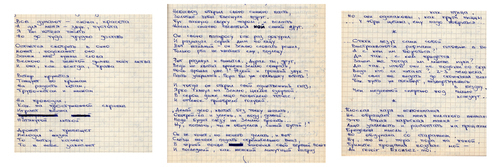
Everyone thinks - words, beauty
But for me it's - noises, empty
I would really want to write
But it's hard to reach right
I'm left with gazing out the window
Maybe it will tell me what to do
Why do I need words?
In the spring's green-glow leaves sing
Wind twirls
Dances on the rooftops
To the glee of cats,
Chimney sweepers and mice
On the wires,
Like on a feverish violin
Plays the spring
With a stretched linden tree
Trembles and shivers
The melody of life
Now it shakes a branch
Now it hangs in the sky
Sky opened its blue mouth
Golden teeth sparkled inside
Now the heat blew from the top
Started spitting, my blue friend
He just finished smoking his cigar
Smeared grey smoke across his face
How naive - he decided to eat Earth
Only his mouth is way too small
Opened his mouth, trying. "You fool,
You won't have time to devour Earth
Night is over!" A loud screeching noise
He closed his mouth. How about sun?
Then he opened his only eye
Brightly glanced at Earth, silly cyclope
In grey fog, his face turned light
And acquired a turquoise tone
"Do your thing, stop doing nonsense
Warm greenery and water, come on,
Spill some tears on the Earth...
Cry some, you sorry blue guy!"
He doesn't want to, but what else? Oh,
There are tears falling fiercely down
Into black mounds, ending first flight
And their last, like a woman's caprice
Poems are pushing themselves out
Marching in rhymes, ready for war
But whom will they fight?
Ah, anyone they can find
Why do they need extra suffering?
Ah, just do they won't die of boredom
Who reads them? 2-3 people
They won't see light till end of time
Let them die then, fall into abyss
Rather then vanish slowly under dust
Flat face of incomprehension
Doesn't pay me any attention
It's such facial mania
Spits in your face and stomps goodbye
What crazy thought
But it's thought through thoroughly
Well then, it's time for sleep
Take my goodbye sweep
Au revoir. Excusez-moi.
May 18, 2013
MINIMIZE interruptions while writing
Photo by Sarah Ann Wright
Once upon a time while tweeting (of course, what else?) I've been asking people what they want me to blog about next, and the topic of interruptions came up. Namely, one of my Twitter followers, Bridget, asked me to write about how to minimize distractions and interruptions like the Internets and such, and although my typical answer to this is, turn it off, silly, there is much more to that than simply turning off your Internet. I'm by no means a time management expert, but I'll share here you with you what I do and how it helps me, and perhaps it will help you too. Because I had to learn it the hard way, by trial and error and through tears and tearing out my hair in frustration. My methods are as follows.
Turn off everything, and I mean, EVERYTHING. Literally, when I start writing, not only do I close all my browser windows except Pandora (gotta have my music), I also turn off my mobile phone and don't pick up home phone if it's ringing. Kids in the house have been trained not to knock on my door while I'm writing, unless it's an emergency. If I come out to grab a snack or a glass of water, they know not to talk to me. I do have a connection to the real world, in case something happens, as in, true emergency, when my family needs to reach me. They can reach me through my boyfriend who is always on Skype with me while I'm writing, so he can let me know if something is going on. And that is the only window into any human contact that I leave open. Even there, we don't chat much, it's mostly me either whining that my writing is shit (and him yelling at me that it's not, usually takes him 3 to 4 lines in ALL CAPS to shut me up), or it's me asking him questions about something technical, like cars or motorcycles or some other gadgets I'm writing about. That's it. The other most important part to this is, I lock myself up like this for at least for 4 hours straight. I don't allow myself out of the room until I either do 2,000 words or 4 hours of writing. I don't check my text messages. I don't look at my email, don't skim through Twitter updates. Nothing. Nada. I keep my mind clear of it. Why? Because. Let me illustrate my second point.
Protect your train of thought like it's your life. When you write, you pull ideas out of you by association. One thing leads to another, leads to another, until they form a kind of translucent imagination web in your mind that allows you to wander into it and record what you're seeing. The problem is, this web is very fragile. In fact, it's terribly fragile. A single word can kill it. A single knock on the door can break it and send the rest of your ideas tumbling to the ground in a mess that you won't be able to untangle later. If you have a mess left. Typically it leaves you completely blank, with all this beautiful stuff gone, your face puzzled. A second ago you had a whole story in your head, and now you have nothing. It's empty. This kills your flow. A simple phrase like, Mom, I lost my jacket! turns your attention to the jacket and breaks your concentration. Puff! It's gone. You can kiss your writing time goodbye. It's extremely hard to be able to pull yourself back together after an interruption, and it's extremely hard to write in short little bursts (it's why writing retreats are booming). This is why so many writers are excited when their writing seems to flow. You know why it flows? Because they finally were able to focus on it, that's all. That's why it's important to have a writing cave, be it as little as your closet, as long as you can shut the door on the world. If you can't do it, it will be very hard for you to battle the world and produce anything at all, because the world will insist on interrupting you and wreaking havoc.
Learn how to say no, and say no every day. I'm one of those people that doesn't like saying "no". I want to help people, I want to interact, it's extremely hard for me to decline any kind of request, so this was the hardest lesson for me to learn. Because I had to. I had to tell no to parties, to dinner invitations, to emails, to offers of promotion, to... many more things. In short, I had to clean up my social life and my life in general, to be able to create a quiet space for me to write. 4 hours every day is a long time. 4 hours in the middle of the day, when people like calling you, and emailing you, and talking to you, is a very long time to stay hidden from them. People will be pissed. People will demand an answer from you right away. People will bang on your door, and it's your job to let them know that you're busy. Without any explanations, without any interactions. Because interactions will suck out your creative energy. You have to learn to respond with a simple NO. Why can't you go with me to this party? Come on, let's go! NO. Why not? Because I said NO. But explain it to me! Because I said NO. But so-and-so will be there, and what kind of a friend are you anyway, if you're... I'm sorry, I'm busy, my answer is NO.
Make the world evolve around your schedule. My entire life I spent my time according to other people's schedules. When someone would ask me to meet for coffee, I would always ask in return, what time would you like to meet, where? And then I would arrange my life around that request, to accomodate the time that is not convenient for me, to go to a place that is difficult to get to and will lose me more time. It never even crossed my mind that I did it, until I started writing. Because all of a sudden these invitations to meet and chat started distracting me from my work, and I felt increasingly uncomfortable adjusting my schedule to other people's schedule, until one day I realized that all of this diddling-daddling is depriving me of my precious writing time and energy, with its constant interruptions of my daily routine flow. And routine is very important to producing art, no matter what anyone says (yell at me here all you want), it's like a safe boundary where your creative genius can feel safe and start blooming. Unless you create it, it won't bloom, won't grow, afraid to open up and be interrupted. It's a fragile thing, it needs to be protected. Human drama will kill it in no time. It's only by sheltering yourself from any interaction that you'll be able to tap into your inner self fully. Of course, as time goes by, you will learn to be more flexible. For example, I can hold my thought mid-interruption better now than 1 year ago, when I was only starting. Still, it's very hard for me. I imagine, it's very hard for you as well.
So, the conclusion to this is... BECOME A HERMIT! And ignore anyone who tries to stop you.
May 15, 2013
ROSEHEAD excerpt, Draft 1
It seems like I started a fashion of posting excerpts to my novels on my blog, with SIREN SUICIDES Draft 4 excerpt and SIREN SUICIDES Draft 5 excerpt. Well then, by popular demand (after asking my Twitter followers), here is an excerpt to ROSEHEAD, 2nd novel that I started writing this Monday, so 2 days ago. Meaning, this is an excerpt from unedited Draft 1 (please forgive mistakes and such). On 1, 2, 3...
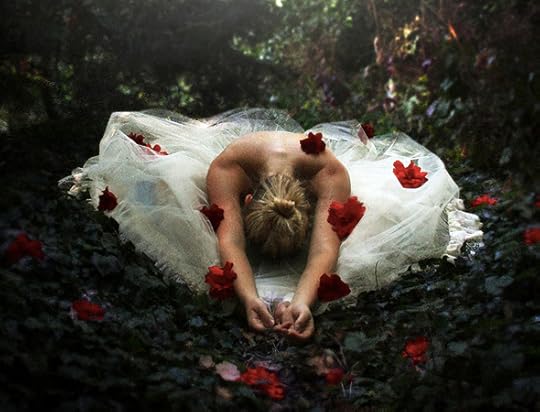
Photo by Rosie Kernohan
ROSEHEAD
A novel by Ksenia Anske, Draft 1
Chapter 1. Arrival
The garden reeked of rotten sweetness as if the roses were not blooming, but rather decomposing in the heat. The sea of them, like a hungry red tongue, licked the west side of an enormous white mansion, forming a spectacular dead end. On its east side scores of linden trees framed the sky in a lacquered pattern of green. As far as the eye could see, the entire road was planted with these trees, which confirmed the name on a tall post, Lindenstrasse in German. Lilith Bloom wrinkled her nose and pushed the button to roll up the car window, having a peculiar feeling that once she steps into this house, she won’t be able to get out. It will swallow her whole and smack its lips in the process. Goodbye 8th grade, goodbye ballet lessons, goodbye books. She shuddered, feeling frozen despite the hot weather.
“Panther.” Lilith whispered. “Panther, wake up.” She reached out and urgently shook a black curled up shape on the back seat to her left, warm from the sun. The shape shivered and yawned, revealing a long pink tongue and rows of pearl-white teeth, then promptly sat up, looking up expectantly at his mistress. It wasn’t exactly a dog, not in the most typical sense of how one would describe it. It was rather a cat in a dog’s body, an independent creature with lithe movements and a mind of his own. In one word, a whippet, Lilith’s pet and best friend. Faithful, smart, and, as Lilith would ascertain her parents, a talking one too. Of course, they refused to believe her.
Panther was the runt of the litter. Lilith’s father, Alexander Bloom, or Al for short, was a whippet breeder and he gave Panther to her for her 12th birthday last year. That was back in July, in her hometown in Massachusetts. Now it was June, and they just arrived to Germany this afternoon and drove up to her grandfather’s house on the outskirts of Berlin, for a grand Bloom family reunion.
“Does it stink to you too?” Lilith asked Panther to confirm her suspicions. Panther tipped his head to the right, blinking his black jewel eyes. He didn’t dare talking in front of her parents, lest they decide to take him away and show him off to their whippet breeder friends like some otherworldly miracle.
“I thought so.” Lilith palmed the end of her skirt.
“Well, we’re here.” Her father professed, without glancing back, turning off the car engine and pulling up the parking break.
“Did you take your pills?” That would be Lilith’s mother, Gabrielle Bloom, swiftly twisting in passenger seat and gazing through metal-rimmed glasses with her typical demand, her fingers in a momentary pause from constant knitting.
Lilith rolled her eyes. “Pills are for sick people, mother.”
“Well, did you?” Her mother insisted, her lower lip beginning to tremble slightly. Overall, she looked like a lost bird perched on top of a roof, not knowing whether she wants to take off and fly towards summer or stay and nest for winter, risking to freeze off her feathers and talons and such. Her greying brown hair stuck out this way and that in a sort of an artistic halo, and she liked sticking in her knitting needles behind her ears where they would stay and sometimes drop into the frying pan while she was cooking dinner.
“Lilith, answer your mother.” Her father demanded, without turning his head, rummaging in his pockets.
“I flushed them down the toilet in the airplane. They looked like two tiny boats in an excruciatingly blue liquid.” Lilith said with an innocent face. She liked using sophisticated words like excruciatingly, especially when annoying her parents.
“Al?” Gabrielle addressed Lilith’s father.
He only shrugged his shoulders, without looking. “Oh, Gabi, no use for worry. She can skip a day, can’t she?”
“Lilith!” What followed was a frenzy of activity, her mother’s hands performing an intricate dance of pulling out her bag, stuffing rolls of wool into it, her half-knit sweater, a bunch of needles, and then rummaging for the vial of pills.
Lilith and Panther exchanged a glance, suppressing a collective giggle, as much as you can imagine a dog giggling.
Next, her mother stuffed a small translucent cylinder into her daughter’s hands and watched her reluctantly open it and take out two bright blue capsules.
“Now.” Her mother said, and Lilith obediently stuck two pills under her tongue, with the intention of spitting them out as soon as she stepped out of the car. Which her father did already, slamming the driver’s door carelessly and stretching out his legs.
Here we can take a good look at him, tall and awkward and scrawny, kind of like a whippet himself. You know how they say, show me your dog, and I will tell you who you are? Yes, like that. His mess of black hair matched the shade of Panther’s black fur exactly, not a single silver line in it, contrary to his wife of fourteen years. His left shoulder was higher, right shoulder lower, his neck long, and his head small, balancing on the very tip of it. He wore beat up jeans and an old polo shirt, with dog hair all over it, from hugging and kissing and squeezing his 7 whippets, oh, about 20 hours ago, upon departure to the airport and giving last instructions to Missis Parks, a neighbor and an avid dog lover who would be taking care of the litter for three weeks that the Bloom family was gone.
Lilith patted Panther, and with words, “Come on,” opened the car door and stepped onto gravel, promptly covering her nose and coughing into it.
“It smells wonderful, doesn’t it?” Her mother exclaimed, and hurried off to open up the car trunk and take out multiple bags. Lilith and Panther exchanged another glance, now standing in the middle of a neat oval-shaped plaza, covered with gravel and packed with cars of all types, Bloom’s rental Audi being the very last.
Now is a good time to take a look at Lilith herself, a slender and petite for her age twelve year old girl about to turn thirteen, sporting an indigo pleated skirt, a white-blue marine shirt, striped knee socks, and black patent-leather mary-janes, with which she energetically ground two pills into dirt, having just spit them out. Her head tilted, she fetched a stray hazel lock and tucked it behind her ear, straightening her ruby knit beret, the one her mother knit for her. She had a collection of those, white beret for going to ballet lessons, black one to take Panther on walks, blue one for reading, lavender one for gazing at the clouds, and ruby one for special occasions. For festive outings which rarely happened, and so it was a big deal for her to be able to wear it now, covering up the top of her head and making her dark-blonde shoulder length hair attain a special shine. Her freckled nose sat between two huge blue eyes, forever open in wonder or daydreaming. Her lips were always parted, as if ready to utter something yet not sure of themselves, doubting, and falling silent in the end.
She dragged out her knit bag and slung it on her shoulder. Her mother made it as well, from navy wool, shaped like a messenger bag, which held a few useless now dollars inside a dog-shaped wallet, a plane ticket, a passport, a pack of Kleenex tissues, a few dried flowers forgotten in one of the pockets, a lip balm, a light pink leotard, tutu, tights, and ballet slippers, for emergency ballet training, a journal with a pen stuck between pages, and a book. Always a book. Presently it was Sir Arthur Canon Doyle’s The Hound of the Baskervilles, a corner bent on page 9.
***
Well, what do you guys think? I'm dying to know.


