Nihar Suthar's Blog, page 2
October 13, 2016
Navigating an Age of Anxiety
According to Dr. Karl Albrecht, current times are the “age of anxiety.” We constantly feel pressured, having to meet one deadline after another. Stress has been proven to be the number one killer in today’s world. It affects all of us, regardless of what language we speak or where we live. Let me tell you a story before I continue:Once, there was a man from a small village…nothing extraordinary about him, he was just a common man. He peacefully slept under a tree. It was a picture-perfect scene: the temperature outside was just right, the sun was peeking through the loosely woven leaf curtain above; the tree provided much soothing shade and a soft breeze gently touched his cheek. A traveler from the big city happened to be passing by and saw him. Appalled to see this display of laziness in the middle of the day, he went straight to the villager and kicked him awake.“Hey you, wake up!” he shouted.The villager was confused. “Who, me?” he asked.“Yea, you! Wake up!” yelled the traveler.“Why? What’s the matter?” asked the villager.“Why aren’t you working?”“Why would I be working?”“So that you can make money,” replied the city fellow.“And then what?” questioned the villager.“Then you make even more money, of course,” yelled the traveler as he was beginning to get impatient.“And after that?”“Once you have enough money, you can start a business.”“How will starting a business help me?” wondered the local.“Owning a business will bring you prestige, obviously.” said the traveler.“And why would I want prestige?”“If you have money, a business, and prestige, then you will find a beautiful wife,” predicted the traveler.“And then what?” pushed the villager.“If you have money, a successful business, prestige, and a wife, then you can buy a big house.”“Why do I need a big house?”The traveler replied with great satisfaction: “If you have money, a successful business, prestige, a wife, and a nice home, then you can easily sleep in the home and feel very secure.”The villager, who had been sleeping earlier, stopped to think for a moment. Then, he candidly said: “Sir, that’s exactly what I was doing before you decided to kick me awake.” Why should the villager have to go through that entire cycle to get peace when he already had it? And why would the traveler feel it had to be otherwise? The truth is that we are products of this fast-paced society. From a young age, we understand that to be an adult is to be busy. Most of us have little voices inside our heads telling us we have to be doing something, all the time. There is a traveler just like the one in the story constantly poking at our minds, demanding that we be doing something, anything. We either get bored or feel like we are wasting time sleeping under a tree, like the villager.Additionally, the modern world is filled with expensive attractions at every step. Consuming is a large part of our lives, and being able to consume everything we like is a stress-generating issue - some would even call it a question of quality of life. We feel we have to be productive, by making and spending as much money as we possibly can. Just like in the story, in our minds, money ultimately translates to security, and that is what we long for. We go through life worrying about this or that, trying hard to earn money and prestige, and it’s tearing us to pieces.Stress slowly seeps into every aspect of our lives: nutrition, relationships, work, etc. It can even prevent us from sleeping...and sleep is one of the simplest human activities ever. We must learn to effectively manage our stress, or it can destroy us.Ultimately, I think we can do this by aiming to step into the shoes of the villager under the tree. Like him, we should take some breaks, reflect, and enjoy the peace that is right in front of us. This will restore our energy levels and allow us to see the world in a different perspective. While it is important to have goals and dreams, do not feel that youmustachieve every single one of those objectives before you can attain tranquility. Be wise, do your best, and make the most of the journey. If you waste all your energy before you even reach your goals, will you enjoy it the same?Make it a point not to get swept away in the currents of this fast-paced society. Work hard towards your visions, but take some time to discover the peace that already exists in front of you.
Why should the villager have to go through that entire cycle to get peace when he already had it? And why would the traveler feel it had to be otherwise? The truth is that we are products of this fast-paced society. From a young age, we understand that to be an adult is to be busy. Most of us have little voices inside our heads telling us we have to be doing something, all the time. There is a traveler just like the one in the story constantly poking at our minds, demanding that we be doing something, anything. We either get bored or feel like we are wasting time sleeping under a tree, like the villager.Additionally, the modern world is filled with expensive attractions at every step. Consuming is a large part of our lives, and being able to consume everything we like is a stress-generating issue - some would even call it a question of quality of life. We feel we have to be productive, by making and spending as much money as we possibly can. Just like in the story, in our minds, money ultimately translates to security, and that is what we long for. We go through life worrying about this or that, trying hard to earn money and prestige, and it’s tearing us to pieces.Stress slowly seeps into every aspect of our lives: nutrition, relationships, work, etc. It can even prevent us from sleeping...and sleep is one of the simplest human activities ever. We must learn to effectively manage our stress, or it can destroy us.Ultimately, I think we can do this by aiming to step into the shoes of the villager under the tree. Like him, we should take some breaks, reflect, and enjoy the peace that is right in front of us. This will restore our energy levels and allow us to see the world in a different perspective. While it is important to have goals and dreams, do not feel that youmustachieve every single one of those objectives before you can attain tranquility. Be wise, do your best, and make the most of the journey. If you waste all your energy before you even reach your goals, will you enjoy it the same?Make it a point not to get swept away in the currents of this fast-paced society. Work hard towards your visions, but take some time to discover the peace that already exists in front of you.


October 6, 2016
Creating Meaningful Connections
About a month ago, I got the chance to travel to Cuba. After having experienced everything there, I have to admit that the country is almost exactly as most people imagine it – famous vintage cars, endless salsa dancing, rich culture, and yes, insane affinities for Cuban cigars and rum. One area I don't think outsiders put much thought towards, however, is the lack of internet access in all of Cuba. The country is still developing, and as a result, there are only about 13 places to get access to internet across the entire island! The fact that internet was non-existent led me to make some interesting observations in my time there. First, I noticed that nobody spent an excessive amount of time on their phones or electronic devices. After all, what could they really do without internet? Most electronic device usage seems to revolve around the internet. Secondly, and more importantly, I noticed that every single family I stayed with would sit together at night and have hours of face-to-face time with each other, establishing meaningful relationships. This idea of face-to-face time is something that is fading away in the Western world today.In fact, according to recent studies byAttentivandCNBC, millennials are sending out more text messages and spending more time than ever on social media platforms communicating with each other, but talking at an extreme minimum in person (besides in the workplace, where millennials seem to prefer face-to-face conversations).Is there a correlation between electronic device/internet usage and how much face-to-face time we spend with each other? After my Cuban adventure, this is what I decided to find out…and as I suspected, there is indeed a connection. Before analyzing the link, though, I found it important to first understand the growth of both electronic devices and the internet. According to the2013 United States Census, 84% of households report owning a computer. Approximately 75% of all American households have access to the internet as well. This latter number was at a mere 18% when the government originally started including internet usage questions in its 1998 census.Thus, there has been a drastic increase in both electronic device and internet usage over the years. In fact, as of 2013,about 90% of Americans report owning a cell phone, while for people under the age of 44, that number is closer to 97%. The younger generation accounts for some of the highest internet usage, with teenagers spending more than an average of 27 hours a week just online.With this background information, I decided to explore how internet usage specifically affects face-to-face communication. I started off by surveying 100 random respondents in Boston, Massachusetts. All 100 people I surveyed owned either a cellphone or tablet, with approximately 55% saying that they spent more than four hours per day on that device (much of which time they reported to be on the internet). About 15% of respondents even confessed to using their cellphones and tablets to access the internet for more than eight hours a day.The most important questions from the survey in my opinion, however, were:1. Do you believe that the presence of technology (including the internet), while spending time with other people, affects face-to-face communication negatively?2. Do you notice a degradation in the quality of your conversations amongst the presence of technology (including the internet)?The responses pointed towards a clear consensus. For the first question, about 90% of respondents felt that the presence of technology (including the internet) negatively affected face-to-face communication, while 5% felt it did not, and 5% were unsure. In regards to the second question, about 80% felt there was indeed a degradation in the quality of their conversations with technology, while 13% did not think so, and 7% were unsure. The 13% that did not believe there was a degradation in their conversations with technology felt that electronic devices often instead stimulated their conversations (being able to look up certain topics on the internet to supplement a conversation, etc.).In addition to the survey questions, I also observed many of the respondents to see how they acted around others when using their phones and on the internet. There were a few moments that stuck out. Once, I noticed two people accessing social media on their phones, while eating lunch across a table from each other. They sat in silence, paying no attention to each others’ presence. On another instance, I saw a person using his phone to Skype. As he was Skyping, one of his friends walked by and greeted him, only to be ignored. I’m sure many of us have witnessed similar such occasions.So, from the responses and observations above, it does in fact seem to be true that electronic device and internet usage is negatively affecting face-to-face time today; but what does this actually mean? And what should we do about it?Just to be clear, I am in no way telling you to stop using your electronic devices altogether or cut off every possible connection from the internet. What I am suggesting, however, is that maybe we should consider limiting non-productive electronic device and internet usage. While Cuba may lag behind modern times when it comes to technological infrastructure, it seems to be years ahead when it comes to face-to-face communication and establishing meaningful relationships. It’s possible, after all, to learn something from everybody in this world. Maybe we can learn the beauty of what a little time away from our electronics/internet can do, courtesy of the Cubans.
The fact that internet was non-existent led me to make some interesting observations in my time there. First, I noticed that nobody spent an excessive amount of time on their phones or electronic devices. After all, what could they really do without internet? Most electronic device usage seems to revolve around the internet. Secondly, and more importantly, I noticed that every single family I stayed with would sit together at night and have hours of face-to-face time with each other, establishing meaningful relationships. This idea of face-to-face time is something that is fading away in the Western world today.In fact, according to recent studies byAttentivandCNBC, millennials are sending out more text messages and spending more time than ever on social media platforms communicating with each other, but talking at an extreme minimum in person (besides in the workplace, where millennials seem to prefer face-to-face conversations).Is there a correlation between electronic device/internet usage and how much face-to-face time we spend with each other? After my Cuban adventure, this is what I decided to find out…and as I suspected, there is indeed a connection. Before analyzing the link, though, I found it important to first understand the growth of both electronic devices and the internet. According to the2013 United States Census, 84% of households report owning a computer. Approximately 75% of all American households have access to the internet as well. This latter number was at a mere 18% when the government originally started including internet usage questions in its 1998 census.Thus, there has been a drastic increase in both electronic device and internet usage over the years. In fact, as of 2013,about 90% of Americans report owning a cell phone, while for people under the age of 44, that number is closer to 97%. The younger generation accounts for some of the highest internet usage, with teenagers spending more than an average of 27 hours a week just online.With this background information, I decided to explore how internet usage specifically affects face-to-face communication. I started off by surveying 100 random respondents in Boston, Massachusetts. All 100 people I surveyed owned either a cellphone or tablet, with approximately 55% saying that they spent more than four hours per day on that device (much of which time they reported to be on the internet). About 15% of respondents even confessed to using their cellphones and tablets to access the internet for more than eight hours a day.The most important questions from the survey in my opinion, however, were:1. Do you believe that the presence of technology (including the internet), while spending time with other people, affects face-to-face communication negatively?2. Do you notice a degradation in the quality of your conversations amongst the presence of technology (including the internet)?The responses pointed towards a clear consensus. For the first question, about 90% of respondents felt that the presence of technology (including the internet) negatively affected face-to-face communication, while 5% felt it did not, and 5% were unsure. In regards to the second question, about 80% felt there was indeed a degradation in the quality of their conversations with technology, while 13% did not think so, and 7% were unsure. The 13% that did not believe there was a degradation in their conversations with technology felt that electronic devices often instead stimulated their conversations (being able to look up certain topics on the internet to supplement a conversation, etc.).In addition to the survey questions, I also observed many of the respondents to see how they acted around others when using their phones and on the internet. There were a few moments that stuck out. Once, I noticed two people accessing social media on their phones, while eating lunch across a table from each other. They sat in silence, paying no attention to each others’ presence. On another instance, I saw a person using his phone to Skype. As he was Skyping, one of his friends walked by and greeted him, only to be ignored. I’m sure many of us have witnessed similar such occasions.So, from the responses and observations above, it does in fact seem to be true that electronic device and internet usage is negatively affecting face-to-face time today; but what does this actually mean? And what should we do about it?Just to be clear, I am in no way telling you to stop using your electronic devices altogether or cut off every possible connection from the internet. What I am suggesting, however, is that maybe we should consider limiting non-productive electronic device and internet usage. While Cuba may lag behind modern times when it comes to technological infrastructure, it seems to be years ahead when it comes to face-to-face communication and establishing meaningful relationships. It’s possible, after all, to learn something from everybody in this world. Maybe we can learn the beauty of what a little time away from our electronics/internet can do, courtesy of the Cubans.
August 9, 2016
Chasing Your Passions
All of us have a passion (whether it’s cooking, playing musical instruments, or flying planes). These obsessions are at their summits when we are young and have the abilities to dream as freely as the wind. However, somewhere around the time where we enter high school, the craze over our passions fizzles out...not because we are no longer obsessed, but because we are told by others around us that we must start thinking “realistically about our lives.”Suddenly panicking that going abroad to Asia to teach will be too difficult, or moving to New York as an actor will be too financially burdensome, we sweep away our lifelong passions in favor of traditional paths that will satisfy others and help us fit into the world. Do not get me wrong – there is absolutely nothing wrong with following an established path, such as becoming a lawyer, accountant, or engineer. If that is your calling, then excellent! There is, however, a problem when we give up our actual obsessions or dreams in lieu of those established careers. This is what is happening too often today.Following your passion may seem difficult or daunting, especially since there is uncertainty associated with it. Normal careers are secure and stable. My ultimate message, though, is that if you build a resolute determination to shoot for your calling, no matter what, it is possible to make it a reality. You do not have to give up your passion to go down traditional paths where you are unhappy. There is a way. You may have to be more creative or resourceful to discover it, but there is always another way.Let me tell you a story about Andre Ozim. He was born in a small town in Oklahoma to a Nigerian mother, before moving to Washington DC. As Andre grew up, he lost himself in various sky-high dreams. However, as he got to high school, he was shoved, like many of us, into taking up something “reasonable,” like law. Andre ran with it. He got an internship as a paralegal in Washington DC. For some reason, no matter how hard he tried, he could never feel fully happy being a paralegal. He wanted to do something else, but had no idea what. Many of us in this situation would likely stick with the paralegal job and just forget about those feelings of unhappiness.In the famous words of Robert Frost, Andre took the “road less traveled.” One day, he got so fed up with his internship that he simply quit. He had about $40 total to his name. With that money, he decided to go out and discover his passion. How, you ask? He jumped on a bus towards one of the hotbeds for inspiration – New York City. Having just $40 and not knowing anybody there, he began the search for his calling.Andre initially stepped into New York City as a model. Everybody around him encouraged him to try modeling, because they were sure that he would be great at it. However, Andre discovered that modeling was not for him. He spent time exploring his other talents. It took almost an entire year for him to find what excited him most…but he ultimately found it. After working on the set of Wolf of Wall Street and meeting Leonardo DiCaprio, Andre became curious about pursuing acting. He started small, by first listing himself on casting websites for student and independent films. It was not long before he got cast for his first short film,Land of Dreams(directed by Lionel Cineas). From there, Andre found what he was effortlessly talented at and what gave him deep satisfaction. He set himself on the path to acting. Today, Andre has already become a successful actor. He was one of the lead actors forJahar, a short film that was recently chosen for this year’s Tribeca Film Festival (2016). While there is still a long path ahead for Andre, he knows that he made the right choice. He will be happier as an actor than he ever would have been as a paralegal. Choose to be happy. Follow your passions instead of settling for an unattractive path that someone else urges you to take.
Today, Andre has already become a successful actor. He was one of the lead actors forJahar, a short film that was recently chosen for this year’s Tribeca Film Festival (2016). While there is still a long path ahead for Andre, he knows that he made the right choice. He will be happier as an actor than he ever would have been as a paralegal. Choose to be happy. Follow your passions instead of settling for an unattractive path that someone else urges you to take.
July 20, 2016
Nihar Suthar Featured in Darpan Magazine
The DARPAN Magazine team recently interviewed and featured Nihar Suthar as a global Indian author in its latest issue. DARPAN is a worldwide pioneer in the South Asian media. The magazine features inspiring South Asian role models and achievers who have made significant accomplishments in their respective fields and societies. Previously, DARPAN has highlighted highly successful people such as Dr. Sanjay Gupta, Kunal Nayyar, Padma Lakshmi, Noureen DeWulf, Lisa Ray, Sunita Williams, and many more.Find the feature on Nihar here:http://www.darpanmagazine.com/magazine/global-indians/introducing-nihar-suthar/
June 30, 2016
Changing the World
Many of us have grand visions of one day completely changing the world. With access to powerful modern-day resources, including the internet, cell phones, video conferencing software, etc., being able to do so is perhaps more possible than ever. I constantly hear stories about people, as young as teenagers, founding nonprofit organizations or inventing products that literally change the world. Just recently, I came across a 17-year old girl who designed a low cost, portable test for Ebola. Her
May 11, 2016
The Hypocrisy of Modern Civilization
Once, there was a young boy, who was barraging his father with many bizarre questions. "Dad, who is the boss of this house?" The father was caught off guard. "Well, son...I am the boss of this household." The boy nodded. "But, when you are at work? Who is the boss of this house then?" "When I am at work, your mother is of course the boss of this house," explained the father. "What about when mother is not home? Who is the boss of the house?" The father was trying his best to patiently answer
April 11, 2016
An Attitude of Never Quitting
I am currently in Toronto, Canada and quickly approaching the end of my book tour for The Corridor of Uncertainty. It is hard to believe that it is almost over. There are so many amazing experiences that I am sure I will never forget. Earlier today, in my free time, I decided to go explore the downtown Toronto area, near Dundas Square. While I was walking around, I noticed a homeless man sitting on the side of the street. There was something different about him. He wasn’t asking any pedestrians
March 1, 2016
Why the Land of Opportunity can be Dangerous
This past week, my book tour took me through Braeburn International School in Arusha, Tanzania. While I was there, I randomly started conversing with a man named Steve Ngugi, the head of boarding at the school. He taught me one important lesson that I think is a good reminder for all of us. The lesson that Steve got across to me was how important it is to be a genuine human. For those of you who are unaware, Tanzania today is considered to be a developing country. Almost every single person
February 7, 2016
Reflections on India
Just like that, my time in India has come to an end. As with any trip, the entire thing seems to have been a blur. I couldn't be more grateful for all the venues I got to speak at and the places I got to see. It was a great start to my book tour. However, after some reflection, here are the main points that I will remember forever about India. The relaxed culture - It's truly incredible how relaxed the people in India are. I feel like the people of the Western world are always stressed out,
February 1, 2016
The Corridor of Uncertainty - Internationally Released!
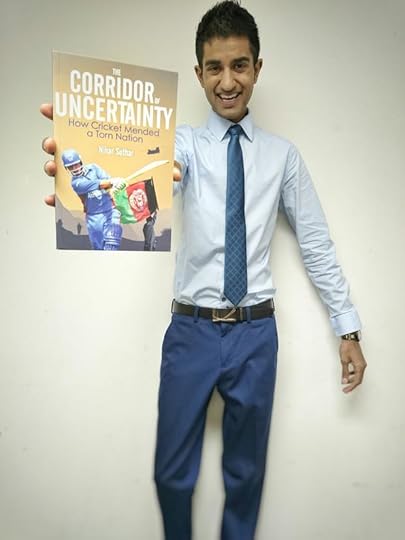
Press Release: In 1979, Afghanistan erupted into one of the most brutal civil wars ever. The fighting lasted almost a decade, throwing the country into a period of political instability, harsh leadership, and extreme danger. Hundreds of thousands of civilians died, and millions relocated to refugee camps. The rest of the world began to believe that violence would always define Afghans. However, deep in the refugee camps of Pakistan, displaced native Afghan children had a dream to unite their