Could not find Kindle Notes & Highlights for that user.
Nicholas L. Vulich's Blog, page 4
July 20, 2013
Baron Von Steuben at Valley Forge

Baron Von Steuben
A savior came to the army at Valley Forge in the form of a stubby, foul mouthed, Prussian drill master, Baron Friedrich Von Steuben.
The man chosen to whip America’s troops into shape didn’t speak a word of English, only German, and a smattering of French. Yet in less than six months he transformed Washington’s army into a well-disciplined fighting force.
A crazier sight was never seen.
Steuben trained the men in groups. He started with 100 men. When they were trained, he had them help train the other brigades. When things didn’t work out the way he wanted, which was often, he blasted the men with a string of curses in German and French. When he realized no one understood him, he got his aide Captain Benjamin Walker to curse them in English.
The local farmers were no help, either. Many of them held back cattle desperately needed by Washington’s troops hoping to make more money selling them in the spring. Others crossed the lines sneaking beef to the British in Philadelphia for a larger profit.
Of the 12,000 soldiers who went into winter quarters with Washington nearly a quarter died from disease, malnutrition, and the weather. A thousand more chose not to reenlist and returned home.
The only good news for Washington was the men who left Valley Forge with him were a better trained and more disciplined fighting force than any he’d had up until that point.
(excerpt from my new book - Bad Ass Presidents)








Duels of Andrew Jackson
 Andrew Jackson fought at least three duels in his lifetime.
His first duel took place in 1788. The twenty-one year old Jackson was ridiculed by Revolutionary war hero Waightsill Avery, and demanded satisfaction. Clearer heads took charge by the time they met to fight, and both men agreed to miss when they fired.
Jackson’s next duel was with Tennessee Governor John Sevier in 1802. Jackson, who at this time was a judge on the Tennessee Supreme Court, accused the ex-governor of dealing in forged land warrants. Sevier burst into his chambers brandishing a sword, and demanded satisfaction. The duel was scheduled to be fought in Virginia, but never took place.
Jackson’s final duel took place at Harrison’s Mill, Kentucky where he faced down Charles Dickinson. The men stood twenty-four feet apart. Dickinson fired first, putting a ball in Jackson’s chest. To his surprise Jackson barely reacted. Instead, he leveled his pistol, took deliberate aim, and shot Charles Dickinson dead.




[image error]
Duels of Andrew Jackson
Andrew Jackson fought at least three duels in his lifetime.
His first duel took place in 1788. The twenty-one year old Jackson was ridiculed by Revolutionary war hero Waightsill Avery, and demanded satisfaction. Clearer heads took charge by the time they met to fight, and both men agreed to miss when they fired.
Jackson’s next duel was with Tennessee Governor John Sevier in 1802. Jackson, who at this time was a judge on the Tennessee Supreme Court, accused the ex-governor of dealing in forged land warrants. Sevier burst into his chambers brandishing a sword, and demanded satisfaction. The duel was scheduled to be fought in Virginia, but never took place.
Jackson’s final duel took place at Harrison’s Mill, Kentucky where he faced down Charles Dickinson. The men stood twenty-four feet apart. Dickinson fired first, putting a ball in Jackson’s chest. To his surprise Jackson barely reacted. Instead, he leveled his pistol, took deliberate aim, and shot Charles Dickinson dead.

Zachary Taylor & The Defense of Fort Harrison

Defense of Fort Harrison in War of 1812
Zachary Taylor’s first test as a soldier occurred early in the War of 1812. No sooner had he taken command of Fort Harrison, a small stockade style fort on the Wabash River in Indiana, when a band of Indians from the Prophet’s town attacked.
The attack came about 11:00 pm. A shot rang out from a sentinel, and then a warning that the Indians had set fire to the lower blockhouse. Harrison ordered his men to water down the blockhouse to keep it from burning, and hurriedly built a breastwork so they could defend themselves when the Indians charged in. As daylight approached the defenders were able to return fire driving the Indians back.
When they discovered they couldn’t take the fort, the Indians faded away into the forests.
On the 16th the garrison was reinforced with six hundred mounted rangers and five hundred infantry led by Colonel Russell. Shortly after that Major General Hopkins arrived with another four thousand men.
On November 19th the army attacked the Prophet’s town, destroying everything – huts, cornfields, etc.
When he returned to Fort Harrison Taylor received notification President Madison had made him a brevet major for his services in the defense of the fort.




December 21, 2012
Elihu Root Secretary of War
By L. A. Coolidge
 Elihu RootIn July, 1899, President McKinley faced a serious problem. The war with Spain had been fought and won. Within the short period of a year the United States had accepted the responsibility for the present control and future development of Cuba, Porto Rico and the Philippines. The regular army of the United States under emergency legislation was more than double in size what it had been a few months before. Instead of being located at a few coast fortifications and a few frontier posts, it was scattered in active service over half the globe. The War Department had suddenly developed into the most important of all government departments, with tasks before it far transcending any questions of mere military administration. Almost unconsciously and as a matter of administrative convenience, the War Department had become responsible for the government of the islands which had formed the colonial dependencies of Spain—islands inhabited by millions of people of different races, religions, laws and traditions. It had become responsible for the proper inauguration of a new stage of national development—a task demanding great foresight great executive genius and extraordinary political wisdom. At that moment the Secretary of War resigned, and President McKinley found himself confronted with the necessity of choosing a successor.
The selection was one which could not be lightly made. The President recognized that no ordinary man could meet all the requirements of the position. It may be doubted whether he really expected to find a man who would be fully equal to the many exactions that would be made upon a new war secretary.
The best he could hope, after determining which of the functions of the department would be of greatest immediate importance, was to secure one who could be trusted to meet that pressing requirement. The most urgent question was that of the administration of the new possessions, involving as it did the preservation of order and the substitution of an American system of government for the mediaeval systems which had prevailed for centuries under the rule of Spain. For this task he concluded that he needed first of all a lawyer of preeminent ability. He selected Elihu Root.Read more »




[image error]
Elihu Root Secretary of War
By L. A. Coolidge
Elihu Root
In July, 1899, President McKinley faced a serious problem. The war with Spain had been fought and won. Within the short period of a year the United States had accepted the responsibility for the present control and future development of Cuba, Porto Rico and the Philippines. The regular army of the United States under emergency legislation was more than double in size what it had been a few months before. Instead of being located at a few coast fortifications and a few frontier posts, it was scattered in active service over half the globe. The War Department had suddenly developed into the most important of all government departments, with tasks before it far transcending any questions of mere military administration. Almost unconsciously and as a matter of administrative convenience, the War Department had become responsible for the government of the islands which had formed the colonial dependencies of Spain—islands inhabited by millions of people of different races, religions, laws and traditions. It had become responsible for the proper inauguration of a new stage of national development—a task demanding great foresight great executive genius and extraordinary political wisdom. At that moment the Secretary of War resigned, and President McKinley found himself confronted with the necessity of choosing a successor.
The selection was one which could not be lightly made. The President recognized that no ordinary man could meet all the requirements of the position. It may be doubted whether he really expected to find a man who would be fully equal to the many exactions that would be made upon a new war secretary.
The best he could hope, after determining which of the functions of the department would be of greatest immediate importance, was to secure one who could be trusted to meet that pressing requirement. The most urgent question was that of the administration of the new possessions, involving as it did the preservation of order and the substitution of an American system of government for the mediaeval systems which had prevailed for centuries under the rule of Spain. For this task he concluded that he needed first of all a lawyer of preeminent ability. He selected Elihu Root.Read more »

Wu Ting-fang
By L. A. Coolidge

His Excellency Wu Ting-Fang and Madame Wu
LEGATION OF THE UNITED STATES, PEKIN, Nov. 30, 1896.THE HONORABLE RICHARD OLNEY,Secretary of State,SIR:— I have the honor to inform you that Mr. Wu Ting-fang has been appointed Chinese Minister to the United States, and will probably reach his post in April next. He was admitted to the bar in London, practiced law in Hongkong, and for several years has been serving the ex-Viceroy, Li Hung-Chang, at Tientsin. He speaks English perfectly.Lo Feng-lu has been appointed Minister to England, Italy and Belgium. This gentleman was interpreter to Li Hung-Chang for many years and accompanied him on his recent tour. Yang-yu, present Chinese Minister to the United States, has been appointed Minister to Russia. Hwang Tsun-hsien has been appointed Minister to Germany. I have the honor to be, Sir,Your obedient servant,CHARLES DENBY.
Thus simply and formally was Wu Ting-fang, the present representative of the Chinese Government in Washington, introduced to the Government of the United States. There had been Chinese ministers before—all of them men of good ability; all of them men of high standing at home; and all of them so little in touch with the affairs of the country to which they were accredited, that they were regarded popularly as objects of curiosity - it is to be feared sometimes as objects of derision by the unthinking.
Read more »




December 20, 2012
Mrs. Stuyvesant Fish, New York Society Leader
By Charles Stokes Wayne
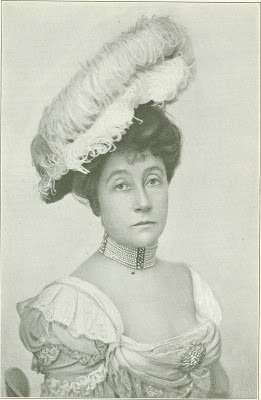
Mrs. Stuyvesant Fish
Mrs. Stuyvesant Fish, as the acknowledged leader of the spectacular element of New York society, occupies a uniquely conspicuous position. The little realm over which she rules is but a small part of the great social world; but it is set upon a hill. She and her subjects, engaged apparently in a continuous performance, are ever in the public eye. Their comings and goings, their routes and fetes, their loves and their aversions, their marriages and their divorces, the clothes they wear, the wines they drink, the pranks they play, the jests they utter, all are chronicled in the newspapers. The conservative old Knickerbocker and some of the new, but staid people, sneer at Mrs. Fish's followers, who, in return, only laugh and set about some new device of entertainment to excite the envy, even if contemptuous, of their detractors.
By force of her aggressive independence rather than by tact has Mrs. Fish attained to the sovereignty that is hers. Family and money have been efficacious aids in the process of elevation, but there are women of more distinguished ancestry and possessing greater income—women, too, of far superior diplomatic equipment – who have struggled in vain for the eminence that Mrs. Fish has reached without seeming effort; reached, in fact, while flying in the face of all precedent, in that she truckled to none, spoke her mind freely on all occasions, put no check on her incisive wit, was a law unto herself, dinner and made enemies faster than she made friends.
Tall, dark and florid, with a figure calculated to display to advantage the sumptuous adornment with which she provides it, Mrs. is distinguee rather than beautiful. Mrs. Fish's jewels are among the handsomest in New York. She does not affect a tiara, but wears in her hair a magnificent diamond spray. About her neck circles a collar of pearls three inches deep. Suspended from it in front, by a thread of diamonds four inches long, is a diamond cluster that, viewed across the horseshoe at the Metropolitan Opera House, looks like an enormous single stone. Extending diagonally down her corsage she wears a row of buttons of diamonds set around sapphires, each sapphire as large as one's finger nail. A festoon of diamonds from the left shoulder to the front of the corsage completes the display.Read more »




Mrs. Stuyvesant Fish
Mrs. Stuyvesant Fish, as the acknowledged leader of the spectacular element of New York society, occupies a uniquely conspicuous position. The little realm over which she rules is but a small part of the great social world; but it is set upon a hill. She and her subjects, engaged apparently in a continuous performance, are ever in the public eye. Their comings and goings, their routes and fetes, their loves and their aversions, their marriages and their divorces, the clothes they wear, the wines they drink, the pranks they play, the jests they utter, all are chronicled in the newspapers. The conservative old Knickerbocker and some of the new, but staid people, sneer at Mrs. Fish's followers, who, in return, only laugh and set about some new device of entertainment to excite the envy, even if contemptuous, of their detractors.
By force of her aggressive independence rather than by tact has Mrs. Fish attained to the sovereignty that is hers. Family and money have been efficacious aids in the process of elevation, but there are women of more distinguished ancestry and possessing greater income—women, too, of far superior diplomatic equipment – who have struggled in vain for the eminence that Mrs. Fish has reached without seeming effort; reached, in fact, while flying in the face of all precedent, in that she truckled to none, spoke her mind freely on all occasions, put no check on her incisive wit, was a law unto herself, dinner and made enemies faster than she made friends.
Tall, dark and florid, with a figure calculated to display to advantage the sumptuous adornment with which she provides it, Mrs. is distinguee rather than beautiful. Mrs. Fish's jewels are among the handsomest in New York. She does not affect a tiara, but wears in her hair a magnificent diamond spray. About her neck circles a collar of pearls three inches deep. Suspended from it in front, by a thread of diamonds four inches long, is a diamond cluster that, viewed across the horseshoe at the Metropolitan Opera House, looks like an enormous single stone. Extending diagonally down her corsage she wears a row of buttons of diamonds set around sapphires, each sapphire as large as one's finger nail. A festoon of diamonds from the left shoulder to the front of the corsage completes the display.Read more »
Naturalist John Muir
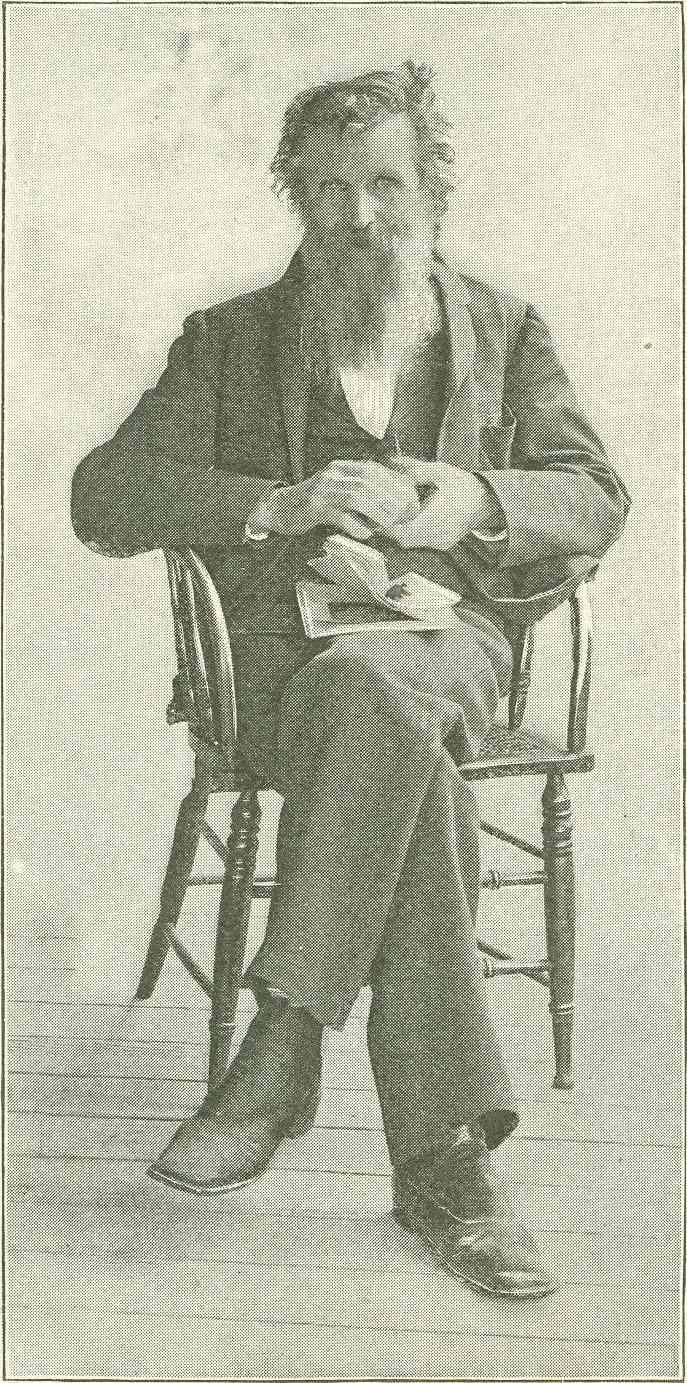 John MuirBy Adeline Knapp
A King of Outdoors: I know no other phrase that so aptly designates John Muir, naturalist, explorer and writer; nor do I know any man to whom the phrase is so applicable.
He has been styled "the Californian Thoreau," and Emerson, who knew and liked him, once went so far as to call him "a more wonderful man than Thoreau." It is doubtful, however, whether Emerson himself knew exactly what he meant by that rather impossible expression. The two men are wholly different in essentials of thought, so that it would be hard to institute any real comparison between them.
For twenty-five years John Muir has made out of doors his realm. For more than half this time he lived and wandered alone over the high Sierras, through the Yosemite Valley, and among the glaciers of California and Alaska, studying, sketching, and climbing. At night he sometimes rested luxuriously, wrapped in a half-blanket beside a camp fire; sometimes, when fuel was wanting, and the way too arduous to admit of carrying his piece of blanket, he hollowed for himself a snug nest in the snow. He is no longer a young man, but when last I saw him he was making plans to go again to the North, to explore the four new glaciers discovered last summer by the Harriman Expedition.
"What do you come here for?" two Alaskan Indians once asked him, when they had accompanied him as far, through perilous ways, as he could hire or coax them to go.
"To get knowledge," was his reply.
The Indians grunted; they had no words to express their opinion of this extraordinary lunatic. They turned back and left him to venture alone across the great glacier which now bears his name. So trifling a matter as their desertion could not deter him from his purpose. He built a cabin at the edge of the glacier and there settled to work, and to live for two long years. He made daily trips over that icy region of deep gorges, rugged descents and vast moraines, taking notes and making sketches, until he had obtained the knowledge, and the understanding of knowledge, that he was after. Muir Glacier is the largest glacier discharging into the wonderful Glacier Bay on the Alaskan coast. Being the most accessible one in that region, tourists are allowed to go ashore to climb upon its sheer, icy cliffs, and watch the many icebergs that go tumbling down from it. This is a thrilling experience to the globe trotter, but to dwell there beside the glacier, to study the phenomena, encounter perils, alone and unaided, is an experience that few besides John Muir would court.
Read more »




December 16, 2012
Admiral George Dewey at the Battle of Manila Bay
 Admiral Dewey on deck of Olympia at
 Battle of Manila Bayby Nick Vulich.
Other than Theodore Roosevelt, Admiral George Dewey was the biggest hero to come out of the Spanish American War.
His victory at the Battle of Manila completely took the world by surprise. All eyes were focused on the fighting in Cuba, when Dewey sailed into Manila Bay and virtually destroyed the Spanish fleet.
At 5:35 on the morning of May 1, 1898, Dewey let out those famous words, "You may fire when you are ready, Gridley!" The U.S. Asiatic Squadron commenced fire. The squadron first fired their starboard guns, then their port guns, while circling around the Spanish fleet.
Within six hours the entire Spanish Fleet under the command of Admiral Montojo was destroyed or captured. Dewey's losses were one dead, six injured. Spanish losses were 161 dead, 210 injured.
After the battle Dewey controlled all of the waters around Manila, but he did not have enough troops to engage the Spanish in a battle on land. Dewey soon received assistance from Filipino insurgent Emilio Aguinaldo and was able to hold off the Spanish until more American troops were sent to help.
Read more »