Brandon Ellis's Blog, page 4
January 27, 2015
Released – Star Guild Episodes 7, 8 & 9 and Episodes 1 – 9
The Star Guild Saga continues as Crystal McCoy, Admiral Byrd, Devon, Daf, and Eden try to navigate through the grand illusion that surrounds Star Guild. Who is really controlling the strings? Why have they been lied to for so long? What is Star Guild’s true history?
This has been a long awaited release by the editor and me. We worked our tails off for over six months to bring Episodes 7, 8 & 9 to you, along with a condensed version of Star Guild, aptly titled “Star Guild Episodes 1 – 9″. We had nothing but smiles on our faces when we were finished, excited to see what would happen next after we pressed the “publish” button on Amazon. In only a few days, and to our delight, we had one great review on each book — both 5 stars.
Both versions are great, but I’m mostly excited about the condensed version of Star Guild as it’s an amazing work of art. From the cover design to the story, my editor pulled out all of her magic to amaze me (and she amazed our proof readers, too). I’m telling you, without this editor, I don’t know where I’d be. She is amazing.
You can grab both books on Amazon. The covers of the books are below and under each cover is a link that will take you to that particular book’s product page on Amazon. There, you can read the sample and the description, and if you like what you read, then you can easily purchase a book and take delight as the saga continues to unfold.


Star Guild – Episodes 7, 8 & 9 Star Guild Episodes 1 – 9


June 4, 2014
Important Changes to Star Guild
My publisher, editor, and I have been in talks for months now about changing the way Star Guild has been published. We first thought that doing two episode Novellas in a fun, enterprising series would be an interesting venture. We crossed our fingers that the books would be a hit in this type of format. We have found that they are a hit, but not as big of a hit as we think they could be. We’ve found, from the reviews and other customer contact, that more episodes in one book would be much better, so we came up with another idea that will be giving two episodes away, for free, to people who have already downloaded and read Star Guild: Episodes 1 & 2 and Star Guild: Episodes 3 & 4.
Here’s what’s going to happen:
We’ve contacted Amazon and asked if they would do us a favor, which they generously agreed to do. They are going to let everyone who has downloaded the books know that there is going to be an addition to them. Star Guild: Episodes 1 & 2 are now going to be Star Guild: Episodes 1 – 3 and Star Guild: Episodes 3 & 4 are now going to be Star Guild: Episodes 4 – 6.
In this way, people are going to have more of the book to digest and enjoy, allowing them to get an even bigger experience while reading the books. It’s exciting because Amazon is helping us, and in a way, partnering with us, to allow us to enhance the story for the reader. And, I’m very grateful for it and I hope everyone will be happy to receive two extra episodes at no extra charge. I love giving gifts and I hope you, and everyone else, enjoys this one.
Amazon explains:
“…we will let customers know they can receive the update through their Manage Your Kindle page on Amazon.com at www.amazon.com/gp/digital/fiona/manage, it would be updated on the download they already have. If we find the quality issues in the earlier version are critical, we will also contact customers via email.”
If you have any questions, please feel free to email me at brandon@thepurelights.com and I’d be very happy to answer them.
Happy Readings…
Brandon
March 6, 2014
Why Free eBooks are Well Worth the Read
Never in my life would I think to write a book and then give it away for free. That would be insane and a waste of valuable time.
That’s what I used to think.
I published a book back in December of 2013 with the idea that I just wanted people to read it and what better way to entice people to read my book, then by putting it on Amazon for free?
So, I did. And, right off the bat, my book soared to the top of my science fiction category. Thousands of people were downloading it, reading it, and, according to the reviews I’ve received in my email and in my book’s review section on Amazon, it was well liked.
And, to think, FREE was an idea I previously looked down upon. I’ve won awards for my previous works and since some of the experts think that I’m talented, then I should be paid for it, right?
Well, to answer that question, I say, “The more you write, the more you learn. The more you publish, the more you find ways to get your books into reader’s hands, regardless of the price and effort.”
I have a passion for writing stories and, because so, I wanted to get my book into as many hands as I could — to the TRUE experts — YOU, the reader.
A year before I ever thought about writing a free book, I downloaded a free book on my kindle with the idea that since it was free, the author must be mediocre, the story must be terrible, and I would most likely be yawning throughout the book. It was free, however, and I couldn’t pass up FREE! My judgmental thoughts were wrong, not by a mile, but by a thousand miles. I found myself completely enthralled in the book. I simply could not put it down. In fact, I was staying up later than I usual did, just to see what was coming on the next page. The book was the first installment of Wool, written by Hugh Howey. I then bought the rest of the installments of WOOL thereafter. And, I laugh thinking about that, because I’m now one of Hugh Howey’s biggest fans. I not only purchased the rest of the series of WOOL, I purchased his other books as well, and they are all just as good! And, to think, it all started with a completely nonchalant click of Hugh Howey’s free download. In fact, I didn’t even know who the guy was at the time. Now, everybody knows him.
Since then, I’ve downloaded several free books from many other extremely talented writers. These writers aren’t well known. They don’t have any NY Times Best Sellers and they aren’t in many books stores either. They are, however, and in some cases, more talented than the big namers, which some of the big namers would agree with.
The writers offering books for free are authors that don’t have best sellers, but what I’ve found, is that they have best seller books. It’s just that they haven’t been discovered yet. Most of them are people I’ve never heard of and I’m an author who peruses author’s blogs, amazon categories, and peer website groups on a daily basis. Heck, I’m an author. Have you heard of me? Probably not.
And, like I said, I didn’t know these authors were talented until they offered me — a reader — a chance at their work at the amazing price of $0.00. They make nothing, nada, zip, zilch, and yet they give you, and me, their hard work and late nights to do what they love — make a story that someone else might enjoy. Two incredibly talented authors and their books come to mind right away when thinking about authors that give away a free book or books; India Drummond’s Blood Faerie, and Monique Martin’s Out of Time. I’ve since purchased the rest of their books in those series and loved every bit of them. I’m now hoping that more of their books will come out soon, so I can get my grubby eyes on them.
So, if you don’t know what I’m saying by now, then I’ll spell it out to you. The majority of free ebooks are excellent, well-written, and full of the author’s soul-filled heart.
I’m also saying it would be wise to give an author that is gifting you a free book, anywhere, some of your valuable time, because they deserve it.
Here is one reason why — I have three children, a full time job, a loving partner, and animals to take care of. Once the kids are sleeping, and the animals aren’t needing my attention anymore, and after I’ve spent quality time with my partner, I then get to my writing. I could be up late, like I was last night, only getting 3 hours of sleep, then heading off to work the next day. So, once I complete a book, get it edited, proof read, design the cover art, and then publish it, we’ve put all of our heart, body, and mind into it. We are rewarded when we see that someone has downloaded it, liked it, and has written a 5 star review. This is why we write, free book or not.
And, so, here I am with a free book that I placed on Amazon just before Christmas — December of 2013. It’s called, “Star Guild: Episodes 1 & 2“. It’s been edited, proof read by my proof reading community, re-edited, re-proof read, and edited again, over and over, just to make sure that it is as perfect as can be.
So, please, go check it out and if you like what you see, then grab a copy. It’s free. Click on the link below:
My second installment to that series is up as well, and though it isn’t free, it’s .99 cents of passion, hard work, and fun.
I hope you enjoy them.
- Brandon
www.brandon-ellis.com
February 28, 2014
A Little Off Kilter from the Norm
Usually I like to write about … well … writing. However, something grabbed a hold of me the other day and shook a little bit of rage in me. That something was, and is, snopes.com — a website created, according to their website, to be “the definitive Internet reference source for urban legends, folklore, myths, rumors, and misinformation.”
The problem is that sometimes they just don’t do their research. Something I’ve found on several occasions. One such occasion I found a couple of days ago about a topic we all know about, ADHD, and another topic that we know little about, Dr. Leon Eisenberg, the first to diagnose and name the disease.
Here’s what’s a little off kilter with snopes.com.
They seem, on many occasions, to use their own opinions, rather than fact.
One such occasion is below:
I’ve been a health researcher for over 15 years. I’ve done extensive research on vaccines, nutrition, medications, diseases, mortality rates and their reasons, ADHD, and much more. When it comes to ADHD, I, like the inventor of the disease, Leon Eisenberg, find it over diagnosed, mislabeled, and virtually made up. It’s a dangerous diagnosis, as well. A 2 year old that is put on Ritalin, for example, is using a drug that is in the same exact class as cocaine. It has the same effects as cocaine, made to over stimulate the brain, which consequently makes the brain relax from “over stimulation”. Heck, Ritalin is even being used by cocaine users themselves, as it has the same identical stimulant and downer effects as cocaine.
The inventor of ADHD, Leon Eisenberg, an MD, gave the first diagnosis of ADHD back in 1968. It, then, according to Leon Eisenberg, ran like wild fire, being diagnosed left and right. In 2009, Leon gave an interview with a German magazine called Der Speigal. In the article, Leon said (in German): “ADHS ist ein Paradebeispiel für eine erfundene Krankheit “, sagte Eisenberg. “Die genetische Veranlagung für ADHS ist völlig überbewertet.” When I put the words above through a German to English translating software program (in fact, I put the entire article through the program) it translated: “ADHD is a prime example of a fabricated disease,” Eisenberg said. “The genetic predisposition for ADHD is completely overrated.”
Fabricated means “made up” or “a lied about”. Simply put, Leon Eisenberg made up the disease, which I’ve heard from many psychologists, psychiatrists, MD’s, and DC’s for years. Some I’ve worked with, others I’ve listened to in talks, seminars, and/or on the radio. They simply can’t believe ADHD is still being diagnosed.
Here is where snopes.com put me into a grumpy mood. Sometimes, either to their knowledge or not, it seems that they make up “stuff” to fuel their point or their website’s agenda. And, the problem is, I don’t know why. Sometimes I wonder if they are a government website posing as a third party website, but I could be completely wrong. The website claims that it ”is (and always has been) a completely independent, self-sufficient entity wholly owned by its operators, Barbara and David Mikkelson, and funded through advertising revenues.”
In the case with Leon Eisenberg and ADHD, snopes.com said that “allowing for the vagaries of translation and reading the statement in context, some native German speakers have reported that Dr. Eisenberg wasn’t asserting that ADHD isn’t a real disorder, but rather that it is over-diagnosed.”
Which Native German speakers are you referring to? Because, they have either told you an untruth, or you never presented this to a German speaker. Dr. Eisenberg WAS asserting that ADHD wasn’t a real disorder in this magazine article. How do I know this? Well, I happen to be friends with a native German. When I sent her this quote: “ADHS ist ein Paradebeispiel für eine erfundene Krankheit “, sagte Eisenberg. “Die genetische Veranlagung für ADHS ist völlig überbewertet.” She told me that it said, verbatim, “ADHD is a prime example of a fabricated disease,” Eisenberg said. “The genetic predisposition for ADHD is completely overrated.” There was no difference between her translation into English compared to the translation software I used. On the other hand, snopes.com says that there is a difference.
Snopes likes to put “some” or “experts” into their articles and posts. The problem is, who are these “some” and who are these “experts”? It would be nice if they gave reference to them for their growing audience to read.
Again, Leon Eisenberg did say that “ADHD is a prime example of a fabricated disease…”
Because snopes.com puts doubt in the truth and accuracy of the statement above, it almost automatically puts doubt in the minds of the reader — the American people. Snopes.com is a reputable website that has the ability to change the mindset of a person, even if their own investigation on the subject is inaccurate, which I’ve found on several occasions, including this one.
So, if I could find this tidbit about the correct native German translation so quickly — that there was absolutely no difference between native German and the software translator for the quote above — then why couldn’t snopes.com do the same? Why did they say that “…some native German speakers have reported that Dr. Eisenberg wasn’t asserting that ADHD isn’t a real disorder, but rather that it is over-diagnosed.”
Again, who are those “native German speakers” that you’re referring to? I found the truth in ten minutes by finding a native German speaker to translate the German from the article into English, and also found that when I used a software program that translated German to English as well, it translated exactly how my native German friend did. No difference.
Snopes.com gave an inaccurate statement, plain and simple. The challenge, now, is that everyone will agree with snopes.com without doing their own research and this piece of history where Dr. Leon Eisenberg spoke of the true nature of ADHD will be forgotten, or worse yet … changed … though, hopefully not forever.
January 27, 2014
How and Why Hugh Howey Became My Hero
It was long ago that I decided to become an author. In fact, I had my first book published when I was in 8th grade. A fun little book called, Penguins on Pluto. It was published in a national school book that I forgot the name of. The last time I saw that book, the one where Penguins on Pluto was published in, was in high school. A teacher opened up this giant, thick book that had a lot of published books in it, flipped to a certain page, pointed at it and asked, “Is that your book?” I looked at him, shy-eyed as I was, and said, “Yeah.”
That was the extent of our conversation and the last memory of that thick book.
Years later, when I was 19 and heading into my sophomore year of college, I prayed my ultimate prayer–hands together, closed eyes, chin pointed to heaven. “Dear God, please make me an author one day. I want to be an author. I will be an author.” Weird prayer, I know. But, that’s how I did it–if I’m remembering it correctly.
Fourteen years passed me like a train whizzing by a train station.
So, when I was 33, I decided to write my first novel. I sat down, wrote to my hearts content, and finished a book. I titled it, The PureLights of Ohm Totem.
Writing it was a blast. I was writing at the peak of the metaphorical imagination mountain and I wasn’t looking down. When I self-published The PureLights of Ohm Totem I was in front of my computer screen at 4 am in the morning, ready to click “Publish” (on Amazon), closing my eyes, imagining love, light, laughter, and a lot of readers finding my book, then I finally clicked “Publish”.
Then came the slide, the fall from the mountain, quicker than an avalanche.
A couple of days after I self published The PureLights of Ohm Totem I was waiting for my interview with Oprah or Ellen or both. When they didn’t call or even inquire about an interview, I was perplexed. Should I call them? They must be waiting for my call.
Apparently, most authors are as grandiose as I was when first publishing. Reality sets in later. So goes life.
Then my book sales. The problem with that was, where were they? Why wasn’t everyone stopping what they were doing, picking up their Kindle, and purchasing my book? Don’t they know how good it is? Where was everyone? All I could hear were crickets fading off in the distance and some wind blowing across the desert with tumbleweeds rolling on the ground in front of me. THERE WAS NO ONE AROUND! “Hellooo, oooout theeeere!”
All I heard was the echo of my own voice.
But, I knew why…
At least, I thought I knew.
The book wasn’t jumping off the digital Amazon shelves because I had clearly started a trilogy and no one wants to start a book and finish it, then wait for the next book in line. They’d rather purchase them all at once so they could devour them all at once. Again, that was my sudden, inspired thought. One, that I now know, isn’t true.
So, I wrote the second book and put it up on Amazon, and then wrote the third book, and sent it to my editor, where it sits today being edited.
After almost two years of writing books (I have several books that are awaiting the editor’s hand) and two years being a self-published author, I still haven’t sold much of anything. Well, I’ve sold just over 200 books and given away about 10,000 downloads. That’s good, right?
If it weren’t for all of the 5 star reviews and a prize that I received from a well known book contest, I’d think I was a dud at this writing thing.
Then came Hugh Howey, an author that knows some things about some things.
At first, I didn’t know much about him, other than he wrote the WOOL series which I also didn’t know much about. I was told to get his books by a fellow professional who told me that this guy, Hugh Howey, was a self-published author that made it big time. So, I purchased the WOOL Omnibus, read it in about three days, and have been sucked into his writing world ever since. I’m reading SAND–his latest book–right now.
Why is he my hero?
He’s a champion of the self-published world, along with a notable of others, such as, J.A. Konrath, Amanda Hocking, Ryk Brown, etc. Hugh is an author on the rise and seems to just get better and better. He’s THE self-published author I look up to. I go to his blog, www.hughhowey.com, every day, seeking out wisdom, advice, and the motivation he gives to us aspiring authors. He is one of the few authors, besides J.A. Konrath, who speaks highly of the opportunity of the self-published author, telling us authors that we have a chance at making money with this, at doing something we love, and that luck can hit anyone of us at any time, granting us a wonderful career such as his.
If you’re an author, go to Hugh’s website. If you’re a reader, go to his website as well and find his books there, purchase one or two of them (you won’t be disappointed) and start reading. His style and stories are unique and he draws you in like most only authors only dream of.
Most importantly, to all of us authors. He sticks up for you. He’s putting his chin on the line for you.
What most readers of books don’t know is that the publishing houses and the Writers Guild look the other way when treating us authors with any respect. They slap us around, stomp on us, then tell us to write more–to make more money for them. “Don’t worry,” they say,” here are some scraps. Eat up.”
There’s Hugh Howey, along with a myriad of others, like J.A. Konrath, sticking up for the little guys, showing us authors how to get where they are, hoping that some of us will listen and become best-sellers like them.
Here are a few of Howey’s posts where he is sticking his neck out for us, hoping to change an industry that is fighting change every step of the way. The problem for these industries is that change is the only real constant in our world. To fight it, rather than join it or accept it, is futile. It creates a down-spin so heavy that the ultimate end is nothing more than a sound. The sound is unmistakable, sounding somewhat like plates crashing to the floor and someone saying, “What was that?”
http://www.hughhowey.com/bread-and-roses/
Hugh Howey Became My Hero
It was long ago that I decided to become an author. In fact, I had my first book published when I was in 8th grade. A fun little book called, Penguins on Pluto. It was published in a national school book that I forgot the name of. The last time I saw that book, the one where Penguins on Pluto was published in, was in high school. A teacher opened up this giant, thick book that had a lot of published books in it, flipped to a certain page, pointed at it and asked, “Is that your book?” I looked at him, shy-eyed as I was, and said, “Yeah.”
That was the extent of our conversation and the last memory of that thick book.
Years later, when I was 19 and heading into my sophomore year of college, I prayed my ultimate prayer–hands together, closed eyes, chin pointed to heaven. “Dear God, please make me an author one day. I want to be an author. I will be an author.” Weird prayer, I know. But, that’s how I did it–if I’m remembering it correctly.
Fourteen years passed me like a train whizzing by a train station.
So, when I was 33, I decided to write my first novel. I sat down, wrote to my hearts content, and finished a book. I titled it, The PureLights of Ohm Totem.
Writing it was a blast. I was writing at the peak of the metaphorical imagination mountain and I wasn’t looking down. When I self-published The PureLights of Ohm Totem I was in front of my computer screen at 4 am in the morning, ready to click “Publish” (on Amazon), closing my eyes, imagining love, light, laughter, and a lot of readers finding my book, then I finally clicked “Publish”.
Then came the slide, the fall from the mountain, quicker than an avalanche.
A couple of days after I self published The PureLights of Ohm Totem I was waiting for my interview with Oprah or Ellen or both. When they didn’t call or even inquire about an interview, I was perplexed. Should I call them? They must be waiting for my call.
Apparently, most authors are as grandiose as I was when first publishing. Reality sets in later. So goes life.
Then my book sales. The problem with that was, where were they? Why wasn’t everyone stopping what they were doing, picking up their Kindle, and purchasing my book? Don’t they know how good it is? Where was everyone? All I could hear were crickets fading off in the distance and some wind blowing across the desert with tumbleweeds rolling on the ground in front of me. THERE WAS NO ONE AROUND! “Hellooo, oooout theeeere!”
All I heard was the echo of my own voice.
But, I knew why…
At least, I thought I knew.
The book wasn’t jumping off the digital Amazon shelves because I had clearly started a trilogy and no one wants to start a book and finish it, then wait for the next book in line. They’d rather purchase them all at once so they could devour them all at once. Again, that was my sudden, inspired thought. One, that I now know, isn’t true.
So, I wrote the second book and put it up on Amazon, and then wrote the third book, and sent it to my editor, where it sits today being edited.
After almost two years of writing books (I have several books that are awaiting the editor’s hand) and two years being a self-published author, I still haven’t sold much of anything. Well, I’ve sold just over 200 books and given away about 10,000 downloads. That’s good, right?
If it weren’t for all of the 5 star reviews and a prize that I received from a well known book contest, I’d think I was a dud at this writing thing.
Then came Hugh Howey, an author that knows some things about some things.
At first, I didn’t know much about him, other than he wrote the WOOL series which I also didn’t know much about. I was told to get his books by a fellow professional who told me that this guy, Hugh Howey, was a self-published author that made it big time. So, I purchased the WOOL Omnibus, read it in about three days, and have been sucked into his writing world ever since. I’m reading SAND–his latest book–right now.
Why is he my hero?
He’s a champion of the self-published world, along with a notable of others, such as, J.A. Konrath, Amanda Hocking, Ryk Brown, etc. Hugh is an author on the rise and seems to just get better and better. He’s THE self-published author I look up to. I go to his blog, www.hughhowey.com, every day, seeking out wisdom, advice, and the motivation he gives to us aspiring authors. He is one of the few authors, besides J.A. Konrath, who speaks highly of the opportunity of the self-published author, telling us authors that we have a chance at making money with this, at doing something we love, and that luck can hit anyone of us at any time, granting us a wonderful career such as his.
If you’re an author, go to Hugh’s website. If you’re a reader, go to his website as well and find his books there, purchase one or two of them (you won’t be disappointed) and start reading. His style and stories are unique and he draws you in like most only authors only dream of.
Most importantly, to all of us authors. He sticks up for you. He’s putting his chin on the line for you.
What most readers of books don’t know is that the publishing houses and the Writers Guild look the other way when treating us authors with any respect. They slap us around, stomp on us, then tell us to write more–to make more money for them. “Don’t worry,” they say,” here are some scraps. Eat up.”
There’s Hugh Howey, along with a myriad of others, like J.A. Konrath, sticking up for the little guys, showing us authors how to get where they are, hoping that some of us will listen and become best-sellers like them.
Here are a few of Howey’s posts where he is sticking his neck out for us, hoping to change an industry that is fighting change every step of the way. The problem for these industries is that change is the only real constant in our world. To fight it, rather than join it or accept it, is futile. It creates a down-spin so heavy that the ultimate end is nothing more than a sound. The sound is unmistakable, sounding somewhat like plates crashing to the floor and someone saying, “What was that?”
http://www.hughhowey.com/bread-and-roses/
January 16, 2014
10 Reasons on How Geeks Have Changed the World
Science Fiction or Sci Fi (Sy Fy) has not always had the best reputation. Yes, the books, short stories, tv series, movies, etc., have enticed us for more than fifty years, yet there is still a stigma surrounding Science Fiction. It’s known to be a genre where geeks, nerds, and gamers go. You see these people at Comic Cons wearing Sci Fi, Fantasy, or Horror genre outfits, acting as if they are indeed the character that they’re dressed up as. You see them being made fun of in movies, on Conan and Leno, or you see them huddled in groups outside of school or at a game shop talking about the characters on Star Wars and why a certain character was motivated to do this or that.
In Sci Fi, the geeks rule the genre. In fact, they rule the world–in a good way–and I’ll tell you why.
But first, I must say that Sci Fi is not only a geek genre. It attracts everybody. In fact, it’s more than likely that a relative of yours watched Battlestar Galactica or your friend absolutely loved Star Wars. Those people enjoy the genre, yet they don’t become the genre.
Geeks become the genre.
A geek, like me, reads a Sci Fi book or watches a Sci Fi movie and, instead of moving on in life, they sit and wonder and think and dream of it. They can’t get the characters out of their mind. It intrigues them so much, that they can’t stop talking about it, and look for more of it, scouring the internet for additional comments, feedback, and information. They then find themselves in a group of Science Fiction lovers, all arguing about the theory and truth behind Star Trek, Star Wars, and Battlestar Galactica. But, there is a truth I want to tell you about. A truth that us Sci Fi fans know to be as real as Yoda’s quotes, and as palpable as an ewok.
Sci Fi is truth. Plain and simple. We’re drawn to it because it is full of future technologies not yet created, future clothes not yet worn, and future ideologies not yet adopted. We, as fans, see these important things and keep the genre going. Because of this, we are single-handedly keeping the human species alive and well. Without us, we most assuredly would get nuked by Cylons, or cross over to Darth Vader’s Dark Side of the force, or find ourselves on the bad end of an angry Klingon’s photon torpedo. We Science Fiction lovers know the tell-tale signs of such incidences, and more importantly, what to do when they arrive.
So, if you look at “us” Sci Fi fans as geeks, then realize what exactly we “geeks” are “geeking out” about. We aren’t just “geeking” because we think the show, movie, or book was awesome. We see something beyond the book, beyond the author’s incredible and genius concepts, we see, like I said above, the truth of it all. We geeks understand that Science Fiction isn’t just entertainment, it is prophecy, philosophy, and story-telling in its finest form.
Let’s take a look at 10 points in Science Fiction that has directly influenced our lives, and how Sci Fi has prophesied future trends and future technologies. All of the below points were influenced and written in books, shows, and movies by, yes, a “geek” that has saved the earth from total annihilation.
Enders Game: We all by now have seen the trailer for the movie or have actually gone and paid good money to watch it. I liked the movie, but I liked the book so much more. Did you know that the book spoke of a world wide web, extending out to a galaxy and universal wide web, that had instant messaging, chat boards, global news feeds, and access to anything you wanted information on? Enders Game was written in the mid 1980′s, long before the internet was used by the public. Yet, it fully explained the internet before it came to light. 1 point for the brilliance and genius of a science fiction writer’s creative mind, let alone his ability to write such an enticing story that accumulated millions of readers.
Star Trek: Trekkies, as we are called, have been onto something for a very long time. Not only were the books, tv show, and movies a hit, so were the concepts and technologies. And, Trekkies embraced all of them. In Star Trek, Starship Enterprise used ion propulsion systems to move their ships at incredible speeds. Did you know that an ion propulsion engine has actually been created and is currently being used? From NASA, “Modern ion thrusters use inert gases for propellant, so there is no risk of the explosions associated with chemical propulsion. The majority of thrusters use xenon, which is chemically inert, colorless, odorless, and tasteless. Other inert gases, such as krypton and argon, also can be used. Only relatively small amounts of ions are ejected, but they are traveling at very high speeds. For the Deep Space 1 probe, ions were shot out at more than 88,000 mph.” (www.nasa.gov) We are in the first phase of studying, building, and using ion propulsion, but what we have attained so far is an ion engine, along with ion thrusters, that have been in continual use for over 5 years without the need to be recharged. So, here’s 1 point for the “geek” of Star Trek, Gene Roddenberry!
Star Wars: My favorite of all Sci Fi was/is Star Wars. It showed two anti-matter devices, one as a weapon and the other as a hover car that Luke drove in a couple of the first scenes. Even though antimatter hasn’t yet been created (so say the 1 per centers that own the world), the concept of antimatter, the theory and application of it, along with actual observation of it in a lab by a guy named Carl D. Anderson (look him up, because I don’t want to spend paragraph after paragraph explaining him), exists. However, if it does come to light some day that there really are cars out there without wheels, yet are magnetically hovering above the ground, then we’ll know that Star Wars has arrived and that the geeks around the planet must develop and use the force to stop the Dark Side. 1 point for George Lucas.
The Jetsons: The cartoon that had us wide-eyed as kids, and some of us as adults too, had many gadgets, gizmo’s, and more importantly, cool flying cars that flew across our tv screens. I always wondered when we’d have flying cars and, years later, a friend pointed me to a website. My jaw dropped as I was looking at a Jetsons’ flying car on the internet and it was real! They can even be purchased and used now! Kudos to the Jetsons. 1 point! The link to the flying car is here: http://www.terrafugia.com/
Buck Rogers: I also watched this show as a kid. I grew up in the 80′s, so the show had been long cancelled when I was watching it. Taken from Listosaur.com, this is why this show was revolutionary: “Focused-beam lasers have been a staple of pulp science fiction from the time of Buck Rodgers in the 1920s right up to the present day. Of course, in the Buck Rogers era, they were known as “disintegrators,” or “infra-rays.” Yes, lasers play a key role in modern weaponry, helping lock on and track targets. But modern-day laser technology is also used in science, surgery, communications, and security technology.” 1 point for Buck!
Star Trek (again): The Prime Directive is a philosophy that, if adhered to, in my opinion, would help civilization along, allowing cultures to evolve on their own, without the help from another culture, which may spiral a culture out of existence by forcing different ways, different concepts, and different morals into their society. Many cultures have been wiped out because another culture attempted to change them, or, in their mind, help them. The Prime Directive, according to Star Trek, “prohibits Starfleet personnel from interfering with the internal development of alien civilizations. It applies particularly to civilizations which are below a certain threshold of development, preventing starship crews from using their superior technology to impose their own values or ideals on them.” That’s pretty cool. 1 point for being a great philosopher. Thank you Star Trek.
Star Wars (again): “The Force is strong in this one.” Thanks Darth Vader, I appreciate that. The force, according to Obi-Wan Kenobi, is “what gives a Jedi his power. It’s an energy field created by all living things. It surrounds us and penetrates us; it binds the galaxy together.” If you look at physics, quantum physics, or eastern religions such as Budhism, and even at your own life, you’ll see that this concept is not foreign, though some may attempt to disagree with it. Science is coming around and noticing that many religious and spiritual truths can be observed, researched, documented, and even video taped, stamping them as a very real phenomena. In this case, the force is “energy”. We have seen that energy is in every living thing, animate or inanimate. Krilian photography is a good example of how we can see it. 1 point for interesting philosophical debates that have been going on over this movie for decades.
Hitchhikers Guide to the Galaxy: Have you ever heard of the iPAD? Of course you have. You would have to live in a tribe in the far reaches of the earth to NOT hear about it. Hitchhikers Guide to the Galaxy had one of these (iPAD-looking device) in the book. The device was the guide to the galaxy, being aptly named the same name as the title of the book, The Hitchhikers Guide to the Galaxy. It eerily resembled the iPAD–touch screen and all. Douglas Adams, the author, was on to something. Too bad he died in 2001. He would have been excited to see that his idea actually came to invention. 1 point to Douglas Adams. May he rest in peace.
1984: There are too many “predictions” and/or “prophecies” from this book to put into this article. I’ll give you a link to four of the predictions that have come true (though, there are a lot more). George Orwell, a “geek” who saw past the fireworks and illusions and studied the man behind the curtain, published 1984 in 1949. Copied and pasted from policymic.com, Alasdair Denvil writes: “In Orwell’s 1984, Big Brother — the purported leader of the Party that rules the nation of Oceania — keeps constant tabs on the population through “telescreens” (basically two-way televisions). With our National Security Agency (NSA) involved in warrantless wiretapping, maintaining a call database (MARINA), and engaged in data-mining (PRISM), we can be forgiven for wondering if Big Brother is no longer a fictional character. The difference, though, is that telescreens weren’t owned by most people in Orwell’s 1984, because they were too expensive. In the real world, however, each of us has a hand-held “telescreen” we carry with us most everywhere we go, which we’ve willingly paid for ourselves and which we almost never turn off.” Read the rest of the article here: http://www.policymic.com. It’s awesome! 1 point to George Orwell.
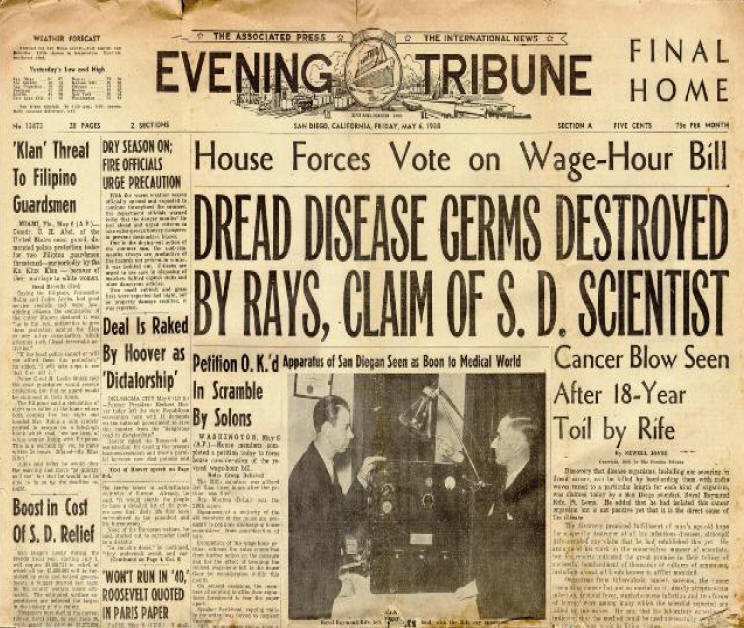
Star Guild: I know, I know. I’m tooting my own horn, but I had too. In Star Guild there is a device known as a Suficell Pod. It’s a pod that someone goes into and lays on a soft bed for an hour, a day, or a week, depending on their condition. What the pod does is cure diseases and illnesses by matching the vibration of the diseased cell, thus shattering the cell, allowing it to exit out of the body through natural means (peeing). It sounds Sci Fi, but it’s not. In the 1920′s this device was created by Dr. Royal Raymond Rife, though not as a pod. It was a hand held device that was studied and researched by the Mayo Institute, curing 100% of the patients it was used on–so say the documentaries and the documents recovered many years ago at the Mayo Institute. At the time, the machine was so popular in the medical industry and science journals that the Chief of Medicine in California penned it as the cure for cancer. It was then burried and shunned by science thereafter. Apparently, the pharmaceutical industries didn’t like the idea. The good news is that the machine is still around, though sparingly used by hippies and alternative health care practitioners. I even had a client who used it to cure her stomach cancer and according to her and her family, it worked. She was deemed cancer free after two weeks of using it. The machine, called the Rife Machine, was main headlined in a 1928 San Diego newspaper, which you can see here: http://www.bibliotecapleyades.net. Does it really work? In Star Guild it does! 1 point for Star Guild.
So, as you can see, “geeks” not only have changed the world, they are currently helping to save it. Not only by the technologies they’ve written about–those that have been copied by rocket science–but by the warnings they have given for what may come and ways to get around it, along with philosophies of how to live in order to change the warnings and predictions into an enlightened civilization. Now, I know what you’re thinking, because I would be thinking it too. How do I become a geek and what is the quickest route to “geekdom”? Just open up a Star Trek, Battlestar Galactica, Star Wars, Star Guild, Hitchhikers Guide, or any other Sci Fi book and enjoy the read. And, when you do, take heed and learn from the best.
10 Reasons of How Geeks Have Changed the World
Science Fiction or Sci Fi (Sy Fy) has not always had the best reputation. Yes, the books, short stories, tv series, movies, etc., have enticed us for more than fifty years, yet there is still a stigma surrounding Science Fiction. It’s known to be a genre where geeks, nerds, and gamers go. You see these people at Comic Cons wearing Sci Fi, Fantasy, or Horror genre outfits, acting as if they are indeed the character that they’re dressed up as. You see them being made fun of in movies, on Conan and Leno, or you see them huddled in groups outside of school or at a game shop talking about the characters on Star Wars and why a certain character was motivated to do this or that.
In Sci Fi, the geeks rule the genre. In fact, they rule the world–in a good way–and I’ll tell you why.
But first, I must say that Sci Fi is not only a geek genre. It attracts everybody. In fact, it’s more than likely that a relative of yours watched Battlestar Galactica or your friend absolutely loved Star Wars. Those people enjoy the genre, yet they don’t become the genre.
Geeks become the genre.
A geek, like me, reads a Sci Fi book or watches a Sci Fi movie and, instead of moving on in life, they sit and wonder and think and dream of it. They can’t get the characters out of their mind. It intrigues them so much, that they can’t stop talking about it, and look for more of it, scouring the internet for additional comments, feedback, and information. They then find themselves in a group of Science Fiction lovers, all arguing about the theory and truth behind Star Trek, Star Wars, and Battlestar Galactica. But, there is a truth I want to tell you about. A truth that us Sci Fi fans know to be as real as Yoda’s quotes, and as palpable as an ewok.
Sci Fi is truth. Plain and simple. We’re drawn to it because it is full of future technologies not yet created, future clothes not yet worn, and future ideologies not yet adopted. We, as fans, see these important things and keep the genre going. Because of this, we are single-handedly keeping the human species alive and well. Without us, we most assuredly would get nuked by Cylons, or cross over to Darth Vader’s Dark Side of the force, or find ourselves on the bad end of an angry Klingon’s photon torpedo. We Science Fiction lovers know the tell-tale signs of such incidences, and more importantly, what to do when they arrive.
So, if you look at “us” Sci Fi fans as geeks, then realize what exactly we “geeks” are “geeking out” about. We aren’t just “geeking” because we think the show, movie, or book was awesome. We see something beyond the book, beyond the author’s incredible and genius concepts, we see, like I said above, the truth of it all. We geeks understand that Science Fiction isn’t just entertainment, it is prophecy, philosophy, and story-telling in its finest form.
Let’s take a look at 10 points in Science Fiction that has directly influenced our lives, and how Sci Fi has prophesied future trends and future technologies. All of the below points were influenced and written in books, shows, and movies by, yes, a “geek” that has saved the earth from total annihilation.
Enders Game: We all by now have seen the trailer for the movie or have actually gone and paid good money to watch it. I liked the movie, but I liked the book so much more. Did you know that the book spoke of a world wide web, extending out to a galaxy and universal wide web, that had instant messaging, chat boards, global news feeds, and access to anything you wanted information on? Enders Game was written in the mid 1980′s, long before the internet was used by the public. Yet, it fully explained the internet before it came to light. 1 point for the brilliance and genius of a science fiction writer’s creative mind, let alone his ability to write such an enticing story that accumulated millions of readers.
Star Trek: Trekkies, as we are called, have been onto something for a very long time. Not only were the books, tv show, and movies a hit, so were the concepts and technologies. And, Trekkies embraced all of them. In Star Trek, Starship Enterprise used ion propulsion systems to move their ships at incredible speeds. Did you know that an ion propulsion engine has actually been created and is currently being used? From NASA, “Modern ion thrusters use inert gases for propellant, so there is no risk of the explosions associated with chemical propulsion. The majority of thrusters use xenon, which is chemically inert, colorless, odorless, and tasteless. Other inert gases, such as krypton and argon, also can be used. Only relatively small amounts of ions are ejected, but they are traveling at very high speeds. For the Deep Space 1 probe, ions were shot out at more than 88,000 mph.” (www.nasa.gov) We are in the first phase of studying, building, and using ion propulsion, but what we have attained so far is an ion engine, along with ion thrusters, that have been in continual use for over 5 years without the need to be recharged. So, here’s 1 point for the “geek” of Star Trek, Gene Roddenberry!
Star Wars: My favorite of all Sci Fi was/is Star Wars. It showed two anti-matter devices, one as a weapon and the other as a hover car that Luke drove in a couple of the first scenes. Even though antimatter hasn’t yet been created (so say the 1 per centers that own the world), the concept of antimatter, the theory and application of it, along with actual observation of it in a lab by a guy named Carl D. Anderson (look him up, because I don’t want to spend paragraph after paragraph explaining him), exists. However, if it does come to light some day that there really are cars out there without wheels, yet are magnetically hovering above the ground, then we’ll know that Star Wars has arrived and that the geeks around the planet must develop and use the force to stop the Dark Side. 1 point for George Lucas.
The Jetsons: The cartoon that had us wide-eyed as kids, and some of us as adults too, had many gadgets, gizmo’s, and more importantly, cool flying cars that flew across our tv screens. I always wondered when we’d have flying cars and, years later, a friend pointed me to a website. My jaw dropped as I was looking at a Jetsons’ flying car on the internet and it was real! They can even be purchased and used now! Kudos to the Jetsons. 1 point! The link to the flying car is here: http://www.terrafugia.com/
Buck Rogers: I also watched this show as a kid. I grew up in the 80′s, so the show had been long cancelled when I was watching it. Taken from Listosaur.com, this is why this show was revolutionary: “Focused-beam lasers have been a staple of pulp science fiction from the time of Buck Rodgers in the 1920s right up to the present day. Of course, in the Buck Rogers era, they were known as “disintegrators,” or “infra-rays.” Yes, lasers play a key role in modern weaponry, helping lock on and track targets. But modern-day laser technology is also used in science, surgery, communications, and security technology.” 1 point for Buck!
Star Trek (again): The Prime Directive is a philosophy that, if adhered to, in my opinion, would help civilization along, allowing cultures to evolve on their own, without the help from another culture, which may spiral a culture out of existence by forcing different ways, different concepts, and different morals into their society. Many cultures have been wiped out because another culture attempted to change them, or, in their mind, help them. The Prime Directive, according to Star Trek,”prohibits Starfleet personnel from interfering with the internal development of alien civilizations. It applies particularly to civilizations which are below a certain threshold of development, preventing starship crews from using their superior technology to impose their own values or ideals on them.” That’s pretty cool. 1 point for being a great philosopher. Thank you Star Trek.
Star Wars (again): “The Force is strong in this one.” Thanks Darth Vader, I appreciate that. The force, according to Obi-Wan Kenobi, is “what gives a Jedi his power. It’s an energy field created by all living things. It surrounds us and penetrates us; it binds the galaxy together.” If you look at physics, quantum physics, or eastern religions such as Budhism, and even at your own life, you’ll see that this concept is not foreign, though some may attempt to disagree with it. Science is coming around and noticing that many religious and spiritual truths can be observed, researched, documented, and even video taped, stamping them as very real phenomena. In this case, the force is “energy”. We have seen that energy is in every living thing, animate or inanimate. Krilian photography is a good example of how we can see it. 1 point for interesting philosophical debates that have been going on over this movie for decades.
Hitchhikers Guide to the Galaxy: Have you ever heard of the iPAD? Of course you have. You would have to live in a tribe in the far reaches of the earth to NOT hear about it. Hitchhikers Guide to the Galaxy had one of these (iPAD-looking device) in the book. The device was the guide to the galaxy, being aptly named the same name as the title of the book, The Hitchhikers Guide to the Galaxy. It eerily resembled the iPAD–touch screen and all. Douglas Adams, the author, was on to something. Too bad he died in 2001. He would have been excited to see that his idea actually came to invention. 1 point to the author of the book, Douglas Adams. May he rest in peace.
1984: There are too many “predictions” and/or “prophecies” from this book to put in this article. I’ll give you a link to four of the predictions that have come true (though, there are a lot more). George Orwell, a “geek” who saw past the fireworks and illusions and studied the man behind the curtain, published 1984 in 1949. Copied and pasted from policymic.com, Alasdair Denvil writes: “In Orwell’s 1984, Big Brother — the purported leader of the Party that rules the nation of Oceania — keeps constant tabs on the population through “telescreens” (basically two-way televisions). With our National Security Agency (NSA) involved in warrantless wiretapping, maintaining a call database (MARINA), and engaged in data-mining (PRISM), we can be forgiven for wondering if Big Brother is no longer a fictional character. The difference, though, is that telescreens weren’t owned by most people in Orwell’s 1984, because they were too expensive. In the real world, however, each of us has a hand-held “telescreen” we carry with us most everywhere we go, which we’ve willingly paid for ourselves and which we almost never turn off.” Read the rest of the article here: http://www.policymic.com. It’s awesome! 1 point to George Orwell.
Star Guild: I know, I know. I’m tooting my own horn, but I had too. In Star Guild there is a device known as a Suficell Pod. It’s a pod that someone goes into and lays on a soft bed for an hour, a day, or a week, depending on their condition. What the pod does is cure diseases and illnesses by matching the vibration of the diseased cell, thus shattering the cell, allowing it to exit out of the body through natural means (peeing). It sounds Sci Fi, but it’s not. In the 1920′s this device was created by Dr. Royal Raymond Rife, though not as a pod. It was a hand held device that was studied and researched by the Mayo Institute, curing 100% of the patients it was used on–so say the documentaries and the documents recovered many years ago at the Mayo Institute. At the time, the machine was so popular in medical industry that the Chief of Medicine in California penned it as the cure for cancer. It was then burried and shunned by science thereafter. Apparently, the pharmaceutical industries didn’t like the idea. The good news is that the machine is still around, though sparingly used by hippies and alternative health care practitioners. I even had a client who used it to cure her stomach cancer and according to her and her family, it worked. She was deemed cancer free after two weeks of using it. The machine, called the Rife Machine, was main headlined in a 1928 San Diego newspaper, which you can see here: http://www.bibliotecapleyades.net. Does it really work? In Star Guild it does! 1 point for Star Guild.
So, as you can see, “geeks” not only have changed the world, they are currently helping to save it. Not only by the technologies they’ve written about–those that have been copied by rocket science–but by the warnings they have given for what may come and ways to get around it, along with philosophies of how to live in order to change the warnings and predictions into an enlightened civilization. Now, I know what you’re thinking, because I would be thinking it too. How do I become a geek and what is the quickest route to “geekdom”? Just open up a Star Trek, Battlestar Galactica, Star Wars, Star Guild, Hitchhikers Guide, or any other Sci Fi book and enjoy the read. And, when you do, take heed and learn.
January 11, 2014
Need a Sci Fi Vacation?
What is the concept of the ad below? To get more people to look at my book. If they like what they see, my next hope is that they download it. After all, it’s free. What do they have to lose? Well, you could say that they have “time” to lose, but truly, it takes less than five minutes to read a couple of pages and say, “You know, I can’t put this down!” (such as Ellen does right here: http://Pixton.com/ic:ixpnsrtj) or say, “Nah, don’t like it. Next!”
The hope, as all author’s hope, is to have everyone like your story. And, that’s what I intend to show with the ad below. My promotion tells the reader, and you, that by reading my book, you’ll escape into a vacation, but not only a vacation, a “Sci Fi” vacation.

Click on the link to download “Star Guild” for free: http://amzn.to/1m09PWJ
January 8, 2014
Survey Says! Which Cover do You Like Better?
Survey Says! Which cover do you like better? A or B?
A:

B: