Raima Larter's Blog, page 14
May 5, 2014
Yoga Monday - The Yoga of Chant
 The Sanskrit Symbol for OmI spent the weekend immersed in a powerful yoga practice. To a casual observer, it may not have looked like we were doing yoga. I would guess that it looked more like a rock concert than a yoga class -- lots of music and musicians, lots of singing and clapping and dancing, and lots and lots of joy. We were, in fact, singing and dancing, but we were also doing yoga - bhakti yoga, to be precise.
Bhakti is the yoga of devotion and although there are several types of bhakti practices, all focused on expressing devotion, the one we practiced this weekend is chanting.
A typical bhakti chant will feature the name of one or another of the many names of the divine, repeated over and over, as a mantra. The chanting can be done to music, with melodies and rhythms and with the help of musical instruments. This is what leads to the rock concert atmosphere.
The difference is, that while it might look like a concert, it feels like yoga - because it is yoga. The repetition of the holy names is thought to open energy channels in the body the same way asana practice clears blocks to the flow of energy. Chanting can clear these blocks too, and often in a much more powerful, and speedier, fashion than practicing yoga poses.
Many students of yoga will be familiar with chanting, since it is a very common practice to chant the single syllable Om either at the beginning or end of class. Ironically, although the chanting of Om is one of the oldest and most widely practiced techniques of yoga, it is often never really explained, particularly to beginning yoga students.
So, why do we do this? Why do we chant this single syllable at the beginning and end of our yoga practice? There are many ways to answer this question, but I like to look at it as a small amount of bhakti practice inserted into every yoga class. In bhakti practice, we chant the divine names to increase our awareness and understanding of that particular aspect of the divine, especially as that particular aspect of divinity is manifested in our own bodies. We chant Om for the same reason - to bring this symbol of the perfection of ultimate reality into our hearts and minds, so we are fully conscious of it.
Although Om is a very simple mantra, just a single syllable, it holds within it the entire universe. The yoga sutras explain that we chant Om repeatedly because this leads us to the contemplation of the meaning of Isvara, the ultimate reality, pure perfection. This, in fact, is our true nature, so by chanting its name, we raise our consciousness of this fact.
One way to think of Om is as the original primordial sound, the single sound which brought forth everything that is, the entire Universe. When we chant Om it is a way to remind ourselves of our true nature, but it is also a way to increase the likelihood that we will remember this important fact: we are that sound which brought everything that is into existence - even after we walk out of our yoga class and into our everyday life.
It's very likely that we will forget this essential fact as soon as we roll up our mat. And that is why we chant it again, and again, and again. Om Om Om
Namaste


April 25, 2014
The Writing Report for April
 This has been a busy month and my own writing has suffered, but I have managed to complete all my assignments for my Fiction Techniques course and will turn in my final draft of the new story I wrote for this course next week. So, I count that as a big win for the month of April.
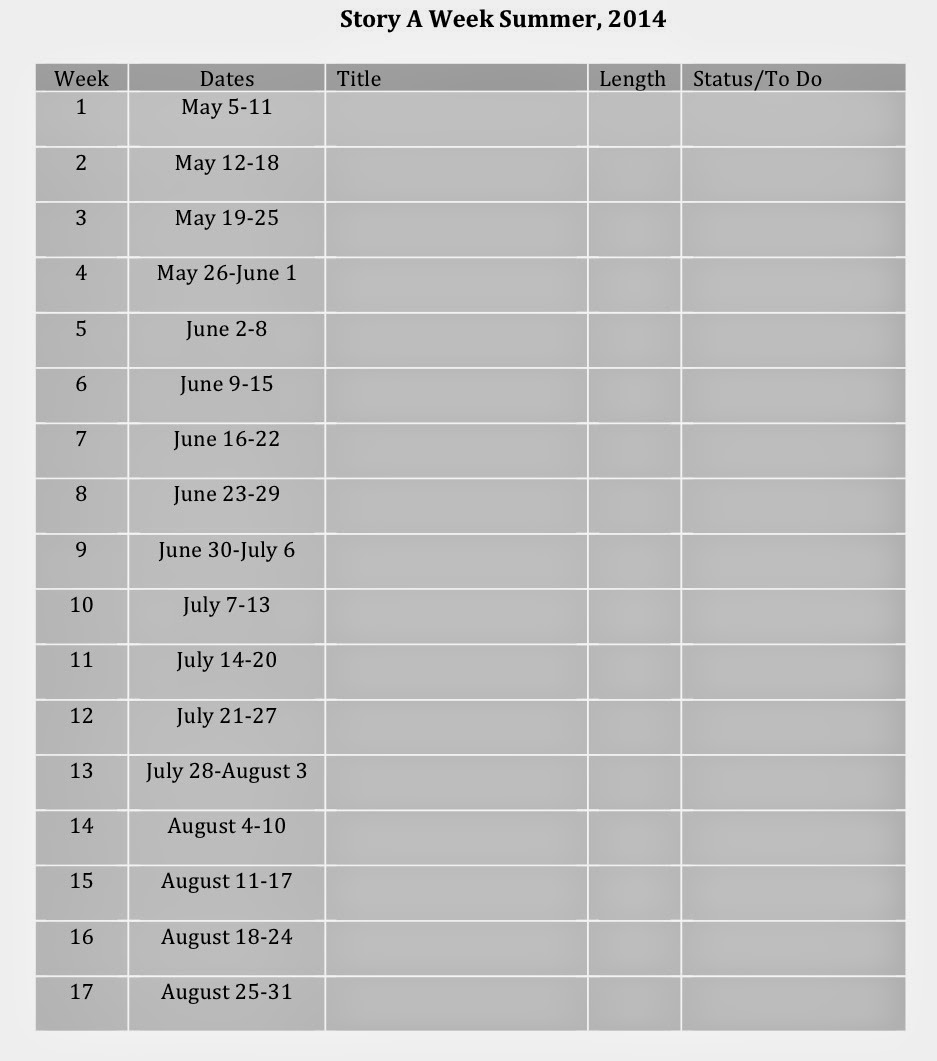
In a couple of weeks I plan to launch my second annual "Story A Week Summer" personal challenge. I did this last summer and was thrilled at the number of story drafts I pulled out and finished, as well as the new stories that got started as a result of this challenge....so I decided to do it again!
Here is a copy of the chart I'm going to use. I have a few ideas for those early weeks, but I honestly don't quite know where this is going to lead me. I'm eager to see what this chart looks like as I begin to fill it in.
Just like last year, my summer has seventeen weeks, since I'm counting from the beginning of May to just before Labor Day. That seems a long way away right now, but I suspect the coming months will go fast. I'll be filing periodic progress reports as the summer gets underway, so stay tuned!


April 13, 2014
Science Sunday: Cool Trajectories
A few weeks ago, a friend forwarded a link to a very interesting video showing a new way to visualize the flight of starlings as they flock around power lines. Later, I located a link to an article in Wired about it, explaining this
new way of manipulating video footage.
The resulting movie makes the trajectory of each bird's flight path visible. Take a look! This is totally mesmerizing....


April 7, 2014
Yoga Monday: The Importance of Daily Practice
 As a yoga teacher, I often tell my students that they really won't begin to experience the full value of yoga until they develop a daily practice. It doesn't have to take a lot of time, I tell them. Even fifteen minutes a day of consistent practice will make a world of difference in the benefits that yoga can produce in one's life.
I say this a lot, so it was with a pang of guilt and humility that I came to realize a few months ago that my own daily practice had taken a nose dive. For years before I became a teacher I practiced every day. I continued that daily practice during my teacher training. As I began teaching, though, my own practice began to change and, before I realized what was happening, had nearly disappeared from my routine.
It was the need to prepare lesson plans that started this change. My own practice began to be geared toward working out sequences through which I could teach certain concepts and ideas in my class. My students certainly benefited from a well-thought-out class plan, but I noticed that my own practice began to become more sporadic and unbalanced.
Apparently, this is a well-known problem that yoga teachers often face, as I found out after talking with several colleagues. We know the importance of a daily practice, we believe in it--but the message quickly becomes, "Do as I say, not as I do."
A few months ago, in December, I had a couple of weeks off from teaching at the same time I also had a few quiet weeks at home, so I took the opportunity to tackle this problem of a terribly inconsistent personal practice. I set an intention to practice asana and meditation every day for those two weeks.
Instead of directing my own practice, I pulled out Judith Lasater's book, "Thirty Essential Yoga Poses for Beginning Students and their Teachers," and followed her Day of the Week sequences. These seven pose collections cycle through all the essential basic poses. Within a week, I had rediscovered the joy of a well-rounded and consistent yoga practice. After two weeks, I was feeling more centered and calm than I had in a very long time.
The new year began and I started to teach again, but by then I was stuck on my daily practice, unwilling to give up this special time for myself each morning. I continued with a daily asana and meditation routine, sometimes using Lasater's book, sometimes dipping into the essential sequences in Patricia Walden's book, "The Woman's Book of Yoga and Health." Occasionally, I went back to my own self-guided practice, but I enjoyed having these two wise and experienced teachers to guide my practice through their writing.
I've been keeping a journal about this, each day writing a short entry, just a sentence or two, about what I did in my practice that day. Recently, I passed the 100-day mark in my journal, and while it felt like a great accomplishment to have reached this number, I knew I was not a bit interested in stopping.
I will keep doing this practice every day, even if I have only ten minutes to do it. No amount of yoga is too small. What is important is the consistency and commitment. This is a truth I have known for a long time and I'm very happy to admit that I am now, finally, practicing what I teach.
Namaste.


March 28, 2014
The Writing Report for March
 We're about to close out the month of March in a few days and with April right around the corner, I've started to think about writing conferences. In trying to decide if I will go to any this year, I've needed to consider all the other obligations in my life, as well as the intent of each conference. I've made my first choice, and will be attending the annual Conversations and Connections conference next Saturday, April 5th.
This conference, organized by Barrelhouse Magazine and sponsored by the Johns Hopkins University Master of Arts in Writing program (in which I'm enrolled) has been going on since 2007. I've attended two or three of these conferences and it was actually at last year's conference that I first began to realize that an MA program might be what I needed to move my writing to the next level.
This insight came during the popular "Speed Dating with Editors" event that takes place over the lunch hour. Participants bring a few pages of a piece--any type, fiction, poetry, creative nonfiction--and sit with an editor from a literary magazine or small press for instant feedback.
Another upcoming conference that I considered attending but couldn't fit into my schedule is the second annual Books Alive! conference sponsored by the Washington Independent Review of Books. That conference is tomorrow, so if you're interested, check it out right now.
There will be more conferences over the next few months. One I won't be able to attend again (since I will be enrolled in a workshop at Hopkins) is the Iowa Summer Writing Festival. This is not actually a conference, but an ongoing series of workshops that takes place over most of June and July. I had a fantastic experience there last summer and would go again if I could work it into my schedule. I highly recommend it!


March 19, 2014


March 9, 2014
Science Sunday: The Complexity of Your Gut
Nature Immunology recently released a very cool video showing how the immune response plays out in your gut. Watch and learn!


March 3, 2014
Yoga Monday: Let it Be
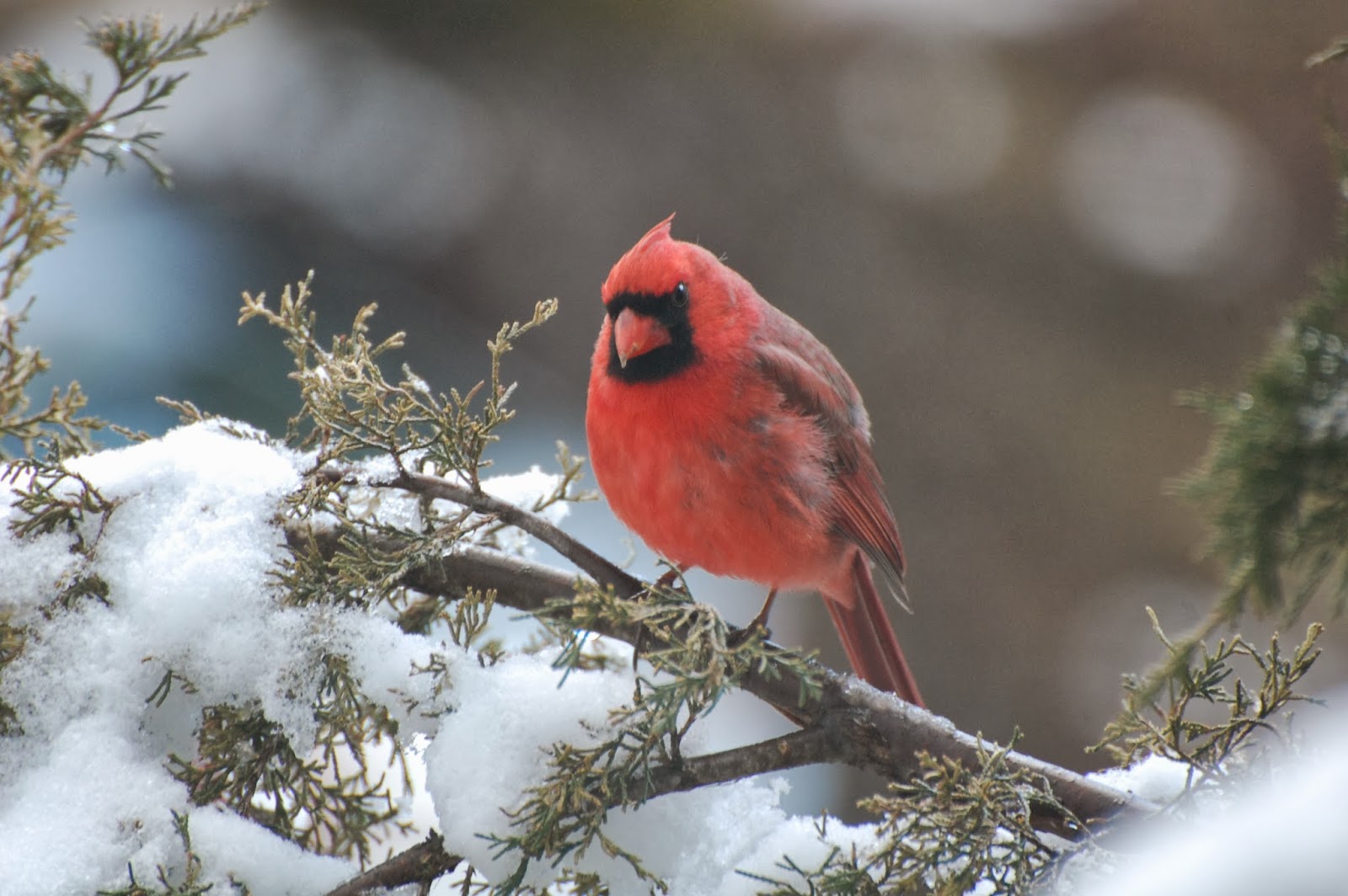
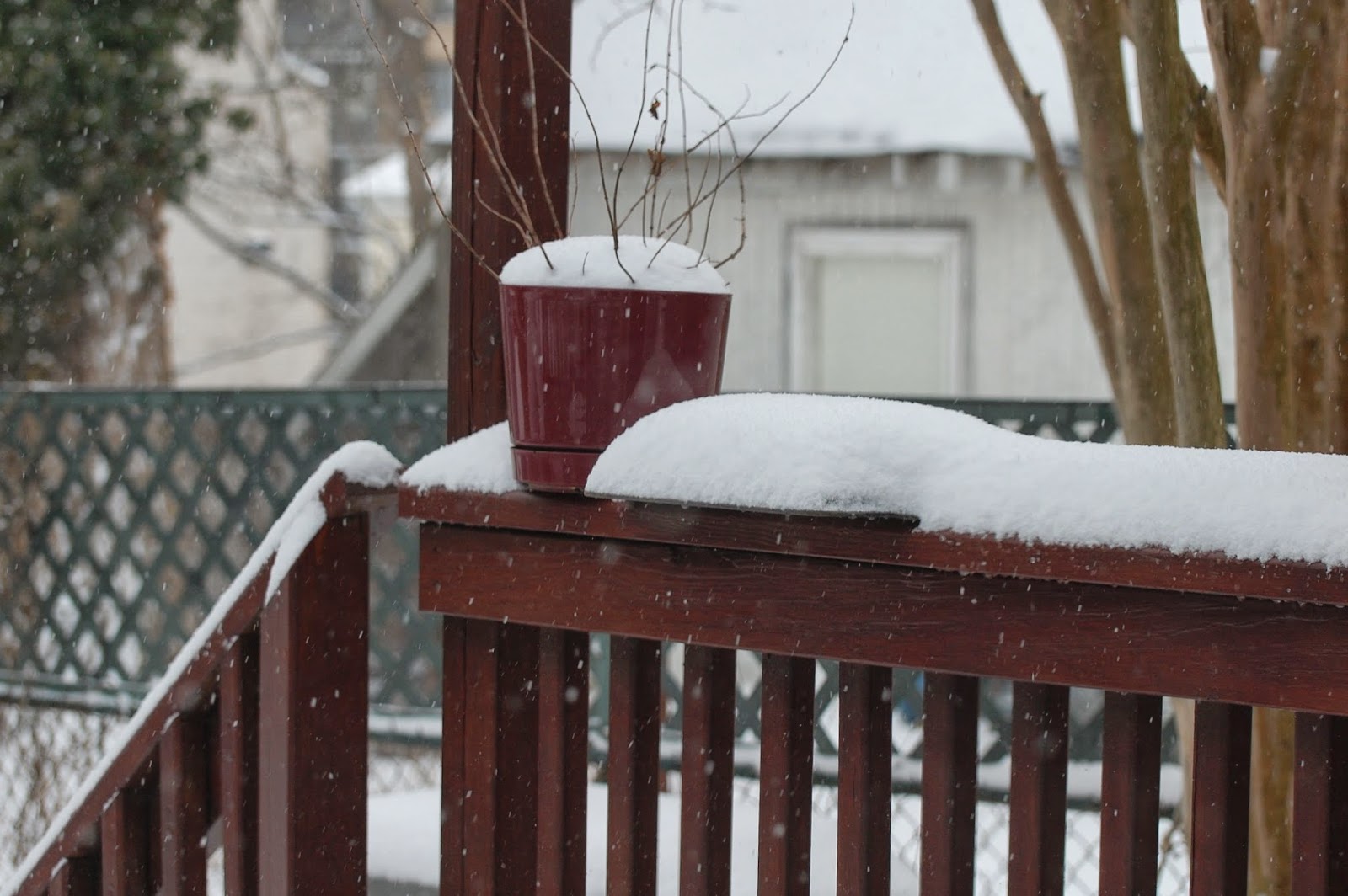 It is snowing. Again. I took this photo about ten minutes ago, and the flakes are still coming down. The weather service says this will continue for several more hours.
It's about 18 degrees Fahrenheit out there, and expected to drop even further, to around 8 degrees by tomorrow morning. The federal government, my area's largest employer, is closed, as are all the county offices and school districts.
Even the bus system has shut down. All of these events have transformed my neighborhood in Arlington, Virginia, just three miles outside of Washington, DC, into an oasis of utter quiet. No buses trundling by on Lee Highway, a half block away from my house. No cars. No sounds outside at all, except the bluster of the wind as it rattles my windows every few moments.
I could rail against this, point out that we've had just about enough winter already, thank you very much. Or I could dismiss it, the way many of us who have been transplanted to Washington DC react to the inevitable freakout that accompanies every flake that hits the area, saying it's just a little snow and people here don't know what real snow is, not the kind of snow we had back in Idaho and Montana and North Dakota.
Or I could notice how quiet it is. I could notice how relaxed I am, how peaceful it feels in my house, how tasty that lunch was that I just made for myself. Tomato soup and a grilled cheese sandwich! What could be better? I could notice that the snow is clean and white and beautiful, as snow always is. I could notice that our heat is working because our power is still on. I could notice that I am grateful for this, and for all of these things.
I could also notice that it is snowing whether I want it to snow or not. I could notice that nothing I say or do or feel will change the fact that, today, it is snowing. Again. This is today's truth.
In yoga, we have a set of ethical principles, the yamas and the niyamas, which appear in the yoga sutras as guides to our practice. Among the yamas, which are the "external disciplines," we find satya, which means truthfulness. When we practice satya, we focus on that which is true, that which is--not that which we would like or wish to be, but that which actually exists.
When we apply satya to our asana practice, we are truthful with ourselves about just how far we can stretch those hamstrings or bend that back. We don't pretend that we can stretch farther than we can or bend more than we ought. If we do, we are being untrue, to ourselves, as well as to the practice.
When we apply satya to our lives, we are truthful about everything--we accept the truth of our past and our present, we accept the truth of who we are, and who we are not. And we especially accept the truth of things we cannot control, like the weather.
Among the niyamas, those "internal disciplines" that guide our yoga practice, we find santosa, which means contentment. A verse in the yoga sutras says, about santosa, "Contentment brings unsurpassed joy."
And, thus, we arrive at the essential lesson of these two yogic principles: by letting go of our attachment to the way things ought to be, and accepting the truth of the way things actually are, we will find joy.
It is snowing. Let it be.


February 28, 2014
The Writing Report for February
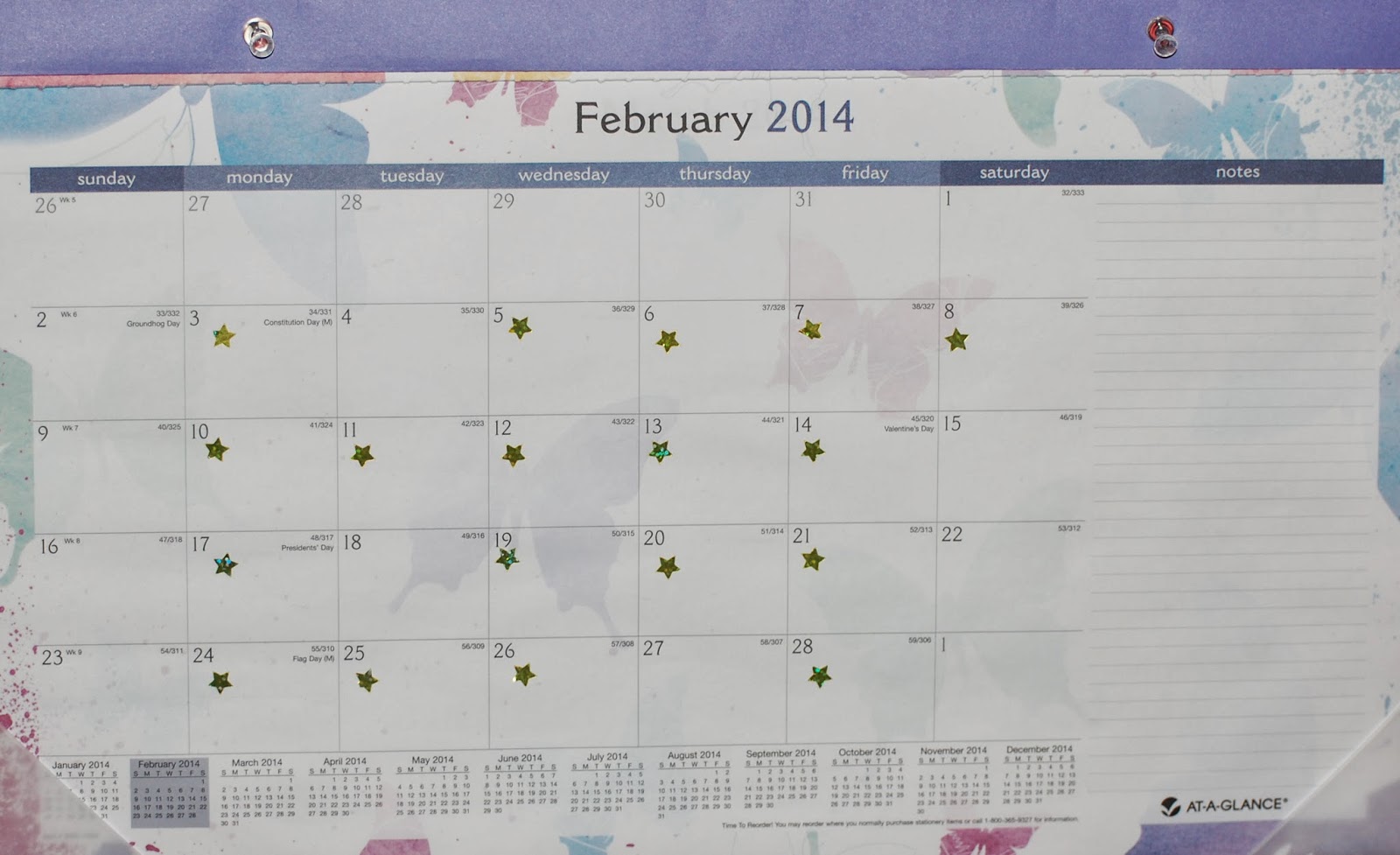 February has been, as usual, a short month, and here it is already time for the monthly writing report. I thought I had not been writing much, but I've been keeping track, making note of the time spent each day on writing, and giving myself a gold star on the calendar for each day I spend at least a half hour writing.
Here is my calendar for this month, and it's actually not too bad, despite the way it seemed at the time. The type of writing I've been doing varies from day to day, but this month has been divided between (a) weekly exercises assigned for my Fiction Techniques class at Hopkins; (b) blog posts; and (c) freewriting.
Although I would have liked to see some time spent on the novel I'm supposed to be revising, I do think it's been wise to set it aside for awhile and concentrate on classwork. I hope to begin working through my revision plan for the novel starting in March....but we'll see how that goes next month. Which starts tomorrow!
I have spent a considerable amount of time on freewriting this month, and this was actually a conscious choice. For some time now, I have been working on developing a technique that more intentionally integrates my yoga practice with my writing. When I talk to myself about this, I call these integrated yoga and writing sessions Asana-Freewrite time, because the method involves deliberate focused asana practice (asana means pose or posture) followed immediately by a session of timed freewriting.
I started to more consciously develop this technique last summer when I took a weekend workshop in Iowa from Robin Bourjaily of Poses & Prose. Her method, inspired by the teachings of Jeffrey Davis, author of "Journey from the Center to the Page," crystallized for me the approach I had already been using for years with my writing, even though I didn't realize this was what I was doing.
I noticed quite some time ago that if I went directly into writing after a period of movement in yoga, the images and characters and ideas that came pouring up were vivid and new and exciting to write about. I got several story ideas this way, many many characters, even an entire novel, but it wasn't until Robin's course that I began to make the connection between the intentional practice of yoga in the process of creating new writing. [By the way, if you are intrigued by this idea, Robin will be teaching the workshop again, at the 2014 Iowa Summer Writing Festival.]
So, I've been working on that for a number of months, trying to find the best way to combine these two core activities in my life. And I haven't wanted to talk about it much, or write about it, because I was just beginning to see what worked for me, and what didn't. I still don't know a lot of specifics, but I do know that I need a starting phrase or two to get the writing flowing once I move off the mat and pick up my pen or sit at the computer.
The phrases that work best for me are ones I learned in a fabulous book by Natalie Goldberg, Wild Mind: Living the Writer's Life. This amazing book changed the way I write by showing me how to do freewriting in a productive way. She has many suggestions in this book, but the approach that works best for me is the following: Set the timer for ten minutes, then write the phrase "I'm thinking about...." and put down whatever thought or image or idea is in your head. When you get stuck, write "Now I'm thinking about...." and keep going, for ten minutes. Walk around for a couple of minutes, not speaking or reading or engaging with words in any way, then return to the page. Set the timer for ten more minutes and write "I'm not thinking about..." and continue with this for ten minutes.
By combining Natalie's freewriting method with Robin's "take your writing to the mat" method, I've now got a technique that works for me, both for generating new material when I need it (such as for those all-too-frequent weekly writing assignments) as well as for revising or adding to material I'm already working on.
Some days, an entirely new piece comes to me, which is what happened today. I took some time to type it up and have filed it in my "Beginnings" binder. Some day, I will pull it out and work on it again, but it feels great to have found a way to capture at least a small portion of the flood of ideas that the Asana-Freewrite method unleashes.
And now: onward to March!