Jen Cudmore's Blog, page 32
December 16, 2013
Character Profile: Raymond Foss
What can I say about Raymond? A lot! He’s one of my favorite characters (although I freely admit I’m partial to them all). He’s much different from my other protagonists because he’s much younger and more immature. With my Blue Heaven Romance, The Whispers of Angels, I wanted to show a different take on romance.
Physical features: average height and build, rather thin, blond hair.
Personality: Shy and reserved to everyone but family, doesn’t have much but he’s content, protective and loyal to his family, takes on responsibility at a young age, limited understanding of life because he’s a loner.
Backstory: Dad abandoned him before he was born, his mom struggled to survive until she remarries. Raymond’s stepdad doesn’t like him and often gets rough with him and his mom. The photo above is similar to what I picture of the Foss family home (I cannot read the credit on the image, so if you can, let me know so I can site the photographer. I found the image on Pinterest. Thanks!)
Creative Process: Initially I envisioned a young boy in baggy overalls walking down a dirt road with a toddler on his shoulders. His other siblings walked along with him, listening to his jokes and stories. He appears happy, but he’s really quite nervous about his mother’s sickness, which is why he’s heading to town to find the doctor. (This exact scene wasn’t needed in the story, since it technically happened prior to chapter 1.)
Very few teenage boys enjoy spending much time with little kids, which makes Raymond different. He’s had such a hard life that I wanted to give him something special to make up for it, so I gave him Eliza. But it couldn’t come easy or he might not appreciate her as much. Just like in real life, his struggles could either make him stronger or he could fail. Raymond is drawn to Eliza, his pretty neighbor, but being near her terrifies him. He doesn’t want to see her disapproval, and when she insists on being friendly, he doesn’t know how to talk with her. Over time, he begins to understand true love. You can read more about Eliza here.
Raymond’s greatest quality is that he encourages readers (and the author!) who had an easier life to be grateful and not take their circumstances for granted. It could always be worse. If you hang in there, the good will come to you.
©Jen Cudmore, 2013 ___ Subscribe to my blog or my email newsletter on the right side of the page!


December 14, 2013
Photos: Winter in Alaska
I’ve heard a lot of authors talk about the environment where they create their stories, and most of them mention beautiful, peaceful landscape. I’m fortunate to not only live in Alaska, but to have lovely view behind my home. My desk, while crammed into the corner of my bedroom, is right beside a window where I can pause from my writing to take in the scene.
 A few days ago I wrote a post for my new friend Ian who lives in Australia. He asked me to talk about Christmas in Alaska. I mentioned snow and ice, Christmas lights and trees, block heaters and how the weather affects airplanes. It inspired me to dig out some photos of the Last Frontier.
For those of you who have never visited, Alaska must be added to your bucket list. God made some beautiful country here. I asked a couple of my friends if they would mind loaning me some photos of Alaska in the winter. Special thanks to Christy Rutter and Michelle Catlett for sharing their collection!
Click to view slideshow.
December 10, 2013
Guest: Heather Day Gilbert – Write What You Want To Read
I’ve always been impressed with this quote by Toni Morrison: “If there’s a book you really want to read, but it hasn’t been written yet, then you must write it.”
That has certainly held true for me as an author, though I can’t say it’s been easy to walk this road. When I first started writing, plenty of agents and authors in the Christian book industry were advising authors to “write your passion.” Now, almost six years later, I rarely see that advice proffered, and if I do, I smile quietly to myself.
Because it is most assuredly not the way to get picked up fast. When I wrote my Viking historical novel, God’s Daughter, it had several strikes against it from the get-go (things I didn’t know until I started querying it). In the Christian industry at that time, they wanted historicals set in America. Although mine was half-set in North America (Newfoundland area), half of it was set in Greenland. Secondly, it was about Vikings, and I could count on one finger the number of Christian authors who’d tackled that people group (Michelle Griep’s Undercurrent). Finally, my book wasn’t considered romance, since the main character was married. And to be honest, if you want to get in the Christian publishing door as a debut author, you are going to want to write romance.
Not that my novel had no romance. It had plenty of it. But it was more accurately a love story. Since it is first-person point of view, we are in my main character Gudrid’s head as she deals with emotional issues and baggage from her past. So while the love story was highly realistic (and broached issues I see women struggling with all the time), it didn’t fall under that unmarried romance umbrella that spans most of Christian fiction.
It was an uphill battle, to say the least, and one I nearly lost. I almost shelved my book forever after receiving numerous “we can’t market this” rejections. Rejections that verified the writing and the story were solid, but I’d followed the wrong passion. I needed to align my passion with the industry to get in the door.
 And yet I knew it was a story that needed to be told. Most people don’t realize that Vikings came to North America long before Columbus. It’s also not as well-known that Vikings converted to Christianity. My main character historically fell into both categories–Gudrid Thorbjarnardottir sailed with her husband to North America, and she was a Christian. I had to get inside her head and view the world through her eyes.
And Gudrid’s head was a complex place to be. She struggled with feelings toward other men–men who filled the gap her husband left wide open. She struggled with maintaining her Christian perspective in a world populated with pagans, and she had no Bible to cling to. She struggled with deaths that relentlessly occurred all around her.
After submitting it nearly everywhere, God began opening my eyes to the fact that I needed to self-publish my novel. The timing was right, the book was ready, and my followers were hungry to read something I’d written.
So I took the plunge and self-published, working with my brother, my crit partner, and my beta readers to get the novel as close to a traditionally published book as possible–from cover art to formatting. It’s still not perfect, but I am thrilled with the end result and the enthusiastic response I’ve gotten. Many of my reviews point out that though Viking fiction isn’t a genre they would have picked up, they’re very thankful they did. They also say it’s unlike other Christian novels out there and that the characters stick with them.
I plan to work my vision for married main characters into every one of my books, no matter what genre. Right now I have a contemporary Appalachian mystery out on submission, and the main character is a married (newly pregnant!) woman. My follow-up Viking novel, Forest Child, will also have a married main character–Gudrid’s sister-in-law, Freydis.
I think Toni Morrison’s advice is crucial to authors. It may not get you on the fast track to publication. But nowadays, you don’t have to wait in endless lines to get published. You can put in the time and effort and publish a product you can be proud of–one that truly does reflect your passion and is that book you always wanted to read.
 Author Bio: Heather Day Gilbert enjoys writing stories about authentic, believable marriages. Sixteen years of marriage to her sweet Yankee husband have given her some perspective, as well as ten years spent homeschooling her three children. Heather is the ACFW West Virginia Area Coordinator.
You can find Heather at her website, Heather Day Gilbert–Author, and at her Facebook Author Page, as well as Twitter, Pinterest, YouTube, and Goodreads. Her Viking novel, God’s Daughter, is here on Amazon and Smashwords.
December 9, 2013
Crossing the Trail: What was Oregon Really Like?
So, what was Oregon really like when the early settlers arrived across the Oregon Trail? I’ve already touched on why I set the series in the Pacific Northwest. Today I thought I would some share some basic facts and how I incorporated them into my Lawmen Series. My goal was to use several different aspects of the life during this time period to make the stories feel more real.
The Great Migration from the east began in 1841. The largest group to cross was in 1949 during the Gold Rush in California. Masses of men (and women) hoping for fortune traversed the path from Missouri to Oregon. My characters were no exception. Most of them (or their families) crossed the trail, but a few sailed by boat down around the tip of South America.
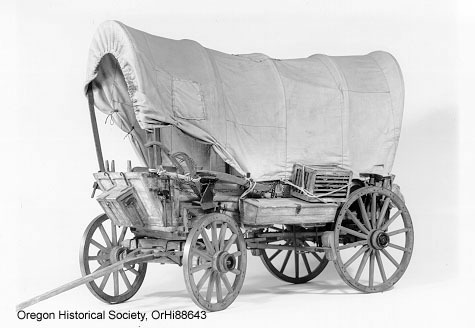
A covered wagon, like the one pioneers used to cross the Oregon Trail. (Photo from City of Tumwater website)
Due to the small space of the covered wagon, they left behind multiple items of value. Unfortunately what little they did bring along was often lost along the way. Tales abound of belongings swept downriver during crossings or abandoned due to weight restrictions when climbing mountains. I read one story where two children shared the same pair of shoes for several months and took turns walking beside the wagon.
The majority of newcomers were men. The first recorded female of white descent to cross the Oregon Trail was Narcissa Whitman, a missionary wife who visited Fort Vancouver in 1936, calling it the “New York of the Pacific Ocean”. In the early 1800’s, the Hudson’s Bay Company spread across Canada in search of furs to sell in Europe and stretched south to cover much of the Pacific Northwest. They built forts along the coast that served as trading bases. Many of these men took on Native American wives and stayed. Some of my characters descended from these unions.
Since many Native American tribes already inhabited the area, I knew I also needed to incorporate a bit of their history as well. Many Chinook tribes lived along the coast. Yakimas and Klickitats inhabited the inner regions of Washington. My characters interact with all three of these tribes at some time during the series. One of my female protagonists is from a Klickitat tribe. I also included some missionaries hoping to convert the heathens.
And of course, there is the Columbia, or the Great River, as the natives called it. I won’t go into detail here, since I’ve mentioned it before. But this mighty force of nature has a special place in my heart and had to be mentioned in my novels.
Because the population was sparse, and because travel across the trail was so difficult, many items were unavailable to the settlers. Items such as stoves, glass windows, and desks were very rare. Vary basic furniture consisted of chunks of wood took the place of stools and tables, although those gifted in wood-working could construct tables, chairs, and desks. Food choices were very limited. They had very little opportunity to purchase wine, tea, salt or sugar. They lived off what they could grow (if they were lucky enough to have the seeds) and what fish/animals they could find.
There is much more, but I’ll leave it at that, just to give you a basic idea of what life was like for these settlers. I don’t know about you, but I’m not sure I would have been brave enough to travel to Oregon back then!
Would you have crossed the Oregon Trail if you lived in the 1840′s?
December 5, 2013
Guest: Marc Cameron – That Sounds About Right
Mike Porcaro was kind enough to invite me on his radio show when my last book was released. He’s a heck of a nice guy and I always find his interviews like a campfire chat with an old friend. We finished up and I was feeling pretty good by the time I walked out of the studio to meet my wife.
“You know you used verisimilitude twice,” she said.
My cellphone rang at that moment. It was my old boss. He skipped the hello and went straight to: “Seriously, Hemingway, verisimilitude?”
I got at least three more texts before the day was out, with friends chipping their teeth about my use of that fifty dollar word.
But frankly, there aren’t too many other ways to say what I’m going for in my books. I admit to writing hard-charging adventures where the good guys generally win in the long run and the villains are exceptionally bad. I know that life is a lot more nuanced than that, but the thing is, I’m really not going for reality. I want to stretch the truth in such a way that it is vastly more exciting that everyday life and yet still feels real.
Yep. I want verisimilitude.
My wife and I were married pretty young, barely in our twenties. I got on with a small police department by the time I was twenty-two. At that time I reckoned that I was pretty dang smart and spent most of every cop movie we watched pointing out all the things the director got wrong. Looking back, it’s a wonder my bride actually sat through a single movie what with me pointing out how this cop was holding his gun wrong or how no SWAT team worth its salt would ever enter a room like that…
It was so clear to me. I knew some stuff and Hollywood did not.
Later, after I was hired by the U.S. Marshals, I saw a movie that included characters who happened to be on the Witness Security Program. In this movie WitSec was managed by the FBI and not the Marshals. I thought how great it was that Hollywood got all the sensitive parts of our operations wrong. It seemed real to the public, didn’t jeopardize anyone’s life and even pinned the dorky mistakes made by the characters on our sister agency.
Before I started writing full-time, I spent twenty-nine years in law-enforcement, twenty-two of those with the federal government. It was a great career for researching the agencies, people and weapons involved with counter-terrorism.
Contrary to Castle and Becket’s adventures (which my wife and I love, by the way) real homicides that aren’t solved immediately are generally drawn out affairs. Circumstantial evidence is often the only evidence you’ll ever have. DNA results are a long time coming, the bad guys lawyer up pretty fast, and the investigators aren’t nearly as pretty. They certainly don’t wear high heels and boss each other around so much. But it sure makes for fun TV.
I never want to be the guy to make my books so real that some igmo with a grudge can use them as a recipe for making a bomb, crashing a plane, killing a judge… or the commission of any other felony in which I might be an expert. To that end, I leave stuff out on purpose. Let’s say I want to have terrorists attempt to make a binary bomb. There are plenty of sites demonstrating how to do this on the Internet. But when I write it, I’ll describe the device in great detail, except say, for one of the ingredients and how to wire the detonator. Tom Clancy-technical, I am not. If a reviewer wants to sit in their sweaty wife-beater T-shirt in their mom’s basement and bash my bomb-making skills…well, that’s the way it goes.
The same goes for the racy scenes in my stories. Heck, parents can certainly get angry with me for the violence—there is a lot of that—and a spicy word or two—but when it comes to raunchy stuff—we all know it’s a human condition. I don’t have to provide a map. I’ll fade to black and let the reader imagine the rest. It’s more comfortable for all of us that way.
I freely admit that my characters are over the top. They travel the world, ride fancy motorcycles, speak several different languages, defuse bombs, get the girl and put the smack on terrorists. The thing is, I know real men and women just like this—larger than life. My plots are not all probable, but they are possible, given the right set of circumstances and a healthy dose of imagination. My friends have heard me say that I know I’m on the right track when I hear the Indiana Jones theme song in my head while I’m writing. I’ll take motorcycle chases, bareknuckle brawls, knife fights, and evil geniuses over a plodding police procedural that, while interesting in its own right, doesn’t get my blood going the way a running gun battle does.
And still, it all has to seem real.
Several years ago while I was working on one of my Westerns, I wanted to have one of the characters shoot the handcuffs off someone with a rifle. Unsure of what might happen, I hung a pair of handcuffs on a dry stick about the size of my wrist, backed off a few feet and shot the locking mechanism with my trusty .44 carbine. The torque of lead twisting the metal cuffs snapped the stick to smithereens, but it looked so cool that I left it in the book. Hey, it could work.
Two of my Thrillers involve terrorist plots to unleash biological weapons on the United States. I’m fortunate to have friends who are physicians and friends with the CDC. My family practitioner gave me loads of good information for the next book. That said, too much detailed description of a deadly virus or bacteria and the associated symptoms and the writing can become so real as to be clinical. I don’t really want to read about that. I just want to see enough that it makes me feel a little queasy—and maybe suspect I’ve somehow contracted the disease from merely reading about it…
Here’s the deal: We writers don’t have to be exactly, perfectly, down-to-the-nose-hair realistic in everything we write. But we can’t be wrong. If I stretch the laws of physics and make Jericho Quinn fly, no one believes it. But if I have him jump from a window that could possibly—but does not—break his ankle while in pursuit of a terrorist, a reader might be persuaded to believe that—especially if they see he is human and gets broken in other ways at other times.
So, I’ll keep doing research and continue to stretch the truth far enough to try and raise my readers’ pulse while making every attempt to make the story ring true.
That’s what I’m looking for; fiction with a ring of truth… I’ll have to use that next time I’m on the radio. Maybe it’ll get less flack than verisimilitude.
 Marc Cameron is a retired Chief Deputy US Marshal and 29-year law enforcement veteran. His short stories have appeared in BOYS’ LIFE Magazine and the Saturday Evening Post. He has published ten novels, six of them Westerns (several as a ghost writer and two under his pen name, Mark Henry). His present Jericho Quinn series—NATIONAL SECURITY, ACT OF TERROR, STATE OF EMERGENCY and TIME OF ATTACK (February 2014 Kensington) features an adventure motorcyclist, Air Force OSI agent and renaissance man who spends his days sorting out his life and hunting terrorists. Marc lives in Alaska with his beautiful bride and BMW motorcycle where he is working on the fifth book in the Jericho Quinn series.
Visit him at:
December 2, 2013
Character Profile: Eliza Potter
I forgot to post a character profile last month, so I figured I’d better get one up. I’m excited to delve into characters from my latest novel, The Whispers of Angels, a love story set in Oregon in the late 1800′s. I’m starting with Eliza, the female protagonist. At first I was afraid she was too flat and boring, but I needed someone who couldn’t relate to the hero very well in the beginning. Here’s a little bit more detail about Eliza.
Eliza Potter:
Physical features – Average height and build with blonde hair and blue eyes, cute dimples, only 17 years old when the story opens.
Personality – Sweet, loyal and caring, she has the potential to love with her whole being. Yet she has no idea how difficult life can be. Her dearest friend is Laura, her older sister. When Laura marries, Eliza must find someone else to occupy her time and her heart, so she quickly makes the Foss family her mission. Her caring nature even manages to draw out Raymond, a loner who is afraid to leave the family wheat farm.
Backstory – The family moved to Oregon when she was a girl. Her mother was an orphan who was separated from her brother at a young age. After she married Joseph, they had Laura and Eliza. Due to her own difficult past, she sheltered her daughters from as much pain as possible and showered them with unconditional love. This gave Eliza a false sense of security and a skewed view of life. She soon realizes that she’s rather self-centered. Her interactions with Raymond and his siblings forces her to mature quickly as she tries to make life easier for them.
Creative process – For this story I envisioned a young boy fighting against great odds to keep his family together. Because Raymond was dear to my heart, I knew I had to give him a love interest that was very sweet and supportive. But every story needs conflict, so I made Eliza a naive young lady who can’t comprehend abandonment and isolation.
I also wanted to explore the idea of young love, since our society pushes couples not to marry until they’re at least late in their twenties. I believe I was in love at age 17, even though I still had a lot of maturing to do. But there’s no reason why a young couple can’t make it if they’re committed to each other and make wise decisions. Marriage is about commitment, not feelings. I wanted to show a young couple beating the odds and taking a stand, even when they’re hurt and confused.
November 28, 2013
Gratitude
I hate waiting. It’s one of my weaknesses. Over the past few years I’ve really tried hard not to get upset when I have to wait in traffic, wait in a food line, wait at the doctor. Long lines in the grocery store are the worst!
A few years back I heard a pastor talk about the children of Israel and their constant ‘murmuring’ when they left Egypt. When I read those passages, I find the people so annoying. I mean, God was taking care of them, giving them a new life, and all they did was complain! Where was the gratitude for all He’d just done for them?
Then I took an honest look at myself and realized I tended to be a complainer, too. I grew irritated and focused on the negative way too often. To get rid of this bad attitude and stop complaining, I had to focus on what I was thankful for. At a church ladies’ retreat, we started a ‘Thankful List” and I was amazed that I was able to make it past 100 items! I started catching myself before the complaints slipped out and began to practice speaking words of thanks.
According to Merriam-Webster, the definition of gratitude is “a feeling of appreciation or thanks”. Because God taught me to redirect my energy, I don’t get impatient quite as often when I’m forced to wait for something. I don’t gripe as often when others don’t see things my way, and I don’t get angry as often when life’s complications arise.
Sometimes when we’re overwhelmed by our feelings, it’s hard to focus on what we appreciate, which is why it’s so important to make it a habit. Many studies have shown the health benefits of living a life of thankfulness, and I’ve felt it for myself.
Next time you feel the urge to get irritated and complain about something, choose to speak a blessing instead. What are you thankful for?
November 26, 2013
Guest: Ian Acheson – The Joy of Community
 Ian Acheson is an author and strategy consultant based in Sydney, Australia. Ian’s first novel,
Angelguard
, was released recently in US, UK, Canada and Australia. You can find more about Angelguard at Ian’s
website.
Ian Acheson is an author and strategy consultant based in Sydney, Australia. Ian’s first novel,
Angelguard
, was released recently in US, UK, Canada and Australia. You can find more about Angelguard at Ian’s
website.
Recently I finished a novel that stirred my spirit. Within the first few pages I found I was praying about some of the insights and ideas presented by the author. I was questioning and being challenged at the same time. I struggled to put it down as my spirit went on a journey with the four characters of the novel.
I loved it. Not just the novel but also the experience I had reading it. The Lord opened my eyes to something fresh and my prayer life was reinvigorated.
Fortunately, there are two more novels in the series that I hope will have a similar effect. But it’s okay if it doesn’t.
The fiction I read is mostly Christian fiction. I actually read more non-fiction which also is typically faith-based whether it’s a biblical commentary, devotional or spiritual development as I like to dub the genre that the Lucado’s, Eldredge’s, Bevere’s and the ilk write into.
Many a Christian novel that I’ve loved I’ve questioned the extent of the spiritual element contained within it. The storyline and dominant theme of the novel are far more prominent than the spiritual thrust.
But isn’t this like the Christian communities we walk in, we gather around, and increasingly we virtually connect into? All these communities consist of people going through different seasons in their faith journey. And those of us who are writers, fiction and/or non-fiction reflect this divergence within our communities. So there’ll be some authors who are called to write stories with very strong spiritual messages. Like the one I just finished. Others are called to write something with a subtler message.
We need both.
Just as we need to journey with fellow believers who are experiencing different seasons in their faith.
 Within a period of weeks, three horrific bomb blasts devastate areas of London, Los Angeles, and Sydney. No explanation is offered, no victory claimed for these acts of terror. Yet behind the scenes a Machiavellian European businessman, aided by the dark forces to whom he has sold his soul, is planning to bring the richest nations to their knees for his own evil purposes.
Jack Haines, an Australian academic, is grieving the loss of wife and children in the Sydney blast. Against his will, he finds himself thrown into a war that transcends the physical world, a conflict in which angelic guards have a special mission for him. But how will Jack respond when angels turn out to be more than precious porcelain statues? And will he accept that he has been chosen to fight for the future of mankind?
This fast-paced supernatural thriller by debut novelist Ian Acheson mixes faith and nonstop action to spin an unforgettable tale.
What’s a recent novel you’ve read that stirred your faith so much you didn’t want it to end?
November 25, 2013
4 Results of Genuine Repentance
When was the last time you prayed for God to point out your sins and help you correct them?
Unfortunately, genuine repentance is lacking in the church lately. People tend to think that conversion was the only step they need to take. They prefer to hold onto their sinful habits and rationalize why they don’t have to change. They convince themselves there is nothing wrong with their behavior. But accepting Christ as your savior is only the beginning.
After conversion comes sanctification, where God will work for the rest of our lives to make us more like Him. We have to listen to God’s prompting. We have to seek Him and ask Him what shortcomings He wants us to work on.
This year has been one of difficult personal growth. I recently starting going through a series called “Change Me, Lord” by Pastor James MacDonald. God showed me some areas where I had a bad attitude about my health and my finances. After a few painful days of talking with Him about these issues, detecting and destroying the lies that led me to continue in my sin, I was able to reach a place of true repentance. It’s quite humbling to realize you’ve justified a sinful attitude for many years.
The four results of true repentance are:
1) Genuine grief – This isn’t regret, but deep, gut-wrenching sorrow that you messed up and wounded God.
2) Repulsion to sin – The item that used to tempt you should now give you a sick feeling.
3) Restitution with others – Making it right with the people that your sin injured.
4) Renewed faith – No looking back with regret, but looking forward with a new zeal for God.
One of my favorite scriptures is Psalm 139:23-24 because it’s about being totally honest and open with God. My husband showed me a neat skit based on this scripture, if you’re interested.
23 Search me, O God, and know my heart;
Try me, and know my thoughts;
24 See if be any wicked way in me,
And lead me in the way everlasting.
If change was easy, everyone would do it. Choose to act like who you really are: a child of God. Is there something God wants you to give up so He can make you more like him? Have you truly repented?
November 21, 2013
Guest: Susan J. Reinhardt, The Road To Success is Paved With …
The road to success is paved with …
… hard work. Okay, so you didn’t want to hear that. We all start out with the dream of putting down our words on paper, releasing them to a welcoming world, and reaping the benefits of a loyal readership.
What it’s been like for me:
1. After some initial success with non-fiction devotionals, articles, and anthologies, God intercepted me and changed my direction. It began innocently enough with a trip to Gettysburg. My husband and I stood in the old town square and soaked in the history. Then, it happened. I “heard” the voices of the forefathers as fading echoes.
2. Eight months later, we were talking about “the Gettysburg experience,” when Beloved declared, “That’s it. That’s your book, and you’ll write it in four months, and it will be called Ghosts of the Past.” So, I sat down at the computer and wrote until I had 55,000 words in exactly four months.
3. I rushed to the next writers conference with visions of a contract dancing in my head. (Please don’t follow my example!) Instead, I was sent away with directions to: A) Make it longer, and B) Learn how to write fiction.
4. Meanwhile, my husband was diagnosed with leukemia, and the next 14 months we battled it together. Very little writing happened during those days.
5. Fast forward through over a year recovering from grief, dealing with personal health issues, and putting my life in order. The last thing I wanted to do was pick up where I left off and write. Beloved’s enthusiasm for the project and my own sense of God’s direction propelled me forward.
6. Altogether, it took eight years to go from the original vision to publication. During that time, what became The Moses Conspiracy, went through numerous re-writes, and more rejections than I care to remember.
7. Finally, a small press offered me a contract and published the story of my heart in March of 2013. Yes…just a few short months ago. The learning, the writing, the challenge of time management, and the joy continue.
Hard work? Most definitely. The satisfaction? Priceless.
 Susan J. Reinhardt‘s publishing credits include many non-fiction devotionals, articles, and contributions to anthologies. Her debut novel, The Moses Conspiracy, released this year. The second book in the trilogy, The Scent of Fear, released this month.
A widow, daughter, stepmom, and administrative assistant, she’s an active church member and full-time employee. In her spare time, she enjoys family and friends, reading, couponing, puttering in the garden, and hunting for small treasures in antique shops.