
M.J. Penny's Blog, page 7
March 15, 2013
The Most Valuable Question You Can Ask

 As you begin to take action toward the fulfillment of your goals and dreams, you must realize that not every action will be perfect.
Not every action will produce the desired result. Not every action will work.
Making mistakes, getting it almost right, and experimenting to see what happens are all part of the process of eventually getting it right.
Thomas Edison is reported to have tried over 2,000 different experiments that failed before he finally got the light bulb to work. He once told a reporter that, from his perspective, he had never failed at all. Inventing the light bulb was just a 2,000-step process. If you can adopt that attitude, then you can be free to take an action, notice what result you get, and then adjust your next actions based on the feedback you have received.
Ready, Fire, Aim!
Don’t be afraid to just jump in and get started moving toward your goals. As long as you pay attention to the feedback you receive, you will make progress. Just getting into the game and firing allows you to correct and refine your aim.
The Most Valuable Question You May Ever Learn
In the 1980s, a multimillionaire businessman taught me a question that radically changed the quality of my life. So what is this magical question that can improve the quality of every relationship you are in, every product you produce, every service you deliver, every meeting you conduct, every class you teach and every transaction you enter into?
Here it is:
“On a scale of 1 to 10, how would you rate the quality
of our relationship during the last week?”
Here are a number of variations on the same question that have served me well over the years…
“On a scale of 1 to 10, how would you rate…
• our service?
• my teaching?
• our product?
• this class/seminar/workshop?
• this meeting?
• our date/vacation?
• our performance?
• this meal?
• my coaching/managing?
• this book/recording/show?
• my parenting/babysitting?
Any answer less than a 10 always gets this follow-up question:
“What would it take to make it a 10?”
This is where the *really* valuable information comes from. Knowing that a person is dissatisfied is not enough. Knowing in detail what will satisfy them gives you the information you need to do whatever it takes to create a winning product, service or relationship.
There Are Two Kinds of Feedback
There are two kinds of feedback you might encounter – negative and positive. We tend to prefer the positive – that is, results, money, praise, promotion, raise, awards, happiness, inner-peace, etc. It feels betters. It tells us we are on course and doing the right thing.
We tend not to like negative feedback – lack of results, little or no money, criticism, poor evaluations, complaints, unhappiness, inner conflict, pain, etc.
However, there is as much useful data in negative feedback as there is in positive feedback. It tells us that we are off course, headed in the wrong direction, doing the wrong thing. This is priceless information!
In fact, it’s so valuable that one of the most useful projects you could undertake is to change how you respond to negative feedback. I like to refer to negative feedback as information for “improvement opportunities.” Here is a place where I can get better.
Ask Yourself for Feedback
In addition to asking others for feedback, you need to ask yourself for feedback, too. More than any other source of feedback, your body will tell you whether or not you are on course or not. When you are relaxed and happy, your body is telling you that you are on track. When you are constantly exhausted, tense, in pain, unhappy and angry, then you are off track.
Take time to listen to what your body is saying to you. Take time to listen to your physical sensations and your feelings. They are sending you important messages. Are you listening?
Remember, Feedback Is Simply Information
You don’t have to take it personally. Just welcome it and use it.
For more on Using Feedback to Your Advantage, review Principle #19 in The Success Principles. It’s one of the most important principles you can apply.
Jack Canfield, America’s #1 Success Coach, is founder of the billion-dollar book brand Chicken Soup for the Soul© and a leading authority on Peak Performance and Life Success. If you’re ready to jump-start your life, make more money, and have more fun and joy in all that you do, get FREE success tips from Jack Canfield now at: www.FreeSuccessStrategies.com
 Tags: attitude, Behaviour, Books & Literature, Good Reads, improvement, lifestyle, positive, positive thinking, positive thought, self help, thinking
Del.icio.us


TweetThis

Digg

StumbleUpon

Comments: 0 (Zero), Be the first to leave a reply!You might be interested in this:
 The Will to Learn by E. R. Thompson - The Human Machine Exercise Shields Children from Stress 7 Steps for Creating the Life YOU Want Be Interested by E.R. Thompson Thinking Success by E. R. Thompson - The Human MachineCopyright © M.J. Penny [The Most Valuable Question You Can Ask ], All Right Reserved. 2013.

The Power of Doing Good – Pick the Brain
Happiness, health, prosperity, peace, a better world for our children – we all want the same things in life. The key to gain these is within us, for ourselves and for the world at large – the key is focusing on good. By choosing to do good, you can [...]

Click here to view original web page at The Power of Doing Good – Pick the Brain
Tags: positive, thinkingDel.icio.us
TweetThis
Digg
StumbleUpon
Comments: 0 (Zero), Be the first to leave a reply!You might be interested in this:
Doing Nothing by E.R. Thompson The10 Best Self Help Phone Apps Be Punctual by E.R. Thompson Praising Children for Their Personal Qualities May Backfire Children of Divorced Parents Are More Likely to Switch or Leave ReligionsCopyright © M.J. Penny [The Power of Doing Good - Pick the Brain], All Right Reserved. 2013.March 14, 2013
6 Tips to Being Happy In The Present Moment – Pick the Brain
We all want to be happy. But we have preconceived notions or beliefs about what needs to happen in our lives before we can be happy. Maybe we need to get that dream job. Or we need to have a million dollars in the bank. Or maybe we need [...]

Click here to view original web page at 6 Tips to Being Happy In The Present Moment – Pick the Brain
Tags: attitude, Behaviour, children, lifestyle, positive, positive thought, self, self helpDel.icio.us
TweetThis
Digg
StumbleUpon
Comments: 0 (Zero), Be the first to leave a reply!You might be interested in this:
How Shakespeare’s writing was influenced by his lead actor Doing Nothing by E.R. Thompson When choosing what to wear, listen to your brainwaves Think Straight Music's role in building a baby's brain Copyright © M.J. Penny [6 Tips to Being Happy In The Present Moment - Pick the Brain], All Right Reserved. 2013.The10 Best Self Help Phone Apps
 Life can be hell when you’re caught in a negative thought cycle. Most times you can never see the onset of what can lead to debilitating depression, anxiety and stress. Life’s problems can sometimes way lay us, and what began as a stressful period in our lives can lead to a long-term habit of negative thinking.
One of the most problematic concerns surrounding a negative mindset is the rut we get into. From going to sleep of a night and waking up of a morning, that feeling of helplessness and futility adds to another day of worry. The results which can lead to a lack of strength and power as we deal with our daily lives can take hold leading to vicious circle of dark thoughts, worry and depression with no light at the end of the tunnel.
Everyone from time-to-time suffers from depression and anxiety, even if in a mild form of some kind and for different reasons. Life now, in a technological, industrial and media driven age is far different from life a hundred years ago, even as little as twenty years ago. Aspirations have changed, and if we’re not careful, we will begin measuring our self worth based on industry’s hunger for sales, driven by advertising and PR.
But sometimes we need to retreat from such a world, regain our balance and peace of mind, and just step out every now and then to catch our breath and regain some perspective on life. For those who seek some life balance there are quite a few iPhone and Andriod apps available that when used really help when seeking that balance.
Bedside 0.63p
Creating your boundaries is a must in a world where we can get overwhelmed with information and communication. Smartphones, with their constant stream of texts, tweets, emails and Facebook notifications can gatecrash our lives all too easily. Bedside is a great app that allows you to switch to ‘bedside’ mode. Only alerting you of emails, texts and calls that you agree to on a whitelist, other notifications are streamed through silently and you are able to access them if you so wish.
It includes a built-in screensaver mode that will remove everything from the screen and leave it completely black, and re-enable everything again once you touch or move your phone. This way, your screen won’t have burn-in issues, and you can see the time quickly at night without having to lock/unlock your phone every time. Also features the ability to use the Text-to-Speech engine in your phone. Enable it in the preferences and Bedside will speak the time anytime you long-press on the screen while Bedside is open. Bedside can be automatically started every time you charge or dock your phone. At only 63p, it’s a great app to claim back that work/life balance without missing those texts, emails and calls you want to hear from. Similar apps on the market, such as Sanity do similar things, but for me, ‘Bedside’ is simple and easier to use.
Build Confidence £1.93
This is my favourite App. I am not usually a fan of guided meditations, but this app ticks all the boxes, and what’s more, it actually works. You simply plug in your headphones and drift to sleep with this relaxing guided meditation intended to clear your mind and build your self confidence. There’s different settings, so you can have a long introduction to focus more on relaxing your body and other modes for drifting off to sleep if using at night.
I was extremely surprised at the effectiveness of this app. Even if you do not suffer from any form of stress or lack of self-confidence, the relaxation is worth the price alone.
Lift (Free – only on iPhone for now, though an Android App will be available soon)
This new free iPhone app offers a common sense approach to personal change. Basically, the Lift app is designed to facilitate the formation of desired habits. With check in times and integrated social media along with graphs, you can see how you are coming along. It’s a great tool to stick to New Year’s resolutions, giving up smoking, making meditation a natural habit, exercising on a regular basis and so on. Definately worth giving a go, and because it’s Free, there’s nothing to lose, except those bad habits!
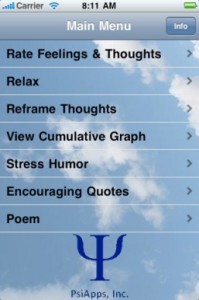
iStress is designed to provide all modes of stress reduction including monitoring, relaxation, positive thinking, humor, and developing an encouraging attitude toward those daily close encounters of the aggravating kind that we call stress. Stress management and Will enable you to learn relaxation techniques, positive thinking, and employ humor and encouraging thoughts to take control of your stress level and emotions. iStress will provide you with a daily/weekly record of stress levels related to thoughts and emotions.
A simple gratitude journal with emphasis on changing one’s attitude is a great little App for both iPhone and Android. By writing down five things you’re grateful for every day, takes the sting out of negative feelings and thoughts. With a function to add photos and even a facility for recording the weather, you can monitor thought patterns. After a month’s use it’s time to see if there’s a difference to your attitude towards life.
The Habit Factor £3.08 for the full version, lite version free
Most of us are creatures of habit. We tend to perform at our best when we incorporate positive habits into our daily routine. The Habit Factor is a tracking app that allows you to set goals and commit to forming good habits.
You can use the application to monitor your adherence to your resolutions and check them off as you accomplish them. If you’re trying to form good habits in your personal and professional life and stick to them, it helps to have a constant reminder like the one The Habit Factor provides.
Cognitive Diary CBT Self-Help - Android Apps on Google Play Free
Another nifty little App to monitor your thoughts and patterns, exchanging negative, destructive thoughts and feelings for positive and healthy ones. Completely free to download, this App intends to change the way you think and make you more aware of unhealthy thoughts and feelings associated with them.
The Worry Box
LEARN TO CONTROL WORRY – Tips and techniques
Self-help For Worry and Anxiety
***Does worry cause you to lose sleep?
***Does worry cause you anxiety and tension?
***Does worry give you headaches?
***Do you avoid things due to fear of outcome?
***Does your worry cause conflict with others?
Put it in the Worry Box
Self-Confidence and Healing
An app intended to assist you in developing your confidence by providing helpful articles and inspiring quotes. The intention is to help you approach this in a new light, not by aspiring for more and more things that will bolster your self-esteem, but by healing your sense of self-worth.
-Use the ‘share function’ to share your favorite quotes via Facebook, Twitter, SMS or other applications.
(To share with Facebook, use the copy button first, then click the share button, choose Facebook and paste)
-Native app. Can be used even when offline or not connected to the internet.
-Can be saved in SD card, hence saving memory.
-This is not a widget and will not crowd your home screen.
-Can use the ‘refresh’ function whenever you like. You don’t have to wait for the next day to read the quote for that day.
-Keep it handy for easy reference and sharing.
 The Secret $4.99
Personally created by Rhonda Byrne to give you new clarity, understanding and wisdom every day – the App is available for the first time direct on your iPhone or Android. Whether you believe in the Law of Attraction or not, this App is a great reminder that there is more depth to life than work, money and life’s problems. Each daily ‘wisdom’ brings light and clarity to an otherwise mundane world.
As well as having your own personal mobile access to this treasury of wisdom and inspiration, you can even schedule the time you’d like to be reminded to access your Secret Daily Teaching. Or, for even more synchronicity, schedule a random alert within your own nominated time frames, and watch as The Secret delivers the perfect message you need in your day, at exactly the time you need it! The Secret Daily Teachings App puts The Secret right in the palm of your hand, to inspire and guide you wherever you are. You’ll never miss a day of the life-changing knowledge!
Tags: Del.icio.us
TweetThis
Digg
StumbleUpon
Comments: 0 (Zero), Be the first to leave a reply!You might be interested in this:
Bangkok Rules released to 5 star reviews A Willing Servant by E.R. Thompson & How to Cure Insomnia The Drill Sergeant by E.R.Thompson Don't Worry by E.R. Thompson Five Signs of Sleep Disorders in School-Age Children with Special NeedsCopyright © M.J. Penny [The10 Best Self Help Phone Apps], All Right Reserved. 2013.March 7, 2013
Exercise Shields Children from Stress
 Exercise may play a key role in helping children cope with stressful situations, according to a recent study accepted for publication in The Endocrine Society’s Journal of Clinical Endocrinology & Metabolism (JCEM).
When they are exposed to everyday stressors, the study found sedentary children had surges of cortisol – a hormone linked to stress. The most active children had little or no increase in their cortisol levels in similar situations.
“The findings suggest physical activity plays a role in mental health by buffering children from the effects of daily stressors, such as public speaking,” said the study’s lead author, Silja Martikainen, MA, of the University of Helsinki, Finland.
The cross-sectional study monitored physical activity and cortisol levels in a birth cohort of eight-year-old children. The 252 participants wore accelerometer devices on their wrists to measure physical activity. Saliva samples were taken to measure cortisol levels. To measure reactions to stress, children were assigned arithmetic and story-telling tasks. The study is the first to find a link between physical activity and stress hormone responses in children.
The children were divided into three groups – most active, intermediate and least active. The most active children’s cortisol levels were the least reactive to stressful situations. The most active children exercised more vigorously and for longer periods of time than their counterparts.
“Clearly, there is a link between mental and physical well-being, but the nature of the connection is not well understood,” Martikainen said. “These results suggest exercise promotes mental health by regulating the stress hormone response to stressors.”
Other researchers working on the study include: A. Pesonen, J. Lahti, K. Heinonen, K. Feldt, R. Pyhälä and K. Räikkönen of the University of Helsinki; T. Tammelin of LIKES Research Center for Sport and Health Sciences; E. Kajantie and J. Eriksson of the National Institute for Health and Welfare; and T. Strandberg of Helsinki University Central Hospital.
The article, “Higher Levels of Physical Activity are Associated with Lower Hypothalamic-Pituitary-Adrenocortical Axis Reactivity to Psychosocial Stress in Children,” appears in the April 2013 issue of JCEM.
Founded in 1916, The Endocrine Society is the world’s oldest, largest and most active organization devoted to research on hormones and the clinical practice of endocrinology. Today, The Endocrine Society’s membership consists of over 16,000 scientists, physicians, educators, nurses and students in more than 100 countries. Society members represent all basic, applied and clinical interests in endocrinology. The Endocrine Society is based in Chevy Chase, Maryland. To learn more about the Society and the field of endocrinology, visit our site at www.endo-society.org. Follow us on Twitter at https://twitter.com/#!/EndoMedia.
Tags: attitude, Behaviour, children, help, lifestyle, mentalDel.icio.us
TweetThis
Digg
StumbleUpon
Comments: 0 (Zero), Be the first to leave a reply!You might be interested in this:
Music's role in building a baby's brain Conquering the Ego How to Concentrate (2) Be Punctual by E.R. Thompson The Nation That Procrastinates Reveals New UK StatisticsCopyright © M.J. Penny [Exercise Shields Children from Stress], All Right Reserved. 2013.More than half of us will send a Facebook message instead of a gift or card this mother’s day
 A recent survey has revealed that more than half of us will simply be sending a quick Facebook message or text rather than a special gift or a card this Mother’s Day.
The survey, which questioned more than 2,000 people under the age of 25 across the UK casts a sorry outlook on today’s younger generation as they skip taking part in the age-old tradition of celebrating mothers.
The survey also revealed nearly 20% will plan on pretending to have sent a Mother’s Day card using the old “lost in the post excuse.”
Matthew Lobas of online retailer SWAGG who headed the survery in February, said “The statistics summed up the little appreciation the younger generation have for adults in general and lifestyle changes in Britain.”
He said “We’re all more strapped for cash than ever with the recession but with a card costing as little as 29p or a small gift for under a fiver it paints a sorry picture to say the least.”
Tags: attitude, Behaviour, lifestyleDel.icio.us
TweetThis
Digg
StumbleUpon
Comments: 0 (Zero), Be the first to leave a reply!You might be interested in this:
Are you really you? When Goals are Forgotten: 4 Steps to Get Back on Track 7 Steps for Creating the Life YOU Want E.R. Thompson - The Human Machine, Secrets of Success Doing Nothing by E.R. ThompsonCopyright © M.J. Penny [More than half of us will send a Facebook message instead of a gift or card this mother's day], All Right Reserved. 2013.Children of Divorced Parents Are More Likely to Switch or Leave Religions
[image error]Adults whose parents were divorced are more likely to switch religions or disassociate themselves from institutional religions altogether — but growing up in a single-parent family does not have any effect on private religious life, including praying, according to a study by a Baylor University sociologist.
The findings also suggest that being a child of divorced parents is not in itself as important a factor in one’s religious life as previous research has indicated, according to Jeremy Uecker, Ph.D., an assistant professor of sociology in Baylor’s College of Arts & Sciences and lead author of the study, which appears in the Journal for the Scientific Study of Religion.
“You have to take into account the context,” Uecker said. “People who are less religious are more likely to get divorced. And if the parents are of different religions or differing levels of religiosity from one another, they also are more likely to divorce. So if we ignore that, we’re overstating the effects of divorce itself on religious outcomes.”
The main reason parental divorce affects religious outcomes, Uecker argues, is that children are separated from one of their parents, and parents are usually considered the primary source of religious training for children.
Other factors after the divorce also may influence children during their formative years and ultimately, affect their religious outcome as adults, he said.
A parent who has been divorced may feel stigmatized or uncomfortable in some congregations and less likely to attend than previously. Typically, a child of divorce stays with his or her mother, who may become depressed or angry with God, and “that may rub off on the child,” Uecker said. The child “may have thought the marriage was ordained by God. When it ends, that could rock their world and have lasting effects.”
Even logistical difficulty in getting to church could be a factor, Uecker said.
The study by Uecker and co-researcher Christopher G. Ellison, Ph.D., a professor in the department of sociology at the University of Texas in San Antonio, is a quantitative analysis of data from 3,346 respondents ages 18 to 87, taken from the General Social Surveys done in 1991, 1998 and 2008. In the surveys, done by the National Opinion Research Center at the University of Chicago, respondents were asked about their religiosity and birth family structure at age 16.
Tags: attitude, Behaviour, children, lifestyle, religionDel.icio.us
TweetThis
Digg
StumbleUpon
Comments: 0 (Zero), Be the first to leave a reply!You might be interested in this:
How To Get Up by E.R. Thompson What are relationships all about? No Scientific Basis for Prohibiting Same-Sex Marriage Conquering Shyness by E. R. Thompson -The Human Machine The Nation That Procrastinates Reveals New UK StatisticsCopyright © M.J. Penny [Children of Divorced Parents Are More Likely to Switch or Leave Religions], All Right Reserved. 2013.March 6, 2013
Five Signs of Sleep Disorders in School-Age Children with Special Needs
 While sleep disturbances are common in all children at some point during childhood, the National Association of School Psychologists estimates that as many as 30 percent of children have restless nights serious enough to be diagnosed with a sleep disorder. For children with special needs, the likelihood of sleep disorders is even higher, due to factors such as physical and behavioral differences, and even side-effects from medication.
Left untreated, sleep disorders can exacerbate existing conditions or cause additional health problems. While not all children with special needs who experience sleep disturbances will be diagnosed with a sleep disorder, experts point to early detection of common signs as the key to improving sleep.
According to Dr. Jennifer Accardo, director of the Sleep Disorders Clinic and Lab at the Kennedy Krieger Institute in Baltimore, Md., parents know their child’s sleep patterns best and are often able to spot a more serious problem if they know the signs.
Signs of Sleep Problems in Children with Special Needs
1. Snoring. Children who struggle to breathe or who noisily pause, gasp or choke in their nighttime breathing are at risk for obstructive sleep apnea. This treatable condition prevents a child from achieving deep, restful sleep and often results in daytime attention and behavior problems.
2. Difficulty falling or staying asleep. Everyone has problems now and then, but chronic difficulty falling or staying asleep can make it hard for children to stay alert and focused during the day. Even children can have insomnia, and those with disabilities tend to struggle the most.
3. Sleepwalking, night terrors and other nighttime activities. At some point, many children walk, talk or cry out in their sleep. Doctors call these occurrences parasomnias and if they happen often or over a long period of time, parents should seek help to find potential triggers.
4. Sleeping too much. Children who have trouble waking up in the morning, getting to school on time or falling asleep during class have clear signs of a sleep problem.
5. Needing parents to be in the room to fall asleep. If children are unable to fall asleep without their parents in the room, then it may be time to seek guidance.
“While a good night’s sleep is important for all children, it is especially critical for children with special needs,” says Dr. Accardo. “Parents can make small changes at home to help their child get a better night’s sleep and improve their performance in daytime activities, therapies and social interactions.”
Tips to Improve Sleep Patterns
1. Make sleep a priority. Without a good night’s sleep, children may have difficulty participating fully in activities such as homework, sports and therapies.
2. Develop a bedtime routine. Everyone needs this, even adults! A short set of calming activities helps children “wind down” to be ready for sleep.
3. Keep schedules consistent between weekdays and weekends. Kids who stay up later and sleep in on weekends may find it hard to return to their regular schedules during the school week.
4. In fact, keep schedules consistent every day! Going to bed and waking up around the same time daily trains your brain to account for the hours you need for other regular activities.
5. Make the bedroom a restful place. TV and video games are not only distracting in the bedroom, but they also produce bright light that signals the brain to wake up.
6. Sleep in the same place every night. Children who sleep on the couch, on the floor or in different beds have more trouble developing good sleep habits.
7. Avoid caffeine. Caffeine in sodas, teas and coffees can keep children and adults awake.
8. Put your child to bed when they are sleepy, but not yet fully asleep. Self-soothing is a fundamental skill for children. Putting children to bed before they are completely asleep gives them an opportunity to develop this skill.
9. Address anxiety. Anxiety commonly affects children with disabilities, and makes sleep difficulties worse.
10. Take note of sleep problem signs. Tracking patterns and signs can help your pediatrician or a sleep expert to more quickly identify the problem and offer solutions.
“If parents are concerned about their child’s sleep patterns and behaviors, they should consult with their pediatrician or a sleep expert,” says Dr. Accardo. “Sleep evaluations can be extremely beneficial in identifying causes and ultimately improving sleep for the entire family.”
About the Kennedy Krieger Institute
Internationally recognized for improving the lives of children and adolescents with disorders and injuries of the brain and spinal cord, the Kennedy Krieger Institute in Baltimore, MD, serves more than 18,000 individuals each year through inpatient and outpatient clinics, home and community services and school-based programs. Kennedy Krieger provides a wide range of services for children with developmental concerns mild to severe, and is home to a team of investigators who are contributing to the understanding of how disorders develop while pioneering new interventions and earlier diagnosis. For more information on the Kennedy Krieger Institute, visit www.kennedykrieger.org.
Tags: children, help, lifestyle, self, self help, sleep disordersDel.icio.us
TweetThis
Digg
StumbleUpon
Comments: 0 (Zero), Be the first to leave a reply!You might be interested in this:
How to Concentrate (2) The Nation That Procrastinates Reveals New UK Statistics Gender Gap Disappears in School Math Competitions Be Interested by E.R. Thompson Music's role in building a baby's brain Copyright © M.J. Penny [Five Signs of Sleep Disorders in School-Age Children with Special Needs], All Right Reserved. 2013.Think Straight
 By: E. R. Thompson – Taken from ‘The Human Machine’
There are a good many people who; while they would indignantly deny that they suffer from “nerves,” are incorrigible worriers. They not only worry about their own affairs, but about the affairs of everyone connected with them.
They assume full responsibility for the plans of their families and friends; they take their mistakes on to their own shoulders; they spend a great deal of time, not in their own present, but in other people’s futures.
It is not that they are simply incurable pessimists. True, they invariably see the worst in every situation, but on top of this they insist on adding to one’s own worries—which are often real enough—their worries, which are too often purely artificial.
This time the trouble is not lack of mental control. It is simply crooked thinking. It is a form of mental laziness, an unwillingness to think out the true values of facts and their real relations.
Such worrying helps nobody, not even the worrier.
Nearly always it ends in irritation and bad temper. Life is long, and the world is a big place. Trivial mistakes aren’t worth the emotion your worrier expends on them.
Past errors and future fears are alike worthless as subjects for thought.
The sort of person I am speaking of is at heart rather selfish, rather self-centred. Everything is considered in one light only: “How is it going to affect me?” No wonder they think crooked! Does the cap fit? Then get outside yourself. Make yourself a transmitter of ideas instead of a passive receiver of them.
Make an effort to see things in their true values. What‘s the use of pretending that every mouse is an elephant?
Tags: attitude, Books & Literature, E. R. Thompson, positive thought, self help, The Human MachineDel.icio.us
TweetThis
Digg
StumbleUpon
Comments: 0 (Zero), Be the first to leave a reply!You might be interested in this:
Gender Gap Disappears in School Math Competitions Be Interested by E.R. Thompson How to Concentrate (2) Conquering Shyness by E. R. Thompson -The Human Machine How Shakespeare’s writing was influenced by his lead actorCopyright © M.J. Penny [Think Straight], All Right Reserved. 2013.March 4, 2013
No Scientific Basis for Prohibiting Same-Sex Marriage
 Leading Mental Health Groups File Briefs in Supreme Court Cases Challenging Defense of Marriage Act, California’s Proposition 8
There is no valid scientific basis for denying same-sex couples the right to legal marriage, or to deprive them of considerable benefits of the institution, according to legal briefs filed with the U.S. Supreme Court by the American Psychological Association and other leading mental health associations.
“Empirical research demonstrates that the psychological and social aspects of committed relationships between same-sex partners largely resemble those of heterosexual partnerships,” the briefs state. “Like heterosexual couples, same-sex couples form deep emotional attachments and commitments. Heterosexual and same-sex couples alike face similar issues concerning intimacy, love, equity, loyalty and stability, and they go through similar processes to address those issues.”
Denying recognition to legally married same-sex couples stigmatizes them, according to the “friend of the court” briefs filed in the cases of Hollingsworth v. Perry, which challenges California’s Proposition 8, and U.S. v. Windsor, which challenges the federal Defense of Marriage Act. Perry is slated to be argued before the court on March 26; Windsor will be argued on March 27.
The briefs cite empirical scientific evidence that demonstrate that “homosexuality is a normal expression of human sexuality, is generally not chosen and is highly resistant to change.” Likewise, “there is no scientific basis for concluding that gay and lesbian parents are any less fit or capable than heterosexual parents, or that their children are any less psychologically healthy and well-adjusted,” according to the briefs.
“In drawing conclusions, we rely on the best empirical research available, focusing on general patterns rather than any single study,” the briefs state. All the studies cited in the brief were critically evaluated to assess their methodology, including the reliability and validity of the measures and tests employed, and the quality of data-collection procedures and statistical analyses.
APA President Donald N. Bersoff, PhD, JD, noted that the association has a long history of supporting equal access to legal marriage based on years of scientific research. “There is no scientific basis for denying marriage to same-sex couples particularly when research indicates that marriage provides many important benefits,” Bersoff said. “The research shows that same-sex couples are similar to heterosexual couples in essential ways and that they are as likely as opposite-sex couples to raise mentally healthy, well-adjusted children.”
Joining APA in filing the Windsor and Perry briefs were: the American Academy of Pediatrics; American Medical Association; California Medical Association; American Psychiatric Association; American Psychoanalytic Association; and National Association of Social Workers. Also joining the Windsor brief were: the New York City and New York state chapters of the National Association of Social Workers and the New York State Psychological Association. Also joining the Perry brief were the American Association for Marriage and Family Therapy; the California Chapter of NASW and the California Psychological Association.
The American Psychological Association, in Washington, D.C., is the largest scientific and professional organization representing psychology in the United States and is the world’s largest association of psychologists. APA’s membership includes more than 137,000 researchers, educators, clinicians, consultants and students. Through its divisions in 54 subfields of psychology and affiliations with 60 state, territorial and Canadian provincial associations, APA works to advance the creation, communication and application of psychological knowledge to benefit society and improve people’s lives.
Tags: mentalDel.icio.us
TweetThis
Digg
StumbleUpon
Comments: 0 (Zero), Be the first to leave a reply!You might be interested in this:
Oiled Wheels by E.R. Thompson Be Punctual by E.R. Thompson The Nation That Procrastinates Reveals New UK Statistics Gender Gap Disappears in School Math Competitions Are you really you?Copyright © M.J. Penny [No Scientific Basis for Prohibiting Same-Sex Marriage], All Right Reserved. 2013.


![[image error]](http://www.mjpenny.com/wp-content/uploads/2013/03/bay-logo1.png)