
Tonya R. Moore's Blog: Tonya R. Moore, page 34
October 3, 2016
Mythology of the Future
What is it that makes human dreams?
Why is it that we create stories of heroes and heroines whose adventures span galaxies? Why is it that our dreams are so big, so fantastic, when the true “known universe” barely extends beyond the heliosphere?
I think about my childhood—books by men like Asimov, Bradbury, Niven and books by women like McCaffrey.
They planted all these wild ideas of possible futures in my head, indirectly shaping the evolution of my imagination. As a child, everything that I yearned for seemed to be things that only existed beyond the stars.
Even now, at night, I’m always looking to the sky for something I cannot name.
There’s no denying that there’s beauty in the world and tiny miracles in the way it breathes and carries us in it.
Still, we’ve demystified so much of it. Long gone are the Moby Dicks, sea monsters, and Shambhalas of the world. Almost every supernatural myth that we re-tell or reinvent to thrill ourselves with is borrowed from something ancient.
You tell me, what will be the mythology of the future?



October 2, 2016
Rainy Days
One stormy day last year, I stood in my doorway, watching the watery spectacle unfold. I saw the glistening body of a snake moving through the grass toward the wood line. There, at the edge of the property, stood a single tree, aflame with yellow flowers. Even amidst all of that gray and wet, that fire couldn’t be extinguished. It stubbornly swayed in the heavy wind.
For some reason, that image made me think back to my childhood.
In the country, we’d set out metal drums to catch rainwater. I’d curl up into a quiet corner reading while half-listening to the pat-pat of raindrops against aluminum and wondering if there was a word for the burning smell that rose up from the asphalt. Time would seem to stand still as the whole world became blanketed by the sound of steadily falling rain.
I still love these times best, when the world is drenched in green and wet.
Whenever it rains, some bittersweet feeling always fills my heart and I can’t quite shake that feeling of missing someone acutely.
— Written for The Daily Post photo challenge, Nostalgia.
https://dailypost.wordpress.com/photo-challenges/nostalgia/


The Quiet One
I remember sitting on my uncle’s verandah as a kid, watching Star Trek through the living room’s glass paned window. I remember the voice of Captain Jean Luc Picard speaking of exploring strange, new worlds and seeking out new civilizations, of boldly going where no one has gone before.
Hearing those words for the very first time, I was electrified.
I was somewhere between eight and ten years old, that day I first fell truly, madly and deeply in love with sci-fi.
I remember night-time stories of the rolling calf, river mummas and duppies, especially some woman named Shirley’s duppy. I remember the lore and superstition that gave me curious thrills of fear and sent chills running down my spine.
I myself have had a supernatural “encounter” or two of my own.
Like those times I would hear someone call my name when there was no one else there. Like that time I thought I was being chased by a rolling calf.
Hearing and sharing these tales gave rise to my love of horror fiction.
I remember a land of twisted rivers, seething hills, lush valleys and the gloriously salty sea air—the breathtaking island of Jamaica, where I was raised.
I was a lonely child, uncommonly quiet at times. I was treated unkindly because of that silence, accused of being sneaky and devious by the adults around me. The ominous words “silent rivers run deep” were often thrown my way. This used to confuse me because I didn’t think I was being quiet.
After all, it was never quiet inside my head.
I remember reading Ray Bradbury for the very first time. The story was “All Summer in a Day” and I cried because I thought I was very much like Margot, treated like a weirdo and subjected to the casual cruelty of other children.
Years later, when I read “The Foghorn” my breath was taken away. My god, was it really possible to put that into words? That desperate, endless yearning.
It was then that I realized that I’d found in writers like Bradbury, McCaffrey, Asimov and Niven, kindred spirits of some kind.
It was then that I started dreaming of writing a story, a story that had not yet been told. A story that would let some other child realize that there was nothing under the sun or beyond, that couldn’t be put into words.
When I sleep, I dream in sci-fi and horror. I dream of monsters and invading aliens. I dream of chasing and being chased. The flotsam and jetsam of my childhood are always in interwoven within the fabric of my most fantastic nightmares.
In my dreams, I speed along the gnarly roads I once traveled in Jamaica. I smell the cereus that bloomed at night in my uncle’s garden and the cool moss and dark greenery of Fern Gully. I grow drunk on the deep, mysterious scent of the earth and sounds of this one winding river that always follows me in my dreams.
Somewhere along the line, my love of reading, dreaming and writing had collided with my love of science fiction and horror. Now, bits and pieces of my dreams and the vaguely remembered lore from my childhood spill from my fingers onto the page.
In the middle of the night, I wake up from terrible nightmares eagerly reaching for a pen.
My name is Tonya Regina Moore. I am a lonely speculative fiction writer, uncommonly quiet at times. I’ve accepted the fact that I’m sometimes regarded as strange by others. I believe silent rivers do run deep but believe me, there’s nothing quiet about me.
It is never quiet inside my head.
— (Article originally guest-posted at SallyEmber.com on 4/08/2015)


October 1, 2016
Space Age Mermaid
Sulily sleeps suspended inside a transparent, cylindrical womb filled with luminous blue fluid. Her suit sticks to her body like a second skin and has knobby nodes that run up the length of her spine and end at the soft helmet’s base at the back of her neck. From the center of the helmet, wires fan outward and upward, gathering at the control center at the top of the container. Sulily’s mouth and nose are covered by a breathing apparatus with a serpentine root that coils and stretches down to the base of the cylinder.
From time to time, her eyelids flicker and her fingers and toes twitch. Otherwise, she simply floats in suspended animation, unaware of even the small, robotic jellyfish that swim around her, monitoring her vitals and the state of the life-preserving fluid. Her unconscious body has already been floating inside the cylinder for three years. She will sleep like this for two more years, awaken for three then sleep again for two more years. When she awakens for the second time, this space age mermaid and her companions will be orbiting a whole new world. At least, that’s the plan.
Sulily dreams in hypersleep.
She doesn’t dream of the friends and family she left behind on Ceres or of the vast distances between stars. The dauntless pioneer doesn’t dream of the new life she will begin on a new planet or of the many adventures and hardships to come. She doesn’t dream of the starship’s photon sails, fluttering on cosmic currents like the wings of a butterfly as it breaches the solar system’s heliopause. She doesn’t dream of Barnard’s Star or of their target planet’s seven mysterious sisters. She doesn’t dream of the unknown continents waiting to be discovered or the icy moon Gog, circling the planet Magog–an ominous pair of names to which Sulily had stridently objected but was outvoted. She doesn’t dream of the past, the future, or even the present.
Sulily dreams of water, Big Water, abundant enough to swallow their massive spaceship whole. It is with longing that she dreams of Earth’s mighty ocean, that vast liquid body thrashing and throwing its weight around with abandon. She dreams of the gentle shushing of froth against the shorelines, of rip-roaring, thunderous waves cresting on the high seas and crashing against jagged cliffs. She dreams of awkward sea cows, humpty-dumpty sunfish, snaky oarfish, and the sightless monstrosities living below the photic zone–she’d once seen them all at an exhibit at the virtual zoo on Ceres. She dreams of shoals of mackerel twisting and folding into dense bait balls and ruthless sharks culling the frenetic herds.
She dreams of dark, green forests of sargassum, the baby seahorses and leafy seadragons taking shelter within their hairy embrace. She dreams of the many-tentacled octopuses, caught up in their furtive mating rituals and jittery war dances deeper down. In her dream, Sulily hears the shrieks of hungry seabirds, the boisterous chatter of dolphins, and the sad, beautiful singing of whales. In her dream, the jellyfish swimming around her are puffy giants with long, curly tendrils trailing along the ocean floor. Surrounded by the bioluminescent denizens of the great Deep, she is Captain Nemo ensconced within her rusty submarine, delving deep down into the starlit trenches of an Earth to which Sulily has never been.
Sulily doesn’t dream of jolly Roger Hartman, slumped at the pilot controls, all skeletonized and bone white. She doesn’t dream of Lady Diana Bergman–Sulily has secretly nicknamed her Princess of Mars–inside her fractured shell, all desiccated and deathly dark. She doesn’t dream of Torey Brown, the taciturn medical technician who died, plunging face first into a plate of scrambled egg whites; beside him on the counter, a worn paperback copy of The Integral Trees, earmarked at page three hundred and eighty-six. Sulily doesn’t dream of Miko Takano, the mechanical engineer with a penchant for reciting poetry aloud, curled up in her bunk, in the throes of a nightmare from which she will never awaken. She doesn’t dream of Mike Tully in the hydroponics bay, done in alongside his crop, dirt still clinging to the tips of his fingernails.
Sulily doesn’t know.
She doesn’t know that one year ago, along had come a wayward piece of cosmic debris, punching a hole into the spaceship’s hull and ripping through the quarters where she and her crewmates sleep. She doesn’t know that three of the seven watery wombs have cracked open like eggs, fluid spewing out, leaving inside only the devastated bodies of their unfortunate occupants. Sulily doesn’t know that the pilot and the rest of the on-duty shift are dead. She sleeps, unaware of the flickering lights and shrill alarms going off all over the ship. She doesn’t hear the intermittent crackle of the radio or the repetitive pleas for a response to mission control. She doesn’t know that the program designed to awaken her at the appointed time or in the event of an emergency has become corrupt and ceased to function.
Lost in her endless dreaming, Sulily will keep sleeping for another seven years.
The phantasmal Nautilus will continue plumbing the depths of the watery abyss for wonders and riches untold. Sulily will continue to float, suspended inside her high tech tomb. Solar winds will continue to bluster against the bow of the great ship. Barnard’s star will continue to lie in wait, expelling fairy dust and fire. Gog will continue to circle Magog—fourteen hundred and thirty-two more times. The ship’s engines will keep humming. The alarms will keep blaring. The desperate voices on the radio will keep calling. The bodies that haven’t rotted down to bone will become eternally mummified. Sole survivor oblivious, the corpse-laden spaceship will sail unerringly to her destined cosmic shore.
At the end of Sulily’s ten-year journey, the hole in the hull will have widened into a gaping maw. The doomed ship will wobble, spin, and burn up as it is sucked into Magog’s magnetic embrace. As if to dream the inevitable away, Sulily will still be dreaming inside her watery grave.
Sulily will never have an inkling of her gruesome fate.


The Light Offering
Tiamaht stands at the water’s edge in the deepest, darkest part of the valley and she waits. Moon wanes and thickest fog slides slowly down from the top of the mountain. The blind oracle waits there patiently for hours, sheltered in the arms of the forest with only the sounds of the wind moving through the wood, her own stuttering breath and the worms twisting under the skin of the earth to keep her company.
She stands there waiting with the hem of her dress trailing in the muddy water with her fingers curled tightly around the handle of her empty basket. She hears the odd sound that rises up and rises up from the deep, dark wet. Fearful, she trembles but Tiamaht hold her stance and she doesn’t falter.
One dreadful beast surges upward, its scaly head breaching the mirror-like surface. It drifts closer to the shore. It stills. Something soft and slippery licks at the tips of Tiamaht’s bare toes. Her throat constricts. A tiny whimper squeaks out. Frightened tears swell up into her sightless eyes, down her cheeks and onto her bosom.
She can feel the weight of the body that rises up out of the river. She senses that it stands on two feet and has the shape of a man. Tiamaht’s arms reach outward, basket raised in supplication.
Wordless breath and light spills from his mouth. His unearthly offering fills her proffered vessel until it overflows. He steps away. He sinks back down into the river. Tiamaht raises the basket to her lips and drinks the nectar, swallows it down until it spills over and washes the tears staining her cheeks away. The incandescent liquid slides down into her belly. It floods her body. It fills her bones.
The light enters her eyes and alters her mind.


Strangestar
The flowers that thrived, deep in the valley had been blooming non-stop for over one hundred years. The redolent profusion of colors and deep tropical scents were rumored to have driven many pilgrims who visited the mountains, stark mad. At least, that was the legend in the lowlands beyond the misty mountain range.
Elissa Dardo, Inspector General for the great metropolis across the sea, made such a pilgrimage during the course of performing her duty. She returned to her homeland after a solitary cycle of the sun, dressed as a beggar with strange whorls and dotted patterns carved into her skin by the blade of a knife. Self-inflicted she had proclaimed and joyfully so because mapped across every inch of her skin, were the greatest secrets of the universe.
Sadly, for the now ostracized Inspector, street walking prophets had been outlawed five decades earlier. No one in the citadel took her seriously, of course. She was summarily imprisoned within the asylum reserved for all the other creatures blighted with her supposed affliction.
Despite the efforts of the citadel’s officials, stories and rumors spread across continents like raging fire. There was a hermit, it was said, who lived in the valley and claimed to be over five hundred years old. He had seen a strange star fall there when he was a child–no bigger than a cherry but brighter than a million fireflies.
It had dug deep down into the earth there and made the valley its home.


September 4, 2016
The Nettle Tree Blog Tour: Genre Bender in a Blender
 The Nettle Tree, edited by Kenneth Weene and Clayton Bye, is a collection of genre-stretching and busting stories which includes my short story, Ephemera.
In this awesome collection, tales from the past, present, near future and far future collide. From gun-toting robots to aquarium-bound zombies, I—along with twelve amazing authors—bring forth a medley of colorful characters who delight, perturb, and plumb the depths of the human soul.
The Publisher is giving away 2 free copies of The Nettle Tree to commenters to this blog post. To enter, simply leave a reply in the Comments section at the bottom of the page.
At this point, I’d like to share a few thoughts on the origin of Ephemera.
Genre Bender in a Blender

I think it was Cowboys and Aliens or maybe that Doctor Who episode set in the Wild West that first triggered the desire to blend the sci-fi and western genres. For a while, though, I just let that notion slide to the back of my mind and there it sat and quietly lurked.
When approached with the invitation to submit a western—a strangely different kind of western—I must admit, at first, I was intimidated by the idea. I mean, writing a western was way, way outside of my comfort zone. Still, I was oddly thrilled by the prospect of trying something new, taking that step into the unknown.
At first, I desperately tried dredging up those ever so vague memories of every cowboy movie or television western I’ve even seen. The movie, Young Guns quickly came to mind but I was drawing a blank on everything else. I was, I admit, at a loss for a while. Then it came to me, not exactly in a flash but real steady like water that suddenly comes pouring out of a tap.
It started one day when I was humming along to The Real Folk Blues after re-watching an episode of Cowboy Bebop. I think it was after the ending credits, just before the fade out, I watched as the nostalgic words flickered on the TV screen “See you, Space Cowboy…”
I suddenly knew that my story would be a sci-fi western and it would not be set on Earth. Almost instantly, my mind reached back to an old piece of flash fiction about shape-shifting alien beings on some faraway planet that humans had colonized. I remembered wanting to explore that particular story idea just a little bit more. This seemed like the perfect time.
I started writing and in no time at all, Ephemera, a story about grave diggers leading the charge to re-colonize an alien frontier, sprang to life. Ephemera is one of thirteen strangely different stories, with a western flavor, in The Nettle Tree anthology.
THE ANTHOLOGY
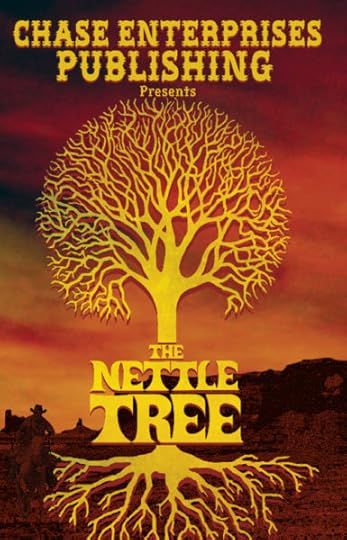 The Nettle Tree
$17.95
Authors: Tonya R. Moore, Leigh M. Lane, Phil Richardson, Salvatore Buttaci, Kenny Wilson, Richard Godwin, Ken Weene, Clayton Clifford Bye, Christopher Wolf, Jeremy C. Shipp, Jim Secor, John Rosenman, Casey June Wolf
Genre: Speculative Western
Tags: aliens, androids, artifical intelligence, creatures, monsters, speculative fiction, western, zombies
Length: Anthology
Publisher: Chase Enterprises Publishing
Publication Year: 2016
ASIN: 1927915104
ISBN: 9781927915103
In this awesome collection, tales from the past, present, near future and far future collide. From gun-toting robots to aquarium-bound zombies, thirteen amazing authors bring forth a medley of colorful characters who delight, perturb, and plumb the depths of the human soul.
Buy from Publisher

Overview
The Nettle Tree, edited by Kenneth Weene and Clayton Bye, is a collection of genre-stretching and busting stories by some of the most talented writers we have. Their challenge was to write strangely different western stories in a format of 3,000 words or less and to take you to places traditional westerns have never taken you. We think they have succeeded admirably. And with powerhouse writers, some known and others whom readers will find delightful discoveries, you will not be disappointed. Our thanks to Chase Enterprises Publishing for making this anthology possible.
The Nettle Tree
FROM THE OTHER AUTHORS
Leigh M. Lane – Coming Soon
Phil Richardson – Coming Soon
Salvatore Buttaci – Coming Soon
Kenny Wilson – Coming Soon
Richard Godwin – Coming Soon
Ken Weene – The Nettle Tree
Clayton Clifford Bye – Coming Soon
Christopher Wolf – Coming Soon
Jeremy C. Shipp – Coming Soon
Jim Secor – Coming Soon
John Rosenman – The Nettle Tree Blog Tour: A Collection of Wild & Woolly Speculative Western Tales
Casey June Wolf – Coming Soon
Don’t Forget
The Publisher is giving away 2 free copies of The Nettle Tree to commenters to this blog post. To enter, simply leave a reply in the Comments section at the bottom of the page.
The post The Nettle Tree Blog Tour: Genre Bender in a Blender appeared first on TONYA R MOORE.
August 23, 2016
Brainstorming Story Ideas 5 Ways
Brainstorming is generally the first step of the writing process. When planning a story, brainstorming helps to spark creativity and helps us to come up with new and original ideas or maybe even put news twists on old ideas.
Sometimes ideas for stories just pop into my head without warning. Who doesn’t just love when that happens? At other times, I have to put some effort into coming up with story ideas. This is where brainstorming comes into the picture.
Here’s a list of 5 ways I generally go about brainstorming story ideas.
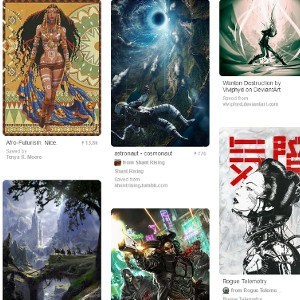 1. Pinterest/Inspiration Board
I keep an “inspiration” board on Pinterest. I also use Beenokle’s Inspiration Gallery to gather collections of inspiring pictures. I like to browse through these boards until I come across an image that just “speaks” to me. Then I move on to my next brainstorming method.
2. Random Words
I write down the first words that come to mind. If I use my inspiration board, I write down the first words that come to mind when I look at the image I selected. I write down random words until I come up with a concept, phrase, or even a single word that sticks out in my mind. Then I start bouncing ideas around.
3. Mind Mapping (or something like it)
I use Scapple, an application created by the awesome folks who brought us Scrivener to create mind maps of a sort when trying to come up with story ideas.
It isn’t exactly mind-mapping software—it’s more like a freeform text editor that allows you to make notes anywhere on the page and to connect them using straight dotted lines or arrows. If you’ve ever scribbled down ideas all over a piece of paper and drawn lines between related thoughts, then you already know what Scapple does. ~ Literature and Latte
 4. Stream of Consciousness
Stream of conscious simply entails this: write. Write whatever comes to mind, even nonsense. Just keep writing until something coherent, something you can use begins to take shape.
5. Challenges and Prompts
Many blogs and websites give writing prompts. Litopia, a writing forum, has their Flash Club. Chuck Wendig regularly issues awesome prompts on his blog. There are even tools such as Random Story Title Generator 2.0 available.
I attempt writing challenges/prompts every once in a while just for the fun of it. I might not be able to use all of the pieces that I write in response to prompts but it gets me into the habit of brainstorming story ideas.
How do you brainstorm new story ideas?
The post Brainstorming Story Ideas 5 Ways appeared first on TONYA R MOORE.
August 9, 2016
To Be Read: Books on Writing
 It’s National Book Lovers Day. Once I noticed that #NationalBookLoversDay was trending on Twitter, my first question was who decided that August 9th should be National Book Lovers Day? Some hasty research produced no answer, so I’m just going to go with a bibliophile.
The very next thing that came to mind was my ever-growing to-be-read pile. I won’t even bother to count the number of books on my kindle that are waiting to be read. A quick glance at one of my bookshelves provided a bit of a surprise. Most of the books that I’m meaning to read next are books on the art of Writing.
The first is Stephen King’s “On Writing” which has been a fixture on my bookshelf for several years now. It was mentioned several times in a Creative Writing class that I took a few months ago, which reminded me that not only did I have the book, I had never quite finished reading it. I recall what I read being very interesting and informative too.
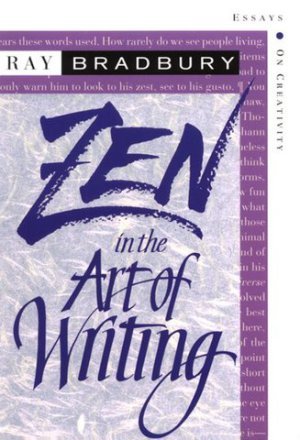
I’m also looking forward to reading Ray Bradbury’s “Zen in the Art of Writing.” As I’ve mentioned many times before, I’m a huge fan of the works of Ray Bradbury but for quite some time, I wasn’t even aware that he had written a book about writing.
Aside from those two books, I also have “Writing Tools: 50 Essential Strategies for Every Writer” by Roy Peter Clark, “Plot Whisperer: Secrets of Story Structure Any Writer Can Master” by Martha Alderson, “How to Write Science Fiction and Fantasy” by Orson Scott Card, and “Writer with a Day Job: Inspiration and Exercises to Help You Craft a Writing Life Alongside Your Career” by Aine Greaney.
Since I have some free time today, I think I’ll start with “On Writing” and work my way down this awesome list.
The post To Be Read: Books on Writing appeared first on TONYA R MOORE.
Get Your Writing Blog Listed at Alltop
Alltop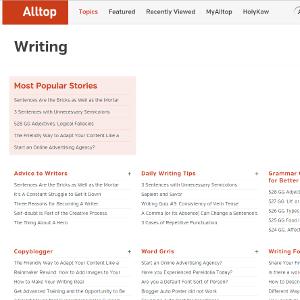 is an online magazine rack of sorts. Alltop endeavors to offer up the latest posts from the best websites and blogs that cover topics that run the gamut from pop culture to entertainment and many more.
The “many more” I speak of includes Writing, Literature, Blogging, SciFi & Fantasy Novels, Horror Novels, Mystery Novels, Romance Novels, and Ebooks. Alltop displays the five most recent headlines from each source, with direct links to each post.
Alltop is the product of Nononina, which was founded by Will Mayall, Guy Kawasaki, and Kathryn Henkens.
Alltop is great for discovering new blogs and websites or keeping up with the latest from your favorite websites and blogs. Users can curate their own unique list of sites and blogs to follow, creating a magazine type collection to check for new posts at-a-glance.
A website needs to get listed at Alltop to be available for curation.
3 Reasons to Get Listed
The most obvious benefits to having your writing listed are as follows:
The opportunity to maximize your web presence
The potential to increase your writing blog’s readership
Relevant links to your writing blog
How to Get Listed
Getting listed is remarkably simple. All you need to do is Register to the site then utilize the Submission Form to supply the following information:
Alltop Topic, Site/blog name, Site/blog URL, RSS feed address, Site/blog owner’s name (first/last), Comments
It can take up to two months for a site to get approved but just for your information, my writing blog got listed one day after submission.
For more information, see Alltop’s About page and see the answers to their FAQ for Site Owners and Bloggers. For those with an interest in learning from one of the best bloggers on the net, I also recommend checking out Guy Kawasaki’s blog.
The post Get Your Writing Blog Listed at Alltop appeared first on TONYA R MOORE.
Tonya R. Moore
- Tonya R. Moore's profile
- 36 followers

