
Allan Krummenacker's Blog, page 11
August 13, 2016
Hey Allan, Is "The Door" Still Coming?
In spite of all the excitement of the anticipated release of "The Vampyre Blogs - Coming Home", this October, I keep hearing people ask 'Whatever happened to "The Door"? Are you going to finish that story? I want to know what happened next with Alex, Veronica, Julie, and Cassandra.'
For those who are still wonder the answer is a resounding "YES!" I am currently working on that story as we speak. In fact I've been working on it for quite a while... a really long while... like over two years... (groan)
All right knock it off Roscoe! I don't need to hear more laughs coming from the peanut gallery. Sheesh.
Now I hear the rest of you asking, "Why is it taking so long?" Well the answer is quite simple, I've spent the last 24 months with a serious case of 'too many ideas'. What does that look like you ask? Here let me show you...
You see one of the biggest problems I've had was that I kept getting new scenes going that seemed to help move the plot along just great. But after a while these ideas either wound up derailing the main plot of the story, and eventually I'd wind up hitting the well-known wall called "Writers Block". In some cases I wound up backpedaling and removing the new scene entirely and found myself stuck once again trying to figure out what I could do to move the story forward again. In the case of "The Door" this kept happening over and over again, which left me both frustrated and stuck.
Now some people will point out that maybe I should have used an outline and stuck with it before I started writing the story. While this idea has merit, there are several problems when it comes to me and outlines. I have certain ideas and scenes so well plotted out that to wind up not using them seems unthinkable. A cardinal sin, a betrayal of all I've dedicated my life to in fact...
However, my characters have this annoying tendency to not tell me their whole life stories until I'm already writing their current adventure. Soon, they start developing in ways I never thought of or having ideas of their own, which I wind up finding far more satisfying than what I had planned for them. So what happens...
They suddenly veer right with the story, while I had planned on having them go to the left. This happens repeatedly, but most of the time the story winds up much better than what I had originally planned. So these days I use what I call a 'loose' outline. There are certain scenes and ideas that I am certain must happen, and have other areas where I'm still not sure how I want to proceed. So I move forward with what I've got and let the characters help me develop those sections.
For the most part this has worked great. However, in the case of "The Door" I had a number of scenes that were so solid, there was no way in the world I was not going to use them. I had them carved in stone, period. Unfortunately trying to lead the characters and the story up to those moments began to become a problem. So I kept trying new ideas to allow me to keep those scenes because they were too 'precious' to lose, "Gollum, Gollum.... we wants those scenes... they must happen... we can't give them up... Gollum, Gollum"
Cough! Sorry about that. Now you know how a writer's mind works some days. Anyway, some of the things I tried to keep those scenes involved a number of tactics, including adding new characters like my vampyre Nathan (my star of "The Vampyre Blogs - Private Edition"). His short-lived involvement with my existing characters allowed me to come up with a whole new host of scenes that really moved the story along. However, it came with a price. The word count skyrocketed, because of having to introduce him to the characters one by one, new scenes just for him, along with other new characters, etc. and the story was becoming unwieldy. So in the end I had to do this...
I took him back out of the story (as most of you know from previous entries). However, a number of the scenes he inspired were kept. I simply gave his actions to existing secondary characters instead, allowing me to build up their appearance time in the story thus making them more interesting. This also allowed me to cut down the word count considerably to something much more manageable, as well as quicken the pace of the story overall.
Still I kept hitting a few more walls. Finally, I set the story aside entirely and focused my energies on "The Vampyre Blogs - Coming Home", and two collaboration projects I have going. This allowed me to keep being creative, and not feel guilty about neglecting this book. More importantly, it also gave me the chance to come back to "The Door" with a fresh pair of eyes and a more open mind.
Upon re-reading what I'd done, I soon saw that certain subplots needed to go, while others needed to be built upon and expanded. I also realized that some of those 'precious scenes' I thought the book could never do without, no longer fit this story. So I removed them from the mix as well.
The result was losing about 40,000 words, while introducing a more coherent and cohesive storyline that is now moving along very nicely. Tensions are rising, mysteries deepening, the air is filling with impending danger for certain characters, while fallout from "The Bridge" is being addressed leading to unanswered questions to be addressed.
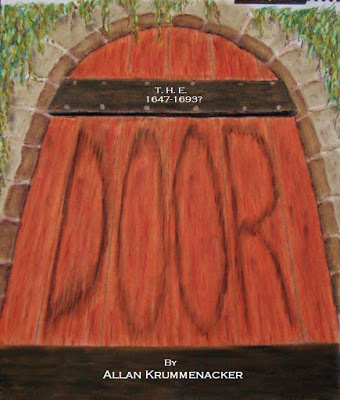
In short, "The Door" is on its way folks. I hope to release it in May of next year, or possibly sooner. We'll see. Part of this will depend on how much time my studies at university take up. Classes start the week after next, so I'm trying to get a lot done between now and then. Furthermore, I'll be expending a lot of energy promoting and marketing "The Vampyre Blogs - Coming Home" in October. Then of course the holidays will arrive and life will get in the way.
But rest assured, "The Door" is coming. It's taken the long way around to arrive, but its on the way. Sometimes, writing is a race where you sprint and other times you have to pace yourself and move slower than you'd like. Rest assured though, that even when you're moving slower, you ARE making progress.
So until next time, take care and keep writing my friends.
For those who are still wonder the answer is a resounding "YES!" I am currently working on that story as we speak. In fact I've been working on it for quite a while... a really long while... like over two years... (groan)

All right knock it off Roscoe! I don't need to hear more laughs coming from the peanut gallery. Sheesh.
Now I hear the rest of you asking, "Why is it taking so long?" Well the answer is quite simple, I've spent the last 24 months with a serious case of 'too many ideas'. What does that look like you ask? Here let me show you...
You see one of the biggest problems I've had was that I kept getting new scenes going that seemed to help move the plot along just great. But after a while these ideas either wound up derailing the main plot of the story, and eventually I'd wind up hitting the well-known wall called "Writers Block". In some cases I wound up backpedaling and removing the new scene entirely and found myself stuck once again trying to figure out what I could do to move the story forward again. In the case of "The Door" this kept happening over and over again, which left me both frustrated and stuck.
Now some people will point out that maybe I should have used an outline and stuck with it before I started writing the story. While this idea has merit, there are several problems when it comes to me and outlines. I have certain ideas and scenes so well plotted out that to wind up not using them seems unthinkable. A cardinal sin, a betrayal of all I've dedicated my life to in fact...
However, my characters have this annoying tendency to not tell me their whole life stories until I'm already writing their current adventure. Soon, they start developing in ways I never thought of or having ideas of their own, which I wind up finding far more satisfying than what I had planned for them. So what happens...

They suddenly veer right with the story, while I had planned on having them go to the left. This happens repeatedly, but most of the time the story winds up much better than what I had originally planned. So these days I use what I call a 'loose' outline. There are certain scenes and ideas that I am certain must happen, and have other areas where I'm still not sure how I want to proceed. So I move forward with what I've got and let the characters help me develop those sections.
For the most part this has worked great. However, in the case of "The Door" I had a number of scenes that were so solid, there was no way in the world I was not going to use them. I had them carved in stone, period. Unfortunately trying to lead the characters and the story up to those moments began to become a problem. So I kept trying new ideas to allow me to keep those scenes because they were too 'precious' to lose, "Gollum, Gollum.... we wants those scenes... they must happen... we can't give them up... Gollum, Gollum"
Cough! Sorry about that. Now you know how a writer's mind works some days. Anyway, some of the things I tried to keep those scenes involved a number of tactics, including adding new characters like my vampyre Nathan (my star of "The Vampyre Blogs - Private Edition"). His short-lived involvement with my existing characters allowed me to come up with a whole new host of scenes that really moved the story along. However, it came with a price. The word count skyrocketed, because of having to introduce him to the characters one by one, new scenes just for him, along with other new characters, etc. and the story was becoming unwieldy. So in the end I had to do this...

I took him back out of the story (as most of you know from previous entries). However, a number of the scenes he inspired were kept. I simply gave his actions to existing secondary characters instead, allowing me to build up their appearance time in the story thus making them more interesting. This also allowed me to cut down the word count considerably to something much more manageable, as well as quicken the pace of the story overall.
Still I kept hitting a few more walls. Finally, I set the story aside entirely and focused my energies on "The Vampyre Blogs - Coming Home", and two collaboration projects I have going. This allowed me to keep being creative, and not feel guilty about neglecting this book. More importantly, it also gave me the chance to come back to "The Door" with a fresh pair of eyes and a more open mind.
Upon re-reading what I'd done, I soon saw that certain subplots needed to go, while others needed to be built upon and expanded. I also realized that some of those 'precious scenes' I thought the book could never do without, no longer fit this story. So I removed them from the mix as well.
The result was losing about 40,000 words, while introducing a more coherent and cohesive storyline that is now moving along very nicely. Tensions are rising, mysteries deepening, the air is filling with impending danger for certain characters, while fallout from "The Bridge" is being addressed leading to unanswered questions to be addressed.

In short, "The Door" is on its way folks. I hope to release it in May of next year, or possibly sooner. We'll see. Part of this will depend on how much time my studies at university take up. Classes start the week after next, so I'm trying to get a lot done between now and then. Furthermore, I'll be expending a lot of energy promoting and marketing "The Vampyre Blogs - Coming Home" in October. Then of course the holidays will arrive and life will get in the way.
But rest assured, "The Door" is coming. It's taken the long way around to arrive, but its on the way. Sometimes, writing is a race where you sprint and other times you have to pace yourself and move slower than you'd like. Rest assured though, that even when you're moving slower, you ARE making progress.
So until next time, take care and keep writing my friends.


July 28, 2016
Showing Another Side of My Creative Mind...
Today I was in one of my moods regarding creativity and decided to share another side of myself. As many of you know, I not only write, but I'm also an artist who specializes in soft pastels and charcoal. I know I've shown some of my book covers, but today I felt like sharing some of the other works I've come up with over the years.
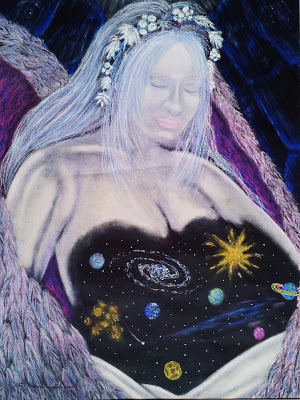
This first piece is a soft pastel which was inspired by a song by Nina Gordon, "Tonight and the rest of my Life". Her we have an angelic figure who holds a universe in her arms and behind her you can make out large fingers which in turn cradle her.
This piece was coming along beautifully until it came time to do the face. I couldn't find the right one to use, or get the angles right. Then my wife stepped in and posed her head just right, and from then on the painting seemed to come alive. It held even more meaning than before to me as I retouched areas and strove to finish it with great love and affection, for now it showed how much she means to me and how she holds MY universe in her arms, forever and always.
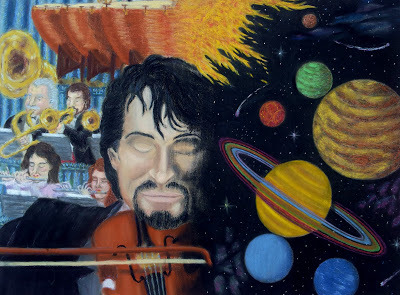
This next piece was inspired by Holts' "The Planets Suite". Many of us has heard the "Mars, Bringer of War" with its powerful ominous tones, but there are a number of other songs on the album that brings the almost all the planets of our solar system into new and even playful ideas. Having played violin in school for a number of years (no I did not ever play Holts' music unfortunately) I often found myself drawn into the music as it filled my head with all sorts of wondrous images. So in this piece I tried to capture those moments and feelings in my work. I like to think I succeeded.
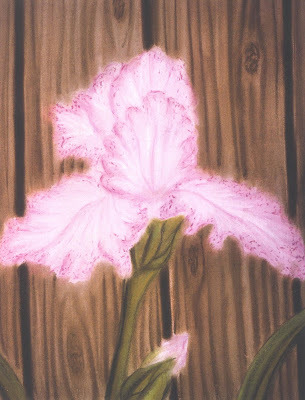
Mind you, I do not specialize simply in cosmic inspired artwork. I'm one of those artists who simply paints whatever catches their fancy. Take this Pink Iris for instance. This lovely blossom was growing in our backyard one year and I was totally captivated by how the sun was catching it in just the right way that it seemed to glow. I immediately set up my easel outside and pulled out my pastels and went to work. In one hour I was done. This is probably one of the fastest pieces I've ever created, and I was very pleased with the results.
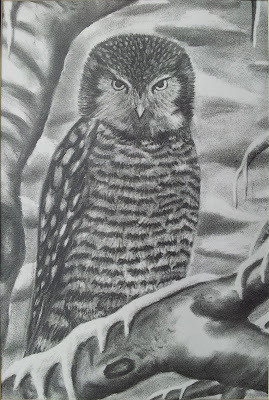
Finally, I wanted to share one of my charcoal pieces. This Spotted Owl, I created from looking at various photos of owls and I came up with this fine, slightly scowling, fellow. While by no means my best charcoal piece, it gives you an idea of some of the effects I've been able to achieve in that medium. I was particularly proud of the feathering effects I was able to capture in this piece.
So what does all this have to do with writing? Sometimes an image can give birth to a story, and vice versa. Both inspiration and creativity can take so many forms and need to be expressed in different ways. In my case, I've been able to blend the two into my books and enjoy every minute of it, even during the more 'difficult' times. They can be a struggle, but they usually lead to some fine results one can be proud of.
If anyone would like to see more of my artwork, you can go to this link at Fine Art America, where prints, pillows, duvets, towels, and so many other items can be purchased with the images beautifully imprinted on them:
http://fineartamerica.com/artists/allan+krummenacker
I'll be sharing more images here as I get better quality photos, as well as continuing my posts about my adventures in writing. I must say even after being an Indie Author for 3 years now, I'm still on a learning curve. Is that true for others as well? Let us know by leaving your thoughts in the comment section below.
Thanks again for tuning. Until next time, take care and keep writing.
This first piece is a soft pastel which was inspired by a song by Nina Gordon, "Tonight and the rest of my Life". Her we have an angelic figure who holds a universe in her arms and behind her you can make out large fingers which in turn cradle her.
This piece was coming along beautifully until it came time to do the face. I couldn't find the right one to use, or get the angles right. Then my wife stepped in and posed her head just right, and from then on the painting seemed to come alive. It held even more meaning than before to me as I retouched areas and strove to finish it with great love and affection, for now it showed how much she means to me and how she holds MY universe in her arms, forever and always.

This next piece was inspired by Holts' "The Planets Suite". Many of us has heard the "Mars, Bringer of War" with its powerful ominous tones, but there are a number of other songs on the album that brings the almost all the planets of our solar system into new and even playful ideas. Having played violin in school for a number of years (no I did not ever play Holts' music unfortunately) I often found myself drawn into the music as it filled my head with all sorts of wondrous images. So in this piece I tried to capture those moments and feelings in my work. I like to think I succeeded.

Mind you, I do not specialize simply in cosmic inspired artwork. I'm one of those artists who simply paints whatever catches their fancy. Take this Pink Iris for instance. This lovely blossom was growing in our backyard one year and I was totally captivated by how the sun was catching it in just the right way that it seemed to glow. I immediately set up my easel outside and pulled out my pastels and went to work. In one hour I was done. This is probably one of the fastest pieces I've ever created, and I was very pleased with the results.

Finally, I wanted to share one of my charcoal pieces. This Spotted Owl, I created from looking at various photos of owls and I came up with this fine, slightly scowling, fellow. While by no means my best charcoal piece, it gives you an idea of some of the effects I've been able to achieve in that medium. I was particularly proud of the feathering effects I was able to capture in this piece.

So what does all this have to do with writing? Sometimes an image can give birth to a story, and vice versa. Both inspiration and creativity can take so many forms and need to be expressed in different ways. In my case, I've been able to blend the two into my books and enjoy every minute of it, even during the more 'difficult' times. They can be a struggle, but they usually lead to some fine results one can be proud of.
If anyone would like to see more of my artwork, you can go to this link at Fine Art America, where prints, pillows, duvets, towels, and so many other items can be purchased with the images beautifully imprinted on them:
http://fineartamerica.com/artists/allan+krummenacker
I'll be sharing more images here as I get better quality photos, as well as continuing my posts about my adventures in writing. I must say even after being an Indie Author for 3 years now, I'm still on a learning curve. Is that true for others as well? Let us know by leaving your thoughts in the comment section below.
Thanks again for tuning. Until next time, take care and keep writing.
July 21, 2016
Stepping Away From Your Work In Progress, Then Coming Back To It...
We've all been there, slaving away at a story and finding yourself getting more lost or frustrated with where it's going. Even if you have a well planned outline to guide you, there's always a scene or situation that arises that leaves you flummoxed and frustrated. You can't seem to move the story or yourself forward for one reason or another. What do you do?

Well, in my case I get up and walk away from the story and I mean in every sense of the word. Step away from your computer and do other things. "But for how long?" I hear you ask. My answer is simply this, "As long as it takes."
"But I can't stop writing, I've got so many ideas in my head..."
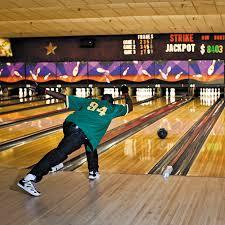
GREAT! Go work on one of those instead. I'm not saying stop writing by any means. What I'm suggesting is that you let your brain work on other projects, or activities such as go bowling...
Take a nice long walk...

Go someplace...
In short do whatever else you enjoy or have been thinking about doing and have put off. Let your mind wander and experience something other than trying to figure out your story. Brains need downtime or something new to work on in order to keep them working right. Or like I said before, work on some other stories or ideas not connected to your work in progress.
Sometimes I find working on an entirely different project makes me feel better about having been stuck on the one I've stepped away from. I actually relax and feel the same passion and satisfaction from using my creative side.
In my case, I've been working on "The Door" for almost two years now and still haven't finished a 1st draft yet. Why? Because I kept hitting various roadblocks.

And each time I hit one, I'd bang my head against it for days before finally walking away. Then after a while (i. e. a few days, weeks, or even months) I'd come back to it with a new idea and started making progress again. But then I hit another obstacle and had to walk away again. It's not that I don't like the story, I love it! It's crucial to furthering my Para-Earth Series, which may have been part of the problem. I was trying to put TOO much into the story and kept getting myself bogged down, or losing sight of the plot. Within the last year I tried introducing new characters who would appear in later books (such as my vampyre Nathan) which helped open new avenues and scenes, but the story began getting too long and convoluted. I was losing sight of the main characters for "The Door" (Alex, Veronica, Cassandra, Julie). So I pulled him back out of the book. But some of the scenes his presence inspired remained because they were useful.
But then I found the book was almost 70,000 words long, even with Nathan and company's removal, so I set the book aside again and worked on "The Vampyre Blogs - Coming Home" getting it ready to be released this October.
Now, with "The Vampyre Blogs - Coming Home" in the hands of beta-readers who I won't hear back from until next month, I found myself coming back to "The Door".
What happened next? I'll tell you in my next entry.
Until then, take care and keep writing...

Well, in my case I get up and walk away from the story and I mean in every sense of the word. Step away from your computer and do other things. "But for how long?" I hear you ask. My answer is simply this, "As long as it takes."
"But I can't stop writing, I've got so many ideas in my head..."
GREAT! Go work on one of those instead. I'm not saying stop writing by any means. What I'm suggesting is that you let your brain work on other projects, or activities such as go bowling...
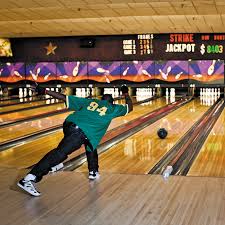
Take a nice long walk...

Go someplace...

In short do whatever else you enjoy or have been thinking about doing and have put off. Let your mind wander and experience something other than trying to figure out your story. Brains need downtime or something new to work on in order to keep them working right. Or like I said before, work on some other stories or ideas not connected to your work in progress.
Sometimes I find working on an entirely different project makes me feel better about having been stuck on the one I've stepped away from. I actually relax and feel the same passion and satisfaction from using my creative side.
In my case, I've been working on "The Door" for almost two years now and still haven't finished a 1st draft yet. Why? Because I kept hitting various roadblocks.

And each time I hit one, I'd bang my head against it for days before finally walking away. Then after a while (i. e. a few days, weeks, or even months) I'd come back to it with a new idea and started making progress again. But then I hit another obstacle and had to walk away again. It's not that I don't like the story, I love it! It's crucial to furthering my Para-Earth Series, which may have been part of the problem. I was trying to put TOO much into the story and kept getting myself bogged down, or losing sight of the plot. Within the last year I tried introducing new characters who would appear in later books (such as my vampyre Nathan) which helped open new avenues and scenes, but the story began getting too long and convoluted. I was losing sight of the main characters for "The Door" (Alex, Veronica, Cassandra, Julie). So I pulled him back out of the book. But some of the scenes his presence inspired remained because they were useful.
But then I found the book was almost 70,000 words long, even with Nathan and company's removal, so I set the book aside again and worked on "The Vampyre Blogs - Coming Home" getting it ready to be released this October.
Now, with "The Vampyre Blogs - Coming Home" in the hands of beta-readers who I won't hear back from until next month, I found myself coming back to "The Door".
What happened next? I'll tell you in my next entry.
Until then, take care and keep writing...
July 6, 2016
Collaborations: What Do They Look Like and How Do I Make Mine Work? Part – II
Welcome back to another installment of collaborations: what do they look like and how do I make mine work? Okay, actually, I’m continuing the discussion from last time. After all, this is supposed to be a blog, not an ongoing saga. I also want to apologize for any strange grammar or punctuation errors in this entry because I’m using Dragon instead of actually typing on a keyboard.
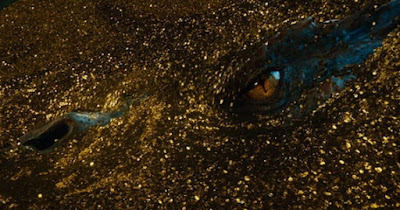
WRONG DRAGON! SORRY DIDN'T MEAN TO WAKE YOU UP, SIR. PLEASE JUST GO BACK TO SLEEP!
Whew! Anyway, I'll be sharing my adventures with Dragon Speaking Naturally software, and learning how to use it, in another blog entry, For now I’m going to continue to share my experiences with collaborations Now, last time I talked about my collaboration with my old friend Rich Caminiti, today I’m going to be discussing my other collaboration with my wife Helen. First off, unlike with Rich, I am able to work with my wife, face-to-face.

Being able to spend time with each other in real life instead of waiting to go on Skype to plot or give feedback like I do with Rich. This gives a whole new dynamic to our collaboration since we don’t always have to be at our computers to work on the story. Instead, we could be driving someplace or having dinner at a restaurant and will be discussing ideas and scenes for the story. Being able to operate like this gives us a distinct advantage to rework a scene before we actually put it to paper. We get the chance to work out the dynamics between the characters, feelings, emotions, reactions and have a more clear idea of how we want a scene to read. Does this automatically mean that we have every scene worked out perfectly? Absolutely not. In fact, we will rework a scene time and again until we find a version that we both really like that works. Even then we will occasionally go back to that scene and rework it with new elements that we hadn’t thought of before to improve it. Furthermore, we may not always agree on exactly how we want a scene to play out. There might be elements that one of us thinks would work better in a later point in the story. In cases like this, it’s much easier to have the other person there with you to work out those differences and come up with a common solution that we can both live with. Another benefit is on occasion someone might forget a detail or plan that we decided to use in a scene a few days before. This actually happens quite often due to my fibromyalgia. I get the infamous "brain-fog" and forget things. Luckily, Helen is always around to help me remember what I forgot what we had planned for a scene and proceed to fix it. I often refer to her as my spare brain in these cases, since they happen rather often to me.
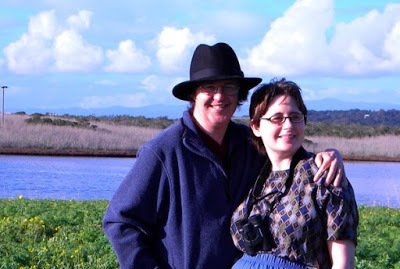
As you can see, we rely on each other quite often which makes our collaboration work even better. Mind you, we don’t always work on the project together at the same exact time. In fact, since she’s a bit of a night owl, I’ll find that she’s been in the story working on it during the night while I was asleep. This is actually a lot of fun for me, because then I get to see all this new material as if I was the reader and now I get to react to it. And of course will be times when I’m working on the story when she doesn’t know what and when she goes in show find what I’ve written and then it will be her turn to react and come up with a new scene or response. In a way to sort of the game of role-playing for us except that were actually putting together a story for others to read and enjoy. Now as I said in the previous entry, Rich and I take turns working on different scenes as well and we get the same effect. But with Helen, I get to see the reactions on her face and get her input and feedback a lot sooner which gives me a great deal of pleasure. So as you can see both collaborations share a lot of similarities but there are also a number of differences. And there are number of ways that you can make a collaboration work, it’s all in how you and your cohort approach things. Most of the time you’ll find there is always a way to make it work, it’s mostly a question of what method is going to work best for the two of you.
And that’s all I have to say for now folks, so until next time, take care enjoy the summer and keep writing.


WRONG DRAGON! SORRY DIDN'T MEAN TO WAKE YOU UP, SIR. PLEASE JUST GO BACK TO SLEEP!
Whew! Anyway, I'll be sharing my adventures with Dragon Speaking Naturally software, and learning how to use it, in another blog entry, For now I’m going to continue to share my experiences with collaborations Now, last time I talked about my collaboration with my old friend Rich Caminiti, today I’m going to be discussing my other collaboration with my wife Helen. First off, unlike with Rich, I am able to work with my wife, face-to-face.

Being able to spend time with each other in real life instead of waiting to go on Skype to plot or give feedback like I do with Rich. This gives a whole new dynamic to our collaboration since we don’t always have to be at our computers to work on the story. Instead, we could be driving someplace or having dinner at a restaurant and will be discussing ideas and scenes for the story. Being able to operate like this gives us a distinct advantage to rework a scene before we actually put it to paper. We get the chance to work out the dynamics between the characters, feelings, emotions, reactions and have a more clear idea of how we want a scene to read. Does this automatically mean that we have every scene worked out perfectly? Absolutely not. In fact, we will rework a scene time and again until we find a version that we both really like that works. Even then we will occasionally go back to that scene and rework it with new elements that we hadn’t thought of before to improve it. Furthermore, we may not always agree on exactly how we want a scene to play out. There might be elements that one of us thinks would work better in a later point in the story. In cases like this, it’s much easier to have the other person there with you to work out those differences and come up with a common solution that we can both live with. Another benefit is on occasion someone might forget a detail or plan that we decided to use in a scene a few days before. This actually happens quite often due to my fibromyalgia. I get the infamous "brain-fog" and forget things. Luckily, Helen is always around to help me remember what I forgot what we had planned for a scene and proceed to fix it. I often refer to her as my spare brain in these cases, since they happen rather often to me.

As you can see, we rely on each other quite often which makes our collaboration work even better. Mind you, we don’t always work on the project together at the same exact time. In fact, since she’s a bit of a night owl, I’ll find that she’s been in the story working on it during the night while I was asleep. This is actually a lot of fun for me, because then I get to see all this new material as if I was the reader and now I get to react to it. And of course will be times when I’m working on the story when she doesn’t know what and when she goes in show find what I’ve written and then it will be her turn to react and come up with a new scene or response. In a way to sort of the game of role-playing for us except that were actually putting together a story for others to read and enjoy. Now as I said in the previous entry, Rich and I take turns working on different scenes as well and we get the same effect. But with Helen, I get to see the reactions on her face and get her input and feedback a lot sooner which gives me a great deal of pleasure. So as you can see both collaborations share a lot of similarities but there are also a number of differences. And there are number of ways that you can make a collaboration work, it’s all in how you and your cohort approach things. Most of the time you’ll find there is always a way to make it work, it’s mostly a question of what method is going to work best for the two of you.
And that’s all I have to say for now folks, so until next time, take care enjoy the summer and keep writing.

June 16, 2016
Collaborations: What Do They Look Like? How Do I Make Mine Work? - Part 1
As you all know by now, I've been working on not one but two different collaborations. The first is "The Pass" a historical/fantasy piece with a fellow I went to high school with some 30 years ago, Richard Caminiti. (for the sake of privacy, I left the clipboard showing his name and arrest number from this police photo out - JUST KIDDING!) Actually it's not really a mug shot, but I couldn't resist using this shot because the expression on his face is so serious. Of course I'm going to get an earful later for this, but that's what friends are for, right?

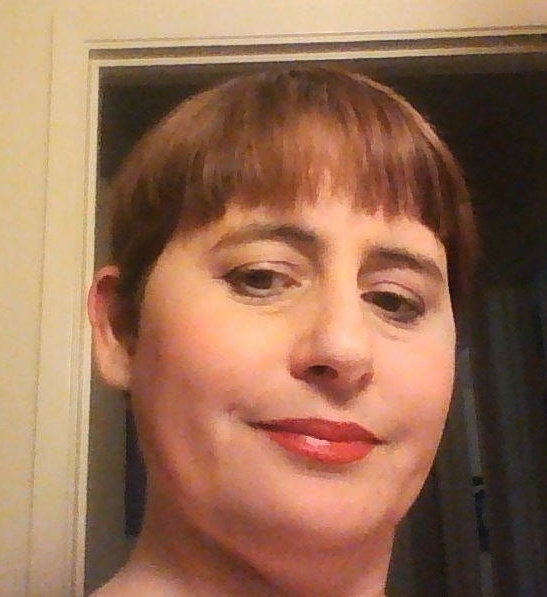
The other is another installment in my Para-Earth Series, titled "The Misty Mountains", with my wife Helen Krummenacker. Note: DEFINITELY NOT A MUG SHOT!
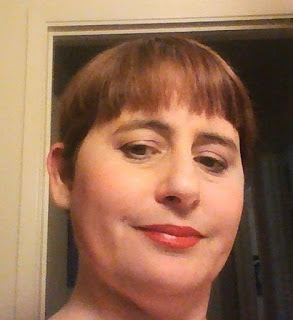
Okay, now that I got that bit of silliness out of my system, lets get back to today's topic namely the discussing more challenges one faces with a collaboration.
Now in Rich's case, the biggest challenge the two of us faced was the distance between us. Now, I'm not talking about ideas or suggestions, we're actually pretty good on that front. I'm talking physical, geographical distance. Rich lives over in North Carolina, whereas I live on west coast of California. So how do we make our collaboration work? Simple use the following:

 Rich and I Skype on a weekly basis, sharing ideas we've come up with and give each other feedback on what the other has added to the story that week. Then through Dropbox, we share the document, going in whenever we have a chance and add new scenes, ideas, etc. However, we always read what the other has added first. We've gotten into the habit of hi-lighting new sections in different colors so we both know who added new material. This way each of us has a good idea of the feel and mood of a particular scene before adding our own touches to it.
Now for the most part this has been relatively easy because we each created certain characters for this book, and they fall mostly under the respective creator's control. Plus there are many scenes where these characters are not in the same scene, allowing each of us to add to the overall story by having each one learn more information about the greater mystery and threat, which will bring everyone together in the end.
However, we also borrow each other's characters for certain scenes we've discussed on Skype and consult back and forth on whether or not the characters behaviors are consistent. Admittedly, this kind of system means it takes us a while to get a story completed, but Rich works full-time, and I've been studying at university, so neither of us have all the time in the world to simply sit and write. Plus there are times where one or the other of us is hitting a wall and needs help. This is where our Skype sessions and e-mails become a great asset. We can help each other out by figuring out where the blockage is coming from, does an area need to be rewritten or cut out, etc. For us, the old adage of "two heads are better than one" really gives us an advantage. Plus, we are very much on the same page for where this story is heading overall. But at the same time, by not always telling the other what we've got planned in a scene, it allows both the other author the surprise and excitement the reader will enjoy, as well as firing up the imagination to build upon this new material.
Again, this is where our weekly Skype sessions come in extremely handy. We can congratulate or raise questions if something in the scene did not seem to make sense, and together we can correct and move things forward. Both Rich and I are very agreeable, but we also trust one another to raise questions or concerns about certain points and whether or not it is working for this particular story. We are already planning on more collaborations and sometimes remove a section to be used in a later work. After all, you can only cram so many ideas into one book without confusing the hell out of the reader, so we try to be careful about that.

So now we drift over to another set of questions, such as what about my other collaboration?
How does a writing with the person I'm living with work for a joint project? Do you agree on everything? Are your writing styles compatible? How do you find a mutual voice you can agree on? What do you do to avoid hurt feelings?
I'll cover these and other issues in my next installment. Until then, take care and keep writing.

The other is another installment in my Para-Earth Series, titled "The Misty Mountains", with my wife Helen Krummenacker. Note: DEFINITELY NOT A MUG SHOT!
Okay, now that I got that bit of silliness out of my system, lets get back to today's topic namely the discussing more challenges one faces with a collaboration.
Now in Rich's case, the biggest challenge the two of us faced was the distance between us. Now, I'm not talking about ideas or suggestions, we're actually pretty good on that front. I'm talking physical, geographical distance. Rich lives over in North Carolina, whereas I live on west coast of California. So how do we make our collaboration work? Simple use the following:

 Rich and I Skype on a weekly basis, sharing ideas we've come up with and give each other feedback on what the other has added to the story that week. Then through Dropbox, we share the document, going in whenever we have a chance and add new scenes, ideas, etc. However, we always read what the other has added first. We've gotten into the habit of hi-lighting new sections in different colors so we both know who added new material. This way each of us has a good idea of the feel and mood of a particular scene before adding our own touches to it.
 Now for the most part this has been relatively easy because we each created certain characters for this book, and they fall mostly under the respective creator's control. Plus there are many scenes where these characters are not in the same scene, allowing each of us to add to the overall story by having each one learn more information about the greater mystery and threat, which will bring everyone together in the end.
However, we also borrow each other's characters for certain scenes we've discussed on Skype and consult back and forth on whether or not the characters behaviors are consistent. Admittedly, this kind of system means it takes us a while to get a story completed, but Rich works full-time, and I've been studying at university, so neither of us have all the time in the world to simply sit and write. Plus there are times where one or the other of us is hitting a wall and needs help. This is where our Skype sessions and e-mails become a great asset. We can help each other out by figuring out where the blockage is coming from, does an area need to be rewritten or cut out, etc. For us, the old adage of "two heads are better than one" really gives us an advantage. Plus, we are very much on the same page for where this story is heading overall. But at the same time, by not always telling the other what we've got planned in a scene, it allows both the other author the surprise and excitement the reader will enjoy, as well as firing up the imagination to build upon this new material.
Again, this is where our weekly Skype sessions come in extremely handy. We can congratulate or raise questions if something in the scene did not seem to make sense, and together we can correct and move things forward. Both Rich and I are very agreeable, but we also trust one another to raise questions or concerns about certain points and whether or not it is working for this particular story. We are already planning on more collaborations and sometimes remove a section to be used in a later work. After all, you can only cram so many ideas into one book without confusing the hell out of the reader, so we try to be careful about that.

So now we drift over to another set of questions, such as what about my other collaboration?
How does a writing with the person I'm living with work for a joint project? Do you agree on everything? Are your writing styles compatible? How do you find a mutual voice you can agree on? What do you do to avoid hurt feelings?
I'll cover these and other issues in my next installment. Until then, take care and keep writing.
May 26, 2016
My Thoughts On The Current "Captain America Has Always Been Hydra" Decision By Marvel..
As a writer, I try to avoid talking about choices made by other writers in regards to where they decide to take characters or storylines. I know how much thought must go into each story idea and how it grows, develops, and takes final form. I also understand how certain decisions are in the end solely up to the author.
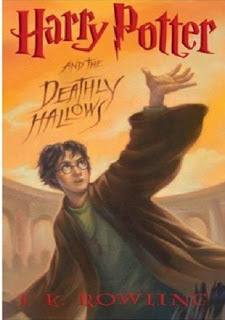
When J. K. Rowling published the seventh book in the "Harry Potter" Series, I was very one of those readers who was screaming and jumping up and down in a rage at the loss of certain characters (I won't mention names as there might actually be readers of this blog who have not read her series), because I felt their deaths served no real purpose to the main story itself, especially since some of them took place off camera. Since then, even the author herself has admitted regret in some of the choices she made.
However, all those characters were her own creation and she had full control to do with them as she pleased. Whereas, figures like Captain America and Superman, have been handed off time and again to new writers at their respective company's behest. But sometimes, certain decisions are made or ideas proposed that are so far out, that one wonders who gave the "Okay" for them in the first place. Especially when those decisions leaves the fans wondering what purpose did it serve?
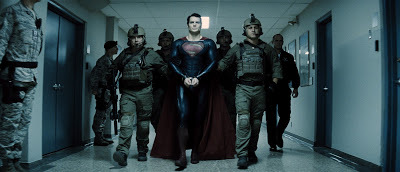
Superman, who has been one of the longest running characters in existence, had always lived by certain rules and tried to uphold them in even his darkest moments, had his nature changed in Zach Snyder's "Man of Steel", which left a sour taste in the mouths of a large part of the audience. Having a long-time hero violate their own code of not killing, was more a shocking disappointment than anything. But, Mr. Snyder wanted to take the character in new direction, making his world darker and more gritty, which was a total 180 from the bright colors and hopeful ideals Superman had always represented in the comics.
Now several years later, after a disappointing continuation of that dark world Mr. Snyder's version of Superman exists in ("Batman Vs. Superman"), we have Marvel Comics publishing a storyline where on of their most iconic characters Captain America, who many have looked to for hope and inspiration, is and has always been a deep undercover agent for Hydra (an offshoot branch of the Nazis back in World War II). This new concept and 'retconning' of Cap's stories over the last 70 years, seems like a slap in the face to readers and fans worldwide.
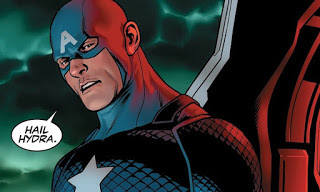
While Cap has gone down some dark roads at times, the idea that he was actually working for such a diabolically evil organization all this time seems like nothing more than a cheap gimmick by the parent company to sell more books. Unfortunately, I fear it may have just the opposite effect. Marvel higher-ups seem be banking on dragging the story out for a number of issues that will keep the readers coming back for more in order to find the real truth behind this supposed betrayal of everything Captain America has come to represent.
Of course, longtime comic book fans know that sooner or later this whole storyline will be retconned or weeded out when another writer takes over the book down the road, but still it seems to make little sense to even do it in the first place. This fascination some people have of "dirtying up" iconic heroes who have inspired children for decades, is quite frankly bewildering to me. I see no reason for it.
Yet at the same time, I can understand the allure (from a writer's standpoint) of putting your own spin and touch on characters you've read about for years. So-called Fanfictions do it all the time. People insert favorite characters and sometimes themselves, into dark or unusual stories and taking them places one would never expect. This to me is normal. I did it myself for newsletters, and just for fun, among some of the science fiction fan clubs I've belonged to over the years. But those stories were always for a specific audience, not for the general public. And this is where I have to question the wisdom of decisions like making Superman darker, or muddying Captain America.
The challenge of taking characters to dark places can be exciting, but if you want them to still shine or be even greater beacons of hope than ever before, you better have one helluva finish for that storyline. At present, I'm not sure what Marvel's writers have planned and will be sitting on the sidelines to wait and see what they do. Based on interviews with the editor and writers, I don't have a lot of confidence at this point, but then again writers, like magicians, never shows you what they have planned. They lie and use misdirection constantly in the hopes of giving you a breathtaking finish that leaves you spellbound and wanting more.
I pray Marvel does have something spectacular in mind, because if they don't, I fear they will have destroyed an iconic character who was created by two Jewish men (Jack Kirby: born Jacob Kurtzberg, and Joe Simon; born Hymie Simon) in 1941, who wanted to create a beacon of hope and justice to a world that needed one more than ever.

When J. K. Rowling published the seventh book in the "Harry Potter" Series, I was very one of those readers who was screaming and jumping up and down in a rage at the loss of certain characters (I won't mention names as there might actually be readers of this blog who have not read her series), because I felt their deaths served no real purpose to the main story itself, especially since some of them took place off camera. Since then, even the author herself has admitted regret in some of the choices she made.
However, all those characters were her own creation and she had full control to do with them as she pleased. Whereas, figures like Captain America and Superman, have been handed off time and again to new writers at their respective company's behest. But sometimes, certain decisions are made or ideas proposed that are so far out, that one wonders who gave the "Okay" for them in the first place. Especially when those decisions leaves the fans wondering what purpose did it serve?

Superman, who has been one of the longest running characters in existence, had always lived by certain rules and tried to uphold them in even his darkest moments, had his nature changed in Zach Snyder's "Man of Steel", which left a sour taste in the mouths of a large part of the audience. Having a long-time hero violate their own code of not killing, was more a shocking disappointment than anything. But, Mr. Snyder wanted to take the character in new direction, making his world darker and more gritty, which was a total 180 from the bright colors and hopeful ideals Superman had always represented in the comics.
Now several years later, after a disappointing continuation of that dark world Mr. Snyder's version of Superman exists in ("Batman Vs. Superman"), we have Marvel Comics publishing a storyline where on of their most iconic characters Captain America, who many have looked to for hope and inspiration, is and has always been a deep undercover agent for Hydra (an offshoot branch of the Nazis back in World War II). This new concept and 'retconning' of Cap's stories over the last 70 years, seems like a slap in the face to readers and fans worldwide.

While Cap has gone down some dark roads at times, the idea that he was actually working for such a diabolically evil organization all this time seems like nothing more than a cheap gimmick by the parent company to sell more books. Unfortunately, I fear it may have just the opposite effect. Marvel higher-ups seem be banking on dragging the story out for a number of issues that will keep the readers coming back for more in order to find the real truth behind this supposed betrayal of everything Captain America has come to represent.
Of course, longtime comic book fans know that sooner or later this whole storyline will be retconned or weeded out when another writer takes over the book down the road, but still it seems to make little sense to even do it in the first place. This fascination some people have of "dirtying up" iconic heroes who have inspired children for decades, is quite frankly bewildering to me. I see no reason for it.
Yet at the same time, I can understand the allure (from a writer's standpoint) of putting your own spin and touch on characters you've read about for years. So-called Fanfictions do it all the time. People insert favorite characters and sometimes themselves, into dark or unusual stories and taking them places one would never expect. This to me is normal. I did it myself for newsletters, and just for fun, among some of the science fiction fan clubs I've belonged to over the years. But those stories were always for a specific audience, not for the general public. And this is where I have to question the wisdom of decisions like making Superman darker, or muddying Captain America.
The challenge of taking characters to dark places can be exciting, but if you want them to still shine or be even greater beacons of hope than ever before, you better have one helluva finish for that storyline. At present, I'm not sure what Marvel's writers have planned and will be sitting on the sidelines to wait and see what they do. Based on interviews with the editor and writers, I don't have a lot of confidence at this point, but then again writers, like magicians, never shows you what they have planned. They lie and use misdirection constantly in the hopes of giving you a breathtaking finish that leaves you spellbound and wanting more.
I pray Marvel does have something spectacular in mind, because if they don't, I fear they will have destroyed an iconic character who was created by two Jewish men (Jack Kirby: born Jacob Kurtzberg, and Joe Simon; born Hymie Simon) in 1941, who wanted to create a beacon of hope and justice to a world that needed one more than ever.
March 26, 2016
My Review of Ira Levin's "Son of Rosemary"
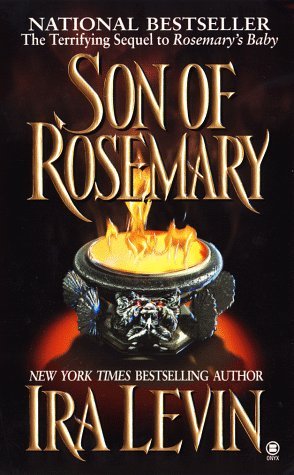
After getting my hands on the original "Rosemary's Baby", I was fascinated to see where Mr. Levin would take the characters after having left them untouched for almost 30 years. I was not disappointed.
This story takes up 34 years after the conclusion of the first novel. We find Rosemary waking up from a coma she had fallen into some 28 years earlier. Her last memories were of still living in the Bramford, and glancing at her son Andy who had recently celebrated his sixth birthday. From the other side of the walls, she could hear the coven chanting as usual then blackness.
She awakens in the year 1999, to learn that the coven had put her into a long-term care facility under the name of Rosemary Fountain (the last name of one of cults members). Realizing the coven had put her into a coma as they had her friend Hutch, she is outraged and fearful for what had become of her son Andy, whose father is Satan himself.
She soon learns that Andy, has become a respected man of influence who is loved and reknowned around the world. Thanks to her own celebrity status as Rip Van Rosemary, the woman who woke up from a 28 year coma, she uses a television interview to reach out to Andy and let him know she's alive and well.
After a tearful reunion, she learns that the coven had told Andy she had died in an effort to raise him in their ways. But as Rosemary had hoped at the end of the first novel, his human half made him rebellious and he has been using his 'influences' to thwart his father's plans and machinations. Or so Andy says.
The story continues with Rosemary being both relieved and skeptical of her son's motives and actions, along with the God's Children organization he has formed to make changes towards peace and tolerance throughout the world. Yet in spite of all the good she sees he has done, something still does not feel right. Especially in those moments when his horns peek out (literally) and his eyes turn from hazel to "Tiger". Still she does her best to aid his more noble efforts, not realizing that they are both being manipulated to bring about the end of man on New Year's Eve at the stroke of midnight, when almost everyone in the world will light special candles provided by the God's Children network.
Many have criticized this book because of how the story ends...
****Warning Spoiler Alert--Do not read further unless you want to know what happens****
Satan reveals himself to have been in Rosemary and Andy's midst all the time. He even crucifies his son for rebelling against his plans thanks to his mother's influence. Yet at the moment of Satan's apparent triumph, Andy manages to send his mother back in time to before his birth and arrange her life in such a way that she and Guy (her husband) do not wind up moving to the Bramford, thus escaping the coven's trap.
The complaint with this angle is that Rosemary wakes up from this prolonged nightmare (i. e. "It was all a dream..."). Yet we are given definite hints that it wasn't and that a part of Rosemary does realize what her son had actually done and that her fondest wish that his human half won out in the end.
Like the first book there is not a lot of gore or outright horror, as seen in other Son of Satan works such as the "Omen" series. Instead, Mr. Levin sticks to the spirit of his original work and plays a psychological game with the readers and Rosemary, leaving us wondering until the end if Andy can be trusted or not.
A brilliant effort by the man who also gave us "The Stepford Wives".
March 21, 2016
My Review Of Daphne Du Maurier's "The Doll: The Lost Short Stories"

After reading Miss Du Maurier's classic "Rebecca" I set out to find more of her works, in particular I wanted to read some of her short works. In "The Doll: THe Lost Short Stories" I found a treasure of tales which left me both fascinated and a bit disconcerted.
One might easily wonder at how I reconcile those two emotions, but I can safely say I learned from the author herself. In this collection of early works, we get to see the sharp insight Miss Du Maurier had to the minds of people. Each story contained in this tome, involve people making bad choices in love and relationships, yet still pursuing objects of affection who are most definitely wrong for them. Those they pursue are either disturbed, toxic, or playing games with the affections of others.
Yet, Miss Du Maurier keeps our interest in each tale, as the reader finds themselves reflecting on their own relationships and behavior, or those of family and friends who they've watched go down similar paths. Each story left me disconcerted in one way or another, which only served to demonstrate the keen insight of the author and the mastery of her craft. To evoke such feeling and thoughts in the reader is truly a work of genius.
I certainly look forward to reading more of her works, especially "The Birds" which the great Alfred Hitchcock brought to the screen starring the wonderful Miss Tippi Hedren.
March 17, 2016
My Review of "Rosemary's Baby" the Novel...

I've waited to get my hands on this novel for some time and it was certainly worth the wait.Keeping in mind that this book was written and set in 1967, this novel is tame in some respects compared to the gore and horror many authors and movies unleash on today's readers. But they are able to do so thanks to the efforts of Mr. Levin and other authors who broke ground and explored these mysteries and possibilities.
Rosemary Wodehouse and her husband Guy find themselves searching for a new home in New York City, so Guy can pursue his acting career on the stage, and soon find themselves with the opportunity to rent an apartment in the old Victorian building called "The Bramford" which has seen its share of notorious characters including a Devil worshipper who claimed to have summoned Satan himself some decades ago.
But now, considered a respectable/historic structure, Guy and Rosemary take a chance after seeing the apartment who's last elderly tenant who slipped into a coma and never recovered. The young couple soon get to meet other residents of the Bramford, including their odd next door neighbors the Castavets, an elderly and rather eccentric couple who take an unusual shine to them.
Shortly afterwards, things begin to happen. Guy is getting more roles and his star begins to rise in the theater world as well as drawing attention from Hollywood. Shortly after that, Rosemary finds herself pregnant after a very unusual dream where most of the other residents of the Bramford, including her new doctor, are wearing dark robes and chanting while Guy makes love to her... or was it him?
Most folks know the full story so I won't go any farther, but I will say Mr. Levin does a very good job of creating an atmosphere of suspicion and isolation, while still surrounded by the city of New York.
The ending actually took me by surprise because of the ray of hope that still burned in spite of the darkness that Rosemary finds herself surrounded by.
I look forward to finding the sequel "Son of Rosemary" to see what he did with it.
I also highly recommend this book to anyone who has even a passing fancy regarding the supernatural and black magic. Even though it may not hold a lot of surprises, the story does have a lot to keep the reader busy.
March 13, 2016
My Review Of Ira Levin's Classic Novel "The Stepford Wives"

A few days ago, I managed to finally locate a copy of this book at my local used book store and immediately snatched it up. Having seen both the original 1975 movie starring Katharine Ross, as well as the more recent Nicole Kidman version, I was eager to read the actual book that made the term Stepford Wives part of our everyday lexicon.
I'm going to assume that most people reading this blog already knows the story and how it ends. If you haven't seen either movie I strongly recommend the 1975 version which is much closer to the book, and not read the rest of this entry until you have because it contains huge SPOILERS!
For those who are continuing to read this post you have been warned...
Mr. Levin once again presents us with an idyllic setting and situation, namely the homey little town of Stepford with its picturesque white picket fences and home town charms. We meet Joanna Eberhart who has just moved here with her husband Walter and their two children Pete and Kim.
We quickly learn that Joanna is a modern thinking woman of her time (early 1970's) and is a freelance photographer who has made good money selling her photos to various magazines. Walter is a successful lawyer who wanted to move from the city and raise his family out in this charming place.
Through Joanna we are introduced to the various residents of Stepford whose female population seems to have a strong leaning towards housework. On her first night Joanna spots her next-door neighbor who is putting out the garbage. While this is not unusual in and of itself, the fact that the woman, who is backlit from the light from her open door, appears to be wearing nothing at all. Even when she returns inside her house, Joanna can clearly see her neighbor's perfect curvy silhouette in the window as the woman continues to do the dishes still naked.
We soon learn that most of the wives of Stepford are pretty much dedicated to being good housekeepers and making their husbands happy in every sense of the word.
Feeling out of step with the female 'crowd' Joanna is delighted to make friends with two other women who have only recently moved to Stepford; Charmaine and Bobbie. Charmaine is a dedicated tennis player who has a clay court in her yard, while Bobbie is a strong woman with definite reservations about how the women of Stepford behave, vowing never to be like them.
After a weekend away with her husband, Charmaine proceeds to neglect Bobbie and Joanna who pay her a surprise visit to find she is having her tennis court ripped up to be replaced by a putting green for her husband. Charmaine has also taken up housework with a vengeance and appears more full-figured than either Joanna or Bobbie remember. Yet even more chilling are Charmaine's words when she is asked why, "Ed's a pretty wonderful guy, and I've been lazy and selfish..." Such phrases like this are echoed repeatedly throughout the book by other wives as well.
As in his work "Rosemary's Baby" Mr. Levin uses the supporting cast of characters to present reasonable arguments that Joanna and Bobbie are just letting their imaginations run away with them. He plants the seeds of doubt liberally, but never enough to be fully convincing. Especially when Bobbie falls to the same fate as Charmaine, leaving Joanna more alone and afraid than ever before.
But the most terrifying part of this story for me was the knowledge that Walter, like so many other husbands, brought his family to Stepford for the sole purpose of having a 'sexy, obedient, fantasy' version made of his wife, knowing she'd be killed after the copy was ready.
For me, it was the enormity of this betrayal that provides the true horror for this piece. The idea that the patriarchal sense of entitlement was more important to these men, than the lives of the women they supposedly loved is inexcusable.
At the time this book was written (1972) the women's movement was still going strong, in spite of facing huge resistance. Yet 40 years later, feminism is still trying to make progress while being attacked with a vengeance on a number of fronts. Wanting true equality for all, regardless of sex, gender, skin color, or whatever, should not be a crime or something one needs to fight for. It should be a right offered to everyone.
Instead the struggle continues, which is why this book is still extremely relevant now. Personally I feel this book should become required reading in high school/college in the hopes of opening more minds so that the future holds more opportunities and understanding for all.


