Felix Abt's Blog, page 5
May 25, 2017
COMMUNIST NEWSPAPER “IL MANIFESTO” SCOLDS NORTH KOREAfor...
COMMUNIST NEWSPAPER “IL MANIFESTO” SCOLDS NORTH KOREA
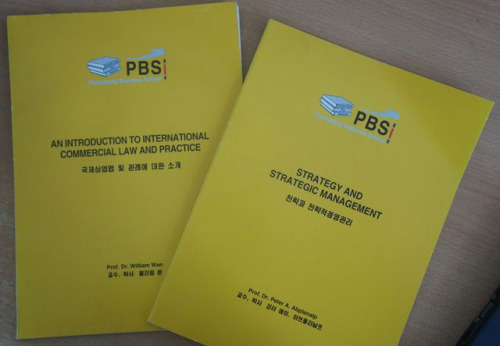
for embracing capitalism “in 2004 when Felix Abt founded the Pyongyang Business School for senior business executives and government officials” (”sin dal 2004, quando lo svizzero Felix Abt ha fondato la Pyongyang Business School”).
Is Felix Abt the culprit or North Korea’s government or both?
More on the Pyongyang Business School here.
Picture shows booklets in English/Korean that were used at the Pyongyang Business School.


April 19, 2017
THE BANNED NORTH KOREA INTERVIEW
This interview was taken by...
THE BANNED NORTH KOREA INTERVIEW
This interview was taken by The Penn Political Review, a publication by the University of Pennsylvania, the Alma Mater of Donald Trump and Ivanka Trump, in
October 2016.
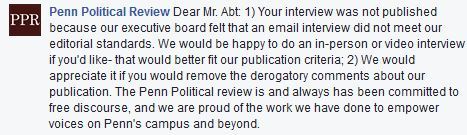
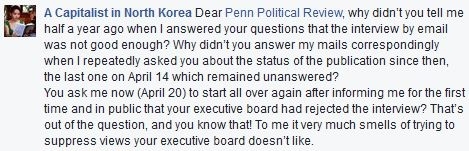
It was not published! The publishers say it is a magazine
which includes “a wide spectrum of student, faculty, and guest opinions from
the University of Pennsylvania and beyond.” And they also explain it is “created and motivated by
freedom of speech”.
Perhaps they are not motivated by it, but Felix Abt is and that’s why the interview is now published here!
A SOBER LOOK AT BUSINESS AND INVESTMENT OPPORTUNITIES AND RISKS
IN NORTH KOREA
Penn Political Review (PPR): What are some of the most
profitable investments in North Korea?
Felix Abt: Since many consumers have risen from a
destitute level of income over the last 15 years to a level that covers basic
needs or that reaches a middle-income, or even became part of the emerging
entrepreneurial middle class, consumer-oriented businesses, from fast-moving
consumer goods to telecommunication, have seen a significant boost in sales and
profits. The mobile phone subscription by more than 3 million inhabitants of
this country of 25 million within a few years illustrates this development.
This has been rather breath-taking by North Korean standards.
As a result, the processing of products such as
cloth or leather to meet consumers’ rising demand for affordable yet more
trendy clothes, shoes and bags has made sense for small and medium-sized
Chinese and other investors. Other items currently made in North Korea by
foreign investors, which can be partly sold domestically as well as exported to
China and other Asian countries, range from artificial flowers to false teeth.
Since the manufacturing of such products is rather low tech and requires only a
6- to 7-digit USD investment, they have attracted dozens of smaller Chinese
manufacturers.
PPR: Can western companies expect these markets to
be opened soon?
Abt: North Korea has been open for foreign
investors and traders for about two decades. When I compared the Foreign Direct
Investment (FDI) laws and regulations of China and Vietnam with North Korea’s
more than a decade ago, I couldn’t notice, at least not on paper, any
significant differences. But let’s look at the bigger picture:
1. We have to keep in mind that emerging or frontier markets are
high-risk markets with a very high rate of
business failures that will decline only over many
years as all stake holders learn from a lengthy trial and error period. Prudent
investors in these markets clearly prefer to invest in smaller projects or
disburse larger amounts of capital over a long
period of time to minimize risks and even try
to keep control over key components of their North Korean manufacturing venture.
Let me illustrate this protracted process with a
concrete example: In the nineties the German chancellor and the Vietnamese
prime minister set up a German-Vietnamese dialogue forum where complaints and
issues between German (and other foreign) investors and their Vietnamese
counterparts were addressed. I was an active participant as I was then
representing a large pool of German companies in Vietnam. Over many years the
thick book full of issues became thinner. Both sides went through an important
and unavoidable learning process leading to a smoother investment and business
environment which helped Vietnam’s economy achieve extraordinarily high growth
rates.
2.
Though the long-term market potential of an emerging market may be high,
business volumes at the beginning are usually small, and so are profits.
Investors in such markets think long-term and invest in a strong market position
(that is high market shares) to harvest over-proportionally when the emerging
market gets more mature and larger. (Followers who try to avoid the risks the
‘early birds’ take enter the market at this ‘late’ stage but will then have to
pay a high market entry price as they’ll face an uphill struggle against the
established competitors)
And
3. Let’s
not forget that entrepreneurs always take risks and that most entrepreneurial
start-ups fail, and not
only in emerging markets.
PPR: How is the legal system changing to attract
foreign investment?
Abt: The legal system is following the changes in
society, and they have been quite dramatic under the surface, hardly noticed by
the outside world. Let me illustrate that: When I settled in Pyongyang advertising
was still illegal. That was truly upsetting for a foreign businessman. But I
discussed the necessity to do advertising to allow my enterprise to survive
with the authorities for quite a long time until I was allowed to start doing
advertising. And you can imagine how pleased I was when a student of the Pyongyang Business
School which I co-founded and run, officially set up North Korea’s first advertising
company.
To give you another example: Staff was at first
always allocated by the state. Thus I had not been allowed to choose from
different candidates when I hired employees. I wanted to change that too: I
once saw a very enthusiastic North Korean lady successfully selling stuff at an
exhibition. I was impressed and decided to hire her. After lengthy negotiations
we reached a deal with her employer who allowed her to quit and join us. With
such “deals” we managed to get the best suited staff from various organizations
thereafter.
PPR: In your opinion, has Western media
misrepresented the development in the country?
Abt: Western media reports contain lots of
opinions, mostly biased, and speculations, often unfounded, but few facts and
seldom an objective analysis. So as an investor in such a frontier market you
learn much more by talking to five different Chinese entrepreneurs on their
experiences in North Korea than reading all North Korea articles published by
the Wall Street Journal, the Washington Post and the Economist combined.
One example: North Korea is portrayed as the world’s
most corrupt country by the mainstream media. When I was a regional director of
a pharmaceutical multinational corporation in Africa we were often confronted
with health officials and gatekeepers who tried to use coercive ways to press
personal gains out of my company. So when, for example, we wanted to launch an
effective anti-malarial (after other anti-malarials had become ineffective due
to overuse causing high resistance), a health minister of an African country
could come up and say that he would only allow the registration, that is admission,
of this new pharmaceutical if we sponsored his son’s university studies in the
United States.
However, when I ran a pharmaceutical enterprise in
North Korea I was never confronted with demands to bribe anybody to get the
pharmaceuticals registered and onto the pharmacy shelves. I was involved in
other businesses in North Korea and there too I was never confronted with the nefarious
demands that I had found quite frequent in the other developing countries where
I had done business. Of course, there is corruption but at least foreign
investors are clearly less confronted with it in North Korea than in so many other
developing countries. That’s based on my private comparisons with investors in
other developing countries.
PPR: How profitable were your own ventures?
Abt: There was a good measure of business failures
for a number of reasons – and I couldn’t blame all of them on North Korea. But
overall my ventures have been profitable, albeit profits were quite moderate.
And the profit and other taxes we paid to the government would not have been large
enough to help fund the political system for a minute, let alone help finance
the country’s nuclear program…
PPR: Moving forward, what factors will determine
the development of business in the country?
Abt: At present, there is not much that drives
business forward; on the contrary, most if not all industries require at least
some products (such as so-called dual use items) for their manufacturing
processes, which are banned by sanctions. If these sanctions are enforced,
manufacturers will have a stark choice to make: manufacture either faulty
products or shut down production. Also, the country’s exports (coal, metals and
minerals) have been banned by sanctions with only a few exceptions. If they’re
enforced, the country’s hard currency income will vanish quickly and imports
cannot be paid for any longer. Numerous other products, from American lipsticks
to French cheese, to Italian salami to Swiss ski lifts and watches, considered as luxury,
are prohibited as well. Moreover, North Korea’s banking system is cut off from
the international banking system. This has become so absurd that foreign
investors have to bring money in a suitcase and have to collect their dividends
in bags in Pyongyang. And if the U.S. succeeds in persuading China to prohibit
North Korea’s state carrier to fly to China, foreign business people with
little time to waste will be forced to undertake long train journeys to and from
North Korea.
Obviously, current U.S. and South Korean government
policies are aimed at bringing the DPRK down. It means that any business
considered legitimate in other countries, are now increasingly “illegitimate”
in North Korea, as such policies tend to ostracize and criminalize all business
activities with this so-called Pariah state. And in a jungle of sanction laws
and regulations that differ from country to country, foreign business people
sourcing across the globe without always knowing the exact origin of an item
can easily be held responsible for any of the numerous sanctioned products in
any country and incur a huge reputational damage, regardless of the fact that
they’re used for civilian purposes. So doing business with North Korea makes
you prone to becoming a serious casualty in an economic war.
For these reasons I have started divesting my
financial participation in North Korean joint venture companies. Other
investors are likely to do the same and potentially new ones will shy away from
the country. Not only foreign investors, but North Korea’s middle class is also
likely to be strongly hurt and massive poverty in the hinterland may re-emerge.
Also, we should not forget that rising middle classes in formerly authoritarian
Asian countries, from Indonesia to the Philippines to Taiwan, forced their
regimes to change. It’s an illusion that sending balloons with propaganda
material to North Korea could transform it and that the domestic and foreign
entrepreneurs couldn’t. All hostile activities are doing is making the regime
feel more insecure and having it allocate more of the very scarce resources to
its self-preservation, while reforms are shelved and repression increases.
PPR: How does one get a job like yours?
Abt: The ABB Group, a global leader in power and automation
technologies, asked me to become their resident country
director in North Korea and build up their business there. I had worked
for ABB before, so they knew me. But I don’t know the exact reason why they
chose me. When they did I was reporting to a Swedish member of the Executive
Committee who had successfully set up one of the very first foreign-invested
factories in China when it opened up. That had then definitely not been a task
for the faint-hearted, but for a pioneer and change agent that he was. He
expected me to follow in his footsteps in North Korea.
UPDATE:
Comments in reaction to this post from the Facebook page of A Capitalist in North Korea:

☆
☆
☆
☆
☆
Picture:
Felix Abt together with Dr. Jon Sung Hun
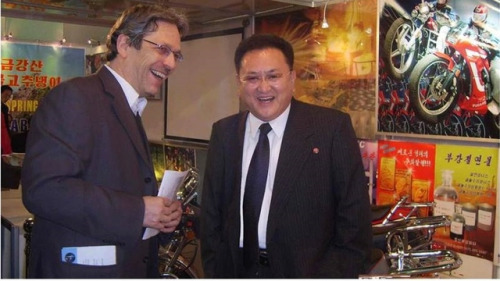
, CEO of North Korea’s Pugang Group. Pugang has been called “the North Korean equivalent of South Korea’s Samsung Group”. This North Korean business leader was repeatedly featured by the Financial Times, the Washington Post and others.
He is a great marketer of - in his own words - “cool motorbikes” and of natural products with allegedly extraordinary
health benefits, something which is very much loved by journalists in
desperate need of writing sensationalist North Korea pieces (and to attribute his personal marketing claims to the country’s leader).
This former Kim Il Sung university professor has a gregarious and
humorous personality. He wasn’t offended when Felix Abt dared to make fun of his
“miraculous” drugs. To journalists it must be
surprising (and perhaps disappointing) that Abt wasn’t sent to a Gulag or
at least instantly expelled as a consequence of challenging Dr. Jon’s claims.
☆
☆
☆
☆
☆
#NorthKorea #miraculous #drugs #pharmaceuticals #Viagra #hot #motorbikes #Pugang #interview #PennPoliticalReview @universityofpennsylvania
ON BUSINESS AND INVESTMENT OPPORTUNITIES AND RISKS
IN NORTH...
ON BUSINESS AND INVESTMENT OPPORTUNITIES AND RISKS
IN NORTH KOREA
Penn Political Review: What are some of the most
profitable investments in North Korea?
Felix Abt: Since many consumers have risen from a
destitute level of income over the last 15 years to a level that covers basic
needs or that reaches a middle-income, or even became part of the emerging
entrepreneurial middle class, consumer-oriented businesses, from fast-moving
consumer goods to telecommunication, have seen a significant boost in sales and
profits. The mobile phone subscription by more than 3 million inhabitants of
this country of 25 million within a few years illustrates this development.
This has been rather breath-taking by North Korean standards.
As a result, the processing of products such as
cloth or leather to meet consumers’ rising demand for affordable yet more
trendy clothes, shoes and bags has made sense for small and medium-sized
Chinese and other investors. Other items currently made in North Korea by
foreign investors, which can be partly sold domestically as well as exported to
China and other Asian countries, range from artificial flowers to false teeth.
Since the manufacturing of such products is rather low tech and requires only a
6- to 7-digit USD investment, they have attracted dozens of smaller Chinese
manufacturers.
PPR: Can western companies expect these markets to
be opened soon?
Abt: North Korea has been open for foreign
investors and traders for about two decades. When I compared the Foreign Direct
Investment (FDI) laws and regulations of China and Vietnam with North Korea’s
more than a decade ago, I couldn’t notice, at least not on paper, any
significant differences. But let’s look at the bigger picture:
1. We have to keep in mind that emerging or frontier markets are
high-risk markets with a very high rate of
business failures that will decline only over many
years as all stake holders learn from a lengthy trial and error period. Prudent
investors in these markets clearly prefer to invest in smaller projects or
disburse larger amounts of capital over a long
period of time to minimize risks and even try
to keep control over key components of their North Korean manufacturing venture.
Let me illustrate this protracted process with a
concrete example: In the nineties the German chancellor and the Vietnamese
prime minister set up a German-Vietnamese dialogue forum where complaints and
issues between German (and other foreign) investors and their Vietnamese
counterparts were addressed. I was an active participant as I was then
representing a large pool of German companies in Vietnam. Over many years the
thick book full of issues became thinner. Both sides went through an important
and unavoidable learning process leading to a smoother investment and business
environment which helped Vietnam’s economy achieve extraordinarily high growth
rates.
2.
Though the long-term market potential of an emerging market may be high,
business volumes at the beginning are usually small, and so are profits.
Investors in such markets think long-term and invest in a strong market position
(that is high market shares) to harvest over-proportionally when the emerging
market gets more mature and larger. (Followers who try to avoid the risks the
‘early birds’ take enter the market at this ‘late’ stage but will then have to
pay a high market entry price as they’ll face an uphill struggle against the
established competitors)
And
3. Let’s
not forget that entrepreneurs always take risks and that most entrepreneurial
start-ups fail, and not
only in emerging markets.
PPR: How is the legal system changing to attract
foreign investment?
Abt: The legal system is following the changes in
society, and they have been quite dramatic under the surface, hardly noticed by
the outside world. Let me illustrate that: When I settled in Pyongyang advertising
was still illegal. That was truly upsetting for a foreign businessman. But I
discussed the necessity to do advertising to allow my enterprise to survive
with the authorities for quite a long time until I was allowed to start doing
advertising. And you can imagine how pleased I was when a student of the Pyongyang Business
School which I co-founded and run, officially set up North Korea’s first advertising
company.
To give you another example: Staff was at first
always allocated by the state. Thus I had not been allowed to choose from
different candidates when I hired employees. I wanted to change that too: I
once saw a very enthusiastic North Korean lady successfully selling stuff at an
exhibition. I was impressed and decided to hire her. After lengthy negotiations
we reached a deal with her employer who allowed her to quit and join us. With
such “deals” we managed to get the best suited staff from various organizations
thereafter.
PPR: In your opinion, has Western media
misrepresented the development in the country?
Abt: Western media reports contain lots of
opinions, mostly biased, and speculations, often unfounded, but few facts and
seldom an objective analysis. So as an investor in such a frontier market you
learn much more by talking to five different Chinese entrepreneurs on their
experiences in North Korea than reading all North Korea articles published by
the Wall Street Journal, the Washington Post and the Economist combined.
One example: North Korea is portrayed as the world’s
most corrupt country by the mainstream media. When I was a regional director of
a pharmaceutical multinational corporation in Africa we were often confronted
with health officials and gatekeepers who tried to use coercive ways to press
personal gains out of my company. So when, for example, we wanted to launch an
effective anti-malarial (after other anti-malarials had become ineffective due
to overuse causing high resistance), a health minister of an African country
could come up and say that he would only allow the registration, that is admission,
of this new pharmaceutical if we sponsored his son’s university studies in the
United States.
However, when I ran a pharmaceutical enterprise in
North Korea I was never confronted with demands to bribe anybody to get the
pharmaceuticals registered and onto the pharmacy shelves. I was involved in
other businesses in North Korea and there too I was never confronted with the nefarious
demands that I had found quite frequent in the other developing countries where
I had done business. Of course, there is corruption but at least foreign
investors are clearly less confronted with it in North Korea than in so many other
developing countries. That’s based on my private comparisons with investors in
other developing countries.
PPR: How profitable were your own ventures?
Abt: There was a good measure of business failures
for a number of reasons – and I couldn’t blame all of them on North Korea. But
overall my ventures have been profitable, albeit profits were quite moderate.
And the profit and other taxes we paid to the government would not have been large
enough to help fund the political system for a minute, let alone help finance
the country’s nuclear program…
PPR: Moving forward, what factors will determine
the development of business in the country?
Abt: At present, there is not much that drives
business forward; on the contrary, most if not all industries require at least
some products (such as so-called dual use items) for their manufacturing
processes, which are banned by sanctions. If these sanctions are enforced,
manufacturers will have a stark choice to make: manufacture either faulty
products or shut down production. Also, the country’s exports (coal, metals and
minerals) have been banned by sanctions with only a few exceptions. If they’re
enforced, the country’s hard currency income will vanish quickly and imports
cannot be paid for any longer. Numerous other products, from American lipsticks
to French cheese, to Italian salami to Swiss ski lifts and watches, considered as luxury,
are prohibited as well. Moreover, North Korea’s banking system is cut off from
the international banking system. This has become so absurd that foreign
investors have to bring money in a suitcase and have to collect their dividends
in bags in Pyongyang. And if the U.S. succeeds in persuading China to prohibit
North Korea’s state carrier to fly to China, foreign business people with
little time to waste will be forced to undertake long train journeys to and from
North Korea.
Obviously, current U.S. and South Korean government
policies are aimed at bringing the DPRK down. It means that any business
considered legitimate in other countries, are now increasingly “illegitimate”
in North Korea, as such policies tend to ostracize and criminalize all business
activities with this so-called Pariah state. And in a jungle of sanction laws
and regulations that differ from country to country, foreign business people
sourcing across the globe without always knowing the exact origin of an item
can easily be held responsible for any of the numerous sanctioned products in
any country and incur a huge reputational damage, regardless of the fact that
they’re used for civilian purposes. So doing business with North Korea makes
you prone to becoming a serious casualty in an economic war.
For these reasons I have started divesting my
financial participation in North Korean joint venture companies. Other
investors are likely to do the same and potentially new ones will shy away from
the country. Not only foreign investors, but North Korea’s middle class is also
likely to be strongly hurt and massive poverty in the hinterland may re-emerge.
Also, we should not forget that rising middle classes in formerly authoritarian
Asian countries, from Indonesia to the Philippines to Taiwan, forced their
regimes to change. It’s an illusion that sending balloons with propaganda
material to North Korea could transform it and that the domestic and foreign
entrepreneurs couldn’t. All hostile activities are doing is making the regime
feel more insecure and having it allocate more of the very scarce resources to
its self-preservation, while reforms are shelved and repression increases.
PPR: How does one get a job like yours?
Abt: The ABB Group, a global leader in power and automation
technologies, asked me to become their resident country
director in North Korea and build up their business there. I had worked
for ABB before, so they knew me. But I don’t know the exact reason why they
chose me. When they did I was reporting to a Swedish member of the Executive
Committee who had successfully set up one of the very first foreign-invested
factories in China when it opened up. That had then definitely not been a task
for the faint-hearted, but for a pioneer and change agent that he was. He
expected me to follow in his footsteps in North Korea.
*****
This interview was taken by
Mr. Jesus
Alcocer of The Penn Political Review in
October 2016 and has not been published. It says it is a publication
which includes “a wide spectrum of student, faculty, and guest opinions from
the University of Pennsylvania and beyond.” And it also explains it is “created and motivated by
freedom of speech”. Now I’m not so sure how valid this claim is…
*****
Picture:
Felix Abt together with Dr. Jon, CEO of North Korea’s Pugang Group. This North Korean business leader was repeatedly featured by the Financial Times and the Washington Post.
He is a great marketer of - in his own words - “cool motorbikes” and of natural products with allegedly extraordinary
health benefits, something which is very much loved by journalists in
desperate need of writing sensationalist North Korea pieces (and even attribute his personal marketing claims to the country’s leader).
This former Kim Il Sung university professor has a gregarious and
humorous personality. He wasn’t offended when Felix Abt dared to make fun of his
“miraculous” drugs. To journalists it must be
surprising (and perhaps disappointing) that Abt wasn’t sent to a Gulag or
at least instantly expelled as a consequence of challenging Dr. Jon’s claims.
*****
#NorthKorea #miraculous #drugs #pharmaceuticals #Viagra #hot #motorbikes #Pugang #interview #PennPoliticalReview @universityofpennsylvania
July 18, 2016
WHEN CAPITALISM CAME TO NORTH KOREAHow a Chinese businessman...
WHEN CAPITALISM CAME TO NORTH KOREA
How a Chinese businessman helped spark North Korea’s
pharmaceutical industry.
By Felix Abt
As one of the first business people to representmultinational groups and smaller organizations in North Korea, I was involved
in the negotiation of well over a dozen joint ventures, most of which didn’t
materialize: the production of transformers and electric cables to give a boost
to North Korea’s dilapidated power grid; milk powder and dairy production to
enable malnourished kids to have a daily glass of milk – sponsored by foreign
donors; and even e-commerce to help North Korean painters sell their
beautiful paintings across the globe.
Of course, setting up businesses in emerging and frontier
markets isn’t for the faint-hearted. And capital is a shy animal which doesn’t
want to be invested in a highly unpredictable and risky environment full of
legal and other uncertainties. I warned the few daring investors that
spectacularly large projects often lead to spectacular failures and recommended that they instead set up smaller
projects with capital disbursement over a longer period and encouraged them to
maintain control of imported key components for their manufacturing ventures as
a way of minimizing the inherently high risks.
This cautionary approach was based on my past experience
with other demanding emerging markets. But North Korea, with an opacity even
greater than China and Vietnam when they had first opened up, was the toughest
place of all. It had very much to do with significant philosophical differences
from the other socialist countries, which had started reforms decades earlier.
Of all the socialist countries North Korea came closest to Karl Marx’s
communist ideal: it became the most demonetized country in our lifetime,
providing all housing, education, food, healthcare, transportation, and so on
completely free of charge.
Apart from Cuba, North Korea was also the country that
received the most aid from other socialist countries. When North Korea’s
socialist trading partners and benefactors, in particular the Soviet Union,
collapsed in the nineties, its entirely state-planned economy and public
distribution system largely collapsed too. It triggered a famine resulting in
many North Koreans starting small-scale private trading activities to survive
and to make a living and other, mostly Western donors stepping in to provide
food and medicine for free.
A few years later, when I settled down in Pyongyang, it felt
like a cultural shock for the North Koreans. They had grown accustomed to
foreigners coming to their country simply to donate goods for free, but had
never before seen foreigners set up and run businesses for profit.
As the CEO of North Korea’s first pharmaceutical joint
venture, I was initially not allowed to set up a sales department and to do
advertising for our products and services, a practice that was then considered
anti-socialist. “In our country, companies don’t have sales departments and
advertising is against the law” was one of the explanations given to me. I
replied that the foreign investors would not be prepared to continue to pump
money into a loss-making enterprise and that if business practices could not be
changed in a way as to make it sustainable thanks to decent profits, it would
be shut down.
To prevent this from happening, changing minds and behavior
patterns became an almost Herculean challenge. To get advice and support I
reached out to a pioneer in China’s pharmaceutical industry, who went through a
similar experience in China just after its Cultural Revolution.
During the Cultural Revolution, he was radically demoted to
the factory’s most toxic production area. After that hazardous and depressing
period was over, Henry Jin was reinstated as head of Shanghai Pharmaceuticals,
one of China’s largest medicine producers. His re-emergence coincided with the
dawn of China’s transformation from a state planned economy to a more
market-driven one. This induced the first foreign investors to arrive, and soon
multinational pharmaceutical giant Bristol Myers Squibb was knocking on
Shanghai Pharmaceuticals’ doors. Recognizing his outstanding competence, the
government appointed Henry to set up the first pharmaceutical joint venture in
Shanghai with this American company.
As Henry explained to me, what started off as promising soon
became wrought with challenges. For one thing, the American majority investors
did not simply want land use rights for the new factory, but also demanded a
substantial cash infusion from the Chinese partners. At the end of a meeting
with senior officials chaired by Shanghai’s mayor Jiang Zemin (who later became
China’s president), the mayor asked if anyone had questions or remarks. Henry
raised his hand: “I’m tasked with setting up the first pharmaceutical joint
venture. Some cash is required but all the banks I’ve contacted have refused to
give us a loan as we don’t have any collateral.” Jiang boldly exclaimed: “I am
your collateral!” And Henry got the necessary bank credits, overcoming the
first of countless other hurdles during “a long march” to doing business in a
modern and efficient way.
In North Korea, I felt quite lonely on the board and frequently
found myself “provoking” and even angering my North Korean colleagues with
ideas which, due to our completely different life experiences, seemed very
strange to them.
Things became much easier for me when Henry accepted my
invitation to serve as a director. He did not want any fee for his invaluable
advice, but simply wanted to help this pharmaceutical enterprise succeed.
Making safer, effective, and more affordable medicine for the North Korean
people was his motivation. He was a contented octogenarian gentleman with a
generous heart who had dedicated himself to charity since his retirement some
years earlier. He became my best ally on the board and a dear friend. He
whole-heartedly supported my business plans and patiently explained to the
North Korean colleagues why things had to be done in the way I suggested.
While our North Korean friends preferred to talk about
adding new production capacities – even as existing ones remained largely
underutilized – Henry and I were advocating the need for setting up an
effective marketing and sales organization, without which the company
could not survive. Henry and I spared no efforts to convince our local partners
of the unavoidable need to adopt new business practices.
To this effect we held board meetings in China and made sure
our directors could meet and talk to Chinese colleagues while there. They were
surprised to learn from directors of state companies that Chinese authorities
were no longer interfering with day-to day-business and were actually firing
and replacing directors who failed to achieve targets, which included profits.
North Korean factories, on the other hand, were then still micromanaged by a
host of government agencies in the same style that Chinese enterprises had been
run decades earlier.
As I was not only interested in developing the factory but
also a wholesale, distribution and retail business, Henry tapped into his huge
network and opened doors for our North Korean board members and company managers
to gain access to Chinese wholesale companies, distributors and pharmacy chains
where they were even allowed to take pictures — something the hosts would never
have allowed their fellow Chinese to do.
As an early bird, circumstances were totally against me.
With the help of highly knowledgeable, empathetic Henry, who enjoyed enormous
respect among all the North Koreans he met, the early heavy losses of the enterprise slowly turned into profits. Though he was
short in terms of body height he was a giant as a humanist and he was convinced
that strong human capital, or better still, a skillful staff, thanks to intense
capacity building (training and exposure to international business practices),
was more important for the good of all stakeholders than the company’s fixed
assets. I was happy that Henry saw the fruits of his efforts: ours became an
award-winning North Korean team and the first to be recognized by the World
Health Organization (WHO) for our Good
Manufacturing Practices (GMP). Thanks to this we also became the first
North Korean enterprise to win
contracts against Asian and European rivals in competitive bidding.
It was plain to see for the North Koreans that our business
approach worked well for all stakeholders and this inspired them.
Pharmaceutical companies started knocking on our doors asking us to share our
management and production expertise with them. Henry’s charisma and leadership,
and experiences during China’s own economic transition, not only inspired our
team but paved the way for North Korea’s emergence in the pharmaceutical
industry.
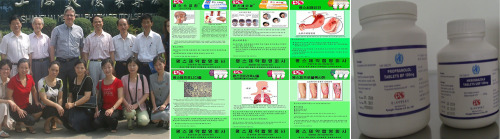
Henry Jin (2nd left,
standing) together with North Korean company executives, Chinese peers, and
Felix Abt in Shanghai.Our flyers, when advertising was not
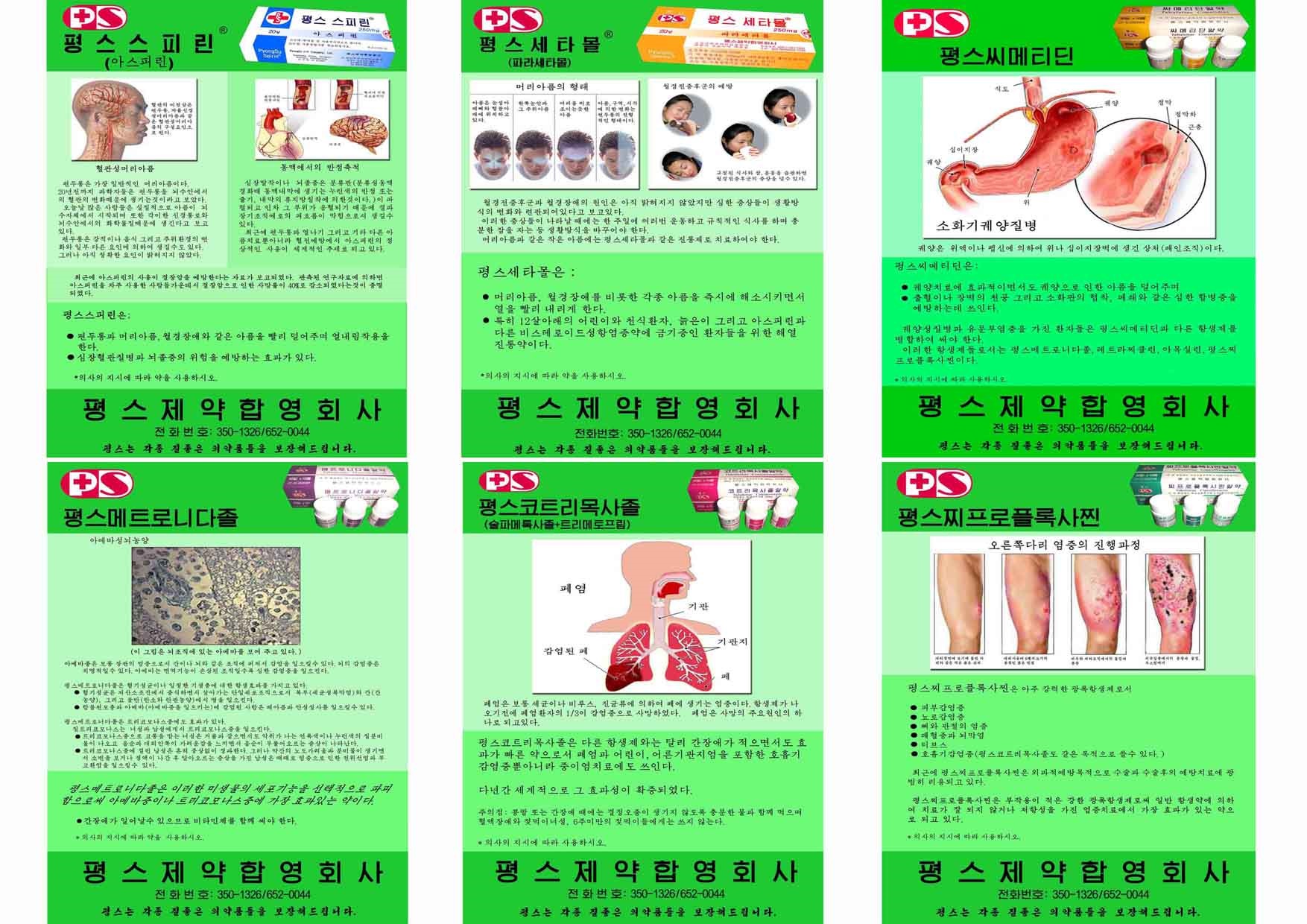
considered anti-socialist any longer. (Image courtesy of Felix Abt)A product of ours for heart conditions
and one to treat worms in adults and kids. These medicines were sold to the
WHO, which distributed them to needy hospitals in North Korea’s hinterland at a
fraction of the price it would have cost to produce in Western countries.
(Image courtesy of Felix Abt)
***
This piece was published by The Diplomat magazine in June 2016.
WHEN ‘SUNSHINE’ RULED ON THE KOREAN PENINSULARemembering a...
WHEN ‘SUNSHINE’ RULED ON THE KOREAN PENINSULA
Remembering a period of unprecedented cooperation
between the two Koreas, despite being technically still at war.
By Felix
Abt
This piece was published by The Diplomat magazine in July 2016
Before South Korea’s conservative presidents severed
ties with North Korea from 2008, their liberal predecessors Kim Dae-jung and
Roh Moo-hyun promoted peaceful engagement and rapprochement, an approach called
the “sunshine policy.” The name stemmed from an ancient Greek fable where the
wind and the sun competed to remove a man’s cloak. No matter how strongly the
wind blew, the man only wrapped his cloak more tightly to keep warm. But when
the sun shone, the warmth made him take his cloak off. The wind symbolized
unsuccessful coercive policies toward North Korea and the sun stood for an
approach able to persuade North Korea to take off its anachronistic and
uncomfortable cloak, changing at last. It wasn’t a “leftist” policy, as it was
labeled by critics from the right, since South Korea’s strongman President Park
Chung-hee had tried a similar policy in the 1970s.
The critics called Kim and Roh’s North Korea
engagement “checkbook diplomacy,” an expensive flop, and considered both
presidents as either naïve, striving for fame, or having a sinister agenda to
strengthen North Korea’s regime. An influential American journalist gave his
book the title Korea Betrayed: Kim Dae-jung and Sunshine. And
“sunshine” even became a term of mockery. In addition, the opponents of
engagement cited North Korea’s first nuclear test in 2006 as an irrefutable
proof of the complete failure of the sunshine policy. To North Korea, it meant
dissuasion and a bargaining chip in negotiating with Washington as the George
W. Bush administration “reversed the age of warm sunshine back to the age of
cold wind,” which made North Korea abandon the non-proliferation treaty, oust
International Atomic Energy Agency inspectors, and start testing long-range
missiles, Kim Dae-jung explained in a speech at Harvard University.
Kim had indeed a very ambitious plan to decrease
inter-Korean tensions and work toward a peaceful reunification. The Korean War
still lingers, as only an armistice was concluded in 1953, not a peace treaty.
Kim was aware of the fact that Pyongyang couldn’t and wouldn’t change quickly
and that he wouldn’t get much gratitude for his efforts either. A transformation
of North Korea similar to the transformations of China and Vietnam, which
brought about significant changes after the West normalized relations with
them, wasn’t just around the corner.
The tool to further Kim’s agenda was the set-up of a
wide cooperative framework that included infrastructure development, such as
the restoration and construction of roads and railways, economic assistance, as
well as a wide variety of inter-Korean business ventures. It was aimed at both
increasing living standards in the North and upping its dependence on the
South. More than 40 different types of agreements were concluded between the
two Koreas during this period. South Korean companies were not only permitted
but actively encouraged to interact with the North; in many cases they
benefited from subsidies. South Korean firms became involved in the North in
mining, agriculture, tourism, car manufacturing, and textile production. The
most outstanding achievement of Kim Dae-jung’s policy was an industrial park in
the North Korean city of Kaesong, where more than a hundred South Korean
companies employed more than 50,000 North Korean workers until South Korea’s
current President Park Geun-hye pulled the plug in 2016 and buried the last
remnants of “Sunshine.”
I lived and worked in North Korea both when the
sunshine policy peaked and when it faded away. As I was also involved in
North-South projects I experienced up close how it played out.
As resident country director of the ABB
Group, a global leader in power technologies,
I participated at a trade fair in Pyongyang where we exhibited an innovative,
environmentally-friendly large transformer for utility and industrial
applications. The transformer was made in an ABB-factory in South Korea. This
triggered lively discussions with North Koreans, who were interested in
transferring at least part of the factory in the South to the North, from which
transformers could be sold to the South, China, and elsewhere.
As CEO of North Korea’s first foreign-invested pharmaceutical
enterprise I explored ways to sell Northern
traditional herbal medicine in the South. I examined the possibility of setting
up up a small processing unit at the Kaesong Industrial Park from which to
distribute the products southward. Our North Korean company co-owners liked the
plan. Yet we were ahead of the times — though the South Korean medicine
wholesalers and retailers I talked to found the idea intriguing, they cautioned
that marketing would become a costly endeavor as Southerners would not trust
that medicine from the North would be safe.
The CEO from a large South Korean construction company
invited me to Seoul to help him draft a plan to get sand, scarce in the South
but abundant in the North.
The former CEO of South Korea’s largest dairy firm
wanted me to help him set up a dairy business in the North. Many members of
this cooperative were farmers of northern descent and enthusiastically
supported the idea. It was a commercial project with a humanitarian component:
Koreans and other donors around the world pledged to sponsor a daily glass of
milk for every North Korean child.
I was also leading the negotiations between North
Koreans and a large South Korean chaebol (business group) on a water project on
Paekdu, a “holy” mountain shared by North Korea and China and revered by the
surrounding peoples throughout history. Both the North and the South Korean
interlocutors were convinced that the magical natural water from Mount
Paekdu (to be sold as is or carbonated or as drinks blended with fruit
juice or artificial flavors) would become a huge commercial and PR-success.
Negotiations were not easy. The mistrust between the
North and South Korean business partners was an important obstacle to business
development. While the Northerners suspected Southerners of having a hidden
agenda to make a hostile takeover, the Southerners feared the Northerners were
out to rip them off. Both sides seemed to have trusted a neutral Swiss
businessman more than their fellow Koreans. Still, the chairman of one of South
Korea’s largest law firms once asked me bluntly: “On which side are you?” “On
my side!” I retorted.
To my surprise, I soon had to face one big anomaly,
namely that the input costs (rent, salaries, electricity, etc.) for South
Koreans businesses were substantially higher than for European and Chinese
businesses. I disagreed with this discrimination and raised the issue with the
authorities who replied, “The Southerners helped destroy our country, that’s
why they have to pay a higher price.”
I wanted to understand the reasoning behind this
attitude and asked a history professor at Kim Il Sung University who explained
to me:
Unfortunately, Northerners have often
been mistreated by Southerners throughout our common history. Southerners
helped foreigners exploit the North’s riches and the North’s people, forced
Northern women into prostitution in the South, forced Northern men to fight
Southern kingdoms’ wars and more recently helped Japan colonize our country and
supported the United States to destroy our cities and dams and other
infrastructure during the Korean War. They can’t get away without paying any
compensation.
That also made me understand why Kim Dae-jung transferred
hundreds of millions of dollars to North Korea, which was called corruption by
his detractors, before the historical first meeting between a North and a South
Korean leader.
During the Sunshine years, not only more and more
business people from the South came to the North. NGOs, artists, religious
groups, and tourists also crossed the Demilitarized Zone (DMZ). Close to two
million South Koreans visited scenic Mount Kumgang. More than 20,000 South
Koreans also met there with their Northern family members. An old North Korean
told me he was never as happy in his life as when he met his Southern family,
torn apart during the Korean War, at Mount Kumgang.
Every day, about 400 South Korean vehicles crossed the
DMZ, which Bill Clinton called the most dangerous place on earth, to North
Korea. About 1,000 people entered the North on a daily basis. In 2008 North
Korea even decided to allow South Korean visitors to use their own cars to make
the trip.
Most of the visits which now had become commonplace
were limited to mount Kumgang, Kaesong, and Pyongyang. But more and more South
Koreans were visiting other parts of the country, in particular when they were
involved in agricultural projects. Of course, they were watched and controlled,
but they also learned a lot as they could understand Korean and, more
importantly, they played the role of ambassadors representing the rich,
imitable South Korea in North Korea’s impoverished hinterland.
This was also a time when North Korean officials
started admitting that mistakes have been made in the past and interaction with
the outside world to help improve things was welcome. Sunshine allowed North
Korea to see a future beyond Kimilsungism, its state ideology.
I watched my staff and other North Koreans observe
Southern visitors. They tried to do so discreetly, but couldn’t always suppress
their amazement with an open mouth or a spontaneous smile. Southerners were
well dressed, looked well fed and healthy, and were tall by Northern standards.
They brought the latest cameras with them, were relaxed, and showed
self-confidence. Their appearance must instantly have neutralized the North’s
propaganda myths of South Koreans oppressed by the U.S. imperialists and their
South Korean puppets.
It was also interesting for me to observe when North
Korean and South Korean business people interacted outside the formal setting
of business meetings — in karaoke rooms for example. Singing together, holding
hands, and even hugging one another (and sometimes getting drunk and very
emotional together) wasn’t choreographed. The encounters transcended politics
and showed me Koreans on both sides of the fence as human beings who could get
along very well if politics did not stand in their way.
In December 2007, South Koreans were disenchanted by
what they perceived as a liberal president’s failed domestic economic policy
(not related to “Sunshine”). They elected Lee Myung-bak, a businessman
from the conservative opposition party as president, thinking he could fix
their woes. Lee had previously made an impressive career in the construction
industry and was nicknamed “bulldozer.” He had been an opponent to “Sunshine”
and when he took over the presidency in early 2008 he quickly started
bulldozing what his predecessors had built up.
Shortly after his election I went to a meeting with
North Koreans working on a North-South project. I explained that it would be a
waste to continue to work on the project given the new political circumstances.
I must have shocked them with bad news that hadn’t reached them yet. It was the
first time I looked into so many genuinely disappointed and sad North Korean
faces. With Sunshine gone, the smiles were gone too.
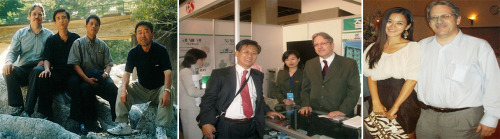
Pictures from left to right:
North Korean businessmen and Felix Abt outside Pyongyang after strenuous
business meetings.
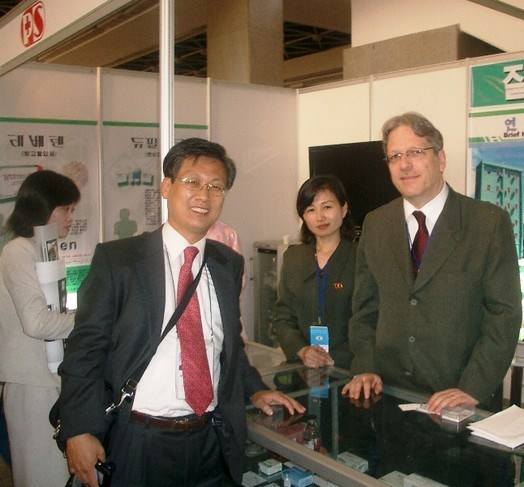
“Sunshine” made it possible: South
Korean lawmakers, visiting a trade fair in Pyongyang, meet up with Felix Abt
and his North Korean staff at their booth.
One
of the last South Korean goodwill ambassadors to North Korea before the sunset
of sunshine policy: Lee Ji-sun, Miss Korea 2007, visiting Pyongyang on behalf
of the World Trade Centers Association, pictured together with Felix Abt
☆
☆
☆
☆
☆
When ‘Sunshine’ Ruled on the Korean...
When ‘Sunshine’ Ruled on the Korean Peninsula
Remembering a period of unprecedented cooperation
between the two Koreas, despite being technically still at war.
By Felix
Abt
ties with North Korea from 2008, their liberal predecessors Kim Dae-jung and
Roh Moo-hyun promoted peaceful engagement and rapprochement, an approach called
the “sunshine policy.” The name stemmed from an ancient Greek fable where the
wind and the sun competed to remove a man’s cloak. No matter how strongly the
wind blew, the man only wrapped his cloak more tightly to keep warm. But when
the sun shone, the warmth made him take his cloak off. The wind symbolized
unsuccessful coercive policies toward North Korea and the sun stood for an
approach able to persuade North Korea to take off its anachronistic and
uncomfortable cloak, changing at last. It wasn’t a “leftist” policy, as it was
labeled by critics from the right, since South Korea’s strongman President Park
Chung-hee had tried a similar policy in the 1970s.
The critics called Kim and Roh’s North Korea
engagement “checkbook diplomacy,” an expensive flop, and considered both
presidents as either naïve, striving for fame, or having a sinister agenda to
strengthen North Korea’s regime. An influential American journalist gave his
book the title Korea Betrayed: Kim Dae-jung and Sunshine. And
“sunshine” even became a term of mockery. In addition, the opponents of
engagement cited North Korea’s first nuclear test in 2006 as an irrefutable
proof of the complete failure of the sunshine policy. To North Korea, it meant
dissuasion and a bargaining chip in negotiating with Washington as the George
W. Bush administration “reversed the age of warm sunshine back to the age of
cold wind,” which made North Korea abandon the non-proliferation treaty, oust
International Atomic Energy Agency inspectors, and start testing long-range
missiles, Kim Dae-jung explained in a speech at Harvard University.
Kim had indeed a very ambitious plan to decrease
inter-Korean tensions and work toward a peaceful reunification. The Korean War
still lingers, as only an armistice was concluded in 1953, not a peace treaty.
Kim was aware of the fact that Pyongyang couldn’t and wouldn’t change quickly
and that he wouldn’t get much gratitude for his efforts either. A transformation
of North Korea similar to the transformations of China and Vietnam, which
brought about significant changes after the West normalized relations with
them, wasn’t just around the corner.
The tool to further Kim’s agenda was the set-up of a
wide cooperative framework that included infrastructure development, such as
the restoration and construction of roads and railways, economic assistance, as
well as a wide variety of inter-Korean business ventures. It was aimed at both
increasing living standards in the North and upping its dependence on the
South. More than 40 different types of agreements were concluded between the
two Koreas during this period. South Korean companies were not only permitted
but actively encouraged to interact with the North; in many cases they
benefited from subsidies. South Korean firms became involved in the North in
mining, agriculture, tourism, car manufacturing, and textile production. The
most outstanding achievement of Kim Dae-jung’s policy was an industrial park in
the North Korean city of Kaesong, where more than a hundred South Korean
companies employed more than 50,000 North Korean workers until South Korea’s
current President Park Geun-hye pulled the plug in 2016 and buried the last
remnants of “Sunshine.”
I lived and worked in North Korea both when the
sunshine policy peaked and when it faded away. As I was also involved in
North-South projects I experienced up close how it played out.
As resident country director of the ABB
Group, a global leader in power technologies,
I participated at a trade fair in Pyongyang where we exhibited an innovative,
environmentally-friendly large transformer for utility and industrial
applications. The transformer was made in an ABB-factory in South Korea. This
triggered lively discussions with North Koreans, who were interested in
transferring at least part of the factory in the South to the North, from which
transformers could be sold to the South, China, and elsewhere.
As CEO of North Korea’s first foreign-invested pharmaceutical
enterprise I explored ways to sell Northern
traditional herbal medicine in the South. I examined the possibility of setting
up up a small processing unit at the Kaesong Industrial Park from which to
distribute the products southward. Our North Korean company co-owners liked the
plan. Yet we were ahead of the times — though the South Korean medicine
wholesalers and retailers I talked to found the idea intriguing, they cautioned
that marketing would become a costly endeavor as Southerners would not trust
that medicine from the North would be safe.
The CEO from a large South Korean construction company
invited me to Seoul to help him draft a plan to get sand, scarce in the South
but abundant in the North.
The former CEO of South Korea’s largest dairy firm
wanted me to help him set up a dairy business in the North. Many members of
this cooperative were farmers of northern descent and enthusiastically
supported the idea. It was a commercial project with a humanitarian component:
Koreans and other donors around the world pledged to sponsor a daily glass of
milk for every North Korean child.
I was also leading the negotiations between North
Koreans and a large South Korean chaebol (business group) on a water project on
Paekdu, a “holy” mountain shared by North Korea and China and revered by the
surrounding peoples throughout history. Both the North and the South Korean
interlocutors were convinced that the magical natural water from Mount
Paekdu (to be sold as is or carbonated or as drinks blended with fruit
juice or artificial flavors) would become a huge commercial and PR-success.
Negotiations were not easy. The mistrust between the
North and South Korean business partners was an important obstacle to business
development. While the Northerners suspected Southerners of having a hidden
agenda to make a hostile takeover, the Southerners feared the Northerners were
out to rip them off. Both sides seemed to have trusted a neutral Swiss
businessman more than their fellow Koreans. Still, the chairman of one of South
Korea’s largest law firms once asked me bluntly: “On which side are you?” “On
my side!” I retorted.
To my surprise, I soon had to face one big anomaly,
namely that the input costs (rent, salaries, electricity, etc.) for South
Koreans businesses were substantially higher than for European and Chinese
businesses. I disagreed with this discrimination and raised the issue with the
authorities who replied, “The Southerners helped destroy our country, that’s
why they have to pay a higher price.”
I wanted to understand the reasoning behind this
attitude and asked a history professor at Kim Il Sung University who explained
to me:
Unfortunately, Northerners have often
been mistreated by Southerners throughout our common history. Southerners
helped foreigners exploit the North’s riches and the North’s people, forced
Northern women into prostitution in the South, forced Northern men to fight
Southern kingdoms’ wars and more recently helped Japan colonize our country and
supported the United States to destroy our cities and dams and other
infrastructure during the Korean War. They can’t get away without paying any
compensation.
That also made me understand why Kim Dae-jung transferred
hundreds of millions of dollars to North Korea, which was called corruption by
his detractors, before the historical first meeting between a North and a South
Korean leader.
During the Sunshine years, not only more and more
business people from the South came to the North. NGOs, artists, religious
groups, and tourists also crossed the Demilitarized Zone (DMZ). Close to two
million South Koreans visited scenic Mount Kumgang. More than 20,000 South
Koreans also met there with their Northern family members. An old North Korean
told me he was never as happy in his life as when he met his Southern family,
torn apart during the Korean War, at Mount Kumgang.
Every day, about 400 South Korean vehicles crossed the
DMZ, which Bill Clinton called the most dangerous place on earth, to North
Korea. About 1,000 people entered the North on a daily basis. In 2008 North
Korea even decided to allow South Korean visitors to use their own cars to make
the trip.
Most of the visits which now had become commonplace
were limited to mount Kumgang, Kaesong, and Pyongyang. But more and more South
Koreans were visiting other parts of the country, in particular when they were
involved in agricultural projects. Of course, they were watched and controlled,
but they also learned a lot as they could understand Korean and, more
importantly, they played the role of ambassadors representing the rich,
imitable South Korea in North Korea’s impoverished hinterland.
This was also a time when North Korean officials
started admitting that mistakes have been made in the past and interaction with
the outside world to help improve things was welcome. Sunshine allowed North
Korea to see a future beyond Kimilsungism, its state ideology.
I watched my staff and other North Koreans observe
Southern visitors. They tried to do so discreetly, but couldn’t always suppress
their amazement with an open mouth or a spontaneous smile. Southerners were
well dressed, looked well fed and healthy, and were tall by Northern standards.
They brought the latest cameras with them, were relaxed, and showed
self-confidence. Their appearance must instantly have neutralized the North’s
propaganda myths of South Koreans oppressed by the U.S. imperialists and their
South Korean puppets.
It was also interesting for me to observe when North
Korean and South Korean business people interacted outside the formal setting
of business meetings — in karaoke rooms for example. Singing together, holding
hands, and even hugging one another (and sometimes getting drunk and very
emotional together) wasn’t choreographed. The encounters transcended politics
and showed me Koreans on both sides of the fence as human beings who could get
along very well if politics did not stand in their way.
In December 2007, South Koreans were disenchanted by
what they perceived as a liberal president’s failed domestic economic policy
(not related to “Sunshine”). They elected Lee Myung-bak, a businessman
from the conservative opposition party as president, thinking he could fix
their woes. Lee had previously made an impressive career in the construction
industry and was nicknamed “bulldozer.” He had been an opponent to “Sunshine”
and when he took over the presidency in early 2008 he quickly started
bulldozing what his predecessors had built up.
Shortly after his election I went to a meeting with
North Koreans working on a North-South project. I explained that it would be a
waste to continue to work on the project given the new political circumstances.
I must have shocked them with bad news that hadn’t reached them yet. It was the
first time I looked into so many genuinely disappointed and sad North Korean
faces. With Sunshine gone, the smiles were gone too.
***
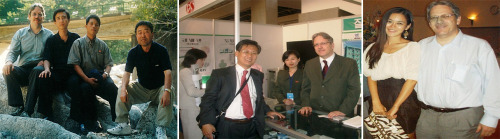
Pictures from left to right:
North Korean businessmen and Felix Abt outside Pyongyang after strenuous
business meetings.
“Sunshine” made it possible: South
Korean lawmakers, visiting a trade fair in Pyongyang, meet up with Felix Abt
and his North Korean staff at their booth.
One
of the last South Korean goodwill ambassadors to North Korea before the sunset
of sunshine policy: Lee Ji-sun, Miss Korea 2007, visiting Pyongyang on behalf
of the World Trade Centers Association, pictured together with Felix Abt
***
This piece was published by The Diplomat magazine in July 2016
NORTH KOREA’S ILLICIT INTERNETA brief history of the internet in...
NORTH KOREA’S ILLICIT INTERNET
A brief history of the internet in North Korea — and North
Korea’s private intranet.
By Felix Abt
North Korea has only a few thousand internet users in a
country of 25 million. To enjoy this exclusive privilege, a North Korean must
first successfully apply for a permit from the government to own a computer and
a second permit to access the internet with it. In contrast, more than 90 percent
of the people in South Korea, one of the world’s most wired countries, are
netizens.
While living in North Korea, I witnessed many changes, some
quite dramatic by North Korean standards, including the emergence of the
internet, and more significantly, its own version, namely a steadily expanding
intranet.
For internet users, North Korea’s telecom at first offered a
slow dial-up connection to a web server hosted in a Chinese province bordering
North Korea. As a resident foreigner, I didn’t need a permit and had
unrestricted access to any website. The restrictions were technological, not
political. Emails with larger
attachments were costly as their transfer often took minutes rather than
seconds, and at that time email use would cost several dollars a minute. Later
I used the internet through access set up by a German business man. An American
satellite link enabled access from North Korea’s telecom to his web server in
Germany. Thanks to his much lower prices I saved several thousand dollars a
month. To the satisfaction of its users, the evolving internet became faster
and cheaper over the years.
In parallel, North Korea developed its “Kwangmyong” which
means literally “bright” or “light.” This free, domestic-only network or
intranet opened in 2000. It offers a Firefox-style browser called “Our Country”
with which users can navigate more than 5,000 websites at present. It is a
large library, a place to propagate information, and a communication platform
between government agencies, universities, industry, and commerce. It has many
pages copied from the World Wide Web and includes flight and train schedules,
weather forecasts, and news sites. Many of North Korea’s three million mobile
phone users are using their devices to surf this intranet.
Intranet content is strictly subject to government approval;
as it says, it wants to “let the breeze from the internet in while shutting out
the mosquitoes.” Its Facebook-like pages, chat rooms, and emails are closely
monitored. It also has been difficult for the North Korean engineers of the first-foreign invested software company I co-founded to
work on projects online with clients abroad, as is common practice in the
software industry. This turned out to be an important competitive disadvantage
for us.
The intranet is also used for commercial purposes and
entertainment. When I was CEO of a pharmaceutical company, we were among the first to set up a
commercial domestic website. It helped us a lot to build our brand and
competitive services and to communicate with the medical profession
across the country while also selling and distributing our pharmaceuticals and
other healthcare products to remote provinces.
Pyongyang’s critics claim the regime is afraid of giving its
population access to the larger internet, as it would undermine its authority.
They may be right. They may also be ignoring the fact that North Koreans know
much more about the outside world than the outside world knows about them:
North Korea has less than 3.000 Western visitors a year, but many more North
Koreans flock to China every year. China issues up to 40,000 work visas for
North Koreans per year. Unsurprisingly South Korean soap operas and some
Hollywood films, which are wildly popular, find their way across the porous
Chinese border into the so-called Hermit Kingdom and North Korea’s youngsters,
reportedly, even watch porn movies.
Therefore the threat from the inflow of information may be
less real than the regime and its foes believe. But even if North Korea allowed
all its citizens unrestricted access to the internet, their access would remain
heavily censored and limited — by the United States, no less. As I’ve noted previously:
Under the conditions of international sanctions imposed
by the U.S. Treasury Department’s Office of Foreign Assets Control … all major
tech companies such as Google (NASDAQ:GOOG), Yahoo (NASDAQ:YHOO), Microsoft
(NASDAQ:MSFT) and Oracle (NASDAQ:ORCL) among others, also restrict access to
their products from sanctioned countries.
LinkedIn blocked my North Korea-based account in compliance
with the U.S. Treasury Department’s directive. I couldn’t use my credit card in
North Korea either but I was one of the few who could and did use Google and
Facebook as these companies seemed to have ignored U.S. sanctions law.
When I lived in Vietnam in the mid-nineties very few people had access to the Internet, then also
perceived as highly risky by the government. By mid-1998 there were an
estimated 1,500 customers, or approximately 4,000 individual internet users, in
Vietnam (population in 1998: 76 million). In this respect it was exactly the same
as when I arrived in North Korea some years later.
But, unlike in North Korea, some significant geopolitical
events would soon help change Vietnam’s landscape: On February 3, 1994,
President Bill Clinton lifted the U.S. trade embargo. On July 11, 1995,
Clinton announced the normalization of U.S.-Vietnam relations, and soon
thereafter a U.S. embassy was set up in Hanoi.
As a consequence, the fear of opening up and letting more
people have access to a hitherto “hostile” internet with its many infectious
“Western mosquitoes” diminished over the years.
As of 2015, some 20 years later, Vietnam has more than 44
million internet users (44 percent of the population), including 30 million
Facebook users.
If the United States were to end the Korean War, sign a
peace treaty and normalize its relations with the “Hermit Kingdom,” it is quite
likely North Korea could also count at least 44 percent of its population — if
not much more — as internet users in 20 years’ time.
***
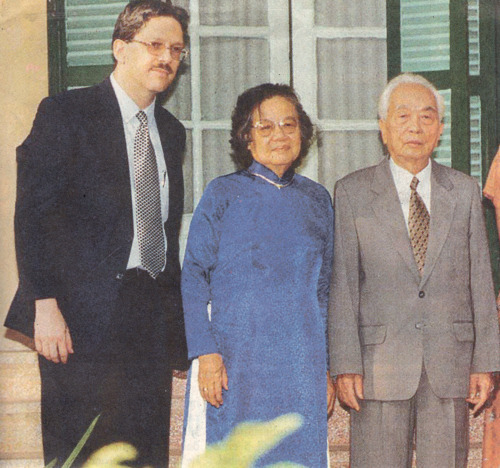
Picture: Uncompromising on the
battle field, for reconciliation and reforms after the war: Vietnam’s legendary
General Giap, the mastermind behind the military defeat of the French Colonial
Power and the war against the invading U.S. military, together with his wife
and Felix Abt
***
This piece was published by The Diplomat magazine in June 2016
May 29, 2016
ON BUSINESS ETHICS, HUMAN RIGHTS, SANCTIONS AND REFORMS IN NORTH KOREA
Here is Felix Abt’s full interview with The Huffington Post
December 6, 2015
A DISTURBING NORTH KOREA EXPERIENCE - CENSORED BY THE FREE...
A DISTURBING NORTH KOREA EXPERIENCE - CENSORED BY THE FREE WESTERN PRESS
When
reporting on North Korea the Western media publish vilifying claims
with alacrity; happy to go to press without substantiation. The more
disparaging and absurd or outlandish the story the more likely,
apparently, it will make it into print: from an ongoing Holocaust with
bodies floating in North Korea’s rivers and piling up on its streets
(which bewilderingly has not been witnessed by either residents or
visiting foreigners, nor picked up by the plethora of satellites
monitoring the ‘rogue state’ and, furthermore, it is hardly credible to
equate this apocryphal carnage with a population steadily on the
increase ), to its leader shooting an amazing 11 holes-in-one, achieving
an unprecedented 38-under-par game on a regulation 18-hole golf course -
on his first try at golf. Were this story to have any basis in fact,
surely the one place it would have been widely promulgated is within the
country itself, to inspire the populace or praise the leadership, but
very few North Koreans were aware of this preposterous claim, so widely
spread in the West, and then only through Western media sources.
Hawkish
recommendations on how to ‘deal with’ North Korea similarly get plenty
of media attention. For example Joshua Stanton, an advocate of the
continuing strangulating sanctions and vociferously opposed to any kind
of engagement, has his opinions readily quoted and published by the
‘free’ press. But the supposed balance which Western media claims for
itself is conspicuously absent in its reportage of North Korea. To
attempt to prove the partisan nature of the press Felix Abt submitted the
article below to the following media and opinion leaders:
The
Guardian, The Independent, The Times (of London), The Telegraph, The
Financial Times, The Washington Post, The Huffington Post, The Diplomat,
Wired, The Wall Street Journal, Bloomberg, Thomson Reuters, Forbes, The
New York Times
It was rejected by every single one. We can only
conclude that they have no desire to publish views contrary to their
established editorial position on North Korea, but rather seek to
suppress such views, even when they come from a source with intimate
personal experience of the state of affairs within the country and
presenting verifiable facts. Wild, unsubstantiated claims make better
copy apparently.
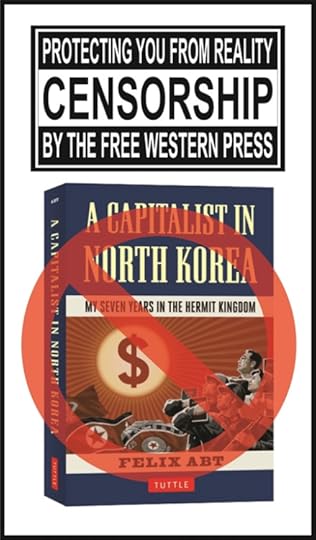
With the exception of The Financial Times, ALL OF
THESE MEDIA have also ignored Abt’s book A Capitalist in North Korea: My
Seven Years in the Hermit Kingdom. Other publications on North Korea,
particularly where they tell horror stories of suppression and death,
whether true or invented, get pages of media attention and praise. The
New York Times, for example, recently published a positive review of a
book by a tourist who visited Pyongyang and its neighborhood for just
one week! Since its author called North Korea the ‘worst place on earth’
she apparently deserved the acclaim. Understandably, its writer, an
American woman, hasn’t traveled to Somalia, Yemen, Iraq, Syria or
Afghanistan as she could easily have been abducted, raped and killed
there. Nevertheless, one week in the ‘hell hole’ of North Korea, as it
is referred to by other widely quoted book authors, deserves full
attention. An honest account of seven years living there, and working
and interacting with North Korean workers, engineers, farmers, doctors
and scientists, however, is too unpalatable to receive recognition from
the blinkered Western media.
If you want to challenge the
information and opinion monopoly held by a press that claims to defend
free speech (with delicious Orwellian irony), please post the link of Felix Abt’s
article: http://38north.org/2012/12/fabt122312/ wherever you can.
March 23, 2015
AUTOMATONS, SLAVES OR MEMBERS OF THE 1% ELITEThat’s the...
AUTOMATONS, SLAVES OR MEMBERS OF THE 1% ELITE
That’s the stereotypical portrayal of North Koreans by foreign media and authors of books on the country. My personal experience of the people of
the DPRK was very different.
I recruited
staff from universities, commercial enterprises and other organizations
in North Korea and had a good mix of ages and backgrounds. Initially
around half were women, but this was increased substantially over time
as women were generally found to be more diligent and dedicated to tasks
than their male counterparts. In my experience, this seems to be true
throughout Asia. Just a small proportion belonged to the
Korean Labor Party.
Most were slim when they started with us,
but many added a little padding the longer they stayed. Older members of
staff were usually married, younger staff often in love and some even
showing symptoms of lovesickness. A few displayed signs of, or confided
to, difficult relationships and a small number were divorced. There were
rumors that some married staff members were not entirely faithful. Some
colleagues liked one another better than others and sometimes there
were misunderstandings and arguments. In other words, it was just like
any of the companies I had worked in around the world.
All of my
staff were hard workers, and if they weren’t they didn’t stay long.
Exceptionally, the harder working staff asked for better training or the
replacement of lazy or incompetent ones. Some always seemed to wear a
serious face, others were often smiling. Some were introvert, others
garrulous and fun-loving, telling jokes and enjoying a laugh. North
Koreans love to joke and tell funny stories, as I experienced in
numerous encounters with not only the employees, but also suppliers and
customers. Some of the jokes would merit a xxx-rating in other
countries!
Without exception the staff loved their children and
were bursting with pride over their achievements. If a child
successfully passed the entrance exam to a good school there was
jubilation. Conversely, a child underperforming was the cause of huge
anguish and could result in tearful scenes. I had great pleasure in
meeting children of my staff on various occasions and found them just
like kids anywhere else: some were shy and reticent, others were curious
and bursting with questions for me. That the staff’s adult children
married well was a very important topic, and so were grandchildren.
There was none so proud among the staff as a contented grandparent.
Though
media in the West claim most North Korean adults use meth and other
drugs, I saw no signs of it among the workforce. I believe I am well
aware of the signs and what to look for and knew that users of such
drugs would typically display the symptoms after a while. On the other
hand, most men were heavy smokers and loved to drink Soju and other hard
alcoholic drinks. However, the latter was generally restricted to
special occasions such as holidays or birthday parties.
As we
jointly had to achieve some really tough objectives in a very demanding
environment a close bond developed between my staff and me. They trusted
me that I wouldn’t betray them and so I learned more about their
families, friends, interests and hobbies than was usual for a westerner.
We became even closer as we organized outings, sport days and Karaoke
evenings and often played volleyball or table tennis together after
work.
My video above
shows one of my female staff members in the company canteen giving a
short performance of ‘Tul’ (also teul or 틀 in Korean), which is as
rigorous and precise as a Swiss clock, on the way to mastering North
Korea’s favorite national sport Taekwondo, the equivalent to the ‘kata’
in karate.
This, then, is just one example of the individualistic
nature of the North Korean staff I was honored to work with: people with
distinct personalities, fears, foibles and idiosyncrasies; as
individual as any other people in any other country. A far cry from the
convenient, prejudiced stereotype the western media love to depict.
☆☆☆☆☆
Q&As with Felix Abt, author of the book A Capitalist in North Korea: My Seven Years in the Hermit Kingdom.
“North Korea Needs A Bold Vision”
Korea Observer: If
you were asked to advise the North Korean government on how to create a
brighter future for its citizens what would you tell them?
Felix Abt:
I would recommend they strive to develop a long-term vision with an
unequivocal strategy and clearly stated goals. They’d need to start
implementing it without delay. The country could, and should, achieve an
annual growth rate of 10 – 15 % over the next 10 to 20 years. To
accomplish this the government would have to rethink previous approaches
and look to widely liberalizing its economy. This is not without
precedent and proven efficacy: China, starting from an economic base
performing at a similarly low level to North Korea’s, introduced
sweeping reforms and subsequently achieved consistent 2-digit growth
rates over a period of many years; resulting in hundreds of millions of
its citizens being lifted out of poverty.
Korea Observer: But that would mean the economy becomes free while there is no political freedom.
Felix Abt:
Political liberalization is much more intractable as the North has a
strong rival system in the South, not something China and Vietnam had to
contend with when they opened up. The solution, I believe, is for the
North’s vision to encompass a “Scandinavian” approach that includes a
highly competitive element, evolving into a market economy while
building up a strong social safety net for all those citizens who would
otherwise struggle under such a system.
To
realize a sustainable growth model, the country would, of course, also
have to reform institutions, for example developing a law-based state
and not incarcerating people for political reasons. Since the vast
majority of North Korean refugees have left the country for economic
reasons, implementing the outlined vision would become a strong
disincentive to abscond, and would certainly be far more effective than a
coercive approach.
☆☆☆☆☆
Published by The Korea Observer here: http://www.koreaobserver.com/automations-slaves-or-members-of-the-1-elite-27211