
Dan Harmon's Blog, page 38
September 16, 2013
I deleted my last post because it was confusing because I can never figure out how to...
I deleted my last post because it was confusing because I can never figure out how to “respond” to tumblr posts.


gaysquib:
Whose a douchebag?
You’re a douchebag.
How do I...

Whose a douchebag?
You’re a douchebag.
How do I respond to this? Did you ever expect a response? Am I allowed to respond? Am I allowed to have feelings about my work? Do you want me to be more like the people that make things that you don’t like? Have you noticed that those people don’t care what you want? Do you admire the people that don’t think about you? Do you perceive me as more like them than I am like you? Do you say shit like this because you like corporations more than people? Or do you say it because you don’t expect to have any effect at all? I want you to know you can move people. I want you to respect yourself and I want your respect. I create what I create in hopes of touching you. File that where you want. Act like you’re important to me. You are.
September 14, 2013
"the greatest kiss in TV history because it’s an accidental...




"the greatest kiss in TV history because it’s an accidental collision of two egomaniacs"
September 4, 2013
More on Dan Harmon's "Story Circle" and my theory it is a cosine wave
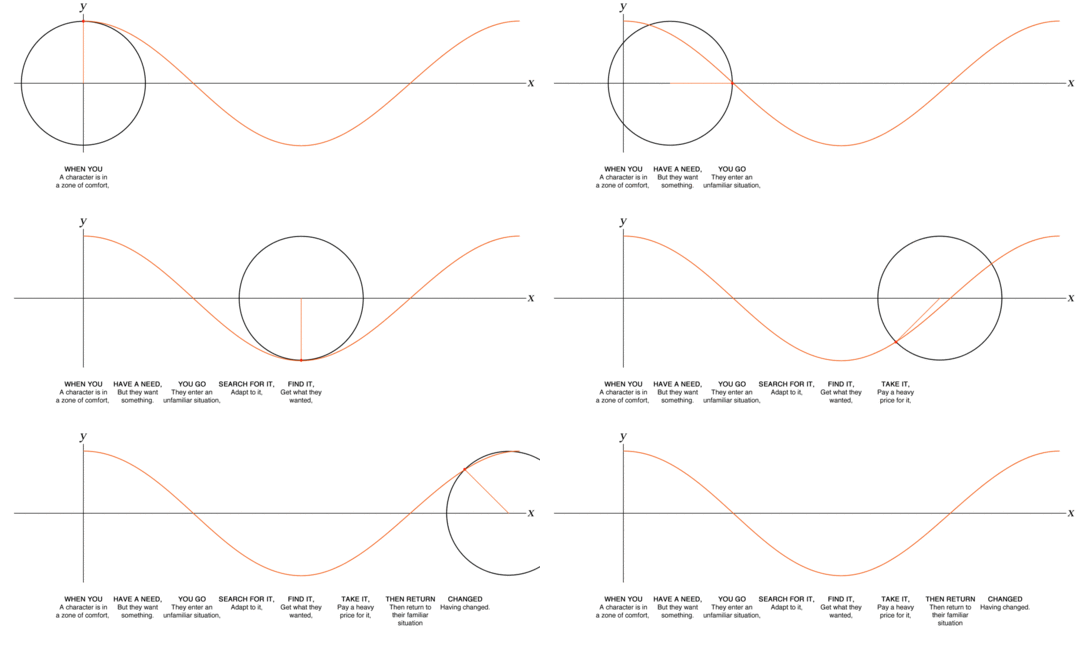
I’ve discussed before how Dan Harmon (creator of Community, co-writer for Monster House) has distilled the Joseph Campbell’s Monomyth into a very basic tool for describing the arcs of a story. Harmon prefers to see his story structure as a circle, whereas I believe that it is in fact a Cosine Wave. Since I’ve posted the above gif I’ve gotten quite a few notes about it and I thought I’d expand on my idea of why Harmon’s circle best fits a Cosine.
September 3, 2013



August 31, 2013
August 13, 2013








August 12, 2013







August 10, 2013
Could you explain a particular Community episode with the story circle? In the simplest, four quadrant version.
Sure, let’s do it with season 2’s D&D episode:
Keep in mind what I’m doing here is deconstructing a finished story, not recalling the process by which the story was broken. Back in season 2 it was probably about identifying act breaks, i.e. asking “what new world are we entering (step 3) and what’s the worst thing that can happen there (step 6).” But no matter how it was assembled, if the end result is a story, we should be able to detect four distinct quadrants.
If I were to take a stab at the episode’s “quadrants” in terms of general plot…and forgive me, I could really screw this up without watching the episode again, but here’s an EXAMPLE at me taking a stab, you can do this on your own and refine it.
Upper half = The Game is a Game
Lower half = The Game is Real
Left half = Pierce in Control
Right half = Abed in Control
The more important use of quadrants is in creating or checking for what the suits call “arcs.” You go through the story in the shoes of any particular character and ask yourself what’s changing from top to bottom and from right to left as they move through the plot. Here’s some possible upper and lower halves choosing Jeff as the protagonist:
- In Control / Out of Control
- Altruism / Guilt
- Pierce is a child / Pierce is a threat
All of those and more might be valid, it’s all subjective, but my favorite is:
- Altruism / Guilt
When I draw a line between “altruism” and “guilt,” the idea that there’s a difference sparks my interest. Sometimes we want to help people because we’re good people and sometimes we want to help people because we don’t want to be bad people. To someone else, there’s no distinction there, but it only needs to be visible to the writer. To me, the arrival of Pierce, who kills Chang and runs off with Fat Neil’s sword, ushers Jeff across a threshold between altruism and guilt, yanking him from a world in which he was “fixing” Neil and tossing him into a world in which he may end up responsible for Neil’s destruction if he “loses” the game.
Moving on to picking a left/right division for Jeff. I’ll tell you a lazy trick we learned in the Community room: when in doubt, the right half of the circle can just be “dishonesty” and the left half “honesty.” It’s almost always going to click because the mid point of a story is almost always where “shit gets real.” But it’s kind of like putting “order” on top and “chaos” on the bottom. Sure, D&D is taking us from dishonest order to dishonest chaos to honest chaos to honest order. But so does Star Wars, Miss Saigon and a commercial for gum. If you’re using quadrants to assemble or identify a specific story, it’s more valuable to get more specific.
I think what’s noteworthy and specific to Winger’s story in D&D is:
Lack of Control / Control
Note I’m “stealing” that idea from my first list of brainstormed top/bottoms. When I was riffing that list up there, I threw out “control,” and thought, “well, it’s not like Jeff ends this story back in control, he kind of loses it and never gets it ba— Ah ha.” Jeff spends the first half of the story - the right half - taking charge (first out of altruism, then out of guilt). Even when his world changes, his preferred methodology doesn’t. He attempts to get Abed to “cheat,” he physically pulls Pierce out of the room and tries to make him stop playing, he also leads the charge on berating Britta for her commitment to the game. But Jeff’s commitment is tested when a fictional Elf Maiden flirts with him. He’s too shy/narcissistic/cool/homophobic to engage with Abed, so Annie takes over and gains the group access to a flock of Pegasi, which Jeff had stated as the goal. Jeff never ends up back in control, not of the group nor of the game. Which allows for the amazing things that transpire between Neil and Pierce, who have their own quadrants to get through.
So, to me, Jeff’s quadrants are, clockwise: Controlled Altruism, Controlled Guilt, Uncontrollable Guilt and finally Uncontrollable Altruism, which is another way of saying Jeff learns that sometimes you’re a bad guy and sometimes you’re a good guy and you don’t really get to choose when or how that happens, but if you try to control it, you’re going to end up the bad guy, and if you stop trying to control it, goodness will prevail.
You could do this process with Neil, with the group, with Pierce and they might all be different and/or overlap in different ways…overall, to me, no matter what character you choose, this episode takes us on a beautiful circular journey around a central point where guilt, altruism, control and surrender intersect and merge with each other.
Yep, no doubt about it. It’s a great show! By the way, I can never mention this episode without giving shout outs to Andrew Guest and Chris McKenna, who stayed up all night writing the script with me for the table read so that the studio could give the note “they’re talking about goblins a lot.”
Excelsior!
August 9, 2013
Could you explain your story breaking process?
Start with random IDEAS. Ideas can be anything - Poop is an idea, America, pickles, the number six, a raccoon, anything.
Some ideas will reveal related ideas, i.e. you may think, upon thinking about raccoons, that you have more than one thought about raccoons. Clouds of related ideas that your mind recognizes as related in any way are potential story AREAS. Look for areas that make you laugh and cry.
Draw a circle to symbolize your area, because your story will take the “reader” through related ideas in a path around a central idea. You don’t have to know what the central idea is. It’s probably dumb. For God’s sake, you’re writing about raccoons.
Divide your circle into a top half and bottom half and ask yourself what those halves might be. Like, your raccoon area might become divided into “positive thoughts about raccoons” and “negative thoughts about raccoons.” If the division doesn’t feel charged for you, pick something else, like male raccoon thoughts and female raccoon thoughts, or biological raccoon thoughts and storybook raccoon thoughts. At some point, you will divide your area into two parts that create a personal “charge” for you, like a battery. ”Ooo, I like the idea that there’s a difference between biological raccoons and storybook raccoons, that tingled when I drew that line, I want to know more.”
Divide the divided circle down the middle and pick another charged dichotomy for left and right. For instance, biological/storybook raccoon area could get divided into dishonest/honest.
Now you have four quadrants to your circle, going clockwise: biological dishonest raccoon, storybook dishonest raccoon, storybook honest raccoon, biological honest raccoon. Any point at which you stop feeling charged, go back a step or start over. Maybe you had to get this far to realize you don’t give a shit about raccoons. Please note that at this point, people around you will start to express confusion and frustration, because they thought the idea was fine already. Depending on your mood and standing, these people are called hacks, traitors, parasites, scabs or successful colleagues.
When you find an area that yields four charged quadrants, experiment with protagonists. Easy answer first, maybe I’m a raccoon. So once upon a time there was a dishonest biological raccoon that became a storybook raccoon, which lead to him becoming honest before finally going back to being biological again. Cool? If not, go back or start over. Again, please note that many people will not want you to go back or start over. These people will one day drown in their own blood while you point and laugh with God. Or maybe they’re good people and you just have Asperger’s.
Then you keep dividing the pie, adding “curvature” to the protagonist’s path with the 8 point story structure you can find me blathering about elsewhere online.
Create more characters as needed, give them their own stories as needed.
Repeat every day until rich people give you money to do it for them. Buy a house, become one of them and hire poor people to do it for you. Somewhere in there try to get a dog and a funny girlfriend or it’s all pretty pointless. Speaking of which, I just realized I’m the only one at the office. Thank you for this question.
Dan Harmon's Blog

- Dan Harmon's profile
- 93 followers

