
Dan Harmon's Blog, page 2
March 6, 2014


March 4, 2014








March 1, 2014
mitzi—may:
when male writers create “strong female characters” that show hints of feminism...
when male writers create “strong female characters” that show hints of feminism without ever calling it feminism.
when said strong female characters go ahead and slut shame and spray hate all over other women.

I’m still waiting to hear what happens when these crimes are committed by a TV show you’re watching.
I suppose when these transgressions occur, you eventually rise up above the all-consuming horde and …
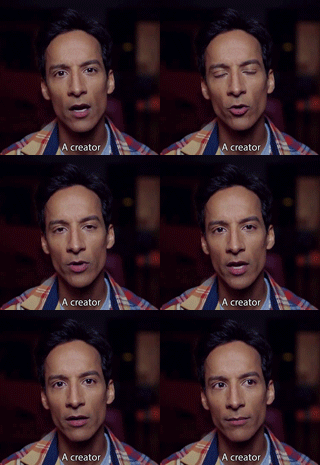
….post an animated GIF. Of a person on a different TV show rolling their eyes.
It’s a bummer to me that I can broadcast 30 minutes of content through a gauntlet of state and corporate-imposed boundaries and still somehow manage to enrage a real person.
It’s a bummer to me that a real person, without restriction, with nobody policing what they say or how they say it, can sit down to make their voice known, and end up…posting a complaint about a sitcom. A sitcom on a network that predates our grandparents, from a company that makes stereos, games and phones.
Everything’s a bummer to me, but I try to focus on what makes me happy and what I’m able to control. Now imagine a GIF of me shitting on your face and tell your parents I said “you’re welcome.”
February 26, 2014
New Channel 101 for Feb. 2014 Is Here
Channel 101's latest batch for this month is here and shows Car Jumper and NY Stories are still deservedly top finishers.
As always, if you’re not familiar with Dan Harmon and Rob Schrab's independent monthly short form series that's been running for more than a few years, then please do acquaint yourself with hours of hilarious awesomeness.
February 24, 2014
"My characters aren’t losers. They’re rebels. They win by their refusal to play by everyone else’s..."
-
Harold Ramis
Today, we mourn of the loss of Harold Ramis, one of the most influential comedy directors of all time.
(via tribecafilm)February 22, 2014
vamosvideo:
“True character is revealed in the choices a human...

“True character is revealed in the choices a human being makes under pressure - the greater the pressure, the deeper the revelation, the truer the choice to the character’s essential nature. But this? Using scissors to cut off the tip of a slice of pizza? I don’t know what this is. ”
― Robert McKee, Story: Substance, Structure, Style and the Principles of Screenwriting
February 20, 2014
atsp88:
Community Intro with JUST the Greendale 7
(I’ve been...
Community Intro with JUST the Greendale 7
(I’ve been thinking about possibly doing a “current cast” version and a “full cast” version as well, but baby steps ya know?)
Inspired by this scene in Easy A http://www.youtube.com/watch?v=pFXz9BQJ3c0
YOU GUYS! I’M STILL ALIVE AND STILL A FAN! I SWEARSIES!
Seriously though, the new season has been epic so far!!
So, due to some personal life stuff I haven’t sat down to make a video in… well a long time. So sorry this is small, the idea came to me and I needed to get back into the groove of things.
I absolutely adore the cootie catcher intro, but I also kinda wondered what it could potentially look like if actual scenes from the show were used. I looked around on youtube for a while and didn’t happen to see one. I saw lots of mash-ups though.
(these are my personal faves)
http://www.youtube.com/watch?v=BD8WOzRG8ik
http://www.youtube.com/watch?v=-tAb1tFm_v8
and now I’m even thinking of making one in the style of the walking dead, just for giggles. We’ll see.
awwwwwwesome sauce as the kids used to say. Community attracts the best editors on all the Internets.
February 18, 2014
I've recently studied your story circle and by extension Joseph Campbell's Monomyth. I found it interesting that your story circle seems to incorporate Campbell's steps perfectly until you hit steps 6 (Take) and 7 (Return). Based on your Channel 101 tutori
By my interpretation, which could be flawed, I didn’t think Campbell was implying that every story includes a “magic flight” and a “rescue from without” followed by a crossing of the return threshold. I think he was suggesting that stories, in general, follow a path of descent and return, and that along that circular path, which [when complete] includes a return, the phenomena we see recurring from culture to culture include heroes being chased, being whisked away, etc. I assume he described those phenomena before describing the return threshold in depth because the return threshold is the more fundamental concept. As if to say, “be it by magic flight, which we see in these examples, or rescue from without, which we see in these examples, one way or another, the hero tends to return, so let’s discuss the examples and significance of returning.” I’m sure I was only trying to make the same point in my tutorials and if I confused you at all I’m sorry.
Campbell talked often about the futility of what he characterized as opacity in mythology. To brutally paraphrase him, a functioning religion (or story) is a window to something invisible, something all around us that we fail to “see” before a crafted frame says “look here.” It’s one thing to stain a window’s glass, to help us experience light, but when we paint the glass solid, by standing too much on ceremony, or by interpreting myth too literally, our story or religion will separate us from the unknown and each other rather than connecting us.
The ironic thing, or I guess the least ironic thing ever, is that Campbell’s wisdom makes a pretty great window, and his step-by-step analysis of mythology has come to be used as a “how to write” handbook or a “what all stories have to be” doctrine. But he never intended that, and he certainly wouldn’t have wanted some fat drunk college dropout boiling his monomyth down to a paint by numbers kit on the internet. The people that created and passed down our timeless stories didn’t do that. They followed their instincts, their fears and desires. They opened their flawed souls and let their gods shine through them. In the modern world, where writing is a recourse to revenue, we are pressured to short-cut the shamanism, like an aspirin company synthesizing tree bark. We attempt to bottle and sell simulated stories and religions, myths that may or may not be connections to the unknown but first and foremost make their deadlines and get our readers or viewers through the day. This is not a bad thing, I’d rather live in a world where a story can make me a provider for my family than a world where I’m just the slowest dishwasher.
But in these moments when we’re blocked, or in the moments we are staring at a board full of diagrams, moving characters and motivations around like chess pieces, trying to “solve” a story as if it were math homework, paralyzed by the academia, it helps to remember that any act of creation, whether folding a paper airplane, baking a cake or writing an episode of SVU, is, by definition, a religious act and a subversive one. We reach out with ape-like hands and filthy minds and we mock and challenge all that came before us by making something be there that was not there. We change the history of the world, we change who we are and we change everything that touches what we make, so we may as well also always change the rules by which we make them.
by now you’ve probably realized I’m not really just answering your question but am using it to deal with insomnia. But to try to bring this around to you, now that you’ve studied Campbell, you’ve got what’s important about it. Heroes go Somewhere Else and Heroes Come Back Different. Everything else is yours to interpret.
I've recently studied your story circle and by extension Joseph Campbell's Monomyth. I found it interesting that your story circle seems to incorporate Campbell's steps perfectly until you hit steps 6 (Take) and 7 (Return). Based on your Channel 101 tutori
By my interpretation, which could be flawed, I didn’t think Campbell was implying that every story includes a “magic flight” and a “rescue from without” followed by a crossing of the return threshold. I think he was suggesting that stories, in general, follow a path of descent and return, and that along that circular path, which [when complete] includes a return, the phenomena we see recurring from culture to culture include heroes being chased, being whisked away, etc. I assume he described those phenomena before describing the return threshold in depth because the return threshold is the more fundamental concept. As if to say, “be it by magic flight, which we see in these examples, or rescue from without, which we see in these examples, one way or another, the hero tends to return, so let’s discuss the examples and significance of returning.” I’m sure I was only trying to make the same point in my tutorials and if I confused you at all I’m sorry.
Campbell talked often about the futility of what he characterized as opacity in mythology. To brutally paraphrase him, a functioning religion (or story) is a window to something invisible, something all around us that we fail to “see” before a crafted frame says “look here.” It’s one thing to stain a window’s glass, to help us experience light, but when we paint the glass solid, by standing too much on ceremony, or by interpreting myth too literally, our story or religion will separate us from the unknown and each other rather than connecting us.
The ironic thing, or I guess the least ironic thing ever, is that Campbell’s wisdom makes a pretty great window, and his step-by-step analysis of mythology has come to be used as a “how to write” handbook or a “what all stories have to be” doctrine. But he never intended that, and he certainly wouldn’t have wanted some fat drunk college dropout boiling his monomyth down to a paint by numbers kit on the internet. The people that created and passed down our timeless stories didn’t do that. They followed their instincts, their fears and desires. They opened their flawed souls and let their gods shine through them. In the modern world, where writing is a recourse to revenue, we are pressured to short-cut the shamanism, like an aspirin company synthesizing tree bark. We attempt to bottle and sell simulated stories and religions, myths that may or may not be connections to the unknown but first and foremost make their deadlines and get our readers or viewers through the day. This is not a bad thing, I’d rather live in a world where a story can make me a provider for my family than a world where I’m just the slowest dishwasher.
But in these moments when we’re blocked, or in the moments we are staring at a board full of diagrams, moving characters and motivations around like chess pieces, trying to “solve” a story as if it were math homework, paralyzed by the academia, it helps to remember that any act of creation, whether folding a paper airplane, baking a cake or writing an episode of SVU, is, by definition, a religious act and a subversive one. We reach out with ape-like hands and filthy minds and we mock and challenge all that came before us by making something be there that was not there. We change the history of the world, we change who we are and we change everything that touches what we make, so we may as well also always change the rules by which we make them.
by now you’ve probably realized I’m not really just answering your question but am using it to deal with insomnia. But to try to bring this around to you, now that you’ve studied Campbell, you’ve got what’s important about it. Heroes go Somewhere Else and Heroes Come Back Different. Everything else is yours to interpret.
I've recently studied your story circle and by extension Joseph Campbell's Monomyth. I found it interesting that your story circle seems to incorporate Campbell's steps perfectly until you hit steps 6 (Take) and 7 (Return). Based on your Channel 101 tutori
By my interpretation, which could be flawed, I didn’t think Campbell was implying that every story includes a “magic flight” and a “rescue from without” followed by a crossing of the return threshold. I think he was suggesting that stories, in general, follow a path of descent and return, and that along that circular path, which [when complete] includes a return, the phenomena we see recurring from culture to culture include heroes being chased, being whisked away, etc. I assume he described those phenomena before describing the return threshold in depth because the return threshold is the more fundamental concept. As if to say, “be it by magic flight, which we see in these examples, or rescue from without, which we see in these examples, one way or another, the hero tends to return, so let’s discuss the examples and significance of returning.” I’m sure I was only trying to make the same point in my tutorials and if I confused you at all I’m sorry.
Campbell talked often about the futility of what he characterized as opacity in mythology. To brutally paraphrase him, a functioning religion (or story) is a window to something invisible, something all around us that we fail to “see” before a crafted frame says “look here.” It’s one thing to stain a window’s glass, to help us experience light, but when we paint the glass solid, by standing too much on ceremony, or by interpreting myth too literally, our story or religion will separate us from the unknown and each other rather than connecting us.
The ironic thing, or I guess the least ironic thing ever, is that Campbell’s wisdom makes a pretty great window, and his step-by-step analysis of mythology has come to be used as a “how to write” handbook or a “what all stories have to be” doctrine. But he never intended that, and he certainly wouldn’t have wanted some fat drunk college dropout boiling his monomyth down to a paint by numbers kit on the internet. The people that created and passed down our timeless stories didn’t do that. They followed their instincts, their fears and desires. They opened their flawed souls and let their gods shine through them. In the modern world, where writing is a recourse to revenue, we are pressured to short-cut the shamanism, like an aspirin company synthesizing tree bark. We attempt to bottle and sell simulated stories and religions, myths that may or may not be connections to the unknown but first and foremost make their deadlines and get our readers or viewers through the day. This is not a bad thing, I’d rather live in a world where a story can make me a provider for my family than a world where I’m just the slowest dishwasher.
But in these moments when we’re blocked, or in the moments we are staring at a board full of diagrams, moving characters and motivations around like chess pieces, trying to “solve” a story as if it were math homework, paralyzed by the academia, it helps to remember that any act of creation, whether folding a paper airplane, baking a cake or writing an episode of SVU, is, by definition, a religious act and a subversive one. We reach out with ape-like hands and filthy minds and we mock and challenge all that came before us by making something be there that was not there. We change the history of the world, we change who we are and we change everything that touches what we make, so we may as well also always change the rules by which we make them.
by now you’ve probably realized I’m not really just answering your question but am using it to deal with insomnia. But to try to bring this around to you, now that you’ve studied Campbell, you’ve got what’s important about it. Heroes go Somewhere Else and Heroes Come Back Different. Everything else is yours to interpret.
Dan Harmon's Blog

- Dan Harmon's profile
- 93 followers

