Bill Steigerwald's Blog, page 4
September 23, 2015
Steinbeck and Charley sleep with the apples in Deerfield, Mass.
The ‘Travels With Charley’ Timeline — Day 2
Sept. 23-24, 1960 — Deerfield, Mass.
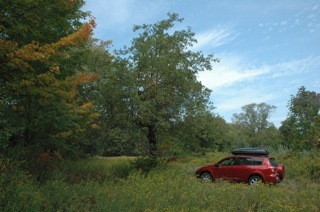
The apple orchard on a dairy farm in Deerfield, Mass., where Steinbeck camped while visiting his son.
Steinbeck and Charley camp Friday and Saturday nights in Rocinante in an apple orchard on a farm on top of the mountain above his son John’s exclusive boarding school, the Eaglebrook School.
In “Travels With Charley” he doesn’t say much about his visit or how many nights he spent at Eaglebrook. But in a letter to his wife Elaine, he makes it clear that he was there until Sunday morning, when he woke up late and almost missed church. Later that day he headed north on U.S. Highway 5 into Vermont and New Hampshire.
Steinbeck’s ‘Act of Courage’
John Steinbeck was especially brave to embark on his solo road trek in 1960 – and it had nothing to do with not having radial tires, GPS or air bags. Given his lousy health, his biographer Jackson Benson said the “Travels With Charley” trip could be best appreciated “as an act of courage.” As Steinbeck’s son Thom told the New York Times, “The book was his farewell. My dad knew he was dying, and he had been accused of having lost touch with the rest of the country. ‘Travels With Charley’ was his attempt to rediscover America.”
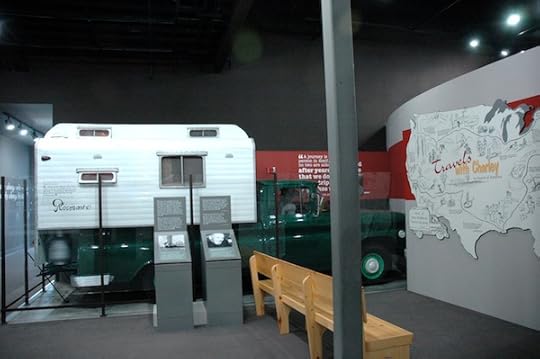
The 1960 pickup truck/camper Rocinante is parked in a place of honor at the National Steinbeck Center in Steinbeck’s hometown of Salinas, Calif.
Steinbeck’s agent, doctor and everyone who loved him tried to talk him out of his trip, which he had been thinking about taking for at least six years. What if he had a heart attack and collapsed in the middle of nowhere? He’d die for sure and he might never be found. He refused to hear such cautionary crap. He was the contemporary rival and equal of Hemingway. He was the World War II correspondent who went on daring midnight raids in PT boats off the Italian coast with Douglas Fairbanks Jr. He was a future Nobel Prize-winner. He may have been born with a heart too small for his big body, as a European doctor once told him. But he was not a famous dead author yet, literally or figuratively. He was still a man – and not an old man. He still had balls. He still had stuff to say and write and prove.
Steinbeck wrote in letters to his agent and others that he was tired of being fussed over like a sick baby or an invalid who had to be “protected” and “hospitalized.” He had to go on his great land-voyage of rediscovery – and go by himself, even though at the last minute he would ask his wife if he could take her 10-year-old standard French poodle Charley with him for company. Defending his solo project in a letter to his agent Elizabeth Otis, he said what he was proposing was not “a little trip of reporting, but a frantic last attempt to save my life and the integrity of my creative pulse.”
— Excerpted from “Dogging Steinbeck”


The ‘Travels With Charley’ Timeline — Day 1
The ‘Travels With Charley’ Timeline — Day 1
Sept. 23, 1960 — Sag Harbor, N.Y.
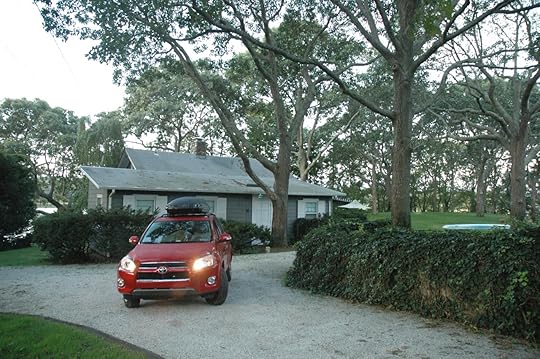
On Sept. 23, 2010, I left John Steinbeck’s summer home in Sag Harbor on Long Island and hit the Steinbeck Highway.
Early Friday morning John Steinbeck and his poodle Charley leave his summer home in Sag Harbor, Long Island, in the pickup truck-camper hybrid he named Rocinante after Don Quixote’s horse.
To get back in touch with America and regular Americans after living in ”the island” of New York, he plans to circle the country counterclockwise and stick to two-lane highways.
He takes three ferries across Long Island Sound to New London, Conn., 36 miles away, then heads for his son’s boarding school in Deerfield, Massachusetts.
September 22, 2015
Steinbeck & Charley — The definitive timeline of their iconic but fictionalized road trip
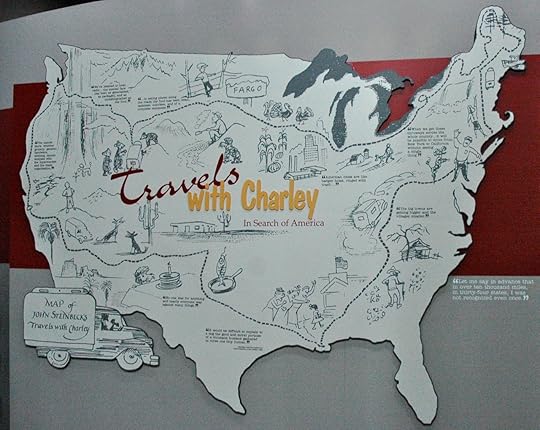
On Sept. 23, 1960, John Steinbeck set out alone on the cross-country road trip that he would turn into his best-selling 1962 nonfiction book “Travels With Charley in Search of America.”
Exactly 50 years later, on Sept. 23, 2010, I left Steinbeck’s summer house on the eastern end of Long Island and followed his cold trail as faithfully as possible as a journalist.
Steinbeck’s journey was much tougher and braver than mine. In 1960 America’s cars were like tanks and its two-lane highways were narrow, thick with traffic and deadly.
The world famous writer drove 10,000 hard and furious miles in his uncomfortable and primitive 1960 GMC pickup truck/camper.
Touching the top of Maine and speeding across the top of the USA to Seattle, he drove back to New York City by way of California, Texas and New Orleans. His trip, which included long layovers on the West Coast and in Texas, took about 75 days. He took no notes or photos.
I had originally set out to retrace Steinbeck’s tire tracks as faithfully as possible as a serious act of journalism. I simply hoped to write a book comparing the America of 1960 he saw on “The Steinbeck Highway” with the America of 2010 I saw.
My adventure with Steinbeck began exactly half a century after his did, on Sept. 23, 2010. As I traveled doglessly for 11,276 miles, I blogged to the Pittsburgh Post-Gazette web site, interviewed dozens of Americans and took thousands of photos.
I got lucky and during my research on and off the road I discovered new or “forgotten” information about Steinbeck, his actual trip and the editing and publishing of his iconic book.
My discoveries about the major discrepancies between Steinbeck’s actual trip and the one he described in “Charley” got me written up in the New York Times and ultimately changed the way Steinbeck’s classic will be read forever.
I didn’t get a New York publishing deal — or a Hollywood movie deal. But I have no regrets. As I detail in my book “Dogging Steinbeck,” chasing Steinbeck’s ghost around the USA for 43 days at age 63 was a trip of a lifetime.
*****
A Steinbeck & Charley TimelineBelow are excerpts from my book “Dogging Steinbeck” and a timeline of where I believe Steinbeck was each day during his trip. It’s based on “Travels With Charley,” the unedited first draft of the book, letters Steinbeck wrote from the road to his wife Elaine and others, biographies of Steinbeck, newspaper articles, interviews and best-guesses. It’s as accurate as I could make it.
Steinbeck & Charley — The timeline of their iconic American road trip
On Sept. 23, 1960, John Steinbeck set out alone on the cross-country road trip that he would turn into his best-selling 1962 nonfiction book “Travels With Charley in Search of America.”
Exactly 50 years later, on Sept. 23, 2010, I left Steinbeck’s summer house on the eastern end of Long Island and followed his cold trail as faithfully as possible as a journalist.
Steinbeck’s journey was much tougher and braver than mine. In 1960 America’s cars were like tanks and its two-lane highways were narrow, thick with traffic and deadly.
The world famous writer drove 10,000 hard and furious miles in his uncomfortable and primitive 1960 GMC pickup truck/camper.
Touching the top of Maine and speeding across the top of the USA to Seattle, he drove back to New York City by way of California, Texas and New Orleans. His trip, which included long layovers on the West Coast and in Texas, took about 75 days. He took no notes or photos.
I had originally set out to retrace Steinbeck’s tire tracks as a serious act of journalism. I simply hoped to write a book comparing the America of 1960 he saw on “The Steinbeck Highway” with the America of 2010 I saw.
While doing research on his exact route I found a letter Steinbeck wrote to an aide of Adlai Stevenson’s in the summer of 1960 describing how he hoped to travel on his upcoming road trip.

Steinbeck’s ambitious plans quickly fell apart. He actually did little of what he said he’d do, including traveling alone, but he had the right idea.
Sick and 58 years old, Steinbeck believed his trip was a failure. Yet that didn’t stop him from crafting his beloved American road book “Travels With Charley.” It was his only Number 1 New York Times best-seller and still sells around the world today.
My adventure with Steinbeck began exactly half a century after his did, on Sept. 23, 2010. As I traveled doglessly for 11,276 miles, I blogged to the Pittsburgh Post-Gazette web site, interviewed dozens of Americans and took thousands of photos.
I got lucky and during my research on and off the road I discovered new or “forgotten” information about Steinbeck, his actual trip and the editing and publishing of his iconic book. My discoveries got me written up in the New York Times and ultimately changed the way Steinbeck’s classic will be read forever.
I didn’t get a New York publishing deal — or a Hollywood movie deal. But I have no regrets. But as I detail in my book “Dogging Steinbeck,” chasing Steinbeck’s ghost around the USA for 43 days at age 63 was a trip of a lifetime.
*****
A Steinbeck & Charley Timeline
Below are excerpts from my book and a timeline of where I believe Steinbeck was each day during his trip. It’s based on “Travels With Charley,” the unedited first draft of the book, letters Steinbeck wrote from the road to his wife Elaine and others, biographies of Steinbeck, newspaper articles, interviews and best-guesses. It’s as accurate as I could make it.
The ‘Travels With Charley’ Timeline — Day 1
Sept. 23, 1960 — Sag Harbor, N.Y.
On Sept. 23, 2010, I left John Steinbeck’s summer home in Sag Harbor on Long Island and hit the Steinbeck Highway.
Early Friday morning John Steinbeck and his poodle Charley leave his summer home in Sag Harbor, Long Island, in the pickup truck-camper hybrid he named Rocinante after Don Quixote’s horse.
To get back in touch with America and regular Americans after living in ”the island” of New York, he plans to circle the country counterclockwise and stick to two-lane highways.
He takes three ferries across Long Island Sound to New London, Conn., 36 miles away, then heads for his son’s boarding school in Deerfield, Massachusetts.
John Steinbeck, Charley & me — Our road trips continue
Fifty-five years ago today John Steinbeck set out alone on the cross-country road trip that he would turn into his best-selling 1962 nonfiction book “Travels With Charley in Search of America.”
Five years ago today I left Steinbeck’s summer house on the eastern end of Long Island and followed his cold trail as faithfully as possible as a journalist.
On Sept. 23, 2010, I left John Steinbeck’s summer home in Sag Harbor on Long Island and hit the Steinbeck Highway.
Steinbeck’s journey was much tougher and braver than mine. In 1960 America’s cars were like tanks and its two-lane highways were narrow, thick with traffic and deadly.
The world famous writer drove 10,000 hard and furious miles in his uncomfortable and primitive 1960 GMC pickup truck/camper.
Touching the top of Maine and speeding across the top of the USA to Seattle, he drove back to New York City by way of California, Texas and New Orleans. His trip, which included long layovers on the West Coast and in Texas, took about 75 days. He took no notes or photos.
I had originally set out to retrace Steinbeck’s tire tracks as a serious act of journalism. I simply hoped to write a book comparing the America of 1960 he saw on “The Steinbeck Highway” with the America of 2010 I saw.
While doing research on his exact route I found a letter Steinbeck wrote to an aide of Adlai Stevenson’s in the summer of 1960 describing how he hoped to travel on his upcoming road trip.
In the summer of 1960 Steinbeck wrote a letter to an aide to Adlai Stevenson describing what he hoped to do on his coming road trip around the USA.
Steinbeck’s ambitious plans — a major journalism project by one of America’s greatest writers — quickly fell apart. He actually did little of what he said he’d do, including traveling alone, but he had the right idea.
Sick and 58 years old, Steinbeck didn’t enjoy his trip and he believed it was a failure.
Yet that didn’t stop him from crafting his still beloved American road book “Travels With Charley.” It was his only Number 1 New York Times best-seller and still sells tens of thousands of copies around the world today.
My great adventure with Steinbeck began exactly half a century later, on Sept. 23, 2010. As I traveled doglessly, I blogged to the Pittsburgh Post-Gazette web site every day, interviewed dozens of Americans and took thousands of photos.
I got lucky and discovered a great deal of new or “forgotten” information about Steinbeck, his actual trip and the editing and publishing of his iconic book.
I even made some genuine literary news in 2011 with my “scoop” that “Charley” — though sold, marketed, reviewed and taught as a work of nonfiction for 50 years — was really a work of fiction and fibs. My discoveries got me on NPR’s “On the Media” and in the New York Times and changed the way Steinbeck’s classic will be read forever.
I didn’t get a New York publishing deal — or a Hollywood movie deal. But I have no regrets. As I detail in my 2013 Amazon ebook “Dogging Steinbeck,” chasing Steinbeck’s ghost around the USA for 11,26 miles and 43 days at age 63 was a trip of a lifetime.
I’m looking forward to doing it again on Sept. 23, 2060.
The ‘Travels With Charley’ Timeline — 1
Sept. 23, 1960 — Sag Harbor, N.Y.
Early Friday morning John Steinbeck and his poodle Charley leave his summer home in Sag Harbor, Long Island, in the pickup truck-camper hybrid he named Rocinante after Don Quixote’s horse.
To get back in touch with America and regular Americans after living in ”the island” of New York, he plans to circle the country counterclockwise and stick to two-lane highways.
He takes three ferries across Long Island Sound to New London, Conn., 36 miles away, then heads for his son’s boarding school in Massachusetts.
April 2, 2015
The best — and fairest — review of ‘Dogging Steinbeck’ on Amazon
A lot of really smart, thoughtful people — and a few dummies — have “reviewed” my book “Dogging Steinbeck” on Amazon. Below is what I think is the best of the 60 comments and reviews that have been put on Amazon’s site so far. Whoever wrote it spent a lot of time assessing my book of “True Nonfiction” in a fair and thorough way. He or she chose to be anonymous. But whoever they are, I thank them for their hard, high-quality work — and for not letting my libertarian politics or their own continuing affection for “Travels With Charley” blind them to the quality and value of my book. Dogging Steinbeck, following John Steinbeck’s route fifty years later., February 25, 2013 By Amazon Customer Verified Purchase(What’s this?) This review is from: Dogging Steinbeck: Discovering America and Exposing the Truth about ‘Travels With Charley’ (Kindle Edition) I remember enjoying Travels with Charley many years ago so I was intrigued when I learned of Dogging Steinbeck in which the author, Bill Steigerwald, follows Steinbeck’s famous cross-country route fifty years later. Before reading Dogging Steinbeck, I took the time to read Travels with Charley again immediately before starting Steigerwald’s book.I enjoyed Dogging Steinbeck very much and admire Steigerwald for his efforts in making and recording his own journey. The day by day observations of the seasonal weather, the local characters and conditions he encountered, and the frequent comparisons to Steinbeck’s own journey to rediscover America made interesting reading. It’s soon became apparent, however, that his experiences and extensive Steinbeck research created considerable doubt about the accuracy of Charley. Indeed, Steigerwald offers convincing evidence that Steinbeck’s beloved classic was more a work of fiction than a trip journal.One of the great pleasures in reading Steigerwald’s book was that he found so many friendly and interesting people in his travels. Certainly the mass media does not spend much time reporting about nice people; the weirdos, extremists, uberwealthy, instant celebrities, and truly dangerous are far more likely to be in the news. It was nice to read that the vast majority of average Americans were still pleasant and helpful to a traveling stranger. I was also pleased to be repeatedly reminded of the many ways that our daily lives have immeasurably improved over the past five decades. It happens that I grew up in a small town on old Route 66 (which figures in both books) so I have personal knowledge of just how dangerous those highways were 50 years ago. Likewise, our medical technology, communications and self-educational opportunities, and personal comfort today are incomparably superior to that of the past.In comparing his experience with Steinbeck’s, perhaps we should recall that old saying, “Don’t go looking for trouble… for you will surely find it.” Most people, most days go through life in a responsive mode. If we approach them in a friendly and respectful manner, they will respond in kind. Perhaps Steigerwald’s book is like another more famous volume, Henry David Thoreau’s Walden, in that the book also tells us a great deal about the writer. If he encountered many nice people, maybe it is because he expected them to be nice, and that he impressed them as being a nice guy himself. They were in sharp contrast with the many shallow, ungrammatical characters [...]
March 31, 2015
Sitting on top of John Steinbeck’s favorite mountain — A free excerpt
Five years ago I started down the road to dogging John Steinbeck. It’s been a tremendous trip and though my book hasn’t become as widely distributed — or profitable — as I hoped, I don’t regret a day I spent pursuing Steinbeck’s ghost and the truth about his book. I’ve made many new friends, including fellow Dutch Steinbeck-chaser Geert Mak and master travel writer Paul Theroux. Theroux has been a loyal supporter. He tells me he mentions me and my “Dogging Steinbeck” project in his upcoming road book about the America South, “Deep South,” which was previewed last summer in Smithsonian magazine. Steinbeck’s love-blinded fans are another story. So are the academics who make their livings touting his works and protecting his reputation as a truth-teller. Despite what I proved — that “Travels With Charley” is largely fiction and riddled with literary dishonesty and deceit — the Steinbeck “scholars” at Steinbeck Review refuse to mention, review or even trash my book. But enough whining. I had a lot of fun digging into Steinbeck and his iconic travel tale. It all started in March of 2010, when I, a mere babe of 62, traveled to Central California to do some early research for what became “Dogging Steinbeck.” A free excerpt: 2 — Stranger in Steinbeck Country Once a journey is designed, equipped, and put in process, a new factor enters and takes over. A trip, a safari, an exploration, is an entity, different from all other journeys. It has personality, temperament, individuality, uniqueness. A journey is a person in itself; no two are alike. – “Travels With Charley” Alone on Fremont Peak I was sitting alone and shivering on top of Fremont Peak, a spectacular little spike of marble overlooking the entire Monterey Peninsula. I couldn’t see Steinbeck’s grave or his ghost, but both of them were out there somewhere under the glare of the dying California sun as it fell toward Monterey Bay. Everything Steinbeck was down there somewhere — the house he grew up in, the statues, the things named after him, the museum/shrine that glorifies him and his works, the places and characters he made famous for eternity in “The Red Pony,” “Of Mice and Men,” “Cannery Row” and “East of Eden.” It’s why they called it “Steinbeck Country.” Except for the pushy wind and the chirpings of a few invisible birds, I had Fremont Peak to myself. No tourists. No park rangers. No other ex-journalists with or without dogs doing books about “Travels With Charley.” Just lucky me, my notebook, my cameras and a head full of conflicting thoughts about my famous new sidekick. It was March 11, 2010. Day 4 of my extreme West Coast research tour. I had learned a ton of new stuff about the man, his last major book and his highway travels. I’d gone to Stanford’s Green Library, where 300 letters from Steinbeck to his agent Elizabeth Otis are kept. I’d been to San Jose State University’s Steinbeck Center. I’d been to San Francisco to meet a writer who interviewed Steinbeck on his “Charley” trip. I’d checked out Cannery Row, downtown Monterey, Steinbeck’s family cottage in Pacific Grove, plus his gravesite and the National Steinbeck Center in Salinas. The only reason I was up on Fremont Peak was because Steinbeck said he climbed to that [...]
January 25, 2015
Hollywood Miracle: How the movie of “The Grapes of Wrath” turned out better than the book
It doesn’t happen too often in Hollywood, where art and reality go to be tortured and distorted in the name of “good” drama. But in 1940 a miracle occurred when Darryl Zanuck produced the movie version “The Grapes of Wrath,” Steinbeck’s mega-selling, culture-shocking, politically correct story of the Okies and Tom Joad. The film version was better. Time magazine’s Richard Corliss does a great job of explaining how that miracle occurred in the latest issue of what’s left of Time. In his essay he reprints the opening paragraph of Time’s original unsigned review of the movie, which premiered 75 years ago Jan. 24 and was written by none other than then-ex-Commie Whittaker Chambers. Chambers’ review, which can be read in its entirety here, shows how sharp he was. Here are the opening paragraphs, which still hold true. The Grapes of Wrath (20th Century-Fox). It will be a red rag to bull-mad Californians who may or may not boycott it. Others, who were merely annoyed at the exaggerations, propaganda and phony pathos of John Steinbeck’s best selling novel, may just stay away. Pinkos who did not bat an eye when the Soviet Government exterminated 3,000,000 peasants by famine, will go for a good cry over the hardships of the Okies. But people who go to pictures for the sake of seeing pictures will see a great one. For The Grapes of Wrath is possibly the best picture ever made from a so-so book. It is certainly the best picture Darryl F. Zanuck has produced or Nunnally Johnson scripted. It would be the best John Ford had directed if he had not already made The Informer. Part of the credit belongs accidentally to censorship and the camera. Censorship excised John Steinbeck’s well-meant excesses. Camera-craft purged the picture of the editorial rash that blotched the Steinbeck book. Cleared of excrescences, the residue is the great human story which made thousands of people, who damned the novel’s phony conclusions, read it. It is the saga of an authentic U. S. farming family who lose their land. They wander, they suffer, but they endure. They are never quite defeated, and their survival is itself a triumph. As I write about in “Dogging Steinbeck,” Time (i.e., Luce) hated Steinbeck because of “Grapes” and bashed him and “Travels With Charley” (though its unsigned reviewer believed it was a true account of Steinbeck’s phony travels). Here’s Time’s mean — but accurate review of ”Charley” from 1962: TRAVELS WITH CHARLEY, by John Steinbeck (246 pp.; Viking; $4.95). Put a famous author behind the wheel of a three-quarter-ton truck called Rocinante (after Don Quixote’s horse), equip him with everything from trenching tools to subzero underwear, send along a pedigreed French poodle named Charley with prostatitis, follow the man and dog on a three-month, 10,000-mile trip through 34 states, and what have you got? One of the dullest travelogues ever to acquire the respectability of a hard cover. Vagabond Steinbeck’s motive for making the long, lonely journey is admirable: ‘To try to rediscover this monster land’ after years of easy living in Manhattan and a country place in Sag Harbor, L.I. He meets some interesting people: migrant Canucks picking potatoes in Maine, an itinerant Shakespearean actor in North Dakota, his own literary ghost back home in California’s Monterey Peninsula. But when the trip is [...]
January 12, 2015
Assaulting the Herald Scotland’s mindless moderation process
Following in the unreliable footsteps of Steinbeck Geert Mak: In America – Travels With John Steinbeck. It looks like I’ll be spending the rest of my life trying to get the credit I deserve for exposing Steinbeck’s fictions and lies in “Travels With Charley” and ruining the fun for Steinbeckies everywhere. The Herald Scotland reviewed Geert Mak’s “In America: Travels With John Steinbeck” on Jan. 10. It was a good review, but it made the usual mistake of not crediting me for what I did. (“Several scholars and journalists” outed Steinbeck, wrote reviewer Ian Bell. I doubt that this self-promoting comment I sent to the Herald will get past its moderators, who don’t work weekends and have better hours (and more dumb rules) than bureaucrats or government regulators. For the record, here is what I wrote: If the readers of Scotland want to know the sordid details of just how much fictionalizing and fibbing Steinbeck did in “Travels With Charley,” and how I exposed his literary crime after 50 years, I urge them to seek out my Amazon ebook “Dogging Steinbeck.” As Geert Mak generously points out in his fine book, in 2010 I proved with my journalism on and off the road that “Travels” was so full of fiction that it could no longer be considered an honest work of nonfiction. (Because of my troublemaking, Penguin Group changed the introduction to “Travels” to say just that.) Also: Mak and I retraced Steinbeck’s 10,000-mile road trip concurrently in the fall of 2010, but we saw two different countries through our windscreens. That’s because he’s a proud Euro-socialist and I’m a proud libertarian. I like the (mostly) prosperous, safe and psychologically healthy country I saw better than the impoverished, fearful and diminished one he saw. Everything any Scot would want to know about my Steinbeck trip — including links to video and many photos — can be had at www.truthaboutcharley.com Jan. 10 Update: My mad attempt to penetrate the Herald Scotland’s over-regulated and asinine comment process continues. I hope this email — which I posted on their web site to give their mindless moderators something to do — annoys them. I repeat what I wrote here, so as to shame them for their tight-ass stupidity. The Herald Scotland is one of the oldest newspapers in the world and it acts like it. As far as I can tell, my three attempts to add a comment to the Jan. 10 review of Geert Mak’s book “In America” have failed because I dared to mention my own Amazon ebook, “Dogging Steinbeck.” Will a rational adult — and not a lawyer or former bureaucrat or mindless robot — please moderate my attempts to add a comment? Pick one, any one, of the comments I’ve sent you. Ask Rosemary Goring’s advice. The fact that I am the veteran newspaper journalist who first exposed the heavy fictional content of “Travels With Charley” in 2010 and changed the way “Charley” will be read forever, is, while admittedly self-promotional (sorry), both important and interesting to the larger discussion of Steinbeck and “Charley.” No? Despite what Mr. Bell implies in his review, in recent years “several scholars and journalists” did not simultaneously come to the same conclusion about “Charley’s” untruthfulness by accident; they only did so after I blew the literary whistle on [...]
Correcting the Herald Scotland — or is it the Scotland Herald?
Following in the unreliable footsteps of Steinbeck Geert Mak: In America – Travels With John Steinbeck. It looks like I’ll be spending the rest of my life trying to get the credit I deserve for exposing Steinbeck’s fictions and lies in “Travels With Charley” and ruining the fun for Steinbeckies everywhere. The Herald Scotland reviewed Geert Mak’s “In America: Travels With John Steinbeck” on Jan. 10. It was a good review, but it made the usual mistake of not crediting me for what I did. (“Several scholars and journalists” outed Steinbeck, wrote reviewer Rosemary Goring. I doubt that this self-promoting comment I sent to the Herald will get past its moderators, who don’t work weekends and have better hours than bankers or bureaucrats. So for the record, here is what I wrote: If the readers of Scotland want to know the sordid details of just how much fictionalizing and fibbing Steinbeck did in “Travels With Charley,” and how I exposed his literary crime after 50 years, I urge them to seek out my Amazon ebook “Dogging Steinbeck.” As Geert Mak generously points out in his fine book, in 2010 I proved with my journalism on and off the road that “Travels” was so full of fiction that it could no longer be considered an honest work of nonfiction. (Because of my troublemaking, Penguin Group changed the introduction to “Travels” to say just that.) Also: Mak and I retraced Steinbeck’s 10,000-mile road trip concurrently in the fall of 2010, but we saw two different countries through our windscreens. That’s because he’s a proud Euro-socialist and I’m a proud libertarian. I like the (mostly) prosperous, safe and psychologically healthy country I saw better than the impoverished, fearful and diminished one he saw. Everything any Scot would want to know about my Steinbeck trip — including links to video and many photos — can be had at www.truthaboutcharley.com