Bill Steigerwald's Blog, page 3
October 2, 2015
Steinbeck’s ‘mystery camp out’ west of Toledo
The ‘Travels With Charley’ Timeline — Day 11
Monday, Oct. 3, 1960 – Somewhere west of Ohio
Leaving his motel in Buffalo, Steinbeck takes his maiden interstate trip, driving 150 miles on I-90 to Erie and into Ohio, where the interstate then ended at Madison. In “Travels With Charley” he says he picked up “the equally wide fast U.S. 20” at Madison and it carried him across northern Ohio “past Cleveland and Toledo, and so into Michigan.”
 In “Charley” he describes camping that night (Monday) on private land somewhere between Toledo and South Bend, Indiana. U.S. 20 almost touches the southern border of Michigan, where there are some lakes that might have attracted Steinbeck. No one knows where he actually stopped, or if. It’s a mystery night, one of four in the book. But Steinbeck was definitely not “sitting alone beside a lake in northern Michigan,” as he writes in the book. “Northern Michigan” was clearly a geographic mistake his publisher’s copy editors missed. (Day 1.)
First Impressions of the USABack home in Pittsburgh on my pit stop, I waited for Steinbeck to get to Chicago. I had retraced the New England leg of his trip in 10 days. That was almost exactly how long it took him. I saw part of the country that on average was whiter, less obese, more Democrat, richer and more likely to be employed than the rest of America was in the fall of 2010. I had already learned some generalities about America and Americans, at least the America and Americans along the Old Steinbeck Highway.
Speeding somewhere in Upstate New York I wrote in the notebook that was always on my knee that “America looks pretty good on U.S. 5, 2, 1 and 11. Richness and wealth predominate. People have tons of stuff – much of it for sale on the roadside. People take care of their houses – most of them. People cling to the water, like Steinbeck did, in their RVs, mobile homes, tiny cottages and mansions. … People drive safely and sanely. People don’t like to throw things away or tear down old houses or barns, no matter how slumped and sagging they are. People are inside their houses. People are friendly, clean and don’t seem to litter much.”
Those were my early drive-by impressions of the USA, but I could have written them at any time on my trip. What was true of the Eastern Time Zone would be true for the rest of the country. So far, I had driven virtually the exact highways Steinbeck did. But even with the help of dates and locations provided by his letters from the road, I often couldn’t sort out what he actually did from the account he gave us in “Charley.” Much of his New England trip remained a mystery.
We know he drove fast and furiously. We know he never really camped on a farm in the White Mountains. We’ll never know if he really stayed at an over-sanitized motel in Bangor, really entertained a family of Canuck potato pickers in Aroostook County or really had a run in with American border guards in Niagara Falls. We have only his nonfiction book to rely on and it was unreliable, to say the least. The more I learned about Steinbeck’s journey, the more obvious it was becoming that nothing in it could be believed.
— Excerpt from “Dogging Steinbeck”


October 1, 2015
Steinbeck turns back at Niagara Falls
The ‘Travels With Charley’ Timeline — Day 10
Sunday, Oct. 2, 1960 – Niagara Falls
Steinbeck writes in “Travels With Charley” that he planned to cross into Canada at Niagara Falls and cut across southern Ontario to Detroit. But a Canadian border guard at the Whirlpool Rapids Bridge warns him U.S. officials might not allow him back in at Detroit because Charley didn’t have the proper inoculations. Steinbeck says he changed his mind and decided to go to Chicago by way of Erie and Toledo. First, he says, he checked into “the grandest auto court” he could find in Buffalo. (Day 1.)
The Old Steinbeck Highway — busy and deadly

America’s two-lane highways in the 1950s were unsafe and slow.
Steinbeck plotted a beautiful if eccentric route for his circumnavigation of America. He stayed close to rivers, lakes and oceans and as far away from big industrial cities as he could. And he deliberately avoided the nascent interstate system, choosing instead what we and William Least Heat-Moon today romantically call “Blue Highways.”
The roads on the Old Steinbeck Highway – U.S. Routes 5, 2, 1, 11, 20, 12, 10, 101 and 66 – were the two-lane interstates of their day. They were what tourists followed, trucks ran on and the early commerce of travel clung to. The highways cut straight through the downtown hearts of cities like Rochester and Buffalo and became the main streets of small towns from Calais to Amarillo.
Except maybe in the boondocks and deserts, in 1960 there was nothing lonely or quiet or safe about the Blue Highways. They were often worn, bumpy, high-traffic death traps – narrow, shoulder-free, poorly painted and lighted. And they didn’t have 24-hour rest stops every 13 miles where you knew you could fill up on gas, coffee and humanity when you ran low. Today the Blue Highways are much safer and smoother because most of their traffic has shifted to the interstates.
— Excerpt from “Dogging Steinbeck”
September 30, 2015
Steinbeck exits New England and skips church
The ‘Travels With Charley’ Timeline — Day 9
Saturday, Oct. 1, 1960 – Vermont to Upstate New York

Steinbeck crossed the “iron bridge” over the Connecticut River twice — going east to the top of Maine and less than a week later going west to Chicago.
On Saturday morning Steinbeck leaves the Whip ‘o Will campground in Lancaster, N.H., crossing the iron bridge over the Connecticut River into Vermont on U.S. Highway 2. He enters New York from northwest Vermont at Rouses Point and heads south on U.S. Route 11 to New York Route 104, where he turns toward Niagara Falls.
Bound for Chicago and a planned rendezvous with his wife Elaine, he wrote a letter to her late that night saying he had pulled into “this trailer park.” He doesn’t say what state he is in, but it most likely was somewhere along U.S. 11 in Upstate New York.
Steinbeck writes in “Charley” that on his last day in New England, which would have been Sunday, Oct. 2, he attended services at a white wooden John Knox (Methodist) church in Vermont and heard a rousing sermon.
He doesn’t name the town or church and today no one in the area seems to be able to figure out which church it was — or if his “mystery church” really existed.
New England is crawling with “blazing white” wood churches like “The White Church,” which is in the village of Deerfield, Mass., where Steinbeck’s son John went to the Eaglebrook School.
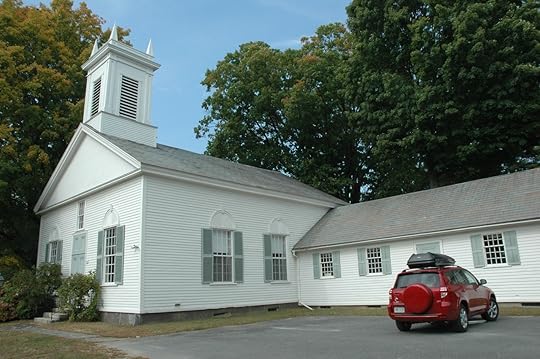
The “White Church” is Deerfield, Mass, might have inspired Steinbeck’s fictional church service in “Travels With Charley.”
Eaglebrook students walked to the church on Sundays and Steinbeck probably attended services there the previous Sunday, Sept. 25, 1960, when he stopped in Deerfield to visit his son. Was that the white church? Probably not. Was it an inspiration? Maybe.
Steinbeck’s Mystery ChurchMy sprint through changeless beautiful New England left me with a religious mystery – where was that “blindingly” white wood church Steinbeck said he attended in Vermont? In the book he describes getting dolled up and going to a church service on his last day in New England. He called it a “John Knox church” and enthused about the minister’s fire-and-brimstone, God-is-going-to-kick-your-ass sermon.
The scolding made Steinbeck feel bad and guilty inside, like a first-rate sinner whose sins were his own fault, not, as the “psychiatric priesthood” of the day would have it, “accidents that are set in motion by forces beyond our control.” He was so “revived in spirit” by this booster shot of God-fearing guilt, he said, that he put $5 in the plate ($35 in 2010 money) and shook hands with the minister warmly at the church door.
Until I woke up and smelled the fiction in “Travels With Charley,” I thought it’d be a breeze finding that white church. I even hoped to dig up the scary sermon Steinbeck heard …. I assumed “John Knox” was Steinbeck’s indirect way of saying it was a Presbyterian church. So before I ever set tire in New England, and long before I realized every other one of its 1.3 million lovely old churches was white and made of wood, I called Presbyterian presbyteries in Vermont and northern New York to ask if they could help. The good Presbyterians of New England tried like hell but failed me.
After my tour of New England, his mystery church remained a mystery. I still didn’t have any idea where it was – or if it ever was. That sly dog Steinbeck, I had come to realize, could have heard that sermon in a church anywhere and at anytime in his life. The only Sunday he could have attended a church service in Vermont was Oct. 2, 1960. But on that day he was already in Upstate New York motoring toward Niagara Falls and Chicago.
— Excerpted from “Dogging Steinbeck”
September 29, 2015
Steinbeck and Charley finally turn west
The ‘Travels with Charley’ Timeline — Day 8
Friday, Sept. 30, 1960 – Lancaster, N.H.
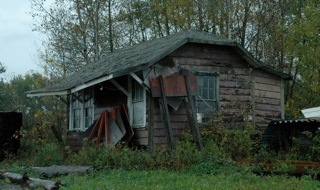
What’s left of one of the Whip ‘o Will cabins is still used as a shed.
After sleeping Thursday night in his truck in the middle of Maine’s woods, Steinbeck drives ”long and furiously” all day Friday. He goes south and then west on U.S. 2 to get back to Lancaster, New Hampshire, which he had passed through earlier in the week going east to Bangor. He sleeps in his camper at a ”ghost” motel/lunch counter by the Connecticut River because, though the office is open, no one is around to rent him a cabin. The motel was the Whip o’ Will, which is now trailer court and convenience store.
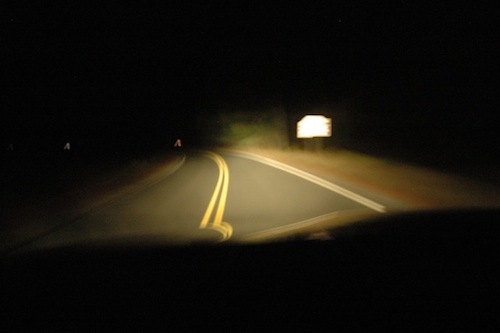
The dark, empty gut of MaineThe middle of Maine feels even emptier when the sun is gone. It was dark when I pulled into Millinocket, the lumber mill town where the Pelletier family of “American Loggers” fame lived. After a surprisingly good spinach salad and a beer at Pelletier’s crowded family restaurant/bar, I drove into the black night for the next major town, Milo. In the dark I covered a distance of 39 miles to Milo, but the road I traveled could have been a high-speed treadmill in a tunnel. As far I could tell, except for Brownville Junction, it was deep forest all the way. I took photos of the twisting road ahead as I chased its white lines at 60 mph, straddling the centerline through a narrow channel of trees.
A few mailboxes flashed by, a house with no lights, maybe a river. My Sirius XM radio, cranked up extra-loud with jazz, cut in and out because of the terrain or overhanging trees, I didn’t know which. I met my third car after 17 miles. In 45 minutes I counted 12. Steinbeck, who slept overnight in his camper shell by a bridge somewhere along Route 11, traveled the same lonely desolate way, but probably in daylight, when the local moose population would have been awake. Maine has 30,000 moose but I didn’t run into one.
— excerpted from “Dogging Steinbeck”
September 28, 2015
Steinbeck and Charley zip in and out of Potato Country, USA
The ‘Travels With Charley’ Timeline — Day 7

It’s not a very accurate representation of Steinbeck’s foray into New England, but it makes the point — he went north and east before heading west.
Thursday, Sept. 29, 1960 – To the top of Maine
From wherever he stopped Wednesday night in northeast Maine, Steinbeck drives north into Aroostook County on U.S. Highway 1. Tracing the U.S.-Canadian border on the south side of the St. Croix River, he reaches the top of Maine, turns south on state Route 11 and plunges deep into the pine wilderness of Maine’s interior. He has to park alone Thursday night somewhere on Route 11 under a concrete bridge in the rain.
Aroostook CountyAroostook County is famous for two things – potatoes and its enormous size. It’s one fifth of Maine and bigger than Connecticut and Rhode Island combined. No one traveling north from Calais along the pretty St. Croix River would challenge those facts. I was 929 miles from Steinbeck’s Sag Harbor driveway. Steinbeck drove the same stretch of U.S. Route 1 on Sept. 29, 1960, exactly 50 years ahead of me. He had a weird thing about wanting to touch the top of Maine before heading west, a weird thing he ultimately regretted as he realized how endless and empty the state was. Steinbeck also wanted to see the famed potato fields of Aroostook County, then the foremost spud-producing area of the country.
***
Maine’s State Route 11, which Steinbeck took south from Fort Kent, is beautiful, empty and devoid of motels, as Steinbeck learned.
After 2,400 miles tracing the edge of the East Coast all the way from Key West, U.S. Highway 1 evaporates without fanfare in the town of Fort Kent. As Steinbeck did, when Route 1 vanished I turned south on state Route 11 for the long haul back to New Hampshire and the way West.
Before I left Fort Kent, I suffered a shock that made me realize what a strange, atypical part of America I had been traveling through. It happened when I saw a black college student on the street. She was the first non-white person I could remember seeing since a pizza shop in downtown Northampton.
The 2010 Census tells the statistical tale. The previous three states I had been in – Vermont, New Hampshire and Maine – might be full of color in the fall, but year round their lilywhite populations don’t look like much of the rest of the country. Each had black populations of about 1 percent. The national percentage was 12.6 percent. The same lack of color would be true for other long stretches of the Steinbeck Highway.
— Excerpted from “Dogging Steinbeck”
September 27, 2015
Steinbeck aims for the top of Maine
The ‘Travels With Charley’ Timeline — Day 6
Wednesday, Sept. 28, 1960 – Deer Isle, Maine
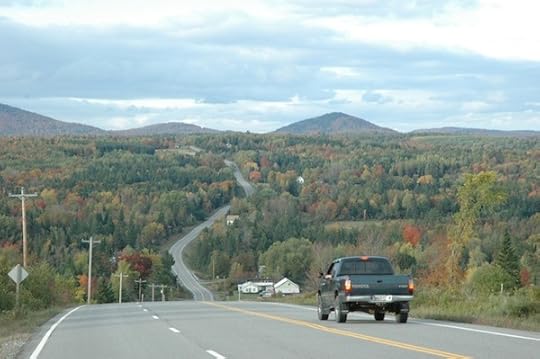
John Steinbeck left Eleanor Brace’s house on Deer Isle in on Wednesday afternoon and drove north along the coast on U.S. Highway 1 toward the top of Maine. He called his wife from a grocery store, but where he stopped for the night is not known. It was probably in or near Calais, in northeast Maine on the Canadian border.
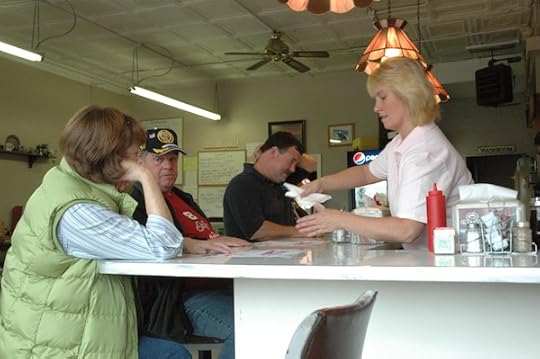
Waitress Traci Brown takes care of some locals at Karen’s Diner in Calais, Maine.
Breakfast in CalaisWe’ll never know if Steinbeck stopped at the border town of Calais for a bed or a cup of bad coffee, but he had to pass down its main street as he drove north on U.S. 1 toward the top of Maine. Pronounced callous despite or perhaps in spite of its French origins, Calais is in Washington County, the state’s poorest. Across the St. Croix River from New Brunswick, Calais was only 22 miles from my beach resort at Gleason Cove. Its economy was far healthier in 1960, according to one of the local “Down Easters”/”Up Easters” I met at the counter in Karen’s Main Street Diner.
The 60-something man, wearing a pristine gold and black United States Army baseball cap, told a familiar story of change and decline. Hundreds of good-paying jobs had disappeared at the paper mills. Young people were leaving and would never come back. The town had lost 25 percent of its population since 1990 and was now about 3,100. Local unemployment was 11 percent compared to the state average of 7.9 percent. If it weren’t for the fact that the department of homeland security beefed up the three border crossings with Canada after it learned one of the 9/11 hijackers entered the States at Calais, he said, there’d be even fewer jobs around.
Karen’s had to be the best diner in a hundred miles – maybe the only one. A friendly pit stop for anyone following Steinbeck’s trail into upper Maine, it’s one of those priceless family-run eateries where getting a perfect breakfast is routine, not a matter of chance. I ordered what would become my signature breakfast for the rest of my trip. It was a #2 at Karen’s – two eggs over medium, sausage, home fries, wheat toast and coffee. It cost $6.25 and became the standard against which I compared 25 others like it that followed. Steinbeck wrote that getting a bad breakfast on the road was almost impossible, and he was still right.
— Excerpted from “Dogging Steinbeck”
September 26, 2015
Steinbeck Critiques the JFK-Nixon Debate
The ‘Travels With Charley’ Timeline — Day 5
Sept. 27, 1960 — Deer Isle, Maine
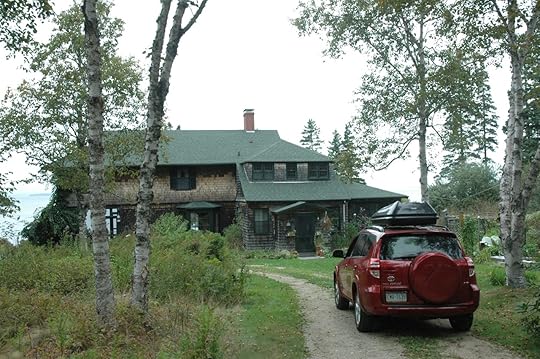
Steinbeck spent two nights at Eleanor Brace’s spectacular house on Deer Isle, Maine, where his agent Elizabeth Otis rented a cottage each year.
Steinbeck and Charley continue their stay on beautiful Deer Isle, Maine, at the fabulous home of Eleanor Brace. He wrote in a letter to his wife from Deer Isle that on Tuesday he “saw the island and talked to people.”
He visited the quaint fishing port of Stonington, where he buys a kerosene lamp at a nautical hardware store on Main Street. He ate a lobster dinner at Brace’s house with Brace and her woman friend and went to bed early, sleeping another night in his camper Rocinante.
In a letter he mailed from Deer Isle to his friend and political hero Adlai Stevenson, Steinbeck said he had heard part of the first televised presidential debate between Richard M. Nixon and John F. Kennedy on Monday, Sept. 26. He was distressed that both candidates were so courteous toward each other.
Steinbeck’s Partisan Politics
By today’s definitions, Steinbeck was a ball of political contradictions. He was a highly partisan FDR big-government Democrat who went ape for Adlai Stevenson in the 1950s and became a White House-sleepover friend of LBJ and frequent weekend guest at Camp David. Like most of his New Deal generation, he had a naïve trust in the federal government to solve massive social and economic problems.
But Steinbeck was never close to being the true-believing commie or socialist both his rightwing enemies and leftwing friends liked to claim he was. He was what we call today “a Cold War liberal.” He supported labor unions, the civil rights movement and LBJ’s war on poverty. He was also a staunch anti-communist who believed in containing the Soviet Union and what then was so impolitely called “Red China.”
He was a sincere patriot, which, along with becoming too friendly with LBJ, may have blinded him to the folly of Vietnam and the fallacy of the Domino Theory. He was a loud public hawk on Vietnam in its early stages, but became a quiet dove when he realized the war was unwinnable. Intolerant of anti-war protesters, whom he thought were stupid and cowardly, he despised hippies and the ‘60s youth culture.
— Excerpted from “Dogging Steinbeck”
September 25, 2015
Steinbeck heads Down East to Maine
The ‘Travels With Charley’ Timeline — Day 4
Sept. 26, 1960 — Deer Isle, Maine

Rocinante’s interior was compact but contained a stove, a refrigerator and a table, like the cabin of a small boat.
Steinbeck writes that he left New Hampshire on what would have been Monday, Sept. 26, and drove east across the neck of Maine. He says he stopped at a motel near Bangor but that he was so put off by the sterile and plastic environment in his room that he went out and slept in the back of his truck.
In fact, on Sept. 26 he drove 250 miles from Lancaster, New Hampshire, to Deer Isle, Maine, a beautiful little island south of Bangor. He was expected at the seaside home of Eleanor Brace, a friend of his agent Elizabeth Otis.
On the Monday night that 70 million Americans watched the first televised Nixon-JFK debate from Chicago, he slept on Brace’s property by the sea in the back of Rocinante.
South of BangorI wanted only to do what Steinbeck did in 1960 – cut through the city of Bangor quickly on my way to the seacoast paradise of Deer Isle, where he spent two days at a gorgeous old house I hoped to find. Driving into the suburbs on state Route 15, the 55-mile trip to Deer Isle became a highlight reel of Maine’s L.L. Bean culture. Boats and RVs of every size, truck caps, kayaks, logs, shingles and gigantic piles of firewood lined the roadside or adorned front lawns. Gas was $2.62 a gallon. The billboard “Guns, Ammo and Camo” pretty much said it all. The closer I got to Deer Isle, the farther back in time I went and the more upscale and artsy-crafty things got.
— Excerpt from “Dogging Steinbeck”
Steinbeck heads out for Maine
The ‘Travels With Charley’ Timeline — Day Four
Sept. 26, 1960 — Deer Isle, Maine
Rocinante’s interior was compact but contained a stove, a refrigerator and a table, like the cabin of a small boat.
Steinbeck writes that he left New Hampshire on what would have been Monday, Sept. 26, and drove east across the neck of Maine. He says he stopped at a motel near Bangor but that he was so put off by the sterile and plastic environment in his room that he went out and slept in the back of his truck.
In fact, on Sept. 26 he drove 250 miles from Lancaster, New Hampshire, to Deer Isle, Maine, a beautiful little island south of Bangor. He was expected at the seaside home of Eleanor Brace, a friend of his agent Elizabeth Otis.
On the Monday night that 70 million Americans watched the first televised Nixon-JFK debate from Chicago, he slept on Brace’s property by the sea in the back of Rocinante.
South of Bangor
I wanted only to do what Steinbeck did in 1960 – cut through the city of Bangor quickly on my way to the seacoast paradise of Deer Isle, where he spent two days at a gorgeous old house I hoped to find. Driving into the suburbs on state Route 15, the 55-mile trip to Deer Isle became a highlight reel of Maine’s L.L. Bean culture. Boats and RVs of every size, truck caps, kayaks, logs, shingles and gigantic piles of firewood lined the roadside or adorned front lawns. Gas was $2.62 a gallon. The billboard “Guns, Ammo and Camo” pretty much said it all. The closer I got to Deer Isle, the farther back in time I went and the more upscale and artsy-crafty things got.
— Excerpt from “Dogging Steinbeck”
September 24, 2015
Steinbeck’s Exclusive Rest Stop
The ‘Travels With Charley’ Timeline — Day Three
Sept. 25, 1960 — White Mountains, N.H.
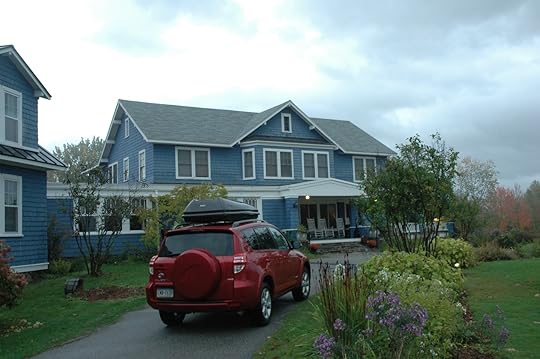
The Spalding Inn is high in the woods of the White Mountains about 7 miles south of Lancaster in Whitefield. It describes itself – without doing its gloriously old-fashioned character enough justice – on its Web site: “Surrounded by manicured lawns, orchards, perennial gardens and a 360-degree view of the Presidential Mountain range, it offers you the perfect escape from city life.”
Steinbeck says in “Travels With Charley” that he drives east into the rugged White Mountains of New Hampshire on U.S. Route 2 near Lancaster, N.H., and camps on a farm.
He says in “Charley” that he talks to the farm owner about the Russians and the boorish behavior of Soviet Premier Nikita Khrushchev at the United Nations.
In the book, Steinbeck and the Yankee farmer talk about Khrushchev banging his shoe on his desk at the United Nations, but that conversation couldn’t have happened. That famous Cold War event — if it actually happened that way — occurred Oct. 11, 1960.
But did Steinbeck really even camp on a farm?
Fifty years later, after searching in vain for the farm and the farmer near Lancaster, a local writer, Jeff Woodburn, learned that Steinbeck was seen in the fall of 1960 at the nearby Spalding Inn in Whitefield. Exactly when that was, Woodburn was not sure.
On March 30, 2010, a woman who worked for the Spalding Inn’s owner at the time said she was absolutely certain Steinbeck slept at the inn for one night. And Donald Spalding, the son of the original owners and operators of the inn, said on March 30, 2011, that there was no doubt that Steinbeck ate dinner and slept at the exclusive inn during “foliage season” of 1960.
America’s Death Roads
By 1960 cars had replaced trains as the country’s mass mode of transportation. Interstates, truck stops and national motel and restaurant chains barely existed. Wal-Mart did not. America’s fleet of cars had doubled since 1941 to 74 million. About 75 percent of homes owned a car and 15 percent owned two. Automobiles were 4,000-pound death wagons with metal dashboards, crummy tires and lights and no safety gear; 1 percent of drivers used seat belts. America’s highways were criminally lethal. About 36,000 of the country’s 180 million people were killed in or by cars in 1960. In 2010, when there were three times as many autos and trucks on the road and 310 million Americans riding around in them, the annual death toll had fallen to 32,708.
— Excerpted from “Dogging Steinbeck”