Sarah Pinsker's Blog, page 2
December 10, 2017
My 2017 Fiction
Hi folks,
It's been a ridiculous year, hasn't it? I usually put together a summary of what I've done over the year, but looking back at this one feels strange. I edited a novel that you won't see for a while, put together a collection that you won't see for a while, wrote a few stories, played shows and went to some great cons and readings. Still, it's all kind of hazy, with highlights trapped between the traumas of phone calls and marches and rallies begging the government not to take our health insurance, not to enact travel bans, not to deport DREAMers, etc. If you joined in on any of that, thank you. If you wrote or read anything at all this year, thank you for that too.
That said, the fiction I read this year was a constant buoy, and I feel like the stories I put out this year were possibly the best I've ever written, particularly these first two.
Novella:
My first novella, "And Then There Were (N - One)," appeared in Uncanny Issue 15, March/April 2017. You can read the whole thing at that link.
Novelette:
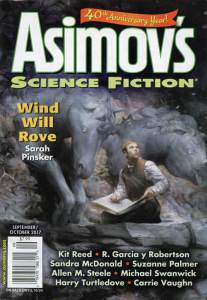
"Wind Will Rove," was the cover story of Asimov's #500, September/October 2017. It's set on a generation ship, and features old-time fiddles and a lot of questions about history. I was honored to be part of Asimov's 40th anniversary, both at the party in New York last spring and in this issue. I'm putting the story online for a little while. You can read a PDF here until I take it down.
Short stories:
"Remember This For Me," Explorers, Catalysts, and Secret Keepers: Women of Science Fiction anthology, December 2017
"The Smoke Means Its Working," Behind the Mask anthology
"The Ones Who Know Where They Are Going," Asimov's, March/April 2017
That list feels shorter than the last few years, but I really love the stories.
And now I can't wait to catch up on all the incredible work that came out this year.
Have a wonderful winter, and thanks for reading!


December 9, 2017
My 2017 Fiction
Hi folks,
It's been a ridiculous year, hasn't it? I usually put together a summary of what I've done over the year, but looking back at this one feels strange. I edited a novel that you won't see for a while, put together a collection that you won't see for a while, wrote a few stories, played shows and went to some great cons and readings. Still, it's all kind of hazy, with highlights trapped between the traumas of phone calls and marches and rallies begging the government not to take our health insurance, not to enact travel bans, not to deport DREAMers, etc. If you joined in on any of that, thank you. If you wrote or read anything at all this year, thank you for that too.
That said, the fiction I read this year was a constant buoy, and I feel like the stories I put out this year were possibly the best I've ever written, particularly these first two.
Novella:
My first novella, "And Then There Were (N - One)," appeared in Uncanny Issue 15, March/April 2017. You can read the whole thing at that link.
Novelette:
"Wind Will Rove," was the cover story of Asimov's #500, September/October 2017. It's set on a generation ship, and features old-time fiddles and a lot of questions about history. I was honored to be part of Asimov's 40th anniversary, both at the party in New York last spring and in this issue. I'm putting the story online for a little while. You can read a PDF here until I take it down.
Short stories:
"Remember This For Me," Explorers, Catalysts, and Secret Keepers: Women of Science Fiction anthology, December 2017
"The Smoke Means Its Working," Behind the Mask anthology
"The Ones Who Know Where They Are Going," Asimov's, March/April 2017
That list feels shorter than the last few years, but I really love the stories.
And now I can't wait to catch up on all the incredible work that came out this year.
Have a wonderful winter, and thanks for reading!
January 19, 2017
Toward Better Futures

I am a science fiction writer. I can name planets. I can invent futures. I can sound the warning bells, in the best traditions of the genre.
I'm a singer-songwriter, raised in folk and punk. I know the power of three chords and the truth.
I'm also a person living in this moment, a moment when hope has crumbled into terror and anger and hatred and disgust. A moment where the party that has been handed the reins is full of individuals who say "my heart goes out to you" but mean "I will work toward your extinction while expressing love."
I'm a queer person whose life was directly made better by the Obama administration. I'm a woman watching the government reshape itself into a hammer to put me in my place. I'm a Jew witnessing the things I was promised "never again" come to pass. I'm an aunt grateful that my niece lives in Canada. I'm a person with healthcare through the ACA, holding my breath as my ability to afford insurance is put in the hands of ghouls wearing human faces.
I have friends who are Muslims and people of color and people with disabilities and friends who embody every letter of the LGBTQIA acronym and more, and friends who live at intersections of some or all of the above, who are all watching the same events through different lenses, with similar fears.
I can't separate the fiction and the fact. Maybe sometime soon I'll find a way. I'm a science fiction writer for better tomorrows, for grand tomorrows, for any tomorrows, living in a present that only promises a bleak one.
So today I'll edit my near-future novel. Today I'll call my congressional reps again. I'll work on a new story. I'll find ways to make my voice heard. I'll retweet to amplify other voices. Saturday I'll go to the March.
And tomorrow? Here's the plan:
Pick up a friend who is coming into town for the March.
Set my DVR to record BBC America's Star Trek: The Next Generation marathon, because it's a better vision of humanity than the one showing on all the network and news channels at that time.
Set a reminder to unfollow the POTUS and FLOTUS feeds at noon.
Turn on Ava Duvernay's amazing documentary "13th" so Netflix can count me.
Go play with my friend's two year old.
Tomorrow I'm not posting or retweeting anything to do with the day's festivities other than perhaps acts of protest.
Tomorrow starting at 11:30 AM EST I'm filling my feeds with works I love: fiction, music, art, acts of resistance. Join me, if you'd like. Let's blot out the hate and pettiness with #WorksILove
And then let's get back to working on better futures, fiction and fact.
January 18, 2017
Toward Better Futures
[image error]
I am a science fiction writer. I can name planets. I can invent futures. I can sound the warning bells, in the best traditions of the genre.
I'm a singer-songwriter, raised in folk and punk. I know the power of three chords and the truth.
I'm also a person living in this moment, a moment when hope has crumbled into terror and anger and hatred and disgust. A moment where the party that has been handed the reins is full of individuals who say "my heart goes out to you" but mean "I will work toward your extinction while expressing love."
I'm a queer person whose life was directly made better by the Obama administration. I'm a woman watching the government reshape itself into a hammer to put me in my place. I'm a Jew witnessing the things I was promised "never again" come to pass. I'm an aunt grateful that my niece lives in Canada. I'm a person with healthcare through the ACA, holding my breath as my ability to afford insurance is put in the hands of ghouls wearing human faces.
I have friends who are Muslims and people of color and people with disabilities and friends who embody every letter of the LGBTQIA acronym and more, and friends who live at intersections of some or all of the above, who are all watching the same events through different lenses, with similar fears.
I can't separate the fiction and the fact. Maybe sometime soon I'll find a way. I'm a science fiction writer for better tomorrows, for grand tomorrows, for any tomorrows, living in a present that only promises a bleak one.
So today I'll edit my near-future novel. Today I'll call my congressional reps again. I'll work on a new story. I'll find ways to make my voice heard. I'll retweet to amplify other voices. Saturday I'll go to the March.
And tomorrow? Here's the plan:
Pick up a friend who is coming into town for the March.
Set my DVR to record BBC America's Star Trek: The Next Generation marathon, because it's a better vision of humanity than the one showing on all the network and news channels at that time.
Set a reminder to unfollow the POTUS and FLOTUS feeds at noon.
Turn on Ava Duvernay's amazing documentary "13th" so Netflix can count me.
Go play with my friend's two year old.
Tomorrow I'm not posting or retweeting anything to do with the day's festivities other than perhaps acts of protest.
Tomorrow starting at 11:30 AM EST I'm filling my feeds with works I love: fiction, music, art, acts of resistance. Join me, if you'd like. Let's blot out the hate and pettiness with #WorksILove
And then let's get back to working on better futures, fiction and fact.
December 19, 2016
Year End Post
I always drag my heels at writing a year's end/eligibility post. It's awkward to write something that amounts to "and now, here's me talking about me." This year, it felt particularly small in the face of everything that's going on in the world. On the other hand, it can be a great way to reflect on personal progress and milestones.
2016, majorly horrible under just about any lens (David Bowie AND Leonard Cohen AND Sharon Jones, 2016?) (Trump, 2016?) was fairly good to me from a writing and publishing perspective. I didn't have as many new stories out as the year before, but I'm very proud of the stories I put out. I won the Nebula for Best Novelette, made the Sturgeon ballot again, only missed the Hugo ballot because of vote manipulation, got to go to George RR Martin's Hugo Losers party, ate dragon egg cake with awesome people. Got to workshop with an amazing group of people at Sycamore Hill. I took an amazing trip to China, where I talked science fiction and music at three different events, tried VR for the first time, and stood in the most amazingly science fictional landscape I've ever seen.
I had my first Guest of Honor gig, at Chessiecon. I'm doing my first reading at the wonderful KGB Fantastic Fiction series in New York this Wednesday. And I wrote some stories I am very, very happy with, some of which came out this year and some of which will come out next year.
My 2016 published fiction included:
Novelette:
Sooner or Later Everything Falls Into the Sea – Lightspeed, February (near future SF) (also in audio)
The rock star washed ashore at high tide.
Short Story:
The Mountains His Crown, Beneath Ceaseless Skies, March (secondary world fantasy) (also audio)
The Royal Surveyors drove their machine through my fields at midday; it took six hours to put all the fires out.
Left the Century to Sit Unmoved, Strange Horizons, May (contemporary fantasy) (also audio)
The pond only looks bottomless.
Clearance, Asimov's, June (SF)
On the Clearance Shelf at a Beachside Souvenir Shop, Orchid Beach, New Jersey
Down Beneath the Bridge As Yet Unbuilt, Shattered Prism, August (historical fantasy, YAish)
One thousand five hundred and ninety five feet, six inches. That was the first number Pat ever had trouble visualizing, though she memorized numbers the way other people memorized scripture or songs.
Talking to Dead People - F & SF, September/October (near future SF)
Yes, I was the one who came up with the name “House of Whacks,” as in “Lizzie Borden took an ax . . .” Like I was someone who could joke about that kind of thing.
Under One Roof – Uncanny Magazine, September (fantasy)
First came the murmurs. Then footsteps above our bedroom, where no feet should have been.
(reprint) Pay Attention – Words, November (near future SF) - originally published in Accessing the Future anthology, 2015
In the beginning, there is noise.
A Song Transmuted – Cyber World anthology, November (near future SF)
I was a fussy baby. The only thing that quieted me was my great-grandfather's piano. They placed my bassinet directly on the piano, with noise-cancelling headphones to keep from damaging my ears. His chords came up through the instrument, up through my bones.
So anyway, that was my publishing year. I hope to make a list of my favorite stories and novels by others in the upcoming weeks, but I'm still playing a bit of catch-up on short fiction.
I'd also like to take this opportunity to say thank you to everyone who came out to a reading or a show, and everyone who took the time to read my work, and everyone I can call friend and colleague and mentor. I'm grateful for all of you.
Here's to 2017 being better than we expect? In the meantime, I'll be over here, writing about hope and resilience in dark times.
December 18, 2016
Year End Post
I always drag my heels at writing a year's end/eligibility post. It's awkward to write something that amounts to "and now, here's me talking about me." This year, it felt particularly small in the face of everything that's going on in the world. On the other hand, it can be a great way to reflect on personal progress and milestones.
2016, majorly horrible under just about any lens (David Bowie AND Leonard Cohen AND Sharon Jones, 2016?) (Trump, 2016?) was fairly good to me from a writing and publishing perspective. I didn't have as many new stories out as the year before, but I'm very proud of the stories I put out. I won the Nebula for Best Novelette, made the Sturgeon ballot again, only missed the Hugo ballot because of vote manipulation, got to go to George RR Martin's Hugo Losers party, ate dragon egg cake with awesome people. Got to workshop with an amazing group of people at Sycamore Hill. I took an amazing trip to China, where I talked science fiction and music at three different events, tried VR for the first time, and stood in the most amazingly science fictional landscape I've ever seen.
[image error]
I had my first Guest of Honor gig, at Chessiecon. I'm doing my first reading at the wonderful KGB Fantastic Fiction series in New York this Wednesday. And I wrote some stories I am very, very happy with, some of which came out this year and some of which will come out next year.
My 2016 published fiction included:
Novelette:
Sooner or Later Everything Falls Into the Sea – Lightspeed, February (near future SF) (also in audio)
The rock star washed ashore at high tide.
Short Story:
The Mountains His Crown, Beneath Ceaseless Skies, March (secondary world fantasy) (also audio)
The Royal Surveyors drove their machine through my fields at midday; it took six hours to put all the fires out.
Left the Century to Sit Unmoved, Strange Horizons, May (contemporary fantasy) (also audio)
The pond only looks bottomless.
Clearance, Asimov's, June (SF)
On the Clearance Shelf at a Beachside Souvenir Shop, Orchid Beach, New Jersey
Down Beneath the Bridge As Yet Unbuilt, Shattered Prism, August (historical fantasy, YAish)
One thousand five hundred and ninety five feet, six inches. That was the first number Pat ever had trouble visualizing, though she memorized numbers the way other people memorized scripture or songs.
Talking to Dead People - F & SF, September/October (near future SF)
Yes, I was the one who came up with the name “House of Whacks,” as in “Lizzie Borden took an ax . . .” Like I was someone who could joke about that kind of thing.
Under One Roof – Uncanny Magazine, September (fantasy)
First came the murmurs. Then footsteps above our bedroom, where no feet should have been.
(reprint) Pay Attention – Words, November (near future SF) - originally published in Accessing the Future anthology, 2015
In the beginning, there is noise.
A Song Transmuted – Cyber World anthology, November (near future SF)
I was a fussy baby. The only thing that quieted me was my great-grandfather's piano. They placed my bassinet directly on the piano, with noise-cancelling headphones to keep from damaging my ears. His chords came up through the instrument, up through my bones.
So anyway, that was my publishing year. I hope to make a list of my favorite stories and novels by others in the upcoming weeks, but I'm still playing a bit of catch-up on short fiction.
I'd also like to take this opportunity to say thank you to everyone who came out to a reading or a show, and everyone who took the time to read my work, and everyone I can call friend and colleague and mentor. I'm grateful for all of you.
Here's to 2017 being better than we expect? In the meantime, I'll be over here, writing about hope and resilience in dark times.
December 2, 2016
Ring the Bells That Still Can Ring: On Optimistic SF in Dystopian Times
Last week I was Guest of Honor at Chessiecon, a small SFF convention in Maryland. The GoH experience was lovely. The staff and volunteers and congoers all made me feel welcome. I had a reading, a concert, an on-stage interview, a signing, and several panels. They made me into a playing card in a con-wide Concardia tournament, which I had to put onto my author bingo card in order to check it off.
Sunday morning, I had an interesting back-to-back pairing of panels: "Who's Writing Optimistic SF?" and "The Handmaid's Tale in the Real World." I'll talk about them in reverse order, since the main point of this post is to pass along the list of optimistic SF.
"The Handmaid's Tale in the Real World" was a great idea for a panel. At the time the panels were generated, months and months and months ago, nobody foresaw the results of this election. In my notes to myself where I said, "Don't forget to talk about Purvi Patel" I didn't imagine that the architect of the Indiana law that jailed her would actually make it to DC, or that Ohio and Texas would ram obscene new abortion bans through their legislatures.
"The Handmaid's Tale," like "Parable of the Sower," wasn't meant to be predictive. Those books are explorations of possible futures, possible futures with big warning signs posted all over the fence. The fact that these dystopic visions feel more real this month should be chilling all of us.
I started the panel by reading the paragraph I keep coming back to:
“That was when they suspended the Constitution. They said it would be temporary. There wasn't even any rioting in the streets. People stayed home at night, watching television, looking for some direction. There wasn't even an enemy you could put your finger on.”
Panels with "…in the Real World" and "____ After the Apocalypse" are great intellectual exercises as long as the threat of the title is theoretical too. Once the threat feels imminent, as it does now, the thought exercise drifts into the possible. I look at the paragraph above and it carries the weight of truth. I'm not sure that's a truth I can face in fiction right now, when it's pervading the rest of my life.
That doesn't mean we have to abandon those books or those exercises, but we have to approach them in a different way. We have to acknowledge that the topics we are playing with are serious and real. That "over there" has the potential to become "over here." That every hypothetical we toss out might be something a real person has to actually face. That involves approaching the topic with greater empathy: toward the audience, toward the other panelists, toward ourselves.
On the Handmaid's Tale panel, we acknowledged all of that. We read the paragraph above, then we left the Handmaid's Tale behind. We talked about how to prevent that, how to fight it, in the real world. The audience went there with us. They gave concrete suggestions. We discussed methodology and safety, vigilance and action.
We're not supposed to read these books and despair; we're supposed to read them and react. We're supposed to open our eyes and keep them open. We're supposed to stand up and say, "What can I do to keep this from happening?"
I hope that conrunners and programming chairs don't shy away from these books or topics in the future, but I hope they approach them with sensitivity and care. Framed poorly, they amplify fear and further marginalize. Framed well, they give strength.
Which leads me to my other Sunday morning panel, "Who's Writing Optimistic SF?" We started with a discussion of optimism vs. hope, and optimistic characters vs. optimistic situations. Then we started throwing out names and titles. The audience joined in. I also asked the same question on Twitter a few days before and got some great answers. I'll include those below as well.
We need both of these kinds of fiction. The dystopic still serves a purpose, but hopeful visions become even more important in dark times. Faith in human goodness, in small acts, in the positive outcomes that can come from human persistence? Those are all things that feel like they're in short supply right now. I don't want or need them to be the only things I read, but even the smallest positives feel important and necessary right now.
I haven't read or vetted all of these, but here are some of the books and authors discussed by the panel:
Hieroglyph: Stories & Visions for a Better Future (anthology featuring stories by Cory Doctorow, Elizabeth Bear, Vandana Singh, Neal Stephenson, more…)
Shine anthology (edited by Jetse de Vries)
Sunvault anthology and other solarpunk
Ursula Vernon's short fiction
Ann Leckie's Ancillary /Radch trilogy
John Scalzi (works mentioned included Lock In, Redshirts)
Lois McMaster Bujold (Vorkosigan books)
Jo Walton's Thessaly series
Martha Wells (Raksura, specifically)
Katherine Addison's Goblin Emperor
Theodore Sturgeon's "The Widget, the Wadget, & Boff"
Becky Chambers' The Long Way to A Small Angry Planet
Janet Kagan's Mirabile
TV shows "Man Seeking Woman," "Supergirl," "The Good Place."
And the tweets:
@SarahPinsker I don't know if she'd agree, but I think @tithenai does.
— Didi Chanoch (@didic) November 27, 2016
@SarahPinsker, well, most days, I like to think I am.
— Lawrence M. Schoen (@klingonguy) November 27, 2016
@SarahPinsker I think a lot fit this definition, but my personal go-tos for comfort optimism are @effies and @zenaldehyde :)
— SL Huang ��������� (@sl_huang) November 27, 2016
@SarahPinsker Some more hopeful (and diverse/inclusive) faves - DAYBREAK RISING by @koliver_writes and VIRAL AIRWAVES by @ClH2OArs
— ���RoAnna Sylver (@RoAnnaSylver) November 27, 2016
@SarahPinsker ! @RoAnnaSylver is avoiding naming herself but we call CHAMELEON MOON "dys-hope-ia" so y'know. that too XD (and thanks <3)
— Claudie Arseneault
@SarahPinsker Don't see @MarissaLingen mentioned yet.
— Andy H. (@indeed_distract) November 28, 2016
@SarahPinsker The Second Mango by @ShiraGlassman and its series is my comfort fictional world right now.
— ���RoAnna Sylver (@RoAnnaSylver) November 27, 2016
@SarahPinsker I'd consider the Lunar Chronicles by @marissa_meyer optimistic. It's about war, but more about resistance and compassion.
— Brittany Constable (@constablewrites) November 28, 2016
@SarahPinsker I'd consider the Lunar Chronicles by @marissa_meyer optimistic. It's about war, but more about resistance and compassion.
— Brittany Constable (@constablewrites) November 28, 2016
@SarahPinsker Jo Walton. ::swoons::
Ada Palmer, I think? Depending how "Seven Surrenders" goes :P
— Ziv W (@QuiteVague) November 27, 2016
@SarahPinsker Becky Chambers, Heather Rose Jones, and Rosemary Kirstein.
— ULTRAGINGLE (@ULTRAGOTHA) November 27, 2016
@SarahPinsker :gasp: this is the term I didn't know I was looking for!! I definitely nominate @beckysaysrawr.
— Eileen Webb (@webmeadow) November 27, 2016
@SarahPinsker Me! But it's pretty long...
— N. S. Dolkart (@N_S_Dolkart) November 27, 2016
@SarahPinsker Should mention that @joannatovaprice wrote a review elaborating on which variety of optimism: https://t.co/rBOobP425l
— N. S. Dolkart (@N_S_Dolkart) November 27, 2016
@SarahPinsker T. Kingfisher (Ursula Vernon) Ann Leckie, and Lois McMaster Bujold.
— ULTRAGINGLE (@ULTRAGOTHA) November 27, 2016
@SarahPinsker Alastair Reynolds' Blue remembered earth was almost creepy in its optimism. I like gloom!
— Jeff Rensch (@huetenan) November 28, 2016
@SarahPinsker I'll add Rachel Aaron's Heartstriker series. Kindle/Audible exclusive with print on demand.
— Alexandra (@thatwasodd) November 27, 2016
@SarahPinsker oddly enough, I think The Expanse qualifies, @JamesSACorey
— Jane Eisenkopf (@IronHeadJane) November 27, 2016
Whew! Okay! And then I asked around in a few other places, and these are the responses I got:
Ada Palmer's Too Like the Lightning
Patricia McKillip's Kingfisher
Joan Slonczewski's A Door Into Ocean
Sarah Zettel's Fool's War, the Quiet Invasion, Playing God
Elizabeth Moon, Remnant Population
Mary Ann Mohanraj's The Stars Change
Rosemary Kirstein's The Steerswoman
Charlie Jane Anders' All the Birds in the Sky
Vernor Vinge's A Fire Upon the Deep & A Deepness int he Sky
Melissa Scott's Trouble And Her Friends
One interesting thing in writing this list is that some of these wouldn't fit my definition of hopeful. Some of them concern end-of-the-world type concerns. Someone mentioned NK Jemisin's Fifth Season/Broken Earth trilogy, which I'd consider dystopic, but they pointed out an optimism in the way characters move forward. That made sense to me. I consider my own fiction to be pretty optimistic, in that even when I'm writing about bad times I tend to focus on the resilience of the human spirit. See Sooner or Later Everything Falls Into the Sea for a recent example.
I guess all of that is to say, research, decide where your limits are, and read at your own risk. I know I discovered a whole bunch of new books in asking this question, and I'm looking forward to exploring them.
If you have more that I missed, feel free to add them in comments. I moderate but I'll let them out of the queue as fast as I can. Bring on the optimistic SF!
December 1, 2016
Ring the Bells That Still Can Ring: On Optimistic SF in Dystopian Times
[image error]
Last week I was Guest of Honor at Chessiecon, a small SFF convention in Maryland. The GoH experience was lovely. The staff and volunteers and congoers all made me feel welcome. I had a reading, a concert, an on-stage interview, a signing, and several panels. They made me into a playing card in a con-wide Concardia tournament, which I had to put onto my author bingo card in order to check it off.
Sunday morning, I had an interesting back-to-back pairing of panels: "Who's Writing Optimistic SF?" and "The Handmaid's Tale in the Real World." I'll talk about them in reverse order, since the main point of this post is to pass along the list of optimistic SF.
"The Handmaid's Tale in the Real World" was a great idea for a panel. At the time the panels were generated, months and months and months ago, nobody foresaw the results of this election. In my notes to myself where I said, "Don't forget to talk about Purvi Patel" I didn't imagine that the architect of the Indiana law that jailed her would actually make it to DC, or that Ohio and Texas would ram obscene new abortion bans through their legislatures.
"The Handmaid's Tale," like "Parable of the Sower," wasn't meant to be predictive. Those books are explorations of possible futures, possible futures with big warning signs posted all over the fence. The fact that these dystopic visions feel more real this month should be chilling all of us.
I started the panel by reading the paragraph I keep coming back to:
“That was when they suspended the Constitution. They said it would be temporary. There wasn't even any rioting in the streets. People stayed home at night, watching television, looking for some direction. There wasn't even an enemy you could put your finger on.”
Panels with "…in the Real World" and "____ After the Apocalypse" are great intellectual exercises as long as the threat of the title is theoretical too. Once the threat feels imminent, as it does now, the thought exercise drifts into the possible. I look at the paragraph above and it carries the weight of truth. I'm not sure that's a truth I can face in fiction right now, when it's pervading the rest of my life.
That doesn't mean we have to abandon those books or those exercises, but we have to approach them in a different way. We have to acknowledge that the topics we are playing with are serious and real. That "over there" has the potential to become "over here." That every hypothetical we toss out might be something a real person has to actually face. That involves approaching the topic with greater empathy: toward the audience, toward the other panelists, toward ourselves.
On the Handmaid's Tale panel, we acknowledged all of that. We read the paragraph above, then we left the Handmaid's Tale behind. We talked about how to prevent that, how to fight it, in the real world. The audience went there with us. They gave concrete suggestions. We discussed methodology and safety, vigilance and action.
We're not supposed to read these books and despair; we're supposed to read them and react. We're supposed to open our eyes and keep them open. We're supposed to stand up and say, "What can I do to keep this from happening?"
I hope that conrunners and programming chairs don't shy away from these books or topics in the future, but I hope they approach them with sensitivity and care. Framed poorly, they amplify fear and further marginalize. Framed well, they give strength.
Which leads me to my other Sunday morning panel, "Who's Writing Optimistic SF?" We started with a discussion of optimism vs. hope, and optimistic characters vs. optimistic situations. Then we started throwing out names and titles. The audience joined in. I also asked the same question on Twitter a few days before and got some great answers. I'll include those below as well.
We need both of these kinds of fiction. The dystopic still serves a purpose, but hopeful visions become even more important in dark times. Faith in human goodness, in small acts, in the positive outcomes that can come from human persistence? Those are all things that feel like they're in short supply right now. I don't want or need them to be the only things I read, but even the smallest positives feel important and necessary right now.
I haven't read or vetted all of these, but here are some of the books and authors discussed by the panel:
Hieroglyph: Stories & Visions for a Better Future (anthology featuring stories by Cory Doctorow, Elizabeth Bear, Vandana Singh, Neal Stephenson, more…)
Shine anthology (edited by Jetse de Vries)
Sunvault anthology and other solarpunk
Ursula Vernon's short fiction
Ann Leckie's Ancillary /Radch trilogy
John Scalzi (works mentioned included Lock In, Redshirts)
Lois McMaster Bujold (Vorkosigan books)
Jo Walton's Thessaly series
Martha Wells (Raksura, specifically)
Katherine Addison's Goblin Emperor
Theodore Sturgeon's "The Widget, the Wadget, & Boff"
Becky Chambers' The Long Way to A Small Angry Planet
Janet Kagan's Mirabile
TV shows "Man Seeking Woman," "Supergirl," "The Good Place."
And the tweets:
@SarahPinsker I don't know if she'd agree, but I think @tithenai does.
— Didi Chanoch (@didic) November 27, 2016
@SarahPinsker, well, most days, I like to think I am.
— Lawrence M. Schoen (@klingonguy) November 27, 2016
@SarahPinsker I think a lot fit this definition, but my personal go-tos for comfort optimism are @effies and @zenaldehyde :)
— SL Huang 黄士芬 (@sl_huang) November 27, 2016
@SarahPinsker Some more hopeful (and diverse/inclusive) faves - DAYBREAK RISING by @koliver_writes and VIRAL AIRWAVES by @ClH2OArs
— ✨RoAnna Sylver (@RoAnnaSylver) November 27, 2016
@SarahPinsker ! @RoAnnaSylver is avoiding naming herself but we call CHAMELEON MOON "dys-hope-ia" so y'know. that too XD (and thanks <3)
— Claudie Arseneault
@SarahPinsker Don't see @MarissaLingen mentioned yet.
— Andy H. (@indeed_distract) November 28, 2016
@SarahPinsker The Second Mango by @ShiraGlassman and its series is my comfort fictional world right now.
— ✨RoAnna Sylver (@RoAnnaSylver) November 27, 2016
@SarahPinsker I'd consider the Lunar Chronicles by @marissa_meyer optimistic. It's about war, but more about resistance and compassion.
— Brittany Constable (@constablewrites) November 28, 2016
@SarahPinsker I'd consider the Lunar Chronicles by @marissa_meyer optimistic. It's about war, but more about resistance and compassion.
— Brittany Constable (@constablewrites) November 28, 2016
@SarahPinsker Jo Walton. ::swoons::
— Ziv W (@QuiteVague) November 27, 2016
Ada Palmer, I think? Depending how "Seven Surrenders" goes :P
@SarahPinsker Becky Chambers, Heather Rose Jones, and Rosemary Kirstein.
— ULTRAGINGLE (@ULTRAGOTHA) November 27, 2016
@SarahPinsker :gasp: this is the term I didn't know I was looking for!! I definitely nominate @beckysaysrawr.
— Eileen Webb (@webmeadow) November 27, 2016
@SarahPinsker Me! But it's pretty long...
— N. S. Dolkart (@N_S_Dolkart) November 27, 2016
@SarahPinsker Should mention that @joannatovaprice wrote a review elaborating on which variety of optimism: https://t.co/rBOobP425l
— N. S. Dolkart (@N_S_Dolkart) November 27, 2016
@SarahPinsker T. Kingfisher (Ursula Vernon) Ann Leckie, and Lois McMaster Bujold.
— ULTRAGINGLE (@ULTRAGOTHA) November 27, 2016
@SarahPinsker Alastair Reynolds' Blue remembered earth was almost creepy in its optimism. I like gloom!
— Jeff Rensch (@huetenan) November 28, 2016
@SarahPinsker I'll add Rachel Aaron's Heartstriker series. Kindle/Audible exclusive with print on demand.
— Alexandra (@thatwasodd) November 27, 2016
@SarahPinsker oddly enough, I think The Expanse qualifies, @JamesSACorey
— Jane Eisenkopf (@IronHeadJane) November 27, 2016
Whew! Okay! And then I asked around in a few other places, and these are the responses I got:
Ada Palmer's Too Like the Lightning
Patricia McKillip's Kingfisher
Joan Slonczewski's A Door Into Ocean
Sarah Zettel's Fool's War, the Quiet Invasion, Playing God
Elizabeth Moon, Remnant Population
Mary Ann Mohanraj's The Stars Change
Rosemary Kirstein's The Steerswoman
Charlie Jane Anders' All the Birds in the Sky
Vernor Vinge's A Fire Upon the Deep & A Deepness int he Sky
Melissa Scott's Trouble And Her Friends
One interesting thing in writing this list is that some of these wouldn't fit my definition of hopeful. Some of them concern end-of-the-world type concerns. Someone mentioned NK Jemisin's Fifth Season/Broken Earth trilogy, which I'd consider dystopic, but they pointed out an optimism in the way characters move forward. That made sense to me. I consider my own fiction to be pretty optimistic, in that even when I'm writing about bad times I tend to focus on the resilience of the human spirit. See Sooner or Later Everything Falls Into the Sea for a recent example.
I guess all of that is to say, research, decide where your limits are, and read at your own risk. I know I discovered a whole bunch of new books in asking this question, and I'm looking forward to exploring them.
If you have more that I missed, feel free to add them in comments. I moderate but I'll let them out of the queue as fast as I can. Bring on the optimistic SF!
November 17, 2016
Chessiecon
Next weekend, I'm the guest of honor at Chessiecon, a small con in the Baltimore suburbs. I was so honored when they asked me, and I've been looking forward to it all year. Even right now, feeling as down and angry and scared of the future as I've ever felt, I'm still looking forward to it. Over the course of the year, I've seen the care they've put in to getting it right. Interesting panel topics, thoughtful programming. Some of it is sadly more relevant than it was when they planned it, I'm pretty sure. The panel on Margaret Atwood's "The Handmaid's Tale" and its real life applications certainly feels timely right now.
So why go to a con on Thanksgiving weekend instead of lying on the couch watching parades or football or Star Wars marathons? When done right, cons are community. There are books to discover and places to buy them, movies to watch, concerts, readings, panels. Funny panels, game show panels, thought-provoking panels. The Girl Scouts are selling cookies in the lobby.
I plan on hanging out in the lobby or the bar as much as I can when I'm not on programming. If you're at the con, feel free to come chat at any of those times. If I'm in those public places - the lobby, the bar, programming spaces, consider me open for conversation. I'm there as a guest of Chessiecon and I will do my best to be present and available for the members of Chessiecon as much as possible. I look forward to spending time with you all.
My schedule:
Friday
04:15 PM - 04:45 PM Reading
06:45 PM - 07:45 PM Concert
09:15 PM - 10:15 PM Slash: The Card Game
Slash: Romance Without Boundaries is a game all about matching romantic partners from across the canons of pop culture, literature and history. Our panelists pick their favorite characters and pitch their love stories to a matchmaker in search of the ultimate One True Pairing.
Nicole "Nickie" Jamison, Sarah Pinsker, Nobilis Reed, Elizabeth Schechter, KM Szpara
Saturday
11:15 AM - 12:15 PM Silent Symphonies: Incorporating Music into Literature
Music is an important part of many stories, but writing about it presents an innate paradox: music is sound, while the page of a book is silent. How do you capture song through words alone? This panel will discuss the role of music in various works of literature and the methods writers have used to tackle this challenge.
Marc Drexler, Mary Fan, Heather Rose Jones, Sarah Pinsker, Don Sakers (M)
03:00 PM - 04:00 PM GoH Interview
Join KM Szpara while he attempts to crack Guest of Honor Sarah Pinsker's plan for world domination, which he suspects involves music, science fiction, and murder houses.
Sarah Pinsker, KM Szpara
06:45 PM - 08:00 PM Group Book / Art / CD Signing
Authors, artists, and musicians gather in one room for signing/book-selling/chatting with fans.
Sunday
11:15 AM - 12:15 PM Who's Writing Optimistic Science Fiction?
Some of the most famous SF/F stories are about dystopias, post-apocalyptic societies, and imminent destruction. Who is writing on the other side of the spectrum? Where is the hopeful future, The Federation, worlds working together for the common good? Are these even opposites, or is there some inherent optimism in stories of people facing disaster?
Jeff Gritman, Cristin Kist, Meg Nicholas, Sarah Pinsker, Don Sakers (M)
12:30 PM - 01:30 PM The Handmaid's Tale in the Real World
Margaret Atwood's The Handmaid's Tale and Shannon Stoker's The Registry both presented plausible dystopias which developed out of contemporary American culture. Are we sliding towards such societies, and if so, how far along the slippery slope are we? How do we stop?
Mary Fan (M), C.S. Friedman, Cristin Kist, Sarah Pinsker, KM Szpara
November 16, 2016
Chessiecon
Next weekend, I'm the guest of honor at Chessiecon, a small con in the Baltimore suburbs. I was so honored when they asked me, and I've been looking forward to it all year. Even right now, feeling as down and angry and scared of the future as I've ever felt, I'm still looking forward to it. Over the course of the year, I've seen the care they've put in to getting it right. Interesting panel topics, thoughtful programming. Some of it is sadly more relevant than it was when they planned it, I'm pretty sure. The panel on Margaret Atwood's "The Handmaid's Tale" and its real life applications certainly feels timely right now.
So why go to a con on Thanksgiving weekend instead of lying on the couch watching parades or football or Star Wars marathons? When done right, cons are community. There are books to discover and places to buy them, movies to watch, concerts, readings, panels. Funny panels, game show panels, thought-provoking panels. The Girl Scouts are selling cookies in the lobby.
I plan on hanging out in the lobby or the bar as much as I can when I'm not on programming. If you're at the con, feel free to come chat at any of those times. If I'm in those public places - the lobby, the bar, programming spaces, consider me open for conversation. I'm there as a guest of Chessiecon and I will do my best to be present and available for the members of Chessiecon as much as possible. I look forward to spending time with you all.
My schedule:
Friday
04:15 PM - 04:45 PM Reading
06:45 PM - 07:45 PM Concert
09:15 PM - 10:15 PM Slash: The Card Game
Slash: Romance Without Boundaries is a game all about matching romantic partners from across the canons of pop culture, literature and history. Our panelists pick their favorite characters and pitch their love stories to a matchmaker in search of the ultimate One True Pairing.
Nicole "Nickie" Jamison, Sarah Pinsker, Nobilis Reed, Elizabeth Schechter, KM Szpara
Saturday
11:15 AM - 12:15 PM Silent Symphonies: Incorporating Music into Literature
Music is an important part of many stories, but writing about it presents an innate paradox: music is sound, while the page of a book is silent. How do you capture song through words alone? This panel will discuss the role of music in various works of literature and the methods writers have used to tackle this challenge.
Marc Drexler, Mary Fan, Heather Rose Jones, Sarah Pinsker, Don Sakers (M)
03:00 PM - 04:00 PM GoH Interview
Join KM Szpara while he attempts to crack Guest of Honor Sarah Pinsker's plan for world domination, which he suspects involves music, science fiction, and murder houses.
Sarah Pinsker, KM Szpara
06:45 PM - 08:00 PM Group Book / Art / CD Signing
Authors, artists, and musicians gather in one room for signing/book-selling/chatting with fans.
Sunday
11:15 AM - 12:15 PM Who's Writing Optimistic Science Fiction?
Some of the most famous SF/F stories are about dystopias, post-apocalyptic societies, and imminent destruction. Who is writing on the other side of the spectrum? Where is the hopeful future, The Federation, worlds working together for the common good? Are these even opposites, or is there some inherent optimism in stories of people facing disaster?
Jeff Gritman, Cristin Kist, Meg Nicholas, Sarah Pinsker, Don Sakers (M)
12:30 PM - 01:30 PM The Handmaid's Tale in the Real World
Margaret Atwood's The Handmaid's Tale and Shannon Stoker's The Registry both presented plausible dystopias which developed out of contemporary American culture. Are we sliding towards such societies, and if so, how far along the slippery slope are we? How do we stop?
Mary Fan (M), C.S. Friedman, Cristin Kist, Sarah Pinsker, KM Szpara