
Frances Caballo's Blog: 10 Twitter Tips Writers Need to Know, page 29
March 30, 2018
Indie Author Weekly Update – March 30, 2018

This week’s Indie Author Update focuses heavily on Facebook for obvious reasons. Be sure to read the post by Charlie Warzel, the first one in the group of Facebook stories below. And of course be sure to read the first post I mention below by Written Word Media because it’s brilliant.
Have a great weekend!
How to Get Amazon to Sell Books for You from Written Word Media: “You may have heard authors and other publishing professionals talk about the Amazon algorithm and how it impacts their books. In this article, we break down what an algorithm is, how the Amazon algorithm works and how it impacts you as an author. Before we begin: Don’t be intimidated by the terms you see. Everyone can understand how this works. And, as an author who is aiming to sell more books on Amazon, it is important that you understand what’s going on behind the scenes.”
Lead Magnet Checklist: 5 Must-Have Features of a Crazy Effective Lead Magnet by Gill Andrews: “The time when people were downloading free ebooks in masses is long over. Lead magnets aren’t hip anymore. These days everyone and their grandma has a ‘Download free ebook’ button on their page. For you as a business owner, it became much more difficult to get those email addresses, get your new subscribers to open your emails and engage with your content. But difficult doesn’t mean impossible.”
How to Get Algorithm-Busting Engagement on Facebook [Podcast] from Chris Syme: “In this episode Chris and Becca interview author Shawn Inmon for tips on how he built his Facebook page from 86 fans to over 3000 by being consistent, persistent, and personable. And, spending less than ten dollars a month.”
Social Media Phobic? Facebook is (Still) Your Friend from Writer Unboxed: “For sure, our collective conscience would be cleaner and we’d all be a lot less distracted without it. Some of us would probably even feel a vengeful twinge of self-righteousness seeing Zuckerberg and his cohorts caught at last with the smoking gun that proves their invention is not only bad for us, but just downright bad.”
Facebook in the News
There were a lot of stories published about Facebook this past week; the ones below are among the best I read.
Facebook Has Had Countless Privacy Scandals. But This One Is Different. by Charlie Warzel: “Facebook’s Cambridge Analytica scandal has everything: peculiar billionaires, a once-adored startup turned monolith, a political mercenary who resembles a Bond villain and his shadowy psychographic profiling firm, an eccentric whistleblower, millions of profiles worth of leaked Facebook data, Steve Bannon, the Mercers, and — crucially — Donald Trump, and the results of the 2016 presidential election.”
Now would be a good time for Mark Zuckerberg to resign from Facebook from TechCrunch: “Facebook is at the center of a dozen controversies, and outrage is peaking. The social network has failed again and again at expanding beyond a handful of core features. Doubts of its usefulness, and assertions of its uselessness, are multiplying. A crisis of confidence at multiple levels threatens the company’s structure and mission. Now is the time for Mark Zuckerberg to spare himself the infamy and resign — for Facebook’s sake and his own.”
Mark Zuckerberg’s Reckoning: ‘This Is a Major Trust Issue’ from The New York Times: “For much of the past week, Facebook has been embroiled in a controversy involving Cambridge Analytica, a political consulting firm with ties to Donald J. Trump’s 2016 presidential campaign, and how the firm improperly obtained and exploited personal data from 50 million Facebook users.”
Can We No Longer Trust Facebook? by David Meerman Scott: “There’s a growing #DeleteFacebook movement as well as congressional scrutiny. No, I’m not going to abandon my Facebook accounts like Elon Musk did with the company pages for Tesla and SpaceX. But I am using Facebook a lot less. I used to go to Facebook every day. Now I’m only there a few times a week. Not because of the news but because I find the platform much less useful than I used to.”
Quote of the Week

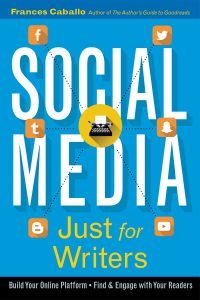
Whether you’re setting up your social media for the first time or wanting to take it to the next level, get the newest edition of Social Media Just for Writers.
This book is a very useful tool for writers looking to extend and reach their audiences. It has systematic detailed information about how to set up accounts and create a professional online profile and author branding. Recommended to anyone curious about why social media is still such a big thing for everyone, particularly for writers.
 Author of this blog: Frances Caballo is an author and social media strategist and manager for writers. She’s a regular speaker at the San Francisco Writers Conference and a contributing writer at TheBookDesigner.com. Frances wrote several social media books including Social Media Just for Writers and The Author’s Guide to Goodreads. Her focus is on helping authors surmount the barriers that keep them from flourishing online, building their platform, and finding new readers. Her clients have included authors of every genre and writers’ conferences. Not sure how you’re doing online? Sign up for her free email course.
Practical tips for marketing your books on the social web
SaveSave
SaveSave
SaveSave
SaveSave
SaveSave
SaveSave
SaveSave
SaveSave
SaveSave
SaveSave
SaveSave
SaveSave
SaveSave
SaveSave
SaveSave
SaveSave
SaveSave
SaveSave
SaveSave
SaveSave
SaveSave
SaveSave
SaveSave
SaveSave
The post Indie Author Weekly Update – March 30, 2018 appeared first on Social Media Just for Writers.


March 26, 2018
Spring Cleaning: 7 Strategies to Clean Up Your Social Media

When was the last time you thought about giving your social media a sheen? Keep reading to learn about my strategies to clean up your social media and prepare for spring.
A couple of years ago I read the little book that is still revolutionizing how people think about their stuff: The Life-Changing Magic of Tidying Up: The Japanese Art of Decluttering and Organizing by Marie Kondo.
It’s not that I have clothes and shoes cluttering my bedroom. And I’m definitely not a hoarder. In fact, about twice a year, my husband and I go through our clothes and other household items and find things that we either no longer use or just don’t fit.
But despite my way of tidying up, as I read the book, I realized that I still had stashed in my closet a Guatemalan wall hanging from the 1990s. Can you believe it?
While reading Kondo’s book, and going through one of her recommended marathon discarding sessions, I remembered the wall hanging in the back of my closet.
Even though I’d had it professionally dry-cleaned years ago, I hadn’t hung it on a wall in more than a decade.
Yet there it was in my closet, waiting for the perfect moment or room to hang again. But the truth is that I’ve never even been to Guatemala.
So why had I been carting this item from house to house, careful to keep it hung and protected in a dry cleaner’s plastic bag? I have no idea.
So I gently folded the blanket and dropped it into one of my four bags of items destined for Goodwill.
With that simple act, I instantly realized the value of Kondo’s book and appreciated her permission to let some things go to reduce the clutter in our closets and to make room only for those items that “spark joy” in us.
When Did You Last Clean Up Your Social Media?
As I thought about Kondo’s book recently, I realized that her strategies also apply to social media. For example, how long ago did you set up your social media accounts? Have you revisited them recently?
When I say revisit them, I mean when was the last time you updated your profiles? I’m as guilty as you might be at forgetting to add new books to my LinkedIn profile or updating my banner images. But as they say, there’s no time like the present to get busy and make sure our profiles are current.
Let’s take this one step at a time.
 Open your LinkedIn profile and follow the steps below.
Headline: Start by examining your headline. Does it include the title of your newest book? Are you describing yourself in a way that’s consistent with how you’re branding yourself today?
For example, some authors start out describing themselves as writers or authors but then develop businesses around editing or design as well. Make sure that how you describe yourself best reflects your writing and business interests.
For example, in my headline, I have room to describe my business focus and the names of my two most recently published books.
Summary: Next, move to your Summary. If you mention recently published books, update that section now. Keep the summary succinct and use bullet points. (Create your text with bullets using Word and then copy and paste the text into your summary.) Be sure to include some form of media, whether it’s the cover of your newest book, a book trailer, or a giveaway to attract email sign-ups. Be sure to use as many keywords as you can in this section. Examples of keywords would be your name, your genre, and the audience you wish to attract.
Experience: Move on to your experience section. How do your work histories relate to your career as an author? Or does it have to in your case? Make any updates that make sense to you.
Publications: Under the Accomplishments section, add the Publications feature and make sure you include your newest books. While you’re here, review your book descriptions. Are they consistent with what’s on your website? Do they include keywords?
Volunteer Experience: I always think it’s a good idea to include volunteer experience to demonstrate that you care about your community. Have you taken on any new volunteer posts? If so, add them now.
General Updates: Have you taken new courses, earned new certificates, or received any awards for your writing recently? Be sure to add those updates in the appropriate sections.
Header Image: Finally, let’s return to the top. Did you create a new header image? Be sure to follow these requirements:
Use these file types: JPG or PNG.
Make sure your image is no larger than 4MB.
Limit your pixel dimensions 1584px x 396px.
 To review and update your Twitter account, navigate to your profile and tap or click Edit Profile. Now you can update your header image, bio, avatar, and theme color. I suggest that you start with your header image.
Header image: Joanna Penn does an excellent job of displaying all her book covers on her header. And she represents both of her brands: nonfiction author, blogger, and podcaster; and her darker brand as a thriller author.

You can hire a graphic designer to create your header image, or you can do it yourself by using a free tool such as Canva.com. One of the beauties of Canva, a free application, is that it has all the templates you need for all of the social media networks. In other words, you don’t need to search for the right sizes for each image you create; Canva does this for you.
You can create simple headers as well. I recently created this one, which I use on Facebook and Twitter.

To create my header, I went to Pixabay and downloaded a royalty-free image for the background. Then I uploaded the cover photos of my two most recently published books and added some text. It took me all of five minutes to create – for free.
Avatar: Are you facing the camera in your picture? If you’re using a book cover or pictures of your cat or dog as your avatar, now’s the time to remove those images and add a picture of yourself. You are your brand; not your cat or dog.
Username: Does your username have numbers symbols in it. If so, then it’s time to change that as well. Just go into your settings and use your author name instead. If someone else is using your name, you can do what I did; I reversed the order of my name so instead of my Twitter handle being @FrancesCaballo it’s @CaballoFrances.
Bio: Does your bio mention your newest book and does it have a link to a giveaway so that you can grow your email list? If you previously wrote that you love lattes, now’s the time to delete that type of information. Another caution: Don’t fill your bio with hashtags. If your branding has changed, then change your theme color.
 When was the last time you seriously considered your Facebook author page?
Banner image: If you updated your header image on Twitter, use the same design here. The dimensions should be 820 x 340 and less than 100 kilobytes.
About Section: Make sure that you complete the following sections:
Category
Name
Username
Genre
Short description
Long description
General information
Bio
Publisher
Awards
Favorite books
Personal interests
Website address
Insights: While you’re here, tap Insights and took a quick look at your analytics (You’ll have access to Insights once you have at least 35 Likes). Determine the optimal time of day to post your status updates and observe how your posts are performing. Finally, review the demographic information. (This section is my favorite.)
Social Media Clean-Up Strategies for Moving Forward
Now review the other social media networks that you’re using. Keep these  strategies in mind:
Use the same avatar for all of the social media networks you use.
Use the same design for your banner images.
Make sure your bio is consistent across all platforms.
Make sure you are using the same author name across all networks. For example, sometimes people with middle names will just use an initial on Twitter and then include the entire middle name on Facebook. You need to use the same name that’s on the covers of your books.
Review your posts. Do you include visuals with every update? It’s important to use images so that you can pin those images on Pinterest and enjoy referral traffic to your site.
On Pinterest and Instagram, you don’t have banner images, but you can review your bio to make sure that it’s up-to-date. On Pinterest, review your pinboard. Are there some that should be discarded? And look at your Instagram profile? Is there consistency to your brand or a theme?
Mark your calendar to review all of your networks every six months to ensure that the information is still current. If it isn’t, spend an hour updating your profiles so that you’re always promoting your current books and business focus.
Finally, follow Marie Kondo’s advice. Don’t clean up your social media accounts on a piecemeal basis. Schedule a marathon session and get it done because as she says, “A tidying marathon doesn’t cause rebound.” And it will make your online life shine.
Whether you’re setting up your social media for the first time or wanting to take it to the next level, get the newest edition of Social Media Just for Writers.
This book is a very useful tool for writers looking to extend and reach their audiences. It has systematic detailed information about how to set up accounts and create a professional online profile and author branding. Recommended to anyone curious about why social media is still such a big thing for everyone, particularly for writers.
Author of this blog: Frances Caballo is an author and social media strategist and manager for writers. She’s a regular speaker at the San Francisco Writers Conference and a contributing writer at TheBookDesigner.com. Frances wrote several social media books including Social Media Just for Writers and The Author’s Guide to Goodreads. Her focus is on helping authors surmount the barriers that keep them from flourishing online, building their platform, and finding new readers. Her clients have included authors of every genre and writers’ conferences. Not sure how you’re doing online? Sign up for her free email course.
Practical tips for marketing your books on the social web
SaveSave
SaveSave
SaveSave
SaveSave
SaveSave
SaveSave
SaveSave
SaveSave
SaveSave
SaveSave
SaveSave
SaveSave
SaveSaveSaveSave
SaveSaveSaveSave
SaveSave
SaveSave
The post Spring Cleaning: 7 Strategies to Clean Up Your Social Media appeared first on Social Media Just for Writers.
March 23, 2018
Indie Author Weekly Update – March 23, 2018

Today’s Indie Author Weekly Update primarily focuses on an a writer’s audience. So be sure to check out the posts by Fauzia Burke, Mark Coker, and Later, an application for Instagram.
As always, enjoy the posts and have a great weekend!
Know Thy Reader – Identifying and Understanding Your Audience by Fauzia Burke: “There has never been a better time to be an author, because for the first time authors have direct access to their readers. While there is more competition in the marketplace, there is also more opportunity. To thrive in today’s competitive markets, personal branding is more important than ever. Your ability to successfully execute your online marketing plan will help you capture and hold your reader’s attention.”
How Indie Authors Can Cultivate Superfans by Mark Coker: “Most book marketing advice focuses on how to get readers to buy your books, yet ignores how to care for your readers once you’ve got them. With subtle tweaks to your publishing process, you have the opportunity to cultivate more passionate readers. I call these passionate readers superfans.”
[Podcast] Start Your Author Email List ASAP by Dave Chesson: “Where authors put their opt-in within their books is important, too. As we’ve talked about in past episodes, when a reader opens an ebook, they don’t necessarily see the front matter, so putting an opt-in in the front of the book is not the best place. Putting at the end, however, means the reader is so interested in your writing, they are probably looking for more from you. You’ve already engaged them through the whole book, they’re thirsty for more.”
How to Design Instagram Stories: 7 Tips to Wow Your Audience! from Later: “Want to design Instagram Stories that wow your followers? It’s not as easy as it looks! If you want to design Instagram Stories that catch the attention of your followers (and make your brand look great), you’ll need to use all the features at your fingertips. With fun, new features being added regularly and all sorts of Instagram Stories hacks available, it’s now easier than ever to create well-branded stories that are sure to impress your followers!”
4 Ways You Can Make Time to Blog Right Now by Rachel Thompson: “Time, writers say, is the biggest challenge when it comes to blogging. We are writing books. We are marketing books. We are thinking about marketing books. We are parents, spouses or significant others, single parents, workers bees, pet puke cleaner-uppers, grocery-shoppers, housekeepers, laundry-do-ers, mental illness sufferers/survivors, advocates, and the beat goes on. Time is a real issue, right?”
How to Build a Blog Site from Scratch by Jeff Goins: “Over the years, I’ve built over a dozen blogs, many of which were built the wrong way, unfortunately. Which required me to go back and start over. Eventually, I learned that building a blog is a lot like building a house. Minus the fact that building a house is way more difficult and labor intensive and, oh yeah, super expensive.”
Facebook in the News
The real scandal isn’t Cambridge Analytica. It’s Facebook’s whole business model: from Slate: “The plot was made for front-page headlines and cable-news chyrons: A scientist-turned-political-operative reportedly hoodwinked Facebook users into giving up personal data on both themselves and all their friends for research purposes, then used it to develop “psychographic” profiles on tens of millions of voters—which in turn may have helped the Trump campaign manipulate its way to a historic victory.”
Changes on Twitter
Twitter has new rules on the posting of duplicate information within any 24-hour period. For information on this new rule by Twitter, read this post: “Twitter is announcing major limits on how users and apps can automate tweets, in order to combat spam and political propaganda bots. Developers are now banned from using any system that simultaneously posts “identical or substantially similar” tweets from multiple accounts at once, or makes actions like liking, retweeting, and following across multiple accounts at once. Twitter will remove these options from its own TweetDeck app, and third-party developers have until March 23rd to comply.”
Quote of the Week

Whether you’re setting up your social media for the first time or wanting to take it to the next level, get the newest edition of Social Media Just for Writers.
This book is a very useful tool for writers looking to extend and reach their audiences. It has systematic detailed information about how to set up accounts and create a professional online profile and author branding. Recommended to anyone curious about why social media is still such a big thing for everyone, particularly for writers.
Author of this blog: Frances Caballo is an author and social media strategist and manager for writers. She’s a regular speaker at the San Francisco Writers Conference and a contributing writer at TheBookDesigner.com. Frances wrote several social media books including Social Media Just for Writers and The Author’s Guide to Goodreads. Her focus is on helping authors surmount the barriers that keep them from flourishing online, building their platform, and finding new readers. Her clients have included authors of every genre and writers’ conferences. Not sure how you’re doing online? Sign up for her free email course.
Practical tips for marketing your books on the social web
SaveSave
SaveSave
SaveSave
SaveSave
SaveSave
SaveSave
SaveSave
SaveSave
SaveSave
SaveSave
SaveSave
SaveSave
SaveSave
SaveSave
The post Indie Author Weekly Update – March 23, 2018 appeared first on Social Media Just for Writers.
March 19, 2018
Everything Authors Want to Know About Instagram

Do you use Instagram? If you don’t, or if you’re still knew to it, this post contains everything authors want to know about Instagram.
Instagram is growing day by day. According to Statista, as of September 2017 Instagram had 800 million users. I wouldn’t be surprised if it had 900 million users or more by now.
According to the Pew Research Center’s March 1st report, Instagram is the fourth most used social media network, behind Facebook, YouTube, and Pinterest.
Part of Instagram’s growth might be due to the mother of all social media networks, Facebook. After Facebook purchased the app in 2014, Instagram’s user base soared by 60%.
Instagram took off with teens and Millennials. Today, according to the Pew Research Center, 35% of all internet users in the U.S. have an Instagram account. Of those, 39% are women and 30% are men.
More About Instagram’s Users
The age breakdown among users trends toward the younger crowd. Most users are between the ages of 18 and 29.
However, there is a fairly large number of users between the ages of 30 and 49. The older age groups tend to be smaller with the 65-and-above crowd making up the smallest percentage of users.
What we know for sure is that for interacting with readers, Instagram is increasingly a great platform for engaging with them.
Readers on Instagram
If your reader demographic is between the ages of 18 and 49, Instagram can be a strategic application for you to use. If you write young adult, new adult, dystopian, and teen and young adult romance and science fiction novels, then you need to spend time connecting with your readers on Instagram.
However, some agents are recommending that all authors, including nonfiction writers with an older readership, also use Instagram.
But if your audience isn’t on Instagram, does it make sense to use it? I’m a huge proponent of saving time on social media by only spending time on those networks where you’ll find your readers and your colleagues.
But with Instagram’s popularity, it might make sense for you to follow Jane Friedman’s advice: grab your username anyway. After doing that, play around with Instagram and see whether it’s worthwhile for your genre and readership. If it isn’t, leave Instagram, focus your energy on other platforms, and return to it later to test it again.
The beauty of Instagram – and this is why it’s easy to test it – is that it’s effortless to incorporate it into your life. You’ll see why if you keep reading. For now, let’s leave the statistics behind and talk about how to sign up and use this tool.
How to Join Instagram
Profile Image
Joining this network is easy. Sign up by navigating to Instagram.com on your desktop computer or download the application on your smartphone and signup.
It’s best to use your smartphone because Instagram was developed for the mobile web and it’s best to be on your phone to add your profile image and images that your post.
As with other social media sites, do not use your book cover or image of your favorite pet as your avatar. Use the best picture of yourself that you have.
Every time you add a new network to your marketing arsenal, represent your brand as best you can. What is your brand? You.
Some writers become irritated at the mention of the term author brand but denying that it exists doesn’t deny its importance. Everything you do and say online reflects upon you so every step you take online, every post, every image you upload, needs to support your author career in as positive a manner as possible.
Username
When you select your username, use your name. If you use a pen name for your books, use that. Basically, use the name that appears on the covers of your books.
Bio
Complete your bio, which Instagram restricts to 150 characters, and add your author website address. Don’t forget to check the box next to Similar Account Suggestions so that Instagram will suggest additional users for you to follow.
Instagram Is a Mobile App
 You’ll be limited in what you can do from your desktop computer. You can create your account and stream your news feed and like images and leave comments. But at its essence, Instagram is a mobile app.
As you’re out and about, visiting your favorite café, buying books, or cruising you’re your favorite downtown area or woodsy path, snap images with your smartphone. Then, upload the pictures directly to Instagram. Select a filter for your image if the image appears too dark or too bright, and post it.
Now this next step is what makes Instagram simple to use. As you post your image to Instagram, you can also post it to other accounts, including Facebook, Twitter, Tumblr, and Flickr. While I don’t recommend syncing Twitter to Facebook or even Instagram to Twitter, linking Instagram to Facebook is seamless. The comment and hashtags you write for your Instagram post will integrate smoothly with your Facebook profile. This is how to connect your accounts:
Navigate to your Instagram profile on your smartphone.
Tap the three dogs in the upper right-hand corner of your profile.
Click Linked Accounts and select the social media networks you want to sync.
If you want a business account, which will provide you with analytics, follow these instructions:
Go to your profile.
Click the three dots in the upper right-hand corner of your profile.
Click Switch to Business Profile.

Once you have a business profile, you’ll connect your Instagram business profile to your Facebook author page. You’ll also get analytics for your Instagram account. You’ll be able to track demographic information of your followers, locations, and the hours and days your followers are on Instagram.
How Authors Can Use Instagram
Authors have taken to Instagram, expanding their brand, and letting readers learn more about them than what they write or blog about. Check out these examples:
Tyler Knott Gregson
You’ll find Tyler on Instagram where he’s known as Tyler Knott, an #Instapoet on this app. He’s a successful poet who rose to fame by using Instagram. He creates quote images and posts them mostly on Twitter and Instagram.
Here’s one of his poems displayed as an image:

Kate Kisset
Author Kate Kisset posted this notice of a giveaway contest was hosting.

Bloomsbury Publishing
Boomsbury Publishing posted this picture of someone reading one of its authors.

Joanna Penn
A nonfiction and dark thriller author who writes her thrillers under the name J.F. Penn, Joanna recently shared this picture of an eerie setting in the woods.

Crissi Langwell
While attending attending an Indie author event at a library, Crissi took an image of a display of her books.

Molly Fisk
Author Molly Fisk shares a picture of her specialty cup of coffee as she’s about to tackle the Sunday crossword puzzle.

Fluer Hols
Author Fluer Hols created this beautiful quote.

Angelica Jurd
There’s nothing wrong with boasting about your Amazon sales!

Share the cover of a new book about to be released, images from your hometown, or of the desk where you write. If you have a favorite café where you like to write, take a picture of the sign or the front of the building. If you love dogs, take a picture of your dog doing something fun. When you have a reading, ask someone to snap a picture of you, preferably not when you’re standing behind a podium but during a moment when you’re animated, laughing, or engaging with an attendee. Most of all, test this app and have fun with it.
When to Post on Instagram
The easiest time to post is right after you take a picture or create a quote.
According to Latergramme, a scheduling post for Instagram, the best time to post is between 2 am and 5 pm EST, with 5 pm being the most opportune time. The best day to post is on Wednesdays, but if you start using Instagram, you’ll need to be consistent and post more frequently than once a week. Once a day is usually sufficient.
When you start out, post images when it’s convenient for you. As you gain followers, you’ll figure out when the most engagement occurs and tailor your timing.
Scheduling Apps for Instagram
Once you start using Instagram regularly, you might want the option to schedule images in advance.
With this app, you can upload images and videos from your computer, not just your smartphone. Onlypult also provides analytics. Plans start at $10.50/month.
This tool enables you to upload images from your computer, iPhone, Tablet, or Android, plan and schedule your posts, upload videos and manage multiple accounts if you have more than one. You can start with a free account. If you have a business profile on Instagram, you can schedule your images.
With this tool, you can organize campaigns or schedule images one-by-one, manage multiple accounts, create content, and add bulk uploads at once. For a single Instagram account, the cost is $20/month.
Instagram Best Practices
Here are a few best practices to get you started.
Use hashtags here just as you would on Twitter. Although hashtags haven’t taken off on Facebook, you can use them as well on that platform.
Don’t be afraid to reveal a bit about your personal life. Take images from a hike, a cycling excursion, or even of your background. Revealing something about yourself will help readers connect to you.
Always be authentic.
Don’t be promotional, unless you’d like to inform users of a contest.
Build your community of readers and colleagues by liking their posts and commenting on them. Be as engaged with them as you’d like them to be with you.
How do you use Instagram?
Author of this blog: Frances Caballo is an author and social media strategist and manager for writers. She’s a regular speaker at the San Francisco Writers Conference. In addition, she’s a contributing writer at TheBookDesigner.com. She’s written several social media books including the 2nd edition of Social Media Just for Writers and The Author’s Guide to Goodreads. Her focus is on helping authors surmount the barriers that keep them from flourishing online, building their platform, finding new readers, and selling more books. Her clients include authors of every genre and writers’ conferences. Not sure how you’re doing online? Sign up for my free email course.
Practical tips for marketing your books on the social web

Want to learn how to save time on social media? You can get my book on this topic for free from Smashwords!
SaveSave
SaveSave
SaveSave
SaveSave
SaveSave
SaveSave
SaveSave
SaveSave
SaveSave
SaveSave
SaveSave
SaveSave
SaveSave
SaveSave
SaveSave
The post Everything Authors Want to Know About Instagram appeared first on Social Media Just for Writers.
March 16, 2018
Indie Author Weekly Update – March 16, 2018

Today’s Indie Author Weekly Update focuses on book marketing strategies. If there’s only two posts you have time to read, be sure to read Gill Andrews’s post on author websites, and then read the post by Joel Friedlander on why your book might not be selling.
Have a great weekend!
15 Reasons Why Your Book Isn’t Selling by Joel Friedman: “We’ve all been there: a book we were excited about, one that we worked on earnestly. But when it hit the market, all that came back was a big yawn. No author wants to be in that situation, most of all a self-published author. We gamble our own time, money, and commitment to our books, and we really need a positive response sometimes just to keep going. But there it is: your baby isn’t selling.”
Five Things You Need As You Begin A Career As A Self-Published Author from BookBaby: “The most important part of being a writer is writing, but if you want a career as a self-published author, you have to do a whole lot more than just write: you have to learn the business of writing and market yourself in a way that puts you on the same playing field as mainstream authors with big publishing houses behind them.”
Want More Readers for Your Blog and Books? Fix These 5 Website Mistakes from Anne R. Allen and by by Gill Andrews: “Writing and sharing your ideas with others – sure. But this website thing? You just wanted more people to read your stories. But now you spend hours agonizing over blog post topics, looking for free images, and figuring out why that widget on your website refuses to work.”
Book Marketing 101: Need to Sell More Books? This Is How! by Dave Chesson: “Book marketing is an extremely important part of a self-publisher’s success. But it can also be confusing. That’s why I’ve broken down the process into 3 phases and given you a guide for each step. Honestly, if I were to write a complete book on Modern Online Book Marketing, this would be EXACTLY IT. So, enjoy it for free.”
Tips on the Business of Writing and Publishing from Jane Friedman: “For AWP 2018, I hired a team of writers to help me cover business-related sessions, as part of the launch for my newest book (official release date: March 16). Their blog posts are available over at the companion website for the book.”
8 Tips to Get Great Amazon Book Reviews by Lisa Tener: “One strategy that can help catapult your book to page one on Amazon results are your Amazon book reviews. Of course, your book needs to be categorized well on Amazon (with the right keywords and categories). It needs to be well-written, too! But after these “givens” reviews rock.”
Man Booker Prize
Man Booker Prize International Longlist: Books Translated From 10 Languages by Porter Anderson: “The 13-title longlist for the 2018 Man Booker International Prize has been announced this afternoon in London (March 12), and features work from Germany, Taiwan, Iraq, Austria, Spain, France, South Korea, Argentina, Hungary, and Poland.”
Quote of the Week

Author of this blog: Frances Caballo is an author and social media strategist and manager for writers. She’s a regular speaker at the San Francisco Writers Conference. In addition, she’s a contributing writer at TheBookDesigner.com. She’s written several social media books including the 2nd edition of Social Media Just for Writers and The Author’s Guide to Goodreads. Her focus is on helping authors surmount the barriers that keep them from flourishing online, building their platform, finding new readers, and selling more books. Her clients include authors of every genre and writers’ conferences. Not sure how you’re doing online? Sign up for my free email course.
Practical tips for marketing your books on the social web
Want to learn how to save time on social media? You can get my book on this topic for free from Smashwords!
SaveSave
SaveSave
SaveSave
SaveSave
SaveSave
SaveSave
SaveSave
SaveSave
SaveSave
SaveSave
SaveSave
SaveSaveSaveSave
SaveSave
The post Indie Author Weekly Update – March 16, 2018 appeared first on Social Media Just for Writers.
March 12, 2018
What Pew Research Center Social Media Stats Mean for Authors

The Pew Research Center (PRC) released a new study on social media use at the beginning of March. Its findings weren’t surprising.
PRC researchers found that Facebook and YouTube dominate the social media landscape.
It’s no surprise that Facebook “remains the primary platform for most Americans.” An estimated 68 percent of U.S. adults report they are Facebook users and three-quarters of them access Facebook on a daily basis. PRC stated:
With the exception of those 65 and older, a majority of Americans across a wide range of demographic groups now use Facebook.
YouTube is even more popular, as I mentioned in a previous blog post. PRC states:
The video-sharing site YouTube – which contains many social elements, even if it is not a traditional social media platform – is now used by nearly three-quarters of U.S. adults and 94% of 18- to 24-year-olds.
Are you trying to reach the Young and New Adult demographic? Here is what the Pew Research Center says about them:
Americans ages 18 to 24 are substantially more likely to use platforms such as Snapchat, Instagram, and Twitter even when compared with those in their mid- to late-20s. These differences are especially notable when it comes to Snapchat: 78% of 18- to 24-year-olds are Snapchat users, but that share falls to 54% among those ages 25 to 29.
The report also noted that Pinterest remains more popular with women (41 percent) than with men (16 percent).
LinkedIn continues to be popular with college graduates and individuals in high-income households. Nothing has really changed there.
What also became evident in this study is that people use multiple social media sites, not just one.
This overlap is broadly indicative of the fact that many Americans use multiple social platforms. Roughly three-quarters of the public (73%) uses more than one of the eight platforms measured in this survey, and the typical (median) American uses three of these sites. As might be expected, younger adults tend to use a greater variety of social media platforms. The median 18- to 29-year-old uses four of these platforms, but that figure drops to three among 30- to 49-year-olds, to two among 50- to 64-year-olds and to one among those 65 and older.
Facebook May Be Popular But Is It Right for Authors? Maybe Not
Are you now itching to redouble your efforts on Facebook? Not so fast. While 68 percent of U.S. users are on Facebook, it’s extremely challenging to reach them. Facebook’s latest tweak to its algorithm has made it virtually impossible for your Facebook fans (readers) to see your posts unless you invest in Facebook advertising. Facebook is basically a pay to play system for authors and anyone with a business page.
There’s a lot of buzz about Facebook groups, and more and more people are starting groups either in addition to having pages or instead of pages. Take Sharon Hamilton as an example.
I interviewed Sharon recently and she’s doing a lot to promote her books. She’s a prolific author in a popular genre and is a New York Times and USA Today, bestselling writer. As of this writing, she has 18,332 Likes and 17,878 followers on her Facebook page. But if you look at her Facebook page, you’ll see that there’s little engagement.
I’ve been following Sharon for quite some time, so I know that she used to have tremendous engagement on her Facebook page. What’s changed? Facebook has. Sharon keeps sharing great information and memes, but Facebook has tweaked its algorithm, making it harder for Sharon’s posts to appear in her fans’ news feeds.
That is unless she buys advertising.
If you look at your news feed these days, you’ll find that you see fewer posts from businesses and authors, fewer ads, and a lot more posts from friends and family. That’s because of Facebook’s algorithm and Mark Zuckerberg’s belief that Facebook users come to Facebook wanting to interact with friends and family and that you and I don’t want to see posts from business pages, such as author pages. In fact, even though I’ve liked many author pages, I never see them in my news feed.
Sharon was smart and started a Facebook group, which is doing well. She also has a street team.
But where does that leave you? One option is read a post I wrote about how to grow your Facebook page. Note that I wrote this post before Facebook’s latest change to its algorithm.
Facebook may seem to be the best place for authors to be but it isn’t. Well, it isn’t unless you’re willing to spend money on advertising.
If you have an extensive email list, start a Facebook group and encourage people to interact with you there, as well. Also, send tweets and Instagram messages with information about your Facebook group. Sharon Hamilton has a link on her website that automatically directs people to her Facebook group, called Rockin’ Romance Readers.
If you want information on how to start and run a group, there’s a blog post on Jane Friedman’s blog with some best practices for Facebook groups.

YouTube Is Number 1
 YouTube is hot as is video. Let’s get real. All visuals are popular.
In comparison to Facebook (68 percent of U.S. users), YouTube claims 73% of them.
How is an indie author going to make good use of YouTube? Here are a few ideas.
Record a reading if it’s fun and lively. Did you write a children’s book? Then post a recording of you reading your book to a circle of kids.
Post your book trailers.
If you wrote a nonfiction book, record some short tips videos.
If you have a podcast, upload the video portion to YouTube.
Until last month, I hosted a webinar series and posted the replay videos on YouTube.
Interview other authors in your genre.
For YouTube to work, be lively in your videos. Have fun with what you’re doing and above all else, strive to connect with your readers.
“Other” Social Media Networks Still Have Their Place
While no one can compete with YouTube and Facebook in terms of the number of users, Pinterest, Instagram, LinkedIn, and Twitter still have their place for authors marketing their books.
Pinterest is terrific at referring traffic to your blog and website so keep using it. Instagram, which Facebook owns, has been piling on the innovations and its users keep surging.
LinkedIn is a platform I only suggest for nonfiction authors. As a fiction author, you can have a profile and belong to a group that you think would be helpful. But traditionally I only think of LinkedIn as a place for businesses and nonfiction writers. If you use LinkedIn, be sure to take advantage of its publishing platform for your blog posts.
Now we come to Twitter. Twitter is where I spend most of my time. If you want to be traditionally published, publishers will want to see a following here. I know this for a fact become I’m in touch with a book coach who works out of Harvard University, and she’s hearing that publishers want to see 30,000 followers on their authors’ Twitter accounts.
Some see Twitter as an outpost, but I don’t. This is a place to engage with readers and form alliances with other authors. Think of authors like Joanna Penn, and she’ll tell you that she basically built her career as a dedicated aficionado of this platform. While Twitter does have an algorithm (read this excellent post by Buffer about it), it’s nothing compared to Facebook’s algorithm. Twitter isn’t a pay to play system. It’s a place where what you tweet will be seen without buying advertising and where you can engage with people.
Which social media should you be on? The answer is you need to be on more than one, but which ones will depend on the demographic you are trying to reach. Study the age demographics in this chart and decide from there.
Just remember to engage, enjoy, and have fun with your marketing. And whichever social media networks you select, make it visually attractive.
Author of this blog: Frances Caballo is an author and social media strategist and manager for writers. She’s a regular speaker at the San Francisco Writers Conference. In addition, she’s a contributing writer at TheBookDesigner.com. She’s written several social media books including the 2nd edition of Social Media Just for Writers and The Author’s Guide to Goodreads. Her focus is on helping authors surmount the barriers that keep them from flourishing online, building their platform, finding new readers, and selling more books. Her clients include authors of every genre and writers’ conferences. Not sure how you’re doing online? Sign up for my free email course.
Practical tips for marketing your books on the social web
Want to learn how to save time on social media? You can get my book on this topic for free from Smashwords!
SaveSave
SaveSave
SaveSave
SaveSave
SaveSave
SaveSave
SaveSave
SaveSave
SaveSave
The post What Pew Research Center Social Media Stats Mean for Authors appeared first on Social Media Just for Writers.
March 9, 2018
Indie Author Weekly Update – March 9, 2018

Welcome to today’s edition of the Indie Author Weekly Update. Do you have trouble getting book reviews? Hey, everyone does. That’s why I included Written Word Media’s post on how to get more reviews.
As always, I hope you have a great weekend!
Five Marketing Tools for Authors Who Hate Marketing from Writer Unboxed: ” If you’re a writer and you’re on social media, have a website, blog, or even just talk about your work with friends, you’re already marketing. So here are five inexpensive and relatively easy-to-use tools to help optimize the marketing you’re already doing.”
3 Inspirational Design Ideas from Bestselling Book Covers from TheBookDesigner.com and by Dave Chesson: “Have you ever come across a book cover design so striking that you not only stop and admire it, but also analyze and learn from it? The best book covers are more than just attractive adornments to the books we love. They also offer ideas and inspiration we can use to guide our own work. There’s no limit to the vast array of inspirational covers out there. Books of all genres and types have covers that not only please the eye but also inspire the mind.”
4 Ways to Create Your Author Persona by Donna Galanti: “Everyone’s persona (or brand) is unique (just like you) and it’s your own personal story that you choose to convey that will draw your readers to you. As Dr. Seuss said, “There is no one alive who is Youer than You.” After all, it’s so much easier to be you than someone else!”
How to Use Scheduling To Automate Your Social Media by Joanna Penn: “Some people think I’m on social media all the time because my presence is there 24/7, but my secret weapon is automation and scheduling, as well as tools that enable me to use social media without spending all my time on it.”
How to Get Book Reviews on Amazon from Written Word Media: “One of the first challenges you’ll face when publishing your book is getting book reviews. Book reviews are important because 1) Books with reviews sell more copies, 2) Many book promotion sites require a minimum number of reviews to use their service and 3) Verified reviews are an additional metric Amazon can use to promote your book.”
Quote of the Week

Author of this blog: Frances Caballo is an author and social media strategist and manager for writers. She’s a regular speaker at the San Francisco Writers Conference. In addition, she’s a contributing writer at TheBookDesigner.com. She’s written several social media books including the 2nd edition of Social Media Just for Writers and The Author’s Guide to Goodreads. Her focus is on helping authors surmount the barriers that keep them from flourishing online, building their platform, finding new readers, and selling more books. Her clients include authors of every genre and writers’ conferences. Not sure how you’re doing online? Sign up for my free email course.
Practical tips for marketing your books on the social web
Want to learn how to save time on social media? You can get my book on this topic for free from Smashwords!
SaveSave
SaveSave
SaveSave
SaveSave
The post Indie Author Weekly Update – March 9, 2018 appeared first on Social Media Just for Writers.
March 5, 2018
Book Marketing and Facebook Advertising with Ricardo Fayet
Ricardo Fayet is a cofounder of Reedsy. He started Reedsy with a few friends after business school.
 A partner came up with the idea of creating a venue that offers expert consultants in self-publishing, such as editors, book cover designers, and marketing experts. Reedsy vets applicant experts before accepting them into their program. Experts submit applications and Reedsy employees review them. They accept 3% of the applicants they receive. Right now they have 800 vetted consultants that self-published authors can hire.
At its core, Reedsy is a marketplace for professionals: various forms of editing, cover designers, illustrators, interior designers, publicists, book marketers, and advertising specialists. They recently added 80 ghostwriters. Finally, they recently added website developers. Reedsy has a blog and every two weeks they offer webinars.
In this webinar, Ricardo discusses marketing but spends most of the time explaining how to use Facebook advertising.
Author of this blog: Frances Caballo is an author and social media strategist and manager for writers. She’s a regular speaker at the San Francisco Writers Conference. In addition, she’s a contributing writer at TheBookDesigner.com, and blogger and Social Media Expert for BookWorks. She’s written several social media books including the 2nd edition of Social Media Just for Writers and The Author’s Guide to Goodreads. Her focus is on helping authors surmount the barriers that keep them from flourishing online, building their platform, finding new readers, and selling more books. Her clients include authors of every genre and writers’ conferences. Not sure how you’re doing online? Sign up for my free email course.
Practical tips for marketing your books on the social web
Want to learn how to save time on social media? You can get my book on this topic for free from Smashwords!
The post Book Marketing and Facebook Advertising with Ricardo Fayet appeared first on Social Media Just for Writers.
March 2, 2018
Indie Author Weekly Update – March 2, 2018

In this week’s Indie Author Update, be certain to read Amy Collin’s post about Amazon and Chris Well’s post on how to have a media-savvy website.
I hope you enjoy your weekend!
Indie Author Updates
36 Smart Ways To Grow Your Email List 2x Faster from Blogging Wizard: “You need to build your email list if you want to grow your blog. Don’t be the person that keeps making excuses for why they aren’t focusing on building their list. I learned that lesson the hard way but you don’t have to. The truth is that email is far more effective at reaching your raving fans than any other tool. That includes social media.”
5 Creative Blog Post Ideas for Savvy Author Marketing from Penny Sansevieri: “You may be a savvy blogger, or maybe you’re still digging in your heels about starting your blog, but no matter where you fall on that spectrum I have to tell you that blogging is a critical piece to your author marketing. If you want to sell more books, I urge you to get on the blog train.”
Three Different Ways to Approach Blogging as a Novelist [With Examples] from Aliventures: “If you’re a novelist, should you have a blog? Opinions differ! You might have been told that you should blog, because you need to build a platform, or because it’s a good way to get people onto your site and then onto your mailing list, or because publishers / readers / the media will want it … or for almost any number of reasons.”
Book Promotion: Do This, Not That – February 2018 from TheBookDesigner.com and by Amy Collins: “Amazon is no longer listing books supplied from IngramSpark as “in stock.” In the past, Amazon would list IngramSpark sourced books as “in stock” because they knew that they could order the book and get them in a day. In the last few months, Amazon has changed this practice. They will only order enough POD IngramSpark sourced books to fill existing orders. Occasionally, they will order a few more when demand shows that they will sell them. Books that previously were listed as “in stock” are no longer and it is dramatically affecting sales.”
Media-Friendly Author Website Content – Part Three from BookWorks and by Chris Well: “This is the last of three posts outlining the essentials that you need if you want a media-friendly author website if you want to get media attention. Still with me? Great! If you recall, in Part One we discussed how to present basic information about yourself and your book(s). Then in Part Two, we went over the different ways you can make it easier for website visitors to contact you to set up an interview, ask questions, invite you to speak, etc.”
How to Put the Joy (and the Impact) Back into Twitter from Alliance of Independent Authors and by Helen Baggott: “Do you have a Twitter account but don’t know why? Do you send out an occasional tweet hoping someone will buy your book? Establishing a presence does take time but it doesn’t have to be hard work – and you might even enjoy it.”
Fiction Contests
Fiction Writing Contests Worth Your Time (Spring 2018) from Writer Unboxed: “This submissions season covers fiction contests with deadlines between March 1, 2018 and May 31, 2018. March is absolutely stacked with deadlines; so no excuses about not submitting! Thanks to Literistic, Poets & Writers, Submittable Discover, and New Pages for many of these contests.”
Quote of the Week

Author of this blog: Frances Caballo is an author and social media strategist and manager for writers. She’s a regular speaker at the San Francisco Writers Conference. In addition, she’s a contributing writer at TheBookDesigner.com, and blogger and Social Media Expert for BookWorks. She’s written several social media books including the 2nd edition of Social Media Just for Writers and The Author’s Guide to Goodreads. Her focus is on helping authors surmount the barriers that keep them from flourishing online, building their platform, finding new readers, and selling more books. Her clients include authors of every genre and writers’ conferences. Not sure how you’re doing online? Sign up for my free email course.
Practical tips for marketing your books on the social web
Want to learn how to save time on social media? You can get my book on this topic for free from Smashwords!
SaveSaveSaveSave
SaveSave
SaveSave
SaveSave
SaveSave
SaveSave
SaveSaveSaveSave
SaveSave
SaveSave
The post Indie Author Weekly Update – March 2, 2018 appeared first on Social Media Just for Writers.
February 26, 2018
Are You Ready for Video Because It’s Huge!

Video is incredibly popular. Experts estimate that in 2018 and beyond, video will just continue to expand.
Listen to what Marketing Insider Group stated:
“As we turn the corner to 2018, the evolution of video marketing isn’t slowing down. In fact, with one more year of technological innovation and creativity behind the camera, the world is in for more captivating video content over the next year.”
Facebook Live
Back in 2015, consumers spent an average of five-and-a-half hours a day watching video content. That number continues to rise. On Facebook alone, some 500 million users view 8 billion videos on a daily basis.
And since Facebook Live debuted in April 2016, its popularity has soared. Here are some interesting numbers:
Facebook Live stream search popularity has risen over 330% since it’s rollout.
Between January and May 2016, Facebook saw a 300% increase in live videos.
5% of all Facebook Live broadcasts happen inside Groups.
One out of every five videos on Facebook is live.
Video, because people watch so much of it, is useful in marketing. At the same time, it’s important to keep your videos to approximately 90 seconds. Five percent of viewers will stop watching a video after 1 minute and 60% by 2 minutes.
Video in General
In 2016, HubSpot, a software and internet marketing company, published a list of statistics about video. I’ll just mention the highlights.
90% of users say that product videos are helpful when deciding whether to buy something, such as a book
People recall great video ads, even up to 30 days after seeing them
92% of mobile video consumers share videos with others
If a consumer enjoys a video, the intent to buy increases
Video can improve your website’s SEO and will improve click-through rates
Videos increase consumer conversions or purchases
Video and YouTube
As if all these facts and findings weren’t sufficient reasons to create videos and post them on YouTube, consider the following significant benefits as well:
Videos on YouTube tend to be highly ranked, so your video could appear high in Google search results. That’s awesome for SEO (search engine optimization).
The human connection is important in book sales and videos allow your readers to hear and see you.
Videos can drive traffic to your website, blog, book landing pages, or Amazon.
You can use video for your blogging.
If you write nonfiction, you can create training videos.
If you write fiction, you can talk about why you wrote your books.
And let’s not forget that you can be creating a book trailer – which is essentially a video commercial for your book and the link to this can then be promoted on your website, blog, and across all your social media platforms.
How to Get Started on YouTube
Just go to YouTube.com and click the signup link. Sign in with your Gmail account or create one. When you click upload next to the empty avatar, a popup will appear confirming your name. Click Create Channel, and you’re on your way to creating a YouTube account. Remember to use your author name when selecting a name for your channel or YouTube account.

Next Steps
YouTube will then prompt you to upload or drag and drop any videos you’ve created. The default setting is for public viewing. The other options are private, meaning no one else can see them, or unlisted, meaning that you’d have to share the link for other people to see the video.
 You can also import any videos you may be storing on Google Photos, decide to use YouTube for live streaming, or create videos using a photo slideshow.
When you click the upload button next to your empty avatar – the pink person icon—you’ll navigate to a page where you can add channel art, what I like to call the top banner image, as well as your avatar image.

The channel banner image needs to be 2560 x 1440 pixels, and it can’t be larger than 4 MB. The minimum size for your image is 2048 x 1152 pixels. The maximum avatar size is 200 x 200 pixels, but you can use an image as small as 150 x 150 pixels. YouTube will collect your avatar from your Google account, or you can upload a different one.
Also, add a channel description. The description should state who you are and what you intend to accomplish or provide on YouTube. Start with the most relevant information, remembering that only the first few sentences of your description will be visible without someone having to click a link to read more of it. Your description needs to include keywords in the title. Always include:
A link to your channel page
A subscription link
Links to related content
Links to social media
Video Creation Tools to Consider
There are a variety of options for creating good video.
Perhaps the easiest and least expensive is to use your use your smartphone or buy an inexpensive video camera. Be sure to get one that allows you to hook up an external mic.
For best results, you’ll also want to steady your recording device with a tripod or selfie stick. The Joby Gorilla pod and Sabrent Flexible Tripod are good options. Selfie sticks can cost as low as $13. For lighting, go outside or record near a window.
Once you create your video, you can upload directly, or you might want to edit it first, in which case you can do this with Microsoft movie maker or the equivalent Mac software, iMovie. Or you can purchase Screencast.
Fiverr.com is another option for low-cost for video editing. Your local community college’s audio-visual department may be able to help you out as well.
Finally, you can also place an ad on Craigslist to search for a videographer or video production student or professional.
5 Best Practices
Publish videos on a regular schedule.
Google prioritizes web pages with YouTube video embeds, so once you create a video, upload it to YouTube and then embed it in your blog.
Remember to identify 3-5 keywords that you want to use in your description when you upload the video to YouTube. Also be sure to have a URL in the description and on the video that you want people to go to take further action
Be sure to promote your video as you would any other announcement – across all promotional social media platforms.
Ask people to like your video and subscribe to your channel. The more YouTube sees these activities, the more your video will rise to higher rankings.
To get started right now, take these three steps:
Go to YouTube.com and sign up for an account, called a channel.
Upload your images.
Start creating videos you can upload to your new channel.
Author of this blog: Frances Caballo is an author and social media strategist and manager for writers. She’s a regular speaker at the San Francisco Writers Conference. In addition, she’s a contributing writer at TheBookDesigner.com, and blogger and Social Media Expert for BookWorks. She’s written several social media books including the 2nd edition of Social Media Just for Writers and The Author’s Guide to Goodreads. Her focus is on helping authors surmount the barriers that keep them from flourishing online, building their platform, finding new readers, and selling more books. Her clients include authors of every genre and writers’ conferences. Not sure how you’re doing online? Sign up for my free email course.
Practical tips for marketing your books on the social web
Want to learn how to save time on social media? You can get my book on this topic for free from Smashwords!
The post Are You Ready for Video Because It’s Huge! appeared first on Social Media Just for Writers.
10 Twitter Tips Writers Need to Know

- Frances Caballo's profile
- 274 followers

