
Frances Caballo's Blog: 10 Twitter Tips Writers Need to Know, page 23
November 9, 2018
Indie Author Weekly Update – November 9, 2018

Welcome back to the Indie Author Weekly Update. You’re going to enjoy today’s roundup. The focus is on book marketing and all the ways you can sell your book from book catalogs to swag to keywords. Enjoy the best posts of the week.
Book Marketing: How to Create a Book Catalog of Your Self-published Books & Why from Alliance of Independent Authors: Self-Publishing Advice Center and by Rachel Amphlett: “When thriller writer Rachel Amphlett discovered that someone had created and published a reading guide and book catalog for her work and was charging readers to download it, she decided to take the matter into her own hands and create her own Readers’ Guide. Here she shares her process and the benefits, to help you do the same for your own back-catalog of books.”
How to Use Swag to Support Your Book Marketing from Jane Friedman’s blog and by Dawn Reno Langley: “More than a million books are published every year, and whether you go traditional or indie, you have a lot of competition. Marketing your book falls squarely on your shoulders no matter where on the publishing spectrum you fall—so you need to how to get the most for your buck. “Book swag” is a proven tool for gathering readers and devoted followers.”
Update Your Keywords to Sell More Books over the Holidays by Penny Sansevieri: “Especially around the holidays, take a moment and tweak your keywords/keyword strings in Amazon. Maybe you can’t incorporate any holiday – or Christmas-specific keywords, but tweak the keywords during the holidays and find the strongest ones for your market. Oftentimes searches that include “gifts for…” ramp up in popularity around this time.”
Have You Pre-Sold Your Book? by Joel Friedlander: “One of the biggest lessons you can learn when you start to really look at marketing your books is about creating anticipation. Think of the last big movie you were looking forward to.”
Amazon and the Also Bought Apocalypse by David Gaughran: “A real horror story has been slowly building for the last year or so and I’m getting a lot of emails on the topic so it’s time to deal with this head-on: what the hell is going on with Also Boughts?”
Quote of the Week

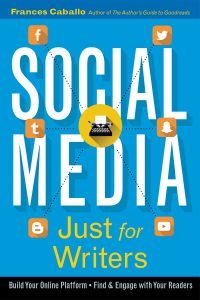
Want to know all of my best social media marketing tips? Get a copy of Social Media Just for Writers.
Well written, well researched – well thought out. This book is a must have!
Ryshia Kennie
 Author of this blog: Frances Caballo is an author and social media strategist and manager for writers. She wrote several social media books including Social Media Just for Writers and The Author’s Guide to Goodreads. Her focus is on helping authors surmount the barriers that keep them from flourishing online, building their platform, and finding new readers. Her clients have included authors of every genre and writers’ conferences. Not sure how you’re doing online? Sign up for her free email course.
Online Book Marketing Strategies for Writers
The post Indie Author Weekly Update – November 9, 2018 appeared first on Social Media Just for Writers.


October 22, 2018
Every Author Needs Visual Marketing

In the past, I theorized that we were moving closer to visual marketing.
Guess what? We’re there. We’ve arrived.
According to this awesome blog post by Hubspot, there are many reasons why you should be focused on visual marketing on your blog and in your social media posts.
Let’s review a few of them.
Tweets with images receive 150% more retweets than tweets without images. Okay, the source for this statistic is Buffer, usually rated among the top three blogs in social media so I believe them and so should you.
In an analysis of over 1 million articles, BuzzSumo found that articles with an image once every 75-100 words received double the social media shares as articles with fewer images. So, if you want more people to read your entire blog post, include multiple, color images.
Users view 85% of videos on Facebook without sound. What this tells me is that it’s the images that mesmerize people.
Cisco projects that global internet traffic from videos will make up 82% of all consumer internet traffic by 2021. You can replace the word images with the word video. Whether you post images or video, you need to do one or the other.
80% of marketers use visual assets in their social media marketing. Convinced yet?
Video (63%), alone, has also surpassed blogging (60%) in usage as a social media marketing asset. Yeah, video is huge. Just look at how popular Facebook Live is.
Also, several sources indicate that including images with your tweets double the chance of a retweet. So don’t tweet anything without including an image.
Finally, I find it interesting that 65% of the population are visual learners. Therefore, it makes sense that we ended up here, in the midst of visual marketing.
Finally, look at the rapid growth of Instagram. The user base soared from 90 million in January 2013 to 300 million in December 2014. Guess where we’re at now?
Instagram has 1 billion monthly users. Incredible, eh?
Free Image Sources for Your Visual Marketing
I’ve written about free image sources in the past but that listed needed to be updated. So here’s an up-to-the-minute list of free image sources that are available today.

When you navigate to this website, the following words greets you:“Beautiful, free photos. Gifted by the world’s most generous community of photographers.”
All images on this website are free to use, which means you can copy, modify, distribute and use the photos for commercial purposes, without any attribution to the photographer.
Crediting photographers here isn’t required, but that would be excellent. It’s your choice.
By the way, you’re going to love these photographs.

Another one of my favorite free image sites is Pixabay.
I’ve been using this site for years, and sometimes I’m amazed at the free images I find.
Pixabay greets you with this message: “Over 1.5 million royalty free stock photos and videos shared by our generous community.”
Once in a while, the folks behind this website ask you to buy them a cup of Java. Otherwise, you can avoid the cost by uploading images of your own for Pixabay to make available for its users.
This website provides vintage imagesfrom public archives that are free of copyright restrictions. Most are black and while a few are in color.
This website provides stock images for free. If you’d like, you can donate to this website.

This website has some fun and unusual images. They are all high resolution pictures that you can use for free both personally and for commercial projects, such as your blog or website. The photographer for all of these images is Ryan McGuire.
Morguefile has come a long way. When researching it in the past, it seemed as though I could only find stodgy looking images. Its website has had a facelift, too. Visit Morguefile today. You’ll be pleasantly surprised.
Oh yeah, their photos are free.
You can search by any category including popular images, recently added images, the most downloaded images, and recently downloaded images. And, of course, these images are free.

This website has a beautiful collection of images that are copyright free that you can use for both commercial and personal use.
Good Free Photos has an extensive public domain stockpile of free and high-resolution pictures. It also has vectors and clip art.
If you’re willing to pay a nominal fee, Freepik is worth the price. A premium account costs $89.99 a year. Alternatively, you can pay a monthly fee of $9.99.
With that fee, you’ll have access to more than 2,322,700 images. Check it out.

Before putting any image on your website or blog, you need to compress the image so that it doesn’t slow your computer.
Everyone hates web pages that take forever to load, right? Well, that is what happens when you don’t compress pictures.
TinyPng is also free so use it.
Want to know all of my best social media marketing tips? Get a copy of Social Media Just for Writers.
Well written, well researched – well thought out. This book is a must have!
Ryshia Kennie
Author of this blog: Frances Caballo is an author and social media strategist and manager for writers. She wrote several social media books including Social Media Just for Writers and The Author’s Guide to Goodreads. Her focus is on helping authors surmount the barriers that keep them from flourishing online, building their platform, and finding new readers. Her clients have included authors of every genre and writers’ conferences. Not sure how you’re doing online? Sign up for her free email course.
Online Book Marketing Strategies for Writers
The post Every Author Needs Visual Marketing appeared first on Social Media Just for Writers.
October 19, 2018
Indie Author Weekly Update – October 19, 2018

I hope you enjoy this week’s Indie Author Update. You’ll find informative posts from Diana Urban from BookBub, Rachel Thompson, Sandra Beckwith, and Amy Collins. Plus, there’s a podcast episode from Dave Chesson. Enjoy!
How Successful Authors Use Social Media: 23 Content Ideas by Diana Urban: “Social media can be a useful part of an author’s platform, helping them connect with readers, fellow writers, and the publishing community. But deciding what content to post next can be a struggle. So how do successful authors use social media to engage with their fans? And what can authors post on social media besides links to their own books?”
What You’re Doing Wrong on Twitter and How to Make It Right from Anne R. Allen and by Rachel Thompson: “Twitter is a wonderful way to connect with readers, book bloggers, and book reviewers if you are connecting with them strategically. Many writers are completely flummoxed how to do that.
Episode 51: The Cold Hard Truth About Book Marketing Services by Dave Chesson: “If you’re worried about marketing your book and are looking into getting a book marketing service, I advise you to proceed with caution. There are some that will work fine with your book, however many will take any book and put it through a conveyor-belt like process for marketing your book.”
3 ways to pitch your book to the press as the perfect holiday gift by Sandra Beckwith: “Every year at this time, newspapers, online news sites, and bloggers start thinking about their holiday gift guides. You’ll start seeing them in late November and all through December.”
Must read post for all writers
Understanding the Current “Dos” and “Don’ts” of Amazon Book Reviews by Amy Collins and from TheBookDesigner.com: “We would like to bring you up to date on the current rules and share some guidelines we have found most helpful when trying to get reviews for your book on Amazon. Here you will find the most frequently asked questions around the Amazon review process and Amazon’s answers. I have gone right to the source and given you the Amazon rules right from the horse’s mouth.”
Quote of the Week

Want to know all of my best social media marketing tips? Get a copy of Social Media Just for Writers.
Well written, well researched – well thought out. This book is a must have!
Ryshia Kennie
Author of this blog: Frances Caballo is an author and social media strategist and manager for writers. She wrote several social media books including Social Media Just for Writers and The Author’s Guide to Goodreads. Her focus is on helping authors surmount the barriers that keep them from flourishing online, building their platform, and finding new readers. Her clients have included authors of every genre and writers’ conferences. Not sure how you’re doing online? Sign up for her free email course.
Online Book Marketing Strategies for Writers
The post Indie Author Weekly Update – October 19, 2018 appeared first on Social Media Just for Writers.
October 15, 2018
20 Tips to Rock Your Social Media Updates

Getting frustrated with your social media updates?
Not seeing as much engagement as you’d like?
Everyone has that complaint from time to time. Even I do. (Yes, me!)
Tips to Improve Your Social Media Updates
There are many ways you can boost engagement and feel better about your social media updates.
Shall we get into the meat of this discussion? Let’s!
Here’s my list of tips to increase engagement on all of your social media posts.
Always post images. Always. It’s easy to do on Instagram and Pinterest because, obviously, if you don’t have a picture to post, you don’t have anything to post. So I’m talking about all of the other platforms, such as Facebook, Twitter, LinkedIn, Google+, etc. We can reverse the order of this tip and put it this way: never post anything on social media without including an image or a video. According to CoSchedule, images increase retweets by 150%, and according to KISSMetrics, Facebook photos attract 53% more Likes and 84% more click-through rates than text posts. Besides, Facebook makes it easy to turn a text post into an image post with its array of color backgrounds for your status updates.
Share quick tips with your followers and fans. Remember that Facebook posts limited to 80 or fewer characters receive 65% more engagement. Yeah, this is another example of when less is more.
Ask questions. If you go to a party and ask questions, people will love you, right? The same dynamic works on social media.
Comment on current events such as Warriors basketball season starting 8-), updates from the World Series, or any issue that is fun and not too controversial. They can even be personalized. Did you take a hike last weekend or win a race? Post images.
Post humorous memes. People love these.
Give away a free eBook for the best photo caption to a funny or ambiguous image.
Share a thought or image that moves you.
Get personal. I tend to like to not be too personal online. It has to do with my comfort level. But the few times that I am less private, engagement soars. So, self-reflect before your self-reveal and then decide if you’re comfortable being more personal and opening up more often. People want to get to know the author behind the books they read.
Share a photo from your past and post in on Thursday with the hashtag #ThrowbackThursday. Author Mark Dawson does this all the time on Facebook.
Buffer reported that to make a tweet more popular, focus on length, nouns and verbs. Don’t focus on mentions or hashtags. Also, use positive words and use an indefinite article such as A or An.
Use emoticons. People love these, and they aren’t going away. I use them sparingly in my business-related emails, but I do use them.
Don’t over-promote yourself. Let’s return to the party analogy I mentioned earlier. Nobody — and I mean not a single person — likes the guy who only talks about himself. It’s a turnoff, right? What you need to realize is that marketing isn’t about your or your books or your blog posts, or your courses. It’s about the benefit. What benefit do readers derive from your books? Even when you focus on the benefit, you still have to do your marketing sparingly. Promote other authors. Promote your readers. Share or retweet what they post. Leave comments on their updates. Marketing is never about you. Sure, you want to sell books, but you won’t get sales by over-promoting yourself. You’ll get sales if you promote other authors, do things for your readers, learn about your readers, answer their questions, and ask them questions. Got it?
Develop content aligned with your marketing objectives. Otherwise, you’ll just be guessing in your marketing and never know for certain what to post.
Run polls and surveys. That’s right, ask your fans and followers what they want to read by your on your blog and in your books, and what they prefer to see on your social media profiles.
Engage in conversations. You can ask questions, and you need to answer questions when readers ask questions. Look at your news feeds and take time to share, retweet, and leave comments.
Sharing images is the first step, making sure that they are correctly sized is the next. Don’t use an image designed for a Twitter post on Facebook and vice versa. Resize images according to the platform’s preferred image dimensions.
As best as you can, make sure that all of your images are the best they can be. Never settle for boring.
Everyone loves a smile, right? Well, it turns out that on Pinterest smiling faces get more saves.
Leverage popular phrases or slogans. During the World Cup a few years ago, “because of fútbol” was a favorite phrase. On Twitter, Monday Motivation and Wednesday Wisdom are hashtags that are always used on those days. These sayings can surface suddenly and be time-limited in their popularity. Use them while they’re hot.
Be consistent in your blog images. Always use the same size for the image at the top of your blog post and use the same fonts.
Facebook posts limited to 80 or fewer characters receive 65% more engagement @CaballoFrancesClick To Tweet
I wrote a post titled Social Media Strategy for Authors Plus 4 Tweets to Never Send that’s been popular. In that blog post, I mentioned these additional tips:
Start with an audit of your present social media networks. Then you’ll know where you stand, where you need to improve, and how to improve your engagement.
Establish clear goals.
Invest the time in blogging at least once a week.
Take time for blog tours when launching a book.
Write guest blog posts for high-trafficked blogs.
Sign up for the social media networks that matter most to your readers.
I suggest more tips in the post.
Photos attract 53% more Likes and 84% more click-through rates Click To Tweet
Want to know all of my best social media marketing tips? Get a copy of Social Media Just for Writers.
Well written, well researched – well thought out. This book is a must have!
Ryshia Kennie
Author of this blog: Frances Caballo is an author and social media strategist and manager for writers. She wrote several social media books including Social Media Just for Writers and The Author’s Guide to Goodreads. Her focus is on helping authors surmount the barriers that keep them from flourishing online, building their platform, and finding new readers. Her clients have included authors of every genre and writers’ conferences. Not sure how you’re doing online? Sign up for her free email course.
Online Book Marketing Strategies for Writers
The post 20 Tips to Rock Your Social Media Updates appeared first on Social Media Just for Writers.
October 12, 2018
Indie Author Weekly Update – October 12, 2018

Welcome to another Indie Author Weekly Update. We’re entering the season of NaNoWriMo and to mark it, there are two blog posts on that topic today. Be sure to read Anne R. Allen’s post on legitimate and seedy publishers as well as David Gaughran’s post on Kindle Unlimited. Finally, Jane Friedman’s blog is always worth a read.
How Can You Tell Legitimate Publishers from the Bad Guys? by Anne R. Allen: “New writers have much to be wary of these days. New publishing scams are landing in writers’ inboxes faster than we can send out warnings. Probably the most dangerous predators for the newbie writer are phony publishers, because they can shatter dreams as well as drain bank accounts.”
To Nano or Not To Nano by Jenny Hansen: “NaNoWriMo, for those of you who are unfamiliar with it, is National Novel Writing Month, where hundreds of thousands of writers gather to bang out as many words as they can in the month of November. Many writers skip it and many writers treat it as a yearly pilgrimage to Writing Mecca.”
How Do You Create? by Grant Faulkner: “When I begin a story, I sit down with an itch of a story idea stirring in my mind, and I write a sentence, without too much thought, without any maps of logic, and then I write another sentence, and then another, one thing leading to the next, writing in pursuit of faint inklings and distant whispers, writing to discover, writing just to write.”
Kindle Unlimited – A Cheater Magnet by David Gaughran: “I don’t hate Kindle Unlimited. While all my own books are currently wide, I also work on marketing campaigns for others which regularly get 10m reads per month, or more. I’m not saying that to brag — the respective authors are doing the hardest part of the equation by writing books which resonate so widely — I merely state this to show that I understand how to (ethically) work Kindle Unlimited, and that I have nothing against it per se.”
How to Write Better Marketing Copy by Jane Friedman: “Overexposure: every writer has experienced this problem. You work on a manuscript for so long that your perception of it dulls. You become blind to its weaknesses and ignorant of its strengths. Though that’s a well-known phenomenon when it comes to editorial perception, overexposure is less acknowledged by marketers. When you’re marketing what feels like your 100th thriller—as an author or for a publishing house—you might feel like you’ve run out of things to say. You’re bored by your go-to descriptions and want to break out of the box and offer a fresh take. But this can be a dangerous strategy.”
5 Tips for Selling Your Books at Events—on a Budget by ChrysFey: “Being one of many authors at a book festival or signing event can be pricey when you add together the cost of the table, books, swag, travel, meals, and anything else the event requires of you. Sometimes it’s challenging to make back the cost of your books and the price of the table. So, finding cheap but cool things to use at book events is essential.”
How to Understand Your Reader’s Level of Awareness to Grow Your Fanbase from Jane Friedman and by Dave Chesson: “Imagine a reader who thinks they like science fiction books, as compared to one that can specifically tell you they love sci-fi military space marine adventures. The latter is more likely to know what they are looking for and quicker to buy the book when they see it.”
 The Death of a Social Media Network
Google+ to Shutter After Reports of Exposed User Data from Social Media Today: “Google announced Monday it would slowly shut down Google+, the search giant’s long-struggling social network, after finding a software bug that divulged the private data of as many as 500,000 users to hundreds of third-party applications, according to a company blog post. The company fixed the flaw in March and didn’t find any evidence that developers misused users’ personal information.”
Quote of the Week

Want to know all of my best social media marketing tips? Get a copy of Social Media Just for Writers.
Well written, well researched – well thought out. This book is a must have!
Ryshia Kennie
Author of this blog: Frances Caballo is an author and social media strategist and manager for writers. She wrote several social media books including Social Media Just for Writers and The Author’s Guide to Goodreads. Her focus is on helping authors surmount the barriers that keep them from flourishing online, building their platform, and finding new readers. Her clients have included authors of every genre and writers’ conferences. Not sure how you’re doing online? Sign up for her free email course.
Online Book Marketing Strategies for Writers
The post Indie Author Weekly Update – October 12, 2018 appeared first on Social Media Just for Writers.
October 8, 2018
25 Tips for Posting on Social Media

Posting on social media can be a quandary for some authors.
Regardless of all the tips posted online, when it comes to a personal decision, many writers don’t know what they should say, especially once they learn that always talking about their books and blog posts is verboten (forbidden).
I get it.
Here’s my confession: I sometimes struggle with what to say on my Facebook profile. My life just isn’t that exciting, you know?
And I’m not into posting selfies. I’m just not that photogenic.
But when it comes to my professional social media accounts — my Facebook page, and Twitter, Pinterest, LinkedIn, and Google+ accounts, I have no problem.
Why? Because I know that on those accounts I need to balance inspirational and education information. I want to encourage people, post images, and ask questions.
I have those platforms down, so to speak.
I want you to feel the same way. I don’t want you to ever feel insecure about what you’re posting or sit in front of a blinking cursor wondering, “What the heck should I say?”
So let’s get to it.
You Need Great Content on Your Blog & on Social Media
Sometimes content you found on the internet years ago can still apply. I know that I  use these tips that I found a few years ago from Search Engine Land. I consider their advice the meat and potatoes of everything I write online.
Is the content informative?
Is it authoritative on the subject matter?
Is it interesting?
Is it well-written?
Is longer content broken up into well-organized sections by headings? You may have long paragraphs in your books, but that style doesn’t work for blogging or for your social media posts.
Does the content make good and interesting use of visual elements? Remember, you need to include images with your blog posts. Multiple photos keep people reading your blog posts. On social media, pictures are a must.
Is the writing free of embarrassing spelling errors or remedial grammar problems? I use Grammarly to check my writing and punctuation. Are you using an editing application to check yours?
Is it written appropriately for its intended audience? How well do you know your audience? Are you writing for women in their 30’s or men 40 and older? You must know your audience if you expect to sell any books. The same is true for your audience on your blog and on social media.
Is the content free of industry-insider jargon, focusing instead on terminology your readers would use (and search for)? Get rid of all jargon and cliches before tapping the publish button.
When appropriate, does the content show your unique voice or even a sense of humor? Are your snarky or quirky? Don’t be afraid to show your real self. Being authentic will enhance your brand. Embrace who you are and don’t be afraid to show those sides of yourself online.
The above suggestions apply mostly to blog writing, but you can adapt some of them for social media.
You can also use these suggestions to evaluate blog posts written by other people you might want to share. Since 80% of the content, you discuss on social media will be from sources other than your own, ask yourself if that content incorporates the above suggestions.
If it doesn’t, don’t use it.
So what will you post 20% of the time when you can talk about yourself? When you think about it, you’re still going to be posting quite a bit of information that emanates from you.
What should you say?

25 Tips for Posting on Social Media
Here are some examples of great content for your social media profiles:
Quotes
Polls
Statistics or data
Questions
Branded images
Infographics
Tips
Recommendations of books you love (use the hashtag #FridayReads on Twitter when you do this)
Request for advice
TBT: Throwback Thursday image
Sharing a meme or comic
Sharing a testimonial for your book
Contests
Video
Controversial questions
Fill-in-the-blank posts (“If I were the boss I would _______.”)
Ask for input on your next book cover.
Ask for reviews.
Ask for advice.
Put up a photo and ask for a caption.
Acknowledge unusual holidays.
Ask for input on names of characters for a book you’re working on.
Share a great sentence from a recent blog post you wrote.
Share a writing prompt.
Talk about what inspired you today.
I’ve been considering adopting a German shepherd. So what did I do?
I turned to Facebook and asked if anyone had a German shepherd and what they thought of the breed. (Until now, I’ve always adopted black Labs.)
The response was phenomenal. Friends posted pictures of their German shepherds.
One person queried why would anyone not have a German shepherd. According to her, German shepherds are the best dogs. Period.
My question is just one example of why I love social media. You receive so much support.
When my dog Dixie died in June, the outpouring of support was tremendous and comforting.
On your Facebook author page, remember to narrow your focus and become known for always posting the best and most up-to-date information in your field.
8 More Tips for Posting on Social Media
If you’re writing a cookbook filled with delicious, gluten-free recipes, you can also post the latest findings in Celiac disease or about new food manufacturers making it easy to follow a strict, gluten-free diet. Don’t forget to post pictures of your gluten-free dishes and baked goods, too.
Did you write a novel featuring a woman entrepreneur or CEO? Write posts about issues that women in business face.
If your novel is set in France, look for information about the particular era you write about and look for dreamy images of France on Pinterest and the specific cities where your characters live. Create pinboards for each town your characters visit or live in and the clothing you imagine they would wear. You can even create a board of your characters’ favorite authors.
Do you love to hike? If your book is about hiking, look for information on new equipment that makes camping and backpacking easy, discuss great hiking trails, and post images from areas you’ve hiked in.
If you write historical fiction, you might want to post information about current political events in the country featured in your novel and images of the clothing the people wore in that era.
If you love to write about the 1960s, create pinboards on Pinterest that include retro bell-bottom pants, white boots, flowered skirts, and peasant blouses.
Do you write about vampires? Review movies that feature vampires and zombies or explore myths about the walking dead.
Do you write poetry? Include quotes from your favorite poets. Repin image quotes from poetry or create some yourself – for Pinterest. Also, post excerpts from your own poetry and created backdrops for your poems using copyright free image sites and Canva.com.
Remember to narrow your focus and become known for always posting the best and most up-to-date information in your field.
On your blog and your social media accounts, your reputation rests on the content you disseminate.
If you write nonfiction, become an authority in your niche. If you write fiction, network with your colleagues and readers and strive to become known for your content.
Remain objective and stay clear of the potentially alienating arguments that can occur in some pockets of social media. Your blood pressure will thank you.
What questions do you still have about social media content? (Yes, I’d really love to know!)
Well written, well researched – well thought out. This book is a must have!
Ryshia Kennie
Author of this blog: Frances Caballo is an author and social media strategist and manager for writers. She wrote several social media books including Social Media Just for Writers and The Author’s Guide to Goodreads. Her focus is on helping authors surmount the barriers that keep them from flourishing online, building their platform, and finding new readers. Her clients have included authors of every genre and writers’ conferences. Not sure how you’re doing online? Sign up for her free email course.
Online Book Marketing Strategies for Writers
The post 25 Tips for Posting on Social Media appeared first on Social Media Just for Writers.
October 5, 2018
Indie Author Weekly Update – October 5, 2018

Today’s Indie Author Weekly Update focuses on book marketing. Be sure to read the Forbes article and Debbie Emmitt’s post on SEO for writers.
Well, the weather has definitely changed here in Northern California where I live. The temperature has dropped and rain has visited us several times. But I love autumn so for me these are all welcome changes.
Speaking of changes, if your book marketing strategies aren’t working, I hope you’ll read all the posts below. They are terrific and will help you implement the adjustments that you need to bring your more sales as an indie author.
$400M Fiction Giant Wattpad Wants To Be Your Literary Agent by Hayley Cuccinello of Forbes: “It took a less than an hour in 2013 for Anna Todd to change her life. The Army wife and part-time babysitter had spent a lot of time reading fan fiction, stories by amateur writers about existing fictional universes and real-life celebrities. So her erotic tale about Tessa and Hardin—a wholesome college freshman and a tattooed bad boy who is a thinly veiled stand-in for singer Harry Styles—came together quickly when she sat down to type the first chapter of After on her phone. Todd posted it to Wattpad, one of the world’s largest destinations for online reading and writing.”
How To Find and Fix Your Book Sales Problem With Dave Chesson and from Joanna Penn: “Dave writes books under multiple pen names and is best known in the Indie author community for creating KDP Rocket and also for his useful blog and podcast at kindlepreneur.com. And today we’re actually going to talk about a number of things that I’m quite excited about, search engine optimization, and also how to find and fix your book sales problems. So a really exciting show today.”
The Four Bios Every Author Needs by Nate Hoffelder: “If you Google author bios you will find a million different articles, each with their own recommendation. Be short and too the point. Use the third person. Simply say who you are, and give your publishing credit. Be formulaic. A lot of this advice is good, but I also think it is incomplete.”
How to Sign Up for eBook Gift Cards Through Dropcards from Indies Unlimited: “Recently I heard about this new (to me) thing: putting eBooks on a gift card to give away or sell at events. I have often thought that having eBooks to sell for a lower price than paperbacks would be a nice alternative for potential readers who balk at a typical paperback price. Coughing up $2 or $4 is infinitely more appealing to some folks than coughing up $10 or $12. It sounded like a pretty cool idea, so I did a little digging.”
20 Podcasts for Authors on Writing, Publishing, and Book Marketing from BookBub Partners: “Wish you could get a free education in writing and publishing? Publishing-related podcasts can provide just that, and the number available has exploded within the past couple of years. Many aim to provide writers with craft tips, career inspiration, productivity hacks, book marketing advice, the latest publishing news, or inside scoops from industry pros.”
Improve Your Author Website With Search Engine Optimization with Debbie Emmitt and from Joanna Penn: “In the last 10 years, I’ve used the principles of content marketing and search engine optimization (SEO) to build my multi-six-figure creative business off the back of this website. In today’s article, Debbie Emmitt delves into some tips for how you can use SEO on your author website.”
Quote of the Week

Get your copy of Social Media Just for Writers and learn all of my best tips.
Well written, well researched – well thought out. This book is a must have!
Ryshia Kennie
Author of this blog: Frances Caballo is an author and social media strategist and manager for writers. She wrote several social media books including Social Media Just for Writers and The Author’s Guide to Goodreads. Her focus is on helping authors surmount the barriers that keep them from flourishing online, building their platform, and finding new readers. Her clients have included authors of every genre and writers’ conferences. Not sure how you’re doing online? Sign up for her free email course.
Online Book Marketing Strategies for Writers
The post Indie Author Weekly Update – October 5, 2018 appeared first on Social Media Just for Writers.
October 1, 2018
Email Marketing or Social Media? Writers Need Both

Social media workshops are all the rage at writers’ conferences but what about sessions on email marketing?
When was the last time you attended a writer’s conference that focused on email marketing: how to set it up, the benefits, what your giveaway should be, and how to use this tool to make the most of your book marketing efforts?
It seems like conference planners are more interesting in workshops on understanding Amazon, Facebook advertising, and social media marketing in general.
Don’t get me wrong. Those are all vital subjects for authors to master.
Yet, email marketing is also an important component of any indie author’s marketing strategy. In some ways, it’s more important than using social media.
Email marketing is a vehicle for book launches and a way to recruit street teams and mail advance review copies.
ARC readers can review your pre-published books to give you insights on editing, inconsistencies in your story, or input into technical aspects of your book.
According to thriller author Mark Dawson, if he’d had ARC readers when he started out he wouldn’t have made a mistake about a gun that a character used in one of his earlier books.
Whenever I do a social media audit I always include a review of an author’s website and one of the items I discuss is email marketing and whether there’s a lead magnet (also known as a giveaway) to entice website visitors to sign up for an author’s email list.
Consider These Email Marketing Statistics
 Campaign Monitor offers this support of email marketing:
Email marketing generates $44 for every $1 spent. Think of Joel Friedlander. If you are on his email list, you receive his blog updates via email as well as his marketing emails, which pitch the many products he sells as part of his toolkits and templates. He’s an excellent example of what can be achieved with email marketing. Mark Dawson and Joanna Penn are excellent role models for fiction writers.
Email ties all of your marketing techniques together. You can use email marketing to send blog updates, encourage people to Like your Facebook page, and let your readers know about new releases. Email marketing is nimble.
Email connects with more consumers than social media. More people use email than social media.
OptinMonster also has data on email marketing. If we compare email marketing to social media and for that comparison specifically use Facebook in our examples, you’ll discover some interesting facts.
58% of adults check email first thing in the morning vs. 11% for Facebook
91% of adults use email daily vs. 57% for Facebook
66% of adults make a purchase as a result of email marketing vs. 20% for Facebook
Collect Addresses for Your Email Marketing Program
What does this mean for you? I have a few tips for you.
Sign up for an email marketing application such as MailChimp (that’s what I use), Constant Contact (I don’t like it, but plenty of people do), or AWeber (many people love this application).
Establish a newsletter schedule and stick to it. If you don’t want to send newsletters – and I don’t blame you for deciding this – then collect email addresses through your email subscription application. You can do this with MailChimp, AWeber or a number of other apps. The idea is to collect email addresses. Don’t use an RSS feed subscription program that doesn’t allow you to identify who’s subscribing to your blog because that would be pointless, and a huge waste of an opportunity.
Use your email list to send quality content to your readers on a regular basis, as well as calls to action for books and contests. The content you select will depend on your genre and niche.
Offer the best giveaway you can create. You’ll notice that on this website, anyone who signs up for my email-based social media course receives a 65-page ebook on Twitter.
Don’t ask people for more than their first name and email address. The more information you request, the less likely they will leave an email address for you.
Never use the word subscribe. You’ll notice that for my free email course my opt-in language is I Want In!!
Are you wondering now whether you should even bother to use social media?
Yes, use both.
 Email marketing is great for selling but guess what’s better at nurturing relationships with your readers and expanding your reach of readers? Yep, good “old-fashioned” social media.
With email, you can speak directly to your readers.
With social media, you can answer questions, share content daily, connect with colleagues and industry leaders, and find new readers.
Remember, email is for your current subscribers.
Social media is for taking relationships a few steps further and for finding new readers.
Number of People Using Social Media Keeps Growing

The above graph is from Statista and demonstrates how social media is expected to grow. The numbers are in the billions.
The company states:
“Social network penetration worldwide is ever-increasing. In 2017, 71 percent of internet users were social network users and these figures are expected to grow. Social networking is one of the most popular online activities with high user engagement rates and expanding mobile possibilities. North America ranks first among regions where social media is highly popular, with a social media penetration rate of 66 percent. In 2016, more than 81 percent of the United States population had a social media profile. As of the second quarter of 2016, U.S. users spend more than 215 weekly minutes on social media via smartphone, 61 weekly minutes via PC, and 47 minutes per week on social networks via tablet devices.”
Back in 2014, Pew Research Center noted that Facebook was somewhat of a “home base” for online adults using social media. At the time, it was the most popular site and often overlapped with the use of other social media platforms.
That hasn’t changed. Today, Facebook has 2.2 billion monthly active users, more than any other social media network.
Email marketing continues in importance while social media use is relentless in gaining ground and expanding its influence.
When developing your book marketing strategy, make sure you incorporate both email and social media marketing into your plan.

Well written, well researched – well thought out. This book is a must have!
Ryshia Kennie
Author of this blog: Frances Caballo is an author and social media strategist and manager for writers. She wrote several social media books including Social Media Just for Writers and The Author’s Guide to Goodreads. Her focus is on helping authors surmount the barriers that keep them from flourishing online, building their platform, and finding new readers. Her clients have included authors of every genre and writers’ conferences. Not sure how you’re doing online? Sign up for her free email course.
Online Book Marketing Strategies for Writers
The post Email Marketing or Social Media? Writers Need Both appeared first on Social Media Just for Writers.
September 28, 2018
Indie Author Weekly Update – September 28, 2018

Thank you for checking out my new Indie Author Weekly Update. There were so many posts this past week that it’s difficult to select one or two that were my favorites. But if I’m pushed, and if you only have time for one post to read, then don’t miss Anne R. Allen’s phenomenal post on how to self-publish successfully. Her advice is priceless.
Well, fall is officially here, which means that we are in my favorite season. Who doesn’t love seeing leaves turn color or feeling the chill in the air first thing in the morning?
Want to Self-Publish Fiction Successfully? Follow These 9 Tips by Anne R. Allen: “Back when the new-fangled Kindle was flying off the cybershelves and Amazon had no imprints of its own, indie authors were Amazon’s darlings. That’s no longer the case, so selling self-published books is more difficult than it was. But “more difficult” doesn’t mean impossible. Plenty of indie novelists are starting out right now who will make the bestseller lists. Some will make considerably more money than their traditionally-published counterparts.”
Pre-Publication Marketing: A Van Tour to Bookstores by Jane Friedman: “In November, Weather Woman by Cai Emmons will release from Red Hen Press. To spread the word this summer, Cai drove “the Weather Woman van” to independent bookstores in the Western United States, distributing advance reader copies and chatting with booksellers.”
How Authors’ Openness on Social Media Makes Reading Better from Book Riot: “There’s a lot that’s toxic about social media, for authors, fans, and reviewers alike. But one thing that’s really rewarding for readers and aspiring writers is the transparency that many published authors have brought to Twitter and Instagram about the writing and publishing process, in all its good, bad, and in-between.”
How to Market Your Books with a Specialist Blog from Alliance of Independent Authors: “It’s received wisdom that every indie author should have a website as the central and authoritative source of information about their books and their writing lives – but how does an unknown author attract potential readers to that website? British crime writer B L (Barry) Faulkner shares his lateral thinking solution that has helped him raise the profile of his books a different way: via a specialist blog about a subject that will appeal to potential readers, including those who have never heard of him.”
6 Ways Video Blogging Can Save Your Author Promotion by Penny Sansevieri: “If saving time isn’t a sweet enough payoff, here are a few more benefits to adding video blogging to your author promotion.”
Book Promotion: Do This, Not That – September 2018 from TheBookDesigner.com and by Amy Collins: “I recently met with a Chicago-area author for breakfast who was concerned that she was doing something wrong. This author had written a terrific book, designed the cover properly, promoted the book heavily, placed ads on Amazon, got reviews and consistently worked to sell her book to stores, libraries, online and to organizations. So what was the problem?”
How To Put Together An Indie Author Street Team from Writer’s Edit: “There’s a lot for indie authors to do when it comes to book promotion and marketing. In fact, there’s so much to do that it can often get a little overwhelming. But while being an indie author is largely a solo pursuit, you don’t have to tackle everything entirely on your own! Enter: the indie author street team.”
Quote of the Week

Well written, well researched – well thought out. This book is a must have!
Ryshia Kennie
Author of this blog: Frances Caballo is an author and social media strategist and manager for writers. She wrote several social media books including Social Media Just for Writers and The Author’s Guide to Goodreads. Her focus is on helping authors surmount the barriers that keep them from flourishing online, building their platform, and finding new readers. Her clients have included authors of every genre and writers’ conferences. Not sure how you’re doing online? Sign up for her free email course.
Online Book Marketing Solutions for Writers
The post Indie Author Weekly Update – September 28, 2018 appeared first on Social Media Just for Writers.
September 24, 2018
5 Tweets to Stop Sending Today

(Note: I updated this post and decided it was valuable enough to post again. I hope you agree!)
Are all tweets created equal? Well, no. Read this post to find out which tweets you need to nix and which you should send.
Twitter has been around twelve years and in the social media sphere, that’s a long time.
Its founder sent the first tweet on March 21, 2006 and within four years it attracted 106 million users.
As of the second quarter of 2018, Twitter averaged 335 million monthly active users. (Source: Statista)
Maybe it’s my funky mood today but I find it surprising that despite Twitter’s history and wide usage users still send me promotional direct messages. BTW: I don’t read direct messages.
For today’s post, I decided to break my rule and take a look at the list of recent direct messages (DM). Below you’ll see their messages. (Note: I’ve deleted usernames and URLs to protect the privacy of these people.)
“I’d be so grateful if you could check out and rate my eBook.”
“Do you love eBooks? Download mine.”
“Thank you for following. Like me on FB.”
“My campaign is 51% funded. Link is in my bio.”
“I use TrueTwit. To validate click here: URL.”
“Connect with me on FB.”
“Connect with me on Google.”
“Please check out my books.”
“Please buy my books.”
“Please read and review my books.”
“Check out my website.”

Stop Sending These Five Tweets
I’m not saying that you can never tweet about your books, Facebook page, blog, or newsletter. What I suggest is that you space those tweets apart and never send them as a direct message as part of your “thanks-for-following” tweet.
For example, I send tweets about my eBooks. I also send tweets about my new blog posts.
However, the majority of information I tweet consists of images and blog posts I didn’t write that I hope writers will find interesting.
If I tweeted about my books more often than I do, people like you would get bored with me.
Here are five tweets to stop sending today:
Stop using the TrueTwit validation application. You’ll never grow your tribe if you use this app. If you are worried about spammers, use ManageFlitter to weed them out.
Don’t send direct messages to your new followers. In fact, stop sending direct messages unless you’re trying to contact someone you know to convey your email address or phone number.
Don’t ask new followers to like your Facebook page, read your book, read your blog, or review your website or book.
Think twice before sending someone a thank you for following. In the early days, I did this but I don’t anymore. I think your time could be better spent doing something else, like a writing a blog post or working on your next book.
Don’t send ten tweets in a row. It’s not nice to flood someone’s timeline with a day’s worth of messages in the span of a few minutes.
Five Great Tweets to Send
Now that I’ve got that off my chest let me share with you the types of tweets that are great to send.
Tweet about your new blog posts. I create rotating tweets using SocialOomph and space them apart about at least twelves weeks apart. Each tweet that I send is different, and the tweets stop, depending on whether it’s evergreen material.
Promote your colleague’s new blog posts. I’m always on the hunt for information that indie authors can use to promote their books. I rely on a number of bloggers and some of them are Joel Friedlander, Penny Sansevieri, Jeff Bullas, Jane Friedman, and Adam Connell.
Let followers know if they have a fantastic Facebook page, blog or website. True praise is awesome to receive.
Tell your followers about a book you read and loved. Use the #FridayReads hashtag and send the tweet, obviously, on a Friday.
Send images. Every tweet you send should have an image. You can also create your own memes based on reading quotes or excerpts from your books.
What would you suggest tweeting?
Well written, well researched – well thought out. This book is a must have!
Ryshia Kennie
Author of this blog: Frances Caballo is an author and social media strategist and manager for writers. She wrote several social media books including Social Media Just for Writers and The Author’s Guide to Goodreads. Her focus is on helping authors surmount the barriers that keep them from flourishing online, building their platform, and finding new readers. Her clients have included authors of every genre and writers’ conferences. Not sure how you’re doing online? Sign up for her free email course.
Practical Tips for Marketing Your Books on the Social Web
The post 5 Tweets to Stop Sending Today appeared first on Social Media Just for Writers.
10 Twitter Tips Writers Need to Know

- Frances Caballo's profile
- 274 followers


